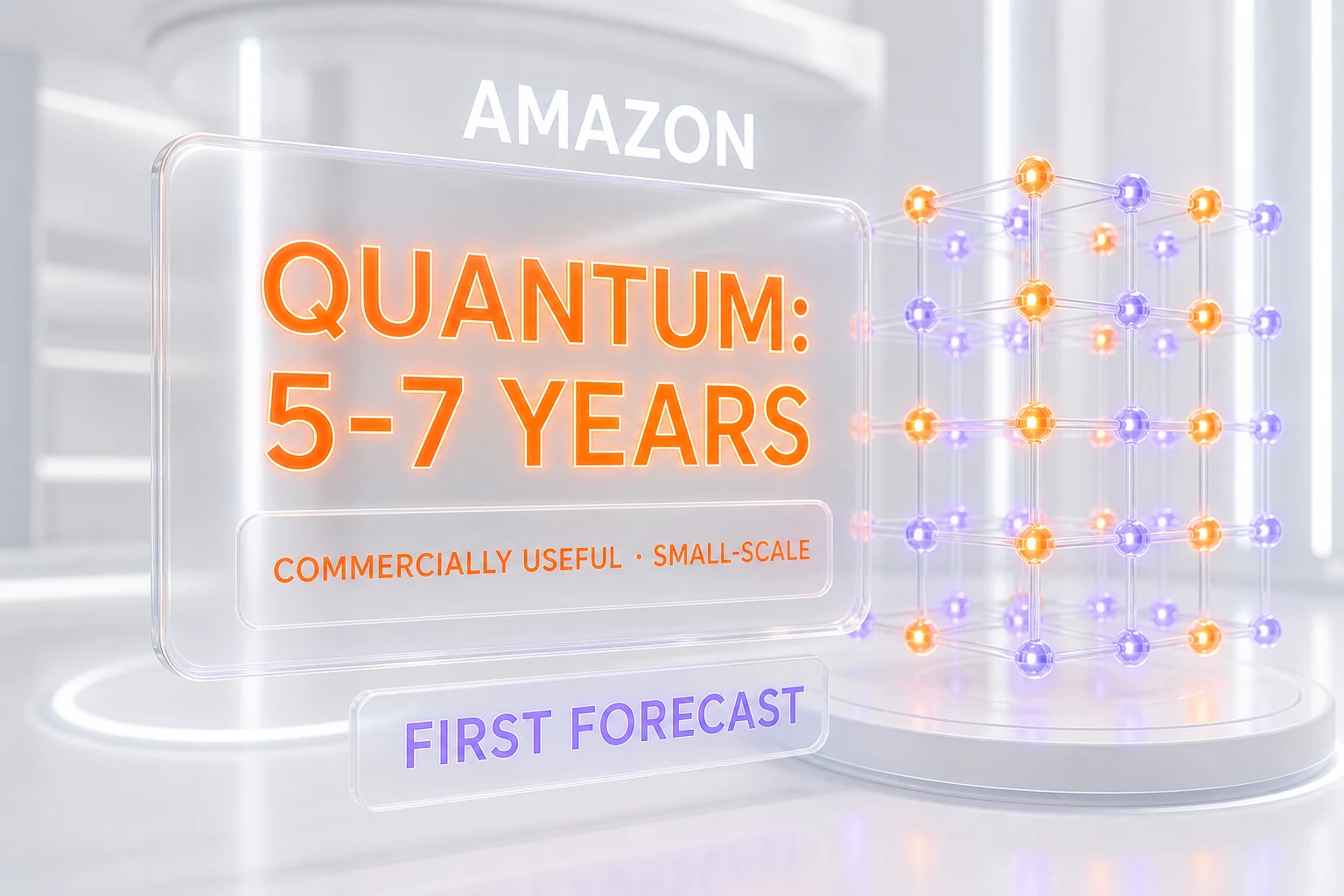
Amazon expects the first "commercially useful small-scale quantum computers" to arrive in five-to-seven years — roughly 2031 — according to Peter DeSantis, the company's senior vice president for foundational AI models, custom silicon, and quantum computing, who spoke to CNBC on June 17, 2026. It is Amazon's first public forecast on a quantum timeline. DeSantis stressed the word "small-scale" and compared the path ahead to the gradual advance of semiconductors. His five-to-seven-year window sits near the middle of expert estimates that span five to fifteen years.
This is a forecast from a single executive, not a shipping product, and the qualifiers matter as much as the headline. Below we break down exactly what DeSantis said, what "commercially useful small-scale" actually implies, where Amazon's number lands against rival timelines from Google, Microsoft, and Nvidia, and the honest answer to the question everyone is asking: what could quantum computing do for AI — and what it almost certainly cannot.
What Amazon Actually Said
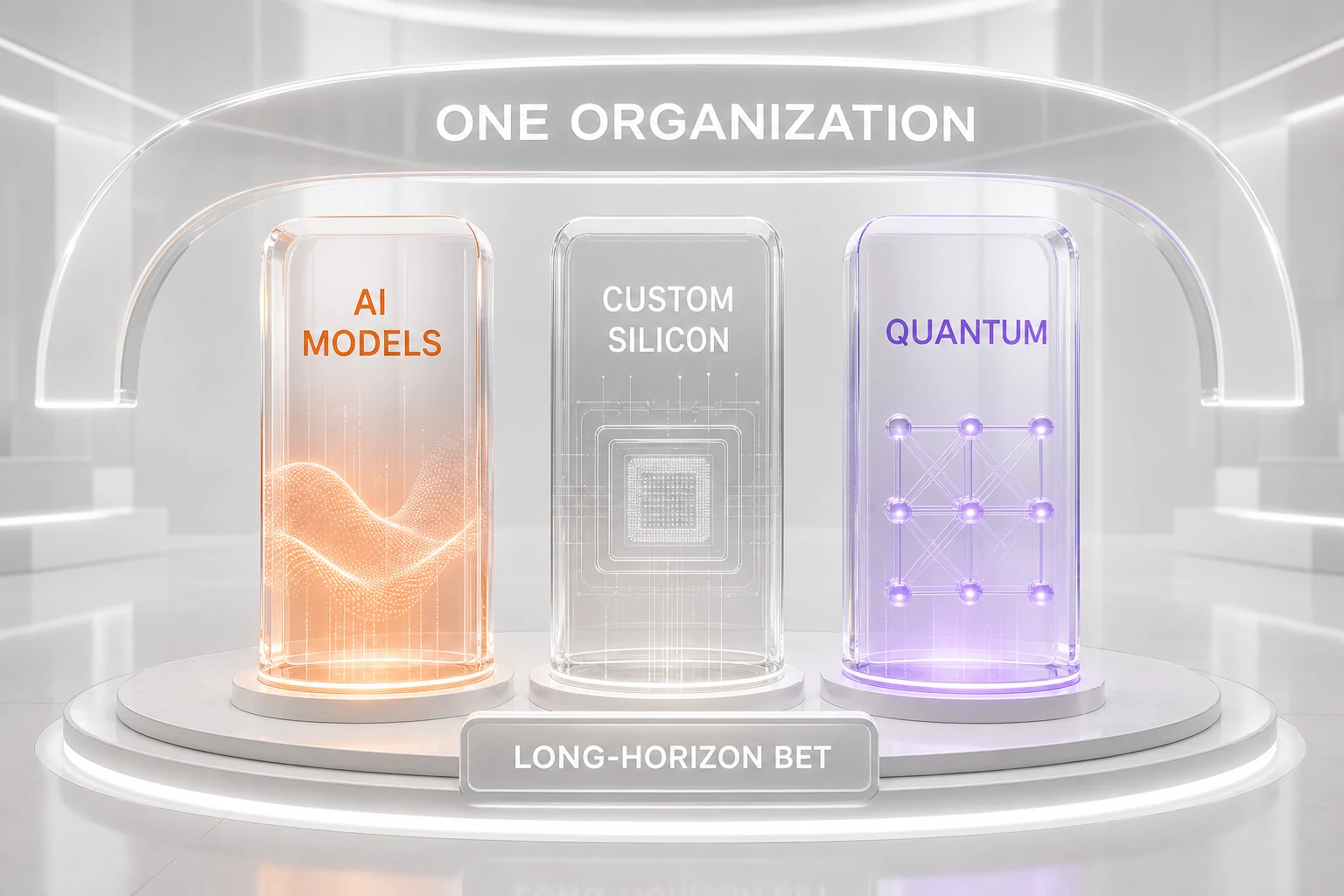
Speaking to CNBC on June 17, 2026, Peter DeSantis put a number on a question Amazon had previously declined to answer publicly. "In five-to-seven years, we're going to start to see the first commercially useful small-scale quantum computers," DeSantis said, per CNBC. He runs a new Amazon organization that brings the company's AI models, custom chips, and quantum computing under one roof — a structural signal that Amazon now treats these three as a single long-horizon bet rather than separate research tracks.
Two qualifiers in that sentence carry most of the weight. The first is "commercially useful," which DeSantis used to separate genuine workloads from the lab demonstrations and benchmark milestones that dominate quantum headlines today. The second is "small-scale," signaling that the early machines will tackle a narrow class of problems rather than serve as general-purpose computers. As several outlets noted, the five-to-seven-year window points to roughly 2031.
On what those early machines would do first, DeSantis pointed to simulation-heavy science. The problems likely to be tackled first, he said, are "quantum-based problems, so things like chemistry, material science" — domains where, in his words, "today we cannot run high enough fidelity simulations in a classic computer." That framing matters: the first payoff he describes is scientific simulation, not the large language models and recommendation systems that define commercial AI in 2026.
Why "Small-Scale" Is the Most Important Word
Quantum hardware lives or dies on error correction. Today's quantum bits, or qubits, are fragile: they lose their quantum state to environmental noise in fractions of a second, and error rates remain far too high for sustained, useful computation. Turning many noisy physical qubits into a smaller number of stable "logical" qubits is the central engineering problem of the field, and it is expensive — historically requiring large overheads of physical qubits per logical qubit.
Amazon's own hardware illustrates how early this stage is. In February 2025, the AWS Center for Quantum Computing at Caltech unveiled Ocelot, its first quantum chip, built around "cat qubits" — an approach that intrinsically suppresses certain types of errors in hardware. AWS said the design could cut the resources needed for error correction by up to 90% compared with conventional approaches. Ocelot is a research prototype with nine qubits on a chip about a centimeter square, cooled to near absolute zero. That is the gap between today and "commercially useful": a nine-qubit error-correction testbed on one end, and on the other, a machine that can earn its keep on a real workload.
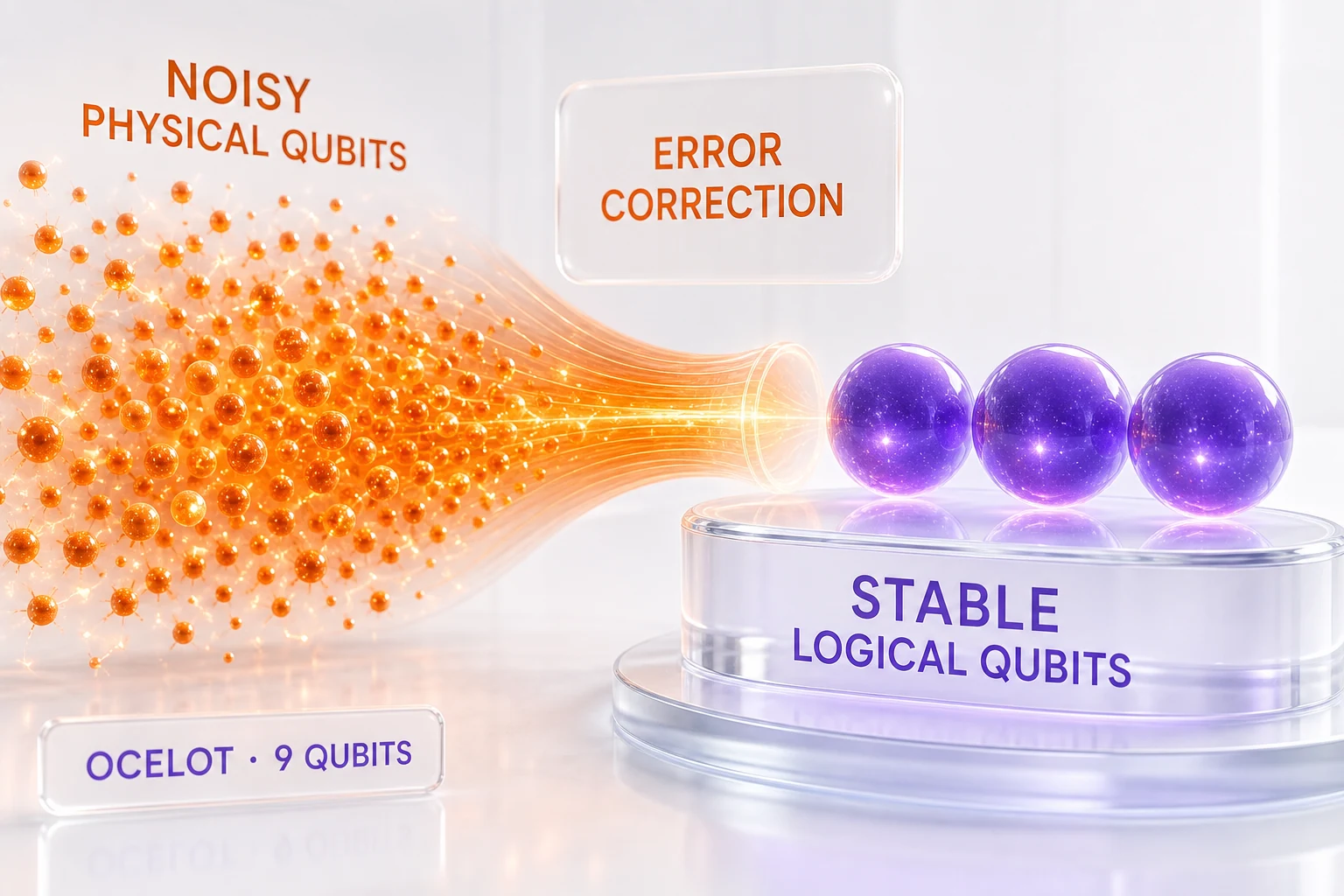
When DeSantis says "small-scale," he is describing the realistic near-term destination — a system that does a handful of valuable things well, not a quantum data center that displaces classical computing. That distinction is the difference between a measured forecast and the "unlimited power" hype the field has spent years trying to outgrow.
How Amazon's Timeline Compares to Google, Microsoft, and Nvidia
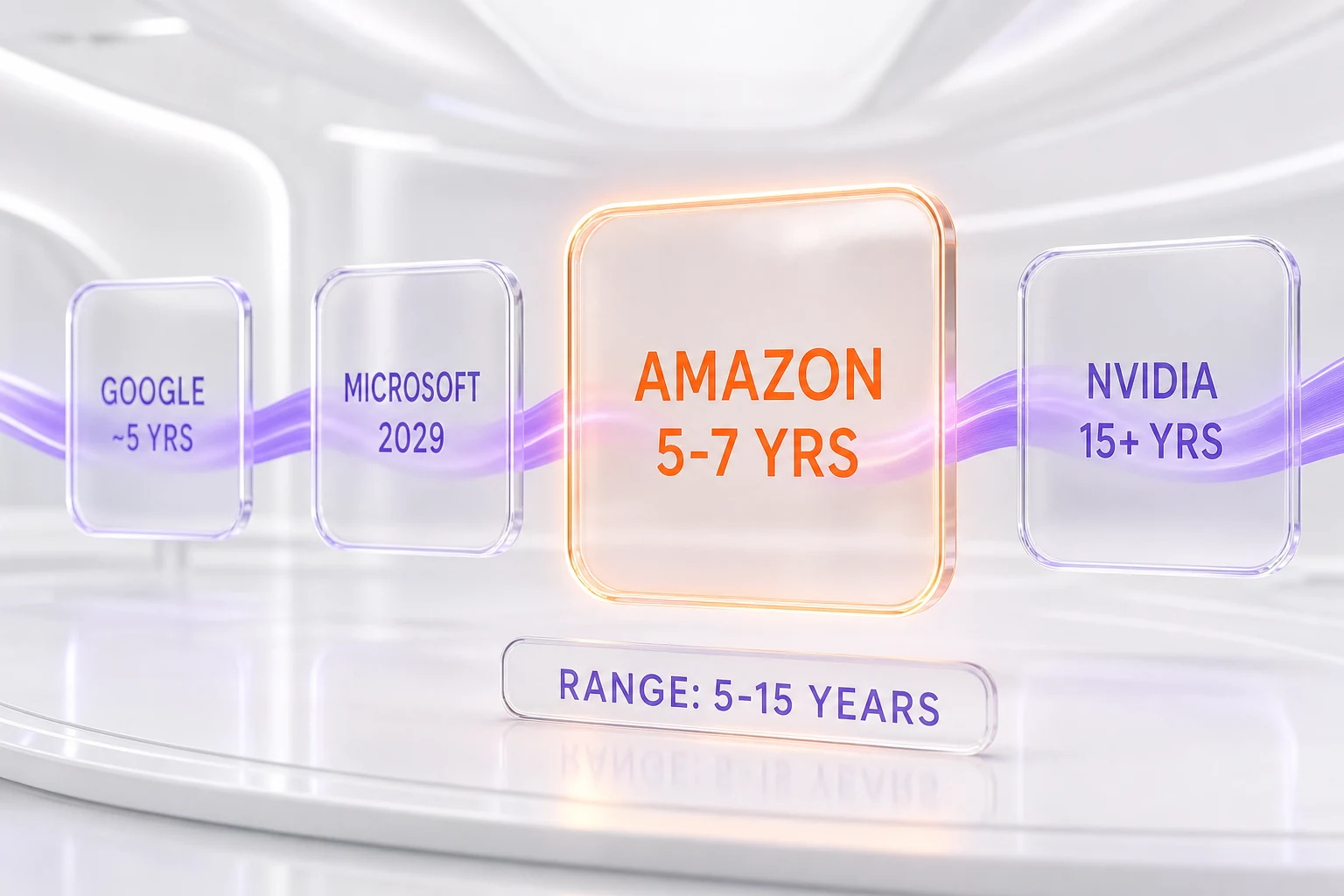
DeSantis's number is notable less for its boldness than for its placement. Per CNBC, his five-to-seven-year window sits roughly in the middle of a public spread that runs from five to fifteen years. That makes Amazon's first forecast a centrist one — neither the most aggressive nor the most cautious voice in the room.
On the optimistic end, a Google quantum executive has put useful quantum computing about five years out, and Microsoft has said it expects a commercially viable quantum machine by 2029, per CNBC. On the conservative end, Nvidia CEO Jensen Huang has said that fifteen years "would probably be on the early side" for useful quantum computers — a striking gap from the others, and a reminder that serious people who build serious chips disagree sharply on this. Amazon's forecast threads between them.
| Source | Public estimate for "useful" quantum | Approx. target |
|---|---|---|
| Google (quantum exec) | ~5 years | ~2031 |
| Microsoft | Commercially viable machine | By 2029 |
| Amazon (Peter DeSantis) | 5-7 years, small-scale | ~2031 |
| Nvidia (Jensen Huang) | 15 years "on the early side" | ~2041 or later |
Estimates above are as reported by CNBC and the cited outlets; each company defines "useful" somewhat differently, which is part of why the range is so wide. Treat the table as a map of stated expectations, not a settled forecast.
The market read the news as bullish for the sector. Per TipRanks and Seeking Alpha, several pure-play quantum stocks rose after Amazon put a number on the timeline — a reminder that, in a field starved for concrete signals, a centrist forecast from a hyperscaler functions as validation. That investor reaction says more about sentiment than about physics; a stock move is not evidence that the hardware will arrive on schedule.
What Quantum Could (and Could Not) Do for AI
This is where careful language matters most, because the gap between what quantum computing might eventually enable and what it can do for today's AI is enormous — and frequently blurred. Here is the honest version.
What quantum could plausibly help with, eventually. The clearest near-term targets DeSantis named — chemistry and materials science — are not AI workloads at all; they are quantum-simulation problems where the physics maps naturally onto quantum hardware. Beyond that, researchers have long studied whether quantum algorithms could speed up certain narrow tasks relevant to machine learning, such as specific optimization problems or sampling routines. If those approaches mature, they could in principle accelerate select components of an AI pipeline. Every clause in that sentence is conditional on purpose: none of it is established, and none of it is imminent.
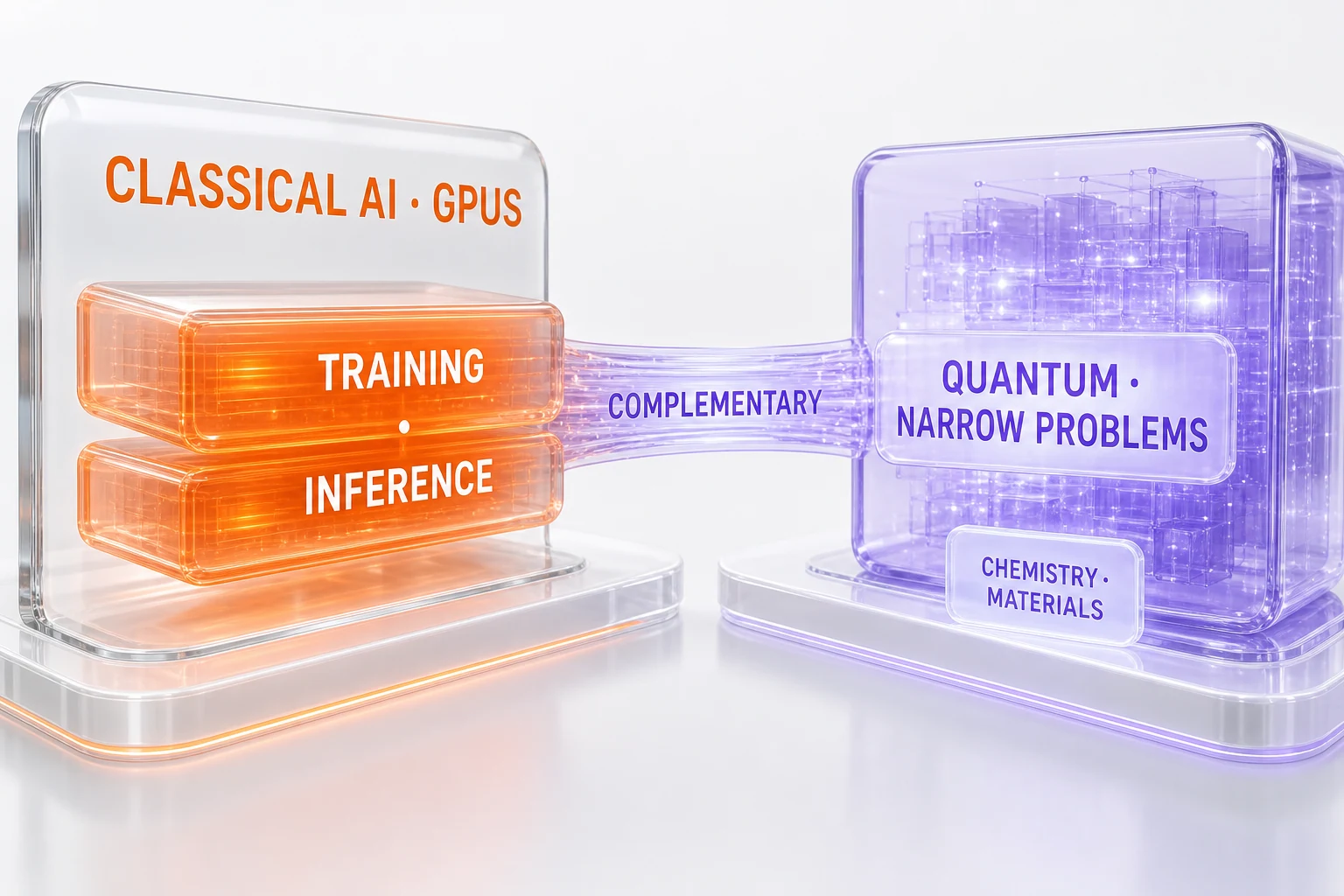
What quantum will not do — at least not for current AI. Quantum computers do not "replace" the GPUs that train and run large language models. Today's AI is bottlenecked by the cost of moving and multiplying enormous matrices at scale, a workload that classical accelerators like GPUs and custom silicon are purpose-built for and keep getting better at. There is no credible path by which a small-scale, error-limited quantum machine of the early 2030s takes over training a frontier model. The "small-scale" qualifier alone rules that out. When the first commercially useful quantum systems arrive, the overwhelming majority of AI compute will still run on classical hardware.
The more realistic relationship is complementary, not competitive. Classical AI accelerators handle the heavy lifting of training and inference; a future quantum machine, if it delivers, would handle a narrow set of problems that classical computers struggle with — and may even be orchestrated by classical AI systems that decide when a quantum subroutine is worth the cost. That is a useful tool in the box, not a replacement for the box.
Why Amazon Bundled AI, Chips, and Quantum
The organizational detail in the CNBC report is easy to overlook but revealing. DeSantis leads a single group spanning foundational AI models, custom silicon, and quantum computing. Amazon already designs its own AI chips — the Trainium and Inferentia families that power large parts of AWS — and treating quantum as part of the same long-horizon silicon effort suggests the company sees a continuum from today's classical accelerators to tomorrow's exotic hardware, rather than a clean break.
It also hedges the timeline. By housing quantum alongside the AI-chip work that generates revenue now, Amazon can fund a multi-year research program whose payoff DeSantis himself places half a decade away, without betting the business on a single breakthrough. The semiconductor analogy he drew is apt here too: the chip industry did not arrive fully formed; it compounded over decades. DeSantis is asking observers to model quantum the same way — as a slow build, not a switch that flips.
Our Take
The most valuable thing about DeSantis's comments is not the number — it is the discipline around the number. "Small-scale," "commercially useful," "start to see," and the semiconductor comparison are all hedges that point the same direction: this is a long game, and Amazon is signaling patience rather than promising a revolution. For a field that has been oversold for a decade, a hyperscaler executive volunteering a centrist, qualifier-laden timeline is a healthier signal than another record-qubit press release.
For anyone building with AI today, the practical takeaway is simple: nothing changes in your stack because of this announcement. Your models still train on GPUs and custom accelerators, your inference costs are still governed by classical hardware, and that will remain true through the back half of this decade even if Amazon's timeline proves exactly right. The quantum story is real, but it is a 2030s story for a narrow set of problems — and the responsible way to track it is to watch for the first genuinely "useful" workload, not the next qubit-count milestone.
What to Watch Next
Three signals will tell us whether DeSantis's forecast is on track. First, error-correction progress: the field's real bottleneck is logical-qubit stability, so watch for chips that push beyond prototypes like Ocelot toward sustained, low-error operation. Second, the first defensible claim of a "commercially useful" quantum workload — likely in chemistry or materials simulation, exactly where DeSantis pointed — rather than a benchmark designed to favor quantum hardware. Third, whether rival timelines converge: if Microsoft, Google, and Amazon keep clustering near the end of this decade while Nvidia holds at fifteen-plus years, that disagreement itself becomes the story worth following.
Frequently Asked Questions
When will quantum computers be useful, according to Amazon?
Amazon SVP Peter DeSantis told CNBC on June 17, 2026 that the first "commercially useful small-scale quantum computers" should appear in five-to-seven years — roughly 2031. It is Amazon's first public forecast on a quantum timeline, and DeSantis stressed that early machines will be "small-scale," targeting a narrow class of problems rather than general-purpose computing.
Will quantum computing replace GPUs for AI?
No — not for today's AI, and not on this timeline. Large language models are trained and run on GPUs and custom accelerators built for large-scale matrix math, and a "small-scale," error-limited quantum machine of the early 2030s cannot take over that work. The realistic relationship is complementary: classical accelerators carry AI's heavy lifting while a future quantum system addresses a narrow set of problems classical computers struggle with. When the first useful quantum machines arrive, the vast majority of AI compute will still run on classical hardware.
Who is Peter DeSantis?
Peter DeSantis is Amazon's senior vice president for foundational AI models, custom silicon, and quantum computing. He leads a new Amazon organization that brings these three areas together, and his June 17, 2026 CNBC interview marked Amazon's first public estimate of when quantum computers could become commercially useful.
What did DeSantis say quantum computers would do first?
Per CNBC, DeSantis said the first problems tackled would be "quantum-based problems, so things like chemistry, material science" — areas where, in his words, "today we cannot run high enough fidelity simulations in a classic computer." Notably, those are scientific-simulation problems, not the language models and recommendation systems that define commercial AI in 2026.
How does Amazon's forecast compare to Google, Microsoft, and Nvidia?
Amazon's five-to-seven-year window sits near the middle of a public range that spans five to fifteen years, per CNBC. A Google quantum executive has estimated about five years; Microsoft has pointed to a commercially viable machine by 2029; and Nvidia CEO Jensen Huang has said fifteen years "would probably be on the early side." Amazon's first forecast threads between the optimists and the skeptics.
What is Amazon's Ocelot quantum chip?
Ocelot is AWS's first quantum computing chip, unveiled by the AWS Center for Quantum Computing at Caltech in February 2025. It uses "cat qubits" to intrinsically suppress certain errors in hardware, and AWS said the design could reduce the resources needed for error correction by up to 90% compared with conventional approaches. It is a research prototype with nine qubits, illustrating how early the hardware still is relative to DeSantis's "commercially useful" target.
Should AI builders change anything because of this announcement?
No. This is a forecast from one executive, not a shipping product, and it changes nothing in a current AI stack. Models still train and run on GPUs and custom accelerators, and that remains true through the rest of this decade even if Amazon's timeline proves accurate. Quantum is a 2030s story for a narrow set of problems — best tracked by watching for the first genuinely useful workload rather than the next qubit-count record.