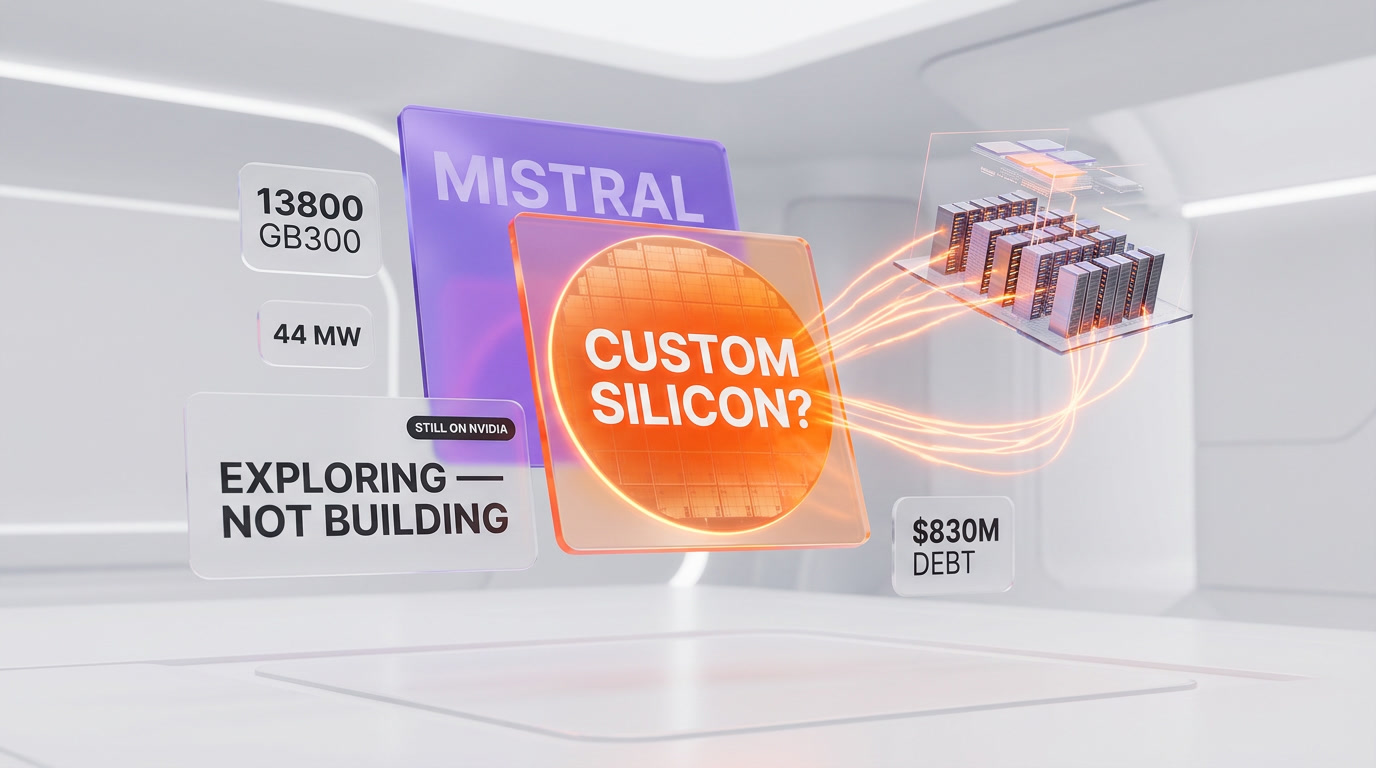
Mistral is exploring the idea of designing its own AI chips, but it is not building them yet. In a May 28, 2026 interview with CNBC, CEO Arthur Mensch said the French lab still relies entirely on Nvidia and is only "testing a few things here and there." The comment landed as Mistral spun up its first dedicated data center near Paris — 13,800 Nvidia GB300 GPUs, 44 megawatts of compute capacity, financed by $830 million in debt and slated to go live in the second quarter of 2026.
The distinction matters. Custom silicon is the most expensive, slowest, and riskiest bet in artificial intelligence infrastructure. Amazon spent years and billions before its Trainium and Inferentia chips carried real production load. Google has iterated on its Tensor Processing Units across roughly a decade. So when a four-year-old startup floats the idea of doing the same, the gap between "we are exploring this" and "we are building this" is the entire story. Mensch was careful to stay on the right side of that line — and several outlets immediately blurred it.
What Mensch Actually Said
The quote is short, and the wording is doing a lot of work. Asked about Mistral's semiconductor ambitions, Mensch told CNBC: "Owning the chips may come, I think it should come at some point, but for now we are relying on Nvidia, which is a great partner to us, and we're testing a few things here and there." That is the first time the Mistral CEO has spoken publicly about the company's chip ambitions at all.
Read it again slowly. "May come." "Should come at some point." "For now we are relying on Nvidia." "Testing a few things." There is no roadmap, no tape-out date, no chip architecture, no fab partner, and no internal silicon team announced. What there is, instead, is a stated intention and an open door. Mensch went out of his way to call Nvidia "a great partner," which is not the language of a company picking a fight with its primary supplier.
That framing matters because the rationale Mensch gave is purely economic, not adversarial. Custom chips, he argued, would let Mistral "lower the cost of deploying tokens to meaningful extents." In plain terms: when you control the hardware and tune it to your own models, you can squeeze the cost of inference — the price of actually serving answers to users — far below what general-purpose GPUs allow. That is the same logic Amazon and Google have followed. It is an infrastructure-economics argument, not a "we are sick of Nvidia" argument.
Why The "Fed Up With Nvidia" Framing Is Wrong
Within hours of the CNBC interview, the sensational version was circulating: that Mistral is "fed up with soaring chip prices" and bolting for the exit. That reading does not match what Mensch said. He explicitly described Nvidia as a great partner and confirmed Mistral runs on Nvidia hardware today, including the GB300 cluster powering its new data center. The honest framing is narrower and more interesting: a lab that has just committed serious capital to GPU infrastructure is openly thinking about the next layer of vertical integration — eventually, conditionally, and on top of a relationship it values.
For anyone tracking the European AI scene, this is a recurring pattern. We have written before about how Mistral keeps stacking infrastructure and sovereignty plays, from its open-weight model releases to its push into sovereign cybersecurity models for European banks. The chip comment fits the same arc: control more of the stack, depend on fewer outside parties, and tell a sovereignty story that resonates in Brussels and Paris.
The Data Center Is The Real Headline
Strip out the chip speculation and the concrete news is the infrastructure. Mistral secured $830 million in debt financing to build its first dedicated data center, located at Bruyères-le-Châtel, southwest of Paris. The facility is built around 13,800 Nvidia GB300 GPUs and rated at 44 megawatts of compute capacity, with operations starting in the second quarter of 2026.
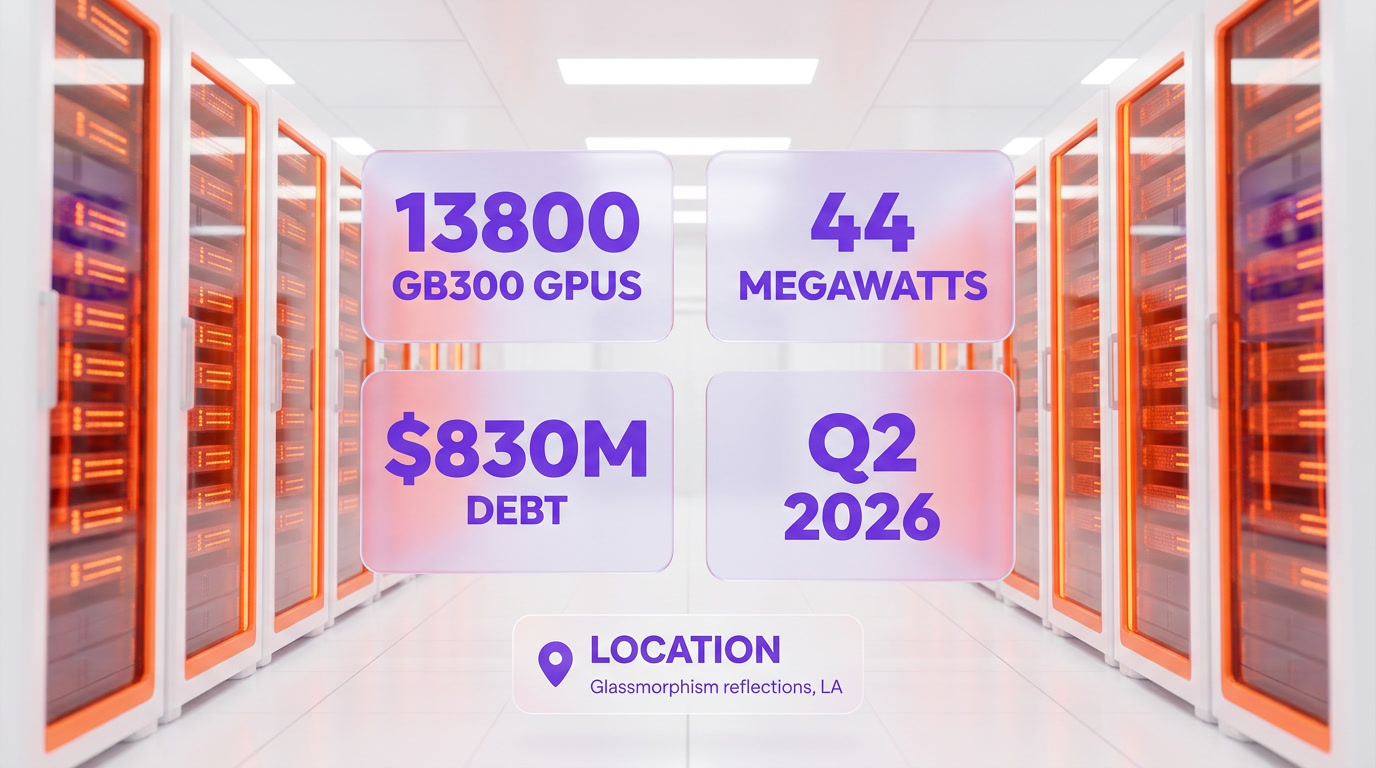
These are not vanity numbers. A 44-megawatt facility puts Mistral in the serious-compute conversation for a European lab, even if it is a fraction of the gigawatt-scale build-outs the largest US players are chasing. The GB300 is Nvidia's top-tier Blackwell-generation accelerator, the same class of silicon the hyperscalers are fighting over. Choosing debt rather than equity to finance it is itself a signal: Mistral is treating compute as a capital asset to be leveraged, not a line item to be diluted into.
This is part of a much larger spend. Mistral has invested €4 billion into data centers across France and Sweden, anchoring a European compute footprint that it wants to control rather than rent indefinitely. The Bruyères-le-Châtel site is the first dedicated, owned link in that chain — and owning the building is exactly the kind of move that, over time, makes owning the chips inside it look less far-fetched.
Why Owning Infrastructure Comes Before Owning Silicon
There is a logical sequence to vertical integration in AI, and Mistral is following it in order. Step one is renting compute from clouds. Step two is owning the data center and buying the chips. Step three — the hardest and last — is designing the chips themselves. You do not jump to step three. You earn your way there by first proving you can run owned infrastructure at scale, which is precisely what the GB300 cluster is meant to demonstrate.
That sequencing also explains why the chip comment is realistic rather than fanciful. A lab running its own 44-megawatt facility has the workload visibility, the cost data, and the engineering culture to eventually ask whether a model-specific accelerator could beat a general-purpose GPU on dollars per token. It does not yet have a chip. But it now has the prerequisite that makes the question worth asking out loud.
The Custom-Silicon Playbook: Amazon, Google, And The Cost Of Inference
Mistral did not invent this idea. It is walking a path that Amazon and Google have spent years and enormous sums clearing. Understanding their playbook is the only way to judge how serious — and how distant — Mistral's ambition really is.
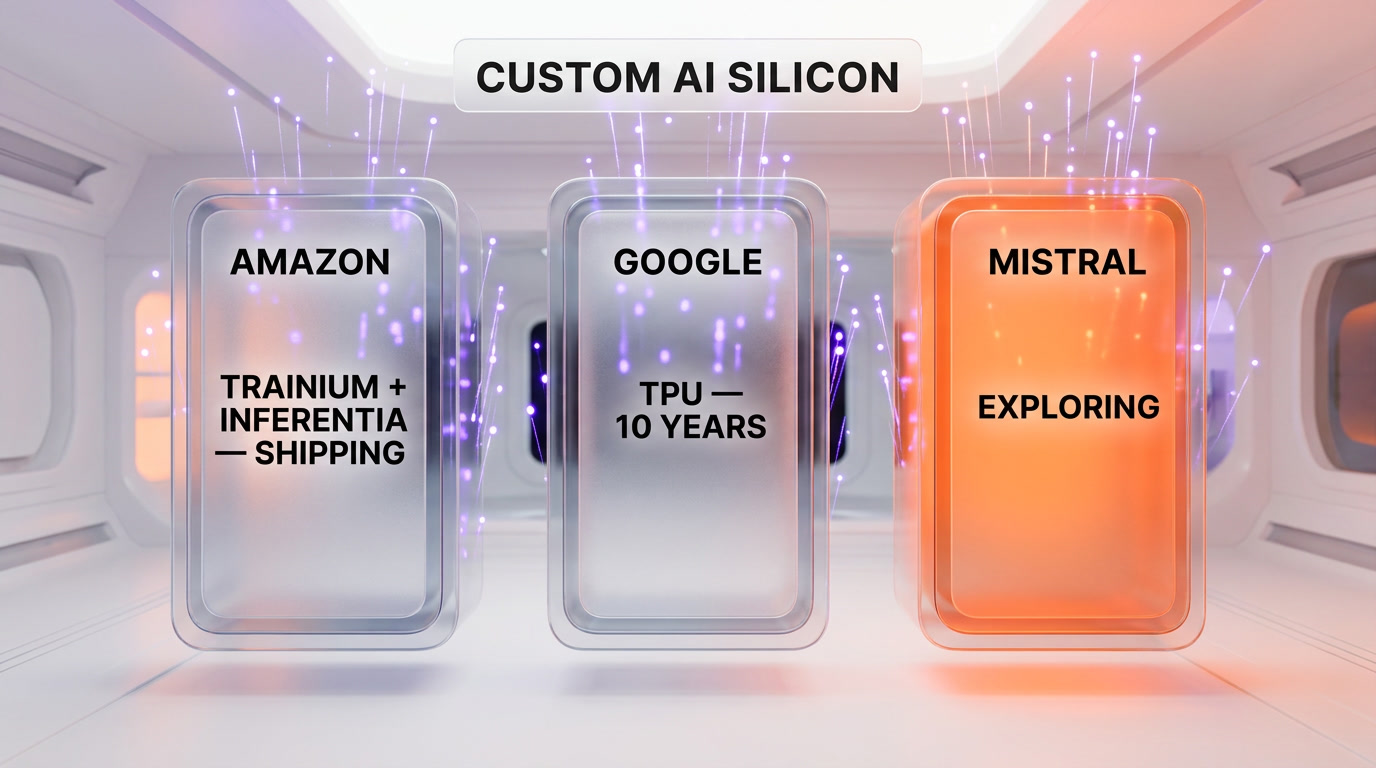
Amazon designs Trainium for training and Inferentia for inference, both engineered to undercut the cost of running workloads on Nvidia hardware inside AWS. Google has shipped many generations of its Tensor Processing Units, the silicon behind much of its own model training and serving. In both cases, the prize is the same one Mensch named: driving down the cost of every token a model produces. When you serve billions of inferences, even a small per-token saving compounds into a structural advantage.
The catch is that custom silicon is a multi-year, multi-billion-dollar commitment with no guarantee of a payoff. You need a chip architecture team, a relationship with a foundry, a software stack that can actually use the chip, and enough internal workload to amortize the cost. Amazon and Google could absorb that because they had endless workloads and balance sheets to match. A startup, even a well-funded one, has to be far more surgical about when and whether to pull that trigger — which is exactly why Mensch's "may come" phrasing is the responsible one.
The Token-Economics Argument, Made Concrete
The phrase "lower the cost of deploying tokens" deserves unpacking, because it is the entire commercial case for custom chips. Every answer an AI model returns is a stream of tokens, and every token costs compute. On rented or general-purpose hardware, that cost is set by the GPU market and the cloud margin stacked on top. If you design a chip tuned to your own model architecture, you can in principle do more inference per watt and per dollar, then pass those savings into pricing or pocket them as margin.
For a lab whose business depends on serving inference cheaply at scale, that math is the difference between a sustainable API and a money-losing one. It is also why the inference layer specifically — not training — is where most cost-driven silicon bets are aimed. We saw the same thesis with the UK's Fractile, the inference-chip startup that raised $220M with Anthropic circling: the entire pitch is that purpose-built inference silicon can crush the cost of serving large models. Mistral floating its own version of that argument is the European echo of a thesis already being funded across the Atlantic and the Channel.
Why It Matters: European AI Sovereignty
Strip away the hardware specifics and what is left is a sovereignty argument. Europe has spent the better part of two years worrying that its AI future runs on American chips, American clouds, and American models. Mistral is the continent's clearest answer to that anxiety, and every move it makes is read through that lens — by investors, by regulators, and by governments writing industrial-policy checks.

A custom chip would be the final, most symbolically loaded layer of that sovereignty stack. Today, even Mistral's most sovereign-flavored products run on American silicon — the GB300s in Bruyères-le-Châtel are Nvidia's. Designing a chip in-house, however distant, is the move that would let Europe say it owns the full stack, from the model down to the metal. That is why even an exploratory comment from Mensch gets amplified far beyond what the actual news warrants: it touches the rawest nerve in European tech policy.
But sovereignty is not a press release; it is a balance sheet. Owning the model is achievable. Owning the data center, as Bruyères-le-Châtel shows, is achievable with debt financing. Owning the chips is a different order of difficulty — the part of the stack where Europe has the least existing capacity and where the gap to TSMC-class manufacturing is widest. Mensch knows this, which is why he reached for "may come" rather than "is coming."
The Consolidation Backdrop
Mistral is not exploring this in a vacuum. The European AI landscape has been consolidating and capitalizing fast — the Cohere and Aleph Alpha merger created a roughly $20B sovereign-AI champion, and capital is flowing toward anyone who can credibly claim to reduce Europe's dependence on US infrastructure. In that climate, signaling a long-term ambition toward custom silicon is partly strategy and partly positioning: it tells the market, and the policymakers, that Mistral intends to go deeper into the stack than any rival on the continent.
How It Compares: Mistral vs OpenAI And Anthropic
Mensch's chip comment is also a competitive signal aimed squarely at OpenAI and Anthropic. Both US labs are racing to lock down compute, and both have been linked to custom-silicon efforts of their own. The infrastructure arms race is no longer just about who has the best model — it is about who controls the cost structure underneath it.
OpenAI's compute strategy leans heavily on partnerships and massive cloud commitments. Anthropic has been aggressively diversifying its silicon supply, and we covered how it has been shopping UK inference chips for 2027 precisely to break free of single-vendor dependence. Against that backdrop, Mistral's "we're testing a few things" is the European version of the same hedge — smaller in scale, but identical in logic.
The honest gap, though, is resources. OpenAI and Anthropic are operating at valuations and revenue levels that dwarf Mistral's, which means their ability to fund a multi-year silicon program is correspondingly larger. Mistral's edge is not its balance sheet; it is its positioning as Europe's champion, with the policy tailwinds and sovereign-capital access that come with that role. The chip exploration is a bet that those tailwinds can, over time, substitute for the raw capital advantage the US labs enjoy.
The Nvidia Question
The most overlooked detail is how carefully Mensch protected the Nvidia relationship. He is announcing a 13,800-GPU Nvidia cluster and floating the idea of one day building chips that would, by definition, reduce his dependence on Nvidia — and he did both in the same breath while calling Nvidia "a great partner." That is not a contradiction; it is the standard posture of every major Nvidia customer that also explores its own silicon. Amazon, Google, and Microsoft all design chips while remaining among Nvidia's largest buyers.
The reality is that even the hyperscalers with mature custom silicon still buy Nvidia in enormous volume, because in-house chips handle specific workloads while general-purpose GPUs handle everything else. Nvidia's position has stayed dominant despite a decade of custom-silicon programs from its biggest customers — a dynamic we explored in detail when looking at Nvidia's roughly $1 trillion in Blackwell and Rubin orders at GTC 2026. Mistral exploring its own chips does not threaten Nvidia in any near-term horizon. If anything, it confirms Nvidia's role as the default — the thing you build on first, and only later think about supplementing.
What's Next
The concrete milestone to watch is not a chip; it is the Bruyères-le-Châtel data center going live in the second quarter of 2026. That is the testable, dated claim in this story. Operating its own 44-megawatt facility on 13,800 GB300 GPUs will give Mistral the workload data and operational maturity that any future silicon decision would have to be built on.
On the chip itself, the right expectation is patience. Mensch said "may come" and "should come at some point," which in semiconductor terms means years, not quarters — assuming it happens at all. The signals to watch for, if Mistral ever moves from exploring to building, would be concrete: a dedicated silicon team, a foundry partnership, or a custom-accelerator architecture disclosure. None of that exists today. Until it does, the accurate headline is the one Mensch gave us himself — Mistral is exploring, testing a few things, and still running on Nvidia.
For now, the company's energy is clearly on infrastructure it can actually deploy. The data centers in France and Sweden, the €4 billion already committed, and the GB300 cluster going live this quarter are the real story. The chips are a thesis about the future. The compute is the present — and that is what will determine whether the chip ambition ever becomes more than a careful sentence in a CNBC interview.
Frequently Asked Questions
Is Mistral building its own AI chips?
No. Mistral is only exploring the idea. CEO Arthur Mensch said in May 2026 that owning chips "may come" and "should come at some point," but that "for now we are relying on Nvidia" and the company is just "testing a few things here and there." There is no announced chip, silicon team, foundry partner, or roadmap.
What exactly did Arthur Mensch say about chips?
His verbatim quote to CNBC was: "Owning the chips may come, I think it should come at some point, but for now we are relying on Nvidia, which is a great partner to us, and we're testing a few things here and there." It was his first public comment on Mistral's semiconductor ambitions.
Why would Mistral want to design its own chips?
Mensch said custom chips could "lower the cost of deploying tokens to meaningful extents." In other words, hardware tuned to Mistral's own models could reduce the cost of inference — serving answers to users — below what general-purpose Nvidia GPUs allow. It is an infrastructure-economics argument, not a fight with Nvidia.
Is Mistral fed up with Nvidia or its chip prices?
No, despite some sensational headlines. Mensch explicitly called Nvidia "a great partner" and confirmed Mistral runs entirely on Nvidia hardware today, including the 13,800 GB300 GPUs in its new data center. The chip exploration is about long-term vertical integration, not abandoning Nvidia.
What are the specs of Mistral's new data center?
Mistral's first dedicated data center is at Bruyères-le-Châtel near Paris, built around 13,800 Nvidia GB300 GPUs with 44 megawatts of compute capacity. It was financed by $830 million in debt and is scheduled to begin operations in the second quarter of 2026.
How much has Mistral invested in AI infrastructure?
Mistral has invested €4 billion into data centers across France and Sweden. The $830 million debt-financed facility at Bruyères-le-Châtel is the first dedicated, owned site in that broader build-out.
Who else designs their own AI chips?
Amazon designs Trainium (training) and Inferentia (inference), and Google has shipped many generations of its Tensor Processing Units (TPUs). Both spent years and billions to undercut the cost of running workloads on Nvidia hardware. Mistral's exploration would follow the same playbook, but it is far earlier on that path.
How does Mistral's chip ambition compare to OpenAI and Anthropic?
All three are racing to control their compute cost structure. Anthropic has been shopping UK inference chips for 2027, and OpenAI leans on large cloud and partnership commitments. Mistral's "testing a few things" is the European version of the same hedge, though OpenAI and Anthropic operate at far larger valuations and budgets.
What is a GB300 GPU?
The GB300 is Nvidia's top-tier Blackwell-generation AI accelerator, the same class of silicon hyperscalers are competing to secure. Mistral's new Bruyères-le-Châtel data center runs on 13,800 of them, making it a serious-compute facility for a European lab.
Does owning chips threaten Nvidia?
Not in any near-term horizon. Even Amazon, Google, and Microsoft, which all design custom silicon, remain among Nvidia's largest buyers, because in-house chips handle specific workloads while general-purpose GPUs handle everything else. Nvidia's dominance has held through a decade of customer custom-silicon programs.
When will Mistral's data center go live?
The Bruyères-le-Châtel facility is scheduled to begin operations in the second quarter of 2026. That is the concrete, dated milestone in this story — far more immediate than any potential custom chip, which Mensch framed as years away, if it happens at all.
Why does this matter for European AI sovereignty?
Europe wants to reduce its dependence on American chips, clouds, and models. Mistral is the continent's clearest answer to that, and a custom chip would be the final, most symbolic layer of an owned full stack. But owning silicon is the hardest layer, where Europe has the least manufacturing capacity — which is why Mensch only described it as something that "may come."