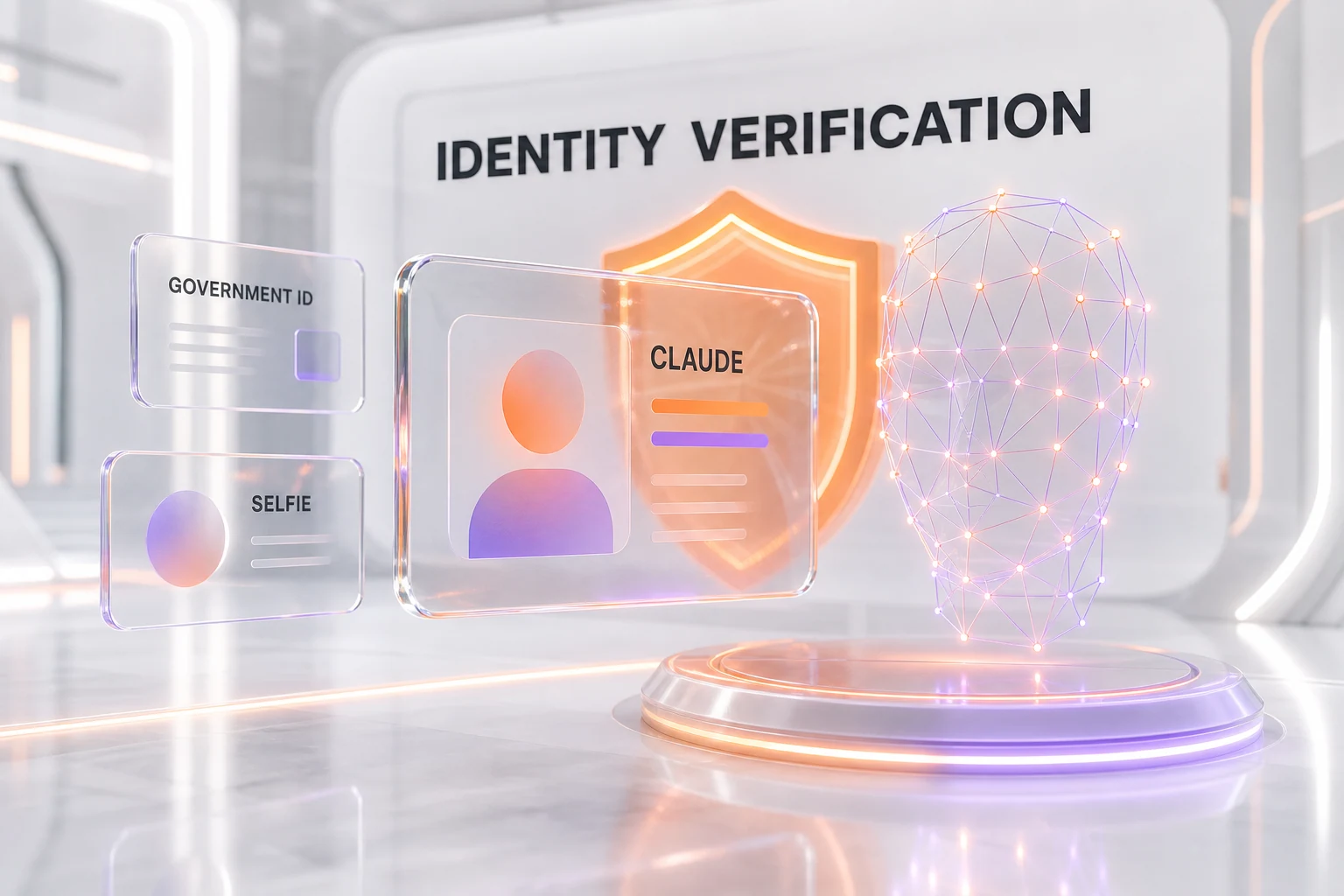
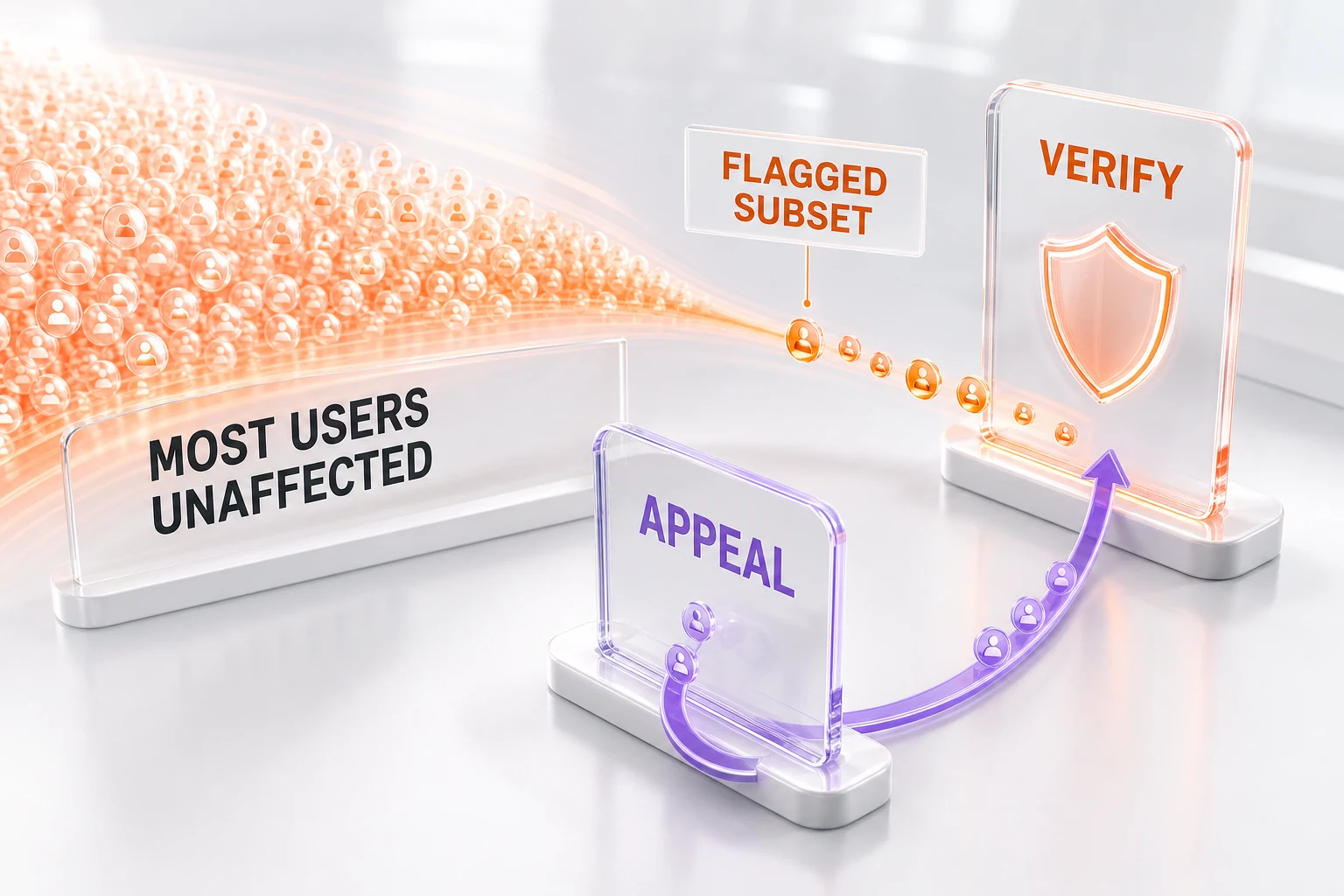
Starting July 8, 2026, Anthropic can ask a small subset of flagged Claude accounts — not all users — to verify their identity with a government-issued ID and a selfie. The check runs through a third-party vendor, Persona, which collects the ID document, a selfie photo or video, and a facial geometry template that may qualify as biometric data in states like Illinois. Anthropic says the verification data is not used to train its models, and flagged users can use the process to appeal rather than lose access outright.
The headline reads alarming, and the underlying privacy update is real: Anthropic now has a documented path to demand a passport, a driver's license, or a national ID card plus a live selfie before it restores access to certain accounts. But the scope is much narrower than "Claude is scanning everyone's face." Based on Anthropic's own help documentation and a June 22 statement from spokesperson Thariq Shihipar to TechCrunch, the requirement targets accounts that have been flagged for potential policy violations but not banned outright. For those users, identity verification is offered as an appeal route — a way back in — rather than a blanket surveillance mandate. Here is exactly what changed, what Persona collects, who has to comply, and why the biometric piece carries real legal weight.
What Anthropic Actually Changed
Anthropic updated its privacy policy on or around June 17, 2026, with the change taking effect July 8, 2026. The update introduces a new category of personal data collection: identity verification, including facial geometry templates. In plain terms, the company can now require a flagged account holder to upload a photo of a government-issued ID and submit a selfie before access is granted or maintained.
The critical detail is who this applies to. Anthropic spokesperson Thariq Shihipar told TechCrunch the requirement covers a "small subset of users" whose accounts have been flagged for potential policy violations but have not been banned outright. Instead of losing access immediately, those users are given a way to verify who they are and appeal. Anthropic's help center frames the prompt as something users "might see when accessing certain capabilities, as part of our routine platform integrity checks, or other safety and compliance measures."
So this is not a new sign-up requirement for the general Claude population. It is an enforcement and appeals mechanism aimed at a flagged minority. For the overwhelming majority of Claude users — including the developers who lean on Claude Code day to day — nothing about the login flow changes on July 8.
What Persona Collects — and Where It Goes
Anthropic is not running these checks in-house. It uses Persona Identities, a San Francisco-based identity-verification platform backed by Founders Fund, to process the documents and biometric data. The roles are structured like a standard data-protection arrangement: Anthropic is the data controller that sets the rules, and Persona is the data processor that executes them. Your ID and selfie are collected and held by Persona, not on Anthropic's own systems.
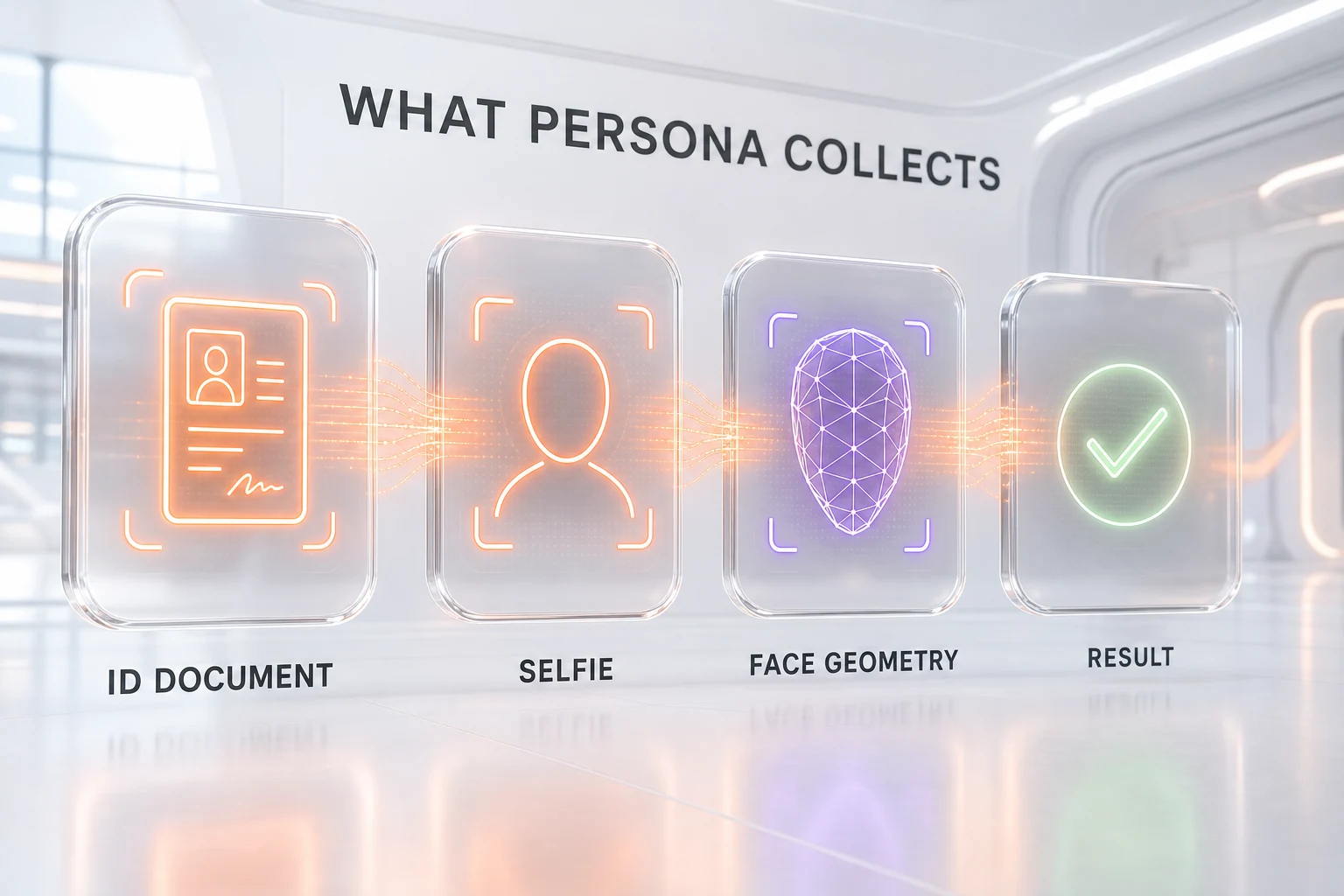
When a verification prompt is triggered, here is what Persona can collect:
- A government-issued ID document — a passport, driver's license, or national identity card. Anthropic's documentation specifies that digital IDs, screenshots, and photocopies are not accepted; it has to be a scan or photo of the physical document, along with the personal information printed on it (name, date of birth, ID number).
- A selfie photo or video — captured live via a phone camera or webcam to confirm the person matches the document.
- A facial geometry template — a digitized representation of the face derived from the selfie, used to match against the ID. Anthropic itself acknowledges this "may be considered biometric data in some jurisdictions." This is the piece that turns a routine KYC check into a biometric one.
- The verification result — for example, an age confirmation or a pass/fail outcome of the identity match.
On the question most users care about — training — Anthropic is explicit. Its help center states: "We are not using your identity data to train our models. Verification data is used solely to confirm who you are and to meet our legal and safety obligations." Persona is required to delete the data "in line with the retention limits we've set and applicable law," though Anthropic has not published a specific retention window.
Who Has to Verify (and Who Doesn't)
This is where reporting has diverged, so it is worth being precise. The one criterion Anthropic has confirmed is account flagging: the requirement applies to a small subset of accounts flagged for potential policy violations but not banned. That is the established fact.
Some outlets have reported a tier-based split — that consumer plans (Free, Pro, and Max) would be subject to verification while business plans (Team, Enterprise, and API) would be exempt. We would treat that framing with caution. Neither Anthropic's official help documentation, TechCrunch's reporting, nor The Next Web's coverage confirms a plan-based carve-out. The verification trigger that Anthropic describes is tied to flagged behavior and "certain capabilities," not to a subscription tier. Until Anthropic states a plan-based rule explicitly, "flagged accounts" is the safer way to understand who is affected.
For users who are flagged, the process doubles as an appeal. Anthropic's documentation points banned and restricted users to log in with the affected account and complete an appeal form at claude.ai/restricted, after which its Safeguards team investigates. In other words, identity verification is not purely punitive — it is the mechanism that lets a wrongly flagged user prove they are a legitimate person and get reinstated, instead of being shut out with no recourse. This is the same broad tension Anthropic has navigated before around access and usage limits on Claude Max accounts: how to police abuse at scale without alienating paying users who did nothing wrong.
The Biometric Risk: Illinois BIPA and Beyond
The facial geometry template is what elevates this from a privacy footnote to a genuine legal-exposure story. A face geometry template is not just a photo — it is a measurable, machine-readable biometric identifier, and several US states regulate it tightly.
The sharpest example is the Illinois Biometric Information Privacy Act (BIPA). BIPA classifies facial geometry as protected biometric data and imposes statutory damages of $1,000 to $5,000 per violation, with a private right of action that lets individuals sue directly. The scale of that exposure is not theoretical: Facebook settled a BIPA class action for $650 million in 2021 over its photo-tagging face-recognition feature. States including Texas and Washington have their own biometric privacy laws as well, though Illinois remains the one with the most aggressive enforcement track record.
Anthropic's structure — using Persona as the processor and stating the data is not used for training — is clearly designed with this legal landscape in mind. Routing collection and storage through a specialized vendor, and explicitly carving the data out of model training, are the kinds of measures that reduce, but do not eliminate, biometric-law risk. The honest read is that any company collecting facial geometry templates from US residents is operating in a high-stakes compliance zone, and Anthropic is no exception.
Why Anthropic Is Doing This
The stated rationale is platform integrity. Anthropic cites routine integrity checks, fraud prevention, abuse investigation, terms-of-service enforcement, and resolving security issues. As frontier AI models become more capable — and more valuable to bad actors who want to bypass safety controls, run coordinated abuse, or evade bans by creating fresh accounts — identity becomes a control surface. A flagged account that can prove it belongs to a real, accountable person is a very different risk profile from an anonymous one cycling through throwaway logins.
There is also a defensible user-protection angle. Offering verification as an appeal path is arguably more humane than a hard ban: a legitimate user caught by an over-eager flag gets a route back in. That framing matters, because the alternative — silently locking people out of an account they pay for — generates exactly the kind of trust erosion that has dogged AI platforms over access disputes and the wider legal fights Anthropic is fighting, including its $1.5 billion copyright settlement.
Zoom out, and this fits a broader industry shift toward identity verification at the frontier. OpenAI's leadership has openly explored biometric proof-of-humanity through Sam Altman's World (formerly Worldcoin) project, which uses iris scans. Age verification and KYC-style checks are spreading across consumer tech under regulatory pressure. Anthropic asking a flagged subset for an ID and a selfie is not an outlier — it is one of the clearest signs yet that anonymous, frictionless access to the most powerful AI systems is quietly ending for anyone who trips a safety flag.
What This Means for Claude Users
For the practical majority: almost nothing. If your account has never been flagged for a potential policy violation, you are very unlikely to ever see a verification prompt, and your normal Claude usage is unaffected by the July 8 change.
If you are flagged, the calculus is different. Refusing verification when it is required will likely mean losing access to the affected capabilities or account. The appeal route at claude.ai/restricted exists precisely so that legitimate users can clear a false flag — so if you believe you were flagged in error, verification is the path to reinstatement rather than a dead end. What you are handing over in that case is real: a government ID, a selfie, and a facial geometry template, processed by Persona under Anthropic's instructions and, per Anthropic, kept out of model training.
The bigger signal is for everyone watching where AI platforms are headed. Biometric identity verification — even when narrowly scoped to flagged accounts — normalizes the idea that access to frontier models can be conditioned on proving who you are. That is a meaningful shift for a technology that, until recently, anyone could use behind a username and an email address. Whether it stays narrow or expands is the thing worth watching over the next year.
Frequently Asked Questions
Who has to provide ID and a selfie to Anthropic?
Not all Claude users. Anthropic's policy applies to a small subset of accounts that have been flagged for potential policy violations but not banned outright. For those flagged accounts, identity verification is offered as an appeal route to regain or keep access, rather than a requirement imposed on the general user base.
What does Persona collect from Claude users?
Persona, Anthropic's San Francisco-based verification vendor, can collect a government-issued ID document (passport, driver's license, or national ID — not digital IDs, screenshots, or photocopies), a selfie photo or video, a facial geometry template derived from that selfie, and the verification result. The data is held by Persona as the data processor, not on Anthropic's systems.
Is my identity data used to train Claude?
No. Anthropic's help center states it is "not using your identity data to train our models" and that verification data is used solely to confirm who you are and to meet legal and safety obligations. Persona is required to delete the data in line with Anthropic's retention limits and applicable law.
Can I refuse or appeal Anthropic's identity verification?
You can appeal. Anthropic directs flagged or restricted users to log in with the affected account and complete an appeal form at claude.ai/restricted, which its Safeguards team then investigates. Refusing verification when it is required, however, will likely mean losing access to the affected capabilities or account.
Why is Anthropic asking for biometric verification now?
Anthropic cites platform integrity, fraud prevention, abuse investigation, terms-of-service enforcement, and compliance. Offering verification as an appeal path lets legitimately flagged users get reinstated instead of facing a hard ban. It also reflects a broader frontier-AI shift toward identity verification, even as facial geometry templates carry real exposure under biometric laws like Illinois BIPA.