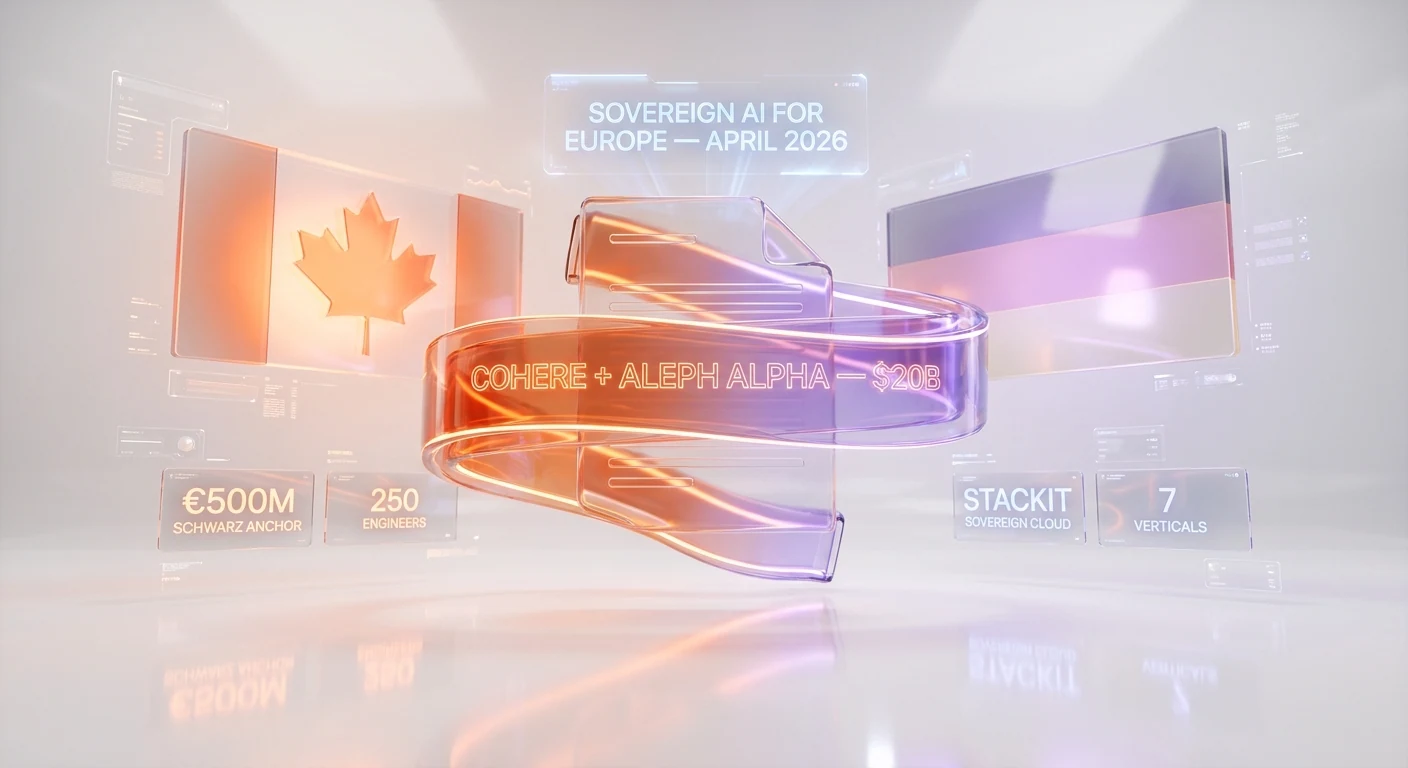
Cohere and Aleph Alpha announced a merger on April 25, 2026, forming a combined entity valued at approximately $20 billion. Germany's Schwarz Group is anchoring Cohere's Series E round with €500 million in structured financing — about $600 million — and the deal carries the political backing of both Canada and Germany, the two countries that launched the Sovereign Technology Alliance in February 2026. The combined company will run on STACKIT, the sovereign cloud platform operated by Schwarz Digits, and will target defence, energy, finance, healthcare, manufacturing, telecommunications, and European public sector customers. Aleph Alpha brings 250 employees and a co-founder departure on the way in. This is Europe's clearest answer yet to the U.S. hyperscaler stack.
The deal — $20B combined, $600M Schwarz anchor, governments behind
The deal structure as reported by TechCrunch on April 25, 2026 and Cohere's official announcement.
| Variable | Detail |
|---|---|
| Announcement date | April 25, 2026 |
| Combined entity valuation | ~$20 billion |
| Cohere prior valuation | $6.8 billion (last funding round) |
| Cohere 2025 ARR | $240 million |
| Aleph Alpha financial profile | Little revenue, significant losses |
| Schwarz Group commitment | €500 million (~$600 million) in structured financing |
| Series E lead investor | Schwarz Group |
| Aleph Alpha headcount joining Cohere | 250 employees |
| Aleph Alpha co-founder Jonas Andrulis status | Departed before the deal closed |
| Sovereign cloud infrastructure | STACKIT (operated by Schwarz Digits) |
| Government context | Canada-Germany Sovereign Technology Alliance, launched February 2026 |
| Target verticals | Defence, energy, finance, healthcare, manufacturing, telecommunications, public sector |
Three numbers anchor the read. The first is the $20 billion combined valuation — a roughly threefold uplift over Cohere's prior $6.8 billion private valuation, and a number that for the first time puts a non-American AI vendor in the same valuation tier as the second-line U.S. independents. The second is Schwarz Group's €500 million commitment in structured financing — a customer-investor doubling down on its existing Aleph Alpha stake to seed Cohere's Series E. The third is the headcount: 250 Aleph Alpha employees, primarily based in Heidelberg, integrating into a company headquartered in Toronto and San Francisco.
Why this matters — the sovereign AI thesis hardens
For two years the "sovereign AI" thesis was an investor talking point, not a structural market. Europe and Canada had national AI vendors — Mistral in France, Aleph Alpha in Germany, Cohere in Canada — but none of them had simultaneously the model quality, the enterprise distribution, and the sovereign cloud infrastructure to compete with the U.S. hyperscaler stack inside regulated procurement processes. The April 25 merger is the moment that changes.
Two adjacent data points from the same week harden the thesis. In our April 30 coverage of Mistral's release of Medium 3.5 with open-weights and asynchronous cloud coding agents, France's national champion shipped a frontier-tier open model with self-hostable economics. The same week, the Cohere-Aleph Alpha merger announced a $20 billion private champion with a sovereign cloud anchor. Read together, they are the first time a non-U.S. block has produced two credible enterprise-grade alternatives in the same news cycle. Procurement teams in European governments and regulated industries that have been forced to default to U.S. vendors now have a serious shortlist.
The political layer matters as much as the technical layer. The Canada-Germany Sovereign Technology Alliance was announced in February 2026 specifically to coordinate procurement, infrastructure, and capital flows for sovereign technology bets. The Cohere-Aleph Alpha merger is the alliance's first commercial output. Both governments blessed the deal — and that political endorsement is the difference between a private merger and a strategic infrastructure bet.
What Cohere gets — the German enterprise wedge
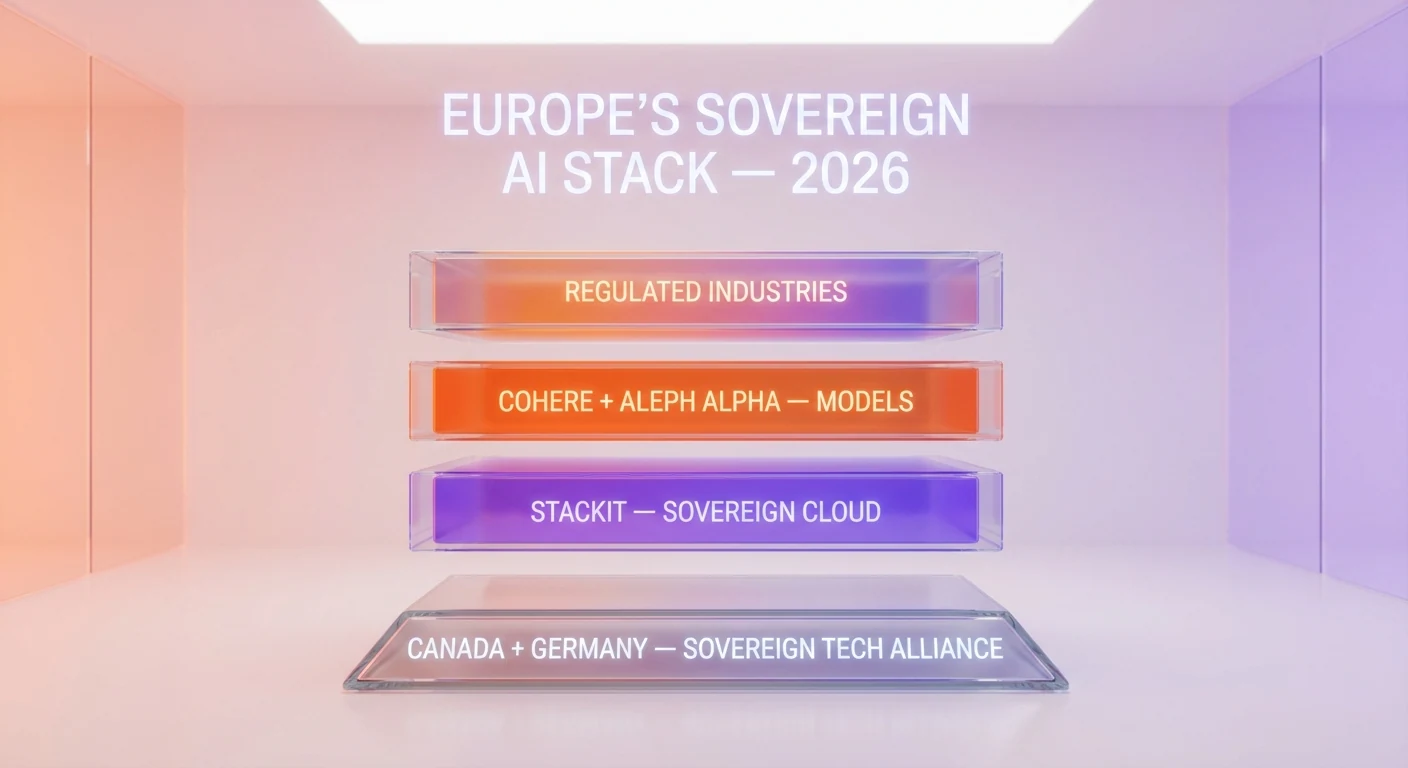
Cohere built its commercial position on enterprise-grade language models, retrieval-augmented generation tooling, and hybrid deployment options for regulated industries. By the end of 2025 it had reached approximately $240 million in annual recurring revenue. The Aleph Alpha acquisition gives it three things its capital stack and product roadmap could not produce on their own.
First, a German enterprise wedge. Aleph Alpha's customer base is concentrated in German federal and Länder governments, German industrial groups, and Bundeswehr-adjacent procurement processes. These are markets where U.S. vendors face material political and regulatory friction, and where the sovereign-procurement requirement is hard. By absorbing Aleph Alpha's customer relationships and the team that built them, Cohere inherits a distribution channel into German regulated procurement that would have taken years and tens of millions of euros to build natively.
Second, sovereign cloud infrastructure. STACKIT, operated by Schwarz Digits, is the cloud platform Aleph Alpha had standardized on for sovereign deployments. The merger means Cohere's combined product stack defaults to STACKIT for European sovereign workloads, removing the U.S. hyperscaler dependency that has historically been the choke point in these procurement conversations. That sovereign-by-default architecture is the cleanest answer Cohere can give to a French ministry, a German Länder government, or a Canadian federal procurement officer.
Third, language and tokenizer expertise on small European languages. Cohere's CEO Aidan Gomez characterized the deal as complementary, noting Aleph Alpha's expertise in small language models and European languages relative to Cohere's focus on the larger model tier. The practical consequence is that a combined Cohere can serve sovereign customers who require model quality in lower-resource European languages — a common gap in U.S. flagship models — without compromising on its frontier-tier capabilities.
What Aleph Alpha gets — survival and a real distribution channel
The honest read on the Aleph Alpha side is that the company needed this deal. Reporting indicates Aleph Alpha generated little revenue and significant losses, and co-founder and former chief executive Jonas Andrulis departed before the merger closed. A sovereign-positioned national champion with weak commercial momentum is a politically fragile asset — capital-intensive, dependent on government support, and exposed to the next German federal budget cycle.
Folding into Cohere converts an unsustainable standalone trajectory into a credible commercial path. The 250-employee team gets a global product platform, a global sales motion, and a long-horizon investor base in Schwarz Group's Series E commitment. Aleph Alpha's customer relationships and sovereign-deployment muscle become Cohere's German wedge. The geopolitical mission stays largely intact — German sovereign workloads still run on STACKIT, still served by a Heidelberg-based engineering presence — but the commercial vehicle is now built to last.
Two practical signals to watch. First, branding. The article does not specify whether the combined entity will retain the Aleph Alpha brand for German sovereign customers or consolidate under Cohere. Brand retention would be a tell that the German political relationships are being protected. Second, leadership. Aleph Alpha's senior engineering leadership integrating into the Cohere research function would be a signal that the model roadmap is unifying rather than running parallel.
Schwarz Group as anchor — a customer-investor model
The Schwarz Group commitment is the most under-discussed part of this deal. Schwarz is the German retail conglomerate behind Lidl and Kaufland, with revenue scale that places it among the largest privately held companies in Europe. It is also the operator of STACKIT, the sovereign cloud platform that Aleph Alpha runs on. By committing €500 million in structured financing — roughly $600 million — and leading Cohere's Series E round, Schwarz is moving from existing Aleph Alpha shareholder to anchor strategic backer of the merged entity.
This is a customer-investor model that the U.S. AI industry has not yet replicated at this scale. The closest comparable is Microsoft's relationship with OpenAI, but that runs through cloud capacity rather than direct equity at the customer level. Schwarz's structure pulls a large European enterprise customer directly into the equity stack of a sovereign AI vendor, with the cloud infrastructure layer running through Schwarz's own STACKIT operation. The strategic alignment between customer demand, capital, and infrastructure is unusually tight.
The European procurement read on this is straightforward. A French ministry buying sovereign AI in 2027 sees a vendor whose largest investor is a German enterprise customer that already runs the underlying cloud, in a deal blessed by Berlin and Ottawa. The political and operational coherence of that purchase is materially higher than buying the same workload from a U.S. hyperscaler.
Verticals — defence, energy, finance, healthcare, public sector
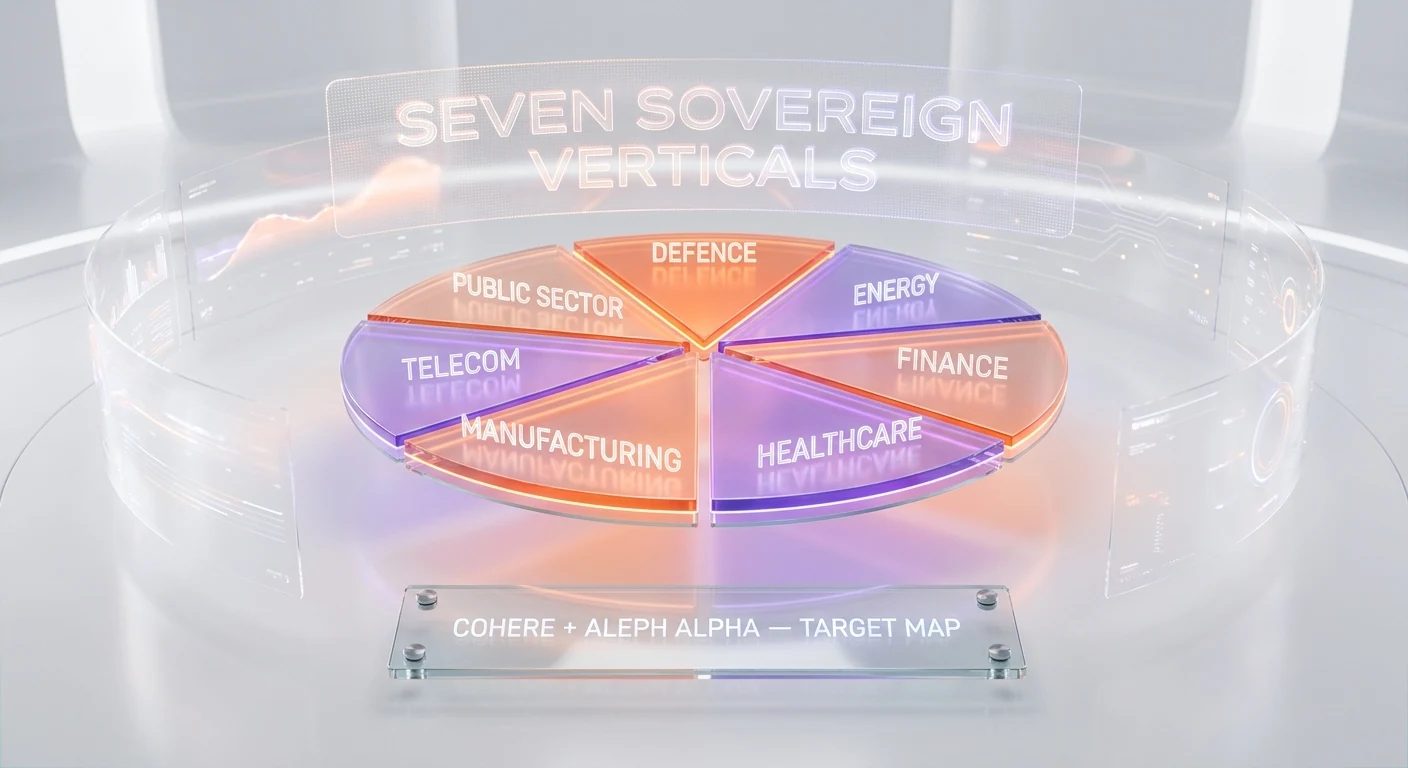
The combined entity's announced target verticals — defence, energy, finance, healthcare, manufacturing, telecommunications, and the European public sector — line up with the regulated, sovereignty-sensitive workloads where U.S. vendors face the highest friction. The shortlist is not a marketing document. It is the procurement map of European and Canadian regulated industries.
Defence is the clearest fit. Sovereign-procurement requirements in defence contracts are explicit, and a vendor with a German engineering presence, Canadian headquarters, sovereign cloud anchor, and political endorsement from both governments can credibly bid into NATO-aligned procurement processes that a U.S. hyperscaler cannot. Aleph Alpha's prior work with Bundeswehr-adjacent customers becomes Cohere's defence reference book.
Healthcare and finance follow similar logic. EU data residency requirements, Schrems II implications for U.S. hyperscaler cloud, and patient-data and financial-data regulations push regulated buyers toward vendors that can demonstrate sovereign infrastructure end-to-end. The merger gives Cohere that demonstration credibly for the first time. Manufacturing and energy are slower-moving procurement targets but represent large enterprise customer concentrations in Germany specifically, which the Aleph Alpha relationships penetrate.
Risks — integration, brand, and the OpenAI-Anthropic gap
Three risks are worth naming honestly.
First, integration. Folding 250 Heidelberg-based engineers into a Toronto-headquartered company spanning San Francisco, London, and now Germany is a non-trivial cultural and management challenge. Aleph Alpha's prior leadership departures are a stress signal. The integration thesis works only if Cohere can absorb the team without losing the customer relationships and government goodwill that justified the deal premium.
Second, brand and customer continuity. The merger announcement does not yet specify whether Aleph Alpha will continue to operate as a brand for German sovereign customers. Procurement teams that bought Aleph Alpha specifically for its German national champion positioning may push back on a Cohere-branded re-up. How Cohere handles brand architecture in Germany over the next 12 months is the cleanest tell.
Third, the gap to the U.S. frontier. Cohere combined with Aleph Alpha is a serious enterprise vendor with a sovereign cloud and government endorsements, but it is not a frontier-tier model lab in the way Anthropic, OpenAI, or Google DeepMind are. Our prior coverage of the foundation-model leadership race tracks the gap. The merged entity does not need to win the frontier — it needs to win sovereign procurement — but the gap creates a ceiling on the verticals where frontier model quality is decisive (advanced agentic workflows, the most demanding research applications). Mistral's open-weights frontier-tier release the same week is a partial answer to this gap on the open-source side. Cohere's answer is enterprise distribution and sovereign infrastructure rather than frontier model leadership.
Our verdict
The Cohere-Aleph Alpha merger is the first time the sovereign AI thesis has produced a vendor at credible commercial scale in Europe. A $20 billion combined entity, a $600 million Schwarz anchor, a sovereign cloud running through STACKIT, two governments politically aligned behind the deal, and a target vertical map that maps directly onto European regulated procurement — this is what "Europe's answer" was supposed to look like, and now it does. Combined with Mistral's open-weights frontier release the same week, the AI vendor map outside the U.S. is materially richer than it was 30 days ago.
The win condition is straightforward. If the combined Cohere can hold Aleph Alpha's German customer relationships through integration, demonstrate procurement wins in defence, finance, and healthcare across France, Germany, and Canada through 2026, and credibly bid into the next round of large EU sovereign cloud procurements alongside STACKIT, the $20 billion valuation reads light by 2027. If integration leaks customers and the Heidelberg engineering team thins out, the same number reads heavy.
For operators in regulated European industries, the merger creates a credible non-U.S. shortlist for the first time. For developers, the relevant takeaway is that the European model ecosystem is broadening — Mistral on the open-weights frontier, Cohere on the sovereign-enterprise tier — and multi-vendor AI strategies that include European model paths now have a real product to integrate against, not just a political talking point.
For the wider context on the foundation-model leadership race that this announcement is reacting to, see our coverage of Anthropic's $800B IPO setup, OpenAI's GPT-5.5 release, and the broader AI news desk.
Frequently asked questions
What is the value of the Cohere-Aleph Alpha merger?
The combined entity is valued at approximately $20 billion as of the April 25, 2026 announcement. Cohere's prior private valuation was $6.8 billion. The merger therefore represents roughly a threefold uplift on Cohere's standalone valuation, with the increment justified by the addition of Aleph Alpha's team, customer relationships, and sovereign infrastructure positioning, plus a fresh Series E led by the Schwarz Group.
Who is anchoring the financing?
Germany's Schwarz Group is anchoring Cohere's Series E round with €500 million — approximately $600 million — in structured financing. Schwarz operates Lidl and Kaufland and runs the STACKIT sovereign cloud platform. Schwarz was already an existing Aleph Alpha shareholder, so the commitment effectively doubles down on the German national champion via the Cohere-merged entity.
Why are Canada and Germany backing this deal?
Both countries blessed the deal in connection with their Sovereign Technology Alliance, launched in February 2026. The alliance is designed to coordinate procurement, capital, and infrastructure for non-U.S. technology bets. The Cohere-Aleph Alpha merger is the alliance's first commercial output and gives both governments a national champion at credible scale to support through procurement and policy.
What infrastructure will the combined company run on?
The combined entity plans to run on STACKIT, the sovereign cloud platform operated by Schwarz Digits. STACKIT was already Aleph Alpha's preferred sovereign-deployment infrastructure. Defaulting to STACKIT for European sovereign workloads removes the U.S. hyperscaler dependency that has historically been the choke point in regulated procurement processes.
What verticals will the merged company target?
The announced target verticals are defence, energy, finance, healthcare, manufacturing, telecommunications, and European public sector organizations. These are the regulated, sovereignty-sensitive markets where U.S. vendors face the highest political and procurement friction and where a sovereign-by-default vendor has the strongest structural advantage.
Did Aleph Alpha really need to be acquired?
Reporting indicates Aleph Alpha generated little revenue and significant losses on a standalone basis, and co-founder and former chief executive Jonas Andrulis departed before the merger closed. The acquisition converts what had become a politically fragile standalone trajectory into a credible commercial vehicle backed by Cohere's enterprise GTM, Schwarz's capital, and Canadian-German political support. For Aleph Alpha specifically, the deal is closer to a survival-and-scale outcome than a pure strategic optimization.
How does Cohere combined compare to U.S. frontier labs?
The merged Cohere is a serious enterprise vendor with a sovereign cloud anchor and government endorsements, but it is not a frontier-tier model lab in the same sense as Anthropic, OpenAI, or Google DeepMind. Its competitive position is enterprise distribution, sovereign infrastructure, and regulated-industry trust rather than frontier model leadership. That is by design — the sovereign procurement market does not require frontier capability for most workloads.
How does this connect to Mistral Medium 3.5?
Mistral released Medium 3.5 with open-weights and asynchronous cloud coding agents in the same week as the Cohere-Aleph Alpha announcement. Read together, the two events are the first time the European AI ecosystem has produced two credible enterprise-grade alternatives in the same news cycle — one on the open-weights frontier (Mistral) and one on the sovereign-enterprise tier (Cohere combined). The sovereign AI thesis materially hardens as a procurement reality rather than an investor narrative.
What are the biggest integration risks?
Three risks stand out. First, folding 250 Heidelberg-based engineers into a Toronto-headquartered company is a non-trivial cultural and management challenge, particularly given Aleph Alpha's prior leadership departures. Second, brand continuity for German sovereign customers is unresolved — procurement teams that bought Aleph Alpha specifically for its national champion positioning may push back on a Cohere-branded re-up. Third, the merged entity still trails U.S. frontier labs on absolute model capability, which sets a ceiling on workloads where frontier quality is decisive.