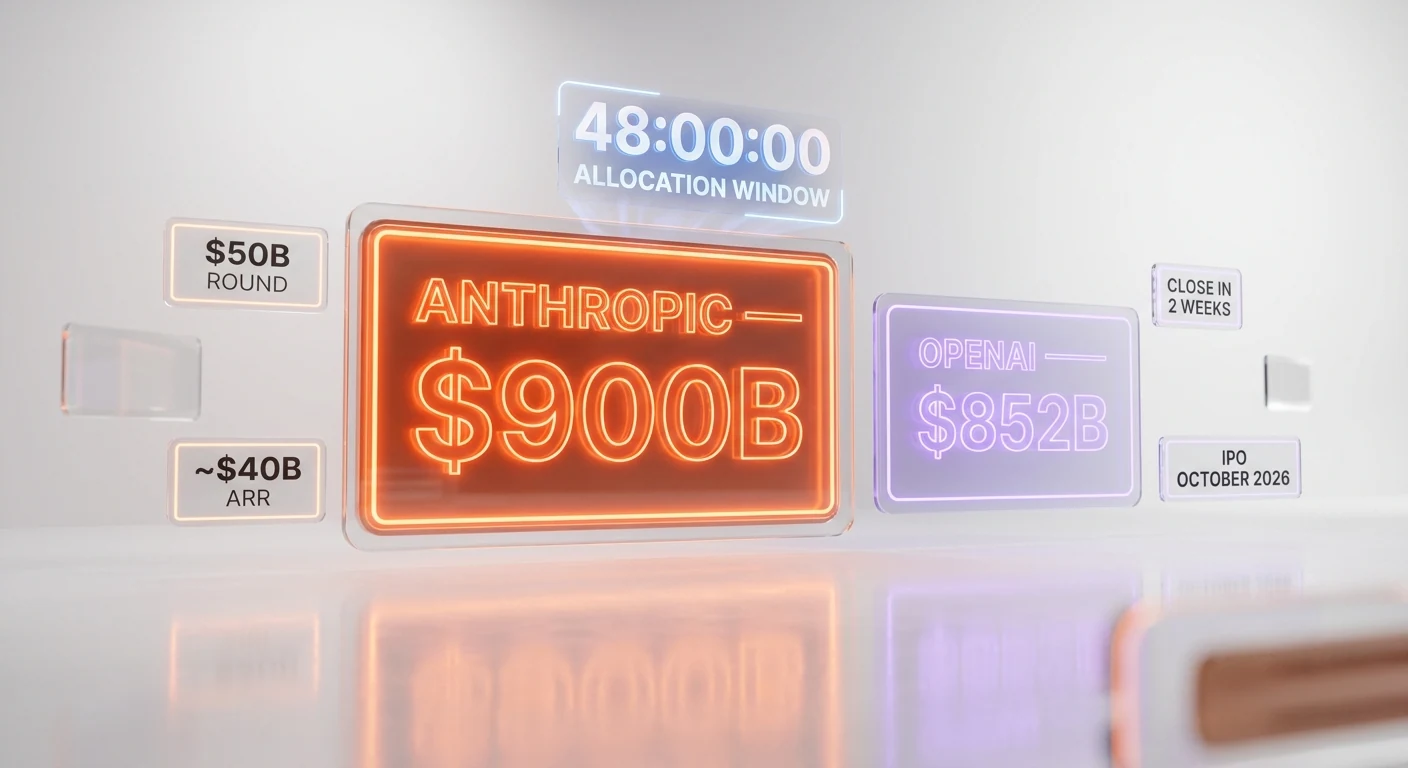
Anthropic is collecting commitments for a roughly $50 billion funding round at a valuation of about $900 billion, with investors given a 48-hour window to submit allocations and the deal expected to close within two weeks, TechCrunch reported on April 30, 2026. The number lands above OpenAI's most recent $852 billion post-money valuation. It arrives six days after Alphabet committed up to $40 billion to Anthropic at a $350 billion valuation. And it pushes Anthropic from $380 billion in February 2026 to $900 billion in less than three months — a 2.4x revaluation that would normally take years to clear procurement and audit. The window is short, the math is loud, and the IPO timing just shifted.
The numbers — $50B round, $900B valuation, 48 hours
Here is the structure of the deal as currently telegraphed by TechCrunch on April 30, 2026, and corroborated by Bloomberg and CNBC reporting from April 29.
| Variable | Anthropic — May 2026 round | Reference point |
|---|---|---|
| Round size | ~$50 billion | Among the largest single private rounds in history |
| Target valuation | ~$900 billion | Above OpenAI's $852B post-money close earlier this year |
| Investor allocation deadline | 48 hours | Unprecedented pace for a private round of this size |
| Expected close | Within two weeks | Lines up with mid-May 2026 |
| Reported ARR | $30B announced; run-rate closer to $40B | Up from $9B at end of 2025 |
| Prior valuation (Series G, February 2026) | $380 billion | 2.4x in roughly three months |
| Prior raise — Amazon | $25 billion (early April 2026) | Pre-Google round |
| Prior raise — Google / Alphabet | $40 billion (April 24, 2026) | $10B cash, $30B performance-based |
Three numbers deserve to be read twice. The $50 billion round size, if it lands, would by itself fund roughly two to three years of Anthropic's reported compute capex at current rates. The 48-hour allocation deadline is the part of the story that institutional investors are reading most carefully — a window that short signals a private market in which demand is so heavy that the company can dictate the calendar. And the $900 billion valuation passes OpenAI's most recent reported post-money number for the first time in either company's history.
Connect the dots — what changed since April 24
This story does not stand on its own. It is the next data point in a sequence we have been tracking week by week. Our April 16 analysis on Anthropic's $800B IPO walked through the revenue crossover with OpenAI and the pre-IPO governance setup. Our April 25 piece on Google's $40 billion bet framed the Alphabet investment as an IPO launchpad. The May 2026 round is the third escalation in three weeks.
What changed since April 25 is concrete. First, Anthropic confirmed publicly that ARR had crossed $30 billion, and TechCrunch is now reporting an internal run-rate closer to $40 billion. That single data point, if accurate, repegs every multiple used to value the company two months ago. Second, the Google round and the Amazon round combined banked at least $65 billion of new commitments in the same two-week window, providing the operational runway that a $50 billion equity raise would normally need to justify. Third, OpenAI's $852 billion close earlier in 2026 created a public anchor against which any Anthropic valuation above that number reads as a category-leadership signal. The May 2026 round is testing exactly that signal.
Why a 48-hour deadline — and what it means
An allocation window that short for a fifty-billion-dollar round is not standard private-market behavior. The mechanics tell most of the story. When demand from a small number of large allocators (sovereign wealth funds, large endowments, top-tier crossover funds) materially exceeds supply, the issuer has the leverage to compress the timeline. The 48-hour window forces investors to make commitment decisions before they can run a full second-round diligence cycle, which in turn favors funds that have already done the work and are pre-positioned to deploy at this size.
Three reasons Anthropic might want this short window.
- Lock the valuation before the IPO. Bloomberg has reported that Anthropic is targeting an October 2026 IPO. A private round that closes in mid-May at $900 billion creates a public reference point that the IPO bookrunners can anchor on. Lengthening the round risks the macro picture shifting before the price is set.
- Filter for conviction capital. Allocators who commit inside 48 hours are signaling that they have already convinced themselves on the thesis. That filter favors long-horizon investors over momentum chasers, which is what the company would want before a public listing.
- Demonstrate demand. The fact that the deadline is plausible at all is itself the headline. Most pre-IPO rounds that target this valuation have to extend timelines because allocators ask for more diligence. Anthropic asking for a closed allocation in 48 hours and getting it — if it does — is the demand proof that the IPO conversation hinges on.
There is a downside risk worth naming. If the round prices below $900 billion, or if it extends past the 48-hour deadline, the optics flip immediately from "Anthropic just overtook OpenAI" to "Anthropic missed its own bar." Tight windows are leverage, but they are also tests.
$900B vs OpenAI's $852B — the on-paper overtake
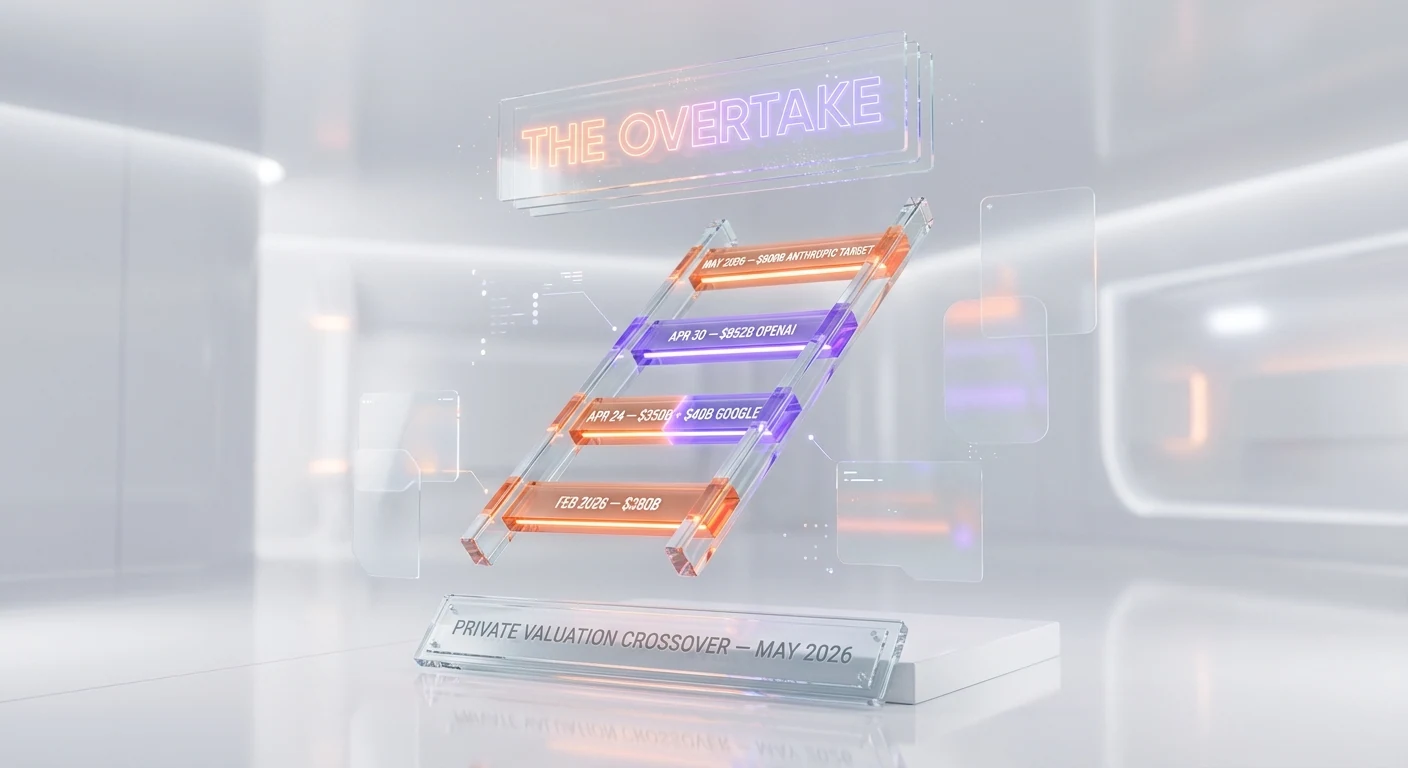
OpenAI closed a funding round at an $852 billion post-money valuation earlier in 2026. If Anthropic closes its current round at $900 billion, the two companies trade places on the private valuation league table — and Anthropic does it while still presenting smaller absolute revenue (roughly $30 billion ARR announced versus OpenAI's roughly $25 billion) but with materially higher growth, materially higher enterprise concentration, and reportedly lower capex burn.
This is the second crossover in five weeks. The first was the revenue crossover in early April, when Anthropic's announced $30 billion ARR overtook OpenAI's roughly $25 billion. The second, if it lands, is the valuation crossover in May. Both crossovers point at the same underlying shift — institutional capital is repricing the foundation-model leadership, with Anthropic moving into the number-one slot on the metrics that public-market buyers care about.
It is worth being precise about what an "overtake" means here. OpenAI's $852 billion is a closed post-money number. Anthropic's $900 billion is a target — investor offers and a working timeline, not yet a closed transaction. Until the round prices and the wire hits, the league-table ordering is provisional. But the directional signal is unambiguous, and the IPO bookrunners are watching this print specifically.
Investor behavior — early backers stepping out
One nuance from TechCrunch's reporting that institutional investors are reading carefully: some early backers from 2024 or earlier are reportedly skipping this round. The motive cited is straightforward — they intend to capture liquidity in an anticipated IPO later in 2026 rather than dilute their position by reinvesting at $900 billion. That is rational behavior for a private investor sitting on a roughly fifty-fold or higher unrealized gain. It is not a vote against the company.
What it does is open allocation room for new institutional buyers — sovereign wealth funds, large public endowments, and crossover hedge funds — who want pre-IPO positions in what they believe will be the most-watched technology IPO of the decade. That investor mix shift is exactly what bookrunners want to see before a listing. The ownership table moves from concentrated venture capital to a broader institutional base, which improves the post-IPO float and dampens the volatility that early-investor lockup expirations would otherwise generate.
The pattern resembles late-stage rounds that immediately preceded large public listings of past technology category leaders, where the allocation conversation moved to permanent capital well before the S-1 was filed.
What this does to the IPO timeline
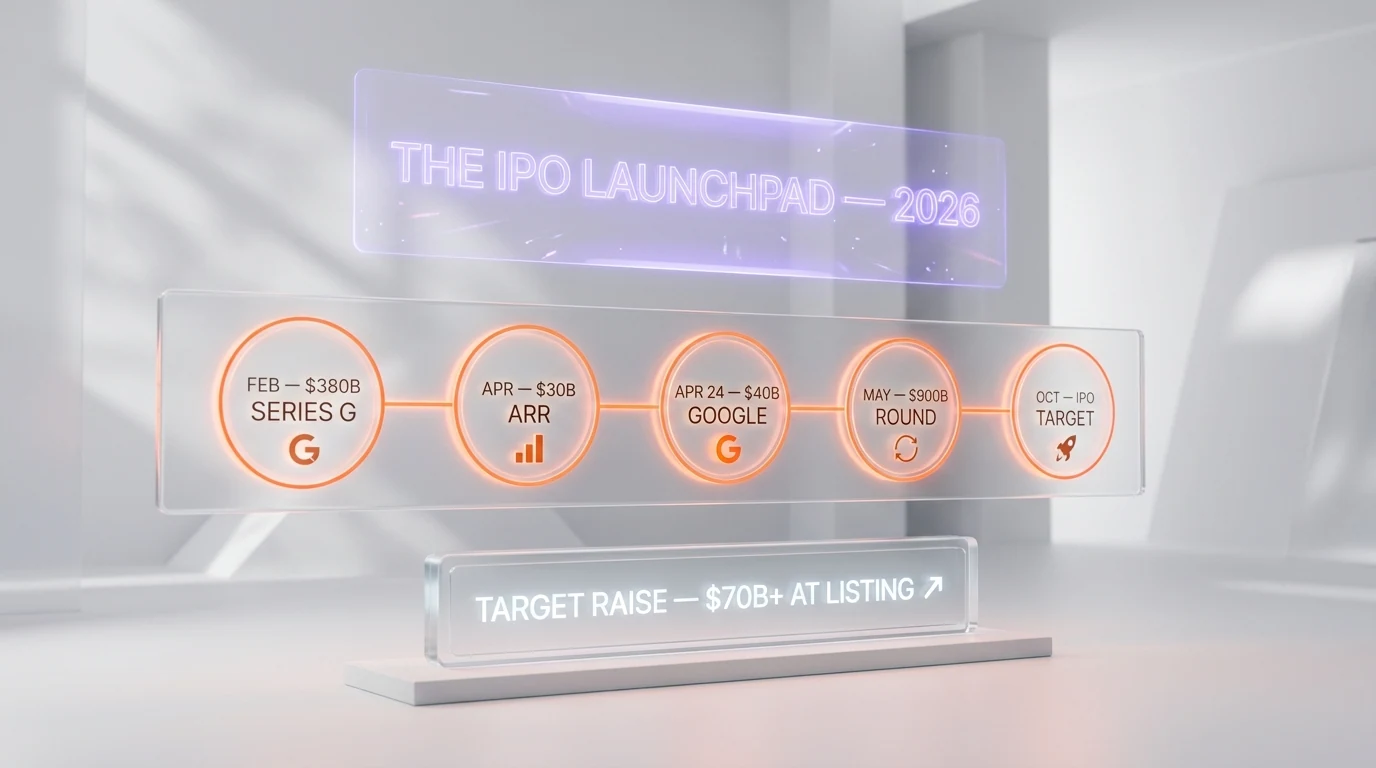
If the May round closes at $900 billion, three things happen to the public-listing roadmap in October 2026.
- The IPO valuation floor moves up. A private close at $900 billion sets a floor under the public listing range. Bookrunners typically price IPOs above the most recent private round, particularly when public-market demand is strong. A $1 trillion-plus listing target moves from speculative to plausible.
- The raise size grows. Anthropic was already targeting more than $60 billion raised at the listing. If the private valuation reprices to $900 billion in May, the same dilution percentage at IPO would imply a raise closer to $70 billion or above.
- The IPO becomes the second-largest in history with margin. SpaceX is the only larger pre-IPO valuation comparable. If the listing pricings hold, this becomes the largest U.S. technology IPO ever and the second-largest IPO globally regardless of sector.
One risk to call out. A private round that prints at $900 billion creates a high bar to clear in the first six months of public trading. If first-day pricing falls below the private mark, the optics turn negative quickly. Bookrunners will work to set the IPO range at a discount to the private valuation specifically to manage this dynamic. Watch for the IPO range to land between roughly $750 billion and $900 billion when the S-1 is priced — anywhere below would signal the macro picture has shifted, anywhere above would signal that the private bar was conservative.
The silence — what Anthropic is not saying
Anthropic declined to comment to TechCrunch on the round details. That non-statement is itself information. In every prior funding cycle through 2024 and 2025, Anthropic communicated rounds either through its own blog or through a coordinated press cycle with the lead investor. The silence on a $50 billion round is consistent with a company in the closed phase of a pricing process, where any executive comment risks moving the price one way or the other and triggering securities-law concerns ahead of an S-1 filing.
The behavior is consistent with pre-IPO discipline. Expect a coordinated announcement once the round prices, plausibly within two weeks of this writing, with simultaneous publication of an S-1 readiness statement or a confidential filing notice. Bloomberg has previously reported that Goldman Sachs, JPMorgan, and Morgan Stanley are in early discussions as potential lead underwriters for the listing.
What this means for operators, developers, and investors
For operators inside Fortune 500 procurement and engineering organizations, the practical takeaway is simple: Anthropic is now the highest-valued private foundation-model company in the world by reported numbers, and its capital position over the next 24 months is unambiguously durable. Multi-year enterprise contracts on Claude infrastructure are no longer a vendor-risk decision in the way they would have been even six months ago.
For developers building on the Claude API and on Claude Code, the implications run in the same direction. An IPO-funded Anthropic with a $900 billion private round behind it has the runway to compete on price, on rate limits, and on context-window expansion for the rest of the decade. Investment in Claude-specific tooling and integration patterns has a longer half-life than it did before this round.
For investors, the data point to track over the next two weeks is the closing price of the round. A close at or above $900 billion locks in the leadership narrative. A close below — for instance at $750 billion or $800 billion — would signal that even at this scale of demand, allocators pushed back on price, which would be a softer setup for the October listing.
Our verdict
The May 2026 round is the most consequential pre-IPO data point of the year for the foundation-model category. If it closes at or above the $900 billion target inside the two-week window, Anthropic completes the second of three crossovers — first the revenue overtake in early April, now the private valuation overtake in May, and then the public listing in October. Each crossover compounds the leadership narrative and adjusts the bar for every downstream procurement, partnership, and capital decision in the AI economy.
The thing to watch is not the headline number. It is the close. A $900 billion private valuation is a target until the wire clears. Once it clears, the league table reads Anthropic first, OpenAI second on private valuation — and every public-market buyer pricing the October listing has a reference point that did not exist 90 days ago. The 48-hour deadline is leverage, but it is also a public test. Anthropic is betting it can pass.
For the broader read on the foundation-model arms race, see our deep dives on OpenAI's GPT-5.5 super-app strategy, Anthropic's Mythos preview, and our AI news desk.
Frequently asked questions
What is the size of the new Anthropic round?
According to TechCrunch reporting on April 30, 2026, Anthropic is collecting commitments for a round of roughly $50 billion. The round is not yet closed, and Anthropic has declined to comment publicly on the details.
What is the target valuation?
The target valuation is approximately $900 billion. If the round closes at that level, Anthropic would for the first time hold a private valuation above OpenAI's most recent reported post-money valuation of $852 billion from earlier in 2026.
Why does Anthropic only give investors 48 hours to commit?
The 48-hour allocation deadline is unusual for a round of this size. The compressed window is consistent with private-market dynamics in which demand materially exceeds supply, allowing the issuer to set a tight calendar that filters for pre-positioned long-horizon investors and reduces the time available for lengthy diligence cycles. It also locks the valuation reference ahead of an anticipated October 2026 IPO.
How does $900 billion compare to OpenAI's valuation?
OpenAI closed a funding round at an $852 billion post-money valuation earlier in 2026. A $900 billion close for Anthropic would cross above OpenAI on private-market valuation for the first time in either company's history. Until the Anthropic round actually closes, the league-table ordering is provisional rather than confirmed.
Did Anthropic confirm the funding talks officially?
No. TechCrunch reported on April 30, 2026 that Anthropic declined to comment on the round. The behavior is consistent with pre-IPO communication discipline, where executive statements during a pricing process can create securities-law and disclosure complications. Expect a coordinated announcement once the round prices.
What is Anthropic's current revenue?
Anthropic announced in early April 2026 that annualized revenue had crossed $30 billion, more than tripling from $9 billion at the end of 2025. TechCrunch reported on April 30, 2026 that the actual run-rate is closer to $40 billion. Both numbers are materially above OpenAI's roughly $25 billion in announced annualized revenue from the same window.
How does this connect to the Google $40 billion investment?
Alphabet committed up to $40 billion to Anthropic on April 24, 2026 — $10 billion in immediate cash at a $350 billion valuation, plus $30 billion in performance-conditional commitments. Combined with Amazon's earlier $25 billion commitment, that is at least $65 billion of new capital commitments in the two weeks immediately preceding the May 2026 equity round at $900 billion. The sequence functions as an IPO launchpad, providing operating capital and a reset valuation reference ahead of the October 2026 listing target.
When is the Anthropic IPO expected?
Bloomberg has reported that Anthropic is targeting an IPO as early as October 2026. Goldman Sachs, JPMorgan, and Morgan Stanley are in early discussions as potential lead underwriters. The May 2026 private round at $900 billion, if it closes, would set a strong floor for the public listing range and likely push the targeted raise above the previously reported $60 billion threshold.
What happens if the round prices below $900 billion?
A close below $900 billion — for example at $750 billion or $800 billion — would signal that even at heavy demand, institutional investors pushed back on price. That outcome would be a softer setup for the October 2026 IPO and would tighten the bookrunner pricing range. The May 2026 round is consequential precisely because it tests the high end of what the private market will pay before the public listing.