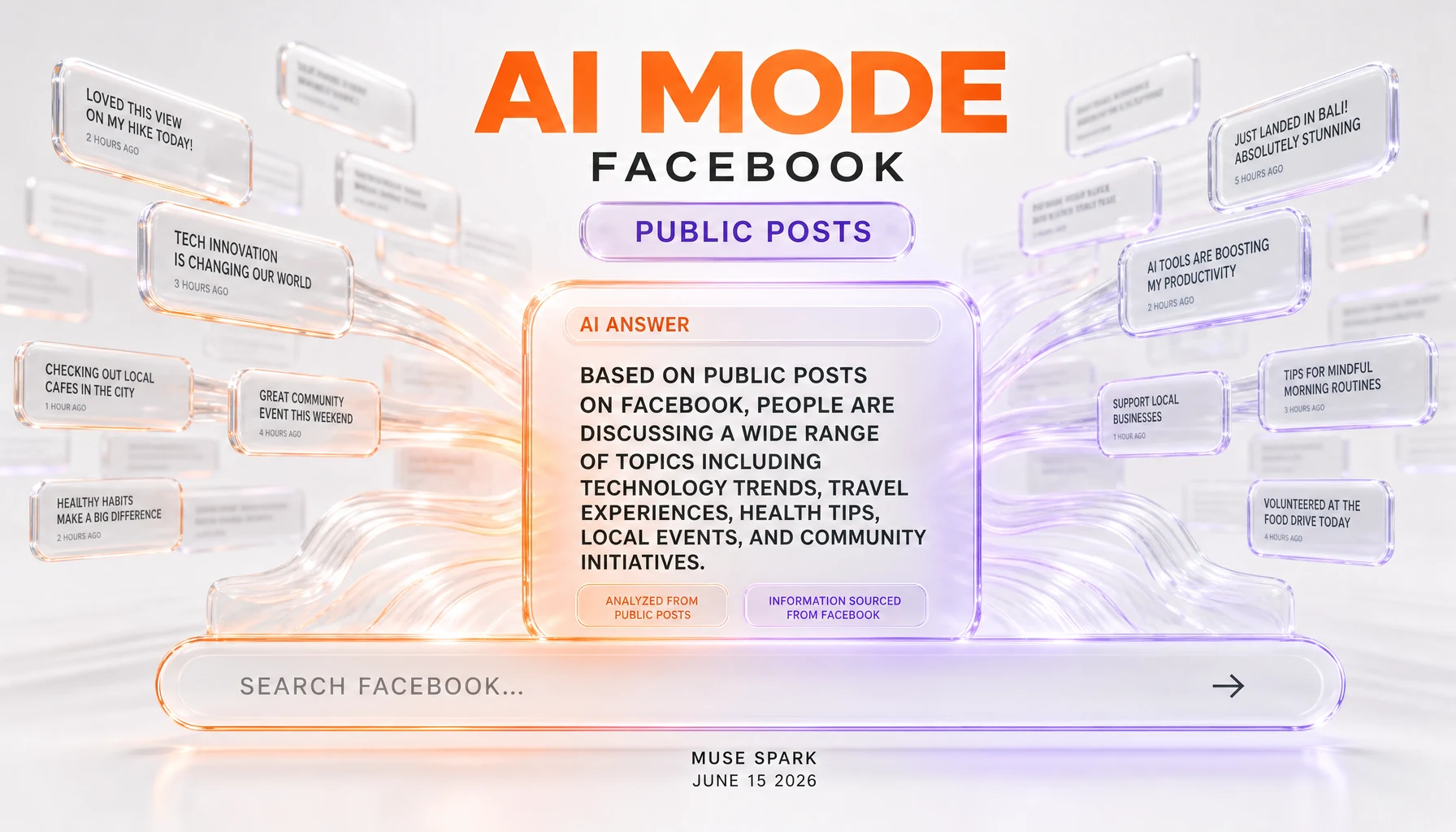
Facebook's AI Mode is a conversational search feature in the Facebook mobile app that synthesizes natural-language answers from the public posts, Groups, and Reels of Facebook's entire community, not the open web. Announced by Meta on June 15, 2026 and powered by Muse Spark, it is live for US users on Android and iOS. Crucially, Meta has announced no way to opt your public posts out of being used in AI Mode answers, so anything you have shared publicly is now raw material for strangers' searches.
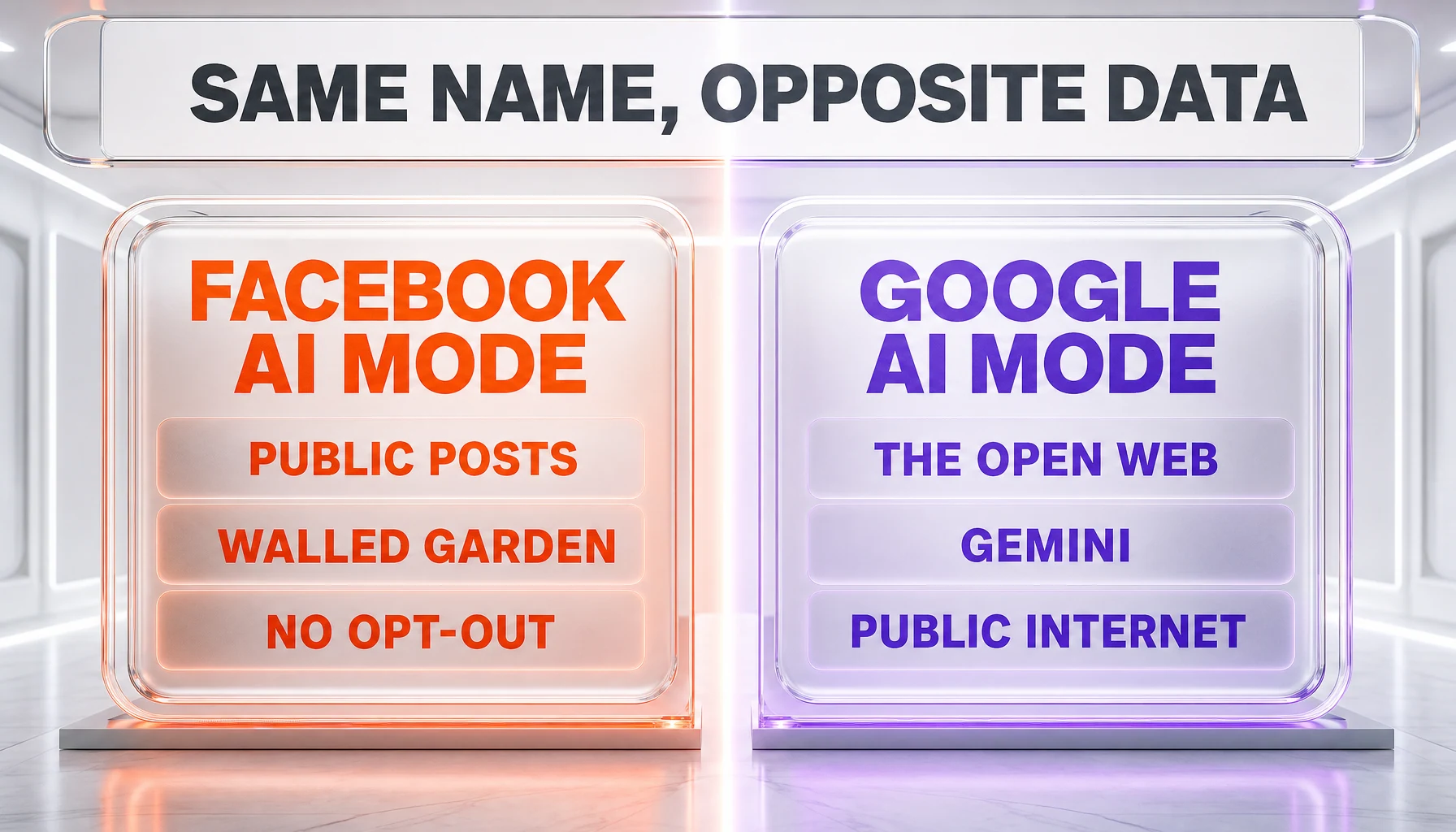
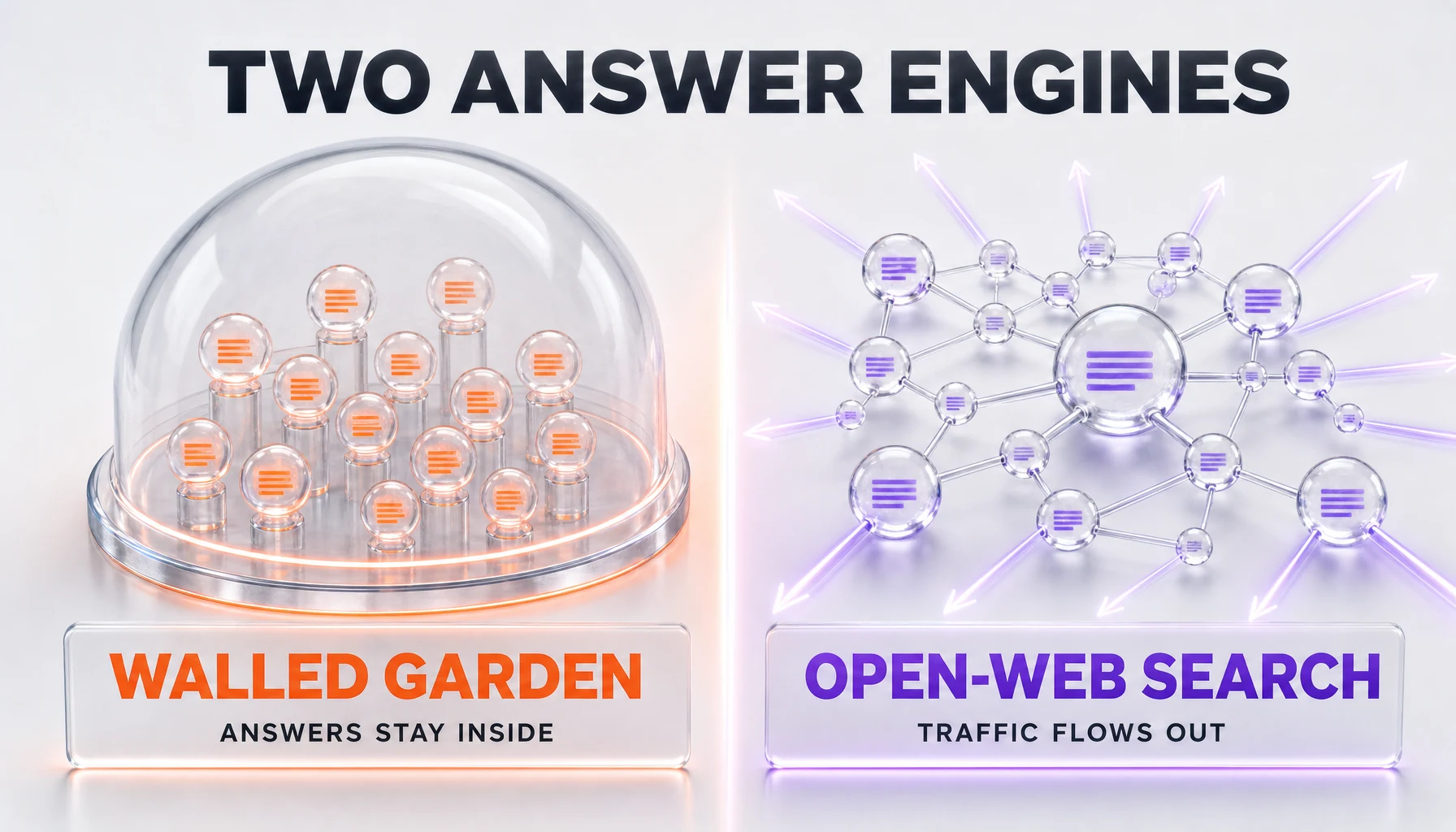
Not to be confused with Google's AI Mode, which carries the same product name but searches the open web, Facebook's version is a walled garden: it answers only from content posted inside Facebook. That single structural choice, paired with the absence of any announced opt-out for your public posts, is what makes this launch worth a close read. We see two questions stacked on top of the feature itself: who controls the data that feeds it, and how reliable an answer can be when it is assembled from the unvetted opinions of millions of strangers.
What Facebook's AI Mode Actually Does
According to Meta, AI Mode replaces the familiar list of links and posts with a single synthesized answer. You type a question in plain language, and instead of scrolling results you get a written response you can interrogate further with follow-up questions, keeping the conversation going the way you would with any chat assistant.
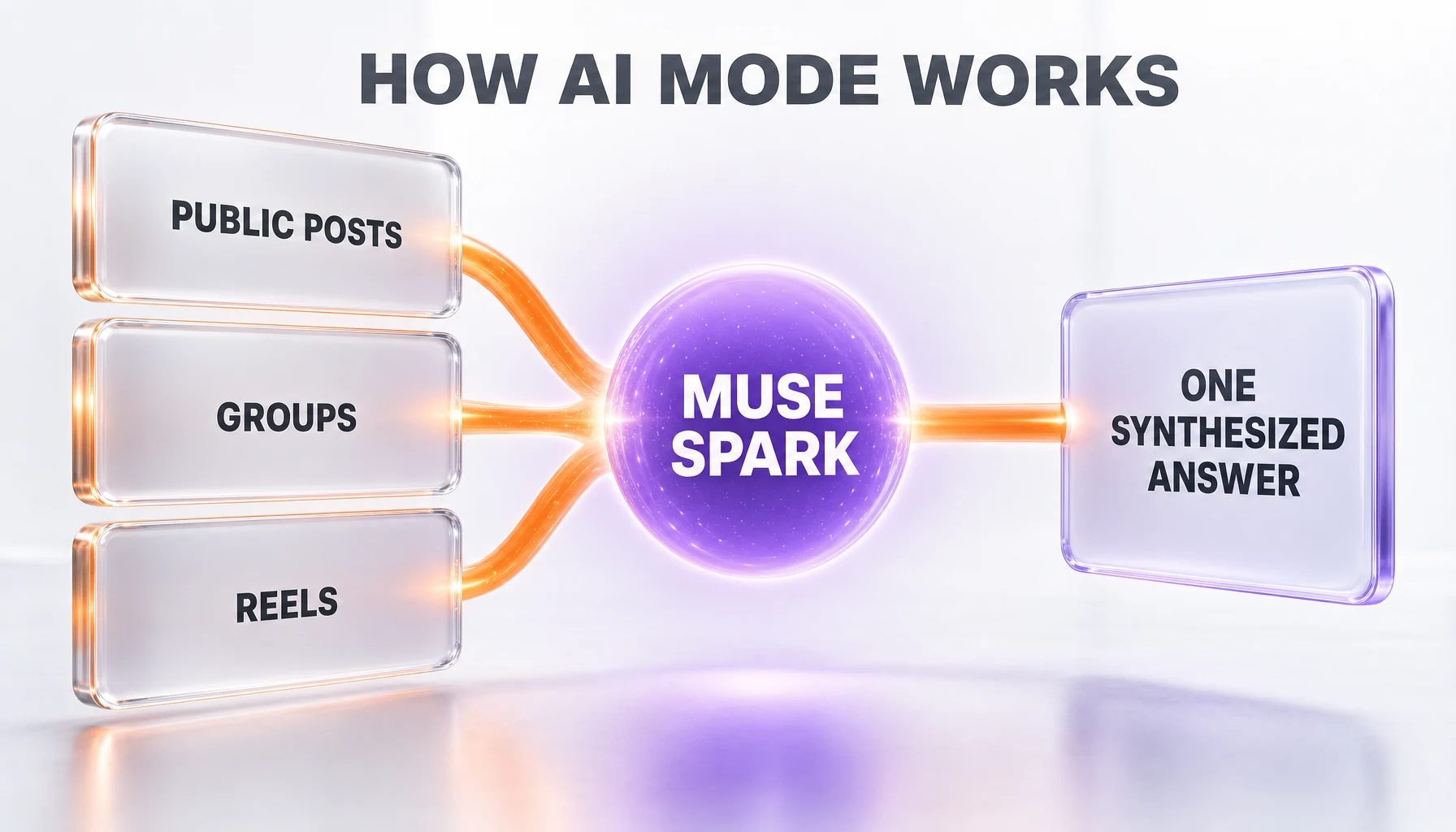
The example Meta gave is telling: ask "What's the best local pizza place my friends have talked about this month?" and AI Mode pulls together posts, comments, and check-ins to produce a recommendation. The sources it draws on, per Meta, span public posts, public Groups, and Reels, and can extend to public Pages, comments, check-ins, and reviews. In other words, it indexes the community's shared activity and turns it into prose.
The defining limit is what it does not touch. AI Mode does not search the open web. It has no access to the broader internet, to news sites, or to anything outside Facebook's own public content. That is the cleanest way to separate it from its namesake. Google's AI Mode synthesizes answers from the open web using Gemini; Facebook's synthesizes answers from the social graph's public posts using Muse Spark. Same two words, opposite data foundations.
Facebook AI Mode vs Google AI Mode at a Glance
Because the naming collision invites confusion, here is the contrast in one view. The table reflects what each company has publicly stated about its respective product.
| Dimension | Facebook AI Mode | Google AI Mode |
|---|---|---|
| Data source | Facebook public posts, Groups, Reels, Pages, comments, check-ins, reviews | The open web |
| Underlying model | Muse Spark (Meta Superintelligence Labs) | Gemini |
| Searches the open web | No | Yes |
| Availability at launch | US, Facebook mobile app (Android and iOS) | Broad rollout, web and mobile |
| Opt-out for your content | None announced | Web publishers control crawling via standard web mechanisms |
The Privacy Problem: There's No Opt-Out
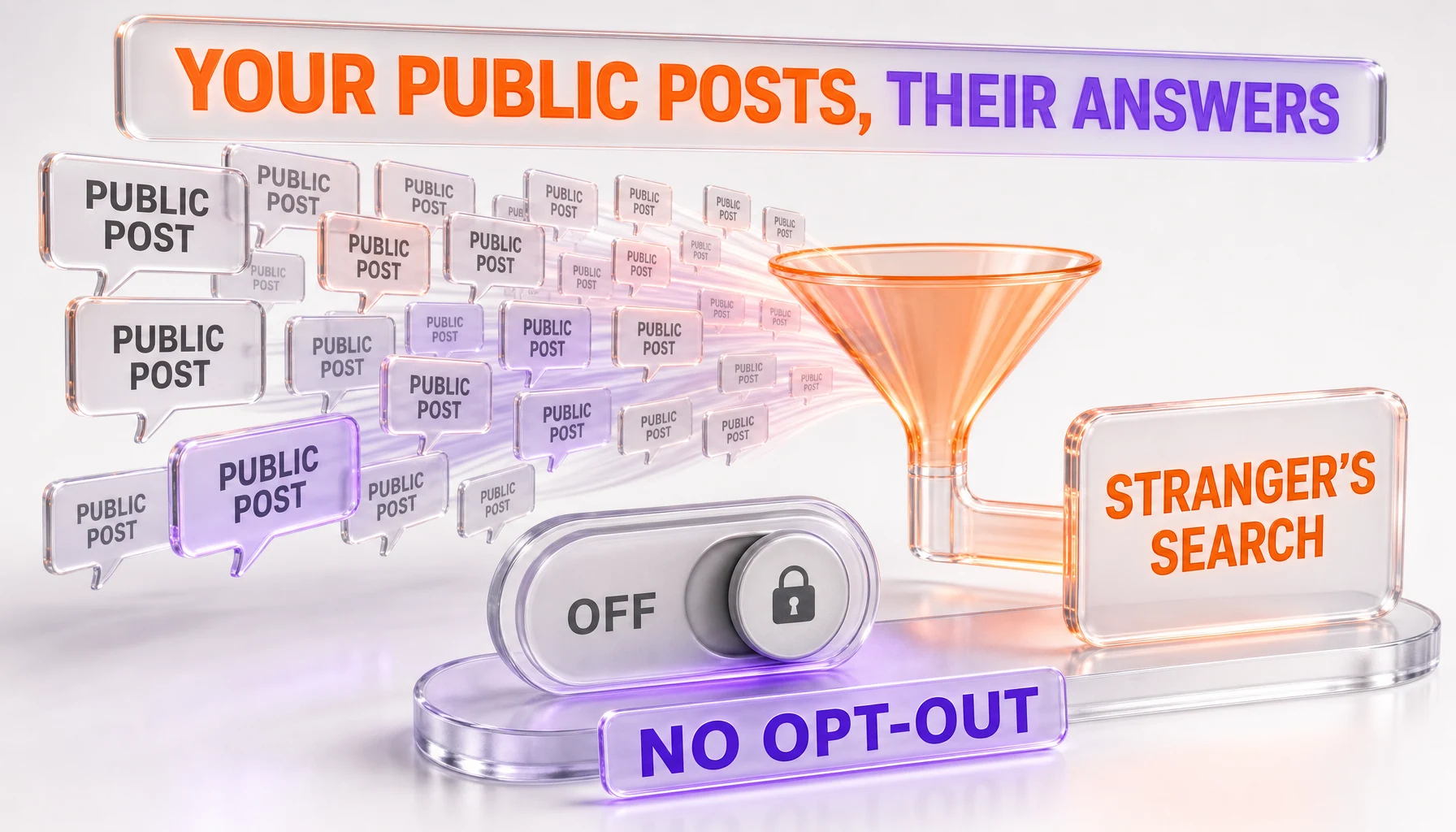
This is the part that deserves the most attention. Based on Meta's announcement and reporting from outlets covering the launch, Meta has not disclosed any mechanism for an individual user to exclude their public posts from being synthesized into AI Mode answers. If you posted something publicly, it is now eligible to be folded into an answer served to a stranger who searched for the right question.
There is a real risk of conflating two different features here, and the distinction matters. Meta's announcement does describe opt-in framing and a feature that "can be turned off," but, as reported, that language applies to a separate camera-roll and photo-sharing-suggestions feature, not to AI Mode search. The toggle that lets you control camera-roll suggestions does nothing to remove your public posts from AI Mode. We flag this because the two are easy to mix up, and the practical consequence is significant: the camera-roll control is not an AI Mode opt-out.
There is a regional nuance. Residents of the EU and EEA have a general setting in Meta's privacy controls to opt out of having their data used for AI training. That setting is not prominently advertised, and Meta has not stated that it specifically excludes public posts from AI Mode. So even in Europe, it would be a stretch to call this a clean, documented way to keep your public posts out of AI Mode answers. The honest summary is that, as of launch, there is no announced opt-out aimed squarely at this feature.
It is worth being precise about what is and is not in scope. AI Mode draws on public content. Private posts, friends-only posts, and content shared to restricted audiences are not the fuel here, by Meta's own description. The concern is narrower and sharper than "Meta is reading everything": it is that the public sharing you did in the past, under a different set of expectations, has been quietly repurposed as a search corpus with no switch to remove it.
Why Muse Spark Matters Here
AI Mode runs on Muse Spark, described by Meta as Meta Superintelligence Labs' first model, introduced in April 2026 and threaded through Meta's consumer surfaces. It is the same underlying infrastructure that powers the rebuilt Meta AI app, the standalone assistant Meta relaunched in May 2026. The shared engine signals that Meta is consolidating its consumer AI on one model family rather than spreading effort across disconnected systems.
The distinction between the two products is easy to lose, so it is worth stating plainly. AI Mode is search inside the Facebook app. Muse Spark also powers a separate, standalone Meta AI app you download on its own. Both lean on the same model, but they are different surfaces with different jobs. AI Mode answers from Facebook's public content; the standalone app is a general-purpose assistant.
The Reliability Question
A conventional search engine, broadly speaking, tries to weight authoritative sources, ranking established publishers and signals of trust above random opinions. AI Mode, by design, does the opposite of that filtering: it draws from unvetted user-generated posts, the comments and opinions of whoever happened to post publicly. That is a structural difference, not a value judgment, and it cuts directly at how much weight an answer should carry.
Meta has not publicly addressed how AI Mode handles accuracy or the risk that a synthesized answer inherits bad information from the posts it summarizes. When the corpus is the open opinions of millions of people, a confident-sounding answer can be built on a foundation of guesses, jokes, or plain errors, and the synthesis can launder all of that into a single authoritative-looking paragraph. For low-stakes questions, such as where friends grabbed pizza, that may be fine. For anything consequential, the lack of source weighting is a reliability disadvantage worth keeping in mind. This is a structural fact about where the answers come from, and Meta has yet to say how it intends to mitigate it.
What It Means for the Open Web and SEO
Step back, and AI Mode looks like Meta planting a flag on a specific idea: the most valuable answer engine is not the one with the most of the web, but the one with proprietary data nobody else can index. We see three implications worth tracking.
- The data is the moat. Years of public posts, Groups, Reels, and check-ins are an asset only Meta can synthesize. A web-based competitor cannot replicate the social graph, which is exactly the point.
- It is a walled garden, by design. Where web-based AI search sends signals (and sometimes traffic) back to the sites it cites, AI Mode keeps the question, the answer, and the underlying content inside Facebook. Nothing about the model rewards the open web.
- Discovery shifts inward. If users get their "best local pizza" answer without leaving the app, the recommendation surface moves away from the open web and into Meta's product. For anyone whose visibility depends on being found, that is a channel they do not optimize for the way they optimize for search engines.
This does not displace web search. It opens a second front. Web-based AI search and walled-garden AI search are now distinct categories with different data, different incentives, and different relationships to the open web. The strategic question for the broader ecosystem is whether more of the platforms with large proprietary corpora follow Meta's lead and build answer engines that point only at themselves.
What's Next
For now, AI Mode is a US-only feature on the Facebook mobile app for Android and iOS. Meta has not confirmed timelines for the UK, for other regions, or for desktop, so the rollout map beyond the United States is unsettled.
The bigger open question is the one Meta has not answered: whether it will give users a real, documented way to keep their public posts out of AI Mode. Until it does, the working assumption has to be that public means available, and that the sharing you did under older norms now feeds a search engine you did not opt into. We will be watching whether reporting, from Meta's Newsroom and from the outlets covering the launch, surfaces an opt-out, and whether regulators in the EU and elsewhere treat a no-opt-out social answer engine as a question worth asking.
Frequently Asked Questions
What is Facebook's AI Mode?
Facebook's AI Mode is a conversational search feature in the Facebook mobile app, announced by Meta on June 15, 2026. Instead of returning a list of links or posts, it synthesizes a single natural-language answer from the public posts, Groups, and Reels of Facebook's community, and you can ask follow-up questions to continue the conversation. It is powered by Muse Spark.
How is Facebook's AI Mode different from Google's AI Mode?
They share a name but draw on opposite data sources. Facebook's AI Mode synthesizes answers from public social content inside Facebook, posts, Groups, Reels, comments, and check-ins, using Muse Spark. Google's AI Mode synthesizes answers from the open web using Gemini. Facebook's is a walled garden limited to its own community content; Google's reaches across the public internet.
Does Facebook's AI Mode search the open web?
No. According to Meta, AI Mode draws only on Facebook's own public content, public posts, Groups, Reels, Pages, comments, check-ins, and reviews. It does not access the open web, news sites, or any source outside Facebook. That is the central structural difference between it and web-based AI search tools.
Can I opt out of having my public posts used in AI Mode?
As of launch, Meta has announced no way to exclude your public posts from being synthesized into AI Mode answers. The opt-in and "can be turned off" language in Meta's announcement applies to a separate camera-roll and photo-sharing-suggestions feature, not to AI Mode search. EU and EEA residents have a general setting to opt out of data used for AI training, but it is not prominently advertised and Meta has not stated it specifically excludes public posts from AI Mode.
Is Facebook AI Mode available outside the US?
Not yet. AI Mode is live for US users on the Facebook mobile app for Android and iOS. Meta has not confirmed timelines for the UK, other regions, or desktop, so availability beyond the United States is currently unconfirmed.
What model powers Facebook's AI Mode?
AI Mode runs on Muse Spark, described by Meta as Meta Superintelligence Labs' first model. It was introduced in April 2026 and has been threaded through Meta's consumer surfaces, including the rebuilt standalone Meta AI app, which uses the same underlying model.
Is AI Mode reliable, and can it be wrong?
It can be. Unlike a search engine that weights authoritative sources, AI Mode synthesizes answers from unvetted user-generated posts, the opinions and comments of whoever posted publicly. Meta has not publicly addressed how it handles accuracy or misinformation, so a confident-sounding answer can inherit errors from the posts it summarizes. This is a structural reliability concern worth keeping in mind for anything consequential.
What's the difference between AI Mode and the Meta AI app?
AI Mode is a search feature inside the Facebook app that answers from Facebook's public content. The Meta AI app is a separate, standalone assistant that Meta rebuilt in May 2026 and that you download on its own. Both run on Muse Spark, but they are different products serving different purposes.
Does AI Mode use my private posts or just public ones?
By Meta's description, AI Mode draws only on public content. Private posts, friends-only posts, and content shared to restricted audiences are not used. The concern is specifically about public posts: anything you shared publicly is eligible to feed AI Mode answers, and Meta has announced no way to remove it.
When did Facebook launch AI Mode?
Meta announced Facebook's AI Mode on June 15, 2026, with the feature live at announcement for US users on the Facebook mobile app for Android and iOS.