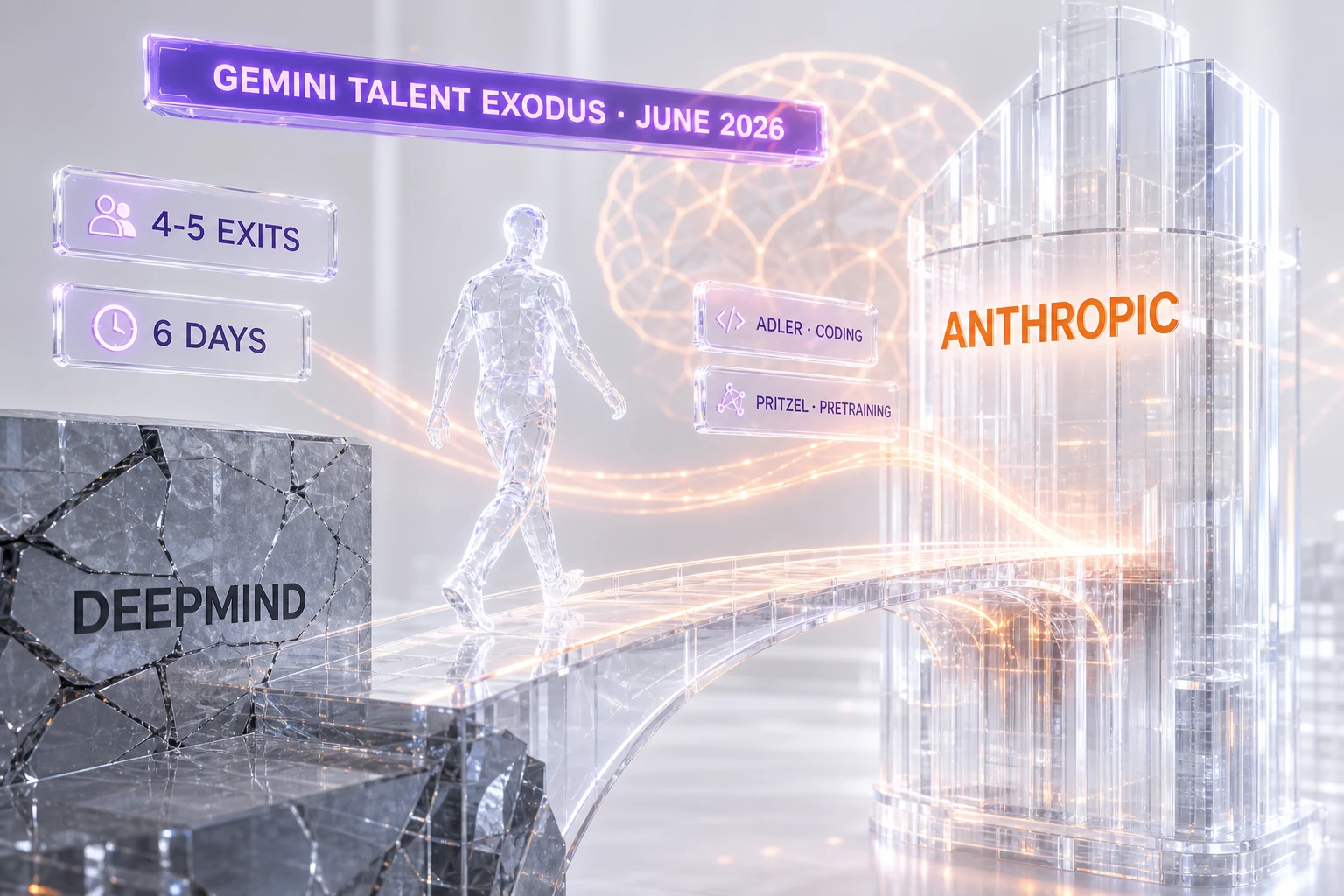
Two more Google researchers viewed internally as key contributors to Gemini — Jonas Adler and Alexander Pritzel — are reportedly set to leave for Anthropic, the maker of Claude. Bloomberg broke the story on June 24, 2026. If the moves hold, that is four senior AI departures from Google in roughly six days, and the second pair to head for Anthropic in a single week. Adler worked on Google's AI coding efforts; Pritzel worked on pretraining. Both also contributed to DeepMind's AlphaFold research.
What Happened
According to a Bloomberg report published June 24, 2026, Jonas Adler and Alexander Pritzel are planning to leave Google for Anthropic. Both are described as key contributors to Gemini, Google's flagship model family. Adler focused on the company's AI coding effort — the work that turns a general model into a capable software engineer — while Pritzel worked on pretraining, the foundational stage in which a model learns from vast volumes of data before any fine-tuning. The two also contributed to Google DeepMind's AlphaFold research, the protein-structure breakthrough that earned a 2024 Nobel Prize.
One framing note matters here: as of this writing, this is a reported move, not a confirmed, on-the-record announcement from Adler or Pritzel themselves. The reporting is sourced to people familiar with the matter rather than a Google statement or a personal post. We are treating it as credible but unconfirmed, and we will update this article if either researcher or Google goes on the record.
What makes the story bigger than two individual resignations is the cadence. This is not an isolated exit — it is the latest in a cluster, and the people leaving sit close to the core of how Gemini gets built.
Six Days, Four Senior Exits
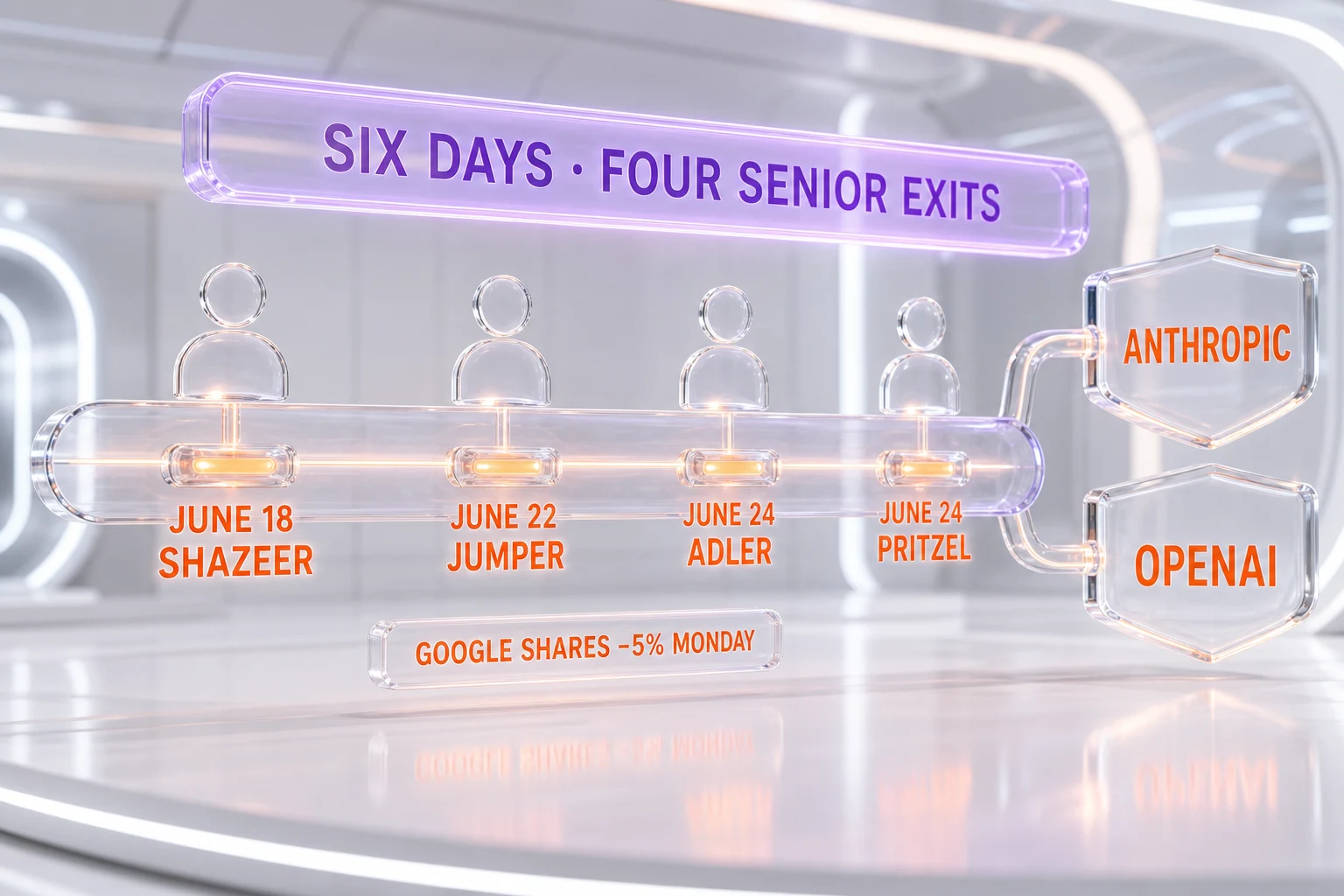
Line the departures up and the pattern is hard to miss:
- June 18 — Noam Shazeer to OpenAI. A co-author of the foundational "Attention Is All You Need" paper and a co-lead on Gemini, Shazeer announced his move on X. Google had brought him back roughly two years earlier through a reported $2.7 billion licensing arrangement around Character.ai, the startup he co-founded after first leaving Google. We covered the significance of that exit in detail in why Noam Shazeer leaving Google for OpenAI is a bigger deal than a normal exec move.
- June 22 — John Jumper to Anthropic. The 2024 Nobel laureate behind AlphaFold left Google DeepMind for Anthropic, a signal that the scientific opportunity elsewhere now looks at least as compelling as staying. We unpacked what that means for the AI-for-science talent war in a Nobel laureate just left DeepMind for Anthropic.
- June 24 — Adler and Pritzel to Anthropic. The two Gemini contributors reported today, the second pair to head for the Claude maker inside a week.
That is four high-profile names — and a fifth if you count each of today's researchers separately — moving to direct competitors in less than a week. Bloomberg reported that news of the departures contributed to Alphabet shares falling more than 5% on Monday, a reminder that the market now reads frontier-AI staffing as a material signal, not gossip.
There is also a structural footnote worth flagging without overstating it: Bloomberg reported that computing power dedicated to one of Shazeer's projects had been reassigned to a London-based DeepMind team, a move framed internally as an attempt to streamline pretraining work. Whether that detail is a cause or a coincidence, it speaks to the friction large organizations create around their most senior people.
Why It Matters
Pretraining and coding are not peripheral specialties. Pretraining is where a model's raw capability is set; it is expensive, slow, and dependent on a small number of people who actually know how to make a frontier run converge. Coding, meanwhile, has become the single most commercially important application of large models in 2026 — it is where Anthropic's Claude and Google's Gemini compete most directly for developers. Losing one person who shapes the foundation and another who shapes the flagship application, in the same week, to the same rival, is a pointed loss.
For Anthropic, the logic is straightforward. The company is building out the team behind Claude, and hiring people who have already shipped a competing frontier model compresses years of institutional learning into a signing. Pairing Adler and Pritzel's pretraining-and-coding expertise with Jumper's scientific pedigree suggests Anthropic is staffing for both the next model generation and a serious AI-for-science push.
For Google, the question is no longer whether it can ship a strong model — Gemini is genuinely competitive — but whether it can hold the bench depth that frontier research demands when two well-capitalized startups are actively recruiting its most senior people. Fortune went as far as to ask whether DeepMind can remain at the forefront of AI development at all. We think that framing is sharp but premature — DeepMind retains enormous talent and compute — yet the direction of travel is real.
Why Now: Two Competing Explanations
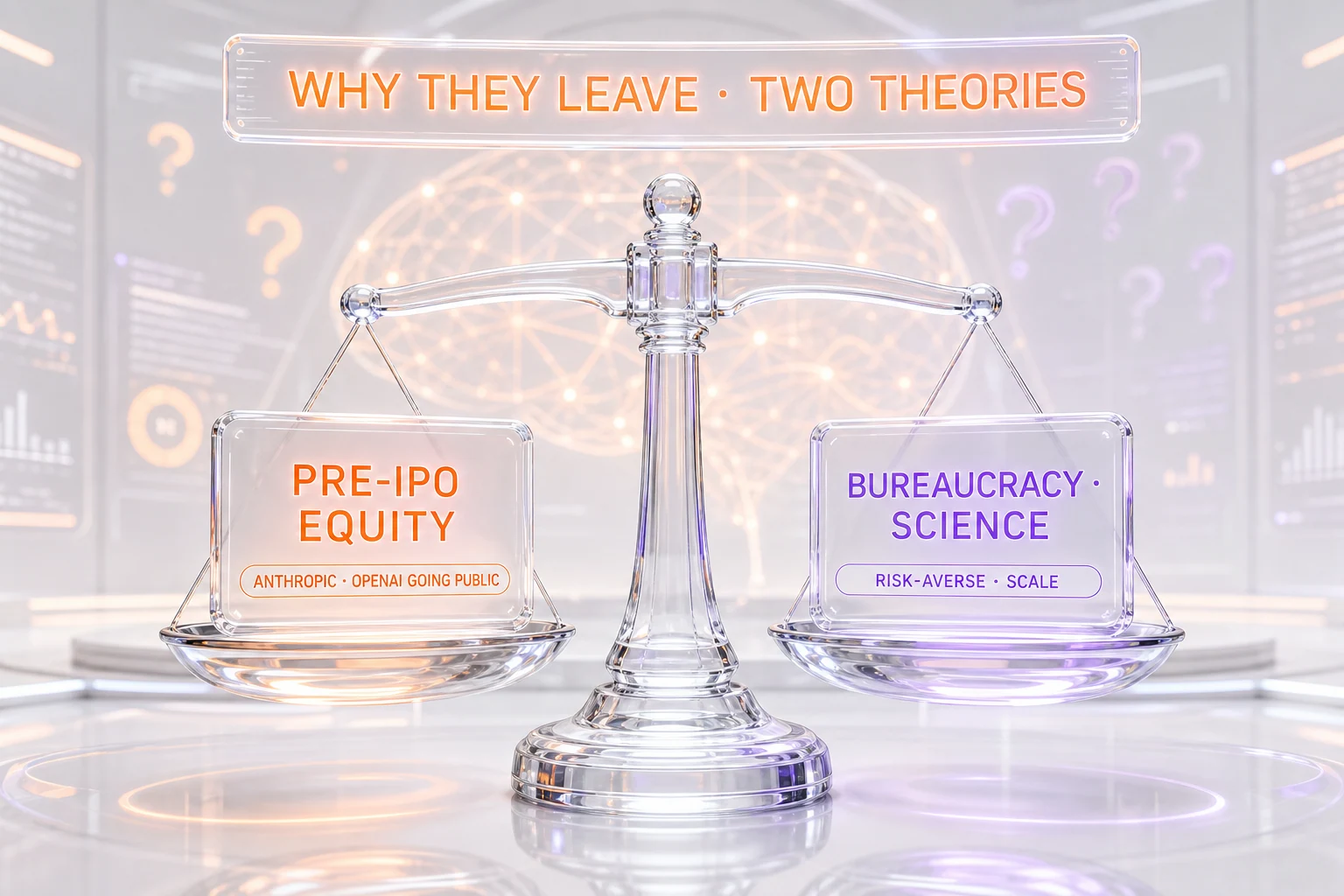
The most-cited explanation is money, specifically pre-IPO money. Both Anthropic and OpenAI are widely expected to go public in the coming months. Joining either before a listing offers the kind of equity upside that an established, roughly $2 trillion company like Alphabet structurally cannot match — there is simply no pre-IPO pop to hand out when you have been public for two decades. On this read, the exodus is a rational response to a once-in-a-cycle window.
But that explanation has a weak spot, and it is worth being honest about it. Several of these researchers were already extremely wealthy. Shazeer is reported to have made hundreds of millions from the Character.ai deal; Jumper holds a Nobel Prize. Writing in Fortune, Jeremy Kahn argued that for people at that level, "money seems an unlikely explanation," pointing instead to structural issues — an organization he described as burdened by its size, bureaucratic, and highly risk-averse. On this read, the pull is partly financial but mostly about autonomy, speed, and the chance to do the most ambitious work without committee overhead.
The honest answer is that both forces are probably operating at once, and they are not mutually exclusive. Pre-IPO equity lowers the cost of leaving; bureaucracy raises the cost of staying. When both move in the same direction for the same handful of people in the same week, you get a cluster like this one. We would caution against reducing it to a single tidy narrative — the reporting supports the equity angle, but the most senior names in the group are exactly the people for whom the structural argument lands hardest.
Our Take
Our read: this is a confidence story as much as a compensation story. Frontier AI is a small world, and senior researchers move toward where they believe the next breakthrough — and the most leverage over it — will happen. Four to five of them deciding that place is Anthropic or OpenAI rather than Google, inside a single week, is a signal the rest of the industry will read closely, regardless of how any individual contract shakes out.
It does not mean Gemini is in trouble. Models are built by large teams, infrastructure, and data pipelines that do not walk out the door with two researchers, and Google still has one of the deepest AI rosters on earth. If you are choosing a model today, the practical comparison still comes down to capability and price — see our coverage of Claude and Gemini 3.1 Pro — not last week's org chart. What it does mean is that the talent market has become a leading indicator of the frontier race, and right now that indicator is pointing away from Google.
What's Next
Three things to watch. First, confirmation: whether Adler, Pritzel, or Google go on the record, and whether either researcher's exact role at Anthropic is disclosed. Second, the IPO timing: if Anthropic or OpenAI files, the pre-equity recruiting window narrows fast, and the pace of poaching may either spike before the deadline or cool after it. Third, Google's response — counter-offers, reorganizations, or a public reaffirmation of DeepMind's roadmap would all tell us how seriously leadership is treating the drain. We will update this article as the picture firms up.
Frequently Asked Questions
Who are Jonas Adler and Alexander Pritzel?
They are two Google AI researchers viewed internally as key contributors to Gemini. According to Bloomberg's June 24, 2026 report, Adler worked on Google's AI coding efforts and Pritzel worked on pretraining — the stage where a model learns from large volumes of data. Both also contributed to Google DeepMind's AlphaFold research alongside Nobel laureate John Jumper.
Where are Adler and Pritzel going?
They are reportedly leaving Google for Anthropic, the company behind Claude. As of this writing it is a reported move sourced to people familiar with the matter, not a confirmed on-the-record announcement from the researchers or from Google.
How many senior researchers has Google lost in June 2026?
Roughly four to five senior names in about six days. Noam Shazeer announced a move to OpenAI on June 18, John Jumper left for Anthropic around June 22, and Adler and Pritzel were reported to be Anthropic-bound on June 24. The Adler and Pritzel pair is the second to head for Anthropic inside a single week.
Why are these researchers leaving Google?
There are two leading explanations. One is pre-IPO equity: both Anthropic and OpenAI are expected to go public soon, offering upside a roughly $2 trillion company like Alphabet cannot match. The other, argued in Fortune, is structural — that for already-wealthy researchers "money seems an unlikely explanation," and the real pull is escaping a large, bureaucratic, risk-averse organization. Both forces are likely at play at once.
Did the departures affect Google's stock?
Bloomberg reported that news of the departures contributed to Alphabet shares falling more than 5% on Monday. We are citing the reported figure; it reflects the market reading frontier-AI staffing as a material signal rather than routine turnover.
Does this mean Gemini is falling behind?
Not on its own. Gemini remains genuinely competitive, and frontier models are built by large teams, infrastructure, and data pipelines that do not leave with two researchers. The departures are better read as a leading indicator of confidence in the talent market than as evidence of a model regression. For a current capability-and-price comparison, look at the individual model pages rather than the org chart.