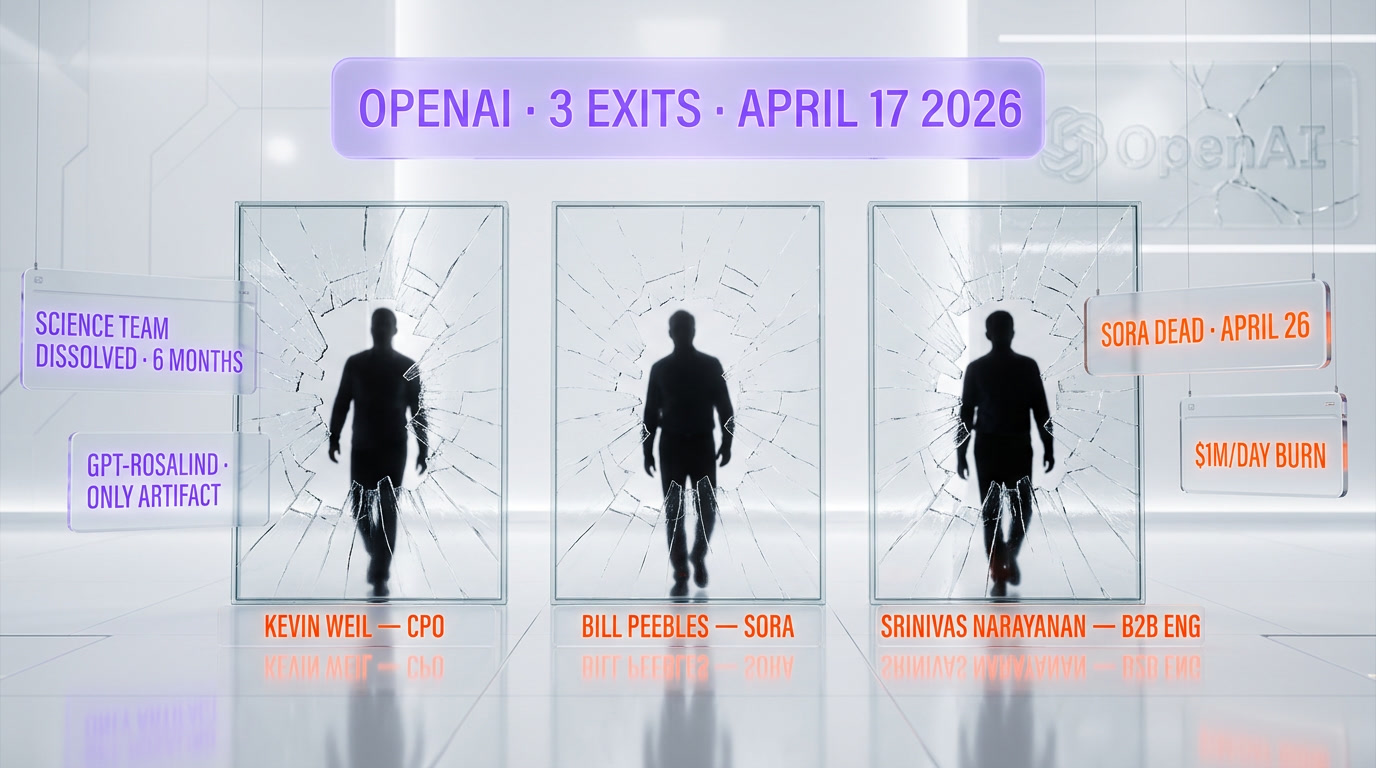
On Friday April 17, 2026, three senior OpenAI leaders announced they were leaving the company on the same day: Kevin Weil (former Chief Product Officer, then Head of OpenAI for Science), Bill Peebles (creator of Sora), and Srinivas Narayanan (head of B2B Applications engineering). The triple exit landed 24 hours after Weil's team shipped GPT-Rosalind, three weeks after OpenAI announced on March 24 that Sora would be shut down (app and web closing April 26, 2026; API closing September 24, 2026) while burning an estimated $1 million per day in compute at peak, and six months after OpenAI for Science was launched in October 2025. We have been running GPT, Claude and Gemini daily for 14 months across our editorial pipeline, and this is the cleanest signal yet that OpenAI's consumer-moonshot era is dead.
One day, three exits — what actually happened on April 17
This was not a slow leak. It was a same-day announcement from three of the most visible product and research leaders at OpenAI. Bloomberg broke the departures of Weil and Peebles on the afternoon of April 17, 2026. TechCrunch and Benzinga added Narayanan to the list within hours. Each of the three posted their own note on X.
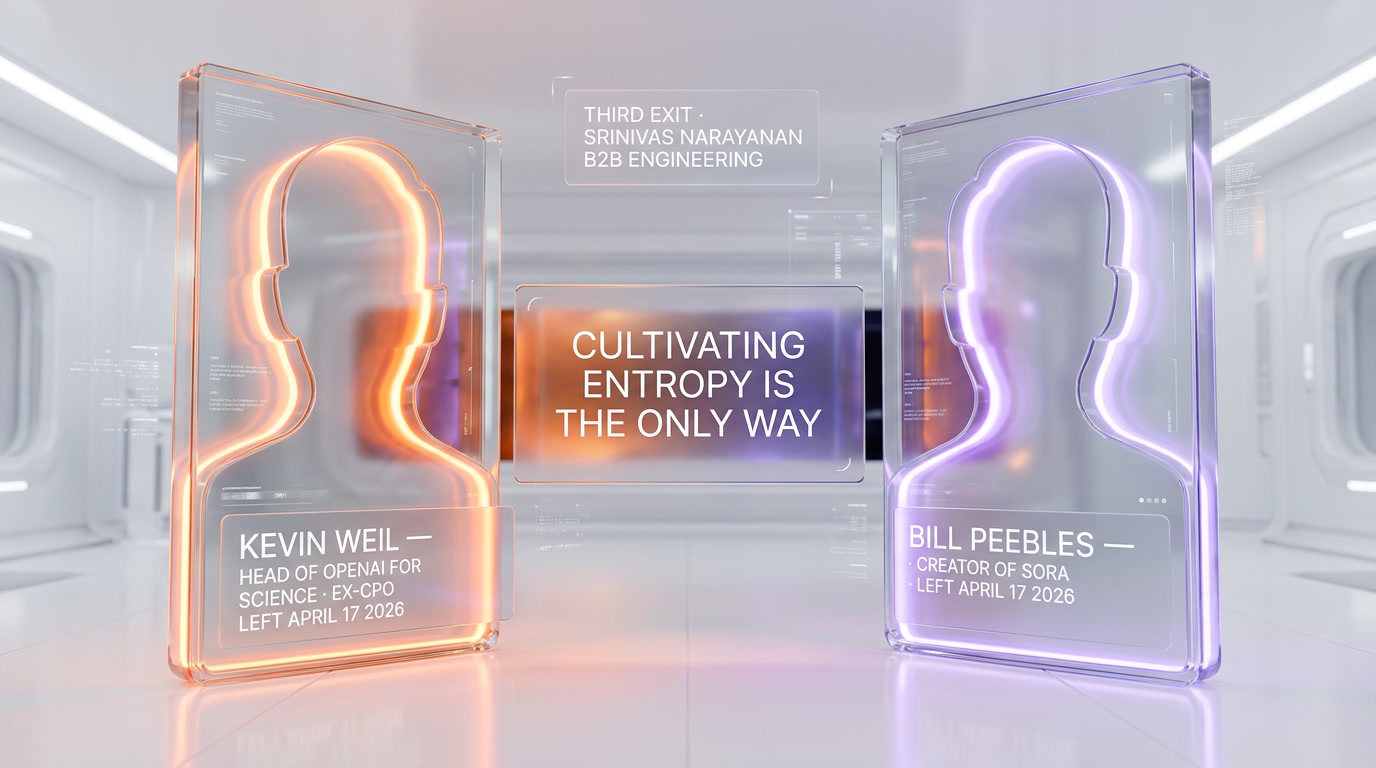
Kevin Weil — from CPO to Head of Science to out
Weil joined OpenAI in June 2024 as Chief Product Officer, poached from Instagram and Twitter (where he had run product for more than a decade). In October 2025, in a move that felt at the time like a sideways promotion, he handed the CPO job to the product leadership bench and took over a new unit called OpenAI for Science. The pitch: use frontier reasoning models to accelerate scientific discovery, starting with life sciences.
Six months and one scandal later, he is gone. In his farewell note on X, Weil wrote: “It's been a mind-expanding two years, from Chief Product Officer to joining the research team and starting OpenAI for Science.” He did not announce where he is going next. Our read: he is either building his own AI-for-science lab or joining one of the new vertical AI startups that has been quietly raising at $200 million plus valuations in the past ninety days.
Bill Peebles — Sora's creator, gone three weeks after the shutdown call
Bill Peebles led Sora from a research paper (Diffusion Transformers, 2023) to the product that defined AI video for eighteen months. He announced his exit on X with a note that landed very differently from Weil's: “Cultivating entropy is the only way for a research lab to thrive long-term.” Read that line twice. That is the politest possible way for a founder-researcher to tell you he thinks his former employer has become too disciplined, too enterprise, too boring to do the work he wants to do.
Peebles also said Sora had ignited “a huge amount of investment in video across the industry” and that the kind of research that produced it requires “space away from the company's mainline roadmap.” Translation: Sora only happened because nobody at the top was watching the compute bill. That era is over.
Srinivas Narayanan — three years running B2B Applications engineering
Narayanan ran OpenAI's B2B Applications engineering team for three years — the unit that shipped ChatGPT Enterprise, ChatGPT Team, and the admin console that Fortune 500 buyers actually touch. His stated reason for leaving was “time with family.” That is almost always code for “I have another offer and I need a clean exit,” but in his case we have no reason to doubt it: Narayanan has been public for years about wanting to slow down. The timing, though, is devastating — losing the enterprise engineering lead the same day the product chief and the flagship research lead walk out is not a coincidence anyone at OpenAI wanted.
Sora — the first high-profile consumer AI product to be killed by its own economics
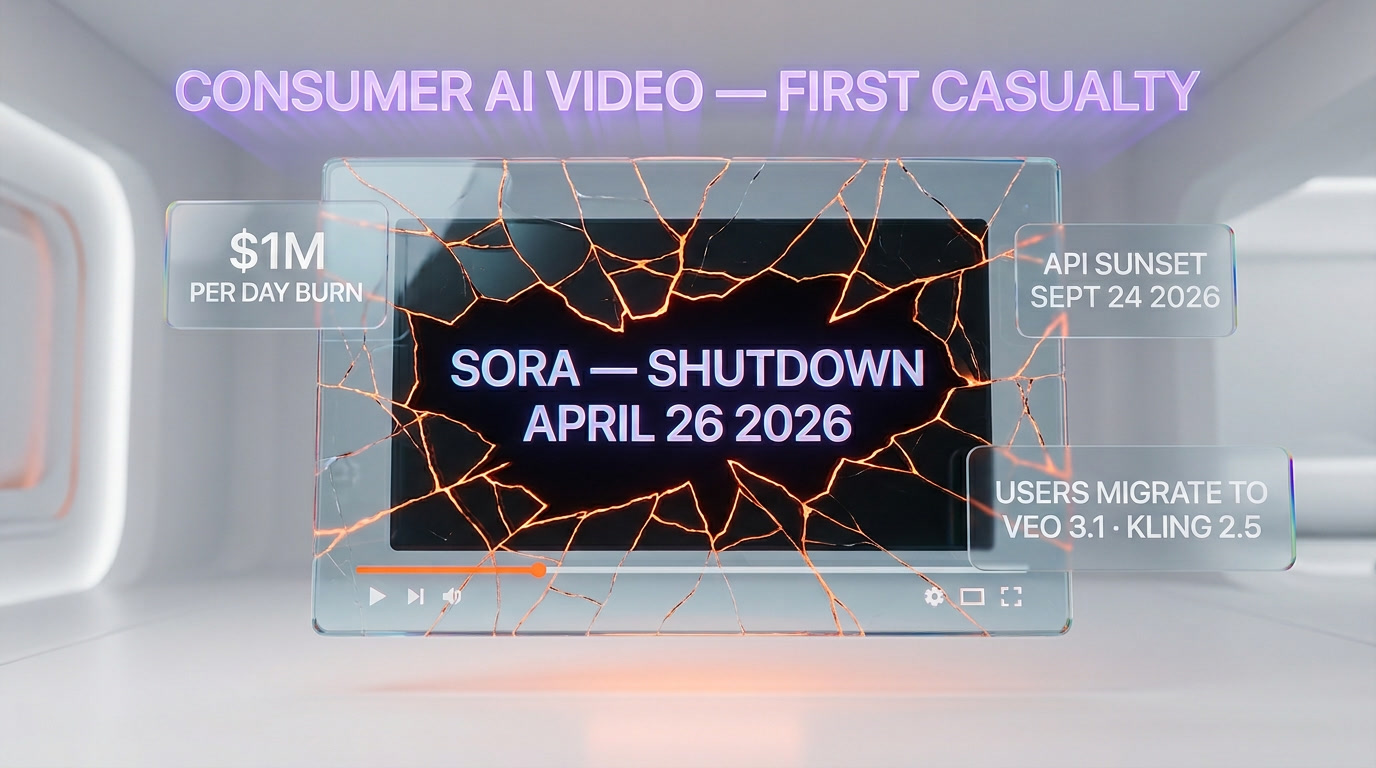
The Sora shutdown is not a side note. It is the story. On March 24, 2026 OpenAI announced a two-stage sunset: the Sora web and app experiences would be discontinued on April 26, 2026, and the Sora API would follow on September 24, 2026. OpenAI did not disclose revenue. External reporting pegged the economics at roughly $1 million per day in inference cost against subscription revenue that never caught up. One widely circulated estimate put peak-burn at $15 million per day against $2.1 million in lifetime revenue. We have not independently verified the $15 million figure; the $1 million per day number is referenced by multiple outlets covering the shutdown, including TechCrunch and Bloomberg.
Why Sora died — and why it was never going to survive
Sora had three structural problems. First, video generation inference cost is one to two orders of magnitude higher per second of output than text. Second, OpenAI priced Sora on a credit model that most consumers found both expensive and confusing — a fatal combination for a mass-market product. Third, Google's Veo 3.1 (and Veo 3.1 Lite, released April 1, 2026) and Kuaishou's Kling 2.5 closed the quality gap in under eighteen months while running at better unit economics.
OpenAI's own framing is that Sora “will stick around as a research project focused on world models” with a long-term goal of “automating the physical economy.” Read: the consumer app is dead, the research team is being reassigned, and the only survival path is a multi-year bet on world-model robotics that will not generate revenue this decade.
Where Sora users are going — Veo 3.1, Kling 2.5, and Runway Gen-4
Two weeks before the announcement, Google launched Veo 3.1 and Veo 3.1 Lite with better temporal coherence, fewer physics glitches, and pricing that undercuts the old Sora tiers (we broke down all three Google tiers in our Veo 3.1 Lite vs Fast vs Full comparison). Kling 2.5 (Kuaishou) shipped in early 2026 with strong Chinese-market traction and improving English-prompt performance. Runway Gen-4 remains the creative-pro favorite. OpenAI is, according to multiple reports, “actively assisting users in migrating their prompt libraries” to Veo 3.1 and Kling 2.5 ahead of the September 24 API cutoff. That is an unusually honest migration path from a company that usually tells customers to wait for the next version.
OpenAI for Science — launched October 2025, dissolved April 2026
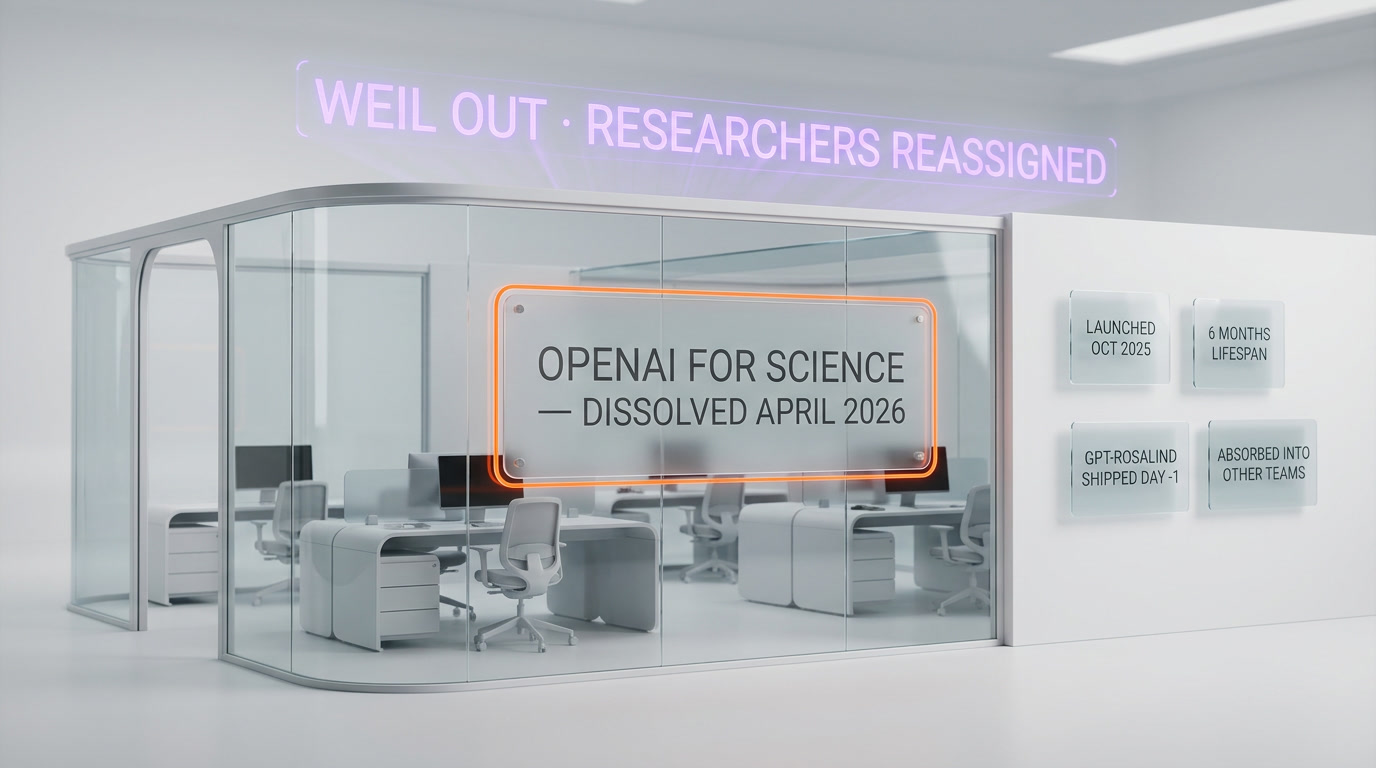
OpenAI for Science was announced in October 2025 with Weil as its founding lead and a public mission to build specialized reasoning models for scientific research — drug discovery, materials, math. In his April 17 note, Weil confirmed the unit is being “absorbed into other research teams.” That is a dissolution, not a restructure. The logo is gone from the org chart.
GPT-Rosalind — shipped 24 hours before the team was dissolved
One day before the leadership exit, OpenAI shipped GPT-Rosalind, a limited-access frontier reasoning model for life sciences, named after chemist Rosalind Franklin. The model is available to Amgen, Moderna, the Allen Institute, and Thermo Fisher Scientific — all existing OpenAI enterprise customers. The research was led by Weil's team and represents the only meaningful shipped artifact of OpenAI for Science's six-month existence. The optics — ship the model Thursday, lose the team lead Friday — are not flattering.
The Erdős problems scandal — what broke the team’s credibility
In late 2025, Weil posted on X that GPT-5 had “solved 10 previously unsolved Erdős problems.” The post went viral. Within 48 hours, the mathematician who runs erdosproblems.com — the authoritative tracker of open Erdős conjectures — publicly corrected the claim: the model had retrieved, not solved, problems that were already in the literature. Weil deleted the tweet. The team never fully recovered from the credibility hit. You do not need to be inside OpenAI to read what happened next: a flagship research unit, six months old, loses its external credibility on its first big public claim, and six months after that its leader is out and the team is reassigned.
The “side quest” era is officially over at OpenAI
Sam Altman used the phrase “side quests” in an internal memo in late 2025 that effectively rebranded everything that was not the main ChatGPT-enterprise-robotics axis as optional. Sora was a side quest. OpenAI for Science was a side quest. The Jony Ive hardware collaboration is still, formally, not a side quest — but it is the next thing to watch.
What stays — enterprise, robotics, the superapp
OpenAI's surviving priorities, per multiple reports over the past ninety days:
- ChatGPT Enterprise and ChatGPT Business. Revenue-positive, growing, strategic.
- “Project Spud” — a desktop “superapp” rolling ChatGPT, Codex, the new browsing agent and the coding agent into one package. Internal target: late 2026.
- Robotics and world models. The salvaged path for the Sora team’s research — long horizon, not a product in 2026.
- The Pentagon contract. Announced earlier in 2026, now a core enterprise pillar alongside Anduril and Palantir integrations.
- The IPO runway. Prediction markets now list OpenAI as the second most likely 2026 to 2027 IPO after SpaceX.
What goes — consumer moonshots
Everything that does not clearly feed enterprise ARR or the AGI narrative is on the chopping block. Sora is the public example. OpenAI for Science was the quiet one. The pattern is clear. If you are building a consumer AI product that depends on OpenAI's API, assume the goalposts are moving toward enterprise pricing and enterprise terms.
Anthropic captures the narrative — our take after 14 months in the trenches
We have been publishing about the AI lab horse race since early 2025. The shape of 2026 is now clear: Anthropic is capturing the enterprise-and-builder narrative that OpenAI used to own. The numbers support the vibe:
- Anthropic's revenue trajectory puts it ahead of OpenAI on annualized enterprise revenue per employee for the first time (see our coverage of the Anthropic $800 billion IPO talk).
- Claude Opus 4.7 (released April 16, 2026, the day before the OpenAI exits) shipped with Routines, Auto Mode, and Task Budgets — features aimed squarely at the “cloud employee” use case that OpenAI said it would dominate.
- Claude Code has eaten developer mindshare. In our editorial pipeline, 14 months of daily use, Claude is now the default coder. ChatGPT is the default summarizer.
Our take: this is not a sudden collapse of OpenAI. OpenAI is a $300 billion-plus entity with the most famous product in consumer AI and the largest enterprise sales motion in the category. But the cultural center of gravity has shifted. The researchers who used to ship consumer moonshots at OpenAI are leaving. Peebles' “cultivating entropy” line is the tell. When your best people describe the company they are leaving as too orderly to do great research, you have a problem that capital cannot buy its way out of.
Sam Altman’s personal security backdrop — the context nobody will say out loud
The exits landed three days after the April 14, 2026 armed arrests at Sam Altman’s San Francisco residence. Two Gen Z men aged 23 and 25 were arrested after firing shots near his home. A manifesto referencing “extinction of humanity” was recovered. This was the second escalation in a month — a 20-year-old Texan had thrown a Molotov cocktail at the same address in late March. We are not drawing a direct line between the attacks and the April 17 departures. What we will say: OpenAI’s internal mood in the four weeks before April 17 was, by every account available to us, the worst it has been since the November 2023 board coup. The exits are not a reaction to the attacks. They are a reaction to everything that made the attacks feel plausible.
Who wins from the OpenAI shake-up
Anthropic — captures the narrative and the hiring funnel
Anthropic now has the strongest combination of product momentum, safety brand, and enterprise credibility of any lab. Every senior researcher we have spoken to in the last thirty days ranked Anthropic as either first or co-first preference for their next role. The IPO talk at $800 billion valuation is not priced in the fundamentals yet. It is a narrative tax.
Google DeepMind — Veo 3.1 wins the video category OpenAI just vacated
Sora’s shutdown hands Google the consumer AI video category by default. Veo 3.1 was already closing the quality gap. Now it has no serious American rival in consumer-priced text-to-video.
Runway and Kling — the creative-pro and APAC wins
Runway Gen-4 is still the creative-professional favorite for high-end video workflows. Kling 2.5 dominates APAC. Both benefit from the Sora consumer exodus — Runway on the pro side, Kling on the price side.
New AI labs — a hiring opening the size of a crater
Three senior OpenAI people on the market in a single day is rare. One, two, three at once creates an unusually liquid moment for new labs: Thinking Machines Lab (Mira Murati), Safe Superintelligence (Ilya Sutskever), Perplexity’s research team, Cohere’s Toronto office. Expect announcements within ninety days.
What AI builders should do this week
- If you ship on the Sora API — migrate now, not September. Veo 3.1 is the default replacement. Runway Gen-4 if you care about fidelity. Kling 2.5 for Asia. Do not wait for the cutoff.
- If your product depends on OpenAI's consumer experiments — assume deprecation risk on anything that is not ChatGPT core. DALL-E, Sora, Voice Mode extras, OpenAI for Science endpoints — all are legible as “side quests” to the current leadership.
- If you are hiring AI engineers — this is the best window in two years. The senior researchers who were locked into OpenAI by equity and mission are, for the first time, on the market in numbers.
- If you are betting on a lab — Anthropic has the momentum, Google has the capital-and-distribution trump, OpenAI has the brand and the enterprise book. The smart portfolio is two of three, not one.
Our verdict
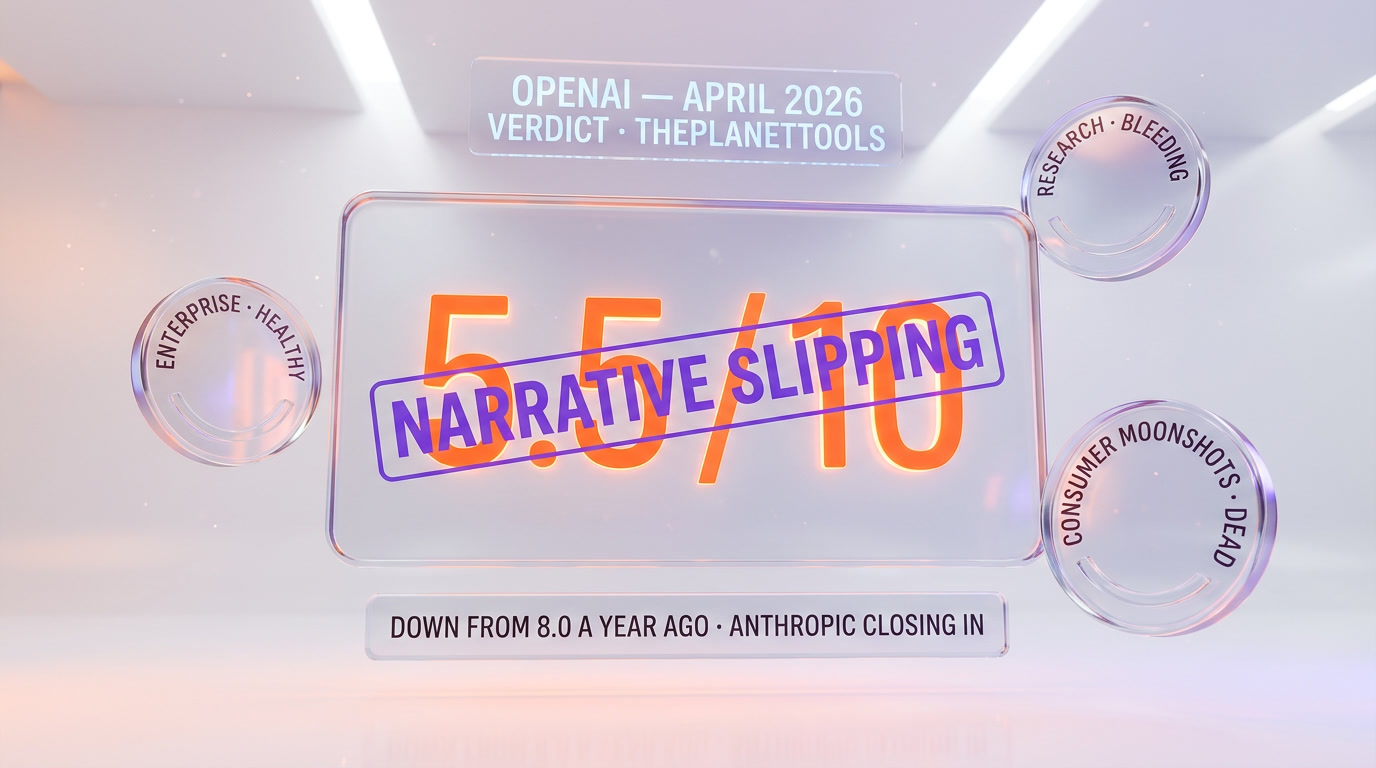
OpenAI is not dying. The enterprise revenue is real, ChatGPT remains the consumer default, the Pentagon contract is a durable tailwind, and the IPO will price at a number that embarrasses every sceptic. But the cultural momentum has moved. When your product chief, your flagship video researcher, and your B2B engineering head all walk out on the same afternoon, three weeks after you kill the most-talked-about consumer AI product of 2024 to 2025, the story is not about the org chart. The story is that the people who build the next thing do not want to build it at your company anymore.
Our score on OpenAI as a place to build in April 2026: 5.5 out of 10. Down from 8.0 a year ago. Half a point for each of the three executives who walked. Half a point for Sora. Half a point for OpenAI for Science. Half a point for the gap between the AGI rhetoric and the consumer product shutdown. What recovers the score: a credible new research leader, a new consumer moonshot that actually ships, a clean messaging reset. Any two of the three, and OpenAI is back to 7.5 by Q4 2026. None of the three, and 2026 is the year Anthropic catches up on revenue and OpenAI becomes a very large enterprise AI company. That is a fine business. It is not the story OpenAI has been selling.
Related reading: our coverage of the April 14 attacks on Sam Altman’s home, Anthropic’s $800 billion IPO revenue story, and our deep reviews of ChatGPT and Claude.
Frequently asked questions
Who left OpenAI on April 17, 2026?
Three senior leaders announced their departures on the same day: Kevin Weil (former Chief Product Officer and Head of OpenAI for Science), Bill Peebles (creator of Sora and lead of the Sora research team), and Srinivas Narayanan (head of B2B Applications engineering for roughly three years). Bloomberg broke the Weil and Peebles story; TechCrunch and Benzinga added Narayanan within hours.
When does Sora actually shut down?
OpenAI announced on March 24, 2026 that Sora would sunset in two stages. The Sora web and app experiences are discontinued on April 26, 2026. The Sora API is discontinued on September 24, 2026. Users must export their library before each cutoff. OpenAI is actively helping users migrate prompt libraries to Google Veo 3.1 and Kuaishou Kling 2.5.
Why is OpenAI killing Sora?
Three structural problems. First, video inference is one to two orders of magnitude more expensive per second than text, and Sora was reportedly burning roughly $1 million per day in compute at peak. Second, the credit-based pricing model never converted consumer users fast enough. Third, Google Veo 3.1 and Kling 2.5 closed the quality gap while offering better unit economics. OpenAI framed the shutdown as a refocus on “world models” research and robotics — a long-horizon bet that is not a 2026 product.
What was OpenAI for Science and why was it dissolved?
OpenAI for Science was a research unit announced in October 2025 and led by Kevin Weil, with a mission to build specialized reasoning models for drug discovery, materials science and mathematics. It was dissolved in April 2026, six months after launch — Weil confirmed on X that the team is being “absorbed into other research teams.” The unit shipped exactly one public artifact, GPT-Rosalind, 24 hours before Weil’s resignation.
What is GPT-Rosalind?
GPT-Rosalind is a limited-access frontier reasoning model for life sciences, named after the pioneering chemist Rosalind Franklin. It was released on April 16, 2026 — the day before Kevin Weil announced his departure. Access is limited to qualified enterprise customers including Amgen, Moderna, the Allen Institute, and Thermo Fisher Scientific. It is the only shipped artifact from the six-month lifespan of OpenAI for Science.
Where are Sora users supposed to go now?
Three defaults. Google Veo 3.1 and Veo 3.1 Lite (released April 1, 2026) have closed the quality gap and offer better unit economics. Kuaishou Kling 2.5 is strong in APAC and improving in English prompts. Runway Gen-4 remains the creative-professional favorite for high-end workflows. OpenAI itself is helping users migrate prompt libraries to Veo 3.1 and Kling 2.5 ahead of the September 24 API cutoff.
Is Sam Altman leaving OpenAI too?
No. As of April 17, 2026 there is no public indication Sam Altman is stepping down. The April 17 departures are at the layer below the CEO — product chief, flagship research lead, B2B engineering lead. The backdrop is tense: Altman’s San Francisco residence was targeted in two separate attacks (a Molotov cocktail on March 24 and armed arrests on April 14) and internal morale is reportedly at its lowest since the November 2023 board crisis. But Altman himself is not exiting.
Is OpenAI losing to Anthropic now?
On narrative and hiring momentum, yes. On revenue and consumer install base, no. Anthropic’s annualized enterprise revenue per employee overtook OpenAI’s for the first time in early 2026, Claude Opus 4.7 shipped with Routines and Auto Mode on April 16 aimed directly at the “cloud employee” use case, and Claude Code has captured developer mindshare. OpenAI still has ChatGPT — the most-used consumer AI product in history — and a larger enterprise sales motion. The race is closer than it was, and the culture gap is now visible externally.
What is Sam Altman’s “side quests” memo?
In late 2025, Sam Altman used the phrase “side quests” in an internal communication that effectively rebranded anything outside the ChatGPT-enterprise-robotics axis as optional. Sora and OpenAI for Science were internally categorized as “side quests.” The phrase became external shorthand in 2026 reporting (TechCrunch, Bloomberg) for the strategic focus on enterprise AI and the upcoming “superapp” codename Project Spud.
What does Bill Peebles mean by “cultivating entropy”?
In his departure note on X, Peebles wrote that “cultivating entropy is the only way for a research lab to thrive long-term.” The line is a polite criticism: a great research lab needs disorder, exploration, and the freedom to build expensive things without immediate ROI. His implication is that OpenAI in April 2026 is too disciplined and too enterprise-focused for the kind of research that produced Sora in the first place. That framing echoes what senior researchers at Anthropic, DeepMind, and several new labs have been saying privately.
How much was Sora actually losing?
External reporting puts Sora at roughly $1 million per day in inference cost at peak, against subscription revenue that never caught up. One widely circulated estimate (Medium, tech-insider.org) quoted $15 million per day in peak compute against $2.1 million in lifetime revenue. We have not independently verified the $15 million figure. The $1 million per day number is referenced by multiple mainstream outlets including TechCrunch and Bloomberg in their April 17 coverage. Either way, the economics never worked at consumer price points.
Where can I read the primary sources?
Primary coverage: Bloomberg’s April 17, 2026 report on the Weil and Peebles departures; TechCrunch’s “side quests” framing published the same afternoon; Benzinga’s triple-exit breakdown covering Narayanan. OpenAI’s own help center article on Sora discontinuation (help.openai.com) has the official dates and data-export guidance. The Decoder, Axios and CFO Tech News covered the GPT-Rosalind release on April 16. For the Erdős problems scandal background: erdosproblems.com and the original X thread archive.