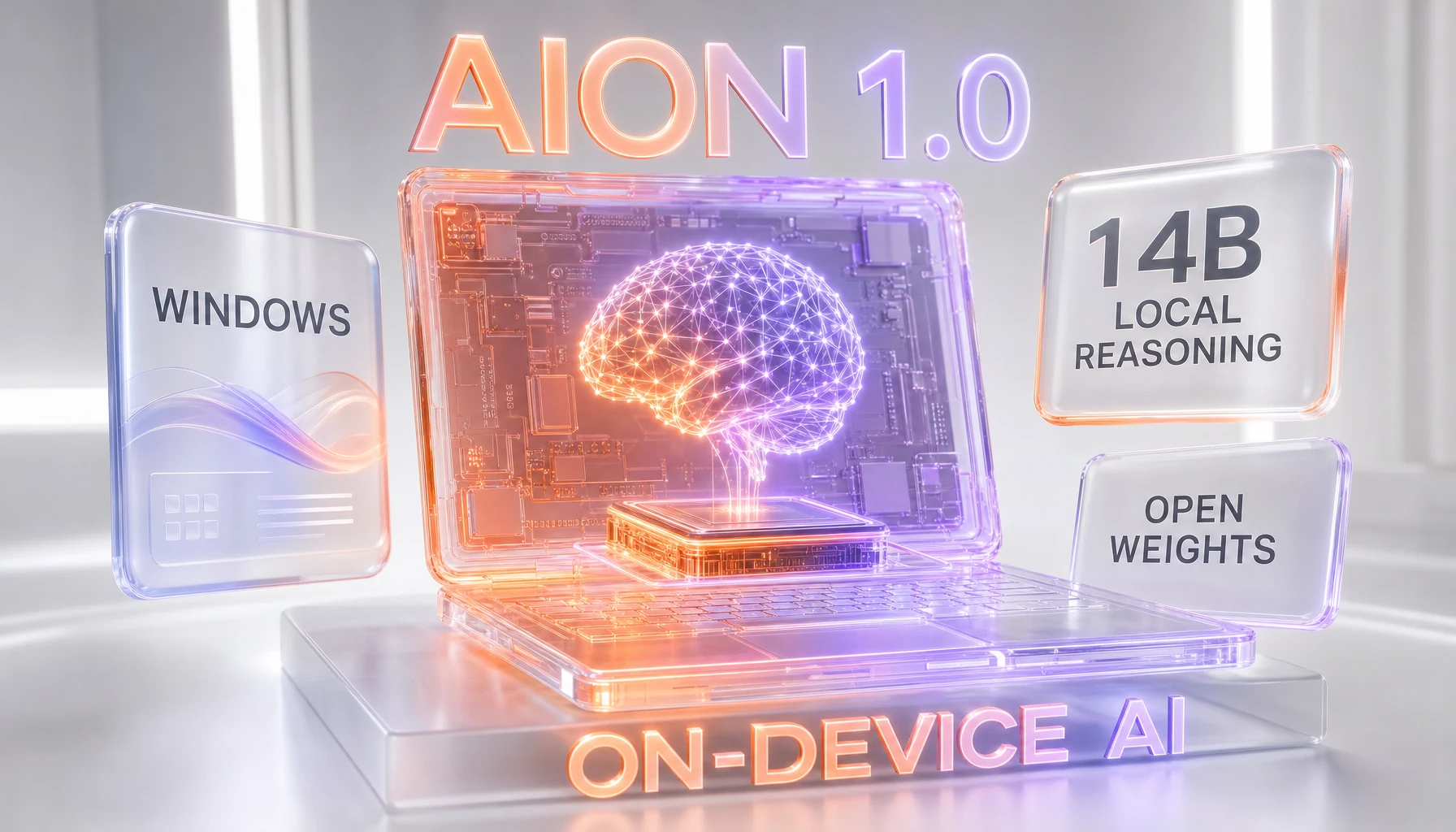
Aion 1.0 is Microsoft's new on-device AI model family for Windows, unveiled at Build 2026 on June 2, 2026. It has two members: Aion 1.0 Instruct, a small open-weights language model tuned for everyday tasks like summarization and rewriting, and Aion 1.0 Plan, a 14-billion-parameter reasoning model that runs agentic workflows — tool-calling, file management, and sub-agent orchestration — entirely on the local device with a 32K context window. Together they signal Microsoft's bet that the next wave of AI does not always need the cloud.
For the better part of three years, "AI on Windows" mostly meant a button that phoned a data center. Build 2026 reframed that story. In its official developer blog, Microsoft positioned Windows as "the trusted platform for development" and used the keynote to push intelligence down the stack — into the operating system itself, into local silicon, and into a tier of hardware designed to keep heavy AI work on your desk instead of in someone else's region. The centerpiece is Aion 1.0, and the most consequential single artifact is a reasoning model small enough to ship in-box yet capable enough to coordinate multi-step agentic tasks without a network round trip.
This is an analysis of what Microsoft actually announced — and, just as importantly, what it did not. There has been a lot of pre-keynote noise. We will separate the shipping reality from the speculation, then walk through why a 14B local reasoner, a tiered "unmetered intelligence" model, and a one-petaflop developer box add up to a coherent — and competitive — strategy.
What Aion 1.0 actually is
Aion 1.0 is a family, not a single model, and the distinction matters because the two members solve very different problems. Microsoft is not trying to put one giant model on your laptop. It is splitting the workload by difficulty and shipping the right-sized model for each rung.
Aion 1.0 Instruct: the everyday workhorse
Aion 1.0 Instruct is the new small language model (SLM) for Windows. Microsoft describes it as "smaller, faster and more efficient than our current Windows OS SLM" — meaning it replaces the on-device model already shipping inside Windows with something leaner. Its job is the high-frequency, low-glamour work that benefits from running instantly and privately: summarizing a document, rewriting a paragraph, detecting user intents, and powering accessibility features.
Two things make Instruct notable. First, it ships with open weights, and Microsoft committed to releasing it as open source on HuggingFace in July 2026. Second, the preview is available today inside the Microsoft Edge Insider channels, so developers can start probing it immediately rather than waiting for a general release. One caveat we will flag plainly: Microsoft has not published a parameter count for Aion 1.0 Instruct. Anyone quoting a specific number for Instruct is guessing — so we will not.
Aion 1.0 Plan: a 14B reasoner that runs locally
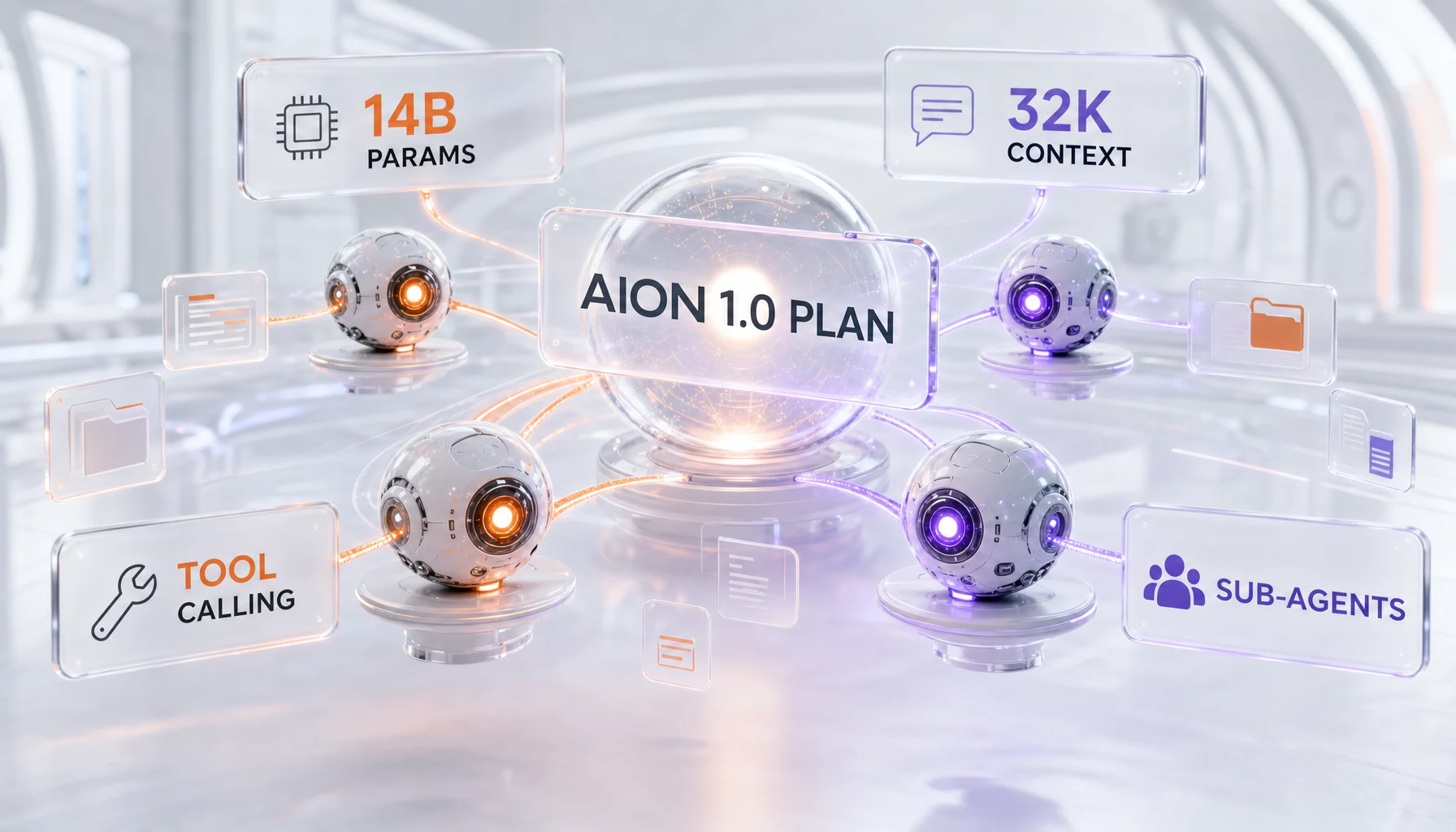
Aion 1.0 Plan is the announcement that should make competitors pay attention. It is a 14-billion-parameter model built for reasoning and tool-calling, with a 32K context window, and Microsoft's own framing of its capabilities is striking: it can "reason over user intent, invoke tools, manage files and orchestrate sub-agents." Read that list again. Those are the verbs of an agent, not a chatbot — and Microsoft intends them to execute on the local device.
Crucially, Aion 1.0 Plan is slated to ship in-box in Windows on compatible devices. It is not a download you go fetch from a marketplace; on supported hardware it will arrive as part of the operating system. The timing is a roadmap item, not a launch: Microsoft says it is coming "in the coming months," so Plan is a promise with a date attached rather than a thing you can run today. That is an honest distinction worth holding onto, because the gap between "announced" and "shipping" is where a lot of AI hype goes to die.
What this is not: clearing up the MAI-Thinking-1 confusion
Before going further, a correction that matters for anyone who followed the pre-Build rumor cycle. In the days before the keynote, speculation circulated that Microsoft would unveil a cloud reasoning model called MAI-Thinking-1. It did not. There is no official Microsoft AI post announcing such a model, and treating it as a Build 2026 announcement would be wrong.
The real reasoning model from this event is Aion 1.0 Plan, and the entire point of it is that it is on-device, not cloud. Conflating the two gets the story exactly backwards. Microsoft's headline reasoning news at Build 2026 is about pulling agentic reasoning down onto the PC — the opposite of routing it to a remote frontier model. Similarly, MAI-Image-2.5, which some coverage lumped in with Build, actually launched on May 26, 2026, ahead of the conference; it is not a Build announcement either. We covered that release in our look at MAI-Image-2.5 reaching No. 3 on the arena.
Why labor this point? Because the difference between "Microsoft shipped a cloud reasoner" and "Microsoft put a 14B reasoner inside Windows" is the difference between a routine catch-up move and a genuine platform play. Only one of those happened.
The strategy: "unmetered intelligence"
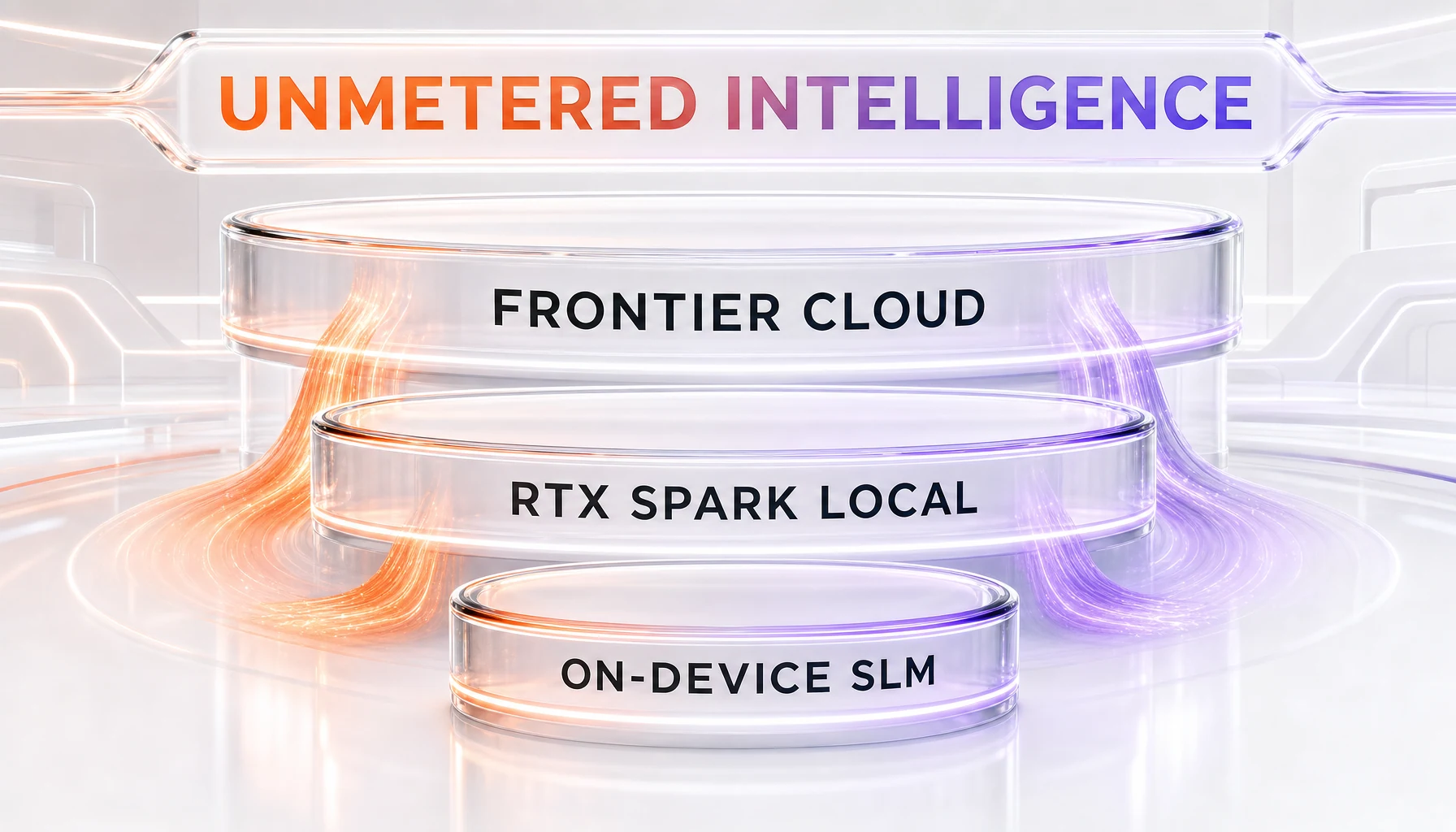
The phrase Satya Nadella used to tie the announcements together is "unmetered intelligence," and it is the most useful lens for understanding the whole keynote. The idea is a tiering of where AI work happens, matched to how hard the work is:
- Lightweight tasks run on-device via the Aion SLM — summaries, rewrites, intent detection, accessibility. Instant, private, free of any per-call cost.
- Mid-weight work runs on local high-performance silicon — the new RTX Spark-class hardware — keeping heavier inference on your own machine.
- Frontier reasoning runs in the cloud, where the largest models live and where the economics still favor centralized compute.
"Unmetered" is doing real work in that sentence. The implicit critique is of the token meter — the per-request, per-token billing that turns every AI feature into a cost center. By moving the high-frequency, low-difficulty tasks onto hardware the user already owns, Microsoft removes those tasks from the meter entirely. The cloud is not abandoned; it is reserved for the work that actually justifies its cost.
This is the same economic pressure we have been tracking from multiple angles. Microsoft itself has been candid that agent workloads can cost more than a human engineer at scale, a tension we explored in our piece on the token economics driving Microsoft's AI choices. On-device inference is one of the few levers that bends that curve without sacrificing capability — and Aion is Microsoft's most explicit move to pull it.
Why a local agent changes the calculus
The headline number — 14 billion parameters — is almost a distraction. What matters is the combination of size and role. A 14B model is large enough to reason competently yet small enough to run on consumer-grade hardware, and Microsoft is not positioning it as a better chatbot. It is positioning it as an orchestrator.
Consider what "orchestrate sub-agents" implies. An agentic workflow typically involves a planner that decomposes a goal, a set of tools or specialized models that execute steps, and a controller that manages state and files between them. If that planner-controller lives in the cloud, every step of a multi-step task incurs latency and cost, and your local files have to travel to a remote model to be useful. If the planner lives on-device — as Aion 1.0 Plan is designed to — the orchestration happens next to your data, your files, and your tools, with the cloud reserved only for the heaviest single steps.
That has three practical consequences. Privacy: sensitive files can be reasoned over without leaving the machine. Latency: the planning loop runs at local speed, not network speed. Cost: the orchestration overhead — which can be the bulk of an agentic task's token consumption — drops off the cloud bill. None of these are theoretical niceties; they are the exact friction points that have kept agentic AI from feeling reliable in production.
The quieter platform upgrades: Speech and expanded SLM acceleration
Aion grabbed the headlines, but two lower-profile platform changes may end up touching more developers day to day.
The first is the new Windows Speech Recognition API, a hardware-accelerated speech-to-text capability that supports both real-time and batch transcription on-device. It entered public preview this week. The honest constraint: it is English-only at launch, which limits its immediate reach but is a typical starting point for a platform API that will broaden later.
The second is a meaningful broadening of where Windows on-device AI can actually run. Until now, much of the inbox SLM acceleration assumed an NPU. Microsoft is extending the existing inbox SLM to run on GPUs, and it is adding Video Super Resolution and Speech Recognition to CPUs — capabilities that were previously NPU-only. In plain terms: more of the on-device AI stack now works on hardware millions of people already own, not just on the newest NPU-equipped machines. That dramatically expands the addressable base for on-device features, which is exactly what you want if your strategy depends on tasks living on the client.
The hardware: Surface RTX Spark Dev Box
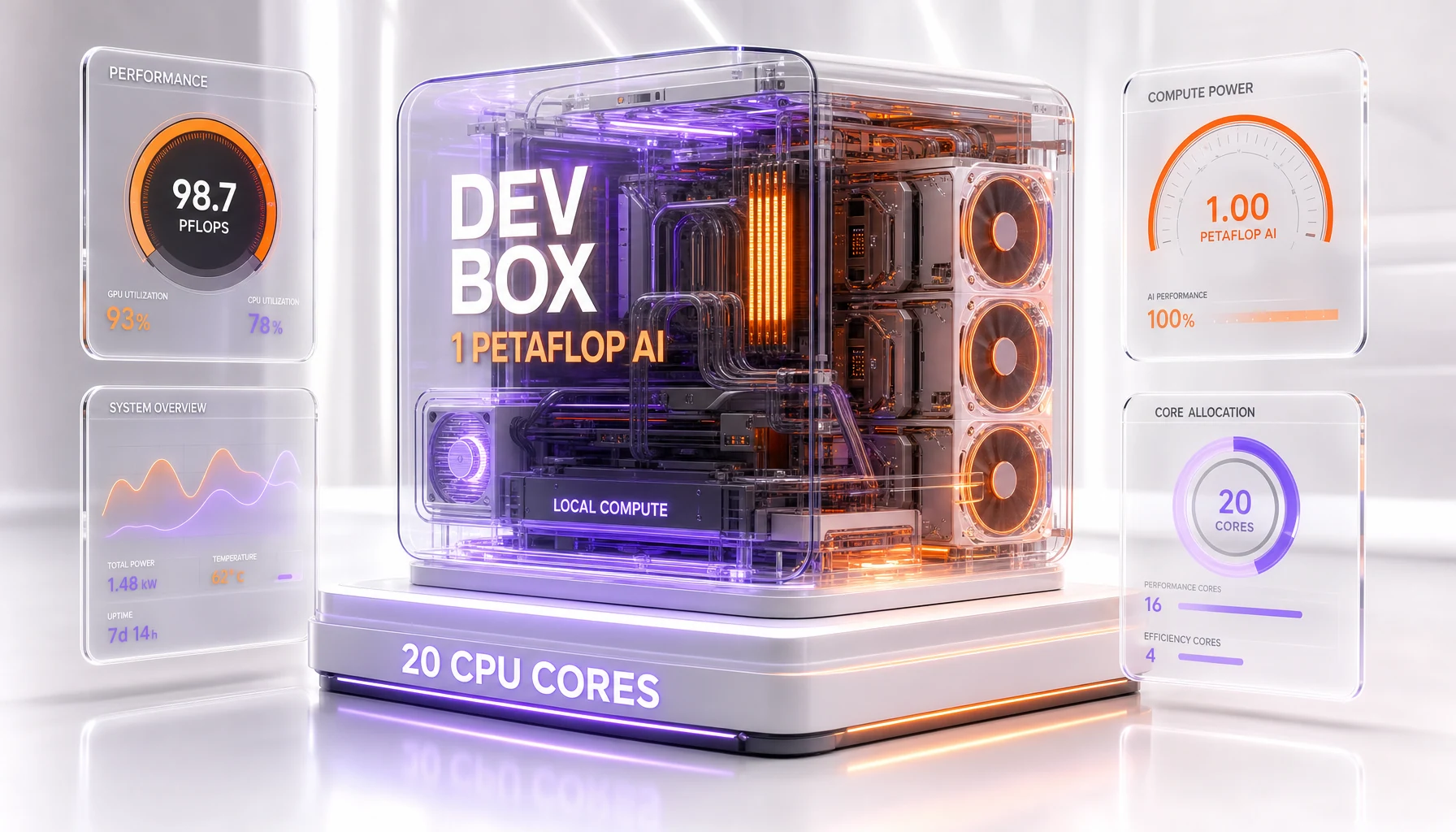
If Aion is the software argument for local AI, the Surface RTX Spark Dev Box is the hardware argument. Microsoft put numbers on it: up to 1 petaflop of AI performance, 20 CPU cores, and NVIDIA's RTX Spark silicon under the hood. It is the physical embodiment of the middle tier in the "unmetered intelligence" stack — the machine that handles mid-weight inference locally so it never reaches the cloud meter.
The RTX Spark name connects to NVIDIA's broader push into consumer Arm-class AI silicon, which we covered when NVIDIA unveiled RTX Spark at Computex 2026. A Dev Box built around it is a natural fit: developers building local-first AI applications need a reference machine with enough headroom to run mid-sized models and orchestrate agents without leaning on a data center.
One spec we will not repeat: rumors of a "Surface Laptop Ultra with 128GB Blackwell" circulated in pre-event summaries, but that claim does not trace to a primary Microsoft source, so we are leaving it out. The verified hardware story is the RTX Spark Dev Box, and that is enough on its own.
Developer tooling: Copilot CLI lands in Windows Terminal
Among the smaller but welcome announcements, GitHub Copilot CLI is coming to Windows Terminal, bringing AI assistance directly into the command line where many developers actually live. There is also a new /fleet feature for managing multiple agent sessions, mentioned in passing during the keynote. Neither is the headline, but both reinforce the theme: AI is moving from a separate app into the places developers already work. For teams already standardized on GitHub Copilot, the terminal integration removes one more context switch.
The open-weights angle and why it matters
Shipping Aion 1.0 Instruct with open weights — and committing to a HuggingFace open-source release in July 2026 — is a strategic choice as much as a technical one. Open weights let developers fine-tune, audit, and embed the model in their own products without a licensing negotiation. For a company that spent years tightly coupled to a single frontier partner, opening up a Windows-native model is a notable shift toward owning the stack on its own terms.
It also lines up with Microsoft's recent pattern of building in-house models to reduce dependence, a trajectory we analyzed when Microsoft launched its in-house MAI models. Aion extends that logic from the cloud down to the device: not just Microsoft's own frontier models, but Microsoft's own on-device models, shipping inside Microsoft's own operating system. Vertical integration, the Apple way — but with open weights as the differentiator.
Competitive context: the local-AI race is on
Microsoft is not the first to bet on on-device intelligence, and that is precisely why Build 2026 matters. The local-AI thesis has been building across the industry. Apple has been optimizing large models for its silicon — we covered how it runs 70B models on the M5 with MLX — and the same company's surprise hardware demand suggested that local AI is already reshaping how buyers think about cloud LLM pricing. Google, meanwhile, demonstrated genuinely tiny models running at the edge when it ran Gemma 3 270M on the Coralboard with no cloud.
What distinguishes Microsoft's move is the platform leverage. Apple controls its hardware; Google controls Android and a deep edge stack. But Windows sits on the broadest installed base of general-purpose computers on earth, and Microsoft is shipping the reasoning model in-box. If Aion 1.0 Plan lands as promised, agentic local AI becomes a default capability of the dominant desktop OS rather than a feature you opt into. That is a different order of distribution.
The honest caveats
It would be easy to over-read this. A few things temper the enthusiasm. Aion 1.0 Plan is a roadmap item — "in the coming months" — not a shipping product, and the history of AI keynotes is littered with on-device models that arrived later and smaller than promised. The Speech Recognition API is English-only at launch. "Compatible devices" is doing quiet work in the Plan announcement; a 14B model has real memory and compute requirements, and the in-box experience will depend heavily on which machines qualify. And the parameter count for Instruct remains unpublished, so the SLM half of the family is still partly a black box.
What would prove the strategy out? Three things: Aion 1.0 Plan actually shipping in-box on a meaningful range of hardware, the July open-source release of Instruct landing on schedule, and developers building real agentic apps that lean on local orchestration rather than treating it as a demo. Until then, the right posture is interested but unconvinced — which is exactly how a 14B local reasoner deserves to be received.
What it means for developers and buyers
For developers, the actionable takeaway is to start designing for a hybrid topology. The Aion 1.0 Instruct preview is live in the Edge Insider channels today, the open-source release is dated for July 2026, and the platform now lets on-device AI run across NPUs, GPUs, and CPUs. That means the cheapest, fastest, most private place to run a task is increasingly the user's own machine — and architecting an app to default to local with cloud fallback is no longer exotic.
For buyers and IT leaders, the message is subtler. On-device AI shifts cost from a recurring cloud bill to a one-time hardware purchase, and it changes the privacy conversation: data that never leaves the device is data you do not have to govern in transit. The Surface RTX Spark Dev Box is the high end of that argument, but the broader CPU and GPU acceleration means even existing fleets gain capability without new spend.
For the industry, Build 2026 is a marker. The center of gravity in AI has spent three years drifting toward bigger models in bigger data centers. Microsoft just planted a flag in the opposite direction — not as a retreat from the cloud, but as a rebalancing. Aion 1.0, and especially a 14B reasoning model that ships inside the world's most-used desktop OS, is the clearest statement yet that the local tier is not a consolation prize. It is strategy.
Frequently asked questions
What is Aion 1.0?
Aion 1.0 is Microsoft's new on-device AI model family for Windows, announced at Build 2026 on June 2, 2026. It includes Aion 1.0 Instruct, a small open-weights model for everyday tasks, and Aion 1.0 Plan, a 14-billion-parameter reasoning model that runs agentic workflows locally.
Is the new reasoning model MAI-Thinking-1?
No. MAI-Thinking-1 was not announced at Build 2026 — there is no official Microsoft AI post about it, and treating it as a Build announcement would be incorrect. The real reasoning model is Aion 1.0 Plan, and the key difference is that it runs on-device, not in the cloud. They should not be confused.
How many parameters does Aion 1.0 Plan have?
Aion 1.0 Plan is a 14-billion-parameter model with a 32K context window. It is built for reasoning and tool-calling, and Microsoft describes it as able to reason over user intent, invoke tools, manage files, and orchestrate sub-agents — all on the local device.
How many parameters does Aion 1.0 Instruct have?
Microsoft has not published a parameter count for Aion 1.0 Instruct. It is described only as "smaller, faster and more efficient" than the current Windows OS SLM. Any specific number you see for Instruct is speculation, not an official figure.
When can I use Aion 1.0?
Aion 1.0 Instruct is available in preview today inside the Microsoft Edge Insider channels, with an open-source release on HuggingFace planned for July 2026. Aion 1.0 Plan is a roadmap item shipping in-box in Windows on compatible devices "in the coming months," not at launch.
What does "unmetered intelligence" mean?
"Unmetered intelligence" is Satya Nadella's framing for tiering AI work by difficulty: lightweight tasks run on-device via the Aion SLM, mid-weight work runs on local RTX Spark silicon, and frontier reasoning runs in the cloud. The goal is to keep high-frequency tasks off the per-token cloud meter by running them on hardware the user already owns.
What is the Surface RTX Spark Dev Box?
The Surface RTX Spark Dev Box is a developer workstation built on NVIDIA's RTX Spark silicon, offering up to 1 petaflop of AI performance and 20 CPU cores. It represents the local hardware tier in Microsoft's "unmetered intelligence" stack, handling mid-weight inference on-device.
Will Aion 1.0 be open source?
Aion 1.0 Instruct ships with open weights and Microsoft has committed to releasing it as open source on HuggingFace in July 2026. This lets developers fine-tune, audit, and embed the model in their own products without a licensing negotiation.
What can Aion 1.0 Plan actually do?
Aion 1.0 Plan is designed to handle agentic workflows locally: reasoning over user intent, invoking tools, managing files, and orchestrating sub-agents. Running the orchestration on-device cuts latency, keeps sensitive files on the machine, and removes the orchestration overhead from the cloud bill.
What is the new Windows Speech Recognition API?
The Windows Speech Recognition API is a hardware-accelerated, on-device speech-to-text capability supporting real-time and batch transcription. It entered public preview this week. At launch it is English-only, with broader language support expected later.
Can on-device AI run without an NPU now?
Yes. Microsoft extended the existing inbox Windows SLM to run on GPUs, and added Video Super Resolution and Speech Recognition to CPUs — capabilities that were previously NPU-only. This significantly expands the range of existing hardware that can run on-device AI features.
How does Aion compare to Apple and Google on-device AI?
Apple optimizes large models for its own silicon and Google has demonstrated tiny models like Gemma 3 270M at the edge. Microsoft's differentiator is distribution: it plans to ship the Aion 1.0 Plan reasoning model in-box in Windows on compatible devices, making agentic local AI a default capability of the most widely used desktop operating system.