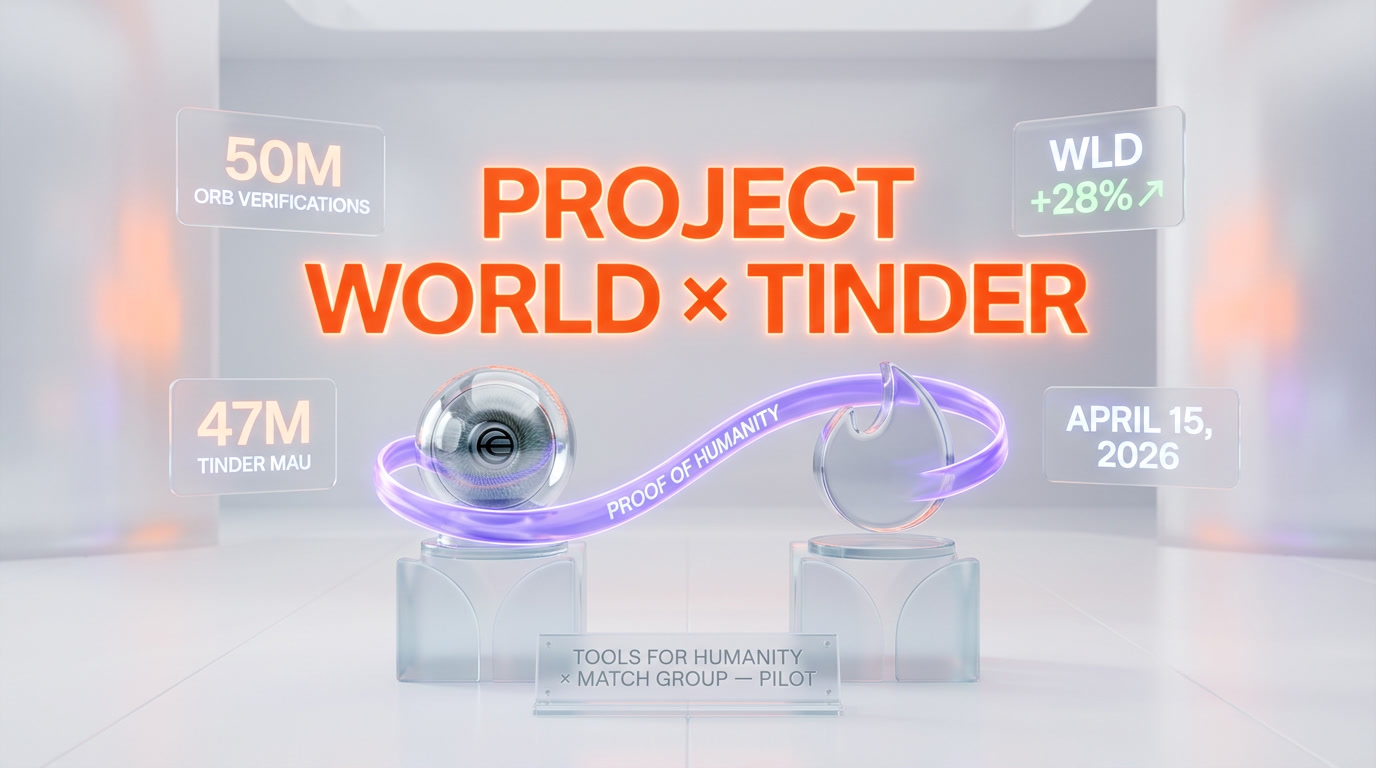
On April 15, 2026, Tools for Humanity — the Sam Altman and Alex Blania company behind Project World (formerly Worldcoin) — announced a pilot partnership with Match Group to bring Orb iris-scanning 'proof of personhood' verification to Tinder. Tinder counts roughly 47 million monthly active users worldwide. Project World has recorded over 50 million verifications across 40 countries at roughly 3,500 Orb devices. The WLD token jumped 28 percent in the 24 hours after the announcement, from $2.10 to $2.69, before settling at $2.48. This is the most high-profile consumer integration Project World has ever landed and the first time biometric iris verification is being positioned as the default signal for human-vs-bot filtering on a mainstream social product. The regulatory context is brutal — the European Data Protection Board has kept Orb operations on ice in Germany, Spain, Portugal and France; Kenya suspended World operations in August 2023 and has not reopened them; Brazil's ANPD issued a partial ban in January 2025. At the same time, the product has genuine demand because AI-generated fake profiles and catfishing on dating apps are at an all-time high. We read the announcement closely, walked through the privacy debate, looked at what the Tinder integration actually does versus what the press release implies, and formed a ground-truth verdict on whether this partnership ships, stalls, or blows up.
What was announced — the plain-language summary
On April 15, 2026, Tools for Humanity (TFH) and Match Group issued a joint press release describing a multi-quarter pilot to integrate World ID, the Project World proof-of-personhood credential, into Tinder. The pilot is slated to launch in Japan and Argentina in Q3 2026, expand to a handful of additional markets in Q4 2026, and — if metrics land — roll out across Match Group's broader property portfolio (Hinge, OkCupid, Match.com, Plenty of Fish) in 2027.
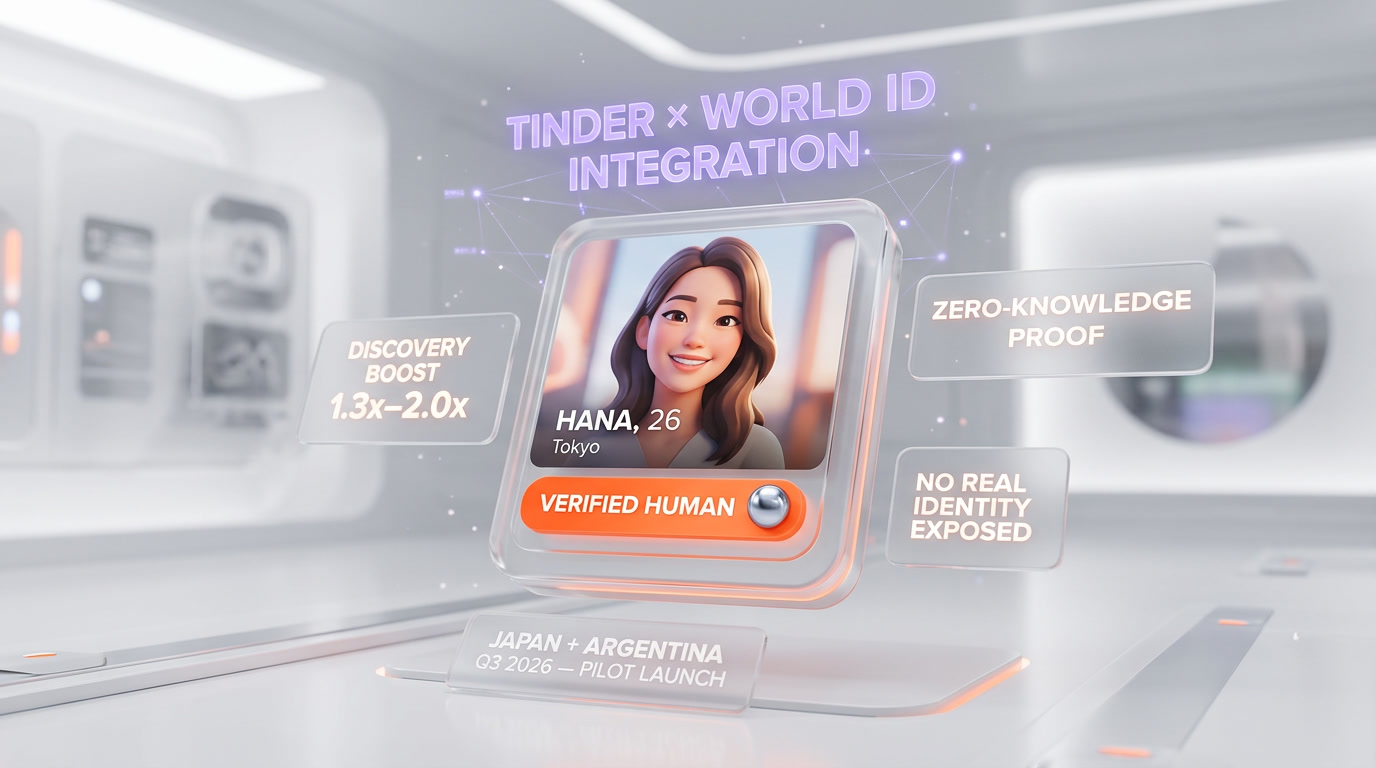
The product itself is narrower than most headlines made it sound. Users who opt in to verification walk to a physical Orb location, scan their iris, and receive a World ID credential. That credential is then cryptographically linked to their Tinder account, adding a 'Verified Human' badge and — per the announcement — preferential placement in the discovery algorithm. Tinder has not committed publicly to making World ID mandatory. But the incentive structure in the initial materials strongly suggests verified users get meaningfully more visibility.
Pilot markets and timeline
The selection of Japan and Argentina is not random. Both countries already have unusually strong Project World adoption — Japan alone accounts for roughly 8 percent of global World IDs, and Argentina has been the highest-growth Latin American market since late 2024, driven by inflation-hedge demand for WLD token distributions. Both countries have dense Orb coverage: Tokyo, Osaka, Nagoya, Buenos Aires and Rosario all have multiple Orb locations per capita. And — critically — neither country has regulatory barriers on Orb data collection of the kind that blocked Orb in the EU.
What each side actually gets
For Tools for Humanity, this is a distribution coup. Tinder is the single highest-trafficked brand where a proof-of-personhood layer could credibly be default-on. If World ID becomes the dating app verification standard, the network effect on every other use case (social, gaming, banking, civic voting) becomes materially easier to close. For Match Group, the bet is simpler — AI-generated fake profiles and catfishing are the number one trust complaint from paying users, and a verifiable 'human-only' lane is a retention product more than a growth product.
How the Orb actually works
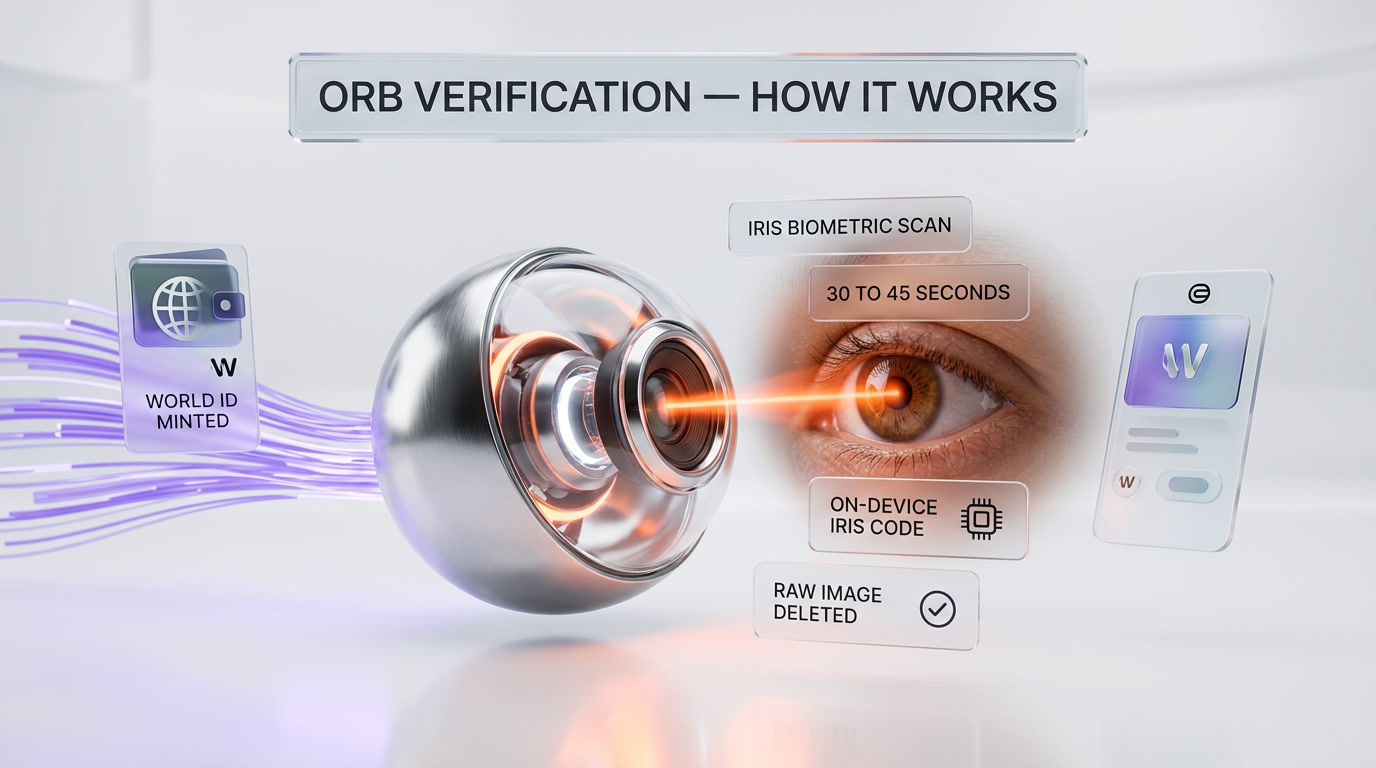
The Orb is the linchpin of Project World and the single piece of hardware that matters in this partnership. It is a metallic chrome sphere roughly the size of a bowling ball. Inside it: a near-infrared camera, a visible-light camera, depth sensors, and a compute module running TFH's iris-code pipeline. A verification session takes approximately 30 to 45 seconds from the moment the user consents to the moment the World ID is issued to their World App wallet.
What it captures, what it keeps, what it discards
TFH's official position — repeated in the Match Group announcement and in the Tools for Humanity privacy documentation — is that the Orb captures high-resolution iris images, converts them locally on the device into a mathematical representation called an iris code, and then deletes the raw biometric image. The iris code alone is used to check against the existing Project World database for uniqueness. If the iris code does not already exist in the network, a new World ID is minted. If it does, the scan is rejected as a duplicate.
This architecture is the core of the privacy argument TFH makes in every market. No raw images stored, the iris code is cryptographically irreversible, the World ID is linked to a self-custodied wallet rather than a government identity document. The counterargument — made in different language by the European Data Protection Board, the Spanish AEPD, and Privacy International — is that 'irreversibility' in cryptography is a term of art that depends on the threat model, and that an iris code is, in practice, a biometric identifier with all the risk profile of one.
The first-time verification flow
For the Tinder integration specifically, the user journey is: (1) on Tinder, the user taps the 'Verify You're Human' prompt; (2) the app hands off to World App (or prompts install) and shows the nearest Orb location on a map; (3) the user visits the Orb operator (usually a retail kiosk, co-working space, or authorized partner); (4) they complete the iris scan; (5) the World ID is minted and returned to their World App; (6) Tinder reads the credential via a zero-knowledge proof that confirms 'this account is linked to a unique, verified human' without revealing which specific World ID.
The WLD token layer
For context, every new World ID historically also unlocks a scheduled WLD token airdrop for the verified user — the token is the Worldcoin-era incentive that drove most of the initial adoption, especially in lower-income markets. In the Match Group partnership, TFH has not disclosed whether Tinder-verified users receive any WLD allocation directly, or whether the partnership changes the base Orb-verification token schedule. We expect clarification in the Q3 2026 pilot terms but the WLD-as-incentive lever is central to the business model and will almost certainly be tuned per-market.
The Tinder integration, layer by layer
The 'Verified Human' badge
The visible product surface is a small badge on verified profiles. Match Group spokespeople have described it in the announcement as a 'trust signal' that indicates the profile is linked to a unique verified human, not a bot, not an AI-generated composite, and not a user with multiple active accounts on the same platform. The badge does not reveal the user's real name, real-world identity, age, or any government document — this is the core design pitch.
Discovery algorithm changes
The announcement says verified profiles will receive 'preferential treatment' in the discovery algorithm. Industry precedent — Tinder has used similar ranking boosts for photo-verified accounts for years — suggests this is a meaningful visibility delta, probably in the 1.3x to 2.0x impressions range for verified accounts during the pilot. That is a strong enough incentive to drive meaningful opt-in among active paying users, without being so aggressive that unverified users immediately churn.
What happens to AI-generated profiles
This is the part where the Match Group case is strongest. AI-generated profiles on dating apps have exploded in 2024 to 2026. OpenAI, Stability, Midjourney and an open-source ecosystem of face generators have made it trivial to create a profile with photographs of a person who does not exist. Match Group's internal trust and safety numbers — disclosed piecemeal in earnings calls and in a January 2026 Bloomberg feature — suggest that somewhere between 12 and 18 percent of new Tinder account creations in the US showed signs of AI-generated photo content.
A proof-of-personhood layer does not directly solve the AI-photo problem (a real human can still use AI-generated photos). But it does solve the adjacent and larger problem: the same human creating dozens of fake accounts for scam, catfishing, or dating-app-fraud schemes. That is a concrete improvement over the current state.
The paid-tier implications
Tinder Gold and Tinder Platinum paying users consistently cite 'better-quality matches' as the number-one reason they subscribe. A verified-human-only discovery mode is the natural premium feature. We expect Match Group to roll out a 'Humans Only' toggle — probably Platinum-tier only, probably in the second half of the pilot — that filters the discovery feed to World-ID-verified profiles exclusively. That is where the partnership stops being a trust experiment and starts being a revenue lever.
The privacy firestorm — a fair read
Europe — GDPR, AEPD, BfDI
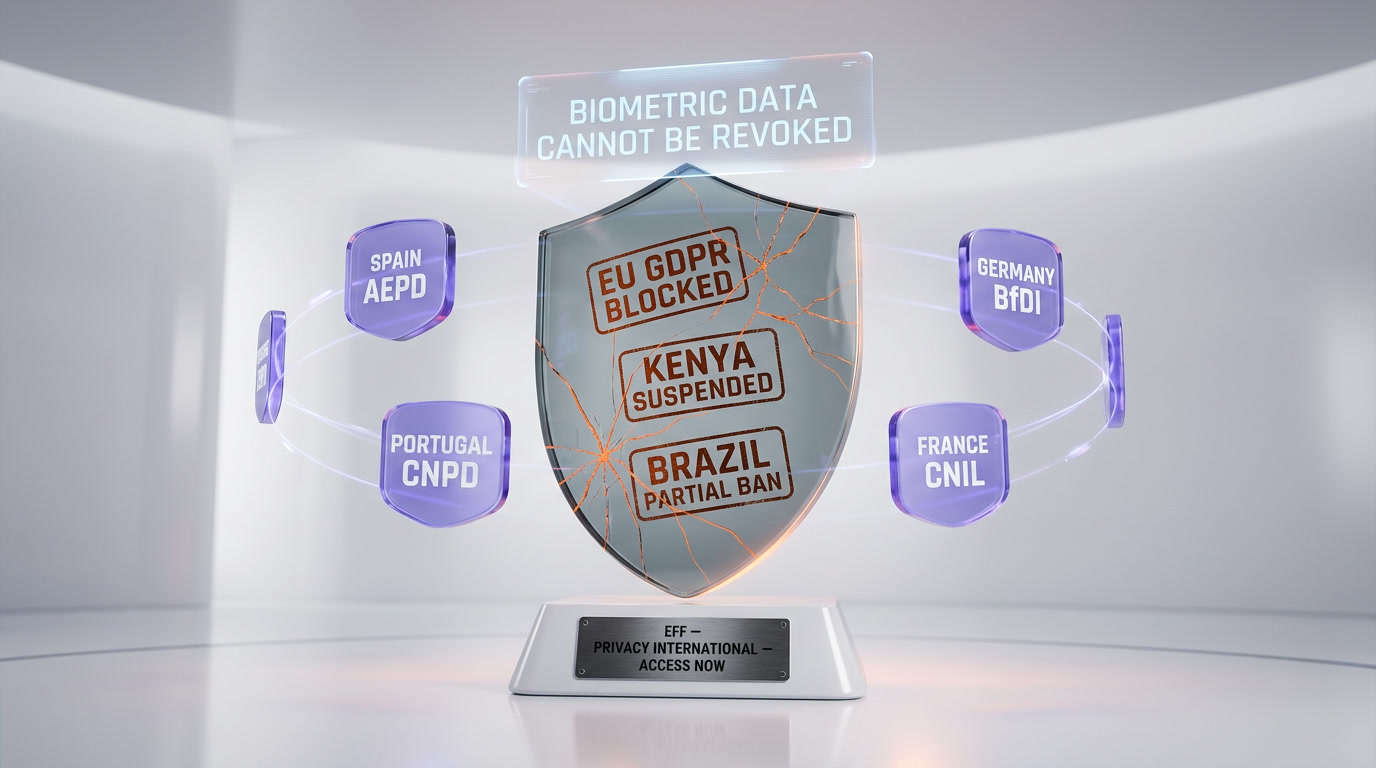
The single hardest market for Project World has been the EU. The Spanish AEPD ordered a temporary halt on Orb operations in Spain in March 2024. The Portuguese CNPD issued a similar order shortly after. The German BfDI published a lengthy position in 2024 concluding that iris-code processing under the Worldcoin architecture did not meet the specific-purpose and data-minimization tests of Article 9 GDPR for special-category biometric data. The French CNIL has held off on a full block but has maintained open investigations. The European Data Protection Board has coordinated across these authorities to keep Orb operations effectively frozen in the four largest EU markets.
The core EU objection is not that iris scanning is intrinsically illegal. It is that Project World has not, in the regulators' view, adequately demonstrated (a) that the 'iris code' cannot be reversed or re-identified under a realistic threat model, (b) that consent collected at retail Orb locations, often in low-income neighborhoods, meets the 'freely given' standard of GDPR when WLD tokens are offered as incentive, and (c) that the data-minimization principle is satisfied when a mathematical iris representation is created and stored indefinitely.
Kenya — the August 2023 suspension
Kenya is the most frequently cited non-EU regulatory case. In August 2023, the Kenyan government ordered Worldcoin (as it was then branded) to cease operations pending a parliamentary investigation. The specific concerns: questions about data export to servers outside Kenya, the use of cash-equivalent token incentives in a country with significant economic vulnerability, and the adequacy of consent procedures. The suspension has not been formally lifted as of April 2026. Kenya is notable because it was, pre-suspension, one of the highest-verification-rate countries — a reminder that raw adoption numbers do not automatically translate into regulatory legitimacy.
Brazil — ANPD partial ban
Brazil's National Data Protection Authority (ANPD) issued a partial ban in January 2025, specifically targeting the combination of biometric collection with token-based compensation. The ANPD allowed Project World to continue certain non-biometric operations but prohibited new Orb verifications that offered WLD in exchange. This ruling did not end Project World in Brazil — but it effectively killed the growth engine in one of the largest Latin American markets. Argentina, notably, has not issued a similar restriction, which is part of why Argentina is on the pilot list for the Tinder partnership.
What EFF, Privacy International and Access Now say
The Electronic Frontier Foundation, Privacy International, Access Now and a coalition of smaller digital rights groups have all published critical positions on Project World between 2023 and 2026. The summary of their concerns: biometric data is different from other personal data because it cannot be revoked. You can change your password. You can get a new credit card. You cannot get new irises. The combination of a permanent biometric identifier, a monetary incentive, a global database, and the proposed integration into high-visibility consumer products (now including Tinder) creates a risk profile that these organizations argue is disproportionate to the trust benefit delivered.
Tools for Humanity's response
TFH's response to all of this is consistent. No raw iris images are retained. The iris code is cryptographically irreversible given current and foreseeable computational resources. The World ID is self-custodied, not stored with TFH. Zero-knowledge proofs mean partners like Tinder never learn a user's iris code or their real identity. TFH also argues that as AI-generated identity fraud scales exponentially, the alternative to proof-of-personhood is not 'no biometric collection' — it is 'government-issued ID collection everywhere,' which is a worse outcome on both privacy and power concentration grounds.
The honest read is that both sides have valid points. The TFH architecture is meaningfully more privacy-preserving than, say, a government ID upload. It is also meaningfully less reversible and less regulated than any prior mainstream consumer identity product. Reasonable people disagree on the net balance.
The WLD token reaction and what it signals
The WLD token moved 28 percent in the 24 hours after the Tinder announcement — from $2.10 to $2.69 intraday, settling at $2.48 after US market close on April 15. That is a significant but not euphoric reaction. For context, WLD's all-time high was $11.94 in March 2024 during the original Worldcoin launch enthusiasm, and the token spent most of 2025 in the $1.50 to $3.00 range. A 28 percent pop suggests the market believes the Tinder partnership is real and material, but also suggests traders are pricing in a significant probability that the pilot does not scale into a full Match Group rollout.
The unlock schedule matters here
The Tools for Humanity and Worldcoin Foundation token holdings follow a multi-year unlock schedule that has, historically, capped WLD price appreciation during good-news cycles. In 2026, roughly 15 percent of total supply is scheduled to unlock, most of it concentrated in H2. That is a real overhang and one of the reasons institutional traders have stayed cautious even on strong news. The Tinder deal does not change the unlock schedule — it just means the unlocks land in a potentially more liquid, more-demand market.
Institutional flows
On-chain data from the 48 hours following the announcement shows increased WLD accumulation from wallets previously identified (via public reporting from Nansen, Arkham, and CoinDesk) as institutional or whale-tier. That is a shift from the 2025 pattern, which was dominated by retail flows. Whether this is a durable institutional thesis or a shorter-term reaction to the Tinder news will take another quarter to see clearly.
Sam Altman's context — why this lands differently in April 2026
This partnership announcement is landing in a very specific moment for Sam Altman. On April 14, 2026, San Francisco police arrested two armed attackers near Altman's private residence with a manifesto referencing the 'extinction of humanity.' Three weeks earlier, a Texan threw a Molotov cocktail at the same address. The AI backlash is the loudest and most personal it has ever been for Altman. We covered the broader context in our piece on the Altman home attacks and the luddite parallel.
That timing affects how the Project World × Tinder news reads in public. A biometric identity product shipped by a company Altman co-founded, positioned as the answer to AI fraud, announced the day after he was personally targeted — the narrative framing writes itself, both for and against. Pro-partnership framing: Altman is building the trust infrastructure AI itself destroyed. Anti-partnership framing: Altman is monetizing the exact problem his other company (OpenAI) is the primary cause of. Both takes are being posted at high volume on X, Bluesky, and every tech-commentary Substack.
For Tools for Humanity, the timing is double-edged. It increases visibility (good for distribution) and lowers the trust bar (bad for regulatory approvals in new markets). For Match Group, the timing is mostly a non-issue — they are a dating app company, not a philosophical AI-safety stakeholder, and paying Tinder users will not change their subscription decision based on Altman's other reputation issues.
Why dating apps genuinely needed something like this
Stepping back from the privacy debate for a moment, the underlying problem Match Group is trying to solve is real and worsening. Dating app fraud has exploded:
- AI-generated profiles: 12 to 18 percent of new Tinder US accounts in 2026 showed signs of AI photo content per Bloomberg's January 2026 feature. Match Group has publicly called this their top trust and safety issue.
- Pig butchering scams: romance-scam-plus-crypto-fraud hybrids have become a federal priority for the US FBI and FTC since 2023. Verified-human filters do not eliminate the problem but raise the operational cost meaningfully.
- Catfishing at scale: single actors operating dozens of profiles simultaneously is the specific behavior that a proof-of-personhood system disables cleanly. One human, one account.
- Bot-driven engagement manipulation: paid-tier conversion on dating apps depends heavily on users receiving matches. Bot-driven fake matches artificially inflate conversion, then erode retention when users realize the match was not real.
None of these problems are hypothetical. All of them are worse in 2026 than they were in 2022. And the existing mitigation stack (photo verification, phone number verification, machine-learning fraud detection) is losing ground against AI-generated adversaries at roughly the same rate that AI capabilities are improving.
That is the honest case for why Match Group is doing this. It is not because Project World has the best press. It is because the status quo on dating-app trust is actively deteriorating.
What the alternatives look like
Project World is not the only proof-of-personhood system in 2026. The comparable competitors:
Civic, Humanity Protocol, Privado ID
Civic and Privado ID have been building decentralized identity for years. Neither requires biometric collection at all. Both use combinations of government ID verification and on-chain attestations. Humanity Protocol, launched in 2024, uses palm print scanning on mobile devices rather than dedicated hardware — a friction reduction but potentially a worse uniqueness guarantee. Match Group reportedly evaluated all three before signing with TFH.
Passkeys and WebAuthn-based identity
The standards-based alternative is WebAuthn and passkeys, which provide cryptographic account binding without any biometric centralization. Passkeys solve account-level security but do not solve the 'is this a unique human' problem — one person can hold unlimited passkeys. That is the gap proof-of-personhood products fill.
Government ID verification (Persona, Jumio, Sumsub)
The existing mainstream solution is government ID verification through vendors like Persona, Jumio, and Sumsub. These are the incumbents. The arguments against them: they require uploading a passport or drivers license, they expose real-world identity to the platform (goodbye pseudonymity), they exclude people without documents, and they centralize biometric templates with large private vendors with spotty security records.
The honest comparative claim Project World makes is that it is worse than passkeys (which do not solve personhood) and better than government ID verification (which exposes identity). That is a narrow but defensible positioning.
Our three scenarios for how this plays out
Base case — pilot runs, ships narrow
Our base case, roughly 55 percent probability: the Japan and Argentina pilots run through 2026. Metrics are moderately positive on trust but modest on conversion. Match Group rolls World ID out as an optional badge across Tinder globally in mid-2027 but does not make it mandatory. Hinge and Match.com get it later. World ID becomes a meaningful but minority verification option — not the default signal.
Bull case — default signal within 18 months
Roughly 20 percent probability: the Tinder pilot delivers standout retention and paid-tier conversion numbers, a 'Humans Only' filter launches and drives material subscription growth, and Match Group aggressively pushes World ID toward default-on status across its portfolio. This is the scenario that justifies the WLD price reaction. It requires (a) strong pilot data, (b) no major regulatory block in Japan or Argentina, and (c) no competing proof-of-personhood system catching up fast enough to change the partnership calculus.
Bear case — regulatory torpedo or data breach
Roughly 25 percent probability: something goes wrong publicly. Options: (1) a data breach or operational incident at TFH that undermines the privacy story (single highest-impact risk); (2) a regulatory action in Japan or another G7 market that mirrors the EU posture; (3) a public incident where a Tinder-verified user turns out to be involved in a high-profile scam or abuse case, destroying the trust narrative; (4) Altman personal-scandal overflow that makes Match Group rethink brand association. Any one of these stalls or kills the broader rollout.
The asymmetric risk in this partnership is real. Upside is distribution to 47 million Tinder users. Downside is a biometric incident that damages the brand of both parties permanently. Match Group's choice to run a geographically limited pilot before any global rollout is, in our read, exactly the right risk posture.
Our take — what we actually think
We think the Project World × Tinder partnership is one of the most important consumer AI-era identity moves of the last 18 months, and also one of the easiest to get wrong in analysis. Two takes that both need to be held at the same time:
First take — the product is real, the demand is real, and the privacy architecture is better than critics often credit it for. Zero-knowledge proofs, local iris-code generation with raw-image deletion, self-custodied World IDs — this is not a naive biometric database. It is a thoughtfully designed proof-of-personhood system. The Match Group decision to run a pilot rather than a global launch is evidence that both sides take the risks seriously.
Second take — the regulatory history is not a PR problem that goes away. The EU block, the Kenya suspension, the Brazil partial ban, the ongoing scrutiny in every G7 country — those are substantive positions held by data protection authorities with real enforcement power. TFH's ability to resolve those positions in 2026 to 2027 will determine whether this partnership is the beginning of a global identity layer or a permanently cornered product.
We are cautiously optimistic on the product utility, skeptical on the global regulatory path, and — most importantly — watchful on operational risk. The single worst outcome for everyone, users included, is a biometric incident at an Orb location that leaks data at scale. TFH's operational security is the quiet linchpin the entire thesis rests on.
Related reading: our coverage of ChatGPT, our deeper analysis of the April 14 Altman home attacks, and our regulation-wave piece on AI companion chatbots.
Our verdict
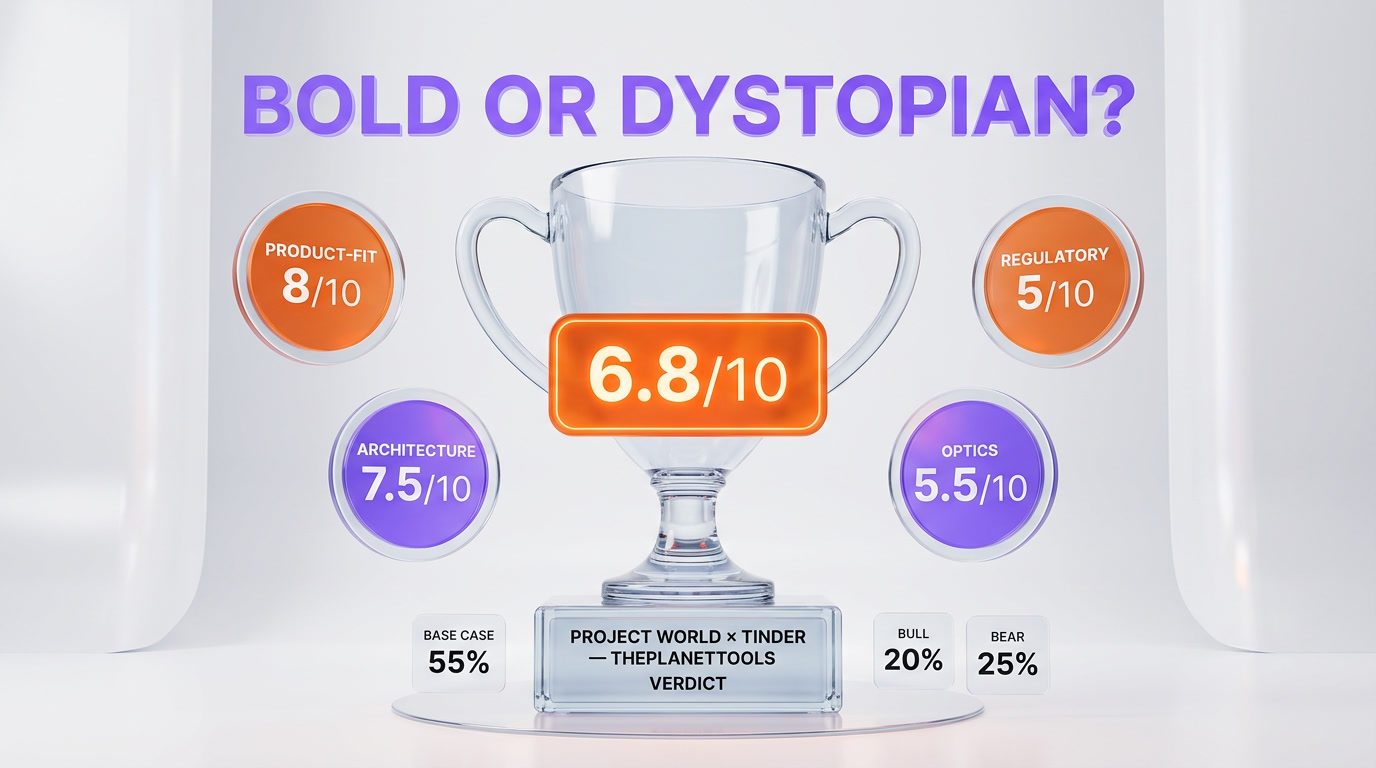
We score the Project World × Tinder partnership 6.8 out of 10. Strong on product-problem fit (the fraud problem is real and worsening). Strong on technical architecture (zero-knowledge proofs, local iris-code generation, self-custodied World IDs). Middling on regulatory path (EU block, Kenya suspension, Brazil partial ban — those will not resolve themselves by pilot milestones). Weak on optics in April 2026 given the Altman personal-safety context and the broader AI backlash. And asymmetrically exposed to operational risk — the story is one data incident away from going from 'trust infrastructure for the AI era' to 'cautionary tale about biometric centralization.'
For readers trying to decide whether to opt in: if you live in a country where the Orb is legally operating, and you already use Tinder and value a human-only experience over privacy maximalism, the current pilot design is reasonable. If you are concerned about biometric centralization, the alternatives (Civic, Humanity Protocol, or simply staying unverified) are viable. Nothing forces this on you yet. That 'yet' is the word to watch over the next 18 months.
Frequently asked questions
What did Project World and Tinder announce on April 15, 2026?
Tools for Humanity (Project World, formerly Worldcoin) and Match Group announced a pilot partnership to integrate World ID proof-of-personhood verification into Tinder. Users opt in, scan their iris at a physical Orb location, receive a cryptographic World ID credential, and get a 'Verified Human' badge plus preferential discovery placement on Tinder. The pilot launches in Japan and Argentina in Q3 2026, expands in Q4 2026, and — if metrics land — rolls out across Match Group's broader portfolio (Hinge, OkCupid, Match.com) in 2027. Tinder has 47 million monthly active users and Project World has 50 million verifications across 40 countries.
How does the Orb iris scan actually work?
The Orb is a chrome metallic sphere containing a near-infrared camera, visible-light camera, depth sensors, and a compute module. A verification takes 30 to 45 seconds. The device captures a high-resolution iris image, converts it locally into a mathematical iris code, and — per Tools for Humanity's official position — deletes the raw biometric image. The iris code is checked for uniqueness against the Project World database. If no match, a new World ID is minted to the user's self-custodied World App wallet. Privacy regulators including the EU's EDPB, Spain's AEPD, Germany's BfDI, and Brazil's ANPD dispute the practical irreversibility claim under real-world threat models.
Why did the WLD token rise 28 percent?
The WLD token rose approximately 28 percent in the 24 hours after the Tinder partnership announcement, moving from $2.10 to $2.69 intraday and settling at $2.48 after US market close on April 15, 2026. The move reflected market belief that the partnership is material and real. It was also capped below full euphoric pricing by the multi-year WLD unlock schedule — roughly 15 percent of total supply unlocks in 2026, concentrated in H2 — which limits how much institutional capital is willing to deploy during positive news cycles. Nansen, Arkham, and CoinDesk on-chain data showed increased institutional or whale-tier WLD accumulation in the 48 hours following the announcement.
Which countries have blocked or restricted Project World?
The EU has effectively frozen Orb operations in Germany (BfDI position), Spain (AEPD order, March 2024), Portugal (CNPD order), and France (CNIL open investigations). The European Data Protection Board coordinates the EU-wide approach. Kenya suspended Worldcoin operations in August 2023 and the suspension has not been formally lifted as of April 2026. Brazil's ANPD issued a partial ban in January 2025 that prohibits new Orb verifications combined with WLD token compensation. Argentina and Japan — the initial Tinder pilot markets — have not issued restrictions, which is part of why those markets were chosen.
Is iris-code processing legal under GDPR?
Unresolved. The core EU regulatory argument is that iris codes are special-category biometric data under Article 9 GDPR. Authorities including Spain's AEPD, Germany's BfDI, and Portugal's CNPD have held that Project World has not adequately demonstrated (a) the practical irreversibility of iris codes under realistic threat models, (b) that consent collected at Orb locations meets the 'freely given' standard when WLD tokens are offered as incentive, and (c) that data-minimization requirements are satisfied when iris codes are stored indefinitely. Tools for Humanity disputes these conclusions and has ongoing legal processes in multiple EU member states. No final EU-wide ruling has been issued as of April 2026.
Who is Alex Blania and what is his role?
Alex Blania is the co-founder and CEO of Tools for Humanity, the company operating Project World. He co-founded the project with Sam Altman in 2019 to 2020. Blania runs day-to-day operations, product strategy, and the Orb hardware program from Tools for Humanity's Erlangen (Germany) and San Francisco offices. While Sam Altman is the public face most people associate with Project World, Alex Blania is the operational leader and the primary signatory on the Match Group partnership.
How does this compare to Civic, Humanity Protocol, and government ID verification?
Project World's competitors: Civic and Privado ID use decentralized identity without biometric collection — weaker personhood guarantee, stronger privacy. Humanity Protocol uses mobile palm-print scanning — lower friction, potentially weaker uniqueness guarantee than iris. Incumbent government ID verification (Persona, Jumio, Sumsub) requires passport or drivers license upload — strong uniqueness but exposes real identity, excludes undocumented users, and centralizes biometric templates with private vendors. Match Group reportedly evaluated all three categories before signing with Tools for Humanity. The honest Project World positioning is: worse than passkeys (which do not solve personhood), better than government ID (which exposes identity).
Will unverified Tinder accounts be penalized?
Not initially. Per the April 15, 2026 announcement, World ID verification is optional at launch. Verified profiles receive a 'Verified Human' badge and 'preferential treatment' in the discovery algorithm — industry precedent suggests this is a 1.3x to 2.0x impressions boost during the pilot. Match Group has not committed to making verification mandatory. However, the likely product evolution is a paid-tier 'Humans Only' filter, probably Tinder Platinum-only, which would let subscribers filter their discovery feed to verified profiles exclusively. That is where the partnership becomes a revenue lever rather than just a trust experiment.
What happens to my data if I scan my iris?
Per Tools for Humanity's official position: the Orb captures a high-resolution iris image, converts it on-device into an irreversible mathematical iris code, deletes the raw biometric image, and uses only the iris code for uniqueness checking against the Project World database. A World ID credential is minted to your self-custodied World App wallet. Tinder reads the credential via zero-knowledge proof that confirms 'verified unique human' without revealing your specific World ID. Privacy advocates including EFF, Privacy International, and Access Now dispute the practical irreversibility of iris codes and the adequacy of the consent process. If you care about biometric data minimization, opting out is the cleanly conservative choice.
What is our overall verdict on the Project World × Tinder partnership?
We score it 6.8 out of 10. Strong product-problem fit — AI-generated dating profiles were 12 to 18 percent of new Tinder US accounts in 2026 per Bloomberg, and catfishing at scale is the number one Match Group trust complaint. Strong technical architecture — zero-knowledge proofs, local iris-code generation, self-custodied World IDs. Middling regulatory path — EU block, Kenya suspension, Brazil partial ban will not resolve themselves by pilot milestones. Weak optics in April 2026 given the Altman home attacks context. Asymmetrically exposed to operational risk — one data incident at an Orb location reframes the entire narrative. Our base case (55 percent probability): pilot runs, ships narrow as an optional badge. Bull case (20 percent): default signal within 18 months. Bear case (25 percent): regulatory torpedo or data breach kills the broader rollout.