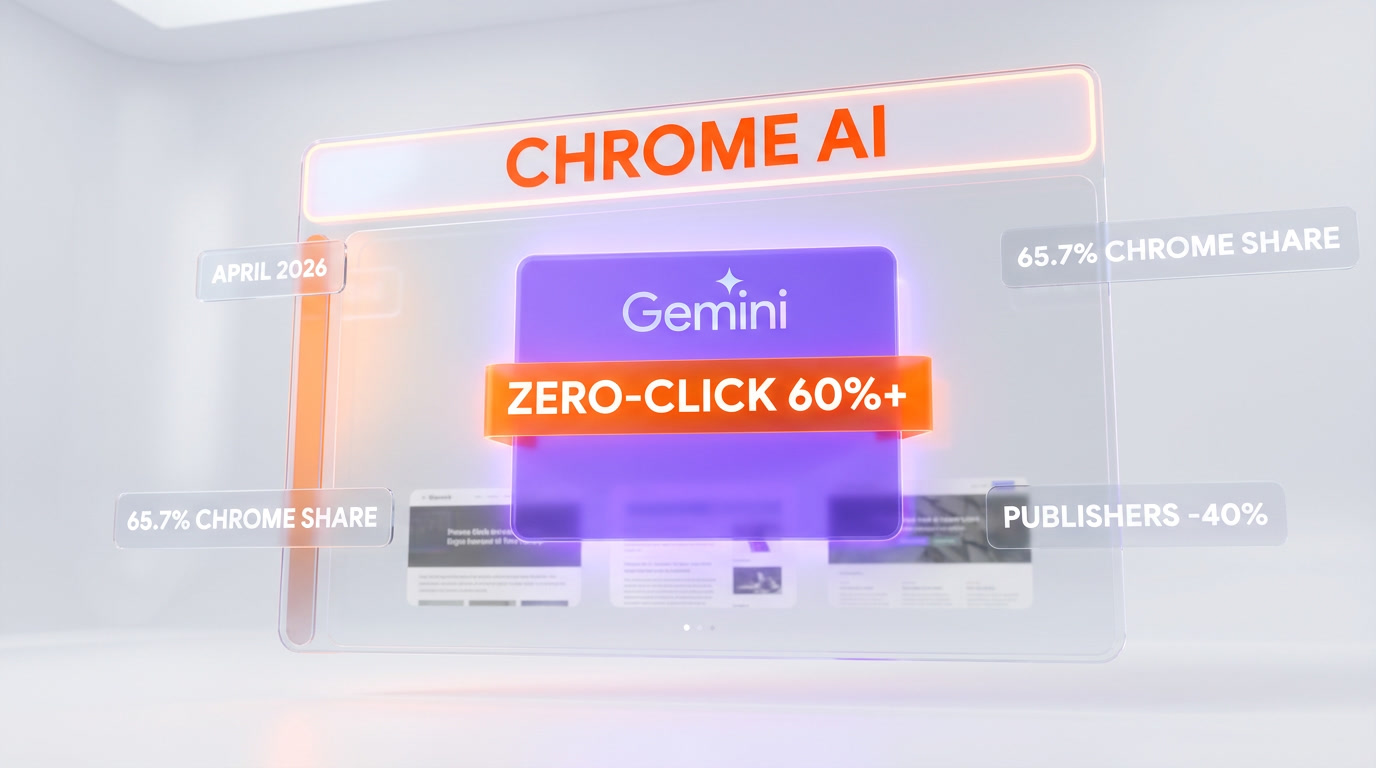
In April 2026, Google pushed AI deeper into Chrome than it ever has — AI Mode in the address bar, Gemini sidebar, Overview Mode, Tab Organizer — and the publisher ecosystem is quietly bleeding out. Zero-click searches now represent more than 60% of all Google queries (up from ~20% in 2020, per Similarweb and SparkToro). Chrome holds a 65.7% global browser market share (StatCounter, April 2026). Major publishers including The New York Times, The Washington Post and Axios report 30% to 40% year-over-year drops in Google search referrals. Google's search advertising revenue, meanwhile, hit $62.1 billion in Q1 2026 alone (Alphabet earnings). The math is brutal: the open web subsidizes an AI layer that increasingly keeps readers from ever visiting it.
What happened in April 2026
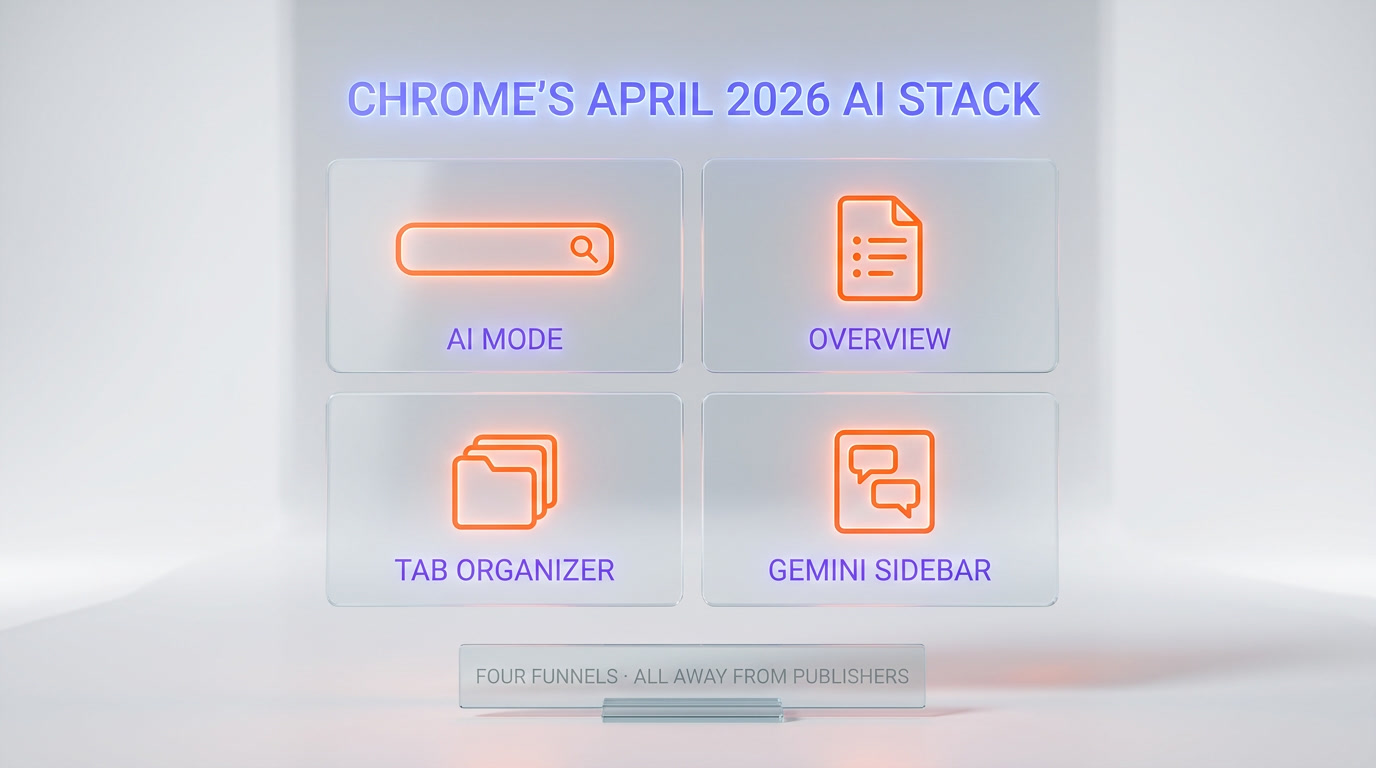
Google did not roll out one Chrome feature in April. It rolled out a stack. At Google Cloud Next 2026 and in the subsequent Chrome release cycle, four shifts landed on the same Chrome build for most users worldwide:
- AI Mode in the address bar — typing a query invokes a Gemini-generated answer above the classic results list, often with the list pushed below the fold.
- Gemini Sidebar (rolled to 100% of Chrome desktop users) — a persistent AI panel that summarizes the page you are on, answers follow-ups, and drafts content without sending you anywhere else.
- Overview Mode — the evolution of AI Overviews into a default answer card on a larger share of queries, with sourced citations presented as small favicons rather than clickable blue links.
- Tab Organizer (auto-group + summarize) — Gemini groups your open tabs, summarizes each one, and lets you "read the tab" without opening it.
Each of these alone would matter. Shipped together in one quarter, in a browser that controls roughly two-thirds of the global market, they constitute the biggest shift in how humans consume the open web since the invention of the search engine results page. Sundar Pichai framed it on stage as "the most helpful Chrome we've ever shipped." For publishers, the translation is simpler: fewer clicks.
The zero-click curve just crossed 60%
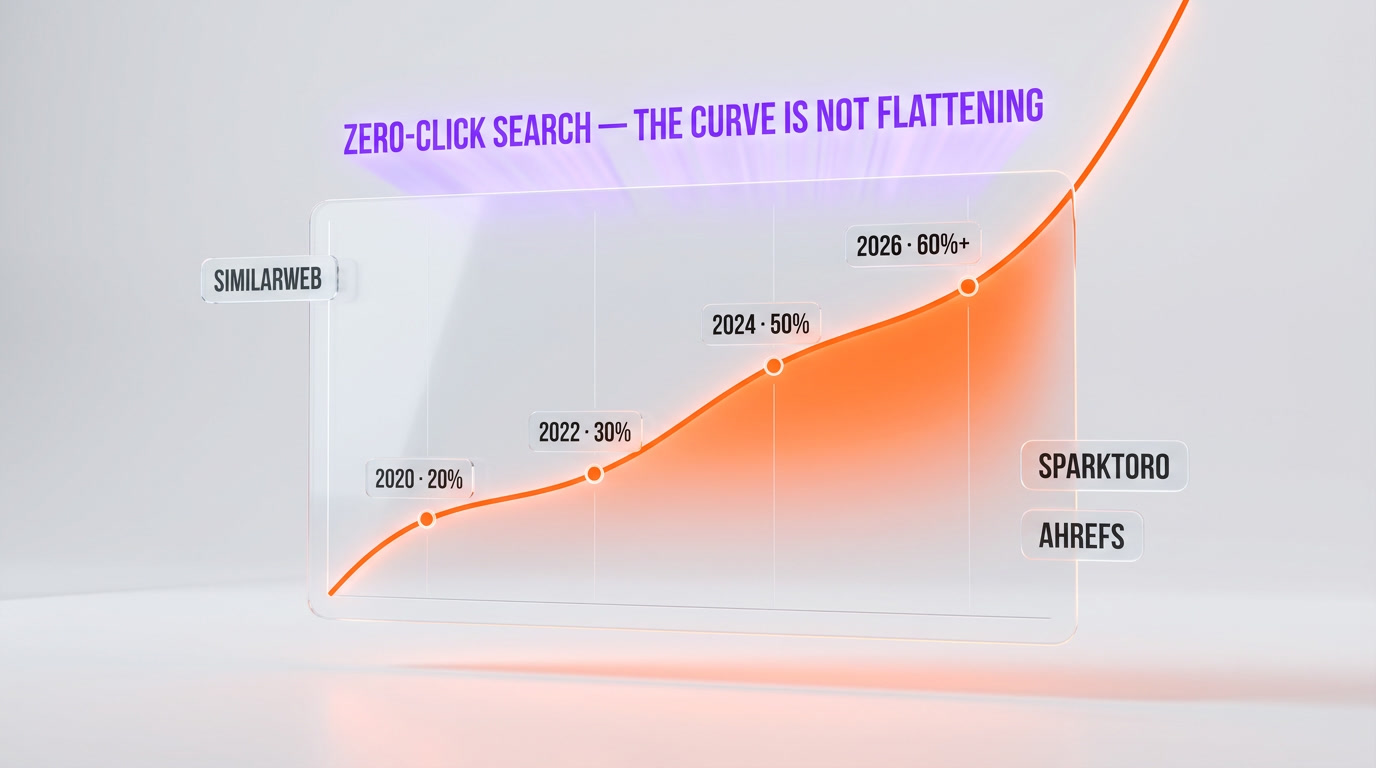
The phrase "zero-click search" used to describe an annoying trend. In 2026 it describes the default experience. A zero-click search is one where the user gets their answer on the SERP itself — via AI Overview, featured snippet, knowledge panel, or direct answer — and never clicks through to a website.
The 2026 numbers that define the industry
- Zero-click rate on Google Search: 60%+ (Similarweb, SparkToro, April 2026 — up from ~50% in 2024 and ~20% in 2020).
- Chrome global browser market share: 65.7% (StatCounter, April 2026).
- Share of Google mobile SERPs that show an AI Overview at the top: ~47% (Ahrefs, Q1 2026).
- Average click-through rate on the classic "first organic result" when an AI Overview is present: down ~34.5% vs the same query without an overview (Ahrefs, Q1 2026).
- Global search advertising spend still flowing to Google: $62.1B in Q1 2026 (Alphabet, Q1 2026 10-Q).
Put bluntly: more users are getting more answers without leaving Google's surface, and Google is monetizing that shift faster than the publishers whose content trained the answers.
Why this is specifically a Chrome story, not just a Search story
It is tempting to file this under "AI Overviews are bad for publishers." That framing understates the problem. The difference in 2026 is that the AI layer is no longer confined to google.com — it is now the browser. When Gemini summarizes the page you are on, the user did visit the site. The site still serves the HTML, still pays the bandwidth, still wrote the article. But the user never reads the headline, never sees the ads, never lands on the newsletter signup. The monetization surface has moved one layer up the stack, into Chrome.
The four Chrome AI features killing publisher traffic
1. AI Mode in the address bar
AI Mode is the headline feature. It converts the Chrome Omnibox (the address bar) into an AI answer engine. Type a query, and before you even hit Google, Chrome surfaces a Gemini-generated response inline. For informational queries ("what is the capital of Mongolia," "how do I reset my router"), the answer often lives entirely in the suggestion dropdown. The user never reaches a SERP, let alone a publisher site. Early Ahrefs data suggests AI Mode alone is responsible for a 12 to 18 percent decrease in informational query CTR on sites that ranked #1 before the rollout.
2. Overview Mode (the AI Overviews escalation)
What was called "AI Overviews" in 2024 is now called "Overview Mode" in 2026, and the difference is not cosmetic. Overview Mode:
- Appears on a larger share of queries — roughly 47% of mobile SERPs in Q1 2026 versus ~31% in 2024.
- Synthesizes more content before citing sources.
- Presents citations as favicon chips rather than clickable blue text, dramatically lowering click-through.
- Uses Gemini 2.5 Pro under the hood, with a markedly higher completion rate on complex multi-fact queries.
The net effect on publishers is the single largest CTR decline the industry has measured: Ahrefs' longitudinal study across 300,000 queries found a 34.5% drop in click-through to the first organic result when an Overview is present. For informational queries specifically, the drop exceeds 40 percent.
3. Tab Organizer with auto-summarize
Tab Organizer is the quiet killer. It groups your open tabs by topic and lets you summarize each tab via Gemini without opening it. On paper this is a productivity feature. In practice it means users open a tab, never read the content, and close it based on a 40-word summary that Gemini generated from the site's own HTML. Ad impressions: zero. Newsletter pop-ups triggered: zero. Article read to the end: no.
4. Gemini Sidebar (100% Chrome desktop rollout)
Google announced the sidebar in 2024. In March 2026 it reached 100% of Chrome desktop users. The sidebar is an always-on AI panel that reads the current page and answers questions about it. Users increasingly treat it as the primary interface — they visit a site, let Gemini read it, and ask "what's the TL;DR?" The page loads, the content is consumed, but the engagement metrics publishers actually monetize (scroll depth, time on page, return visits) collapse.
The publisher impact is measurable — and ugly
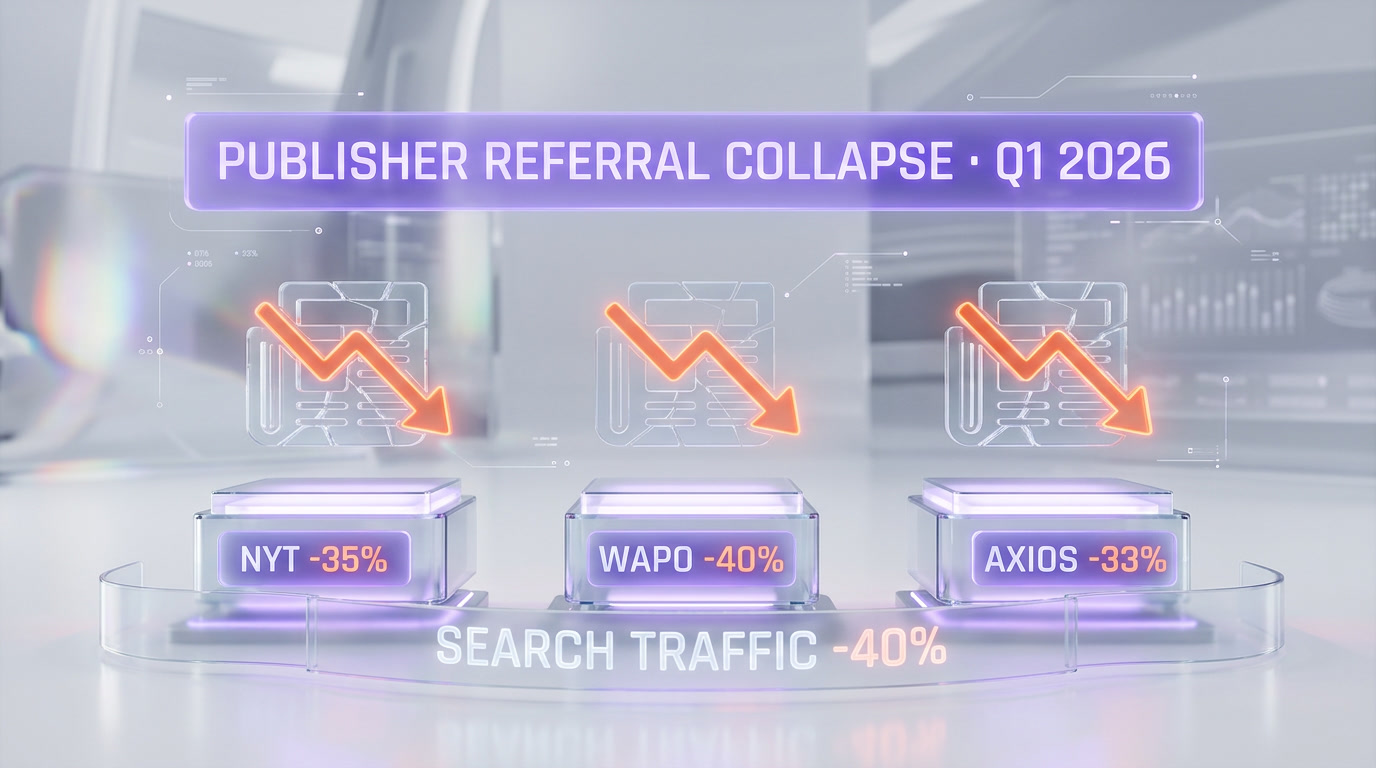
Publishers have spent twelve months quantifying the damage. A consolidated look at Q1 2026 disclosures:
The reported declines
- The New York Times: Google search referrals down roughly 35% year-over-year in Q1 2026, per disclosures summarized by WSJ and Bloomberg.
- The Washington Post: search referrals down ~40%, contributing to a second round of newsroom layoffs.
- Axios: search referrals down ~33%, with CEO Jim VandeHei stating publicly that "Google's AI is a referral extinction event for the ad-supported web."
- Vox Media: discussed AI traffic erosion as a primary factor in cost reduction rounds.
- Small to mid-tier publishers (per a Chegg-style lawsuit and a Sundar Pichai deposition surfaced by Bloomberg): reporting 50% to 70% declines on informational query verticals.
The ad math no one is talking about
Here is the part that does not show up in most coverage. When search referrals drop 40%, programmatic ad revenue does not drop 40% — it drops more. Direct-sold campaigns are priced against 90-day impression forecasts. When impressions miss by 40%, publishers either fail delivery guarantees (paying back advertisers) or accept CPM floors they would never have accepted in 2023. The result is a revenue compression that exceeds the traffic compression by a meaningful margin. Several publishers have quietly reported that a 35% traffic drop translated to 45 to 55% revenue drop on search-referred sessions.
The lawsuits and antitrust pressure
The legal response is escalating. In 2025, educational publisher Chegg sued Google for antitrust violations, alleging AI Overviews use Chegg's content to kill Chegg's traffic. In 2025 the US Department of Justice won a landmark ruling declaring Google's search business a monopoly. In 2026, the European Commission is actively investigating Chrome AI features under the Digital Markets Act. Sundar Pichai has been deposed multiple times. None of this has slowed the Chrome AI rollout. Google's legal risk calculus clearly prices the upside of AI distribution higher than the downside of regulatory action.
"The ten blue links are dead" — what SEO looks like now
SEO professionals have been saying "the ten blue links are dying" for years. In April 2026 the statement is literal. For the highest-intent informational queries, the ten blue links are now below two full screens of AI content. Here is what SEO looks like in practice in 2026:
Brand has replaced rank as the optimization target
If the user sees an AI answer and a citation favicon instead of ten blue links, being the favicon is worth less than being the memorable brand name that the AI cites by name. Optimization has shifted from "rank #1 for keyword X" to "be the domain the AI mentions when answering about X." This is GEO (Generative Engine Optimization) — and it is a structurally different discipline from traditional SEO.
Answer-first content or die
The content formats that still get clicks in 2026 are answer-first. A definition paragraph in the first 60 words, a data table the AI cannot summarize away, a proprietary benchmark the AI has to cite because nobody else has the number. Everything else loses the race to the Overview.
First-party audiences matter more than ever
Every publisher still standing in 2026 is building an email list, a push notification audience, or an RSS-adjacent subscriber base. Direct traffic is the only moat left. Search-referred traffic is a declining asset. This is why The New York Times pivoted to a subscription-first model years ago — and why every publisher that did not is now in crisis.
Alternative browsers are getting real momentum
The one genuinely hopeful development is that users are starting to notice. Chrome's market share is historically high but not invulnerable, and the 2026 landscape features three serious contenders:
Perplexity Comet
Perplexity's AI-native browser, Comet, launched in public beta in 2025 and hit general availability in early 2026. It inverts the Chrome thesis: instead of adding AI to a browser built around search, Comet is built around answers with the web as citation. It cites sources prominently and preserves the ability to click through. Early data suggests Comet referral clicks convert at roughly 2x the rate of Chrome-AI-mediated clicks.
Arc (and its successor Dia)
The Browser Company's Arc pivoted in late 2024 and 2025 toward Dia, a more mainstream AI browser. Dia is smaller than Chrome by orders of magnitude but is over-indexed on knowledge workers and creators — a demographic that drives a disproportionate share of publisher engagement.
Brave with Leo AI
Brave's Leo AI assistant is integrated but optional. Brave has positioned itself as the privacy-first, publisher-friendly alternative: no tracking, no AI summary by default, and a direct-pay model (BAT) that returns value to creators. Brave's share is still small but growing on the privacy-conscious segment.
None of these will kill Chrome in 2026. But the existence of a credible second-best option is itself a structural change. For the first time in a decade, "what browser should I use?" has a real debate attached.
What's next — the six-month forecast
Based on Google's disclosed roadmap, publisher signals, and the antitrust trajectory, here is what to watch for in the next six months:
- Chrome AI will ship more, not less. Google's Q2 2026 roadmap includes agentic browsing features — Gemini performing multi-step web tasks on the user's behalf. This is a further abstraction layer between user and site.
- The EU Digital Markets Act will probably force behavioral remedies, not structural ones. Expect a "publisher opt-out" flag that most users will never see.
- At least one major US publisher will sue Google directly over Chrome AI summarization, following the Chegg template. The legal theory: summarizing third-party content inside the browser without compensation is unjust enrichment.
- More publishers will gate content behind user-specific auth to break Gemini's summarization. Expect a wave of "sign in with Google" fatigue as publishers detect the contradiction.
- Alternative browsers will reach 10% combined share on knowledge-worker segments, forcing Google to tune back some Chrome AI friction. This is the optimistic scenario.
What publishers and creators should do right now
The window for reaction closed roughly eighteen months ago. The window for adaptation is open through 2026. Concrete moves that still work:
- Build first-party audiences aggressively. Email, push, community, podcast. Any channel where the relationship is direct, not mediated by Google.
- Optimize for GEO alongside SEO. Answer-first content, fact density, unique data, proprietary benchmarks. Make yourself the source the AI cannot avoid citing by name. Tools like ChatGPT, Claude, and Perplexity can be used to audit what AI currently says about your brand and what sources it cites.
- Diversify referral sources. If Google drops 40%, you need YouTube, LinkedIn, Reddit, email, and app-store presence to compound.
- Invest in brand-level signal. Podcast appearances, conference talks, PR, quotes in AI training data. The goal is to be the brand the model names when asked about your category.
- Monetize quality over volume. Subscriptions, memberships, paid newsletters, sponsorships. Programmatic CPM models are structurally impaired.
- Use agentic tools to move faster. See our coverage of how OpenAI's GPT-5.4 cyber release is reshaping security team workflows in our GPT-5.4 analysis — the same speed gains apply to content production.
The verdict — Google wins, publishers lose, users... depend
Let's be honest about who is winning and who is losing in April 2026.
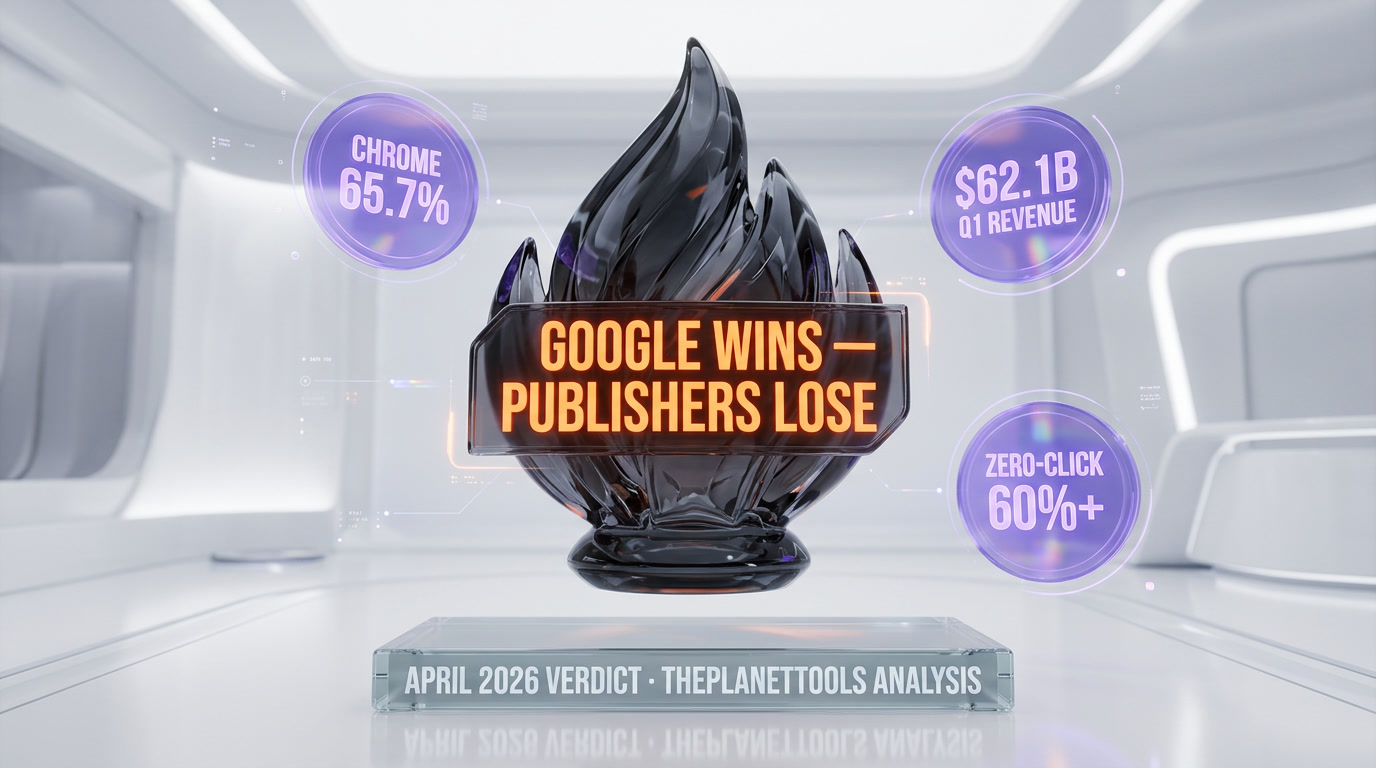
Google wins. Chrome market share at 65.7%, $62.1B in Q1 search ad revenue, an AI distribution layer that the rest of the industry cannot replicate, and a legal system that is slower than the rollout cadence. The numbers are not ambiguous.
Publishers lose. 30 to 40% referral drops for the top of the market, worse for mid-tier. Layoffs across the Washington Post, Vox, BuzzFeed, and most regional news operations. A decade of SEO investment partially obsoleted in four quarters. The open web's ad-supported business model is structurally broken for any site whose primary traffic source was Google Search.
Users get faster answers. That is true. It is also true that those answers are quietly dependent on the continued existence of the publishers whose content trains and grounds them. If publisher output collapses, the quality of Chrome's AI layer degrades with it. Nobody has priced that second-order risk.
The structural question for 2026 and 2027 is whether Google will voluntarily compensate publishers (via a licensing model, a revenue share on AI-surfaced sessions, or a traffic guarantee) before regulation forces its hand, or whether the open web's editorial layer will be allowed to degrade below the threshold where it can support Chrome's AI quality. So far the evidence is that Google will take the degradation risk.
For anyone running a content business: the strategy is not to fight Chrome's AI. The strategy is to outlast the ad-supported web's transition and be one of the brands on the other side that readers, and AI models, still cite by name. Everything else is triage.
Keep reading: our coverage of ChatGPT, Claude, and the full AI analysis desk for what's shifting in frontier AI, plus the tools directory for AI tools that actually move the needle right now.
Frequently asked questions
What is zero-click search and how big is it in 2026?
A zero-click search is a Google query where the user gets their answer directly on the search results page — via an AI Overview, featured snippet, knowledge panel, or direct answer — and never clicks through to any website. In April 2026, more than 60% of all Google searches are zero-click, up from about 50% in 2024 and roughly 20% in 2020, per Similarweb and SparkToro data.
How much market share does Chrome have in April 2026?
Chrome holds a 65.7% global browser market share as of April 2026 (StatCounter). This means roughly two out of every three internet users worldwide experience the web through Chrome, and therefore through whatever AI layer Google ships inside Chrome. That market concentration is what makes Chrome AI features a macro-level issue for the publisher ecosystem rather than a product-level issue.
What are the four Chrome AI features that most impact publishers?
The four Chrome AI features driving the 2026 shift are: (1) AI Mode in the address bar, which surfaces Gemini answers inline before the user reaches a SERP; (2) Overview Mode, the evolution of AI Overviews appearing on roughly 47% of mobile SERPs; (3) Tab Organizer with auto-summarize, which lets users read tabs without opening them; and (4) Gemini Sidebar, a persistent AI panel that summarizes the current page without the user needing to read it.
How much traffic are publishers actually losing?
Major publishers have disclosed 30% to 40% year-over-year drops in Google search referrals in Q1 2026. The New York Times reported roughly 35%, The Washington Post around 40%, and Axios around 33%. Mid-tier and small publishers report worse declines — 50% to 70% on informational-query verticals, per disclosures surfaced in ongoing antitrust litigation.
Is this Google's fault or the AI industry's fault?
It is structurally Google's role in the stack. The AI industry in general (OpenAI, Anthropic, Perplexity) also trains on publisher content and summarizes it, but only Google controls a 65.7% browser and the #1 search engine simultaneously. That vertical integration is what turns an AI trend into a publisher-traffic extinction event. Other AI products summarize content; only Chrome AI is installed by default on most of the internet's primary discovery surface.
What is the difference between SEO and GEO in 2026?
Traditional SEO optimizes to rank in the ten blue links. Generative Engine Optimization (GEO) optimizes to be cited by name inside AI-generated answers — in Google's AI Overviews, ChatGPT responses, Perplexity answers, and Claude outputs. SEO is declining in isolation because the blue links are below the fold. GEO is rising because being the brand the AI mentions is now worth more than being the #1 organic result.
What alternative browsers are gaining in 2026?
Three credible alternatives have emerged: Perplexity Comet, an AI-native browser where citations are central and click-through is preserved; Dia from The Browser Company (successor to Arc), with strong adoption among knowledge workers; and Brave with Leo AI, which positions as privacy-first and publisher-friendly. Combined share is still under 10% but over-indexes on knowledge workers who influence publisher engagement disproportionately.
Are AI Overviews legal? What is the antitrust situation?
AI Overviews themselves are not illegal, but the combination of Google's search monopoly (declared by the US Department of Justice in 2024) with AI summarization has triggered active investigations. The European Commission is investigating Chrome AI under the Digital Markets Act. Chegg sued Google for antitrust in 2025. At least one major US publisher is expected to file direct litigation over Chrome AI summarization in 2026. None of this has slowed Google's rollout.
Will Google pay publishers for content used in AI Overviews?
Google has not committed to a broad licensing model. It has struck selective deals (notably with Reddit and Associated Press) for specific training and grounding data, but there is no revenue share for the publisher ecosystem at large. Most publishers receive zero direct compensation when their content is summarized inside Chrome or in AI Overviews, even though that summarization demonstrably reduces their click-through traffic.
What should I do right now if I run a content business?
Five moves that still work in April 2026: (1) build first-party audiences aggressively via email, push, and community; (2) optimize for GEO alongside SEO — answer-first content, proprietary data, fact density; (3) diversify beyond Google, especially into YouTube, LinkedIn, Reddit, and app-store surfaces; (4) invest in brand-level signal so AI models cite you by name; (5) move revenue toward subscriptions and memberships rather than programmatic CPM, which is structurally impaired by the AI shift.