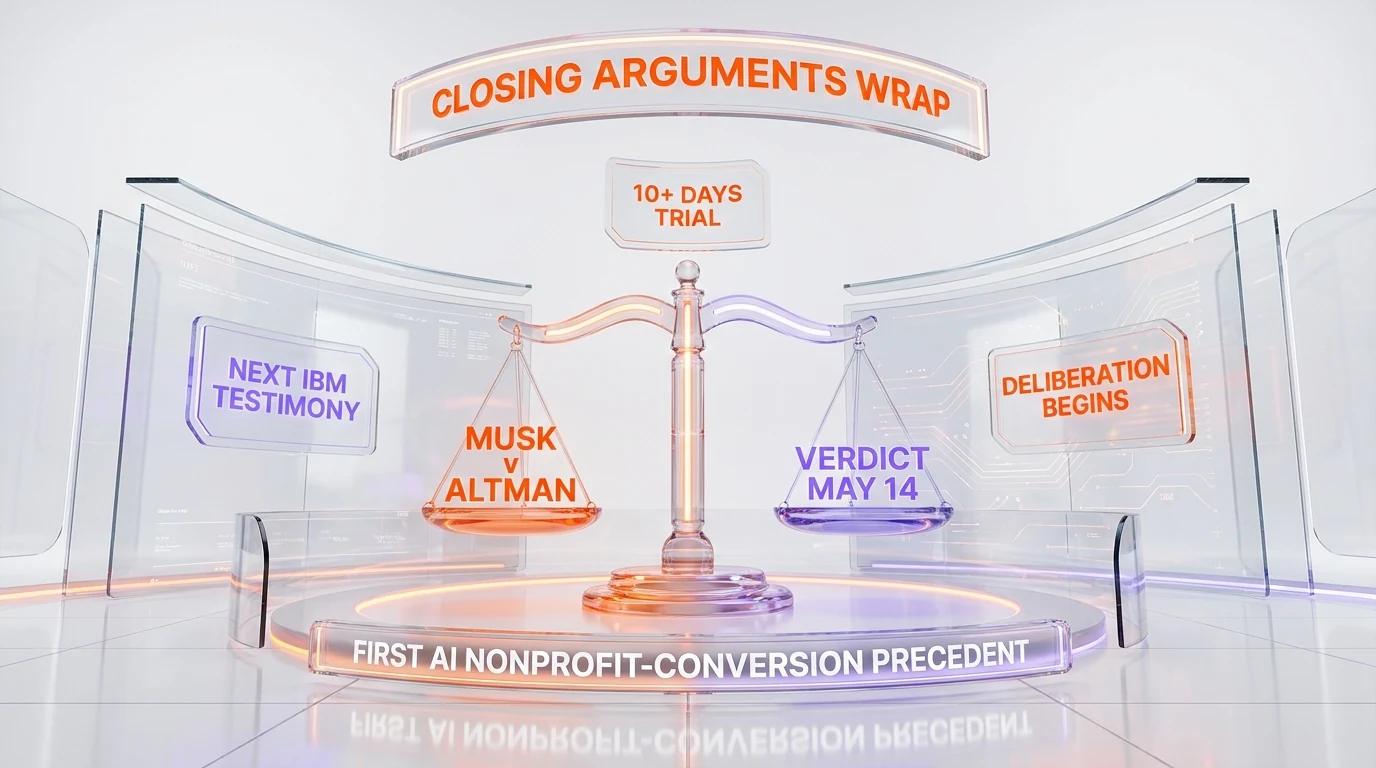
Closing arguments in Elon Musk v. Sam Altman wrapped on May 14, 2026, sending the case to jury deliberation after more than 10 days of testimony in the Northern District of California. The trial is the first major US legal test of whether an AI lab can convert from a nonprofit research entity into a for-profit public benefit corporation without violating the original charter — and the discovery phase has already delivered two bombshells that will outlive the verdict. Microsoft CEO Satya Nadella, per CNBC reporting on May 13, 2026, internally feared as early as April 2022 that Microsoft was on track to become "the next IBM" through its OpenAI dependency. Elon Musk, in turn, admitted under oath that xAI distills OpenAI models — a concession that lawyers across the AI industry are now studying closely. Axios confirmed the closing-arguments timing on May 14.
We have been tracking this case since the original complaint was filed, and the trial record reshapes three separate questions that the AI industry was operating on assumption rather than precedent. First, can a foundation-stage AI nonprofit lawfully convert into a for-profit equity vehicle without restoring control to founding donors. Second, does a cloud provider's compute exclusivity create a fiduciary obligation to the underlying model lab. Third, does training a competing frontier model on the outputs of another lab's released model constitute model theft, fair use, or something the courts have not yet named. Each of those three questions has now been argued under oath, and the answers are about to be public.
What the trial actually decides
The case in front of Judge Yvonne Gonzalez Rogers is narrower than the industry chatter suggests. Musk is not asking the court to dissolve OpenAI. He is asking the court to find that the 2024-2025 conversion of OpenAI from a capped-profit subsidiary structure into a Delaware public benefit corporation violated the original 2015 founding charter, that the conversion enriched Sam Altman and a small set of insiders, and that the nonprofit OpenAI Inc. parent entity was deprived of fair value when control shifted to the PBC. The remedies on the table range from a damages award to a full unwind of the conversion — and the jury has been instructed that the second option is on the menu, not just the first.
The defense, led by William Savitt of Wachtell Lipton Rosen Katz, has built its case on three pillars. The conversion was unanimously approved by the OpenAI board. The original charter contemplated commercial activity to fund the safety mission. And Musk himself, the defense argues, proposed in early 2018 that OpenAI fold into Tesla as a for-profit subsidiary — a proposal the board rejected, which the defense frames as the actual moment Musk lost standing to challenge a later commercial structure. The plaintiff team, led by Marc Toberoff, has countered that the 2018 Tesla proposal was conditional on retaining the safety mission and that the eventual PBC conversion stripped donor protections that Musk's $44 million in early contributions explicitly relied on.
The Microsoft "next IBM" revelation that reshaped week two
The single most consequential document entered into evidence during week two was an April 2022 internal Microsoft strategy memo, disclosed during discovery and described in CNBC's May 13 reporting. In the memo, Satya Nadella expressed concern that Microsoft's compute and capital commitments to OpenAI were creating a dependency relationship that could leave Microsoft "the next IBM" — a reference to IBM's 1980s positioning as the hardware partner of a software ecosystem that ultimately captured all the strategic upside. The memo predated the November 2022 ChatGPT launch by seven months. It also predated the multi-billion-dollar 2023 Microsoft investment in OpenAI by roughly nine months.
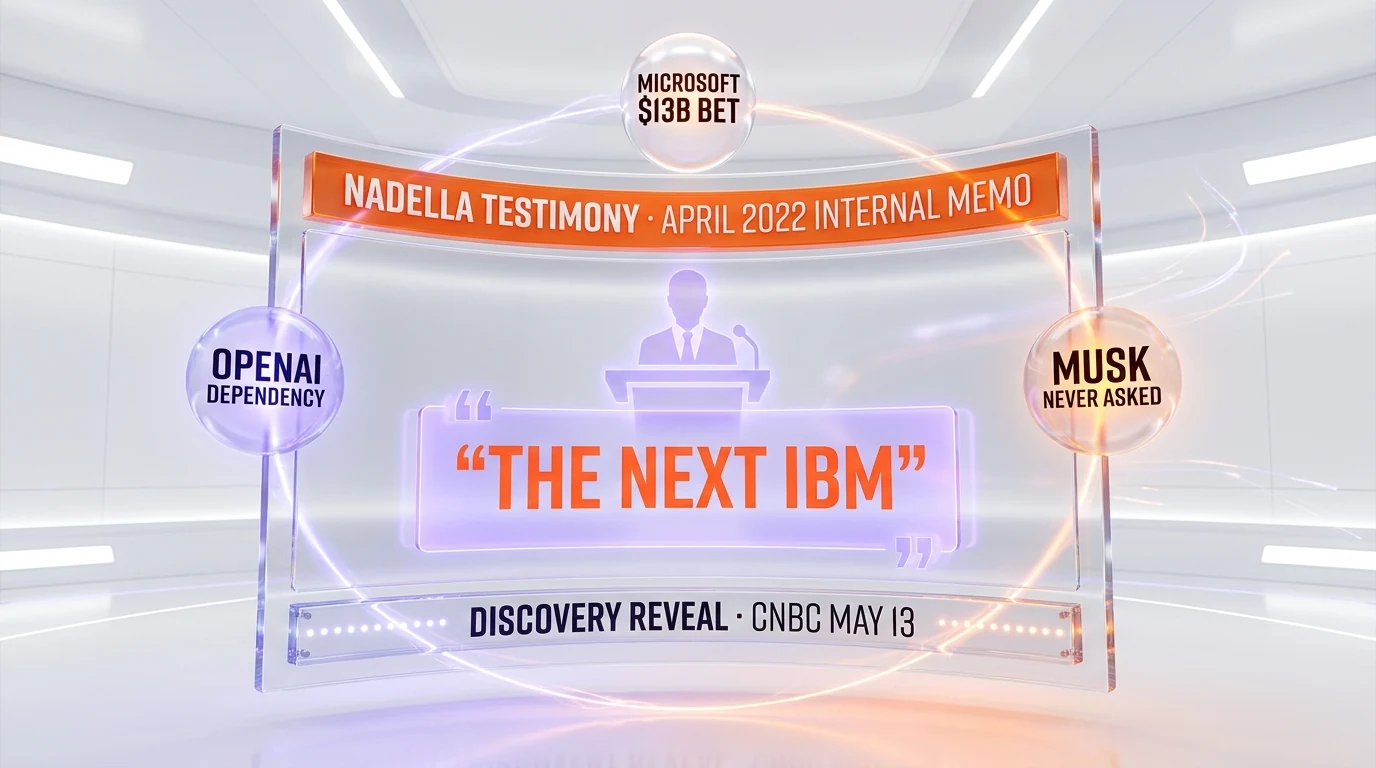
The strategic implication of the memo is not that Microsoft was naive about the OpenAI relationship. The opposite. Nadella documented the structural dependency risk at the CEO level, and Microsoft signed the multi-billion-dollar commitment anyway. That is a deliberate trade, not a miscalculation, and it reframes how every subsequent cloud-AI partnership should be read. Anthropic and Amazon. Mistral and Microsoft. xAI and the SpaceX Colossus stack. Every one of those deals is now operating with the Nadella memo as the implicit benchmark for what a CEO is willing to underwrite when the alternative is being locked out of the frontier model race entirely.
Nadella testified on May 11 in person. CNBC's account of the testimony notes that Nadella told the court Musk had never directly raised concerns about OpenAI's structure with him, and that Microsoft's investment decision was based on commercial strategy rather than any specific representation from Sam Altman about future conversion plans. That testimony is the defense's strongest contemporaneous record on the question of whether the conversion was foreseeable to industry partners in 2022. If Microsoft, the largest commercial counterparty, did not believe a conversion was on the table at the time of its first major investment, the plaintiff's argument that the conversion was a planned-from-inception structural pivot loses force.
Musk admits xAI distills OpenAI models — and the room shifts
The other bombshell of the trial came on May 13, when Musk took the stand for direct examination. Under questioning about xAI's training methodology, Musk acknowledged that the lab uses distillation techniques drawing on OpenAI's publicly released models. Distillation, in this context, refers to training a student model to mimic the outputs of a teacher model — a standard technique in the open-source community when the teacher is open-weight, but legally and reputationally fraught when the teacher is a commercial API operated by a competitor.
The admission matters in two directions. For the trial itself, the defense framed it as evidence of Musk's contradictory posture: Musk publicly criticizes OpenAI's commercial structure while operating a competing lab that derives training signal from OpenAI's outputs. For the broader industry, the admission turns a long-running technical rumor into a documented fact in a federal court record. Distillation from commercial APIs sits in a contested legal zone. OpenAI's terms of service prohibit using outputs to train competing models. A federal trial transcript in which xAI's founder describes the practice under oath becomes the foundational citation in every future case OpenAI brings against a competitor.
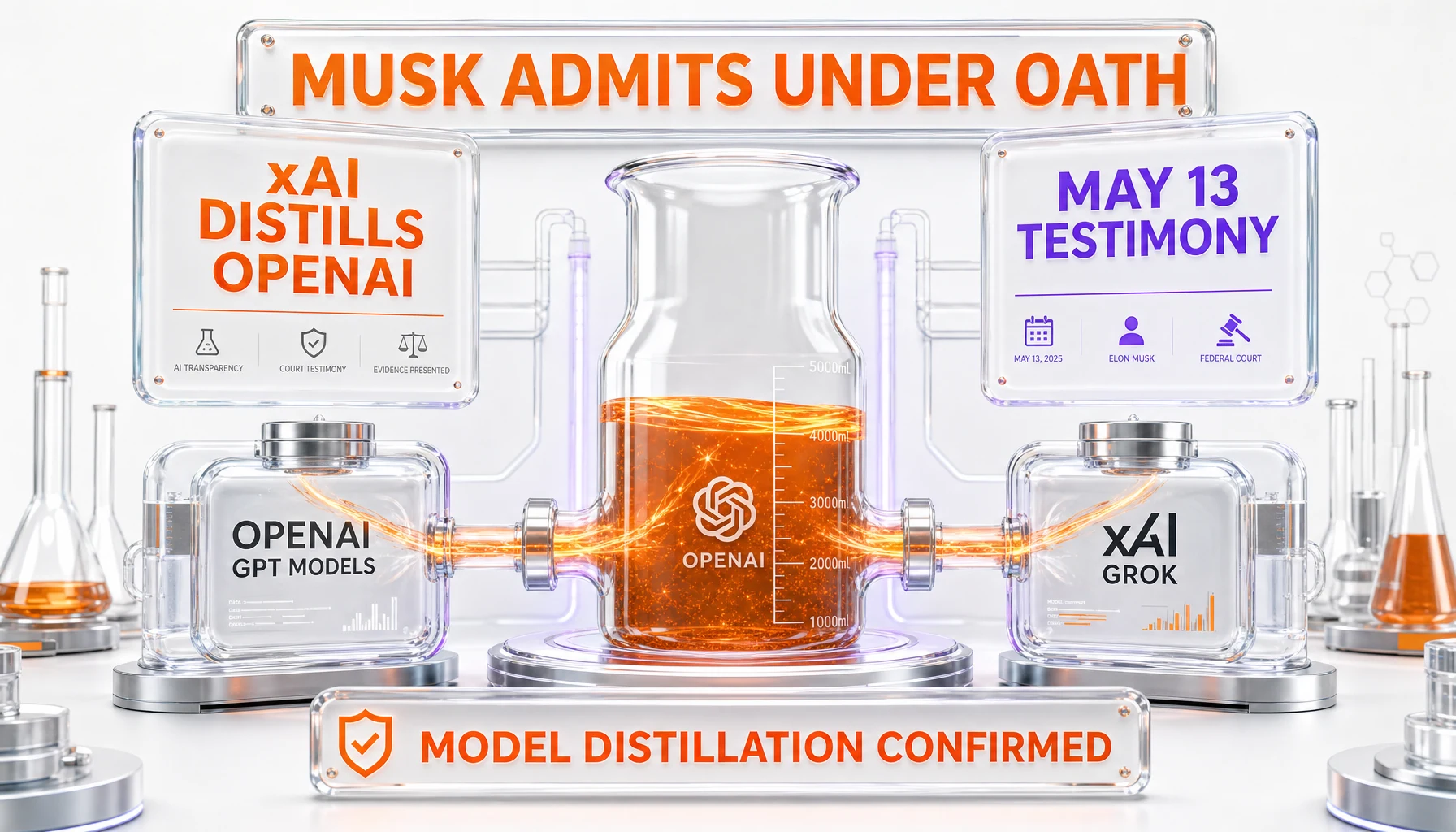
xAI's response, delivered through spokespeople rather than the trial record, has been that the techniques are industry-standard and that the models used were publicly accessible. That defense is structurally weak in litigation because publicly accessible is not the same as licensed for derivative training, and the OpenAI terms of service have been the controlling document for any commercial API access since 2023. The implication is that OpenAI has, sitting in the May 13 trial transcript, the strongest single piece of evidence it has ever obtained for a future commercial claim against xAI. That is not the trial's ostensible subject. It is the trial's most expensive collateral consequence for Musk.
Ten days of testimony: the shape of the record
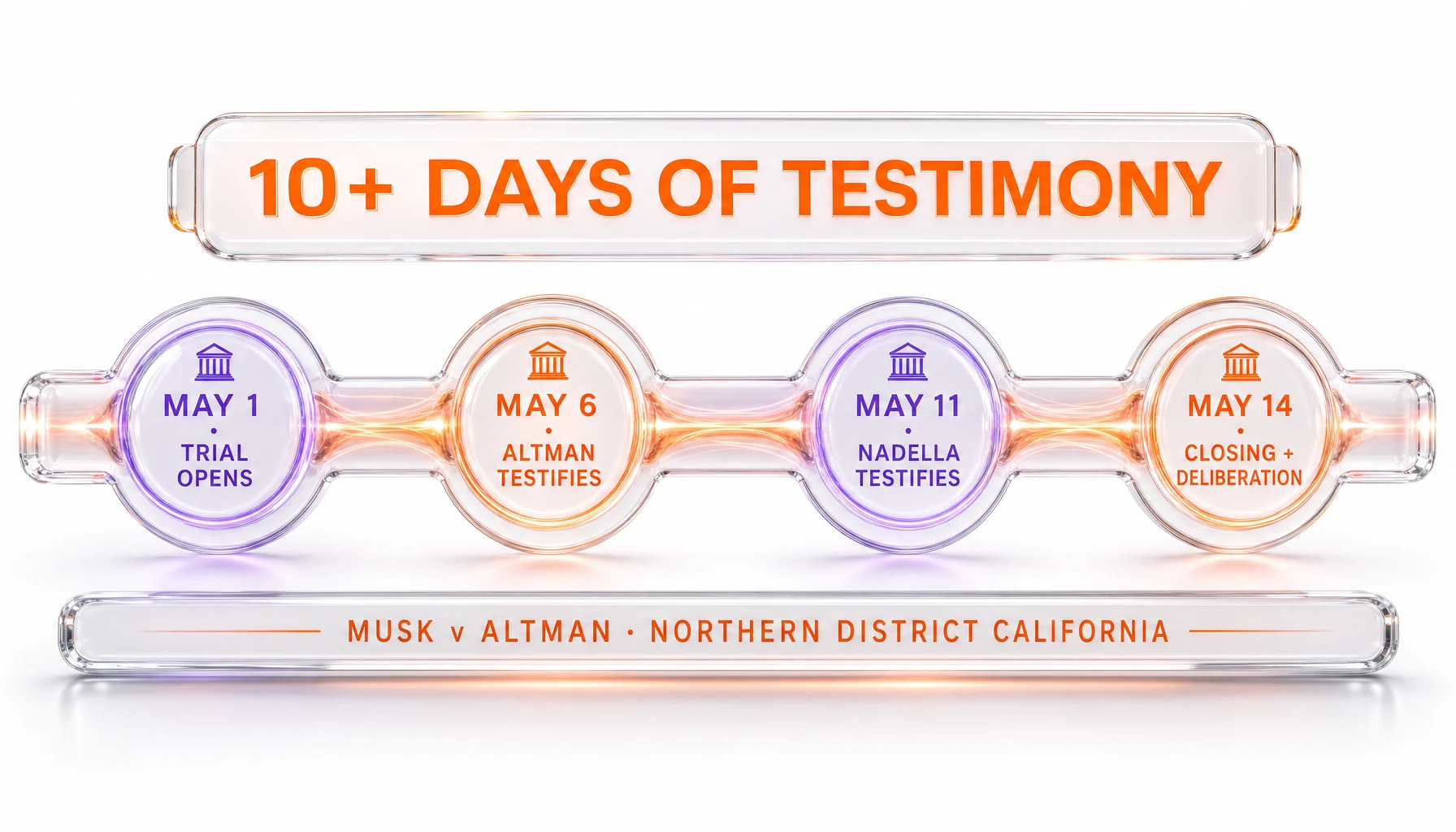
The trial opened on May 1, 2026 with jury selection and procedural motions. Opening statements were delivered on May 4. Sam Altman testified on May 6 and May 7. Greg Brockman testified on May 8. Mira Murati, who left OpenAI in 2024 and now runs Thinking Machines Lab, was called by the plaintiff on May 9 and offered limited testimony covering the period of her tenure under the original capped-profit structure. The court spent May 10 on documentary evidence including the founding emails between Musk, Altman, and Brockman from 2015 — emails that have been partially public since the original complaint but were entered with full annotation for the first time during trial.
Nadella testified May 11 in person. Reid Hoffman, an early OpenAI board member, testified May 12. Musk took the stand May 13 for direct and cross-examination. May 14 brought rebuttal witnesses and closing arguments. The jury, a panel of nine selected from the Northern District pool, begins deliberation immediately after closing arguments and is expected to return a verdict within five to ten business days based on the technical complexity of the conversion documents and the size of the damages question.
What the jury actually decides (and what it cannot decide)
The verdict form, finalized during the May 13 jury instructions conference, asks the jury to answer six discrete questions. Was the 2015 OpenAI founding agreement a binding contract or a statement of intent. Did the 2024-2025 PBC conversion materially alter that agreement. Was Sam Altman personally enriched by the conversion in a manner that the founding agreement prohibited. Did Musk suffer damages from the conversion in his capacity as a donor. If yes, what is the dollar amount of those damages. And finally, separately, did the conversion violate California state law on charitable trust principles.
The jury cannot order the unwind of the conversion directly. That is a remedy reserved for the court if the jury answers the first four questions in Musk's favor with sufficient damages findings. The most likely outcomes, based on the trial record, are a partial finding for Musk with damages in the $500 million to $2 billion range, a complete defense verdict, or a mixed finding that establishes the contract violation but assigns nominal damages while leaving the conversion intact. The full-unwind scenario remains theoretically possible but is the least likely on the trial evidence, primarily because the practical disruption to OpenAI's operations would be a remedy the court has signaled it is reluctant to order.
The precedent the AI industry actually gets
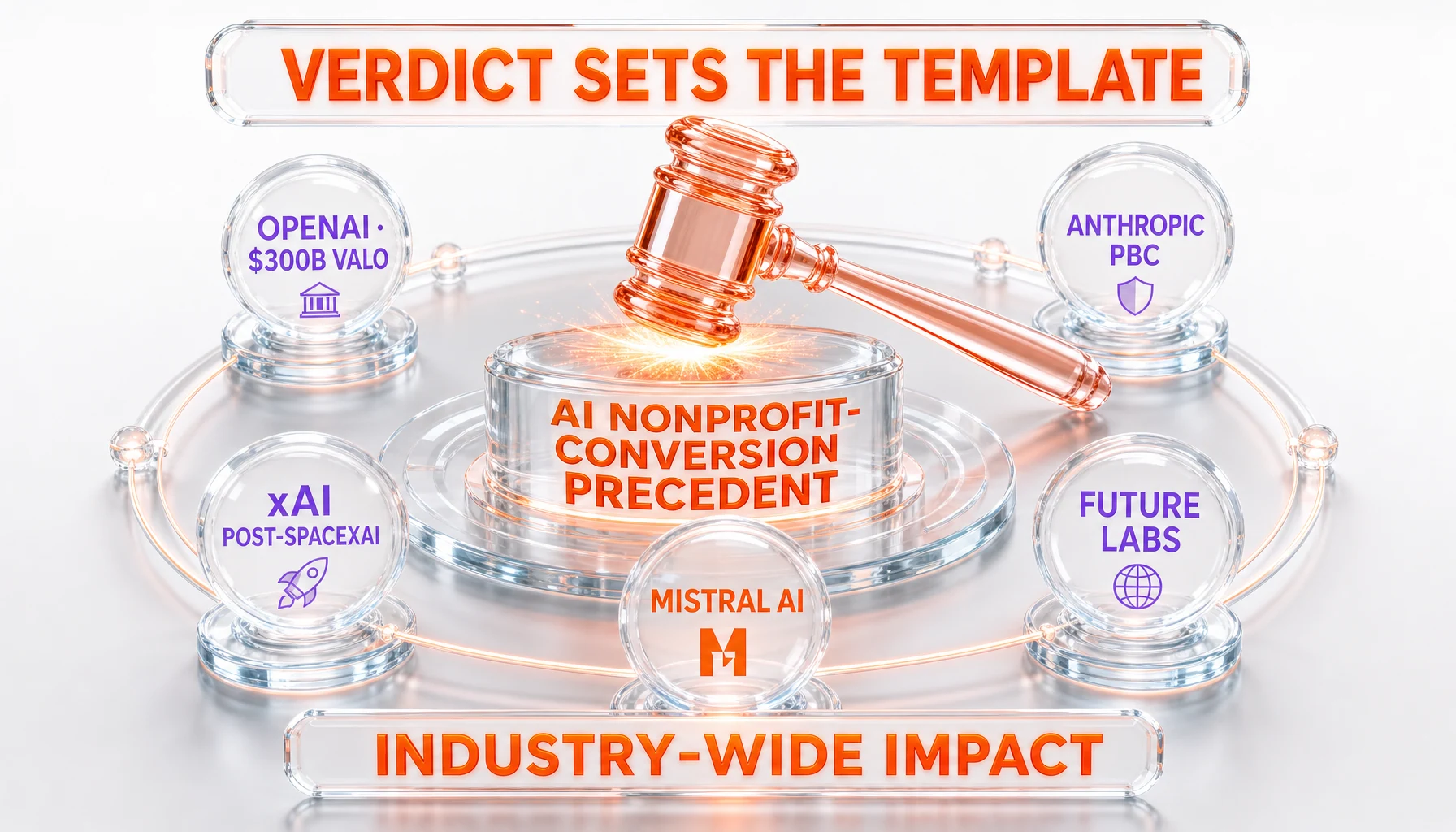
Whatever the jury decides, the trial record now sits as the single most detailed public document on the governance and capital structure of a frontier AI lab. That has consequences far beyond the question of whether Musk wins damages. Every AI nonprofit that has signaled or considered a PBC conversion — and there are several — now has a template for what the legal challenge looks like. Anthropic, structured as a PBC from inception, sits in a different posture but has paid close attention to the trial because its IPO path through late 2026 depends on courts treating PBC conversions as legitimate.
The OpenAI structure itself is now exhaustively documented in trial exhibits. The capped-profit subsidiary mechanics. The board composition changes through 2023 and 2024. The compensation arrangements for Altman and the executive team during the conversion period. The Microsoft contractual exclusivity terms. Each of those documents, sealed or partially redacted in trial filings, is now legally citable as discovery in any future case. That is the most durable consequence of the trial regardless of verdict: the AI industry no longer operates with founding-stage governance documents treated as proprietary.
For context on how the OpenAI structure has evolved beyond the trial period, our analysis of the OpenAI Deployment Company $4 billion joint venture walks through the May 2026 partnership with Bain, McKinsey, Capgemini, and the Tomoro acquisition — the post-conversion commercial expansion that the plaintiff's argument frames as the predictable downstream consequence of the structural pivot Musk is challenging.
What this changes for Musk (and xAI's successor)
Musk himself is not the focal point of the case mechanics but he is the focal point of the strategic narrative. The same week as closing arguments, xAI completed its formal dissolution into SpaceXAI, the consolidation we covered in the xAI dissolved into SpaceXAI analysis. The timing is not coincidental. Musk's posture toward OpenAI required xAI as the competing commercial vehicle. With xAI folded into SpaceX's broader infrastructure, the trial becomes a question of legacy rather than current commercial standing. That shift may strengthen the defense's argument that Musk's damages claim is now ahistorical — the alternative AI strategy he is asserting OpenAI deprived him of has itself been wound down.
The xAI distillation admission is the bigger problem. As the SpaceXAI consolidation completed and the trial closed, the OpenAI legal team gained a federal trial transcript admission of practices their terms of service prohibit. The scale of the post-trial legal exposure for the SpaceXAI entity, in our reading, exceeds the size of any plausible damages award Musk wins against Altman. That is the inversion the trial produces: Musk may win the case and lose the war that follows.
SpaceXAI and Anthropic: the next ten years of context
The trial verdict will land in a market where the AI lab landscape has consolidated dramatically since the lawsuit was filed. The xAI and SpaceX merger valued at $1.25 trillion rewrote the competitive landscape Musk was litigating against. Anthropic moved toward IPO at $350 billion pre-money. Mistral consolidated European AI development. The OpenAI structure Musk is challenging is no longer the only or even the dominant frontier model commercial vehicle.
That changes how the jury's damages calculation gets framed. The plaintiff argument that Musk was deprived of value he could have built through an alternative OpenAI structure has to contend with the empirical fact that Musk built that alternative — xAI — and that the alternative has now been absorbed into a different commercial vehicle entirely. The defense will close on exactly that point. The plaintiff will counter that Musk's alternative path required dilutive funding rounds and operational compromises that the original OpenAI nonprofit structure was designed to avoid, and that the conversion forced him into a competing commercial structure that itself proved insufficient.
The marketing and narrative dimension that bleeds into the case
One sidebar that came up repeatedly during witness examination was the question of public-facing narrative posture between OpenAI and its competitors. Plaintiff counsel pressed Altman on the May 2026 Anthropic exchange — the public exchange Sam Altman made about Anthropic's marketing approach, which we covered in the Altman vs Anthropic fear-based marketing takedown. The line of questioning attempted to establish that Altman's external posture toward competitors is consistent with an internal posture toward Musk: dismiss the challenge, control the narrative, frame the competitor as operating in bad faith. Defense counsel objected and most of the line was struck, but the framing entered the trial atmosphere and may surface in the closing arguments themselves.
The strategic point is narrower than the soap-opera tone suggests. Altman's narrative posture toward competitors is documented enough that the plaintiff team did not need original testimony to establish the pattern. That posture, applied to Musk's 2018 departure from the OpenAI board, becomes part of the plaintiff's argument that Altman has consistently treated dissent within and around OpenAI as an inconvenience to be dismissed rather than a fiduciary obligation to be addressed.
The frontier models the verdict touches
The commercial products downstream of this case continue to ship and grow market share regardless of the legal outcome. Our coverage of ChatGPT as the consumer flagship, Claude as the Anthropic alternative, and Grok as the xAI line, reflects the operational reality that the trial does not pause product roadmaps. None of those teams have indicated any internal slowdown waiting for the verdict. Engineering ships, product launches, and the legal question gets resolved on a parallel timeline.
That parallelism is itself a structural argument the defense has leaned on during closing. If the OpenAI conversion had truly harmed the mission, the argument goes, ChatGPT and the API ecosystem would not have continued accelerating safety research investment, model release cadence, and developer tooling. The plaintiff counter is that acceleration is not evidence of mission compliance — it is evidence of commercial pressure that the original nonprofit structure was specifically designed to dampen. Whether the jury reads acceleration as success or as deviation will determine the damages line.
How the verdict changes the Anthropic IPO and SpaceXAI roadmap
Two specific commercial events sit downstream of the verdict in ways that will be visible immediately. Anthropic's reported October 2026 IPO timing assumed that the Musk v. Altman trial would either settle or close before the registration statement filed for public comment. The closing-arguments wrap on May 14 keeps that timing intact. A clean defense verdict in Musk v. Altman accelerates Anthropic's IPO underwriting calculus because it removes the discount that institutional investors apply to PBC structures in jurisdictions where the legal framework is unsettled. A plaintiff win at any damages level introduces friction into that calculus.
For SpaceXAI, the verdict is more direct. A plaintiff win that establishes a precedent for unwinding a nonprofit-to-PBC conversion creates immediate exposure for any AI lab that has executed or contemplated similar restructuring. SpaceXAI itself is not in that position — it was built as a commercial entity from inception — but the post-trial OpenAI legal posture toward distillation, now armed with Musk's own admission, is the live commercial risk Musk and his lawyers will be triaging in the days after the verdict, regardless of which side prevails on the main question.
What would prove our reading wrong
Three scenarios would force a material revision of the analysis above. First, a full unwind ordered by the court would reset OpenAI's commercial structure overnight and trigger consequences for Microsoft's investment that we are not currently modeling. That outcome remains the least likely on the trial evidence, but a sufficiently aggressive damages finding combined with a charitable trust ruling could push the court toward equitable remedies beyond monetary damages.
Second, the OpenAI legal team could decide that pursuing distillation claims against SpaceXAI based on the May 13 trial admission carries reputational risk that outweighs the commercial gain. Public legal action between Musk and Altman has so far been one-directional. A retaliatory OpenAI suit against SpaceXAI based on the trial transcript would be a significant escalation, and a strategic decision not to pursue it would soften the secondary consequence we describe in the SpaceXAI section.
Third, the Nadella memo could prove less consequential to industry partnership structures than the trial framing suggests. If, six months after the verdict, no observable behavioral change appears in subsequent cloud-AI deal terms — same exclusivity clauses, same dependency structures — that would be evidence that CEOs broadly were already pricing in the "next IBM" risk and the memo's disclosure changes optics rather than strategy. We would revise the structural-implication argument accordingly if that materializes.
Our read on what prints next
The most likely outcome, based on the trial record we have observed across the public filings and the press reporting on closing arguments, is a mixed verdict that finds limited contract liability with damages in the $300 million to $1 billion range, leaves the PBC conversion intact, and produces no charitable trust finding. That outcome lets both sides claim partial victory. Musk gets a damages award and the validation that the conversion violated some part of the founding agreement. Altman keeps the operating structure intact and the OpenAI commercial trajectory uninterrupted. The Anthropic IPO timeline stays on track. The Microsoft "next IBM" memo enters the historical record as the most-cited internal corporate document in AI industry history.
The xAI distillation admission is the wildcard that no commentator has fully priced. Inside OpenAI's general counsel office, that admission is a complete reset on the commercial-API protections strategy. Inside SpaceXAI, it is a six-to-twelve-month legal containment problem that will require either licensing negotiations, technical re-architecture of the training pipeline, or a quiet legal settlement that takes the question off the table before OpenAI files. Whichever path SpaceXAI chooses, the trial that Musk pursued for nonprofit governance reasons has handed his competitor the single best piece of legal ammunition the AI industry has produced this decade.
The verdict prints within ten business days of May 14. The full consequences print over the next ten years.
Frequently Asked Questions
When does the Musk v. Altman trial verdict come out?
Closing arguments wrapped on May 14, 2026 and the case went immediately to jury deliberation. The jury, a nine-person panel from the Northern District of California pool, is expected to return a verdict within five to ten business days, putting the verdict window roughly between May 21 and May 28, 2026.
What is the "next IBM" testimony about?
During discovery, an April 2022 internal Microsoft memo was disclosed in which Satya Nadella expressed concern that Microsoft was on track to become "the next IBM" because of its OpenAI dependency. CNBC reported the discovery on May 13, 2026. The memo predated the November 2022 ChatGPT launch by seven months and predated the multi-billion-dollar Microsoft investment by roughly nine months.
Did Satya Nadella testify in the Musk v. Altman trial?
Yes. Nadella testified in person on May 11, 2026. Per CNBC's account, Nadella told the court that Musk had never directly raised concerns about OpenAI's structure with him, and that Microsoft's investment decision was based on commercial strategy rather than any specific representation from Altman about future conversion plans.
Did Elon Musk admit that xAI distills OpenAI models?
Yes. Under questioning on May 13, 2026, Musk acknowledged that xAI uses distillation techniques drawing on OpenAI's publicly released models. Distillation refers to training a student model to mimic the outputs of a teacher model. OpenAI's commercial API terms of service prohibit using outputs to train competing models, which makes the sworn admission consequential beyond the trial itself.
What is the OpenAI nonprofit-to-PBC conversion that is being challenged?
OpenAI began in 2015 as a nonprofit research entity. It added a capped-profit subsidiary structure to attract capital, then converted in 2024-2025 into a Delaware public benefit corporation. Musk's complaint argues that the conversion violated the original 2015 founding charter and enriched Sam Altman and a small set of insiders at the expense of the nonprofit parent's mission.
Can the jury order OpenAI to unwind its PBC conversion?
The jury cannot order the unwind directly. The verdict form asks six discrete questions about contract violation, personal enrichment, damages amount, and California charitable trust principles. A full unwind of the conversion is a remedy reserved for the court if the jury answers the first four questions in Musk's favor with sufficient damages findings. The full-unwind scenario remains theoretically possible but is the least likely outcome on the trial evidence.
Who are the lawyers in Musk v. Altman?
The plaintiff team is led by Marc Toberoff. The defense is led by William Savitt of Wachtell Lipton Rosen Katz, representing Sam Altman and OpenAI. The case is being heard in the Northern District of California in front of Judge Yvonne Gonzalez Rogers.
What damages is Musk asking for?
Musk has not requested a specific dollar amount in the trial pleadings. Based on the trial record and the structure of the verdict form, the most likely damages range, if the jury finds for the plaintiff on contract liability, is between $300 million and $2 billion. Our base case is a partial finding with damages in the $300 million to $1 billion range, leaving the PBC conversion intact.
How does the verdict affect Anthropic's IPO timing?
Anthropic's reported October 2026 IPO assumed the Musk v. Altman trial would settle or close before the registration statement filed for public comment. The May 14 closing-arguments wrap keeps that timing intact. A clean defense verdict accelerates Anthropic's IPO underwriting calculus by removing the PBC structural discount. A plaintiff win at any damages level introduces friction into that calculus.
What is the biggest consequence of the trial for SpaceXAI?
The May 13 distillation admission. OpenAI's terms of service prohibit using outputs to train competing models. Musk's sworn admission that xAI uses distillation on OpenAI's released models converts a long-running technical rumor into a federal court record. The post-trial legal exposure for SpaceXAI from a future OpenAI commercial claim potentially exceeds the size of any plausible damages award Musk wins against Altman.
Is this the first AI nonprofit-conversion trial?
Yes. Musk v. Altman is the first major US legal test of whether an AI lab can convert from a nonprofit research entity into a for-profit public benefit corporation without violating the original charter. The verdict establishes the legal template for how every future AI nonprofit-to-PBC conversion will be challenged or defended.
What should AI builders and operators watch in the weeks after the verdict?
Five signals to track between the May 14 closing and the end of June 2026: the verdict itself and its damages math, any OpenAI legal action against SpaceXAI citing the May 13 distillation admission, changes to cloud-AI partnership exclusivity terms in subsequent industry deals, Anthropic's IPO registration statement timing, and any settlement language between OpenAI and other parties whose model outputs may have been used for training by competing labs.