Grok 4.5 vs MiniMax M3: Frontier Price vs Open-Weight Value (2026)
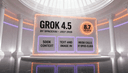

Grok 4.5 scores 54 to MiniMax M3's 44 on one independent index — but MiniMax runs five times cheaper, doubles context to 1M, and ships open weights.
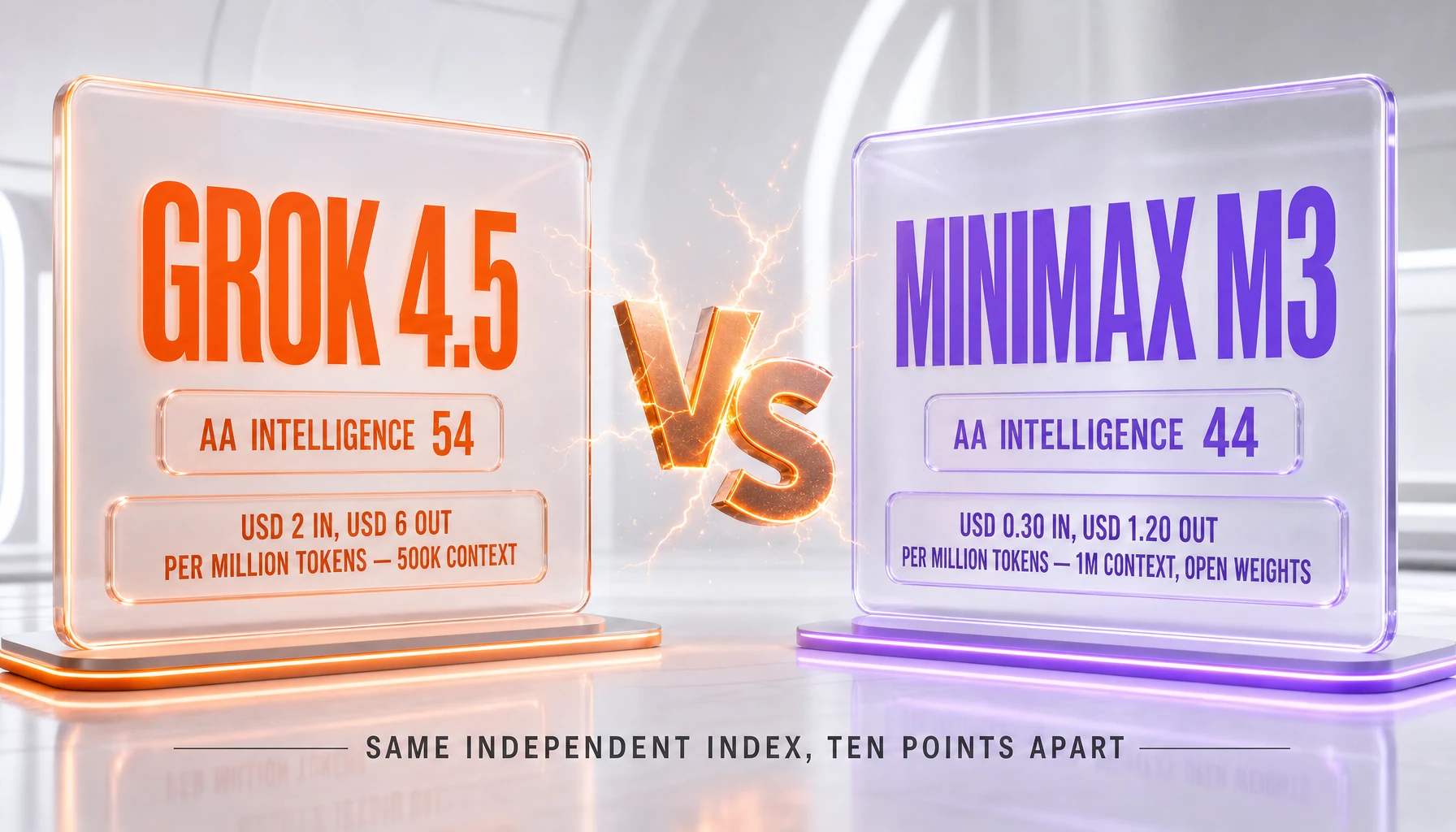
Feature Comparison
| Feature | Grok 4.5 | MiniMax M3 |
|---|---|---|
| Independent intelligence score (Artificial Analysis Intelligence Index v4.1) | 54 — measured by an independent evaluator on version 4.1 of the index | 44 — measured by the same evaluator on the same index version, ten points below; the open-weight leader, level with DeepSeek V4 |
| Maximum context window | 500,000 tokens | 1,000,000 tokens — twice as much |
| Input price (per million tokens) | USD 2.00 | USD 0.30 up to 512K context — just under seven times cheaper |
| Output price (per million tokens) | USD 6.00 | USD 1.20 up to 512K context — exactly five times cheaper, on the line that drives most bills |
| Long-context pricing (above 512K tokens) | Doubles above 200K: USD 2 input and USD 6 output below the threshold, USD 4 and USD 12 above it | Doubles above 512K to roughly USD 0.60 input and USD 2.40 output — still cheaper than Grok, but the full 1M window is not billed at the headline rate |
| Independently measured intelligence per dollar of output | About 9 index points per dollar of output | About 37 index points per dollar of output — roughly four times more, both sides independently sourced |
| Independent coding evidence | An Artificial Analysis Coding Agent Index v1.3 result of 64.44, produced by an independent evaluator | None. No independent coding score has been published for this model; its coding numbers come only from the vendor |
| Vendor self-reported coding benchmark | Not the basis of its coding case — its coding figure is independently charted | SWE-bench Pro 59 percent, self-reported by MiniMax on its own infrastructure and not independently reproduced |
| Model weights and licensing | Closed and proprietary. API only, no weights released | Positioned as open-weight; weights and technical report committed within ten days of launch but pending at the time of writing |
| Self-hosting and data residency | Not possible — managed API only | Intended to be self-hostable once weights ship; hosted API meanwhile is operated from China, under Chinese data law |
| Architecture transparency | Not disclosed by SpaceXAI | Published: mixture-of-experts, roughly 428 billion total parameters with about 23 billion active, MiniMax Sparse Attention (MSA) |
| Independent hallucination measurement (AA-Omniscience) | A 54 percent hallucination rate — a measured weakness on a different axis from the Intelligence Index, which happens to share the same number | No published measurement — unknown rather than good |
| Native multimodality | Multimodal input, text output; no native image generation | Native multimodality trained from step zero — text, image, and video input |
| European Union availability | Restricted in the EU as of mid-July 2026 under the EU AI Act; SpaceXAI has signalled a staged opening, so verify for your region — this changes fast | Available; as an open-weight model it can ultimately be self-hosted inside the EU |
| Hosted metered API | Available from SpaceXAI, OpenAI-compatible | Available from MiniMax, operated from China |
Pricing Comparison
Grok 4.5
MiniMax M3
Detailed Comparison
Grok 4.5 and MiniMax M3 sit at opposite ends of the value curve. Grok 4.5, from SpaceXAI (formerly xAI), scores 54 on the independent Artificial Analysis Intelligence Index against MiniMax M3's 44 — ten measured points. MiniMax M3 answers with output that costs five times less, twice the context at one million tokens, and an open-weight design. There is no single winner here: pick Grok 4.5 for independently proven capability, MiniMax M3 for price, context, and control.
We ran both models side by side over July 2026 — Grok 4.5 through the SpaceXAI API where we could reach it, and MiniMax M3 through its hosted API — and this comparison is about a genuine trade-off rather than a knockout. One model is a capable, expensive, closed frontier system whose intelligence has been measured by someone other than the company that built it. The other is an open-weight, ultra-cheap challenger with twice the context and a much lower bill, whose capability claims are, for now, mostly the vendor's own. The interesting question is not which model is stronger on paper. It is which trade-off fits the work in front of you.
Quick verdict
This one splits, and we are calling it a split rather than manufacturing a winner. Grok 4.5 wins measured intelligence — 54 to 44 on the same independent index — and it is the only one of the two with an independently charted coding score, which makes it the pick when you need capability that a third party has actually verified. MiniMax M3 wins nearly everything else: output that costs five times less, twice the context window, an open-weight design you can eventually self-host, published architecture, and native multimodality. MiniMax M3 wins more rows in the table further down this page; that is not the same as winning the decision. Grok 4.5 owns the one axis where the evidence is independent, and MiniMax M3's advantages lean on numbers the vendor has not yet let anyone else check. Choose the axis that binds your work, and the model chooses itself.
Grok 4.5 and MiniMax M3 at a glance
Grok 4.5 is the flagship reasoning model from SpaceXAI, the company formerly known as xAI, which rebranded on July 6, 2026 after the SpaceX–xAI merger. It is closed and API-only, with a 500,000-token context window, and it scores 54 on version 4.1 of the independent Artificial Analysis Intelligence Index — fourth in the frontier tier, behind Claude Fable 5, GPT-5.5, and Opus 4.8, but priced well below them at USD 2 per million input tokens and USD 6 per million output tokens. Its case rests on measurement: an independent Artificial Analysis Coding Agent Index v1.3 result of 64.44 places it among the charted entries on agentic coding, measured through the Grok Build harness at high effort. Two things scope its appeal hard — it carried an EU restriction for its first nine days, lifted on July 17, 2026, and it carries a measured 54 percent hallucination rate on the independent AA-Omniscience evaluation.
MiniMax M3, released on June 1, 2026, is an open-weight frontier model from MiniMax built as a mixture-of-experts design — roughly 428 billion total parameters with about 23 billion active per token — with a new MiniMax Sparse Attention (MSA) mechanism and native multimodality trained in from step zero. It scores 44 on the same version 4.1 of the independent Artificial Analysis Intelligence Index, which makes it the open-weight leader, level with DeepSeek V4 and just ahead of Kimi K2.6. Its headline is economics: USD 0.30 per million input tokens and USD 1.20 per million output tokens, a one-million-token context window, and weights the company committed to publishing within ten days of launch. The catch is that every capability number it advertises is, for now, vendor-reported and unverified by anyone outside MiniMax.
The head-to-head comparison
The table below is the neutral spec sheet. Everything in the left three columns is either a vendor list price or an independent Artificial Analysis figure — we have kept vendor self-reported benchmarks out of it deliberately, because those belong in their own clearly labeled discussion further down.
| Attribute | Grok 4.5 | MiniMax M3 |
|---|---|---|
| Publisher | SpaceXAI (formerly xAI) | MiniMax |
| Released | July 2026 | June 1, 2026 |
| Independent AA Intelligence Index (v4.1) | 54 | 44 |
| Context window | 500,000 tokens | 1,000,000 tokens |
| Input price (per million tokens) | USD 2.00 | USD 0.30 up to 512K context |
| Output price (per million tokens) | USD 6.00 | USD 1.20 up to 512K context |
| Long-context pricing | Doubles above 200K | Doubles above 512K |
| Model weights | Closed, API only | Open-weight (weights pending at launch) |
| Architecture | Undisclosed | MoE, ~428B total / ~23B active, MSA |
| Multimodality | Multimodal input, text output | Native text, image, video input |
| EU availability | Restricted as of mid-2026 | Available; self-hostable in future |
Pricing: what each model actually costs
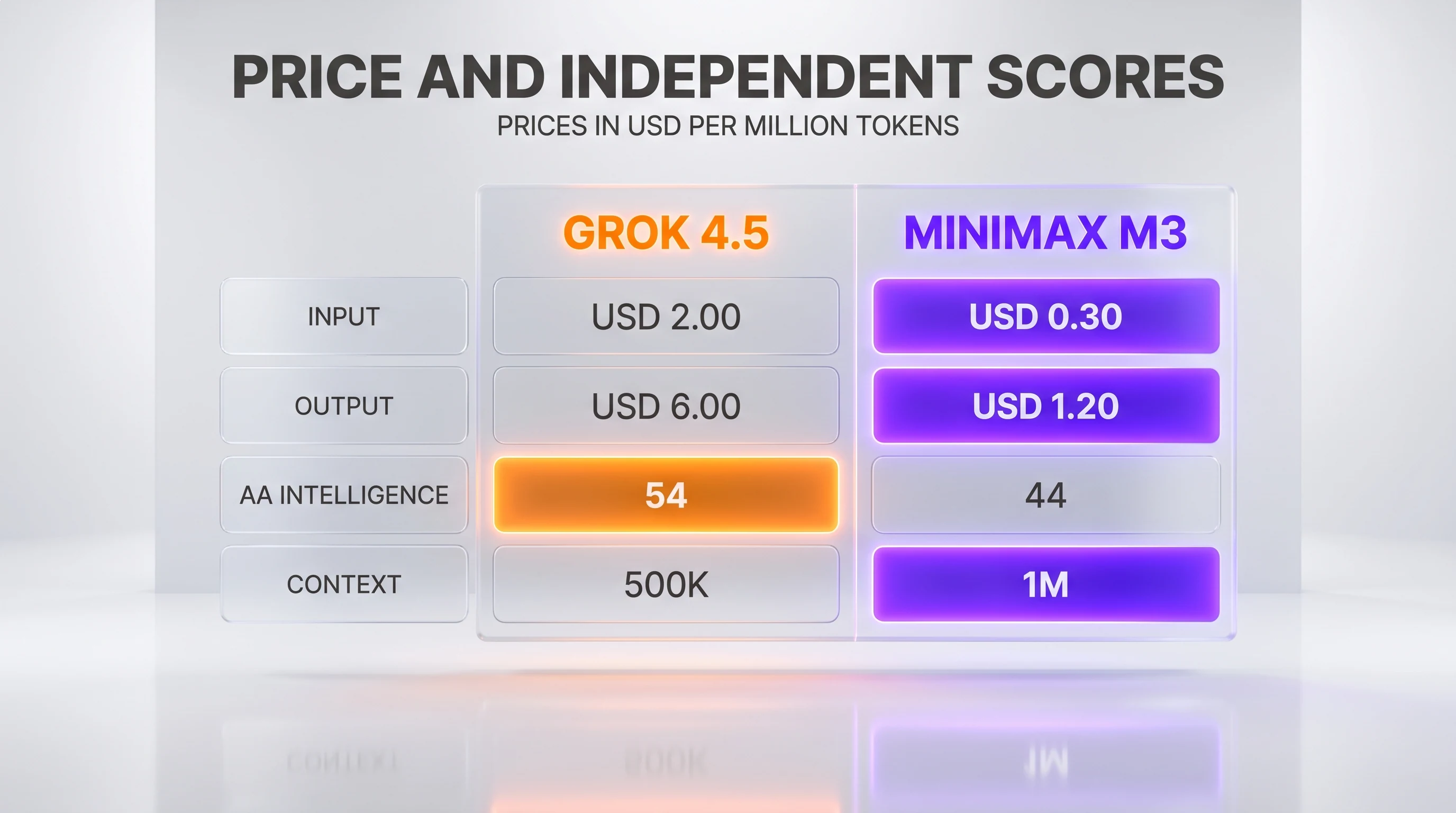
This is where the comparison stops being close. Grok 4.5 is already one of the cheapest frontier-tier models — USD 2 per million input tokens, USD 0.30 cached, and USD 6 per million output tokens, roughly half the price of Claude Opus 4.8 or GPT-5.6 Sol. MiniMax M3 undercuts even that, and not by a little: USD 0.30 per million input tokens and USD 1.20 per million output tokens for context up to 512K. That is just under seven times cheaper on input and exactly five times cheaper on output.
Output price is the line that dominates a real coding or agent bill, because models emit far more than they read on iterative work. A workload that produces twenty million output tokens in a month costs about USD 120 on Grok 4.5 and about USD 24 on MiniMax M3 at the standard rate — a gap of roughly USD 96, five to one. Scale that to a team running hundreds of millions of output tokens a month and the difference is a budget line, not a rounding error.
There is one asterisk on MiniMax M3's price, and it matters for long-context work. The USD 0.30 and USD 1.20 rates apply up to 512K tokens of context. Above that, and its window runs to a full one million tokens, the per-token rate doubles to roughly USD 0.60 input and USD 2.40 output. Even doubled, MiniMax M3 stays cheaper than Grok 4.5 — about three times on input and two and a half times on output — but the top half of that headline context window is not billed at the headline price. Budget for the higher figure whenever you actually fill the window.
Put capability and price together and the value math is stark. Measured against dollars of output, both sides of the ratio independently sourced — the scores from Artificial Analysis, the prices from each vendor's list — MiniMax M3 returns roughly four times as many index points per output dollar: 44 points at USD 1.20 against 54 points at USD 6. Grok 4.5's ten-point lead is real, and it is measured. It is also expensive.
How we tested
We treated this the way we treat every model comparison: run the same prompts through both, read the independent benchmarks rather than the press releases, and be explicit about what we could and could not verify ourselves. Grok 4.5 we exercised through the SpaceXAI API on structured-output, reasoning, and short agentic-coding tasks, where it was fast — responses under five seconds on our tasks — and reliable on schema-valid JSON. MiniMax M3 we exercised through its hosted API on comparable tasks.
Where we lean on numbers, we lean on independent ones. The Intelligence Index and Coding Agent Index figures come from Artificial Analysis, a third party that runs its own harness. That is a deliberate choice, because the two models are asymmetric in how much of their story is independently checked. Grok 4.5's headline capability figures are third-party-measured. MiniMax M3's are, for now, the vendor's own — so wherever a MiniMax benchmark appears on this page, we label it vendor-reported, and we never set it against an independent Grok 4.5 figure as if the two were the same kind of evidence.
Coding: independent evidence versus vendor claims
Both models are pitched partly as coding tools, and both have a coding number attached. The difference is who produced each number. Grok 4.5 is charted on the Artificial Analysis Coding Agent Index v1.3 at 64.44, measured through the Grok Build harness at high effort and read on August 2, 2026 — the strongest part of its case. It is a figure a disinterested party stands behind.
MiniMax M3's coding evidence is a different kind of thing, which is why we discuss it in its own paragraph rather than in the same breath. The company reports a strong SWE-bench Pro result, and it ships a dedicated MiniMax Code agent for autonomous workflows, but the score is measured by MiniMax on its own infrastructure, on a different benchmark family, and has not been reproduced by any independent evaluator. We give the specific vendor figure in the section below on MiniMax M3's benchmarks, kept well away from Grok 4.5's independent number, because the two are not in the same units and not the same class of evidence. Placing them side by side would fake a comparison that does not exist.
Where MiniMax M3's benchmarks stand
MiniMax M3's technical pitch is genuinely impressive, and it is worth stating clearly. On its own testing, MiniMax reports a SWE-bench Pro score of 59 percent, alongside large speedups from the new MSA sparse-attention design — the company cites more than nine times faster prefill and more than fifteen times faster decode against its previous generation at long context. It is a multimodal, mixture-of-experts model of roughly 428 billion total parameters with about 23 billion active, and MiniMax committed to publishing the weights and a technical report within ten days of launch.
Every one of those figures is vendor-reported. None had been reproduced by an independent evaluator at the time of writing, and the open weights that would let others check them were still pending despite the ten-day commitment. That does not make the numbers false — MiniMax has shipped strong models before — but it does mean they carry a vendor-reported label until someone outside the company confirms them. It is also why MiniMax M3's one independently measured figure, its Intelligence Index, does the heavy lifting in our verdict, and its self-reported coding result does not.
Best for each use case
Best for independently proven capability: Grok 4.5
If your decision hinges on capability that a third party has actually measured — not promised — Grok 4.5 is the pick. Its ten-point Intelligence Index lead and its independent coding score are the only capability claims in this matchup that come from outside the vendor. For work where being wrong is expensive and you cannot afford to bet on unverified numbers, that independence is worth the premium.
Best for price and long context: MiniMax M3
If budget or context length is the binding constraint, MiniMax M3 wins without much argument. Five-times-cheaper output and a one-million-token window make it the rational default for high-volume agent work, large-document processing, and anyone whose bill scales with output tokens. The ten-point intelligence gap is headroom many workloads never touch.
Best for control and data residency: MiniMax M3, eventually
Open weights are MiniMax M3's structural advantage over a closed API. Once the weights ship, you can self-host, fine-tune, and keep data inside your own perimeter — none of which Grok 4.5 permits. The caveat is timing and jurisdiction: until the weights are public, the only route is a hosted API operated from China, which is the wrong choice for regulated or confidential workloads.
EU availability: no longer a differentiator
Access to Grok 4.5 was restricted in the European Union when we first published this comparison. That changed on July 17, 2026, when SpaceXAI opened the model to EU users in the API console, so both are now reachable from the EU and this is no longer a reason to prefer one over the other. What still separates them for European buyers is where each is operated: Grok 4.5 runs from us-east-1 and us-west-2, and MiniMax M3's hosted route runs from China.
Grok 4.5: strengths and weaknesses
Grok 4.5's argument is measured capability at an aggressive price, undercut by access and reliability caveats.
Where it wins:
- Independently measured intelligence — 54 on version 4.1 of the Artificial Analysis Intelligence Index, ten points clear of MiniMax M3 on the same index.
- An independent Artificial Analysis Coding Agent Index v1.3 result of 64.44 — capability a third party stands behind.
- Aggressive pricing for the frontier tier at USD 2 input and USD 6 output per million tokens, roughly half of Opus 4.8 or GPT-5.6 Sol.
- Fast, reliable output in our hands-on tests — responses under five seconds, valid schema-adherent JSON on every run.
- OpenAI-compatible API, so most existing SDK code runs with only a base-URL and model-name change.
Where it falls short:
- Restricted in the European Union for nine days after launch under the EU AI Act — a real barrier at the time, lifted on July 17, 2026.
- A measured 54 percent hallucination rate on the independent AA-Omniscience evaluation, so factual work needs retrieval or human review.
- Closed and API-only — no weights, no self-hosting, no data residency control.
- A 500,000-token context window, half of MiniMax M3's, and multimodal input only, with no native image generation.
- Fourth on the Intelligence Index, behind Claude Fable 5, GPT-5.5, and Opus 4.8 — cheap for the frontier tier, not the top of it.
MiniMax M3: strengths and weaknesses
MiniMax M3's argument is frontier-class ambition at open-weight economics, undercut by a verification gap.
Where it wins:
- Exceptional price — USD 0.30 input and USD 1.20 output per million tokens, five times cheaper than Grok 4.5 on the output line that drives most bills.
- A one-million-token context window, twice Grok 4.5's, for whole-codebase and large-document work in a single call.
- Open-weight mixture-of-experts design, roughly 428 billion total parameters with about 23 billion active, with weights committed within ten days of launch.
- The strongest independently measured open-weight intelligence to date — 44 on the AA Intelligence Index, level with DeepSeek V4.
- Native multimodality trained from step zero, plus a new MSA sparse-attention design the vendor reports as far faster at long context.
Where it falls short:
- Every headline capability benchmark is vendor-reported on MiniMax's own infrastructure, with no independent verification available yet.
- Open weights and the technical report were still pending at the time of writing, despite the ten-day commitment.
- The hosted API is operated from China, so prompts fall under Chinese data law — unsuitable for sensitive or regulated workloads until self-hosting is possible.
- Context above 512K tokens costs double, so the full one-million-token window is not billed at the headline rate.
- Ten points behind Grok 4.5 on the one capability benchmark both models independently share.
When to pick each
Pick Grok 4.5 when independently verified capability is non-negotiable, when your team can reach it and absorb roughly five-times-higher output pricing, when you want an OpenAI-compatible drop-in, and when your factual workflows already include retrieval or human review to manage its hallucination rate. It is the model to reach for when being confidently wrong is costly and you refuse to bet on unverified numbers.
Pick MiniMax M3 when budget or context length is the binding constraint, when your volume runs to hundreds of millions of output tokens a month, when you want the eventual option to self-host under an open-weight license, and when you can accept vendor-reported capability figures while independent results catch up. It is the rational default for cost-sensitive, high-volume, or long-context work — provided your data can live on a China-operated API until the weights ship, or you can wait for them.
What would change this verdict
Because this is a split resting on an evidence gap and a regulatory restriction, two developments would move it, and both are plausible within months. If MiniMax publishes M3's open weights and independent evaluators reproduce its capability numbers — particularly a coding result on a shared benchmark — then MiniMax M3 stops trading on vendor faith, and its price and context advantages start to look decisive rather than merely attractive. The verification gap is the main thing holding its case back, not the model itself. On the other side, SpaceXAI completed the staged European opening it had signalled: on July 17, 2026 Grok 4.5 lost its single hardest constraint, and EU teams that had been locked out gained a genuine choice. A third, quieter shift would matter too: if an independent evaluator ever charts MiniMax M3 on the same coding index that already carries Grok 4.5, the one comparison we refuse to make today becomes possible, and the coding question stops being a matter of whose harness you trust. None of these had happened as we published — which is exactly why we date every figure on this page and tell you to re-check the two fastest-moving facts before you commit.
The verdict
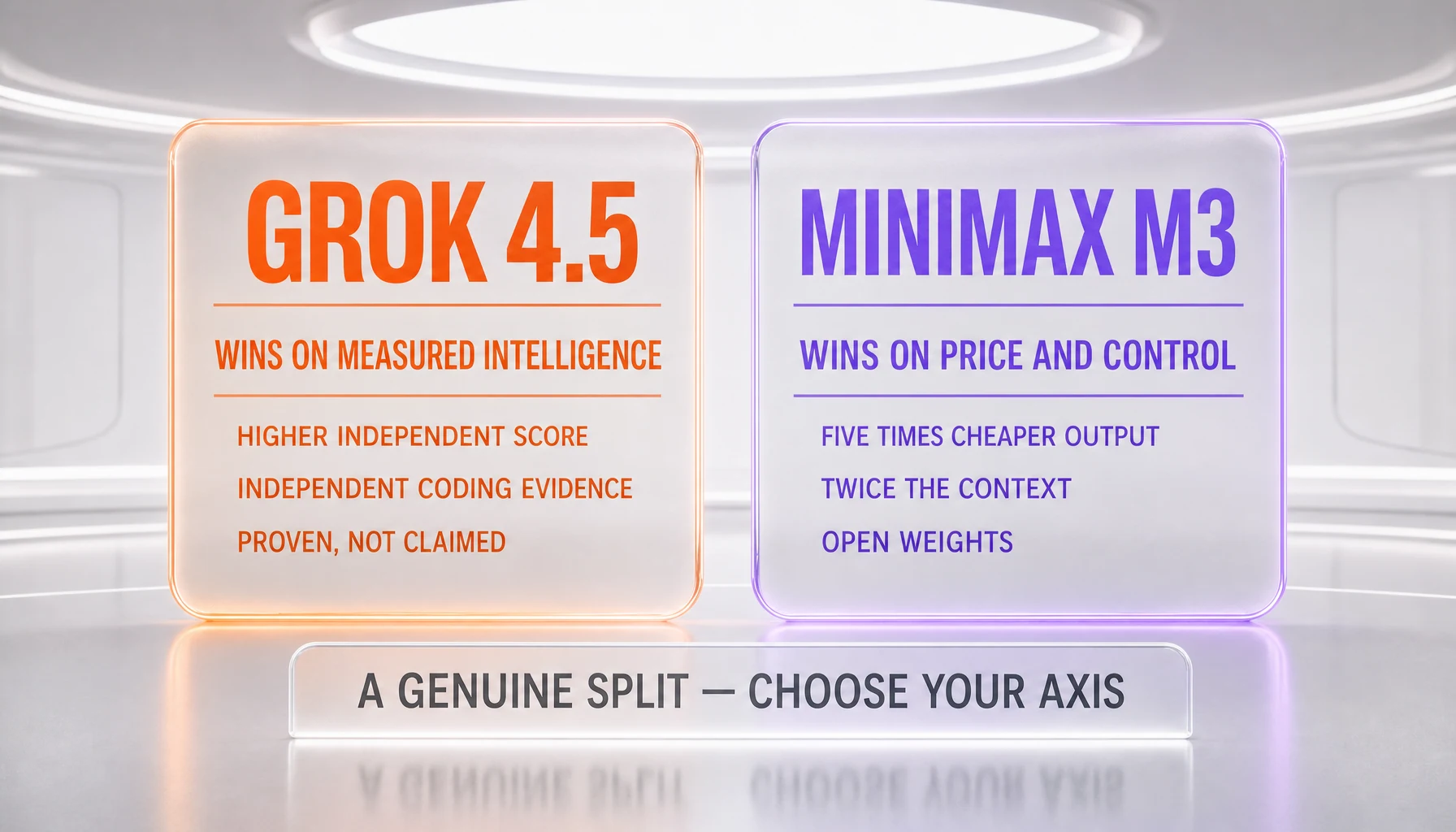
Grok 4.5 versus MiniMax M3 is a genuine value split, and we are recording it as one rather than forcing a winner. Grok 4.5 wins measured intelligence — 54 to 44 on the same independent index — and it is the only model of the two with an independently charted coding score, so it owns the one axis where the evidence comes from outside the vendor. MiniMax M3 wins the rest of the table: output that costs five times less, twice the context at one million tokens, an open-weight design you can eventually self-host, published architecture, and native multimodality. That MiniMax M3 wins more rows does not settle it, because its advantages rest heavily on vendor-reported numbers and weights that had not yet shipped, while Grok 4.5's rest on independent measurement. The decision reduces to a single question: do you value capability that a third party has proven, at a premium, or price, context, and control on vendor faith with a China-operated hosted API until the weights arrive? Answer that, and the model chooses itself. Buyers who need proven capability should pick Grok 4.5; buyers who optimize for cost, context, and openness should pick MiniMax M3.
For the full specifications, current pricing, and our standalone testing notes, see our reviews of Grok 4.5 and MiniMax M3. If you want to see how Grok 4.5 fares against other open-weight challengers, our Grok 4.5 vs Kimi K2.6 comparison runs the same value analysis, and Grok 4.5 vs Claude Opus 4.8 tests whether its Opus-class claim holds. For a broader shortlist, see our roundup of the best AI coding tools of 2026. Both frontier models also line up against the wider field in GPT-5.6 Sol vs Grok 4.5.
Last compared: July 2026. Pricing and independent benchmark figures reflect published rates and Artificial Analysis version 4.1 as of mid-July 2026. Grok 4.5's EU availability landed on July 17, 2026; MiniMax M3's open-weight release was still changing as we published — verify that one before you commit.
Frequently asked questions
Which is better, Grok 4.5 or MiniMax M3?
Neither wins outright, and pretending otherwise would be dishonest. On version 4.1 of the independent Artificial Analysis Intelligence Index — the same yardstick, the same evaluator, for both models — Grok 4.5 scores 54 and MiniMax M3 scores 44, a ten-point gap in Grok's favor. MiniMax M3 answers with roughly five-times-cheaper output, twice the context window at one million tokens, and an open-weight design. If you need independently proven capability and can live with the price, pick Grok 4.5. If you optimize for cost, context length, and control, and you can accept vendor-reported capability numbers, pick MiniMax M3.
Is Grok 4.5 cheaper or more expensive than MiniMax M3?
MiniMax M3 is dramatically cheaper. Grok 4.5 lists at USD 2 per million input tokens and USD 6 per million output tokens. MiniMax M3 lists at USD 0.30 per million input tokens and USD 1.20 per million output tokens for context up to 512K, which is just under seven times cheaper on input and exactly five times cheaper on output. A workload that burns twenty million output tokens in a month costs about USD 120 on Grok 4.5 and about USD 24 on MiniMax M3 at the standard rate — a gap of roughly USD 96, five to one, on the line that dominates most bills.
Why does MiniMax M3 cost double above 512K tokens?
MiniMax M3's list price of USD 0.30 per million input and USD 1.20 per million output applies to requests up to 512K tokens of context. Above that threshold, and its window stretches all the way to one million tokens, the per-token rate doubles to roughly USD 0.60 input and USD 2.40 output. It is still cheaper than Grok 4.5 at that tier — about three times on input and two and a half times on output — but the full one-million-token window is not billed at the headline rate, so budget for the higher figure whenever you actually fill the context.
Is Grok 4.5 available in the European Union?
Not freely, as of mid-July 2026. Access to Grok 4.5 is currently restricted in the European Union, tied to the obligations general-purpose models face under the EU AI Act. This is the situation today, not a permanent verdict: SpaceXAI has signalled that access should open up on a staged basis, so the restriction is expected to ease over the coming period. It is the fastest-moving fact on this page. Verify whether Grok 4.5 is reachable from your region before you build on it, and re-check if your last look was more than a couple of weeks ago. MiniMax M3, as an open-weight model, can ultimately be self-hosted inside the EU.
Which model is more intelligent when measured independently?
Grok 4.5, by ten points. On version 4.1 of the Artificial Analysis Intelligence Index, an independent benchmark run by a third party rather than by either vendor, Grok 4.5 scores 54 and MiniMax M3 scores 44. Both numbers come from the same index version, so they are directly comparable — this is the one head-to-head capability figure on the page that both models actually share. MiniMax M3's 44 still makes it one of the strongest open-weight models measured to date, level with DeepSeek V4, but on measured general intelligence Grok 4.5 leads.
Can I compare Grok 4.5's coding score with MiniMax M3's?
No, and this is the single most important caveat on the page. Grok 4.5 is charted on the Artificial Analysis Coding Agent Index v1.3 at 64.44, produced by an independent evaluator running the Grok Build harness at high effort. MiniMax M3's coding numbers, by contrast, come only from the vendor, measured by MiniMax on MiniMax's own infrastructure on a different benchmark family entirely. The two figures are in different units, produced under different evidence regimes — one disinterested, one from the company selling the model — so lining them up side by side would imply a comparison that does not exist. We never place them together, in any table, sentence, or image. The independently measured intelligence scores are the only capability numbers the two models can honestly be compared on.
How trustworthy are MiniMax M3's benchmarks?
Treat them as promising but unproven. Every headline capability figure MiniMax has published for M3 is vendor-reported, measured on the company's own infrastructure with no independent third-party verification available yet. Its coding claim, a SWE-bench Pro result of 59 percent, is self-reported and has not been reproduced by anyone outside MiniMax. The open weights and technical report that would let others check the numbers were committed within ten days of launch but were still pending at the time of writing. None of this means the figures are wrong — MiniMax has a strong track record — but until independent evaluators publish their own results, the numbers deserve a vendor-reported label rather than the trust an independent benchmark earns.
Is MiniMax M3 really open-weight, and can I self-host it?
That is the intention, with a caveat on timing. MiniMax M3 is positioned as an open-weight mixture-of-experts model, roughly 428 billion total parameters with about 23 billion active per token, and MiniMax committed to releasing the weights and a technical report within ten days of launch. Once those weights are public, you can download the model, run it on your own hardware, and keep data inside your own perimeter — the classic open-weight advantage that Grok 4.5, a closed API-only model, cannot match. The honest caveat is that at the time of writing the weights had not yet shipped, so self-hosting was a near-term promise rather than something you could do that day. Until then, the only way to run MiniMax M3 is the hosted API, which is operated from China and therefore falls under Chinese data law.
What are the context windows of Grok 4.5 and MiniMax M3?
Grok 4.5 offers a 500,000-token context window. MiniMax M3 offers one million tokens, twice as much, which is a concrete advantage for whole-codebase prompts, large document sets, and very long agent transcripts in a single call. The nuance is pricing: MiniMax M3 bills the portion of context above 512K tokens at double its standard rate, so the second half of that window is not free. Grok 4.5's window is smaller and its own rates double above 200,000 prompt tokens, well before its 500,000-token ceiling.
Which model should I pick for coding?
It depends on what you trust and what you can access. Grok 4.5 is the safer pick when you need capability that a disinterested third party has actually measured, and when your team can reach it and absorb the higher price. MiniMax M3 is the value pick when budget or context length is the binding constraint, when you want the option to self-host once its weights ship, and when you are comfortable relying on vendor-reported capability figures in the meantime. One more factor tilts sensitive work toward Grok 4.5 despite the price: MiniMax M3's hosted API is operated from China, so regulated or confidential codebases may rule it out until self-hosting is possible.
Is Grok 4.5's hallucination rate a problem?
It is a real, measured weakness, and it is worth understanding precisely. On the independent AA-Omniscience evaluation, Grok 4.5 hallucinates at a 54 percent rate, meaning it tends to answer confidently rather than abstain when it reaches the edge of its knowledge. For open-domain factual work, that argues for retrieval grounding or human review. For coding, where a compiler and a test suite verify output rather than trust, it is far more manageable. Note that this failure rate is a different measurement from the Intelligence Index on a different axis that happens to share the same number. MiniMax M3 has no published hallucination measurement, so its reliability here is unknown rather than demonstrably better.
Is SpaceXAI the same company as xAI?
Yes. xAI rebranded to SpaceXAI on July 6, 2026, following the merger of SpaceX and xAI. It is the same team and the same Grok model line — the name changed, the products did not. Grok 4.5 is a SpaceXAI model. If you see a source still calling it xAI, that is a reference to the pre-rebrand name rather than a different organization; do not treat SpaceXAI as an error to be corrected back to xAI.
Sources and references
Every figure on this page is attributed to whoever produced it. Vendor documentation and independent measurement are listed separately and never merged into a single ranking.
- SpaceXAI — Model documentation (specifications and pricing)
- Artificial Analysis — Grok 4.5 (independent index score and cost per task)
- Hugging Face — MiniMaxAI/MiniMax-M3 (published weights and license)
- Artificial Analysis — MiniMax M3 (independent index score)
- Artificial Analysis — Model leaderboard (Intelligence Index scores and cost per task across configurations)
Our Verdict
Grok 4.5 versus MiniMax M3 is a genuine value split, and we record it as one rather than forcing a winner. Grok 4.5 wins measured intelligence — 54 to 44 on the same independent Artificial Analysis Intelligence Index (version 4.1) — and it is the only model of the two with an independently charted coding score, so it owns the single axis where the capability evidence comes from outside the vendor. MiniMax M3 wins nearly everything else on the spec sheet: output that costs five times less at USD 1.20 against USD 6 per million tokens, twice the context at one million tokens, an open-weight mixture-of-experts design you can eventually self-host, published architecture, and native multimodality. That MiniMax M3 wins more rows does not settle the decision, because its advantages rest heavily on vendor-reported numbers and weights that had not shipped at the time of writing, while Grok 4.5's rest on independent measurement. Two caveats scope each side. Grok 4.5 is restricted in the European Union as of mid-July 2026 under the EU AI Act — SpaceXAI has signalled a staged opening, so this is today's state rather than a permanent one, and EU readers must verify access for their region before building. And Grok 4.5 carries a measured 54 percent hallucination rate on the independent AA-Omniscience evaluation, a failure rate on a different axis from its Intelligence Index, which argues for retrieval or human review on factual work. MiniMax M3's caveats are the verification gap and jurisdiction: until its weights ship, its capability numbers are the vendor's own and the only way to run it is a hosted API operated from China, under Chinese data law. The decision reduces to one question — do you value capability a third party has proven, at a premium, or price, context, and control on vendor faith? Buyers who need independently proven capability should pick Grok 4.5; buyers who optimize for cost, context length, and openness should pick MiniMax M3. There is no universal winner here, only the right tool for the axis that binds your work.
Choose Grok 4.5
SpaceXAI's reasoning model — Opus-class speed at $2 and $6 per million tokens, 500K context, available to EU users since July 17, 2026; succeeded by Grok 4.6 on August 12.
Try Grok 4.5 →Choose MiniMax M3
Open-weight frontier model from MiniMax combining near-frontier coding, a 1M token context window, and native multimodality — from $0.30 per million input tokens.
Try MiniMax M3 →Frequently Asked Questions
Is Grok 4.5 better than MiniMax M3?
Grok 4.5 versus MiniMax M3 is a genuine value split, and we record it as one rather than forcing a winner. Grok 4.5 wins measured intelligence — 54 to 44 on the same independent Artificial Analysis Intelligence Index (version 4.1) — and it is the only model of the two with an independently charted coding score, so it owns the single axis where the capability evidence comes from outside the vendor. MiniMax M3 wins nearly everything else on the spec sheet: output that costs five times less at USD 1.20 against USD 6 per million tokens, twice the context at one million tokens, an open-weight mixture-of-experts design you can eventually self-host, published architecture, and native multimodality. That MiniMax M3 wins more rows does not settle the decision, because its advantages rest heavily on vendor-reported numbers and weights that had not shipped at the time of writing, while Grok 4.5's rest on independent measurement. Two caveats scope each side. Grok 4.5 is restricted in the European Union as of mid-July 2026 under the EU AI Act — SpaceXAI has signalled a staged opening, so this is today's state rather than a permanent one, and EU readers must verify access for their region before building. And Grok 4.5 carries a measured 54 percent hallucination rate on the independent AA-Omniscience evaluation, a failure rate on a different axis from its Intelligence Index, which argues for retrieval or human review on factual work. MiniMax M3's caveats are the verification gap and jurisdiction: until its weights ship, its capability numbers are the vendor's own and the only way to run it is a hosted API operated from China, under Chinese data law. The decision reduces to one question — do you value capability a third party has proven, at a premium, or price, context, and control on vendor faith? Buyers who need independently proven capability should pick Grok 4.5; buyers who optimize for cost, context length, and openness should pick MiniMax M3. There is no universal winner here, only the right tool for the axis that binds your work.
Which is cheaper, Grok 4.5 or MiniMax M3?
Grok 4.5 starts at $2 in / $6 out per M tokens. MiniMax M3 starts at $0.3 in / $1.2 out per M tokens. Check the pricing comparison section above for a full breakdown.
What are the main differences between Grok 4.5 and MiniMax M3?
The key differences span across 15 features we compared. For Independent intelligence score (Artificial Analysis Intelligence Index v4.1), Grok 4.5 offers 54 — measured by an independent evaluator on version 4.1 of the index while MiniMax M3 offers 44 — measured by the same evaluator on the same index version, ten points below; the open-weight leader, level with DeepSeek V4. For Maximum context window, Grok 4.5 offers 500,000 tokens while MiniMax M3 offers 1,000,000 tokens — twice as much. For Input price (per million tokens), Grok 4.5 offers USD 2.00 while MiniMax M3 offers USD 0.30 up to 512K context — just under seven times cheaper. See the full feature comparison table above for all details.