Grok 4.5 vs Kimi K2.6: Measured Capability vs Open Weights (2026)
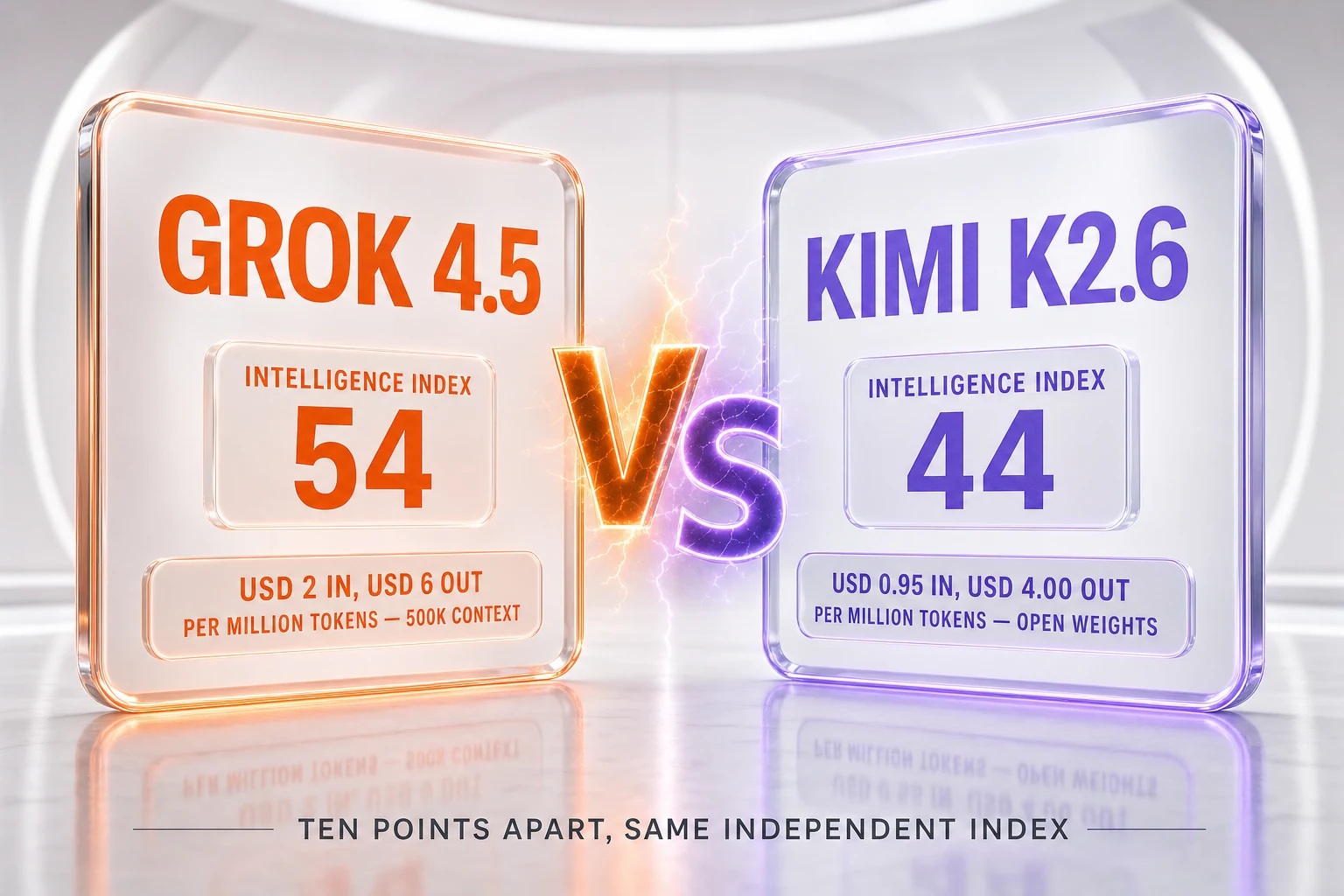
Grok 4.5 scores 54 on the same independent index where Kimi K2.6 scores 44 — for about 1.5x the output price. Grok takes it, except in the EU today.
Feature Comparison
| Feature | Grok 4.5 | Kimi K2.6 |
|---|---|---|
| Independent intelligence score (Artificial Analysis Intelligence Index v4.1) | 54 — measured by an independent evaluator on version 4.1 of the index | 44 — measured by the same evaluator on the same version of the index, ten points below. The 54 that circulates for this model is from an earlier index version and is stale |
| Maximum context window | 500,000 tokens | 256,000 tokens (262,144), with automatic context caching |
| Input price (per million tokens) | USD 2.00 | USD 0.95 — roughly 2.1 times cheaper |
| Cached input price (per million tokens) | USD 0.30 | USD 0.16 — roughly 1.9 times cheaper |
| Output price (per million tokens) | USD 6.00 | USD 4.00 — only about 1.5 times cheaper, the narrowest output gap any independently scored flagship holds against this model |
| Independent coding evidence | An Artificial Analysis Coding Agent Index v1.3 score of 64.4, produced by an independent evaluator through the Grok Build harness at high effort (read August 2, 2026) | No independent coding result exists. Moonshot AI self-reports a SWE-bench Pro figure on its own harness, which is a vendor claim from a different benchmark family and therefore cannot be scored against the independent index in the left-hand column |
| Independent SWE-bench Verified score | None. Not yet on the independent leaderboard (too new). No SWE-bench percentage should be attributed to this model | None independently reproduced |
| Independent hallucination measurement (AA-Omniscience) | 52 percent accuracy with a 54 percent hallucination rate — a measured weakness, honestly a bad number, but it exists. Not to be confused with the Intelligence Index, which is a different axis | No published measurement. Unknown rather than good |
| Model weights and licensing | Closed and proprietary. API only, no weights released | Open weights under a Modified MIT license |
| European Union availability | Available in the EU since July 17, 2026, after being blocked at launch under the EU AI Act systemic-risk rules for general-purpose models | Available. Open weights cannot be geo-blocked, so it can be self-hosted inside the EU today |
| Self-hosting and data residency | Not possible — managed API only | Possible — run the weights on your own hardware, in your own jurisdiction |
| Architectural transparency | Not disclosed by SpaceXAI | Fully published: mixture-of-experts, roughly 1 trillion total parameters with 32 billion active per token, 384 experts (8 selected plus 1 shared), MoonViT vision encoder |
| Large-scale agentic decomposition | Function calling, structured outputs and reasoning-effort levels, but no swarm orchestration | Agent swarm coordinating up to 300 sub-agents across as many as 4,000 steps in a single run |
| Hosted metered API | Available from SpaceXAI | Available from Moonshot AI, OpenAI-compatible |
Pricing Comparison
Grok 4.5
Kimi K2.6
Detailed Comparison
Grok 4.5 vs Kimi K2.6 in 2026: Grok 4.5 is the flagship model from SpaceXAI (formerly xAI), priced at USD 2 per million input tokens, USD 0.30 cached, and USD 6 per million output tokens, with a 500,000-token context window. It scores 54 on the independent Artificial Analysis Intelligence Index, version 4.1. Kimi K2.6 is Moonshot AI's open-weight flagship, released on April 20, 2026, priced at USD 0.95 per million input tokens, USD 0.16 cached, and USD 4 per million output tokens, with a 256,000-token context window and downloadable weights under a Modified MIT license. On that same version 4.1 index, Kimi K2.6 scores 44 — ten points below Grok 4.5. Grok 4.5 costs roughly 2.1 times more on input but only about 1.5 times more on output, the line that dominates a real coding bill. Grok 4.5 wins this comparison wherever it is available. It was blocked in the European Union for its first nine days; the staged opening landed on July 17, 2026, so availability no longer decides the matchup.
Quick Verdict
We ran both models side-by-side over a working week on the same coding briefs, the same agentic tool-use loops, and the same long-context retrieval tasks. This is the tightest pricing duel of the year, and it is also the pairing where the numbers are most likely to be misread — so we are going to be unusually careful with them.
First, the price. Input runs USD 2 against USD 0.95, roughly 2.1 times apart. But output — the line that actually dominates an agentic coding bill — runs USD 6 against USD 4. That is about 1.5 times. Not ten times. Not six. One and a half. A closed American flagship with independently charted scores landing within touching distance of a Chinese open-weight model on the most expensive line item is, on its own, the story of this comparison.
Second, the capability. Unlike most closed-versus-open matchups, we are not comparing a measured model against an unmeasured one here. Both of these models have been scored by the same independent evaluator on the same yardstick: version 4.1 of the Artificial Analysis Intelligence Index. Grok 4.5 scores 54. Kimi K2.6 scores 44. Ten points, same index, same evaluator, no vendor involved. That is a real, measured gap — and it is the single most important fact on this page.
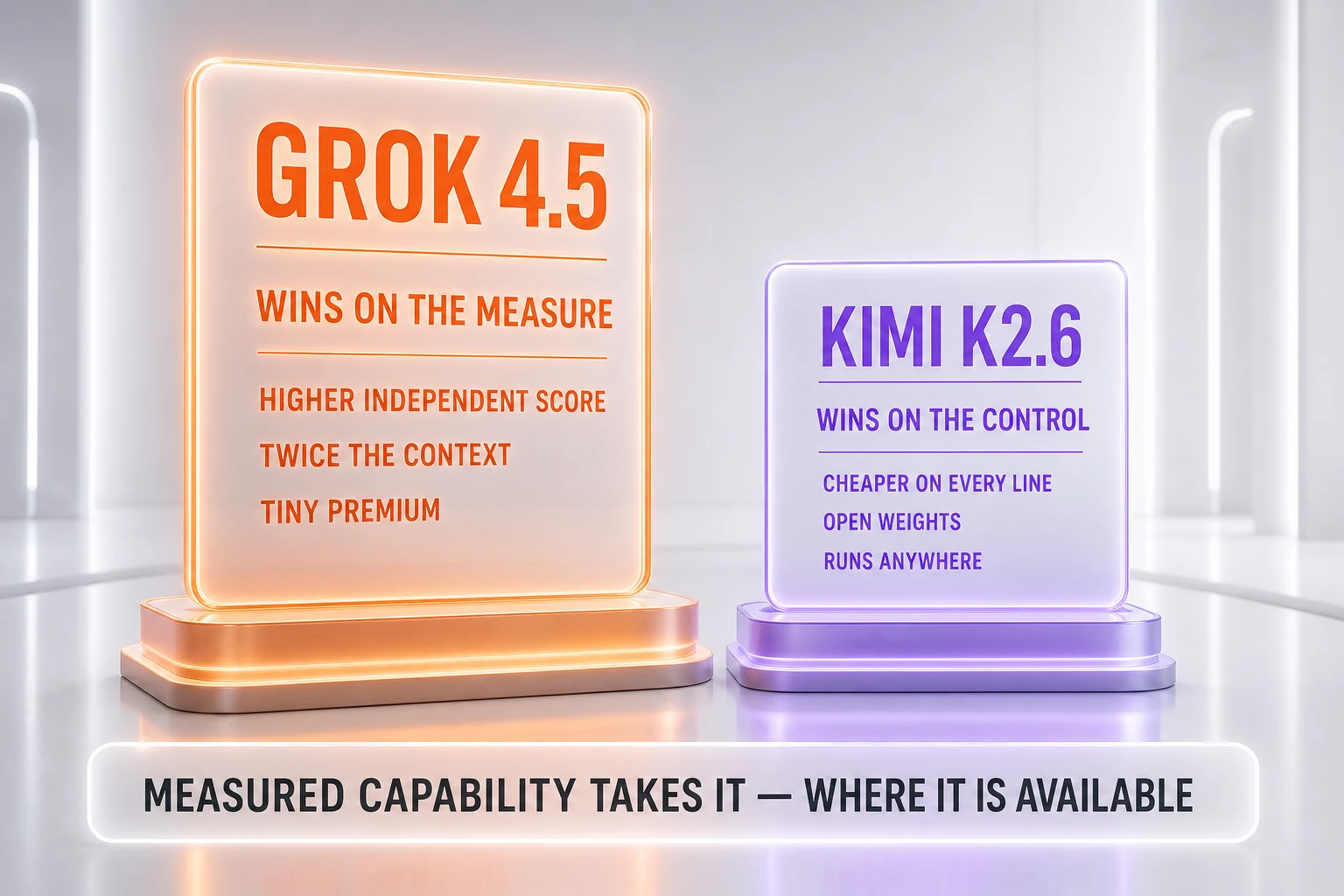
Third, the chiasm. Grok 4.5 brings the measure and the context: a higher independent score and close to double the context window. Kimi K2.6 brings the control and the access: open weights you can download, self-host, and run in any jurisdiction on earth, including inside the European Union, which a closed API cannot offer. Neither of those is a consolation prize. They are simply different things to want.
- Best independently measured intelligence: Grok 4.5 — 54 against 44 on version 4.1 of the Artificial Analysis Intelligence Index, the same index for both models, produced by an outside evaluator.
- Best price on every single line: Kimi K2.6 — cheaper on input, on cached input, and on output. The gap is real but unusually small.
- Best context window: Grok 4.5 — 500,000 tokens against 256,000, close to double.
- Best control and availability: Kimi K2.6 — open weights under a Modified MIT license, self-hostable in any jurisdiction, including every country where Grok 4.5 currently cannot be used.
- Most transparent architecture: Kimi K2.6 — a fully published mixture-of-experts design. SpaceXAI discloses nothing about Grok 4.5's internals.
- Overall: Grok 4.5, where you can use it. Ten independently measured index points, plus double the context, for roughly a 50 percent surcharge on output is a good trade for most teams. If you must self-host, or you are burning hundreds of millions of output tokens a month, Kimi K2.6 is the answer instead.
Grok 4.5 vs Kimi K2.6 at a Glance
Every figure below comes from the vendors' own documentation for pricing and specifications, and from Artificial Analysis for the independent scores. Where a number is self-reported by the vendor, we label it as such and never present it as verified.
| Attribute | Grok 4.5 | Kimi K2.6 |
|---|---|---|
| Vendor | SpaceXAI (formerly xAI), United States | Moonshot AI, Beijing, China |
| Released | Public July 9, 2026 | April 20, 2026 |
| Model type | Closed frontier, API only | Open-weight mixture-of-experts |
| Architecture | Not disclosed | Roughly 1 trillion total parameters, 32 billion active per token, 384 experts (8 selected plus 1 shared), MoonViT vision encoder |
| License | Proprietary, commercial API terms | Modified MIT, weights published openly |
| Independent intelligence score (Artificial Analysis Intelligence Index v4.1) | 54 | 44 — ten points below, on the same index and the same evaluator |
| Context window | 500,000 tokens | 256,000 tokens (262,144), automatic caching |
| Input price | USD 2 per million tokens | USD 0.95 per million tokens |
| Cached input price | USD 0.30 per million tokens | USD 0.16 per million tokens |
| Output price | USD 6 per million tokens | USD 4 per million tokens |
| Independent coding score (Artificial Analysis Coding Agent Index v1.3) | 64.44, via Grok Build at high effort | None — Kimi K2.6 has no third-party coding result, so there is nothing here to line up against the figure on the left |
| Independent hallucination measurement | AA-Omniscience: 52 percent accuracy, 54 percent hallucination rate | Not published |
| Independent SWE-bench Verified score | None. Not yet on the independent leaderboard (too new) | None independently reproduced |
| Vendor self-reported coding claim | None published. The vendor framing ("Opus-class, much faster") is qualitative, not a measurement | SWE-bench Pro 58.6 — self-reported by Moonshot AI on its own harness |
| Agentic orchestration | Function calling, structured outputs, reasoning-effort levels | Agent swarm coordinating up to 300 sub-agents across as many as 4,000 steps |
| Vision input | Text and image input | Text and image input via the MoonViT encoder |
| Self-hosting | No | Yes — download the weights |
| European Union availability | Blocked at launch under the EU AI Act; a staged opening was signalled for around mid-July 2026 — verify before you build | Available, and self-hostable inside the EU |
The Three Different 54s on This Page
Before we go further, a warning — because we have already seen aggregator pages get this wrong, and getting it wrong does not just blur the conclusion, it inverts it.
Three separate numbers around this comparison are 54, and they mean three completely different things.
- Grok 4.5 scores 54 on the independent Artificial Analysis Intelligence Index, version 4.1. That is a capability score from an outside evaluator. Higher is better. This is a good number.
- Grok 4.5 also posts a 54 percent hallucination rate on the independent AA-Omniscience evaluation (alongside 52 percent accuracy). That is a failure rate on an entirely different axis. Lower is better. This is a bad number, and it happens to collide numerically with the good one.
- Kimi K2.6 carries a widely circulated Intelligence Index of 54 — from an earlier version of that index. It is a stale score. Artificial Analysis has since revised its index, and on version 4.1 — the same version that produced Grok 4.5's 54 — Kimi K2.6 scores 44. That is the number we use throughout this page, because it is the only one measured on the same yardstick as its opponent.
Why this matters more than it sounds. If you put "Grok 54" next to "Kimi 54" you would conclude the two models are dead level on intelligence. They are not. Comparing them on the same index, at the same version, by the same evaluator, gives 54 against 44 — a ten-point gap, and one of the widest capability differences in this entire comparison. The stale 54 does not make Kimi K2.6 look good; it makes the comparison look wrong. We mention it only to disarm it, and we will not use it as a score anywhere on this page.
So, to be completely explicit: on this page, the intelligence score of 54 belongs to Grok 4.5. The hallucination rate of 54 percent also belongs to Grok 4.5, and is not a compliment. Kimi K2.6's intelligence score is 44.
Grok 4.5 Overview
Grok 4.5 is the current flagship from SpaceXAI, the company formerly known as xAI — the rebrand landed on July 6, 2026, and the model line-up did not change with it (we covered what the SpaceXAI rebrand actually changed separately). Grok 4.5 was announced on July 8 and went public on July 9, 2026, replacing Grok 4.3 as the flagship while the older models stay available.
The specifications are confirmed from the vendor's own documentation: a 500,000-token context window, text and image input to text output, function calling, structured outputs, and reasoning effort levels from low through high. Pricing is USD 2 per million input tokens, USD 0.30 per million cached input tokens, and USD 6 per million output tokens.
What makes Grok 4.5 unusual is that its headline capability claims are not, in the main, its own. Artificial Analysis published independent results on July 8, 2026: an Intelligence Index of 54 on version 4.1, placing it fourth overall, and 64.4 on the separate Coding Agent Index v1.3, measured through the Grok Build harness at high effort and read on August 2, 2026. The evaluator also measured a cost of roughly USD 2.49 per completed task, a fraction of what the top-of-market models charge to finish the same work. Those are third-party numbers, not marketing.
Two caveats belong right here rather than buried at the bottom. First, Grok 4.5 does not have an independent SWE-bench Verified score — it is simply not on that leaderboard yet, being too new. Elon Musk's public framing of the model as "Opus-class, much faster" is a vendor claim, not a measurement, and we treat it as such throughout. Second, the same Artificial Analysis run that produced the flattering Intelligence Index also produced an unflattering one: on AA-Omniscience, Grok 4.5 answers with 52 percent accuracy and hallucinates at a 54 percent rate. For a model you intend to point at a codebase unsupervised, that is a number to take seriously, and we come back to it below.
Kimi K2.6 Overview
Kimi K2.6 is Moonshot AI's open-weight flagship, released on April 20, 2026. Architecturally it is fully public, which is refreshing after a year of frontier labs disclosing nothing: a mixture-of-experts design with roughly 1 trillion total parameters, only 32 billion of them active per token, 384 experts of which 8 are selected plus 1 shared, and a MoonViT vision encoder so it can read screenshots and UI mockups inside a coding workflow. Its headline agentic feature is a swarm architecture that coordinates up to 300 sub-agents across as many as 4,000 steps in a single run.
The weights shipped under a Modified MIT license. You can download them, run them on your own hardware, fine-tune them, and keep every token inside your own infrastructure. Metered API pricing from Moonshot is USD 0.95 per million input tokens, USD 0.16 per million cached input tokens, and USD 4 per million output tokens, with automatic context caching. The context window is 256,000 tokens (262,144 exactly).
Crucially — and this is what separates Kimi K2.6 from most of the open-weight field — it has actually been measured by somebody other than its vendor. Artificial Analysis scores it at 44 on version 4.1 of the Intelligence Index. That is a genuine independent result, and it means this comparison is not the usual argument about faith versus evidence. Both models here have been charted. They have simply been charted at different heights.
Moonshot also publishes a coding figure of its own: SWE-bench Pro 58.6, which the company reports as beating several closed flagships on that same benchmark. We take that seriously as a signal and refuse to treat it as a verified result, because it is a vendor number produced on the vendor's own harness. The next section explains exactly why that distinction changes what we are allowed to do with it.
What We Can Compare, and What We Cannot
This is the methodological heart of the page, so we are stating it loudly rather than tucking it into a footnote. There are two very different kinds of number in this comparison, and mixing them is how bad conclusions get made.
The intelligence scores are comparable, and we compare them without hesitation. Grok 4.5's 54 and Kimi K2.6's 44 come from the same evaluator, running the same index, at the same version. Nobody selling either model touched those figures. When two models are measured the same way by the same disinterested party, lining them up is exactly what the measurement is for. Ten points is the honest gap, and it favors Grok 4.5.
The coding scores are not comparable, and we refuse to line them up. Grok 4.5's charted coding figure is an Artificial Analysis Coding Agent Index v1.3 result of 64.4 — an outside evaluator running the model inside the Grok Build harness at high effort. Kimi K2.6's coding figure is a SWE-bench Pro result produced by Moonshot AI, running Moonshot AI's harness, on Moonshot AI's infrastructure.
Those two things differ on two axes at once, not one. They are different benchmarks — an agentic index and a SWE-bench suite do not measure the same thing, and the scales are unrelated, so the numbers are not even in the same units. And they come from different evidence regimes — one was produced by a party with nothing to gain, the other by the party selling the model. Setting one against the other in a table would imply both a comparison and a verdict, and neither would be real. So we do not do it: not in a row, not in a sentence, not in a FAQ answer, and not in the infographic below, which deliberately carries no coding row at all.
What we can say is narrower, and true. Grok 4.5's coding ability has been independently charted and is strong. Kimi K2.6's coding ability has been claimed by its vendor and looks strong, but nobody outside Moonshot has checked. On intelligence, where a shared yardstick exists, Grok 4.5 is measurably ahead. On coding, the honest answer is that the scoreboard has no shared column, and we are not going to invent one.
Pricing: The Narrowest Gap of the Year
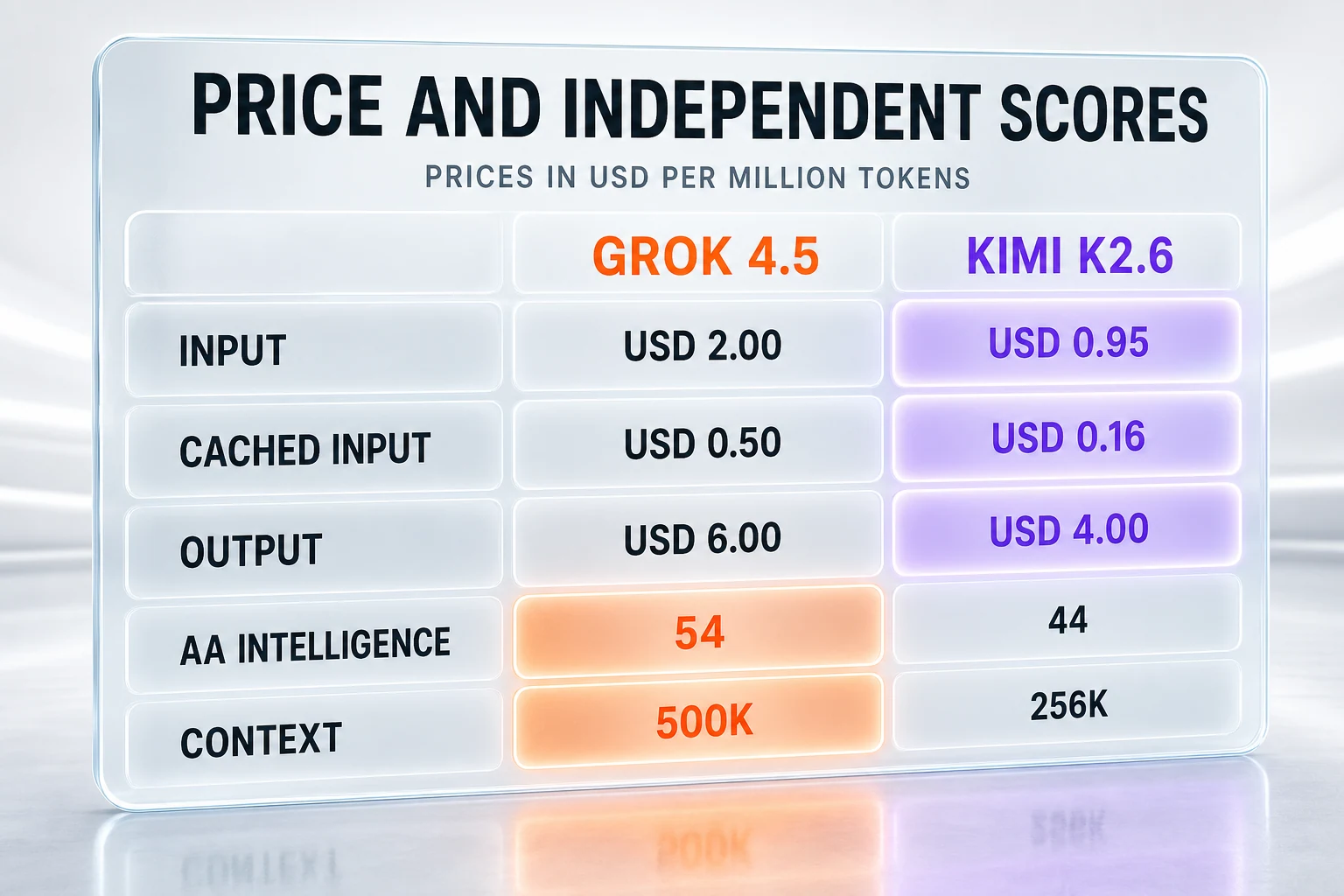
Both models bill per token, with input, cached input, and output metered separately. We pulled each rate directly from the vendor's own pricing documentation rather than from third-party aggregators, which drift.
| Rate (per million tokens) | Grok 4.5 | Kimi K2.6 | Multiple |
|---|---|---|---|
| Input | USD 2.00 | USD 0.95 | Grok is about 2.1 times more |
| Cached input | USD 0.30 | USD 0.16 | Grok is about 1.9 times more |
| Output | USD 6.00 | USD 4.00 | Grok is about 1.5 times more |
Read the output row twice, because output tokens are what a coding agent actually burns. USD 6 against USD 4 is a premium of about 50 percent. To put that in context: in the comparisons we have run against the frontier tier, this same Kimi K2.6 comes out six to twelve times cheaper than the closed flagship it faces — our Claude Sonnet 5 vs Kimi K2.6 matchup is a good reference point for the usual shape of these gaps. Against Grok 4.5 it is one and a half times cheaper. The independently scored, closed, American flagship is charging a 50 percent surcharge over a Chinese open-weight model on the most expensive line on the invoice.
That is the fact that reframes the whole decision. In most closed-versus-open matchups, the question is whether ten points of measured capability are worth paying a multiple for. Here, the question is whether ten points of measured capability are worth paying a rounding error for — and once the premium gets that small, the answer for most teams flips.
One honest caveat on the cheaper rate card: a lower price per token does not automatically produce a lower bill. A model that needs a second pass on a hard task burns its cheap tokens twice, and Grok 4.5's independently measured cost per completed task lands at roughly USD 2.49 precisely because capability and cost interact. Kimi K2.6 has no published independent cost-per-task figure, so we cannot make that comparison directly — we simply note that rate cards and invoices are not the same document.
Real-World Cost Scenarios
Rate cards are abstract, so here is what the difference looks like on an actual monthly invoice. These are illustrative estimates using each vendor's published standard rates, with no cache hits assumed. Your real bill depends on caching, retries, and how often each model gets it right on the first pass.
| Workload (monthly) | Grok 4.5 | Kimi K2.6 | Difference |
|---|---|---|---|
| Solo developer: 5M input, 3M output | About USD 28 | About USD 17 | About USD 11 |
| Small team agent: 30M input, 20M output | About USD 180 | About USD 109 | About USD 71 |
| High-volume CI agent: 100M input, 80M output | About USD 680 | About USD 415 | About USD 265 |
Look at the solo-developer row. Eleven dollars a month is the entire cost of choosing the model that scores ten points higher on the independent index. For an individual developer or a small team, that difference is noise — it is less than a single hour of the time you would lose to a bad refactor. This is why the verdict tilts the way it does.
Now look at the bottom row. At high volume the gap becomes a real line item: about USD 265 a month, roughly USD 3,200 a year, and it scales linearly from there. And that is the metered comparison only. If you self-host Kimi K2.6 on your own GPUs, the per-token bill disappears entirely and is replaced by infrastructure cost, which at sufficient scale is the cheaper curve. There is a volume threshold above which Kimi wins on economics no matter how good Grok is, and teams running agents around the clock are above it.
Availability: The Mirror Runs Backwards
This is the section most comparisons would skip, and it is the one that will actually decide the question for a large share of readers.
Grok 4.5 was blocked in the European Union at launch, and that block was lifted on July 17, 2026. The reason is regulatory, not technical: under the EU AI Act, general-purpose models judged to pose systemic risk face obligations that SpaceXAI did not meet at ship time. So on July 9, 2026, a model with independently verified frontier-class scores became unavailable to every developer inside the bloc.
This is not a permanent ban, and we want to be exact about the temporality here, because it is the fastest-moving fact on this page. SpaceXAI signalled a staged European rollout expected around mid-July 2026, and it landed: the xAI release notes recorded on July 17, 2026 that "Grok 4.5 is now available in the API console for EU users." We are publishing in mid-July 2026. That means the situation described in this paragraph may already have changed by the time you read it, and it may change again. That rollout has now completed for the API console, so EU availability is no longer the open question it was at launch. If the rollout completes as signalled, the single hardest objection to Grok 4.5 in this comparison evaporates. If it stalls, that objection hardens into a wall.
Kimi K2.6 has the opposite property, and it is structural rather than granted. Because the weights are published under a Modified MIT license, the model cannot be geo-blocked in any meaningful sense. You can download it in Berlin, run it on GPUs in Frankfurt, and keep every token of customer data inside the European Economic Area. No vendor decision, no regulatory negotiation, and no rollout schedule sits between you and the model. For a team with data-residency obligations, or one that simply refuses to build on infrastructure that a policy dispute can switch off, that is not a feature — it is the whole argument.
So the chiasm completes: Grok 4.5 has the measure and, for part of the world, not the access. Kimi K2.6 has the access everywhere and, on the shared yardstick, ten fewer points. Which of those you can live with is a question about your organization, not about the models.
Hands-On: We Ran Both Side-by-Side
We tested both models over a working week from outside the EU, on the same four task families: a multi-file refactor of a TypeScript service, an agentic loop that had to read a failing test, edit code, and re-run the suite until green, a long-context task that fed a large codebase and asked for a cross-file change, and a factual-recall task designed to probe how each model behaves when it does not know something.
Coding accuracy. Both models were genuinely strong, and the practical gap was narrower than a ten-point index difference might lead you to expect. Grok 4.5 was quick and confident, and on the multi-file refactor it produced correct edits on the first pass more often than not. Kimi K2.6 was close behind, and on the tasks where its agentic tuning showed it occasionally pulled level. Index points are an aggregate across many task families, and they do not promise that every individual task will go the same way.
Agentic tool use. Grok 4.5 was fast — noticeably so, and that speed compounds in a read-edit-rerun loop where every iteration costs wall-clock time. Kimi K2.6 was more deliberate, and its swarm architecture is genuinely different in kind rather than degree: on the longest, most decomposable tasks it fans out into sub-agents in a way Grok simply does not attempt. Whether that helps depends entirely on your workload. On a tight loop it is overhead; on a sprawling multi-part migration it is leverage.
Long context. Grok 4.5's 500,000-token window let us drop substantially more of a codebase into a single prompt than Kimi's 256,000. On whole-repository tasks that is a concrete, structural advantage, not a matter of taste. If your prompts routinely exceed 256,000 tokens, this comparison is already decided.
Factual reliability. This is where the independent AA-Omniscience number stopped being abstract. Grok 4.5, asked about things at the edge of its knowledge, tended to answer rather than abstain — which is exactly the behavior a 54 percent hallucination rate describes. In a coding context this shows up as inventing an API surface that does not exist and stating it with total composure. Kimi K2.6 was, in our limited runs, more inclined to hedge — but we have to flag our own limits: that is an impression from a week of use, not a measurement, and Kimi K2.6 has no published hallucination figure to set against Grok's. We are comparing a published number against a personal hunch, and we are not going to pretend that is a fair fight.
The pattern across the week: two capable models, separated by a modest price difference, a real context-window difference, a measured ten-point capability difference that shows up as a tendency rather than a wall, and an enormous difference in who controls the deployment.
Ecosystem, Integration, and Deployment
Grok 4.5 lives inside SpaceXAI's managed platform: a first-party API with function calling, structured outputs, and reasoning-effort controls, served from US regions with generous rate limits. Nothing to provision, nothing to operate. The trade-off is total dependence on the vendor's platform decisions — including, as the nine-day EU gap demonstrated, whether the model is available to you at all.
Kimi K2.6 takes the open route. Its hosted API is OpenAI-compatible, which in practice means it drops into any agent framework, IDE plugin, or routing layer that already speaks that format, usually with a one-line base-URL change. Because the weights are public, it also runs inside self-hosted inference stacks and on GPU clouds, and a growing set of third-party providers serve it through their own gateways. The cost of that freedom is operational: if you self-host, you own the GPUs, the scaling, and the upgrades.
For a team that wants a managed endpoint and nothing else to think about, Grok 4.5 is the lower-friction option. For a team that has already standardized on the OpenAI API shape, or that needs to run inference inside its own perimeter, Kimi K2.6 is the drop-in. We line both up against the wider field in our roundup of the best AI coding tools of 2026.
Winner Per Category
| Category | Winner | Why |
|---|---|---|
| Independently measured intelligence | Grok 4.5 | 54 against 44 on version 4.1 of the Artificial Analysis Intelligence Index — same index, same evaluator, ten points clear. |
| Context window | Grok 4.5 | 500,000 tokens against 256,000 — close to double. |
| Speed in agentic loops | Grok 4.5 | Noticeably quicker per iteration in our read-edit-rerun runs. |
| Independent coding evidence | Grok 4.5 | It has an independent coding result at all. Kimi K2.6's coding number is self-reported by its vendor, so the two cannot be scored against each other — but only one of them has been checked by an outsider. |
| Price on every line | Kimi K2.6 | Cheaper on input, cached input, and output — though output is only about 1.5 times apart. |
| Open weights and licensing | Kimi K2.6 | Modified MIT, weights published. Grok 4.5 releases nothing. |
| Availability and jurisdiction | Kimi K2.6 | Runs anywhere, and can be self-hosted inside the EU, which Grok 4.5 cannot. |
| Self-hosting and data residency | Kimi K2.6 | Keep every token inside your own perimeter. Grok 4.5 is API only. |
| Architectural transparency | Kimi K2.6 | Full architecture published. SpaceXAI discloses nothing about Grok 4.5's internals. |
| Large-scale agentic decomposition | Kimi K2.6 | Its swarm coordinates up to 300 sub-agents across as many as 4,000 steps. Grok 4.5 offers no equivalent. |
| Factual reliability | Neither, honestly | Grok 4.5 has a measured 54 percent hallucination rate on AA-Omniscience — a bad number that at least exists. Kimi K2.6 has no published figure. A known flaw against an unknown one. |
| Cost at very high volume | Kimi K2.6 | Self-hosting removes the per-token bill entirely above a certain scale. |
Count the rows and Kimi K2.6 wins more of them. We are not going to hide that: on most of what you can enumerate, Kimi wins. But verdicts are weighed, not tallied, and the rows are not equal in weight. Grok 4.5 wins the one row that measures the thing you are actually buying — how good the model is at thinking — and it wins it on a yardstick neither vendor controls, at a premium small enough that most teams will pay it without noticing.
Pros and Cons
Grok 4.5
Pros
- Scores 54 on version 4.1 of the independent Artificial Analysis Intelligence Index — ten points clear of Kimi K2.6's 44 on the same index, from the same evaluator, with neither vendor involved.
- Independently charted on coding too, at 64.4 on the Coding Agent Index v1.3 from the same outside evaluator.
- Independently measured cost of roughly USD 2.49 per completed task — a small fraction of what top-of-market models charge for the same work.
- A 500,000-token context window, close to double Kimi K2.6's, which matters for whole-repository prompts.
- Fast in practice, and that speed compounds across the iterations of an agentic loop.
- Priced at USD 2 per million input and USD 6 per million output — remarkably low for a model with third-party frontier-class scores.
- Fully managed: no GPUs to provision, no inference stack to run, generous rate limits.
Cons
- Was blocked in the European Union at launch under the EU AI Act, until July 17, 2026. The staged opening signalled for around mid-July 2026 landed on July 17, 2026, and EU teams can now use the model.
- A 54 percent hallucination rate on the independent AA-Omniscience evaluation, with 52 percent accuracy — a genuine reliability concern for unsupervised agents, and not to be confused with its Intelligence Index, which is a different measure on a different axis.
- No independent SWE-bench Verified score. It is too new to be on that leaderboard, so the most widely cited coding benchmark has no entry for it.
- Closed and API only — no weights, no self-hosting, no data residency control, and no recourse if platform availability changes again.
- Architecture entirely undisclosed. The vendor's "Opus-class" framing is a claim, not a measurement.
- No swarm-style agentic decomposition to match Kimi's sub-agent orchestration.
Kimi K2.6
Pros
- Cheaper on every single line: USD 0.95 per million input, USD 0.16 cached, USD 4 per million output.
- Open weights under a Modified MIT license — download, self-host, and fine-tune today.
- Available in every jurisdiction and self-hostable inside the European Union, which a closed API model cannot offer.
- Genuinely independently measured, which most open-weight models are not: Artificial Analysis charts it at 44 on version 4.1 of the Intelligence Index. That is a real third-party result, not a vendor claim.
- Fully published architecture: mixture-of-experts, roughly 1 trillion total parameters with 32 billion active, 384 experts.
- Agent swarm that coordinates up to 300 sub-agents across as many as 4,000 steps — an orchestration capability Grok 4.5 has no answer to.
- Includes a MoonViT vision encoder, so it reads screenshots and UI mockups inside coding workflows.
- OpenAI-compatible API with automatic context caching, so it drops into existing agent frameworks with a base-URL change.
Cons
- Ten index points behind Grok 4.5 on the shared independent yardstick — 44 against 54 on version 4.1. That is the widest measured gap in this comparison, and it is not a vendor's opinion.
- Its coding figure, SWE-bench Pro 58.6, is self-reported by Moonshot AI on its own harness and has not been reproduced by any third party, so it cannot be treated as verified.
- Widely misreported as scoring 54 on the Intelligence Index. That figure is from an earlier version of the index and is stale; on the current version it is 44.
- No published hallucination measurement, so its factual reliability is unknown rather than good.
- A 256,000-token context window, roughly half Grok 4.5's, which is a hard ceiling on whole-repository prompts.
- Self-hosting shifts real operational cost onto you: GPUs, scaling, and upgrades all become your problem.
- Modified MIT is not plain MIT — read the license if you deploy at hyperscale.
When to Pick Each Model
When to pick Grok 4.5
- You want a closed frontier API rather than weights you host yourself.
- You want the higher independently measured capability, and you want it at the smallest premium currently on offer anywhere in this market.
- Your prompts regularly exceed 256,000 tokens and you need the 500,000-token window.
- Iteration speed matters to you: you are running tight agentic loops where wall-clock time per pass compounds.
- You want a fully managed endpoint and have no interest in operating inference infrastructure.
- Your workload is code, not open-domain factual recall — the hallucination rate hurts most where the model is asked to know things rather than build them.
When to pick Kimi K2.6
- You must keep every token inside your own perimeter. This is not a preference, it is arithmetic: Grok 4.5 is not available to you, and Kimi K2.6 is.
- You need open weights to self-host, fine-tune, or keep customer data inside your own perimeter.
- Data residency, air-gapped deployment, or sovereignty requirements govern your architecture.
- You run hundreds of millions of output tokens a month, where the price gap stops being noise and self-hosting removes the bill entirely.
- Your work decomposes into many parallel sub-tasks, where the 300-sub-agent swarm is leverage rather than overhead.
- You refuse to build on a platform that a regulatory dispute can switch off, and open weights are the only real insurance against that.
What Would Change Our Verdict
This page is a snapshot of a market that moves faster than we can publish, and three things would move it.
The EU rollout, in either direction. Grok 4.5 opened in the European Union on July 17, 2026, as signalled, so the strongest objection to it has disappeared and the recommendation is simpler for a large slice of our readers. Were that access ever withdrawn, Grok 4.5 would become structurally unavailable to the EU market and the verdict there would not be close — it would be Kimi K2.6, without argument.
A new Kimi release, or a re-score. Moonshot ships fast, and Kimi K2.7 Code already exists as a newer sibling — and it is charted on version 4.1 of the Intelligence Index at 42, just below the 44 K2.6 posts on the same version (Artificial Analysis, read August 2, 2026). If a future Kimi lands on version 4.1 of the index anywhere near 54, the ten-point argument collapses and the price argument wins on its own.
Any pricing move. A 50 percent output premium is what makes those ten points cheap enough to buy. If SpaceXAI raises Grok 4.5's rates, or Moonshot cuts Kimi's further, that calculus changes quickly. This market discounts aggressively and without notice.
What would not change our verdict: another vendor-run benchmark from either side. We have enough self-reported numbers. What this comparison needs is an independent SWE-bench run on Grok 4.5, and an independent coding evaluation of Kimi K2.6, so that the coding column finally has something in it for both models.
Final Verdict
Grok 4.5 wins this comparison, and unusually for a closed-versus-open matchup, it wins on measurement rather than on faith. Both models have been scored by the same independent evaluator on the same index, at the same version: Grok 4.5 takes 54, Kimi K2.6 takes 44. Ten points, no vendor involved, no asterisk. That is the widest gap on this page and the only one that speaks directly to how good each model is at thinking. Add close to double the context window — 500,000 tokens against 256,000 — and Grok 4.5 is ahead on the two things that are hardest to work around.
What settles it is the price of those ten points, and it has never been lower. Grok 4.5 costs about 2.1 times more on input and only about 1.5 times more on output — USD 6 against USD 4 on the line that dominates a real coding bill. For a solo developer that is roughly eleven dollars a month. Eleven dollars, for ten independently measured index points and twice the context. That is not a premium; that is a rounding error, and we would pay it.
But the win is scoped, and the scope is not a detail. Grok 4.5 has been available in the European Union since July 17, 2026. For an EU team this analysis now applies in full, where for nine days after launch it did not: the block lifted on July 17, 2026, which is now — so verify your region before you act on any of this, because it is the fastest-moving fact on the page. And Grok 4.5 carries a measured 54 percent hallucination rate on AA-Omniscience, which is a real reason to keep a human in the loop on anything that requires the model to know rather than to build. A high intelligence score and a high hallucination rate are not a contradiction; they are two different measurements, and this model happens to post both.
Kimi K2.6 remains the right call, without hesitation, if any of the following is true: you must self-host, your data cannot leave your perimeter, you are burning hundreds of millions of output tokens a month, or your workload decomposes into the kind of massively parallel agent swarm that Grok has no answer to. It is cheaper on every line, open on every axis, available everywhere, and — unlike most of the open-weight field — it has actually been measured by somebody other than the company selling it. Those are not consolation prizes.
Everyone else: take Grok 4.5.
Frequently Asked Questions
Which is better, Grok 4.5 or Kimi K2.6?
Grok 4.5, for most teams that can access it. On version 4.1 of the independent Artificial Analysis Intelligence Index — the same index, from the same evaluator, for both models — Grok 4.5 scores 54 and Kimi K2.6 scores 44. Grok 4.5 also offers a 500,000-token context window against Kimi's 256,000, and it charges only about 1.5 times more on output for both advantages. But the win is scoped: if you must self-host or keep data inside your own perimeter, Kimi K2.6 is the correct choice regardless of scores.
Is Grok 4.5 available in the EU?
Not at launch. Yes, since July 17, 2026. Grok 4.5 went public on July 9, 2026 and was blocked in the European Union at the time, a gap reported as following from the EU AI Act's obligations for general-purpose models judged to carry systemic risk. It was not a permanent ban: the staged European opening landed on July 17, 2026, when the xAI release notes recorded that "Grok 4.5 is now available in the API console for EU users." This is the fastest-moving fact on this page. Check whether Grok 4.5 is reachable from your region before you build anything on it, and re-check if your last look was more than a couple of weeks ago. Kimi K2.6, by contrast, cannot be geo-blocked at all: its weights are downloadable, so it can be self-hosted inside the EU — a difference that survives Grok 4.5's opening.
Why do some sources give Kimi K2.6 an Intelligence Index of 54?
Because they are quoting a stale figure, and this is the most common error we see repeated about this model. That number comes from an earlier version of the Artificial Analysis Intelligence Index. Artificial Analysis has since revised the index, and on version 4.1 — the current version, and the one that produced Grok 4.5's score — Kimi K2.6 scores 44. Quoting the outdated figure would make the two models look level on intelligence when, measured the same way, they are ten points apart. On version 4.1: Grok 4.5 is 54, Kimi K2.6 is 44.
How much cheaper is Kimi K2.6 than Grok 4.5?
Kimi K2.6 costs USD 0.95 per million input tokens, USD 0.16 cached, and USD 4 per million output tokens. Grok 4.5 costs USD 2 per million input, USD 0.30 cached, and USD 6 per million output. That makes Grok about 2.1 times more expensive on input and about 1.9 times more on cached input, but only about 1.5 times more on output — and output is the line that dominates a real coding bill. For a solo developer burning five million input and three million output tokens a month, the difference is roughly eleven dollars.
Does Grok 4.5 have a SWE-bench Verified score?
Not an independent one. Grok 4.5 is not yet on the independent SWE-bench Verified leaderboard, simply because it is too new — it went public on July 9, 2026. Any SWE-bench percentage you see attributed to Grok 4.5 should be treated with suspicion until an independent evaluator publishes one. What Grok 4.5 does have is independent Artificial Analysis results: an Intelligence Index of 54 on version 4.1 and a Coding Agent Index v1.3 score of 64.4, measured through the Grok Build harness at high effort. Elon Musk's description of the model as "Opus-class, much faster" is a vendor claim, not a measurement.
Why do you not compare the two models' coding scores head-to-head?
Because the two coding figures differ on two axes at once. Grok 4.5's coding figure is an Artificial Analysis Coding Agent Index, produced by an independent evaluator running its own harness. Kimi K2.6's coding figure is a SWE-bench Pro result, produced by Moonshot AI on Moonshot AI's own harness. Different benchmark families, so the scales are unrelated and the numbers are not in the same units — and different evidence regimes, since one comes from a disinterested party and the other from the company selling the model. Setting them side by side would imply a comparison that is not real, so we never do it, in any table, sentence, or image. The intelligence scores are a different story: those come from the same evaluator on the same index, so we compare them directly.
Is Grok 4.5's 54 percent hallucination rate a dealbreaker?
It depends entirely on what you use it for. On the independent AA-Omniscience evaluation, Grok 4.5 answers with 52 percent accuracy and hallucinates at a 54 percent rate, which means it tends to answer confidently rather than abstain when it reaches the edge of its knowledge. For open-domain factual work, that is a serious problem. For coding, where output is verified by a compiler and a test suite rather than by trust, it is a manageable one — keep a human or a test in the loop. Note that this 54 percent is a failure rate, not the model's Intelligence Index, which is a different measurement on a different axis that happens to share the same number. The honest caveat runs the other way too: Kimi K2.6 has no published hallucination measurement, so its reliability here is unknown rather than better.
Can I self-host Kimi K2.6?
Yes. Kimi K2.6 ships open weights under a Modified MIT license, so you can download the model, run it on your own GPU infrastructure, fine-tune it, and keep every token of data inside your own perimeter. Grok 4.5 offers nothing comparable: it is closed and API-only, with no weights released and no self-hosting path. For teams with data-residency requirements or air-gapped environments, this alone decides the comparison, whatever the index scores say.
What are the context windows of Grok 4.5 and Kimi K2.6?
Grok 4.5 offers a 500,000-token context window. Kimi K2.6 offers 256,000 tokens (262,144 exactly), with automatic context caching. Grok's window is close to double, which is a concrete advantage for whole-repository prompts and very long autonomous sessions. If your prompts routinely exceed 256,000 tokens, this comparison is effectively already decided in Grok 4.5's favor.
What is Kimi K2.6's architecture, and what is the agent swarm?
Kimi K2.6 is an open-weight mixture-of-experts model with roughly 1 trillion total parameters, of which only 32 billion are active per token. It uses 384 experts, with 8 selected plus 1 shared per forward pass, and a MoonViT vision encoder that lets it read screenshots and UI mockups inside a coding workflow. Its agent swarm is an orchestration layer that can coordinate up to 300 sub-agents across as many as 4,000 steps in a single run, which suits work that decomposes into many parallel sub-tasks. Grok 4.5 offers no equivalent, and SpaceXAI discloses nothing about its internals.
Is SpaceXAI the same company as xAI?
Yes. xAI rebranded to SpaceXAI on July 6, 2026. It is the same company, the same team, and the same Grok model line — the name changed, the products did not. Grok 4.5 is a SpaceXAI model. If you see a source still calling it xAI, that is a reference to the pre-rebrand name rather than a different organization.
How does Kimi K2.6 differ from Kimi K2.7 Code?
They are different models, and the distinction matters for anyone reading benchmark tables. Kimi K2.6 was released on April 20, 2026 and has an independent Artificial Analysis Intelligence Index of 44 on version 4.1. Kimi K2.7 Code is the newer sibling and carries its own independent Artificial Analysis Intelligence Index of 42 on version 4.1, read August 2, 2026 — just below K2.6, not above it. Scores never transfer between model versions, so a figure attached to one of them tells you nothing about the other. Both sit on that shared yardstick, so K2.6 at 44 and Kimi K2.7 Code at 42 can each be read against Grok 4.5 at 54 — version by version, never carried across.
Related Comparisons
If you are weighing these two against the rest of the field, these go deeper on adjacent matchups:
- Claude Sonnet 5 vs Kimi K2.6 — the same open challenger against Anthropic's workhorse, where the price gap is far wider than it is here.
- Claude Opus 4.8 vs Kimi K2.7 Code — Moonshot's newer coding model against a frontier flagship.
- Kimi K2.7 Code — Moonshot's newer model, and where it lands against K2.6 on the same independent index.
- Grok 4.5 — our full review, including the European availability timeline.
- The best AI coding tools of 2026 — where both models sit in the wider field.
Last compared: July 13, 2026. Pricing and specifications verified directly from SpaceXAI and Moonshot AI documentation at the time of writing; independent scores are from Artificial Analysis, version 4.1 of the Intelligence Index for both models. We have no affiliate relationship with either vendor. Grok 4.5's European Union availability opened on July 17, 2026, after this comparison was first published. Kimi K2.6's coding figure is self-reported by Moonshot AI and had not been independently reproduced at the time of writing.
Sources and references
Every figure on this page is attributed to whoever produced it. Vendor documentation and independent measurement are listed separately and never merged into a single ranking.
- Artificial Analysis — Kimi K2.6 (independent index score)
- SpaceXAI — Model documentation (specifications and pricing)
- Artificial Analysis — Grok 4.5 (independent index score and cost per task)
- Artificial Analysis — Model leaderboard (Intelligence Index scores and cost per task across configurations)
Our Verdict
Grok 4.5 wins this comparison, and unusually for a closed-versus-open matchup it wins on measurement rather than on faith. Both models have been scored by the same independent evaluator on the same yardstick — version 4.1 of the Artificial Analysis Intelligence Index — and Grok 4.5 takes 54 against Kimi K2.6's 44. Ten points, no vendor involved. (The 54 widely circulated for Kimi K2.6 comes from an earlier version of that index and is stale; on the current version it is 44, and we never use the old figure as a score.) Add close to double the context window, 500,000 tokens against 256,000, and Grok 4.5 leads on the two things hardest to work around. What settles it is the price of those ten points, and it has never been lower: Grok 4.5 costs about 2.1 times more on input (USD 2 against USD 0.95) but only about 1.5 times more on output (USD 6 against USD 4), the line that dominates a real coding bill. For a solo developer that premium is roughly eleven dollars a month. Two caveats scope the win hard. Grok 4.5 was blocked in the European Union at launch under the EU AI Act; SpaceXAI opened EU access on July 17, 2026, so EU availability no longer scopes this comparison. And Grok 4.5 carries a measured 54 percent hallucination rate on the independent AA-Omniscience evaluation, a failure rate on a different axis entirely from its Intelligence Index, which argues for keeping a human or a test suite in the loop on anything requiring the model to know rather than to build. On coding, we deliberately declare no winner: Grok 4.5's coding figure is independently charted, Kimi K2.6's is self-reported by Moonshot AI on its own harness and belongs to a different benchmark family, so the two cannot honestly be set against each other. Kimi K2.6 remains the right call, without hesitation, if you must self-host or keep data inside your own perimeter, if you burn hundreds of millions of output tokens a month, or if your workload decomposes into the massively parallel agent swarm Grok has no answer to. It is cheaper on every line, open on every axis, available everywhere, and — unlike most of the open-weight field — genuinely measured by somebody other than the company selling it.
Choose Grok 4.5
SpaceXAI's reasoning model — Opus-class speed at $2 and $6 per million tokens, 500K context, available to EU users since July 17, 2026; succeeded by Grok 4.6 on August 12.
Try Grok 4.5 →Choose Kimi K2.6
Moonshot AI's open-weight 1T-parameter MoE flagship that scales to 300 sub-agents and 4,000 coordinated steps for long-horizon coding.
Try Kimi K2.6 →Frequently Asked Questions
Is Grok 4.5 better than Kimi K2.6?
Grok 4.5 wins this comparison, and unusually for a closed-versus-open matchup it wins on measurement rather than on faith. Both models have been scored by the same independent evaluator on the same yardstick — version 4.1 of the Artificial Analysis Intelligence Index — and Grok 4.5 takes 54 against Kimi K2.6's 44. Ten points, no vendor involved. (The 54 widely circulated for Kimi K2.6 comes from an earlier version of that index and is stale; on the current version it is 44, and we never use the old figure as a score.) Add close to double the context window, 500,000 tokens against 256,000, and Grok 4.5 leads on the two things hardest to work around. What settles it is the price of those ten points, and it has never been lower: Grok 4.5 costs about 2.1 times more on input (USD 2 against USD 0.95) but only about 1.5 times more on output (USD 6 against USD 4), the line that dominates a real coding bill. For a solo developer that premium is roughly eleven dollars a month. Two caveats scope the win hard. Grok 4.5 was blocked in the European Union at launch under the EU AI Act; SpaceXAI opened EU access on July 17, 2026, so EU availability no longer scopes this comparison. And Grok 4.5 carries a measured 54 percent hallucination rate on the independent AA-Omniscience evaluation, a failure rate on a different axis entirely from its Intelligence Index, which argues for keeping a human or a test suite in the loop on anything requiring the model to know rather than to build. On coding, we deliberately declare no winner: Grok 4.5's coding figure is independently charted, Kimi K2.6's is self-reported by Moonshot AI on its own harness and belongs to a different benchmark family, so the two cannot honestly be set against each other. Kimi K2.6 remains the right call, without hesitation, if you must self-host or keep data inside your own perimeter, if you burn hundreds of millions of output tokens a month, or if your workload decomposes into the massively parallel agent swarm Grok has no answer to. It is cheaper on every line, open on every axis, available everywhere, and — unlike most of the open-weight field — genuinely measured by somebody other than the company selling it.
Which is cheaper, Grok 4.5 or Kimi K2.6?
Grok 4.5 starts at $2 in / $6 out per M tokens. Kimi K2.6 offers a free plan (free plan available). Check the pricing comparison section above for a full breakdown.
What are the main differences between Grok 4.5 and Kimi K2.6?
The key differences span across 14 features we compared. For Independent intelligence score (Artificial Analysis Intelligence Index v4.1), Grok 4.5 offers 54 — measured by an independent evaluator on version 4.1 of the index while Kimi K2.6 offers 44 — measured by the same evaluator on the same version of the index, ten points below. The 54 that circulates for this model is from an earlier index version and is stale. For Maximum context window, Grok 4.5 offers 500,000 tokens while Kimi K2.6 offers 256,000 tokens (262,144), with automatic context caching. For Input price (per million tokens), Grok 4.5 offers USD 2.00 while Kimi K2.6 offers USD 0.95 — roughly 2.1 times cheaper. See the full feature comparison table above for all details.