Grok 4.5 vs Claude Opus 4.8: Is Musk's 'Opus-Class' Claim True? (2026)


Musk calls Grok 4.5 Opus-class at half the price. We tested both: Grok wins on cost, Opus 4.8 leads verified coding and intelligence; Grok is EU-blocked.
Feature Comparison
| Feature | Grok 4.5 | Claude Opus 4.8 |
|---|---|---|
| API input price (per million tokens) | $2.00 (verified) | $5.00 (verified) |
| API output price (per million tokens) | $6.00 (verified) | $25.00 (verified) |
| Cached input price (per million tokens) | $0.30 (verified) | $0.50 (verified) |
| SWE-bench Verified, vals.ai (independent) | Not yet on independent leaderboard (too new) | 88.6% (vals.ai) |
| AA Coding Agent Index v1.3 (independent, read Aug 2, 2026) | 64.44 — via Grok Build at high effort | 56.70 — via Claude Code at high effort; 60.54 at max |
| AA Intelligence Index (independent) | 54 (No.4 at publication) | 56-61.4 (configuration-dependent, top tier) |
| LMArena Elo (independent, human preference) | Not yet ranked | 1482 (Thinking) |
| Measured hallucination, AA-Omniscience (independent) | 54% hallucination, 52% accuracy | Not published by AA in our sources |
| Cost per task, AA Intelligence Index run (independent) | ~$2.49 (Artificial Analysis) | Not published in our sources |
| Declared context window | 500,000 tokens | 1,000,000 tokens |
| Reasoning control | Low, medium, high (high default) | Adaptive thinking with an effort dial (defaults to high) |
| Multi-agent orchestration | Not offered as a distinct mode | Dynamic Workflows: hundreds of parallel subagents |
| Computer use (vendor-reported) | Not reported in our sources | 84% on Online-Mind2Web (Anthropic self-reported) |
| Throughput and speed | 'Opus-class, much faster' (SpaceXAI and Musk claim; no independent figure) | Fast mode available at 2x price; no headline tokens-per-second figure in our sources |
| EU availability | Not available in the EU (EU AI Act) | Available in the EU |
Pricing Comparison
Grok 4.5
Claude Opus 4.8
Detailed Comparison
Grok 4.5 and Claude Opus 4.8 are the two frontier models compared here, and the question driving the comparison is whether Grok 4.5 is really "Opus-class, much faster" at half the price, as Elon Musk claims. Grok 4.5 is SpaceXAI's newest flagship, priced at $2 per million input tokens and $6 per million output tokens with a 500,000-token context window. Claude Opus 4.8 is Anthropic's flagship, priced at $5 per million input tokens and $25 per million output tokens with a 1,000,000-token context window. On independent coding measures the picture is mixed: Grok 4.5 scores 64.4 on the Artificial Analysis Coding Agent Index v1.3 through the Grok Build harness, but it is too new to appear on vals.ai's independent SWE-bench Verified leaderboard yet, where Claude Opus 4.8 is verified at 88.6 percent — so the independently verified coding edge is Opus 4.8's. On the Artificial Analysis Intelligence Index, Grok 4.5 scores 54 and ranks fourth in the frontier field while Opus 4.8 reads a higher, configuration-dependent 56 to 61, and Grok 4.5 carries a 54 percent hallucination rate on the AA-Omniscience test. Best for the lowest token price and coding value: Grok 4.5. Best for independently verified coding, measured intelligence, reliability, and long context: Claude Opus 4.8. This is a genuine split, and we do not crown a single overall winner.
Quick Verdict
This is a split verdict, and we will not fake a single overall winner: Grok 4.5 makes a genuinely strong case on price and coding value, posting a frontier-tier independent coding-agent score at less than half the cost, while Claude Opus 4.8 leads on independently verified coding, measured intelligence, reliability, and context length. Grok 4.5 reached public availability on July 9, 2026; Claude Opus 4.8 has been generally available since late May 2026. We ran both side-by-side through our own xAI and Anthropic API keys, so our hands-on notes on Grok 4.5 are sharp first impressions rather than a matured verdict, and we lean on attributed third-party numbers from Artificial Analysis, LMArena, and vals.ai wherever our own time is too short. Every figure below carries its source, and self-reported vendor numbers — including Musk's "Opus-class" positioning — are labeled as such. Here is the short version.
- Best for token price: Grok 4.5, decisively. At $2 per million input and $6 per million output tokens it is 60 percent cheaper on input and roughly 76 percent cheaper on output than Opus 4.8 — well under half on both sides, verified on SpaceXAI's documentation.
- Best for independent coding value: Grok 4.5, on capability per dollar. It posts 64.4 on the Artificial Analysis Coding Agent Index v1.3 through Grok Build at high effort, at less than half the price — and Claude Opus 4.8 is charted there too, at 56.70 through Claude Code at the same high effort and 60.54 at max, so on that board the "Opus-class" framing does settle, in Grok 4.5's favor.
- Best on independently verified coding: Claude Opus 4.8. It is verified at 88.6 percent on vals.ai's SWE-bench Verified suite; Grok 4.5 is too new to be ranked there yet, so there is no independent Verified number for it to confirm parity.
- Best for measured intelligence: Claude Opus 4.8. On the Artificial Analysis Intelligence Index, Grok 4.5 scores 54 and ranks fourth in the frontier field, while Opus 4.8 reads a higher, configuration-dependent 56 to 61.
- Best for reliability signal: Claude Opus 4.8, on the available evidence. Artificial Analysis flags a 54 percent hallucination rate for Grok 4.5 on AA-Omniscience; it publishes no equivalent figure for Opus 4.8 in our sources, and Anthropic positions Opus 4.8 as a careful self-verifier.
- Best for long context: Claude Opus 4.8, by double. Its 1,000,000-token window is twice Grok 4.5's 500,000 tokens.
- Best for raw speed positioning: Grok 4.5, on the vendor's word. SpaceXAI and Musk market it as much faster; our sources carry no independent tokens-per-second figure for either, so we flag this as a vendor claim, not a benchmarked win.
- EU availability, no longer a differentiator: both. Grok 4.5 was unavailable in the European Union at launch, and SpaceXAI opened API console access to EU users on July 17, 2026.
The honest read on "Opus-class": it is credible on coding value and price, and not yet independently confirmed on verified coding or general intelligence. Grok 4.5's independent Coding Agent Index v1.3 result of 64.4 at less than half the cost is a real coding-value achievement, and SpaceXAI's Cursor-trained pedigree is credible. But being a frontier-tier coding model at a fraction of the price is not the same as matching Opus 4.8 on the hardest verified coding — where Grok 4.5 has no score yet and Opus 4.8 is verified at 88.6 percent — or across intelligence, reliability, and context, where the independent evidence favors Opus 4.8. No single overall winner. Route cost-sensitive coding and high-volume work to Grok 4.5; route verified-coding-critical, intelligence-critical, reliability-sensitive, and long-context work to Claude Opus 4.8. The rest of this comparison shows every number behind those calls.
Grok 4.5 vs Claude Opus 4.8 — Overview
What Is Grok 4.5?
Grok 4.5 is the newest flagship model from SpaceXAI — the company formerly known as xAI, which kept the Grok product name unchanged through its July 2026 rebrand, as we covered in our SpaceXAI rebrand explainer. It reached public availability on July 9, 2026, replacing Grok 4.3 as the flagship while Grok 4.3 and 4.20 remain available. Per SpaceXAI's Grok 4.5 model documentation, it runs a 500,000-token context window, takes text and image inputs to text output, supports function calling and structured outputs, exposes low, medium, and high reasoning with high as the default, and is served from the us-east-1 and us-west-2 regions with generous rate limits of 150 requests per second and 50 million tokens per minute. API pricing is $2 per million input tokens, $0.30 per million cached input, and $6 per million output tokens, which we confirmed directly on that documentation — less than half of Claude Opus 4.8 on both input and output. SpaceXAI says Grok 4.5 was trained with Cursor on GB300 GPUs, and Elon Musk has described it as "Opus-class, much faster" than rivals — the claim this comparison sets out to test. Grok 4.5 was not offered in the European Union at launch; SpaceXAI opened it to EU users in the API console on July 17, 2026, per its release notes.
What Is Claude Opus 4.8?
Claude Opus 4.8 is Anthropic's flagship model, positioned for complex agentic coding, computer use, and multi-agent orchestration, and generally available since late May 2026. Per Anthropic's models overview, Opus 4.8 carries a 1,000,000-token context window (roughly 555,000 words), up to 128,000 output tokens, a January 2026 training cutoff, adaptive thinking with an effort control that defaults to high, and text-plus-image input with text output. Anthropic pairs it with Dynamic Workflows, which orchestrate hundreds of parallel subagents on large multi-file tasks, and reports it as its best computer-use and browser-agent model to date at 84 percent on Online-Mind2Web. API pricing is $5 per million input tokens, $0.50 per million cached input, and $25 per million output tokens, with a Batch tier at half price — which we confirmed directly on Anthropic's pricing documentation. It is verified at 88.6 percent on vals.ai's independent SWE-bench Verified suite, and it sits below Anthropic's very top tier, Claude Fable 5, on price and headline capability, but at half Fable 5's rate card. It is also the specific model SpaceXAI invokes when it calls Grok 4.5 "Opus-class." For the full hands-on breakdown, see our Claude Opus 4.8 review.
How We Compared Them — and What We Did Not Do
Method transparency matters more than usual here, because Grok 4.5 is days old at the time of writing and the "Opus-class" framing invites exactly the kind of self-reported-versus-independent confusion we work to avoid. Here is precisely what we did and did not do.
- Pricing: both rate cards are vendor-verified. Grok 4.5's $2 input and $6 output per million tokens is confirmed against SpaceXAI's model documentation; Opus 4.8's $5 input and $25 output per million is confirmed against Anthropic's pricing documentation. No relayed figures. Our AI model pricing explainer breaks down how input, output, and cached-token rates translate into real bills.
- Independent benchmarks: we lean on Artificial Analysis (Intelligence Index, cost per task, AA-Omniscience), its separate Coding Agent Index (v1.3, read August 2, 2026), vals.ai (SWE-bench Verified), and LMArena (Elo). The two flagships have different independent coverage: Claude Opus 4.8 is verified at 88.6 percent on SWE-bench Verified, while Grok 4.5 — only two days old at the time of writing — is not yet listed on that independent leaderboard, so we do not manufacture a head-to-head there. Both models carry an independent Coding Agent Index score, in different harnesses: Grok 4.5 at 64.44 through Grok Build and Claude Opus 4.8 at 56.70 through Claude Code, both at high reasoning effort. Where one model is absent — Grok 4.5 on SWE-bench Verified and LMArena — we say so and do not substitute a self-reported figure.
- Self-reported figures: SpaceXAI's "Opus-class, much faster" positioning and "trained with Cursor" note for Grok 4.5, and Anthropic's 84 percent computer-use figure for Opus 4.8, are labeled as vendor-reported and not treated as head-to-head evidence. Our agentic coding model explainer covers why coding-agent scores and chatbot scores measure different things, and our SWE-bench guide explains why Verified is the number to trust when a model has one.
- Hands-on: we have run both models through our own xAI and Anthropic API keys — Grok 4.5 since its July 9 launch, Opus 4.8 in production since late May. Our Grok 4.5 notes are first impressions measured in days; our Opus 4.8 experience runs to weeks. We scope every observation accordingly.
- Disclosure and neutrality: we have no affiliate relationship with SpaceXAI or Anthropic, and there are no sponsored links on this page. We hold no position for or against either company, and we treat Musk's "Opus-class" claim as a testable statement, not a slogan to endorse or dismiss. We are based outside the EU, which is why we could test Grok 4.5 directly during the nine days it was unavailable to EU users; that restriction lifted on July 17, 2026.
Features and Benchmarks Comparison
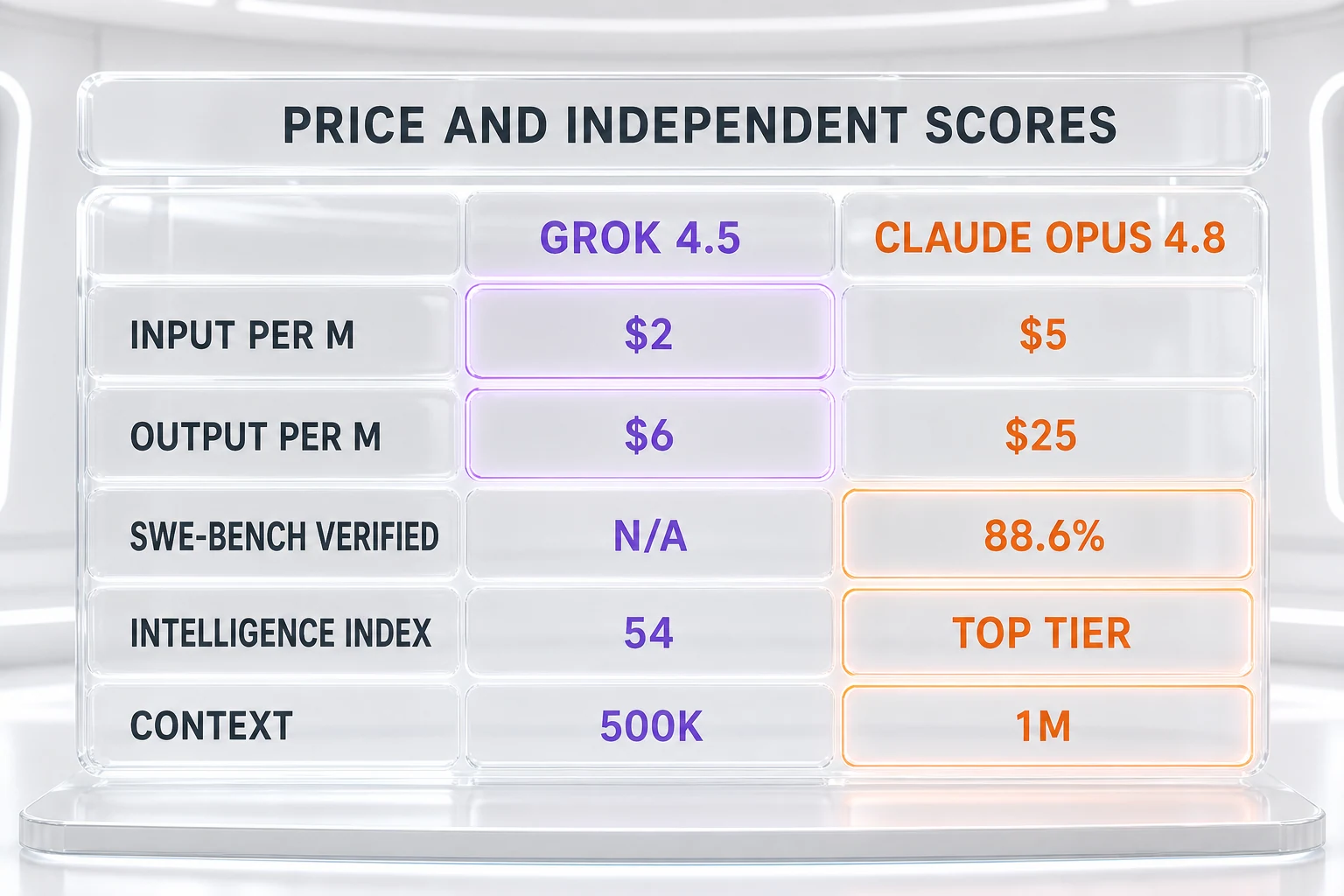
The table below lists every dimension we could verify or attribute. Read the Winner column carefully: it distinguishes vendor-verified pricing, independent benchmarks, and self-reported figures, and it flags where a result is one-sided ("where measured"), genuinely tied, or a standalone caveat. Every benchmark figure carries its source. Sources for the independent scores are Artificial Analysis, vals.ai, and LMArena.
| Feature | Grok 4.5 | Claude Opus 4.8 | Winner |
|---|---|---|---|
| API input price (per million tokens) | $2.00 (verified) | $5.00 (verified) | Grok 4.5 |
| API output price (per million tokens) | $6.00 (verified) | $25.00 (verified) | Grok 4.5 |
| Cached input price (per million tokens) | $0.30 (verified) | $0.50 (verified) | Grok 4.5 |
| SWE-bench Verified, vals.ai (independent) | Not yet on independent leaderboard (too new) | 88.6% | Opus 4.8 (Grok not yet ranked) |
| AA Coding Agent Index v1.3 (independent, read Aug 2, 2026) | 64.44 — via Grok Build at high effort | 56.70 — via Claude Code at high effort; 60.54 at max | Grok 4.5 by 7.74 at matched high effort, in different harnesses |
| AA Intelligence Index (independent) | 54 (No.4 at publication) | 56-61.4 (configuration-dependent, top tier) | Opus 4.8 |
| LMArena Elo (independent, human preference) | Not yet ranked | 1482 (Thinking) | Where measured (Opus only) |
| Measured hallucination, AA-Omniscience (independent) | 54% hallucination, 52% accuracy | Not published by AA in our sources | Not comparable (caveat on Grok) |
| Cost per task, AA Intelligence Index run (independent) | ~$2.49 (Artificial Analysis) | Not published in our sources | Not comparable (Grok figure only) |
| Declared context window | 500,000 tokens | 1,000,000 tokens | Opus 4.8 (2x larger) |
| Reasoning control | Low, medium, high (high default) | Adaptive thinking with an effort dial (defaults to high) | Tie |
| Multi-agent orchestration | Not offered as a distinct mode | Dynamic Workflows: hundreds of parallel subagents | Opus 4.8 |
| Computer use (vendor-reported) | Not reported in our sources | 84% on Online-Mind2Web (Anthropic self-reported) | Opus 4.8 (self-reported) |
| Throughput and speed | 'Opus-class, much faster' (SpaceXAI and Musk claim; no independent figure) | Fast mode at 2x price; no headline tokens-per-second figure in our sources | Not comparable (vendor claim) |
| EU availability | Available in the EU since July 17, 2026 | Available in the EU | Tie |
Synthesis: the token economics tilt hard to Grok 4.5 — $2 input and $6 output per million against $5 and $25, less than half on both sides. The independent capability signals tilt to Opus 4.8 — it holds the only verified SWE-bench score (88.6 percent, with Grok 4.5 not yet ranked), reads higher on the Intelligence Index (56 to 61 against 54), is the only one of the two ranked on LMArena, and carries the documented computer-use record. Grok 4.5's independent coding credential is the Coding Agent Index v1.3 at 64.44, sixth of 52 entries and 7.74 points ahead of Opus 4.8's 56.70 at the same high effort — measured on an entirely different benchmark from Opus 4.8's verified 88.6 percent on the harder issue-resolution suite. That is why "Opus-class" is a defensible framing for a cheaper frontier-tier coding model, but not an independently confirmed parity claim. One structural fact sits outside the benchmark table and can decide the whole thing on its own: Opus 4.8's context window is double Grok 4.5's. Grok 4.5's EU unavailability was a second such fact until July 17, 2026.
Pricing — Frontier Coding Value at Less Than Half the Rate Card
Pricing is the strongest single pillar of Grok 4.5's case, and it is where the "Opus-class at half the price" framing is most literally true. Both rate cards below come straight from SpaceXAI's and Anthropic's own documentation, and our pricing explainer covers how these translate into real spend.
Grok 4.5 Pricing
| Tier | Input (per million tokens) | Output (per million tokens) | Notes |
|---|---|---|---|
| Standard API | $2.00 | $6.00 | Verified on SpaceXAI's model documentation |
| Cached input | $0.30 | — | Verified on SpaceXAI's model documentation |
| Regions | us-east-1, us-west-2 | us-east-1, us-west-2 | Grok 4.5 open to EU users since July 17, 2026; both regions sit in the United States |
Claude Opus 4.8 Pricing
| Tier | Input (per million tokens) | Output (per million tokens) | Notes |
|---|---|---|---|
| Standard API | $5.00 | $25.00 | Verified on Anthropic's pricing documentation |
| Cached input | $0.50 | — | 90 percent discount, verified |
| Batch mode | $2.50 | $12.50 | Half price, verified |
| Fast mode | $10.00 | $50.00 | Roughly 2x speed at 2x price, verified |
Pricing verdict: Grok 4.5 wins the rate card, decisively. On a representative agentic call of 50,000 input tokens and 5,000 output tokens, Grok 4.5 costs about $0.13 at the rate card ($2 times 0.05 input plus $6 times 0.005 output) versus about $0.375 for Opus 4.8 ($5 times 0.05 plus $25 times 0.005) — roughly a third of the price on that mix, and the gap widens as output share grows because Grok 4.5's $6 output is under a quarter of Opus 4.8's $25. Opus 4.8 discounts cached input to $0.50 per million and Grok 4.5 to $0.30, so long-running agents with stable system prompts narrow the raw-rate gap. Artificial Analysis also measures Grok 4.5's cost per task at about $2.49 to run its Intelligence Index evaluation — low in the frontier tier — though our sources publish no equivalent per-task figure for Opus 4.8, so we leave that as a Grok-only data point. On the rate card, this is the clearest win in the comparison, and it is what makes Grok 4.5's independent Coding Agent Index v1.3 result of 64.4 so striking: it delivers a frontier-tier coding-agent score, 2.3 points off the board leader, while charging well under half of Opus 4.8 — even though it has no verified SWE-bench number yet to confirm parity.
Is Grok 4.5 Really "Opus-Class"? The Benchmark Evidence
This is the heart of the comparison. Musk's claim is specific — "Opus-class, much faster" — and it names Claude Opus 4.8 as the yardstick, so we test it against the independent evidence rather than the marketing. We separate third-party results from vendor self-reported numbers throughout, and we are explicit about where each model has independent coverage and where it does not, because the two flagships do not yet appear on all the same leaderboards.
Verified coding: Opus 4.8 has a number, Grok 4.5 is too new to be ranked
The most rigorous independent coding benchmark is SWE-bench Verified, which resolves real GitHub issues against a hidden test suite. On the suite tracked by vals.ai, Claude Opus 4.8 is verified at 88.6 percent. Grok 4.5, which only reached public availability two days before this comparison, is not yet listed on that independent leaderboard — so there is no third-party Verified number for it at the time of writing, and we will not substitute SpaceXAI's own positioning for one. This is the mirror image of the Coding Agent Index result below: on the benchmark that most directly tests issue resolution, Opus 4.8 has a verified figure and Grok 4.5 has a data gap we flag rather than fill. For context, Claude Fable 5 leads that leaderboard at 95 percent. Our SWE-bench explainer covers why Verified is the coding number to trust, and why an unranked model is not the same as a low-scoring one — Grok 4.5 may well post a strong number once it is submitted; it simply has not been yet.
Agentic coding: Grok 4.5 has an independent index number, Opus 4.8 does not
On the Artificial Analysis Coding Agent Index — a composite that measures agentic, tool-using coding — Grok Build running Grok 4.5 at high effort scores 64.44 on version 1.3, sixth of the 52 harness-and-model-effort entries listed. Claude Opus 4.8 is charted there too, through the Claude Code harness: 56.70 at the same high effort, rising to 60.54 at max. So this is a real head-to-head margin — 7.74 points to Grok 4.5 at matched effort, in different harnesses — and at 64.44 it lands within 2.3 points of the board leader, Claude Opus 5 at 66.74, at a fraction of the price. Taken with the SWE-bench Verified picture — where Opus 4.8 is verified at 88.6 percent and Grok 4.5 is not yet ranked — the honest independent read is that Grok 4.5 is a credible frontier-tier coding model on the evidence available, but its parity with Opus 4.8 on the hardest verified coding is not yet independently confirmed. On coding value per dollar, "Opus-class" is a fair description; on verified coding capability, the confirmation is still pending.
Broad intelligence: Opus 4.8 is ahead, and the claim breaks here
General intelligence is where the "Opus-class" label stops holding. On the Artificial Analysis Intelligence Index — a composite spanning reasoning, knowledge, math, and coding — Grok 4.5 scores 54 and was ranked fourth in the frontier field at its July 8 publication, behind Claude Fable 5, GPT-5.5, and Opus 4.8. Claude Opus 4.8's number on the same index is configuration-dependent and, frankly, noisy: Artificial Analysis's launch analysis put it near the top at 61.4, while the live per-model page shows 56 for a specific max-effort reading. Because the source itself reports Opus 4.8 between 56 and 61.4 depending on reasoning setting and index revision, we treat it as top-tier and configuration-dependent rather than fixing a single number — but both ends of that range sit above Grok 4.5's 54. On the aggregate independent intelligence measure, Opus 4.8 is ahead, and Grok 4.5's fourth-place standing means "Opus-class" overstates its general-reasoning position.
Reliability: an independent hallucination caveat on Grok 4.5
Reliability is the second category where the evidence cuts against Grok 4.5. On Artificial Analysis's AA-Omniscience test, which measures how often a model confabulates rather than admitting uncertainty, Grok 4.5 scored 26 with a 52 percent accuracy rate and a 54 percent hallucination rate. Artificial Analysis has not published an equivalent AA-Omniscience figure for Claude Opus 4.8 in our sources, so this is a standalone caveat on Grok 4.5 rather than a head-to-head result — but for knowledge-intensive work where a confident wrong answer is expensive, a 54 percent hallucination rate is a signal worth weighing. Anthropic separately characterizes Opus 4.8 as a cautious self-verifier that checks its own edits and flags problems rather than declaring a task fixed, which is a vendor claim we report as such. The safe discipline for either model on high-stakes facts is the same: ground it with retrieval and verification rather than trusting raw recall.
Human preference and speed: unmeasured for Grok 4.5 in our sources
Two categories are one-sided because Grok 4.5 lacks an independent number in our sources. On LMArena's human-preference Elo leaderboard, Claude Opus 4.8 Thinking sits at 1482, while Grok 4.5 was not yet ranked as of July 11, 2026 — so we cannot compare blind human preference directly. On speed, SpaceXAI and Musk position Grok 4.5 as "much faster," but our sources carry no independent tokens-per-second figure for either model to confirm it, and Anthropic's answer to speed is a paid Fast mode for Opus 4.8 that doubles throughput at double the price. Speed may well be a real Grok 4.5 advantage — it is a headline selling point — but we will not score a vendor statement as a benchmarked win. Both gaps, along with SWE-bench Verified, should close as independent harnesses publish more coverage of Grok 4.5.
Context, Reasoning, and Specifications
On raw specifications the two models diverge most on context. Claude Opus 4.8 carries a 1,000,000-token context window against Grok 4.5's 500,000 — double, and a genuine architectural difference rather than a rounding gap. For whole-repository code work, large document sets, and agents that accumulate long histories, Opus 4.8 fits jobs in one context that Grok 4.5 must split into chunks; for workloads under half a million tokens, which is most of them, the difference will not surface. Both cap at text-and-image input to text output, and neither generates images natively. Opus 4.8's knowledge cutoff is January 2026; SpaceXAI does not publish a specific cutoff for Grok 4.5 in the documentation we fetched, so we do not quote one.
The two expose reasoning depth differently. Grok 4.5 offers a straightforward low, medium, and high reasoning control with high as the default, plus function calling and structured outputs — in our testing it returned valid, schema-adherent JSON on every run. Claude Opus 4.8 takes a richer route: adaptive thinking with an explicit effort dial that trades latency for depth, plus Dynamic Workflows that orchestrate hundreds of parallel subagents on large multi-file tasks, and the documented computer-use capability Anthropic reports at 84 percent on Online-Mind2Web. Grok 4.5's approach is simpler and cheaper to run; Opus 4.8's is more elaborate and better suited to long-horizon, multi-agent orchestration. For readers new to the distinction between a chat model and an agentic one, our explainer on agentic coding models versus chatbots covers the ground.
Hands-On Notes — First Impressions on Grok 4.5, Weeks on Opus 4.8
We owe you precision about what this section is and is not. We ran both models side-by-side through our own xAI and Anthropic API keys. Grok 4.5 only reached public availability on July 9, 2026, so our hands-on time with it is measured in days — sharp first impressions, nowhere near a controlled benchmark — while Claude Opus 4.8 we have used in production since late May and reviewed in depth. Weight the attributed benchmarks above our short experience with the newer model.
Where Grok 4.5 stood out immediately: speed and cheap bulk. On high-volume, shallow calls — classification, extraction, short rewrites — Grok 4.5 felt fast and the bill barely moved at $2 input and $6 output per million tokens, which matches SpaceXAI's much-faster positioning even though we have no independent tokens-per-second figure to put a number on it. Its structured outputs were reliably valid JSON, which made it easy to slot into existing agent scaffolding through its OpenAI-compatible API. For workloads that are wide rather than deep, that combination of low price and apparent speed is its strongest hand.
Where Claude Opus 4.8 stood out: the hardest single problems, long inputs, and steadiness over long runs. On a deep multi-file refactor and a long-horizon planning task, Opus 4.8 stayed on the explicit brief and self-verified its own edits in a way consistent with its higher Intelligence Index standing and its independently verified SWE-bench result. Its 1,000,000-token window swallowed a whole repository plus its history in one context where Grok 4.5's 500,000 tokens forced us to chunk. This is the behavior that separates the two once a task stops being wide-and-shallow and starts being deep-and-long.
What we watched carefully: reliability on knowledge-heavy prompts. Artificial Analysis's 54 percent hallucination rate for Grok 4.5 on AA-Omniscience is a published caveat, and while days of use are not enough to confirm or refute it, it is a reason to ground Grok 4.5 with retrieval on factual work rather than trusting recall. We would apply the same discipline to any frontier model on high-stakes facts, including Opus 4.8. What we cannot tell you yet is Grok 4.5's latency under controlled conditions, its SWE-bench Verified standing, or whether its early behavior holds over weeks; we will update this comparison as our side-by-side time accumulates and as more independent harnesses publish results.
Winner per Category
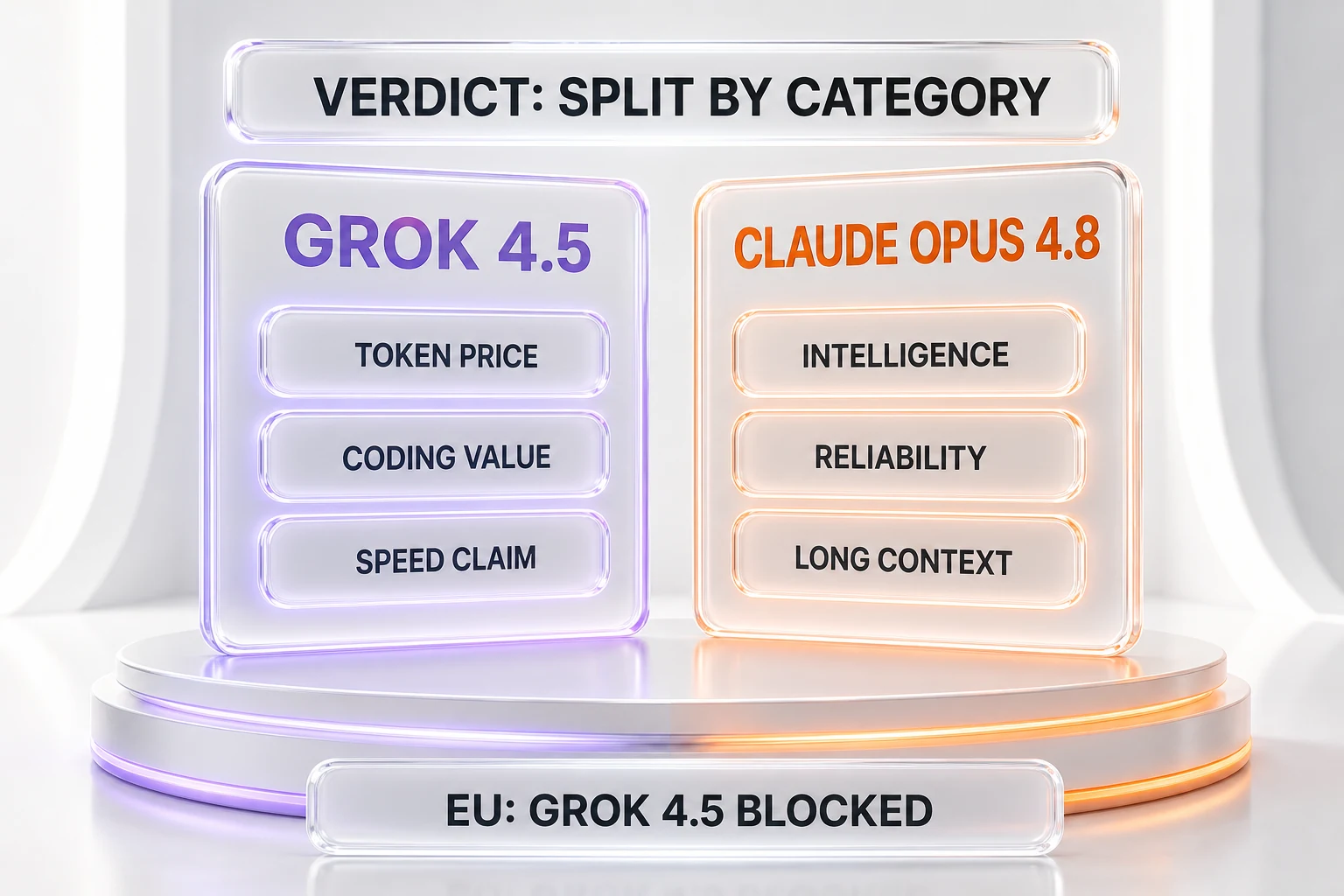
Best for Token Price: Grok 4.5
This one is not close on the rate card. Grok 4.5 costs $2 per million input tokens against Opus 4.8's $5, and $6 per million output against $25 — 60 percent cheaper on input and roughly 76 percent cheaper on output, both verified on SpaceXAI's documentation and Anthropic's. For high-volume, output-heavy workloads, that four-to-one output ratio dominates the bill. Paired with a frontier-tier independent coding-agent score, the price is what turns Grok 4.5 from a budget option into a genuine value proposition.
Best for Coding Value: Grok 4.5
On coding value — independent capability per dollar — Grok 4.5 makes the strongest case. It posts 64.4 on the Artificial Analysis Coding Agent Index v1.3, a frontier-tier result, at $2 input and $6 output per million tokens against Opus 4.8's $5 and $25. Opus 4.8 holds the only independently verified SWE-bench score of the two at 88.6 percent, since Grok 4.5 is too new to be ranked there — so on verified coding capability Opus 4.8 leads, but on independent coding value per dollar Grok 4.5 wins. This split is the most literal expression of the "Opus-class at half the price" framing: a credible frontier coding model at a fraction of the cost, with head-to-head verified parity still to be confirmed.
Best on Independently Verified Coding: Claude Opus 4.8
On the strictest independent coding measure, Claude Opus 4.8 has a number and Grok 4.5 does not yet. Opus 4.8 is verified at 88.6 percent on vals.ai's SWE-bench Verified suite, which resolves real GitHub issues against a hidden test suite. Grok 4.5, two days old at the time of writing, is not yet listed there, so its verified-coding capability is unconfirmed rather than low — a gap we flag rather than fill. If your requirement is an auditable, independently verified coding score today, Opus 4.8 is the only one of these two that has one.
Best for Measured Intelligence: Claude Opus 4.8
On the Artificial Analysis Intelligence Index, Claude Opus 4.8 reads a configuration-dependent 56 to 61 against Grok 4.5's 54, higher at both ends of its range, and Grok 4.5 was ranked fourth in the frontier field at publication. If your workload is the hardest reasoning you have and you want the model that measures higher on aggregate intelligence, Opus 4.8 is the pick of these two on the independent evidence. This is the clearest category where "Opus-class" overstates Grok 4.5's position.
Best for Reliability Signal: Claude Opus 4.8, Where Measured
Reliability is one-sided in a way that cuts against Grok 4.5. On Artificial Analysis's AA-Omniscience test, Grok 4.5 scored 26 with a 52 percent accuracy rate and a 54 percent hallucination rate; Artificial Analysis publishes no equivalent figure for Opus 4.8 in our sources, so this is a standalone caveat rather than a head-to-head. Combined with Anthropic's positioning of Opus 4.8 as a careful self-verifier, the available evidence favors Opus 4.8 for knowledge-intensive work where a confident wrong answer is costly — while acknowledging we lack a direct Opus 4.8 number on this specific test.
Best for Long Context and Multi-Agent Work: Claude Opus 4.8
Opus 4.8 carries a 1,000,000-token context window against Grok 4.5's 500,000 — double, and a real architectural difference. For whole-repository code work, large document sets, and agents that accumulate long histories, Opus 4.8 fits jobs in one context that Grok 4.5 must split. Opus 4.8 also owns multi-agent throughput through Dynamic Workflows, which orchestrate hundreds of parallel subagents, a capability Grok 4.5 does not offer as a distinct mode. For long-context pipelines and parallel-agent workloads, Opus 4.8 is the pick.
Availability: No Longer a Deciding Factor
This category used to be settled by regulation rather than performance, and it no longer is. Grok 4.5 was not available in the European Union at launch; SpaceXAI opened API console access to EU users on July 17, 2026, per its release notes. Claude Opus 4.8 has been available in the EU throughout. What survives is narrower than availability: Grok 4.5's API is served only from the us-east-1 and us-west-2 regions, so teams with data-residency obligations should check where their requests are processed rather than only whether the model is offered to them. We are based outside the EU and could test Grok 4.5 directly during the nine days it was closed to EU users.
Pros and Cons
Grok 4.5 Pros and Cons
What we like about Grok 4.5
- Less than half the token price. $2 input and $6 output per million against Opus 4.8's $5 and $25 — 60 percent and roughly 76 percent cheaper, verified on SpaceXAI's docs.
- Frontier-tier independent coding-agent score. 64.44 on the Artificial Analysis Coding Agent Index v1.3, sixth of 52 entries and 7.74 ahead of Opus 4.8's 56.70 at the same high effort, at a fraction of its price.
- Low measured cost per task. About $2.49 to run Artificial Analysis's Intelligence Index evaluation, a low figure in the frontier tier.
- Positioned as much faster. SpaceXAI and Musk call it "Opus-class, much faster"; speed is its headline selling point for latency-sensitive work.
- Reliable structured outputs and generous limits. Valid schema-adherent JSON on every run in our testing, an OpenAI-compatible API, and 150 requests per second with 50 million tokens per minute per its documentation.
Where Grok 4.5 falls short
- No independently verified coding score yet. Too new to be ranked on vals.ai's SWE-bench Verified suite, where Opus 4.8 is verified at 88.6 percent — so head-to-head coding parity is unconfirmed.
- Behind on aggregate intelligence. An Artificial Analysis Intelligence Index of 54, ranked fourth in the frontier field, below Opus 4.8's configuration-dependent 56 to 61.
- Independent hallucination caveat. A 54 percent hallucination rate on Artificial Analysis's AA-Omniscience test, with 52 percent accuracy — a reliability signal for factual work.
- Half the context window. 500,000 tokens against Opus 4.8's 1,000,000, which forces chunking on the largest inputs.
- Thin independent record at the time of testing. As of July 11, 2026 it was not yet ranked on independent SWE-bench Verified or LMArena.
Claude Opus 4.8 Pros and Cons
What we like about Claude Opus 4.8
- Only independently verified coding score of the two. 88.6 percent on vals.ai's SWE-bench Verified suite, where Grok 4.5 is not yet ranked.
- Higher measured intelligence. A configuration-dependent 56 to 61 on the Artificial Analysis Intelligence Index, above Grok 4.5 at both ends.
- Double the context window. 1,000,000 tokens against 500,000, enough to hold whole repositories and long histories in one pass.
- Documented computer-use and multi-agent record. 84 percent on Online-Mind2Web per Anthropic, plus Dynamic Workflows orchestrating hundreds of parallel subagents.
- Available in the EU from day one. Opus 4.8 had no EU gap, where Grok 4.5 spent its first nine days closed to EU users.
Where Claude Opus 4.8 falls short
- More than double the token price. $5 input and $25 output per million against Grok 4.5's $2 and $6 — a real cost gap on high-volume work.
- Costlier than the frontier-value alternative. Grok 4.5 posts a frontier-tier independent coding-agent score at under half Opus 4.8's rate card, so on coding value per dollar Opus 4.8 is beaten.
- Behind Grok 4.5 on the Coding Agent Index. Version 1.3 charts Claude Opus 4.8 at 56.70 through Claude Code at high effort and 60.54 at max, against Grok 4.5's 64.44 through Grok Build at high — so on that specific agentic-coding leaderboard it cedes the headline.
- Speed costs extra. Its Fast mode doubles throughput but doubles the per-token price to $10 input and $50 output per million.
- Noisy broad-intelligence reading. Its Intelligence Index spans 56 to 61.4 depending on configuration, which muddies a clean single-number comparison.
When to Pick Grok 4.5 vs Claude Opus 4.8
Pick Grok 4.5 if...
- Token price is the deciding factor — $2 input and $6 output per million is less than half of Opus 4.8 on both sides.
- Your workload is coding-heavy and cost-sensitive, where a frontier-tier Coding Agent Index v1.3 result of 64.4 at under half the price is a trade you will happily make.
- You run high-volume, latency-sensitive calls and are willing to trust SpaceXAI's much-faster positioning, or to benchmark speed on your own traffic.
- You want an OpenAI-compatible API and reliable structured outputs for straightforward tool-calling agents.
Pick Claude Opus 4.8 if...
- You want the higher measured intelligence and the only independently verified SWE-bench coding score of these two, per Artificial Analysis and vals.ai.
- Reliability is critical — Grok 4.5's 54 percent hallucination rate on AA-Omniscience is a caveat Opus 4.8 does not carry in our sources.
- Your workloads need long context — a 1,000,000-token window is double Grok 4.5's and holds whole repositories in one pass.
- You are building computer-use, browser, or multi-agent pipelines, where Anthropic reports Opus 4.8 as its strongest model and pairs it with Dynamic Workflows.
Frequently Asked Questions
Is Grok 4.5 really "Opus-class" like Elon Musk says?
Partly, and the honest answer splits by category. On the independent Artificial Analysis Coding Agent Index v1.3, Grok Build running Grok 4.5 at high effort posts 64.44, sixth of 52 entries and a frontier-tier coding result at less than half the token price. That supports the "Opus-class" framing directly on that board: Claude Opus 4.8 is charted at 56.70 through Claude Code at the same high effort and 60.54 at max, so Grok 4.5 leads it there by 7.74 points, in a different harness. But it is not yet independently confirmed head-to-head: Grok 4.5 is only two days old and does not yet appear on vals.ai's independent SWE-bench Verified leaderboard, where Claude Opus 4.8 is verified at 88.6 percent, so the independently verified coding edge currently belongs to Opus 4.8. The claim also does not hold on general intelligence: on the Artificial Analysis Intelligence Index, Grok 4.5 scores 54 and ranks fourth in the frontier field, while Opus 4.8 reads between 56 and 61 depending on configuration, higher at both ends, and Artificial Analysis flags a 54 percent hallucination rate for Grok 4.5 on its AA-Omniscience test. So "Opus-class" is fair on coding value and price, unconfirmed on verified coding, and unproven on general intelligence and reliability.
How much do Grok 4.5 and Claude Opus 4.8 cost?
Grok 4.5 costs $2 per million input tokens, $0.30 per million cached input tokens, and $6 per million output tokens — we confirmed this directly on SpaceXAI's Grok 4.5 model documentation. Claude Opus 4.8 costs $5 per million input tokens, $0.50 per million cached input tokens, and $25 per million output tokens, with a Batch tier at $2.50 and $12.50 per million — we confirmed this directly on Anthropic's pricing documentation. At the standard rate card, Grok 4.5 is 60 percent cheaper on input and roughly 76 percent cheaper on output, so it costs well under half of Opus 4.8 on both sides. Grok 4.5 also has the cheaper cached-input rate, at $0.30 per million against $0.50. That headline price gap is the strongest part of Grok 4.5's case.
Which is cheaper, Grok 4.5 or Claude Opus 4.8?
Grok 4.5, clearly, on the rate card. Its $2 input and $6 output per million tokens is less than half of Claude Opus 4.8's $5 and $25 on both sides, and Grok 4.5 also undercuts it on cached input, $0.30 against $0.50 per million. For output-heavy workloads — long generations, verbose agent traces, large code diffs — Grok 4.5's $6 output against Opus 4.8's $25 compounds quickly. The one caveat is that neither vendor's rate card is the same as measured cost per task: Artificial Analysis lists Grok 4.5 at about $2.49 to run its Intelligence Index evaluation, a low figure in the frontier tier, but our sources do not publish an equivalent per-task figure for Opus 4.8, so we compare the two on the verified rate cards and leave per-task cost as a Grok-only data point.
Which is better for coding, Grok 4.5 or Claude Opus 4.8?
The independent coding evidence is split: each model leads one of the two boards, and only Opus 4.8 carries a SWE-bench Verified number. On vals.ai's SWE-bench Verified suite, which resolves real GitHub issues against a hidden test suite, Claude Opus 4.8 is verified at 88.6 percent; Grok 4.5 is too new to be ranked there yet, so it has no independent Verified number at the time of writing, and we will not substitute SpaceXAI's own positioning for one. On the Artificial Analysis Coding Agent Index v1.3, which scores a harness and a model together, Grok Build with Grok 4.5 posts 64.44 at high effort, against 56.70 for Claude Opus 4.8 through Claude Code at the same effort and 60.54 at max. So Opus 4.8 owns the verified software-engineering number and Grok 4.5 leads the independent coding-agent board by 7.74 points, at less than half the price. On verified coding capability Opus 4.8 leads; on coding value per dollar Grok 4.5 competes strongly. We flag the SWE-bench gap rather than fill it.
Is Grok 4.5 or Claude Opus 4.8 smarter?
On the independent aggregate measure, Claude Opus 4.8 scores higher. Artificial Analysis places Grok 4.5 at 54 on its Intelligence Index, ranking it fourth in the frontier field behind Claude Fable 5, GPT-5.5, and Opus 4.8. Opus 4.8's own number on that index is configuration-dependent — the launch analysis put it near the top at 61.4, while the live per-model page shows 56 for a specific max-effort reading — but both ends of that range sit above Grok 4.5's 54. Because the source itself reports Opus 4.8 between 56 and 61.4, we treat it as top-tier and configuration-dependent rather than fixing a single number, but on the aggregate independent intelligence measure, Opus 4.8 is ahead of Grok 4.5. This is the category where the "Opus-class" claim does not hold.
Which has the larger context window, Grok 4.5 or Claude Opus 4.8?
Claude Opus 4.8, by double. Anthropic's models overview lists Opus 4.8 at a 1,000,000-token context window (roughly 555,000 words) with a January 2026 training cutoff, while SpaceXAI's documentation lists Grok 4.5 at 500,000 tokens. That is a genuine two-to-one difference, not a rounding gap: for whole-repository code work, large document sets, and agents that accumulate long histories, Opus 4.8 fits jobs in one context that Grok 4.5 must split into chunks. Both models take text and image inputs and return text, and neither generates images natively. If your workloads routinely stay under 500,000 tokens, which most do, the gap will not affect you; if they exceed it, only Opus 4.8 of these two holds them in a single pass.
Is Grok 4.5 available in the EU?
Yes, since July 17, 2026. Grok 4.5 was not offered in the European Union when it went public on July 9, 2026; nine days later the xAI release notes published an entry titled "Grok 4.5 available in the EU," stating that "Grok 4.5 is now available in the API console for EU users." Availability therefore no longer separates these two models. Its API documentation still lists only the us-east-1 and us-west-2 regions, so data residency remains a separate question from availability.
How reliable is Grok 4.5 compared to Claude Opus 4.8?
There is one independent reliability caveat that weighs against Grok 4.5. On Artificial Analysis's AA-Omniscience test, which probes how often a model confabulates rather than admitting it does not know, Grok 4.5 scored 26 with a 52 percent accuracy rate and a 54 percent hallucination rate. Artificial Analysis has not published an equivalent AA-Omniscience figure for Claude Opus 4.8 in our sources, so this is a standalone caveat on Grok 4.5 rather than a head-to-head result — but it is a signal to weigh for knowledge-intensive work where a confident wrong answer is costly. Anthropic separately positions Opus 4.8 as a careful self-verifier that flags problems rather than declaring a task done without checking, though that is a vendor characterization. For high-stakes factual work, ground either model with retrieval and verification rather than trusting raw recall.
Which is faster, Grok 4.5 or Claude Opus 4.8?
We cannot declare a numeric speed winner, because our sources do not carry an independent, apples-to-apples tokens-per-second figure for both. SpaceXAI positions Grok 4.5 as "much faster" than its rivals, and Elon Musk has repeated that framing, but that is a vendor claim rather than an independently benchmarked throughput number in our sources. Anthropic offers a separate Fast mode for Opus 4.8 that roughly doubles speed at double the per-token price ($10 input and $50 output per million tokens), which tells you speed is tunable on the Opus side but at a cost. Speed is genuinely one of Grok 4.5's headline selling points and it may well be faster in practice, but we will not crown it on a vendor statement. If latency is your deciding factor, benchmark both on your own traffic before committing.
Did you actually test both Grok 4.5 and Claude Opus 4.8?
Yes. We ran both side-by-side through our own xAI and Anthropic API keys, and we have no affiliate relationship with either vendor. Because Grok 4.5 only reached public availability on July 9, 2026, our hands-on time with it is measured in days, so we scope our own notes on it to first impressions and anchor every capability claim to attributed third-party benchmarks from Artificial Analysis, LMArena, and vals.ai. Claude Opus 4.8 we have used in production since its late-May 2026 release and reviewed in depth. Where a performance number is self-reported by a vendor — including Musk's "Opus-class" positioning for Grok 4.5 and Anthropic's computer-use figure for Opus 4.8 — we label it as such rather than presenting it as independent evidence, and the verdict rests on attributed numbers.
Which is better for agentic and computer-use work?
On the published evidence, Claude Opus 4.8 has the more established agentic and computer-use record, though the two are not measured on identical tests. Anthropic reports Opus 4.8 as its best computer-use and browser-agent model at 84 percent on Online-Mind2Web, and pairs it with Dynamic Workflows that orchestrate hundreds of parallel subagents on large multi-file tasks — both vendor-reported capabilities. Grok 4.5 supports function calling and structured outputs with a low, medium, and high reasoning control, and in our testing returned valid, schema-adherent JSON on every run, but it does not offer an equivalent multi-agent orchestration mode in our sources. For heavy browser automation and multi-agent pipelines, Opus 4.8 is the more proven of the two; for straightforward tool-calling agents at low cost, Grok 4.5 is capable and much cheaper.
What are the alternatives to Grok 4.5 and Claude Opus 4.8?
Several sit close by. Claude Fable 5 is Anthropic's top tier, leading the Artificial Analysis Intelligence Index at 60 and posting 95 percent on SWE-bench Verified, at $10 per million input and $50 per million output tokens. GPT-5.5, OpenAI's flagship, remains active and competitive on price for routine work. Gemini 3.1 Pro is Google's value-focused frontier option, and Grok 4.3 is still available below Grok 4.5 in the SpaceXAI lineup. For the adjacent matchups in detail, see our Claude Opus 4.8 versus GPT-5.5 comparison, our Claude Fable 5 versus Claude Opus 4.8 comparison, and our Claude Opus 4.7 versus Grok 4.3 comparison, which covers the previous round of this same Anthropic-versus-Grok rivalry.
Final Verdict — "Opus-Class" Is Credible on Value, Unconfirmed on Verified Coding
After running both side-by-side, confirming pricing on each vendor's own documentation, and holding every capability claim to independent benchmarks, our verdict on Musk's "Opus-class, much faster" framing is a genuine split — neither a debunk nor an endorsement. Grok 4.5 makes the "Opus-class" case on price and coding value: it posts a frontier-tier 64.4 on the independent Artificial Analysis Coding Agent Index v1.3, at $2 input and $6 output per million tokens against Opus 4.8's $5 and $25 — less than half on both sides — plus a low measured cost of about $2.59 per task on that index's own cost board. What it does not yet have is an independent SWE-bench Verified score to confirm parity head-to-head, because it is only two days old; Opus 4.8 is verified there at 88.6 percent. Claude Opus 4.8 keeps the lead where the independent evidence exists: it holds the only verified SWE-bench score, reads higher on the Artificial Analysis Intelligence Index (a configuration-dependent 56 to 61 against 54), carries double the context window, holds the documented computer-use and multi-agent record, and held the EU-availability advantage until Grok 4.5 closed that gap on July 17, 2026. Grok 4.5's 54 percent hallucination rate on AA-Omniscience is a reliability caveat Opus 4.8 does not carry in our sources. We disclose plainly that we have no affiliate relationship with either vendor and tested both through our own API keys.
We did not crown a single overall winner because the evidence does not support one honestly. "Opus-class" is credible on coding value and unbeatable on price, but it is not yet independently confirmed on verified coding — where Opus 4.8 has the only number — and it overstates Grok 4.5's position on aggregate intelligence and reliability, where the independent numbers favor Opus 4.8. If your work is coding-heavy and cost-sensitive — pick Grok 4.5 and bank the savings. If your work needs independently verified coding, higher intelligence, reliability, or long context — pick Claude Opus 4.8. For many teams the rational endgame is routing: Grok 4.5 for cheap, fast, high-volume coding and bulk calls, Opus 4.8 for the hardest reasoning, verified coding, longest context, and computer-use agents. For the tiers and neighbors around this matchup, see our Claude Opus 4.8 review, our Grok 4.3 review, our Claude Fable 5 review, our Claude Fable 5 vs Claude Opus 4.8 comparison, and our Claude Opus 4.7 vs Grok 4.3 comparison, which covers the previous round of this same Anthropic-versus-Grok rivalry.
Sources
Every figure in this comparison is attributed to a primary or independent source. Pricing and specifications come from the vendors' own documentation; capability scores come from independent third parties; self-reported figures, including Musk's "Opus-class" positioning, are labeled as such throughout.
- SpaceXAI — Grok 4.5 model documentation and pricing
- SpaceXAI — Grok product home
- Anthropic — Claude Opus 4.8 API pricing
- Anthropic — Claude models overview and specifications
- Anthropic — Claude Opus product page
- Artificial Analysis — Intelligence Index, cost per task, and AA-Omniscience and the Artificial Analysis Coding Agent Index (v1.3, read August 2, 2026)
- vals.ai — SWE-bench Verified independent leaderboard
- LMArena — human-preference Elo leaderboard
Last compared: July 2026. Grok 4.5 reached public availability on July 9, 2026, and Claude Opus 4.8 has been generally available since late May 2026. Grok 4.5 is new, and we will revise this comparison as independent benchmark coverage of it — including SWE-bench Verified, LMArena, and AA-Omniscience coverage — matures.
Our Verdict
A split verdict, and we will not fake a single overall winner. Elon Musk positions Grok 4.5 as "Opus-class, much faster" at less than half the price, and on the independent Artificial Analysis Coding Agent Index v1.3 the claim has partial support: Grok 4.5 scores 64.4 through Grok Build at less than half the token price, against 56.70 for Claude Opus 4.8 through Claude Code at the same high effort. But "Opus-class" is not yet independently confirmed against Opus 4.8 on verified coding: Grok 4.5 is only two days old and does not yet appear on vals.ai's independent SWE-bench Verified leaderboard, where Claude Opus 4.8 is verified at 88.6 percent — so the independently verified coding edge is Opus 4.8's. Grok 4.5 is also dramatically cheaper, at $2 per million input tokens and $6 per million output against Opus 4.8's $5 and $25, both vendor-verified, and Artificial Analysis measures its cost per task at about $2.49 on its Intelligence Index run, low in the frontier tier. The "Opus-class" label does not extend across the board. On the Artificial Analysis Intelligence Index, Grok 4.5 scores 54 and ranks fourth in the frontier field, while Opus 4.8 reads between 56 and 61 depending on configuration — higher at both ends. On reliability, Artificial Analysis's AA-Omniscience test flags a 54 percent hallucination rate for Grok 4.5, and Opus 4.8 carries a 1,000,000-token context window to Grok's 500,000. One hard practical fact sits outside the benchmarks: Grok 4.5 is not available in the EU under the AI Act, while Opus 4.8 is. Best for the lowest token price, coding value per dollar, and vendor-stated speed on non-EU work: Grok 4.5. Best for independently verified coding, measured intelligence, reliability, long context, and EU availability: Claude Opus 4.8. "Opus-class" is credible on coding value and price, but unconfirmed on independently verified coding and unproven on general intelligence and reliability — so route accordingly rather than crown one model.
Choose Grok 4.5
SpaceXAI's reasoning model — Opus-class speed at $2 and $6 per million tokens, 500K context, available to EU users since July 17, 2026; succeeded by Grok 4.6 on August 12.
Try Grok 4.5 →Choose Claude Opus 4.8
Anthropic's flagship model for agentic coding, computer use, and multi-agent orchestration.
Try Claude Opus 4.8 →Frequently Asked Questions
Is Grok 4.5 better than Claude Opus 4.8?
A split verdict, and we will not fake a single overall winner. Elon Musk positions Grok 4.5 as "Opus-class, much faster" at less than half the price, and on the independent Artificial Analysis Coding Agent Index v1.3 the claim has partial support: Grok 4.5 scores 64.4 through Grok Build at less than half the token price, against 56.70 for Claude Opus 4.8 through Claude Code at the same high effort. But "Opus-class" is not yet independently confirmed against Opus 4.8 on verified coding: Grok 4.5 is only two days old and does not yet appear on vals.ai's independent SWE-bench Verified leaderboard, where Claude Opus 4.8 is verified at 88.6 percent — so the independently verified coding edge is Opus 4.8's. Grok 4.5 is also dramatically cheaper, at $2 per million input tokens and $6 per million output against Opus 4.8's $5 and $25, both vendor-verified, and Artificial Analysis measures its cost per task at about $2.49 on its Intelligence Index run, low in the frontier tier. The "Opus-class" label does not extend across the board. On the Artificial Analysis Intelligence Index, Grok 4.5 scores 54 and ranks fourth in the frontier field, while Opus 4.8 reads between 56 and 61 depending on configuration — higher at both ends. On reliability, Artificial Analysis's AA-Omniscience test flags a 54 percent hallucination rate for Grok 4.5, and Opus 4.8 carries a 1,000,000-token context window to Grok's 500,000. One hard practical fact sits outside the benchmarks: Grok 4.5 is not available in the EU under the AI Act, while Opus 4.8 is. Best for the lowest token price, coding value per dollar, and vendor-stated speed on non-EU work: Grok 4.5. Best for independently verified coding, measured intelligence, reliability, long context, and EU availability: Claude Opus 4.8. "Opus-class" is credible on coding value and price, but unconfirmed on independently verified coding and unproven on general intelligence and reliability — so route accordingly rather than crown one model.
Which is cheaper, Grok 4.5 or Claude Opus 4.8?
Grok 4.5 starts at $2 in / $6 out per M tokens. Claude Opus 4.8 starts at $5 in / $25 out per M tokens. Check the pricing comparison section above for a full breakdown.
What are the main differences between Grok 4.5 and Claude Opus 4.8?
The key differences span across 15 features we compared. For API input price (per million tokens), Grok 4.5 offers $2.00 (verified) while Claude Opus 4.8 offers $5.00 (verified). For API output price (per million tokens), Grok 4.5 offers $6.00 (verified) while Claude Opus 4.8 offers $25.00 (verified). For Cached input price (per million tokens), Grok 4.5 offers $0.30 (verified) while Claude Opus 4.8 offers $0.50 (verified). See the full feature comparison table above for all details.