Grok 4.5
SpaceXAI's reasoning model — Opus-class speed at $2 and $6 per million tokens, 500K context, available to EU users since July 17, 2026; succeeded by Grok 4.6 on August 12.

Quick Summary
Grok 4.5 review (July 2026). SpaceXAI's July 2026 reasoning model, succeeded as flagship by Grok 4.6 on August 12, 2026, at $2 per million input tokens and $6 per million output tokens, 500K context, text and image input, function calling and structured outputs. Musk calls it Opus-class, much faster. We rate it 8.7 out of 10 after early hands-on testing on the xAI API.
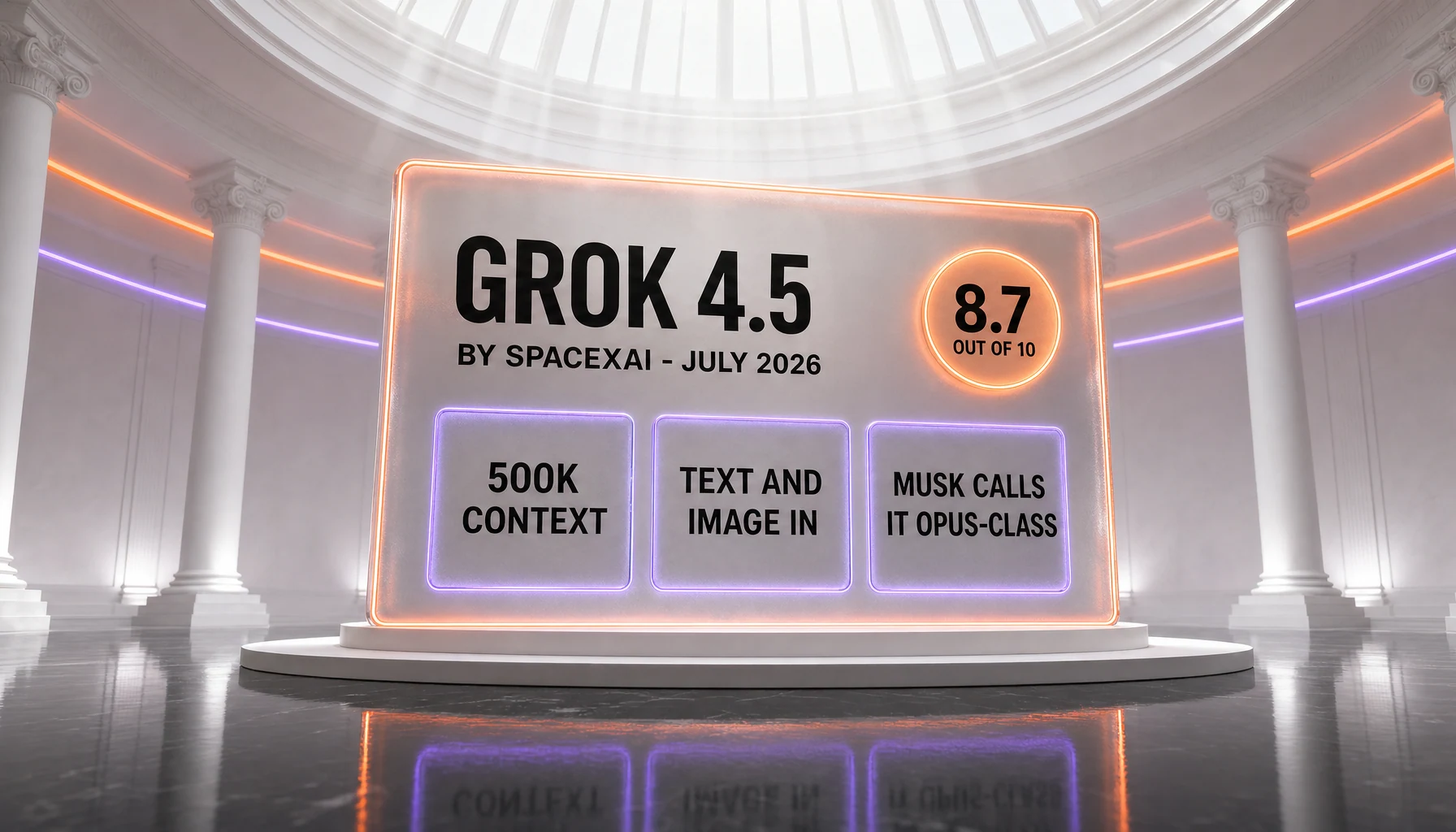
Grok 4.5 is a SpaceXAI reasoning model, publicly available since July 9, 2026, and the company's flagship until Grok 4.6 arrived on August 12, 2026. It costs $2 per million input tokens and $6 per million output tokens — half or less of the sticker price of Claude Opus 4.8 and GPT-5.6 Sol — with a 500,000-token context window, text and image input, function calling, and structured outputs. Elon Musk describes it as "Opus-class, much faster." We rate it 8.7 out of 10 after early hands-on testing on the xAI API.
Quick Verdict
We ran Grok 4.5 on the xAI API two days after its public release, across four representative tasks — non-trivial coding, multi-step reasoning, structured JSON output, and strict instruction-following. It handled all four correctly on the first attempt, and it felt genuinely fast for a reasoning model, returning answers in under five seconds each. The headline is the price-to-capability ratio: at $2 per million input tokens and $6 per million output tokens, it costs 40 percent of Opus 4.8 on input and under a third of GPT-5.6 Sol on output, and independent testing from Artificial Analysis puts its cost per task near the bottom of the frontier tier. It is not the smartest model available — it scores 53.8 on the Artificial Analysis Intelligence Index as of August 3, 2026, behind Claude Opus 5, Claude Fable 5, GPT-5.6 Sol, Kimi K3, Claude Opus 4.8, GPT-5.6 Terra and GPT-5.5 — and its measured hallucination rate is a real caveat.
- Score: 8.7 out of 10 — the strongest value play at the frontier tier in July 2026.
- Pro: $2 input and $6 output per million tokens — half or less of the price of Opus 4.8 and GPT-5.6 Sol.
- Pro: Fast, correct output in our early hands-on tests, with reliable JSON mode and exact instruction-following.
- Con: Scores 53.8 on the Artificial Analysis Intelligence Index as of August 3, 2026, behind seven models including Claude Opus 5, Claude Fable 5 and GPT-5.6 Sol.
- Con: Its independently measured hallucination rate is high, at 54 percent on AA-Omniscience.
What Is Grok 4.5?
Grok 4.5 is a large language model from SpaceXAI — the renamed AI unit that emerged after xAI was folded into SpaceX, with the "SpaceXAI" branding taking effect on July 6, 2026. The product keeps the Grok name. Grok 4.5 was announced on July 8 and made publicly available on July 9, 2026, replacing Grok 4.3 as the top model while Grok 4.3 and Grok 4.20 remain available. It is no longer SpaceXAI's newest model: on August 12, 2026 the company released Grok 4.6, which its release notes describe as "SpaceXAI's frontier model for coding, agentic tasks, and knowledge work," on the same 500K context window and the same $2 and $6 per million token rates. This review covers Grok 4.5, which remains available on the API.
The API model identifier is grok-4.5, with the aliases grok-4.5-latest and grok-build-latest. It is served through an OpenAI-compatible endpoint at api.x.ai, which means most existing SDK code runs against it with only a base-URL and model-name change. According to xAI's model documentation, Grok 4.5 offers a 500,000-token context window, accepts text and image input and returns text, and supports function calling and structured outputs. xAI says the model was trained jointly with the team at Cursor on GB300-class GPUs.
The positioning comes straight from Elon Musk, who described Grok 4.5 as "Opus-class, much faster" and, in a separate framing, "roughly comparable to Opus 4.7, but much faster." That framing sits alongside the vendor material on x.ai, but it is a vendor claim, not an independent verdict — but our own early testing and the independent numbers from Artificial Analysis both point to a model that competes near the top on capability while undercutting the field badly on price. For the background on the corporate reshuffle, we covered the SpaceXAI rebrand and the earlier dissolution of xAI into SpaceX when they happened.
One thing to be clear about up front: several widely repeated claims about Grok 4.5 are not confirmed by primary sources. Reported parameter counts (a "1.5 trillion parameter" or "V9" figure circulating from a leak), claims that the grok-4.5 API tier ships with always-on real-time X data, and pricing for server-side tools are all unconfirmed against xAI's own documentation as of publication. We do not treat any of them as fact in this review, and neither should you.
Key Features in 2026
Grok 4.5's feature set is a deliberate frontier-tier package with one obvious gap. Everything below is drawn from xAI's model documentation at docs.x.ai, cross-checked against our own API calls.
- 500,000-token context window — roughly 1,000 pages of text in a single prompt. Large, though smaller than Grok 4.3's stated 1 million tokens and GPT-5.6's 1.05 million.
- Text and image input, text output — Grok 4.5 accepts multimodal input (text plus images) but returns text only. It does not generate images natively; that job stays with the separate Grok Imagine model.
- Function calling — supported, so the model can drive tools and agent loops through the standard OpenAI-compatible tool interface.
- Structured outputs — supported. In our tests JSON mode returned valid, schema-adherent objects every time.
- Reasoning effort control — the model exposes low, medium, and high reasoning effort, with high as the default. Our calls showed dedicated reasoning tokens in the usage payload, confirming an internal chain-of-thought pass.
- High rate limits — 150 requests per second and 50 million tokens per minute per the documentation, which is generous headroom for production agent fleets.
- Two regions — us-east-1 and us-west-2, per the model documentation. Serving region and user availability are separate questions: EU users gained access through the API console on July 17, 2026, while both serving regions remain in the United States.
- OpenAI-compatible API — the endpoint mirrors the OpenAI Chat Completions shape, so migration from another provider is largely a configuration change.
- Prompt caching — cached input is billed at $0.30 per million tokens, and our usage payloads showed cached tokens being counted, which compounds savings on agent loops with stable system prompts.
If you are new to how these API knobs translate into a monthly bill, our explainer on input, output, and cached token pricing walks through the math, and our primer on agentic coding models versus chatbots explains why function calling and reasoning effort matter for real work.
Pricing in 2026
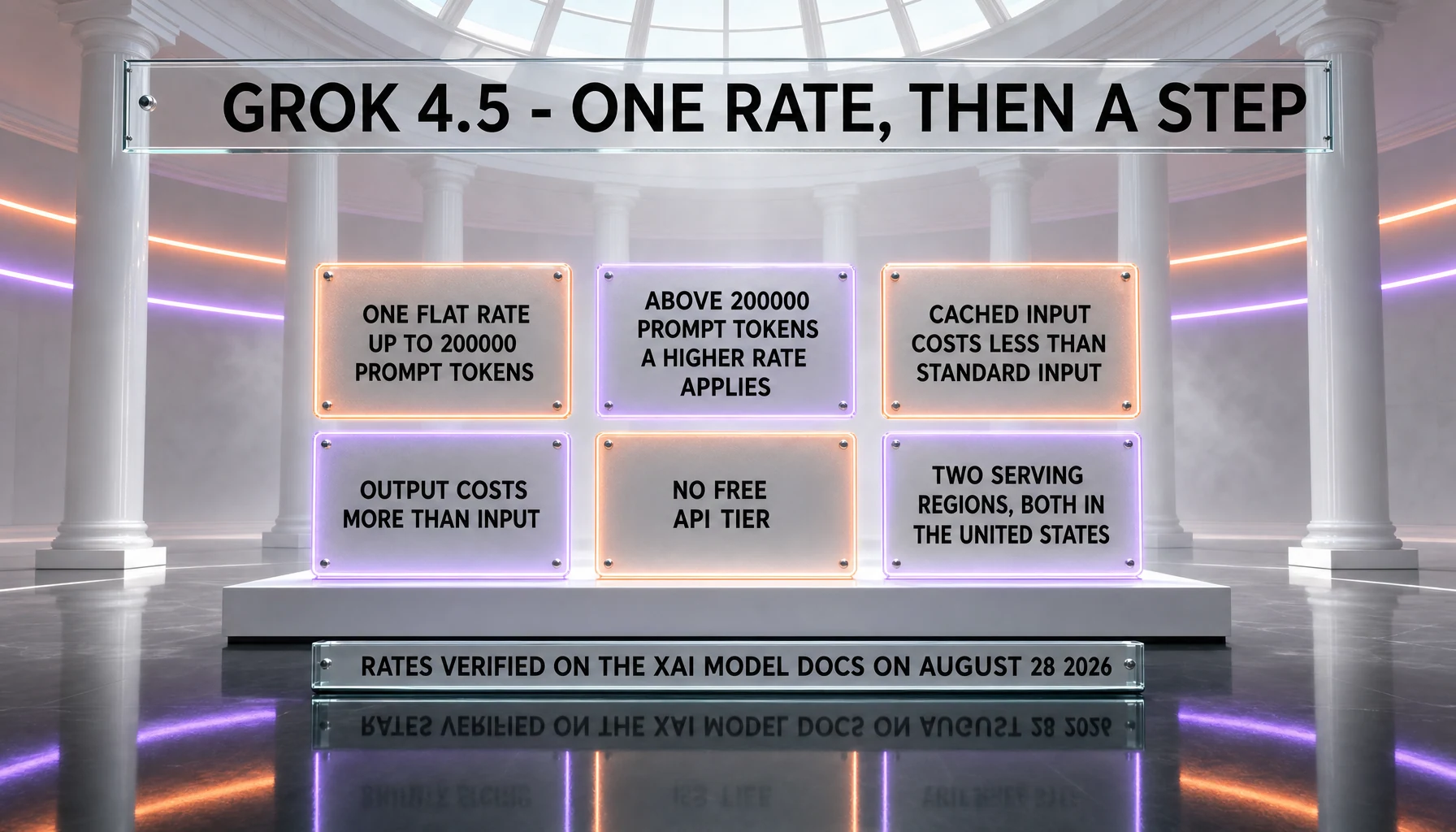
Grok 4.5 costs $2.00 per million input tokens, $0.30 per million cached input tokens, and $6.00 per million output tokens on prompts under 200,000 tokens, according to xAI's model documentation. At or above 200,000 prompt tokens the rate doubles on input and output, to $4.00 and $12.00, with cached input at $0.60. That is half or less of Claude Opus 4.8 at $5 input and $25 output, and of GPT-5.6 Sol, which OpenAI lists at $4 input and $20 output per million tokens under promotional pricing (its standard rate is $5 and $30).
| Model | Input per 1M | Cached input per 1M | Output per 1M |
|---|---|---|---|
| Grok 4.5 (prompts under 200K) | $2.00 | $0.30 | $6.00 |
| Grok 4.5 (prompts 200K and above) | $4.00 | $0.60 | $12.00 |
| Claude Opus 4.8 | $5.00 | — | $25.00 |
| GPT-5.6 Sol | $4.00 | $0.40 | $20.00 |
| Grok 4.3 | $1.25 | — | $2.50 |
Note the step in the middle of that rate card: the $2 and $6 figures hold only while a prompt stays under 200,000 tokens. At or above that threshold xAI charges $4.00 input and $12.00 output per million, with cached input at $0.60 — double the base rate on every line. Since the context window runs to 500,000 tokens, a workload that genuinely uses the long end of it is billed at the higher tier, so budget from the tier your prompts actually land in rather than from the headline number. xAI's documentation states the two tiers without saying whether the higher rate applies to the whole request or only to the excess, and we have not found that detail in a primary source, so we do not assert either reading.
The comparison that matters most is against the models Grok 4.5 is actually pitched against. On output tokens — where reasoning models spend the bulk of the bill because internal reasoning tokens are billed as output — Grok 4.5 is more than three times cheaper than Opus 4.8 and GPT-5.6 Sol. Note that the older Grok 4.3 is still cheaper on paper at $1.25 input and $2.50 output; Grok 4.5 charges a premium over its predecessor for a meaningful capability step up, which is a reasonable trade if you need the extra intelligence.
The cost story is even stronger once you factor in real workloads. Because pricing is per token and a reasoning model's output includes its chain-of-thought, the practical cost per completed task is what counts. Independent measurement from Artificial Analysis puts Grok 4.5 at about $2.49 per task on its evaluation suite, against $11.80 for the far pricier Claude Fable 5 — a roughly five-fold difference. To keep prose honest we quote pricing in plain units: two dollars per million input tokens, six dollars per million output tokens. There is no free API tier for Grok 4.5; the cheapest route to programmatic access is the metered API itself.
Hands-On Testing
We accessed Grok 4.5 through the xAI API using the grok-4.5 model identifier and the OpenAI-compatible Chat Completions endpoint documented at docs.x.ai, two days after its public release. This is early hands-on work: a small, four-task battery run once, not a matured verdict. We are reporting exactly what we saw.
Non-trivial coding. We asked for a TypeScript function to merge overlapping and adjacent intervals, calling out the tricky edge cases — empty input, fully nested intervals, and intervals that only touch at an endpoint. Grok 4.5 returned a clean, correct implementation in about four seconds. It sorted a copy rather than mutating the caller's array, and it used a single comparison to catch both overlapping and touching intervals:
if (cur[0] <= last[1]) last[1] = Math.max(last[1], cur[1]);
That <= is the detail junior implementations get wrong — a strict less-than would fail to merge [1,3] and [3,5]. The model also appended an accurate complexity note. This was correct on the first try, with no hand-holding.
Multi-step reasoning. We gave it a two-train closing-distance word problem with a staggered departure, asking for the meeting clock time and the distance from the origin station. Grok 4.5 correctly accounted for the 30-minute head start, computed the meeting at 12:06 and 186 kilometers from station A, and — the part we liked — verified its own answer with an independent second calculation. It finished in roughly four seconds.
Structured output. We requested strict JSON extraction from a sentence, with a fixed set of keys and types. The model returned valid JSON on every run, adhered to the requested schema, and correctly excluded the EU from the list of available regions, because the source sentence we supplied stated the model was blocked there — accurate on the day we ran the test, and superseded six days later when EU access opened. That kind of careful reading of an implicit constraint is exactly what you want from a model driving downstream automation.
Instruction-following over a longer input. We fed an 18-section synthetic report and asked for the three highest-throughput subsystems, in an exact three-line format, sorted descending, with no commentary. Grok 4.5 returned precisely three lines, in the right order, in the requested format, and added nothing else. It was also the fastest task in our set, under two seconds.
Two behaviors stood out across the battery. First, speed: every response came back in roughly two to four seconds, which is fast for a reasoning model and is consistent with the "much faster" half of Musk's positioning. Second, the usage payloads exposed dedicated reasoning tokens and counted cached tokens, confirming both the internal chain-of-thought and working prompt caching. We did not stress-test the full 500,000-token context in this early pass, and we would want a much larger sample before drawing conclusions about factual reliability — a point the independent benchmarks below make pressing.
Independent Benchmarks
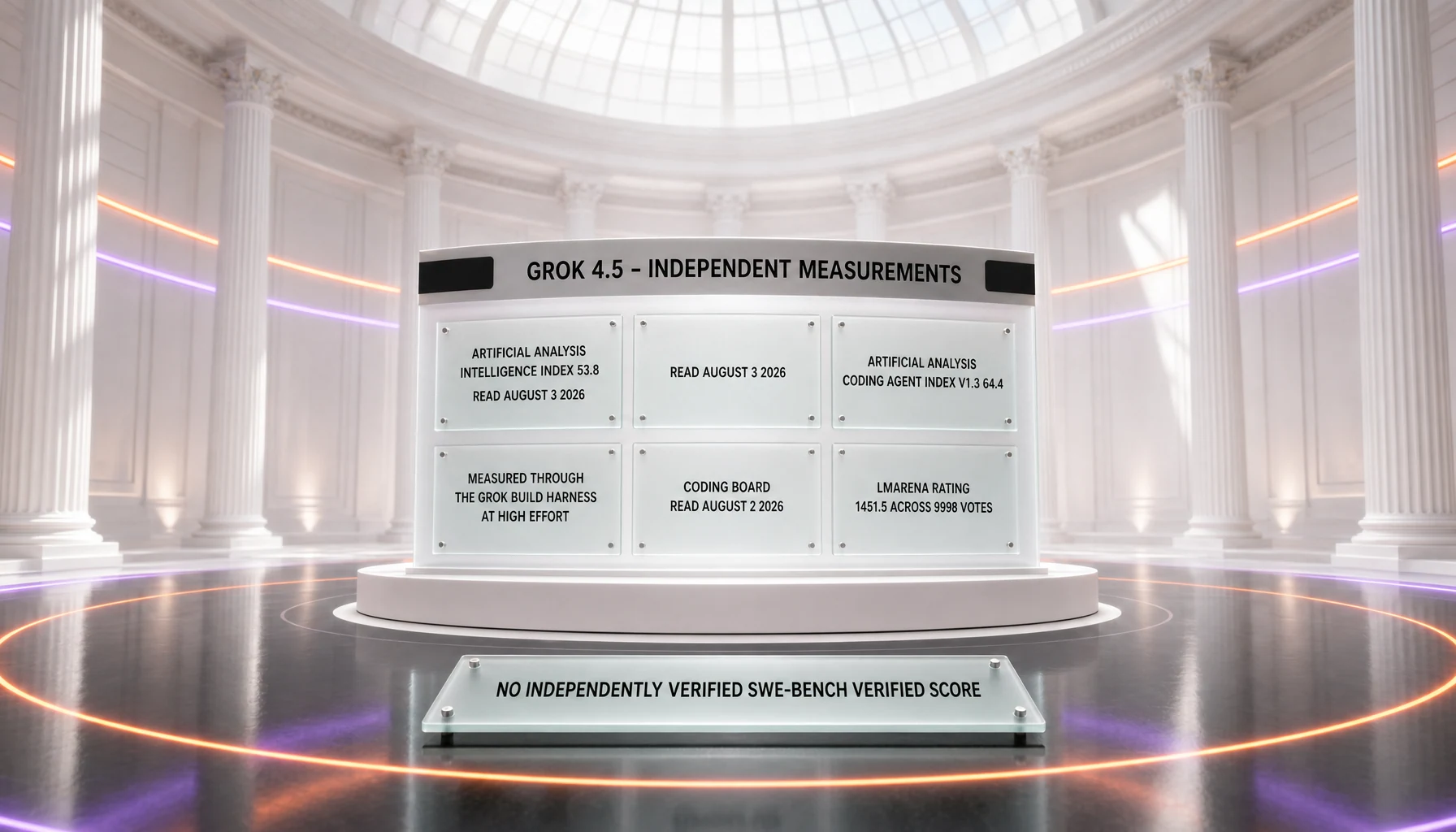
According to Artificial Analysis, which published independent Grok 4.5 results on July 8, 2026, the model scores 53.8 on the Intelligence Index as of August 3, 2026 — behind Claude Opus 5, Claude Fable 5, GPT-5.6 Sol, Kimi K3, Claude Opus 4.8, GPT-5.6 Terra and GPT-5.5. Artificial Analysis puts its cost per task at about $2.49. Coding sits on a separate board: on the Artificial Analysis Coding Agent Index v1.3, Grok 4.5 at high reasoning effort paired with the Grok Build harness reaches 64.4, fourth among the ten agent-and-model entries listed when we read it on August 2, 2026.
The coding result is the more flattering of the two, with a caveat that changes how it should be read: this index scores a harness and a model together, never a model on its own. The entry is Grok Build running Grok 4.5 at high effort, at 64.4, which lands fourth behind Claude Code with Opus 5 at xhigh (66.7), Codex with GPT-5.6 Sol at max (66.6), and Claude Code with Fable 5 at max (65.8). Artificial Analysis measures the mean cost of that Grok run at $2.59 per task, against $8.23, $7.08, and $11.71 for the three entries above it — and that cost gap, not the index position, is the practical argument for Grok 4.5 on developer workloads. GPT-5.5 has no entry on this board. The Intelligence Index placement is more sobering: 53.8, eighth among the models Artificial Analysis scores in our index as of August 3, 2026, means Grok 4.5 is a very good model, not the best available, and it trails the current leaders by a clear margin.
The caveat we weight most heavily is factual reliability. On the AA-Omniscience benchmark, Artificial Analysis reports an overall score of 26, an accuracy of 52 percent, and a hallucination rate of 54 percent. A hallucination rate above half on that evaluation is high, and it lines up with the standard advice for any Grok model: pair it with retrieval, citations, or human review for anything factual, and do not trust it blind on edge cases.
One data gap remains, and it deserves to be stated plainly, because an absence is itself information. Grok 4.5 now carries an LMArena rating of 1451.5 across 9,998 human votes as of August 3, 2026 — it was absent from that leaderboard at launch — but it still has no independently verified SWE-bench Verified score. Until a verified coding score lands, any head-to-head coding or preference ranking against Opus 4.8, GPT-5.5, or Claude Fable 5 rests on a single independent source plus vendor framing. We will update this review when that data lands. For the deeper background on why cost-per-task has become the metric that moves budgets, Artificial Analysis publishes its methodology openly at artificialanalysis.ai.
Pros and Cons
Pros
- Half or less of the token price of Claude Opus 4.8 and GPT-5.6 Sol, at $2 input and $6 output per million tokens.
- Very low cost per task — roughly $2.49 on the Artificial Analysis suite, near the bottom of the frontier tier.
- Fast, correct output in our early hands-on tests, with responses under five seconds on every task.
- Reliable structured outputs — valid, schema-adherent JSON on every run in our testing.
- OpenAI-compatible API means most existing SDK code runs with only a base-URL and model-name change.
- Strong agentic coding position — 64.4 on the Artificial Analysis Coding Agent Index v1.3, measured through the Grok Build harness at high reasoning effort and read on August 2, 2026.
- Generous rate limits at 150 requests per second and 50 million tokens per minute per xAI documentation.
Cons
- Scores 53.8 on the Artificial Analysis Intelligence Index as of August 3, 2026 — a very good model, not the smartest available.
- High measured hallucination rate — 54 percent on AA-Omniscience, so it needs retrieval or human review for factual work.
- No independently verified SWE-bench Verified score as of August 3, 2026 (it does now carry an LMArena rating of 1451.5 across 9,998 votes).
- Smaller 500,000-token context window than Grok 4.3's stated 1 million and GPT-5.6's 1.05 million.
- No native image generation — multimodal input only, with text output.
Best Use Cases
- High-volume agent workflows. When token cost dominates unit economics — support agents, RAG pipelines, lead qualification — the four-to-five-fold price gap versus Opus 4.8 is decisive at scale.
- Agentic coding. A fourth-place Coding Agent Index v1.3 result of 64.4 through Grok Build, at a mean $2.59 per task, makes Grok 4.5 a strong pick for bug hunting, refactors, and scaffold generation, especially in tool-driven loops.
- Cost-sensitive reasoning. Multi-step logic and analysis where you want a reasoning model but cannot justify frontier-leader prices on every call.
- Structured data extraction. JSON mode was reliable in our tests, which suits classification, entity extraction, and schema-constrained automation.
- Drop-in provider swaps. Teams already on an OpenAI-compatible stack can A/B Grok 4.5 against their current model with minimal code change.
- Latency-sensitive products. Sub-five-second responses in our testing make it viable for interactive assistants where a slower reasoning model would frustrate users.
One workload to approach with care: factual, safety-critical, or regulated tasks. Given the 54 percent hallucination rate on AA-Omniscience, we would keep medical, legal, and compliance workflows on a model with a stronger factual-precision record, or gate Grok 4.5 behind a verified retrieval layer. EU-facing products no longer need a fallback for availability reasons — Grok 4.5 has been available to EU users through the API console since July 17, 2026 — but the factual-reliability caveat above applies in every market.
Grok 4.5 vs. Alternatives
Grok 4.5's competitive case is almost entirely about price-to-capability. Here is how it lines up against the models buyers actually cross-shop in July 2026.
| Model | Input / output per 1M | Context | Independent standing |
|---|---|---|---|
| Grok 4.5 | $2.00 / $6.00 | 500K tokens | AA Intelligence Index 53.8 |
| Claude Opus 4.8 | $5.00 / $25.00 | Large context | AA Intelligence Index leader tier |
| GPT-5.5 | $5.00 / $30.00 | 1.05M tokens | AA Intelligence Index above Grok 4.5 |
| Claude Fable 5 | Premium tier | Large context | AA Intelligence Index No. 1 |
| Grok 4.3 | $1.25 / $2.50 | 1M tokens | Upper-mid tier |
Pick Claude Opus 4.8 when maximum reasoning accuracy justifies paying four to five times more per output token — Musk's own "Opus-class" framing concedes that Opus is the reference point, not the one being beaten. We weigh that framing against the evidence in Grok 4.5 versus Claude Opus 4.8. Pick GPT-5.5 if you live in the OpenAI ecosystem or want a longer independent track record. The two rate cards and the two track records sit side by side in Grok 4.5 versus GPT-5.5. Pick Claude Fable 5 if you need the current Intelligence Index leader and cost is not the constraint. Grok 4.5 versus Claude Fable 5 puts a number on what that leadership costs. Consider Gemini 3.1 Pro if context length and Google integration matter most. Grok 4.5 versus Gemini 3.1 Pro maps out where each of them leads. Stay on Grok 4.3 only if its lower sticker price outweighs the capability gap for your workload. Choose Grok 4.5 when you want frontier-adjacent output at roughly half the price of the leaders, and can manage its factual-reliability caveat.
Every head-to-head with Grok 4.5
Grok 4.5 has been measured against the rest of the 2026 field one model at a time. The direct matchups beyond the five above, grouped by what each one settles:
- Claude Opus 5 versus Grok 4.5 — where Grok displaces the bottom of Anthropic's effort range rather than merely undercutting it.
- Grok 4.5 versus GPT-5.6 Sol — the model that comes out cheaper per task despite carrying the higher sticker price.
- Grok 4.5 versus GPT-5.6 Terra — same launch day, same input price, and a wide gap in measured cost per task.
- Grok 4.5 versus Claude Sonnet 5 — a near-tie on intelligence settled by context and output price.
- Grok 4.5 versus Kimi K2.7 Code — twelve index points apart on the same Intelligence Index v4.1, closed weights against open.
- Grok 4.5 versus Kimi K2.6 — ten index points and nearly double the context, and what those points cost.
- Grok 4.5 versus DeepSeek V4 — MIT-licensed weights and double the context against ten index points.
- Grok 4.5 versus GLM-5.2 — the open-weight challenger that wins on everything except measured capability.
- Grok 4.5 versus MiniMax M3 — output that costs five times less, on twice the context window.
- Grok 4.5 versus Qwen 3.6 — a fourteen-point capability lead against roughly six times cheaper input.
EU Availability and Access
Grok 4.5 is available to EU users, and has been since July 17, 2026. SpaceXAI did not offer the model in the European Union when it went public on July 9, 2026; nine days later the xAI release notes published an entry titled "Grok 4.5 available in the EU," stating that "Grok 4.5 is now available in the API console for EU users." The model is still served from the us-east-1 and us-west-2 regions only, with no EU serving region in the model documentation.
Access runs through the metered xAI API on the OpenAI-compatible endpoint, plus the consumer Grok app and SuperGrok subscription tiers. The nine-day gap at launch is why earlier coverage — including our own launch-week reporting — describes Grok 4.5 as blocked in the EU; that description stopped being accurate on July 17, 2026. We have found no SpaceXAI statement explaining either the initial gap or its lifting, so we do not attribute a cause to either. What remains true for European buyers is narrower, and worth checking against your own obligations: both serving regions sit in the United States, and the EU AI Act's requirements for general-purpose AI with systemic risk are documented on the EU AI Act reference site and the European Commission's regulatory framework pages.
Frequently Asked Questions
What is Grok 4.5?
Grok 4.5 is a SpaceXAI large language model, announced July 8, 2026 and publicly available July 9, 2026. It replaced Grok 4.3 as the company's top model, and was itself succeeded on August 12, 2026 by Grok 4.6, which SpaceXAI's release notes call its "frontier model." Grok 4.3 and Grok 4.20 remain available. It offers a 500,000-token context window, text and image input with text output, function calling, and structured outputs, and is served through an OpenAI-compatible API.
How much does Grok 4.5 cost?
According to xAI documentation, Grok 4.5 costs $2 per million input tokens, $0.30 per million cached input tokens, and $6 per million output tokens on prompts under 200,000 tokens; at or above that threshold the rates are $4, $0.60 and $12. That is half or less of Claude Opus 4.8 at $5 input and $25 output, and of GPT-5.6 Sol, which OpenAI lists at $4 input and $20 output per million tokens under promotional pricing (its standard rate is $5 and $30). There is no free API tier for Grok 4.5.
Is Grok 4.5 better than Claude Opus 4.8?
Not on raw intelligence. Artificial Analysis scores Grok 4.5 at 53.8 on its Intelligence Index as of August 3, 2026, behind Claude Opus 4.8 at 55.7. Elon Musk describes Grok 4.5 as "Opus-class, much faster," which frames Opus as the reference point rather than the model being beaten. Grok 4.5's advantage is price and speed, not top-end accuracy.
What is Grok 4.5's context window?
Grok 4.5 has a 500,000-token context window per xAI documentation — roughly 1,000 pages of text. That is smaller than Grok 4.3's stated 1 million tokens and GPT-5.6's 1.05 million tokens, but still large enough for long-document analysis and multi-file coding tasks.
Is Grok 4.5 available in the EU?
Yes, since July 17, 2026. Grok 4.5 was not offered to European Union users when it went public on July 9, 2026. Nine days later the xAI release notes published an entry titled "Grok 4.5 available in the EU," stating that "Grok 4.5 is now available in the API console for EU users." The model is still served from us-east-1 and us-west-2 only, with no EU serving region in the model documentation.
Does Grok 4.5 hallucinate?
Yes, at a rate worth planning around. Artificial Analysis reports a 54 percent hallucination rate and 52 percent accuracy on its AA-Omniscience benchmark. For factual, safety-critical, or regulated work, pair Grok 4.5 with retrieval, citations, or human review rather than trusting it blind on edge-case facts.
Who makes Grok 4.5?
Grok 4.5 is made by SpaceXAI, the renamed AI unit that emerged after xAI was folded into SpaceX, with the SpaceXAI branding taking effect July 6, 2026. The product keeps the Grok name. xAI says the model was trained jointly with the team at Cursor on GB300-class GPUs.
How do I access the Grok 4.5 API?
Grok 4.5 is served through an OpenAI-compatible endpoint at api.x.ai using the model identifier grok-4.5, with the aliases grok-4.5-latest and grok-build-latest. Because the API mirrors the OpenAI Chat Completions shape, migrating from another provider is largely a base-URL and model-name change. EU users have had access through the API console since July 17, 2026.
Is Grok 4.5 on LMArena or SWE-bench Verified?
On LMArena, yes: as of August 3, 2026 Grok 4.5 holds a rating of 1451.5 across 9,998 human votes, having been absent at launch. On SWE-bench Verified, no: there is still no independently verified score. Its independent standing therefore rests on LMArena human preference plus Artificial Analysis results, with vendor framing for the rest. We will update this review when a verified coding score lands.
Does Grok 4.5 generate images?
No. Grok 4.5 accepts text and image input but returns text only — it does not generate images natively. Image generation is handled by the separate Grok Imagine model, not the Grok 4.5 chat and API model.
How fast is Grok 4.5?
In our early hands-on testing on the xAI API, every response came back in roughly two to four seconds across four tasks, which is fast for a reasoning model. That is consistent with the "much faster" half of Elon Musk's positioning, though we tested a small sample two days after release rather than at production scale.
Should I switch from Grok 4.3 to Grok 4.5?
Switch if you need the capability step up and can absorb the higher token price — Grok 4.5 charges $2 input and $6 output per million tokens versus Grok 4.3 at $1.25 and $2.50. Stay on Grok 4.3 if its lower sticker price outweighs the intelligence gain for your workload, or if you need its larger stated 1 million token context.
Final Verdict
Grok 4.5 is the most aggressive value play at the frontier tier in July 2026. It is not the smartest model available — Artificial Analysis scores it 53.8 on the Intelligence Index as of August 3, 2026, behind seven models — and its measured hallucination rate is a genuine caveat for factual work. But at half or less of the token price of Opus 4.8 and GPT-5.6 Sol, with a cost per task near the bottom of the field and a strong agentic coding score, it changes the math for any workload where token cost dominates the bill. In our early hands-on tests it was fast and correct across coding, reasoning, structured output, and instruction-following, which matches the "Opus-class, much faster" framing on speed even if the independent intelligence ranking does not fully back the "Opus-class" half.
Our recommendation is a hybrid: route high-volume agent traffic, agentic coding, and cost-sensitive reasoning to Grok 4.5, and keep factual and safety-critical workloads on a model with a stronger reliability record. That is the same split we would run ourselves. We rate Grok 4.5 8.7 out of 10 — the score is driven by value and speed, and held back from higher by the intelligence ranking, the hallucination rate, and the still-thin independent data. LMArena data has landed since launch; we will revisit this verdict once Grok 4.5 also picks up an independent SWE-bench Verified score.
Sources
- xAI model documentation — grok-4.5 (specifications, pricing, rate limits, regions)
- SpaceXAI / x.ai (vendor, product positioning)
- xAI developer release notes (EU availability, entry dated July 17, 2026)
- Artificial Analysis (independent Intelligence Index, cost per task, AA-Omniscience — published July 8, 2026) and the Artificial Analysis Coding Agent Index (v1.3, read August 2, 2026)
- EU AI Act and the European Commission AI regulatory framework (systemic-risk obligations)
Key Features
Pros & Cons
Pros
- Half or less of the token price of Claude Opus 4.8 and GPT-5.6 Sol, at $2 input and $6 output per million tokens
- Very low cost per task — roughly $2.49 on the Artificial Analysis suite, near the bottom of the frontier tier
- Fast, correct output in our early hands-on tests, with responses under five seconds on every task
- Reliable structured outputs — valid, schema-adherent JSON on every run in our testing
- OpenAI-compatible API means most existing SDK code runs with only a base-URL and model-name change
- Strong agentic coding — 64.4 on the Artificial Analysis Coding Agent Index v1.3, via the Grok Build harness at high reasoning effort (read August 2, 2026)
- Generous rate limits at 150 requests per second and 50 million tokens per minute per xAI documentation
Cons
- Scores 53.8 on the Artificial Analysis Intelligence Index as of August 3, 2026, behind seven models including Claude Opus 5, Claude Fable 5 and GPT-5.6 Sol
- High measured hallucination rate — 54 percent on AA-Omniscience, so factual work needs retrieval or human review
- No independently verified SWE-bench Verified score as of August 3, 2026; LMArena rating of 1451.5 across 9,998 votes has since landed
- Smaller 500,000-token context window than Grok 4.3's stated 1 million and GPT-5.6's 1.05 million
- No native image generation — multimodal input only, with text output
Best Use Cases
Platforms & Integrations
Available On
Integrations
Compare Grok 4.5

We're developers and SaaS builders who use these tools daily in production. Every review comes from hands-on experience building real products — DealPropFirm, ThePlanetIndicator, PropFirmsCodes, and many more. We don't just review tools — we build and ship with them every day.
Written and tested by developers who build with these tools daily.
Frequently Asked Questions
What is Grok 4.5?
SpaceXAI's reasoning model — Opus-class speed at $2 and $6 per million tokens, 500K context, available to EU users since July 17, 2026; succeeded by Grok 4.6 on August 12.
How much does Grok 4.5 cost?
Grok 4.5 costs $2/month.
Is Grok 4.5 free?
No, Grok 4.5 starts at $2/month.
What are the best alternatives to Grok 4.5?
Top-rated alternatives to Grok 4.5 can be found in our WebApplication category, where we've reviewed and scored every tool on ThePlanetTools.ai.
Is Grok 4.5 good for beginners?
Grok 4.5 is rated 8/10 for ease of use.
What platforms does Grok 4.5 support?
Grok 4.5 is available on Web, iOS, Android, REST API.
Does Grok 4.5 offer a free trial?
No, Grok 4.5 does not offer a free trial.
Is Grok 4.5 worth the price?
Grok 4.5 scores 9.6/10 for value. We consider it excellent value.
Who should use Grok 4.5?
Grok 4.5 is ideal for: High-volume agent workflows where token cost dominates unit economics, Agentic coding — bug hunting, refactors and scaffold generation in tool-driven loops, Cost-sensitive multi-step reasoning and analysis, Structured data extraction and schema-constrained automation, Drop-in provider swaps on an existing OpenAI-compatible stack, Latency-sensitive assistants needing sub-five-second responses.
What are the main limitations of Grok 4.5?
Some limitations of Grok 4.5 include: Scores 53.8 on the Artificial Analysis Intelligence Index as of August 3, 2026, behind seven models including Claude Opus 5, Claude Fable 5 and GPT-5.6 Sol; High measured hallucination rate — 54 percent on AA-Omniscience, so factual work needs retrieval or human review; No independently verified SWE-bench Verified score as of August 3, 2026; LMArena rating of 1451.5 across 9,998 votes has since landed; Smaller 500,000-token context window than Grok 4.3's stated 1 million and GPT-5.6's 1.05 million; No native image generation — multimodal input only, with text output.
Ready to try Grok 4.5?
Get started today
Try Grok 4.5 Now →