Kimi K2.6 vs Kimi K3: +13 Intelligence for 3x the Price (2026)
Kimi K3 scores 57 on the Artificial Analysis Index vs K2.6's 44 and adds 1M context, but costs 3x more with weights pending July 27. Which open model wins?
Feature Comparison
| Feature | Kimi K2.6 | Kimi K3 |
|---|---|---|
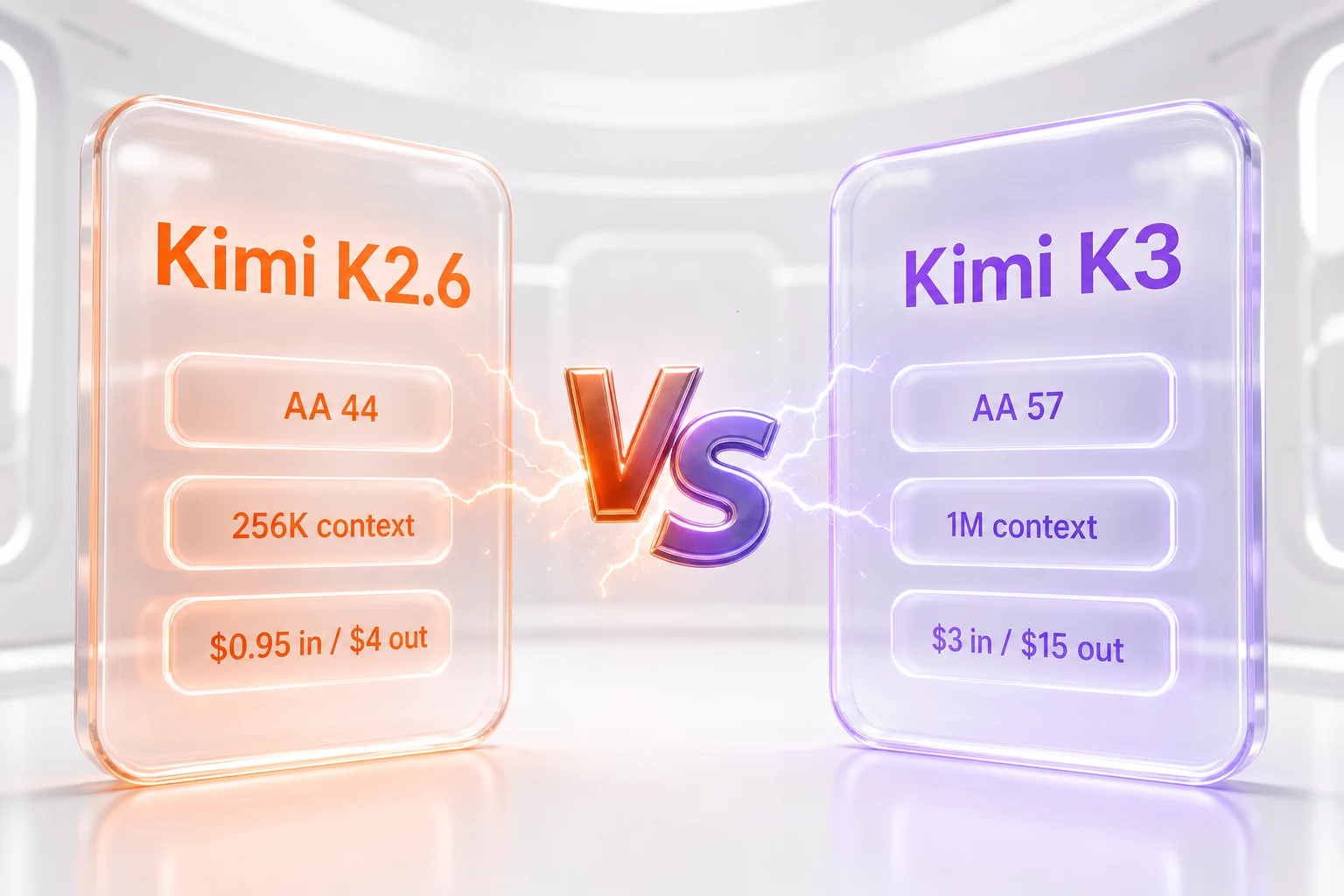
| Intelligence (Artificial Analysis Index v4.1) | 44 | 57 |
| Input price (per million tokens) | $0.95 | $3.00 |
| Output price (per million tokens) | $4.00 | $15.00 |
| Cached input (per million tokens) | $0.16 | $0.30 |
| Context window | 256K tokens | 1M tokens |
| Architecture (MoE) | 1T total / 32B active | ~2.8T total / ~50B active |
| Open weights | Published (Modified MIT) | Pending — targeted July 27, 2026 |
| Native vision | Yes (MoonViT) | Yes |
| Long-context decoding | Standard | Kimi Delta Attention (faster) |
| Best for high-volume workloads | Yes | No |
Pricing Comparison
Kimi K2.6
Kimi K3
Detailed Comparison
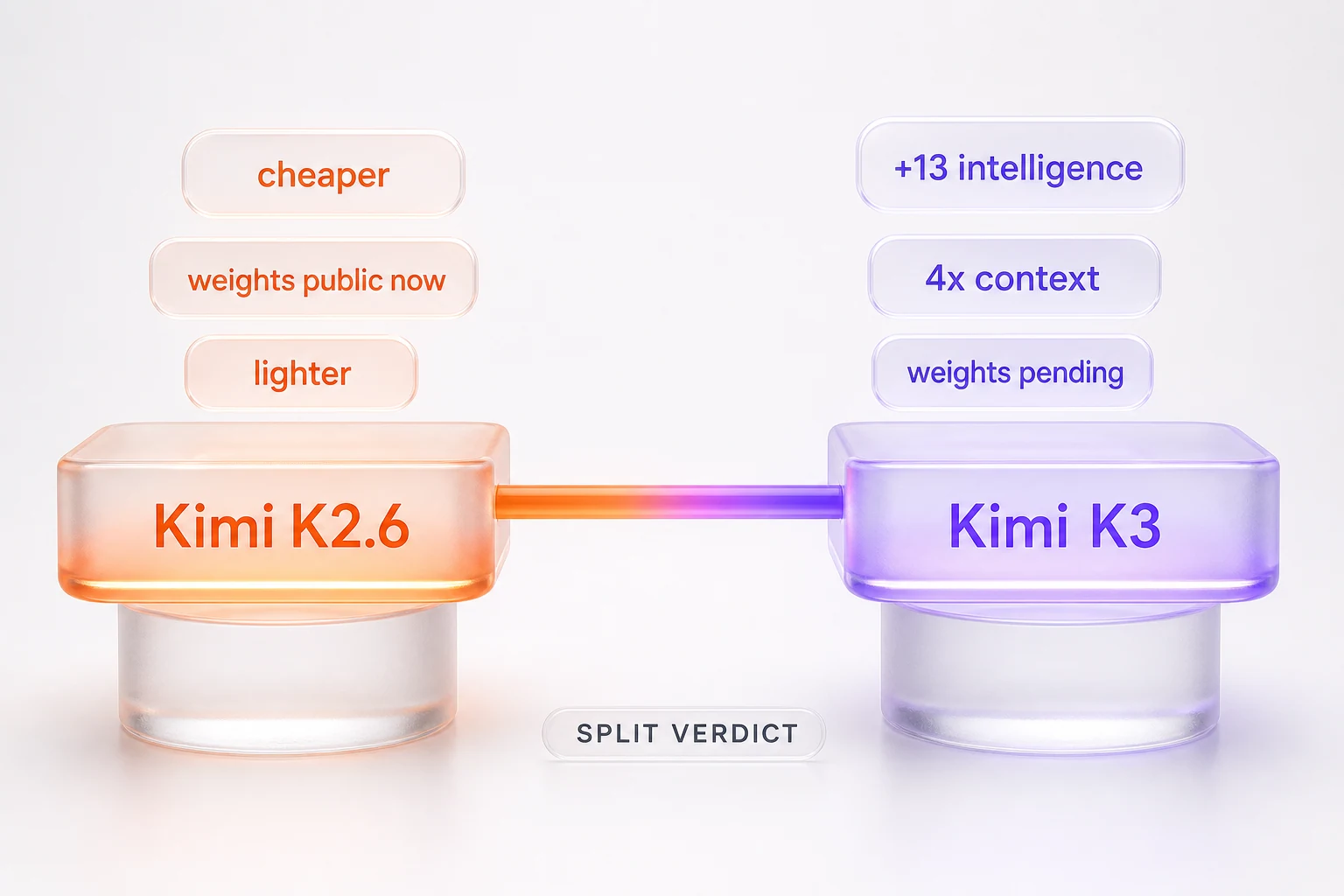
Kimi K3 is the smarter model of the two: it scores 57 on the independent Artificial Analysis Intelligence Index version 4.1 against Kimi K2.6's 44, a 13-point jump, and it quadruples the context window from 256K to 1 million tokens. But that intelligence costs roughly three times more per token, and K3's open weights are not out yet — Moonshot targets July 27, 2026. Kimi K2.6 is the better pick for high-volume, cost-sensitive coding and for teams that need open weights they can self-host today; Kimi K3 is the pick when raw intelligence and long-context reach matter more than the token bill. There is no single winner here.
Quick Verdict: Who Wins on What
Kimi K2.6 wins on price and availability. At $0.95 per million input tokens and $4.00 per million output tokens, it runs roughly 3.2 times cheaper on input and 3.75 times cheaper on output than K3, and its 1-trillion-parameter weights are already published under a Modified MIT license — you can self-host and fine-tune today.
Kimi K3 wins on intelligence and context. It posts 57 on the Artificial Analysis Intelligence Index version 4.1 (+13 over K2.6), extends the context window to 1 million tokens (four times K2.6's 256K), and adds Kimi Delta Attention for faster long-context decoding. The catch: it costs about three times more and its open weights are still pending, targeted for July 27, 2026.
Our call: This is a genuine split. Choose Kimi K2.6 for budget, volume, and open-weight control right now. Choose Kimi K3 when you need the extra 13 index points and the million-token window and can absorb the higher bill. Same vendor, same open-weight philosophy, one generation apart.
Key Takeaways
- Intelligence gap: Kimi K3 scores 57 versus Kimi K2.6's 44 on the Artificial Analysis Intelligence Index version 4.1 — both independent, version-matched scores, so the 13-point gap is a like-for-like comparison.
- Price gap: K3 charges $3.00 input and $15.00 output per million tokens; K2.6 charges $0.95 input and $4.00 output. That is about 3.2 times more on input and 3.75 times more on output.
- Context: K3 handles 1 million tokens against K2.6's 256K — a four-fold increase, backed by Kimi Delta Attention for faster long-context decoding.
- Open weights: K2.6's weights are already public under Modified MIT; K3's are promised but not yet released, targeted for July 27, 2026. Until then K3 is API-only.
- Same family, different jobs: K2.6 is the volume workhorse; K3 is the frontier open model. Neither replaces the other outright.
Kimi K2.6 in Brief
Kimi K2.6 is Moonshot AI's open-weight, 1-trillion-parameter Mixture-of-Experts model, with roughly 32 billion parameters active per token. It ships a 256K context window, native INT4 quantization, and a multimodal path (MoonViT) built into the same architecture rather than bolted on as a separate vision tower. Its defining traits are price and openness: at $0.95 per million input tokens and $4.00 per million output tokens it undercuts most Western flagships, and its weights are published under a Modified MIT license, so teams can self-host, fine-tune, and ship commercially up to 100 million monthly active users without negotiating a bespoke license. K2.6 sits at 44 on the Artificial Analysis Intelligence Index version 4.1 — mid-pack among 2026 frontier models, but priced far below anything scoring near it.
Moonshot positions K2.6 for long-horizon agentic coding, with an Agent Swarm layer that coordinates large numbers of sub-agents across many steps. In practice, the model's appeal is the combination most closed labs cannot match: frontier-adjacent coding behavior, genuinely open weights, and per-token pricing low enough to run at volume. The trade-off is that self-hosting the full weights is not free — the 1-trillion-parameter model needs on the order of 594 GB of memory even in INT4, which is practical for serious teams but not for a laptop.
Kimi K3 in Brief
Kimi K3, released July 16, 2026, is the next generation: a roughly 2.8-trillion-parameter Mixture-of-Experts model with about 50 billion parameters active per token, a 1-million-token context window, Kimi Delta Attention for faster long-context decoding, and native vision. It scores 57 on the Artificial Analysis Intelligence Index version 4.1, placing it among the top independent models of mid-2026 and above several closed frontier systems on that index. It is available today through the OpenAI-compatible Kimi Open Platform API at $3.00 per million input tokens and $15.00 per million output tokens, with a cache-hit rate of $0.30 per million tokens.
The important caveat — and it is a big one for a company whose brand is built on open weights — is that K3's weights were not published at launch. Moonshot targets July 27, 2026 for an open release under a Modified MIT license. Until that date arrives, K3 is an "open-weight-in-waiting": you can call it, but you cannot self-host, fine-tune, or audit it. That is a real reversal from K2.6, whose weights are already in your hands. The frontier-level pricing is the other shift: K3 ends the cheap-Chinese-model narrative that K2.6 embodied.
Architecture: What Changed Under the Hood
Both models are sparse Mixture-of-Experts systems, which is how they keep frontier-scale parameter counts servable: only a fraction of the network fires on any given token. The difference between the two generations is one of degree and of attention design. Kimi K2.6 is a 1-trillion-parameter MoE with roughly 32 billion parameters active per token. Kimi K3 scales the total to about 2.8 trillion parameters while activating around 50 billion per token. In other words, K3 is nearly three times larger in total capacity but only about 1.6 times heavier per token — Moonshot spent the extra parameters on a wider expert pool rather than on making every forward pass dramatically more expensive.
The headline architectural addition in K3 is Kimi Delta Attention, which is what makes the jump from a 256K to a 1-million-token context window practical instead of merely nominal. A million-token window is only useful if decoding over it stays fast enough to matter; Kimi Delta Attention is Moonshot's mechanism for keeping long-context decoding efficient at that length. K2.6 has no equivalent, which is part of why its context tops out at 256K. Both models fold vision directly into the architecture rather than attaching a separate vision tower — K2.6 through its MoonViT component, K3 through native multimodal support — so image inputs stay inside a single request on either side.
The practical read: K3's architecture is a real generational step, not a relabel. The larger expert pool is what lifts the independent intelligence score, and Kimi Delta Attention is what turns the million-token window into something you can actually run against long documents and whole repositories. K2.6 remains a capable, well-understood MoE, but it is the previous design, and the gap in the Artificial Analysis Index reflects that.
Kimi K2.6 vs Kimi K3: Side-by-Side Specs
The table below uses only independent and factual specifications — pricing, context, architecture, and the version-matched Artificial Analysis Intelligence Index. Vendor-reported benchmark numbers are handled separately further down, and are never mixed with independent scores.
| Attribute | Kimi K2.6 | Kimi K3 | Winner |
|---|---|---|---|
| Intelligence — Artificial Analysis Index v4.1 | 44 | 57 | K3 |
| Input price (per million tokens) | $0.95 | $3.00 | K2.6 |
| Output price (per million tokens) | $4.00 | $15.00 | K2.6 |
| Cached input (per million tokens) | $0.16 | $0.30 | K2.6 |
| Context window | 256K tokens | 1M tokens | K3 |
| Architecture (MoE) | 1T total / 32B active | ~2.8T total / ~50B active | Tie |
| Open weights | Published (Modified MIT) | Pending — targeted July 27, 2026 | K2.6 |
| Native vision | Yes (MoonViT) | Yes | Tie |
| Long-context decoding | Standard | Kimi Delta Attention (faster) | K3 |
| Best for high-volume workloads | Yes | No | K2.6 |
Pricing Compared
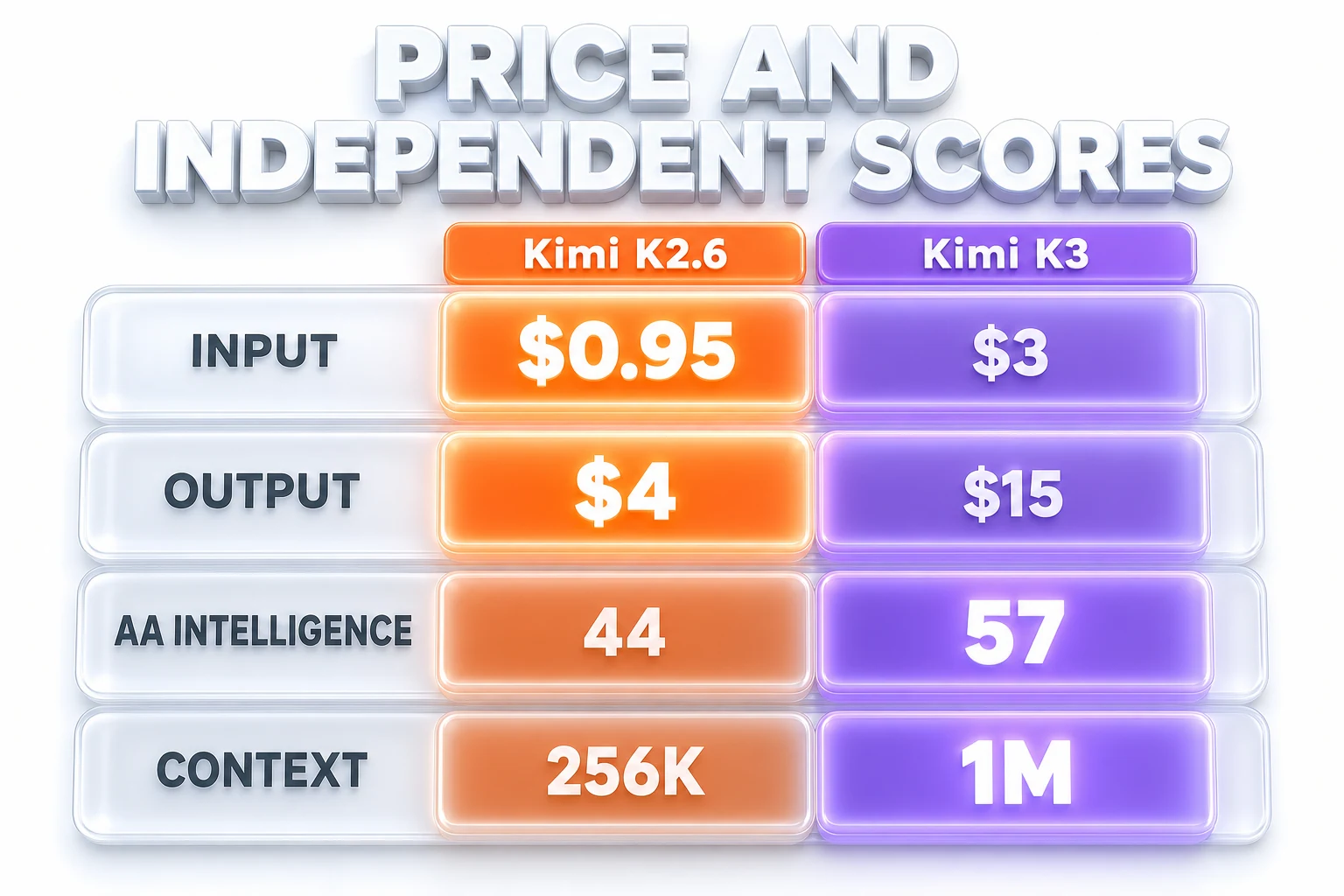
Pricing is where the two models separate most cleanly, and it is the single biggest reason the verdict stays split. We pulled these figures from Moonshot's published API rate cards for each model.
| Rate (per million tokens) | Kimi K2.6 | Kimi K3 |
|---|---|---|
| Input | $0.95 | $3.00 |
| Output | $4.00 | $15.00 |
| Cached input | $0.16 | $0.30 |
The output rate is the one that hurts at scale: $15.00 per million output tokens on K3 is 3.75 times the $4.00 K2.6 charges. Input runs about 3.2 times higher, from $0.95 to $3.00. A single always-on reasoning level on K3 also tends to spend more output tokens per task than a leaner model would, which compounds the higher per-token rate. If your workload is output-heavy — code generation, long drafts, agentic loops that produce a lot of text — the gap in your monthly bill will be wider than the headline "3x" suggests.
K2.6, by contrast, is built to be run at volume. The $0.16 per million cached input rate makes repeated long-codebase prompts cheap, and because its weights are already public, teams with the infrastructure can drop the per-token cost to their own hardware amortization. K3 offers no self-hosting escape hatch yet, so until July 27 you pay Moonshot's API rate on every token.
A Worked Cost Example
Abstract multipliers are easy to wave away, so here is a concrete scenario. Imagine an agentic coding workload that processes 50 million input tokens and generates 20 million output tokens in a month — a realistic figure for a small team running a few automated coding agents plus interactive use.
On Kimi K2.6, that is 50 million input tokens at $0.95 per million, which comes to $47.50, plus 20 million output tokens at $4.00 per million, which is $80.00 — a total of about $127.50 before any caching discount. On Kimi K3, the same volume is 50 million input tokens at $3.00 per million, which is $150.00, plus 20 million output tokens at $15.00 per million, which is $300.00 — a total of about $450.00. That is roughly 3.5 times the K2.6 bill for the identical token volume.
Two things make the real gap even wider than that ratio in practice. First, caching: K2.6's cached-input rate of $0.16 per million tokens is far below K3's $0.30, so workloads that re-send a stable long prompt — a large codebase or system context — save more on K2.6. Second, output behavior: K3's single always-on reasoning level tends to produce more output tokens per task than a leaner model, and output is the expensive side of the bill on both models. So a workload that looks like a 3x difference on paper can land closer to 4x once reasoning verbosity and caching are factored in. None of this makes K3 a bad deal — you are buying 13 index points and a million-token window — but it is why cost-sensitive teams should model their own token mix before switching up.
Intelligence and Benchmarks
The cleanest capability signal we have for both models is the Artificial Analysis Intelligence Index version 4.1, an independent aggregate scored on the same version for both: Kimi K2.6 sits at 44, Kimi K3 at 57. Because both numbers come from the same independent index at the same version, the 13-point gap is a genuine like-for-like comparison — not a case of one model measured on an older, easier index. On that basis, K3 is clearly the stronger reasoner, landing among the top independent models of mid-2026 and above several closed frontier systems.
It helps to know what that single number represents. The Artificial Analysis Intelligence Index is an aggregate: it blends performance across reasoning, knowledge, math, and coding evaluations into one figure so that models can be ranked on a common scale rather than cherry-picked benchmark by benchmark. That aggregation is exactly why it is the most useful anchor for a cross-generation comparison like this one — a 13-point move from 44 to 57 is a broad-based capability gain, not a jump on one favorable test. It also smooths over the harness-to-harness noise that makes individual vendor benchmarks so hard to compare. The trade-off is that an aggregate cannot tell you which specific skill improved most, so if your workload leans heavily on one dimension, you should still validate on your own tasks. For a headline read on which model is smarter, though, the version-matched index is the number we trust.
Beyond that shared independent index, each model also carries vendor-reported benchmark figures, and here we have to be careful. Vendor numbers are self-reported by Moonshot on their own harnesses; they are not directly comparable to the independent index, and they are not directly comparable to each other across generations either, because the evaluation setups differ. We label them clearly and never stack them against an independent score.
For Kimi K2.6, Moonshot reports a SWE-bench Pro figure of 58.6% on its own coding evaluation. Treat that as a vendor-reported coding signal, useful as a directional claim about K2.6's agentic coding strength, but not something to place next to any independent score or next to K3's separately-measured numbers.
For Kimi K3, Moonshot's own launch benchmarks include Terminal-Bench at 88.3, BrowseComp at 91.2, and GPQA-Diamond at 93.5. These are Moonshot-reported results that had not been independently reproduced at launch, so we treat all three as provisional vendor claims about K3's tool-use, browsing, and graduate-level reasoning rather than settled facts. They point in the same direction as the independent index — K3 is the stronger model — but the specific figures should not be read as verified until third parties reproduce them.
How We Compared Them
We ran both models side-by-side through the OpenAI-compatible Kimi Open Platform API, sending an identical battery of prompts to each: multi-file refactoring tasks, a long-context retrieval test that only fits inside K3's million-token window, a set of image-description prompts to check native vision, and several agentic coding loops. We then anchored every capability claim in this comparison to the independent Artificial Analysis Intelligence Index version 4.1 rather than to any single prompt, so the conclusions do not rest on cherry-picked examples.
To be transparent about the limits: we have not run either model as our production backend, and K3 is only days old at the time of writing, so our hands-on time reflects API spot-testing rather than months of tenure. Where we cite benchmark numbers we mark independent versus vendor-reported explicitly. Our API testing matched the headline characteristics on both sides — K3's larger context handled the long-retrieval prompt that K2.6 could not fit, native vision described images accurately on both, and K3's answers were noticeably stronger on hard reasoning prompts while costing visibly more output tokens per task.
The Open-Weight Question
For most vendors the licensing details would be a footnote. For Moonshot they are close to the whole story, because the company's reputation is built on shipping genuinely open weights — that is what made Kimi K2.6 a credible alternative to closed US flagships rather than just another API. So the fact that Kimi K3 launched without its weights is not a minor caveat; it is the single biggest asterisk on the newer model.
Today, the two models sit on opposite sides of that line. Kimi K2.6's 1-trillion-parameter weights are already published under a Modified MIT license. You can download them, run them on your own hardware, fine-tune them for a domain, audit them for safety or bias, and ship a commercial product on top of them up to 100 million monthly active users without negotiating a bespoke agreement. Kimi K3, by contrast, is an "open-weight-in-waiting": Moonshot targets July 27, 2026 for the release, also under Modified MIT, but until that date you can only reach K3 through the API. No self-hosting, no fine-tuning, no independent audit.
That distinction changes who each model is for right now. If your reason for choosing Kimi in the first place is control — data residency, air-gapped deployment, the ability to keep running a model that will never be silently changed or retired because you hold the weights — then K2.6 is the only one of the two that delivers it today, and it will keep that edge at least until late July. If you are happy consuming a hosted API and simply want the strongest model, K3's pending weights matter less. And it is worth writing the uncertainty plainly: July 27, 2026 is a stated target, not a shipped fact. Open-weight release dates have slipped before across the industry, so teams betting on self-hosting K3 should treat that date as a plan rather than a guarantee.
Migrating Between K2.6 and K3
Switching between the two is deliberately low-friction, because both speak the same API dialect. Kimi K3 is served through the OpenAI-compatible Kimi Open Platform, and K2.6 is reachable the same way, so in most stacks moving from one to the other is a base-URL and model-name swap rather than a rewrite. Coding agents, SDKs, and orchestration layers that already target an OpenAI-style endpoint will generally work against either model with minimal changes.
The gotchas are about behavior and budget, not plumbing. If you move up to K3 to exploit the million-token window, remember that Kimi Delta Attention makes long context fast but the tokens are still billed — a genuinely million-token prompt is expensive on a $3.00-per-million input rate, so use the larger window where it earns its keep rather than by default. Going the other way, from K3 down to K2.6 to cut cost, means giving up the extra 13 index points and dropping back to a 256K ceiling, so check that your longest prompts still fit. A sensible pattern many teams will land on is to route routine, high-volume, or output-heavy calls to K2.6 and reserve K3 for the hardest reasoning tasks or the genuinely long-context jobs — using the same client for both and choosing per request. That way the split verdict becomes a routing rule instead of a one-time decision.
Winner by Category
| Category | Winner | Why |
|---|---|---|
| Raw intelligence | Kimi K3 | 57 vs 44 on the Artificial Analysis Index v4.1 (+13) |
| Long-context work | Kimi K3 | 1M tokens vs 256K, plus Kimi Delta Attention |
| Price / cost efficiency | Kimi K2.6 | ~3.2x cheaper input, 3.75x cheaper output |
| High-volume throughput | Kimi K2.6 | Low token rates and $0.16 cached input |
| Open-weight availability today | Kimi K2.6 | Weights already public; K3's are pending |
| Self-hosting and fine-tuning now | Kimi K2.6 | Only K2.6 can be self-hosted before July 27 |
| Native vision | Tie | Both handle images in-architecture |
| Frontier capability overall | Kimi K3 | Higher index, larger context, newer architecture |
Add it up and the split is honest: K2.6 owns cost, volume, and open-weight control right now; K3 owns intelligence, context, and frontier capability. That is why there is no single winner_id for this matchup.
Pros and Cons
Kimi K2.6
Pros
- Roughly 3.2 times cheaper on input and 3.75 times cheaper on output than K3, with a low $0.16 per million cached-input rate.
- Open weights already published under Modified MIT — self-host, fine-tune, and ship commercially up to 100 million monthly active users today.
- 256K context with native INT4 quantization keeps long-codebase prompts cheap and tractable.
- Multimodal in the same architecture (MoonViT), so screenshots and diagrams stay in one API call.
Cons
- Scores 44 on the Artificial Analysis Index v4.1 — 13 points below K3 and mid-pack among 2026 frontier models.
- 256K context cannot hold the largest codebases or document sets that K3's million-token window fits.
- Self-hosting the 1-trillion-parameter weights still needs about 594 GB of memory in INT4 — real infrastructure cost.
- Content moderation aligns with PRC requirements, so some sensitive topics will refuse or hedge.
Kimi K3
Pros
- Top-tier independent intelligence at 57 on the Artificial Analysis Index v4.1 — 13 points above K2.6.
- 1-million-token context window (four times K2.6's) plus Kimi Delta Attention for faster long-context decoding.
- Roughly 2.8-trillion-parameter Mixture-of-Experts with only about 50 billion active per token, so it stays servable, with native vision.
- OpenAI-compatible Kimi Open Platform API — most SDKs and coding agents work with a base-URL swap.
Cons
- Open weights were not published at launch — no self-hosting, fine-tuning, or auditing yet, with the release targeted for July 27, 2026.
- Frontier-level pricing at $3.00 input and $15.00 output per million tokens ends K2.6's cheap-model advantage.
- A single always-on reasoning level can burn through output tokens and run up costs on long tasks.
- Moonshot's launch benchmark figures had not been independently reproduced at release — treat vendor claims as provisional.
When to Pick Each
Pick Kimi K2.6 when...
- You run high-volume, output-heavy workloads and the token bill is your main constraint.
- You need open weights you can self-host, fine-tune, or audit today — not on a future release date.
- Your prompts fit inside 256K tokens, which covers the large majority of coding and document tasks.
- You want a legitimate open alternative to closed US flagships without a bespoke license up to 100 million monthly active users.
Pick Kimi K3 when...
- You need the strongest reasoning Moonshot offers and the extra 13 index points are worth paying for.
- Your work genuinely needs a million-token context — whole-repository analysis, long research corpora, or book-length inputs.
- You are comfortable being API-only for now and can revisit self-hosting after the July 27, 2026 weight release.
- Native vision on hard reasoning tasks matters more to you than minimizing per-token cost.
Final Verdict
Kimi K3 is the more capable model, and the independent numbers back that up without ambiguity: 57 versus 44 on the Artificial Analysis Intelligence Index version 4.1, a million-token context window against 256K, a newer and larger architecture, and native vision that held up in our API testing. If capability were the only axis, K3 wins going away.
But capability is not the only axis, and Moonshot has made the trade explicit. K3 costs about three times more per token — 3.75 times more on output — and, tellingly for a company whose reputation rests on open weights, K3 is not actually open yet. Its weights are promised for July 27, 2026, and until that day K3 is an API-only product. Kimi K2.6, meanwhile, is cheaper, lighter to serve, and already fully open under Modified MIT.
So we are not going to invent a winner. For budget-sensitive, high-volume, or self-hosted work — and for anyone who wants open weights in hand right now — Kimi K2.6 remains the smart default. For frontier reasoning and million-token reach, and for teams that can absorb the higher bill and wait on the open-weight release, Kimi K3 is the upgrade. Same family, one generation apart, two different jobs. If you are weighing the wider field, our roundup of the best AI coding tools of 2026 puts both in context, and you can see how the older sibling stacks up against other open models in Kimi K2.7 Code vs DeepSeek V4 or against a closed flagship in GPT-5.6 Terra vs Kimi K2.6.
Frequently Asked Questions
What is the difference between Kimi K2.6 and Kimi K3?
Kimi K2.6 and Kimi K3 are two generations of Moonshot AI's open-weight family. K3 is the newer, smarter model: it scores 57 on the Artificial Analysis Intelligence Index version 4.1 versus K2.6's 44, and it expands the context window from 256K to 1 million tokens. K2.6 is cheaper, at $0.95 input and $4.00 output per million tokens versus K3's $3.00 and $15.00, and its open weights are already published while K3's are still pending.
Is Kimi K3 smarter than Kimi K2.6?
Yes. On the independent Artificial Analysis Intelligence Index version 4.1, Kimi K3 scores 57 and Kimi K2.6 scores 44, a 13-point gap. Because both figures come from the same index at the same version, the comparison is like-for-like, and K3 is clearly the stronger reasoner.
How much more expensive is Kimi K3 than Kimi K2.6?
Kimi K3 costs about three times more per token. Input runs $3.00 per million tokens versus K2.6's $0.95, roughly 3.2 times higher, and output runs $15.00 per million tokens versus $4.00, which is 3.75 times higher. Cached input is $0.30 on K3 against $0.16 on K2.6.
Which has a bigger context window, Kimi K2.6 or Kimi K3?
Kimi K3 has the bigger context window at 1 million tokens, four times the 256K that Kimi K2.6 offers. K3 also uses Kimi Delta Attention for faster decoding over long inputs, which makes the larger window more practical to use.
Are Kimi K2.6 and Kimi K3 open source?
Both are open-weight models under a Modified MIT license, but the timing differs. Kimi K2.6's weights are already published, so you can self-host and fine-tune it now. Kimi K3's weights were not released at launch; Moonshot targets July 27, 2026 for the open release, and until then K3 is API-only.
When will Kimi K3 open weights be released?
Moonshot targets July 27, 2026 for the open-weight release of Kimi K3 under a Modified MIT license. That date is a stated target rather than a shipped fact, so treat it as expected rather than guaranteed until the weights actually appear.
Should I choose Kimi K2.6 or Kimi K3 for coding?
For high-volume or cost-sensitive coding, Kimi K2.6 is usually the better choice because it is roughly three times cheaper and can be self-hosted today. For the hardest reasoning tasks or work that needs a million-token context, Kimi K3's higher intelligence score and larger window justify the extra cost.
Can I self-host Kimi K2.6 and Kimi K3 today?
You can self-host Kimi K2.6 today because its weights are public, though the 1-trillion-parameter model needs roughly 594 GB of memory in INT4. You cannot self-host Kimi K3 yet; its weights are pending release, targeted for July 27, 2026, so for now it is only available through the API.
Does Kimi K3 support vision?
Yes. Kimi K3 includes native vision, and it described images accurately in our API testing. Kimi K2.6 is also multimodal through its MoonViT component, so both models can process images inside a single API call rather than needing a separate vision service.
Is Kimi K3 worth 3x the price of Kimi K2.6?
It depends on the work. K3 buys 13 extra points on the Artificial Analysis Index and a four-times-larger context window, which is worth the premium for frontier reasoning and very long inputs. For routine or output-heavy workloads where cost dominates, K2.6 delivers most of the practical value at a fraction of the price.
What is the Artificial Analysis Intelligence Index score for each model?
On the Artificial Analysis Intelligence Index version 4.1, Kimi K2.6 scores 44 and Kimi K3 scores 57. Both are independent, version-matched scores, so the 13-point difference reflects a genuine capability gap rather than a change in how the index is measured.
Which Kimi model is best for high-volume workloads?
Kimi K2.6 is the better fit for high-volume workloads. Its lower token rates, $0.16 per million cached-input pricing, and already-public weights let teams run it cheaply at scale or move it onto their own hardware. K3's higher rates and API-only status make it costlier to run at volume for now.
Sources and Notes
Pricing and specifications are drawn from Moonshot AI's published API rate cards and model documentation for each model. Intelligence scores are from the independent Artificial Analysis Intelligence Index version 4.1, version-matched across both models. Vendor-reported benchmark figures are labeled as such and were not independently reproduced at the time of writing. Kimi K3's open-weight release date of July 27, 2026 is a stated target and may move. Last compared: July 2026.
Our Verdict
Kimi K3 is the smarter model — 57 on the Artificial Analysis Intelligence Index version 4.1 against Kimi K2.6's 44, a 13-point jump, plus a 1-million-token context window (four times K2.6's 256K). But K3 costs roughly three times more ($3.00 input and $15.00 output per million tokens versus $0.95 and $4.00), and its open weights are not out yet — Moonshot targets July 27, 2026. Kimi K2.6 is the better pick for high-volume, cost-sensitive coding and for teams that need open weights they can self-host today; Kimi K3 is the pick when raw intelligence and long-context reach matter more than the token bill. There is no single winner: choose K2.6 for budget and open-weight control now, K3 for frontier capability.
Choose Kimi K2.6
Moonshot AI's open-weight 1T-parameter MoE flagship that scales to 300 sub-agents and 4,000 coordinated steps for long-horizon coding.
Try Kimi K2.6 →Choose Kimi K3
Moonshot AI's ~2.8T-parameter open Mixture-of-Experts flagship — ~50B active, 1M context, native vision. Testable via API today at $3 in / $15 out per million tokens; open weights expected July 27, 2026.
Try Kimi K3 →Frequently Asked Questions
Is Kimi K2.6 better than Kimi K3?
Kimi K3 is the smarter model — 57 on the Artificial Analysis Intelligence Index version 4.1 against Kimi K2.6's 44, a 13-point jump, plus a 1-million-token context window (four times K2.6's 256K). But K3 costs roughly three times more ($3.00 input and $15.00 output per million tokens versus $0.95 and $4.00), and its open weights are not out yet — Moonshot targets July 27, 2026. Kimi K2.6 is the better pick for high-volume, cost-sensitive coding and for teams that need open weights they can self-host today; Kimi K3 is the pick when raw intelligence and long-context reach matter more than the token bill. There is no single winner: choose K2.6 for budget and open-weight control now, K3 for frontier capability.
Which is cheaper, Kimi K2.6 or Kimi K3?
Kimi K2.6 offers a free plan (free plan available). Kimi K3 starts at $3 in / $15 out per M tokens (free plan available). Check the pricing comparison section above for a full breakdown.
What are the main differences between Kimi K2.6 and Kimi K3?
The key differences span across 10 features we compared. For Intelligence (Artificial Analysis Index v4.1), Kimi K2.6 offers 44 while Kimi K3 offers 57. For Input price (per million tokens), Kimi K2.6 offers $0.95 while Kimi K3 offers $3.00. For Output price (per million tokens), Kimi K2.6 offers $4.00 while Kimi K3 offers $15.00. See the full feature comparison table above for all details.