Claude Sonnet 5 vs Kimi K2.6: Closed Capability vs Open-Weight Price (2026)

Claude Sonnet 5 vs Kimi K2.6: Sonnet 5 leads SWE-bench Pro 63.2% vs 58.6%; Kimi K2.6 is open-weight and 2-3x cheaper per token. Our 2026 verdict.
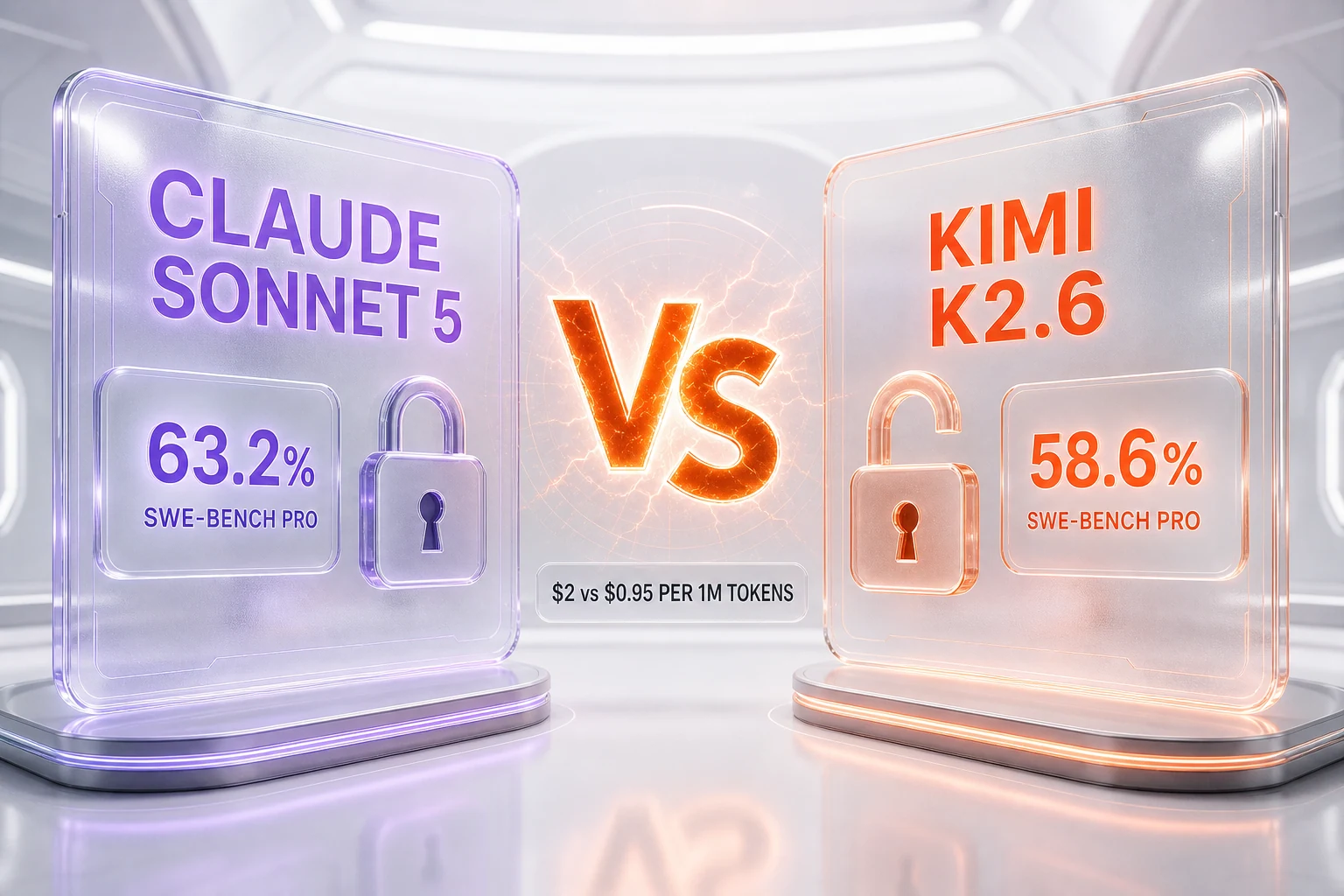
Feature Comparison
| Feature | Claude Sonnet 5 | Kimi K2.6 |
|---|---|---|
| SWE-bench Pro (vendor-reported) | 63.2% | 58.6% |
| Computer use (OSWorld-Verified) | 81.2% | Not published |
| Input price per 1M tokens | $2 | $0.95 ($0.16 cached) |
| Output price per 1M tokens | $10 | $4.00 |
| Model weights and license | Closed (Anthropic API) | Open-weight, Modified MIT |
| Context window | 1M tokens | 256K tokens |
| Multi-agent orchestration | Tool use in agent loops | Agent Swarm: 300 sub-agents, 4,000 steps |
| Safety and governance docs | Public system card, safeguards on by default | PRC-aligned moderation on hosted API |
| Ecosystem and distribution | Claude Code, default on free and Pro Claude.ai | Kimi Code CLI, Hugging Face weights |
Pricing Comparison
Claude Sonnet 5
Kimi K2.6
Detailed Comparison
Claude Sonnet 5 and Kimi K2.6 are both agentic coding models, but they sit on opposite sides of the closed-versus-open divide. Anthropic's closed Claude Sonnet 5 leads the one benchmark both vendors report on the same scale — SWE-bench Pro, at 63.2% versus Kimi K2.6's 58.6%, a 4.6-point edge — and adds a documented safety profile plus the Claude ecosystem. Moonshot AI's open-weight Kimi K2.6 answers with roughly two to three times lower token prices and downloadable weights you can self-host. In short: Sonnet 5 wins on capability and distribution; Kimi K2.6 wins on price and openness.
Quick Verdict
If you want the single sentence: pick Claude Sonnet 5 when raw agentic capability, a mature ecosystem, and documented safety matter most; pick Kimi K2.6 when token cost and open-weight control matter more than a 4.6-point benchmark gap. This is a genuine split decision, not a blowout.
On the one benchmark both companies publish on the same scale — SWE-bench Pro — Sonnet 5 reports 63.2% and Kimi K2.6 reports 58.6%. That 4.6-point edge is the widest clean capability gap we found between these two, and it is why Sonnet 5 is the narrow overall winner on the capability axis. But Kimi K2.6 costs $0.95 per million input tokens and $4.00 per million output tokens against Sonnet 5's $2 and $10, ships as open weights under a Modified MIT license you can self-host, and layers on an Agent Swarm that coordinates up to 300 sub-agents. For a cost-sensitive team running long-horizon agents, that trade can easily flip the decision.
- Best raw capability: Claude Sonnet 5 (63.2% vs 58.6% SWE-bench Pro; 81.2% OSWorld-Verified computer use, which Kimi does not publish)
- Best price: Kimi K2.6 (two to three times cheaper per token, even more with cache hits or a third-party host)
- Best for openness and control: Kimi K2.6 (downloadable weights, self-host, fine-tune, no per-token lock-in)
- Best ecosystem and safety documentation: Claude Sonnet 5 (Claude Code, default model on free and Pro Claude.ai, published system card)
- Narrow overall winner: Claude Sonnet 5 — but only if the capability and ecosystem edge is worth paying two to three times more per token and giving up self-hosting
How We Compared Them
Honesty first, because these are both recent models. We have limited first-day hands-on time with Claude Sonnet 5, which launched on June 30, 2026, and our assessment of Kimi K2.6 is research-led — we have not run K2.6 in production at ThePlanetTools. So this is not a "we ran both side by side for a month" piece. It is a structured comparison built on each vendor's published system card and pricing, third-party provider listings, and the limited hands-on signal we have on the Anthropic side.
Two rules shaped the numbers below. First, we only place two figures head to head when both vendors report the same benchmark on the same scale. In practice that means SWE-bench Pro is the only clean side-by-side capability number we have: 63.2% for Sonnet 5 (from Anthropic's system card) against 58.6% for Kimi K2.6 (from Moonshot's release). Both are vendor-reported and neither has been independently reproduced by us, so read the 4.6-point gap as "each company's own best number," not a referee's scorecard. Second, we verified pricing directly from each vendor's pricing page rather than from search snippets — Anthropic's API pricing documentation for Sonnet 5, and Moonshot's platform pricing page for Kimi K2.6 — and confirmed both were current at the time of writing.
Where a benchmark exists for only one model — Sonnet 5's 81.2% on OSWorld-Verified computer use, or Kimi K2.6's HLE-Full-with-tools and BrowseComp scores — we describe it as single-sided and refuse to invent a matching number for the other side. That keeps the comparison defensible rather than tidy.
Meet Both Models
Claude Sonnet 5 — the closed, ecosystem-backed workhorse
Claude Sonnet 5 is Anthropic's mid-tier model, released June 30, 2026, and described by Anthropic as its most agentic midsize model — built to make plans, drive browsers and terminals, and run across multi-step tasks. It sits below the Claude Opus 4.8 flagship and replaces Claude Sonnet 4.6 as the default workhorse. Its headline is agentic performance: 63.2% on SWE-bench Pro, about 91% of Opus 4.8's 69.2%, and 81.2% on OSWorld-Verified. It is closed — you reach it through the Claude API (model id claude-sonnet-5), inside Claude Code, and as the default model on the free and Pro plans of Claude.ai. That last point matters: the same model powering production agents is the one a free user chats with in the browser, so you can evaluate the exact model before spending on the API.
Kimi K2.6 — the open-weight, lower-priced challenger
Kimi K2.6 is Moonshot AI's open-weight, 1-trillion-parameter Mixture-of-Experts model released April 20, 2026 under a Modified MIT license. It activates 32 billion parameters per token over a 256,000-token context window, ships natively in INT4 quantization, and is natively multimodal through a 400-million-parameter MoonViT vision encoder. Its signature feature is the Agent Swarm, which decomposes a brief into as many as 300 sub-agents coordinating across up to 4,000 steps in a single autonomous run. Moonshot AI is a Beijing-based lab, and K2.6's hosted API applies content moderation aligned with PRC regulatory requirements — a real consideration for some Western workflows, though self-hosting the open weights sidesteps much of it. It reports 58.6% on SWE-bench Pro and leads several open-weight peers such as DeepSeek V4 and Qwen 3.6 on coding benchmarks.
Head-to-Head at a Glance
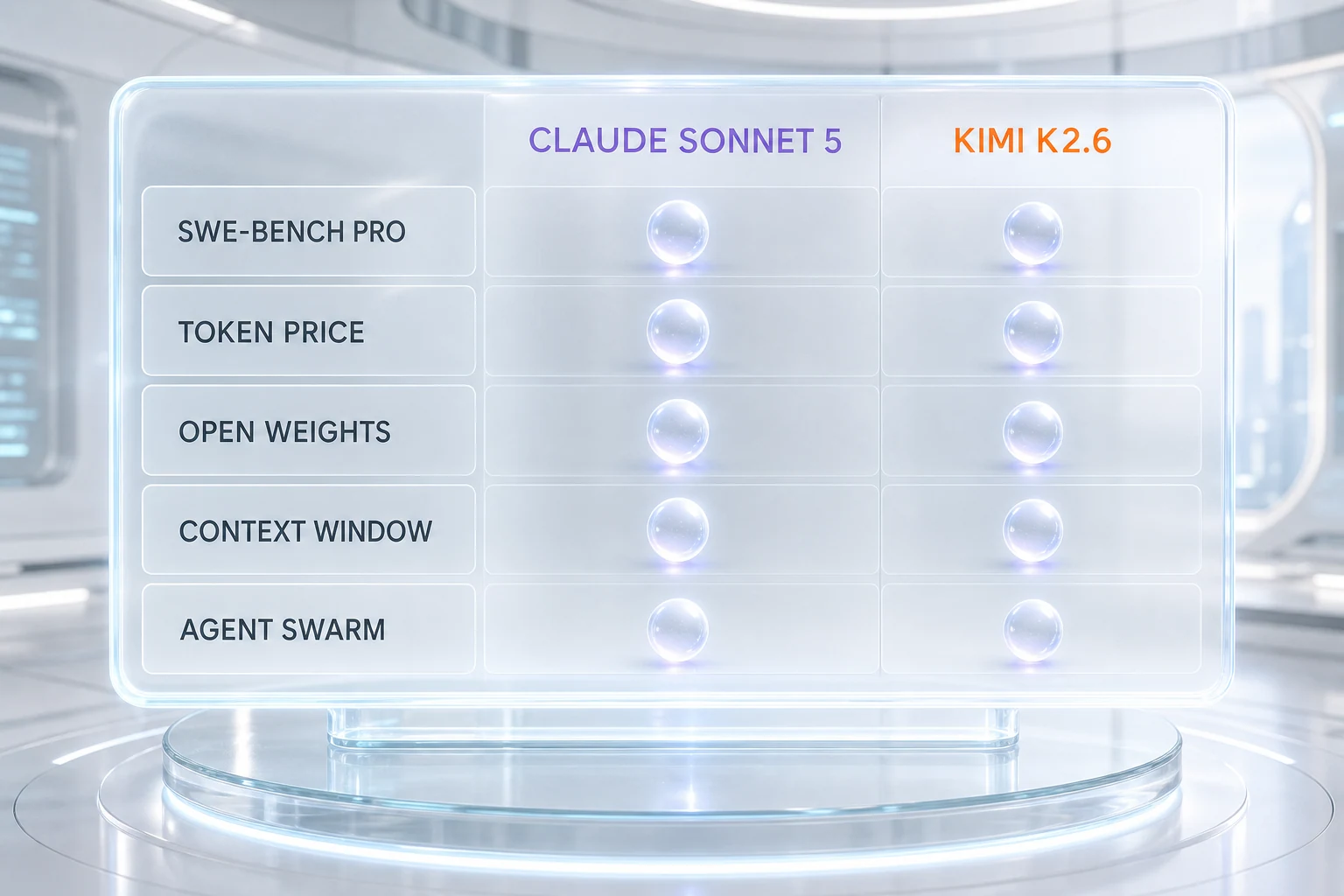
| Dimension | Claude Sonnet 5 | Kimi K2.6 | Edge |
|---|---|---|---|
| SWE-bench Pro (vendor-reported) | 63.2% | 58.6% | Sonnet 5 (+4.6) |
| Computer use (OSWorld-Verified) | 81.2% | Not published | Sonnet 5 |
| Input price per 1M tokens | $2 | $0.95 ($0.16 cached) | Kimi K2.6 |
| Output price per 1M tokens | $10 | $4.00 | Kimi K2.6 |
| Model weights and license | Closed (Anthropic API) | Open-weight, Modified MIT | Kimi K2.6 |
| Context window | 1M tokens | 256K tokens | Sonnet 5 |
| Multi-agent orchestration | Tool use in agent loops | Agent Swarm: 300 sub-agents, 4,000 steps | Kimi K2.6 |
| Safety and governance docs | Public system card, safeguards on by default | PRC-aligned moderation on hosted API | Sonnet 5 |
| Ecosystem and distribution | Claude Code, default on free and Pro Claude.ai | Kimi Code CLI, Hugging Face weights | Sonnet 5 |
The table splits almost evenly, and that is the point. Sonnet 5 takes the capability rows (coding, computer use, context, safety documentation, ecosystem); Kimi K2.6 takes the economics rows (input price, output price, open weights, agent orchestration). Which column of "edge" matters more is entirely a function of what you are building and how you buy.
Capability: What the Benchmarks Actually Say
The cleanest capability signal is SWE-bench Pro, a coding-agent benchmark both vendors report. Anthropic's system card puts Sonnet 5 at 63.2%; Moonshot reports 58.6% for Kimi K2.6. The 4.6-point gap favors Sonnet 5 and is the widest apples-to-apples capability difference we could establish. Two caveats keep it honest. Both numbers are vendor-reported and we have not independently reproduced either, so this is each company's own best figure rather than a neutral referee's. And a few points on a single benchmark rarely decide a real production choice on its own — throughput, reliability under load, and cost usually matter more once you are past the demo.
On computer use, Sonnet 5 reports 81.2% on OSWorld-Verified, the benchmark that measures whether a model can operate real software — clicking through dashboards, filling forms, extracting data from interfaces without an API. Kimi K2.6 does not publish an OSWorld-Verified figure. Its nearest agentic signals are different benchmarks — Terminal-Bench 2.0 at 66.7% and BrowseComp at 83.2% (rising to 86.3% with the full Agent Swarm enabled) — and because they are not the same test, we do not line them up against OSWorld. What we can say is that Sonnet 5 gives you a documented computer-use number and Kimi K2.6 asks you to infer computer-use quality from adjacent benchmarks and its swarm architecture.
Kimi K2.6 does hold its own — and sometimes leads — on benchmarks where we have no Sonnet 5 counterpart to compare against. Moonshot reports HLE-Full-with-tools at 54.0, SWE-Bench Verified at 80.2, and LiveCodeBench v6 at 89.6, and its coding scores beat open-weight peers like DeepSeek V4 and Qwen 3.6 in the same tables. Those are strong numbers, but without matching Sonnet 5 figures on the identical benchmark we treat them as context for how capable K2.6 is in absolute terms, not as head-to-head wins over Sonnet 5. The takeaway: on the one clean shared benchmark, Sonnet 5 is ahead by a real but modest margin, and it is the only one of the two with a published computer-use score.
Pricing: Where Kimi K2.6 Pulls Ahead
Price is the axis where the two models diverge most, and it is Kimi K2.6's strongest argument. We verified both directly from vendor pricing pages.
| Cost dimension | Claude Sonnet 5 | Kimi K2.6 |
|---|---|---|
| Input per 1M tokens | $2 | $0.95 (cache miss) |
| Cached input per 1M tokens | $0.20 | $0.16 (83% cache discount) |
| Output per 1M tokens | $10 | $4.00 |
| Free consumer access | Default model on free and Pro Claude.ai | Adagio free tier on kimi.com |
| Self-host cost | Not available (closed) | Your own infrastructure only (approx. 594 GB in INT4) |
Read the raw rates and Kimi K2.6 is roughly two times cheaper on input and two-and-a-half times cheaper on output than Sonnet 5, and Anthropic's cancellation of the September 1, 2026 increase makes that ratio permanent. Kimi's 83% cache-hit discount ($0.16 per million cached input tokens) compounds the gap further on iterative agent loops where the same context is re-read across many tool calls. And third-party hosts undercut Moonshot's own rate — DeepInfra, for example, lists roughly $0.75 input and $3.50 output per million tokens for K2.6 — so the effective floor for Kimi is lower still. For anyone self-hosting the open weights, the marginal per-token price drops to infrastructure cost.
Two honesty notes prevent this from being a pure rout. First, cross-vendor token pricing is not perfectly one-to-one, because Anthropic and Moonshot use different tokenizers; Anthropic even notes that Sonnet 5's newer tokenizer produces more tokens for the same text than earlier Claude models. So the real cost difference on your actual workload may not track the headline per-token ratio exactly — you should measure on your own prompts. Second, Sonnet 5 is genuinely free to try as the default model on Claude.ai's free plan, and its $2 and $10 rate is the cheapest Anthropic has ever priced a frontier-adjacent Sonnet. Kimi K2.6 still wins the price axis clearly, but "clearly" is not "infinitely."
Openness and Distribution: The Other Half of the Decision
Capability is only one axis; how the model is distributed is the other, and here the two are near-mirror images. Kimi K2.6 ships as open weights under a Modified MIT license. You can download the roughly 594 GB INT4 release from Hugging Face, self-host it on vLLM, SGLang, or KTransformers, fine-tune it, and ship it commercially up to 100 million monthly active users before any attribution clause applies. That is a strategic asset: no per-token vendor exposure, no risk of a hosted model being silently changed underneath you, and a genuine exit option if a provider's pricing or policy shifts. The cost is operational — running a 1-trillion-parameter MoE in INT4 realistically needs an 8xH100-class cluster, so "open" does not mean "free to run" for a small team.
Claude Sonnet 5 is closed, and it turns that into an ecosystem advantage rather than only a limitation. It is the default model on the free and Pro plans of Claude.ai, it is built into Claude Code, it is available to Max, Team, and Enterprise, and it exposes the same Messages API and SDKs as prior Claude models — so adopting it is a one-line model-string change with no prompt rework. It also comes with a published system card documenting lower rates of undesirable behavior, hallucination, and sycophancy than its predecessor, stronger prompt-injection resistance, and cyber safeguards on by default. For teams that need Western jurisdiction, English-first documentation, and a paper trail for governance and compliance reviews, the closed-but-documented package is often the safer institutional choice.
There is also the content-moderation dimension. Kimi K2.6's hosted API applies moderation aligned with PRC regulatory requirements, so sensitive geopolitical or historical topics may refuse or hedge — a real ceiling for some Western publishing, research, or journalism work. Self-hosting the open weights bypasses much of that, but only if you have the hardware and the appetite to run your own inference. This is the crux of the whole comparison: Kimi K2.6 hands you control and a lower bill; Sonnet 5 hands you a managed, documented, ecosystem-integrated product. Neither is universally "better."
Multimodal Input and Vision
Both models read images, but they frame vision differently. Claude Sonnet 5 accepts image input alongside text — screenshots, diagrams, charts, and PDF pages — with text-only output, and that vision path is load-bearing for its computer-use loop: parse a dashboard screenshot into structured data, then decide the next click. Kimi K2.6 goes a step wider, integrating a 400-million-parameter MoonViT vision encoder directly into the same architecture rather than bolting on a separate vision tower, so it ingests images and video frames in the same forward pass as text. For a screenshot-to-code or design-to-code workflow, both are set up to compete; Kimi K2.6's native video handling is the broader input surface on paper, while Sonnet 5's vision is tightly coupled to its documented computer-use strength. Without running both on identical multimodal tasks we will not rank fidelity, but the architectures point at the same use cases from opposite directions — one optimized around a managed computer-use agent, the other around an open, self-hostable multimodal core.
Winner by Category
Best raw capability: Claude Sonnet 5
On the one clean shared benchmark, Sonnet 5's 63.2% beats Kimi K2.6's 58.6% on SWE-bench Pro, and Sonnet 5 is the only one of the two with a published computer-use score (81.2% OSWorld-Verified). If your priority is squeezing the highest documented agentic quality out of a single model, Sonnet 5 has the edge.
Best price and cost control: Kimi K2.6
At $0.95 input and $4.00 output per million tokens — with an 83% cache-hit discount and third-party hosts undercutting even that — Kimi K2.6 is decisively cheaper, and self-hosting removes per-token cost entirely. For high-volume, long-horizon agent workloads, this is the axis that most often decides the bill.
Best openness and control: Kimi K2.6
Open weights under Modified MIT mean self-hosting, fine-tuning, and no vendor lock-in. If avoiding per-token exposure or keeping an exit option is a strategic requirement, Sonnet 5 cannot compete here by design.
Best ecosystem and safety documentation: Claude Sonnet 5
Default availability on Claude.ai, integration with Claude Code, mature SDKs, one-line migration, and a public system card give Sonnet 5 the more complete managed package for teams that value distribution and a governance paper trail.
Best multi-agent orchestration: Kimi K2.6
Kimi K2.6's Agent Swarm coordinates up to 300 sub-agents across 4,000 steps in a single run — the most aggressive in-production orchestration layer of the two. Sonnet 5 does tool use well inside agent loops, but Moonshot ships the more explicit swarm primitive.
Narrow overall winner: Claude Sonnet 5
Because the stated axis of this comparison is capability plus distribution, and Sonnet 5 leads on both the shared capability benchmark and ecosystem maturity, it is the narrow overall winner. But it is narrow on purpose: flip the priority to cost or openness and Kimi K2.6 is the rational pick without hesitation.
Pros and Cons of Each
Claude Sonnet 5
What stands out:
- Highest shared-benchmark capability of the two: 63.2% SWE-bench Pro, about 91% of Opus 4.8, plus a documented 81.2% OSWorld-Verified computer-use score
- Free to evaluate as the default model on Claude.ai's free and Pro plans before any API spend
- Mature ecosystem: Claude Code, same Messages API and SDKs, one-line migration from prior Sonnet
- Public system card with measured safety improvements and safeguards on by default
- Full 1M-token context window at standard pricing
Where it falls short:
- Roughly two to two-and-a-half times more expensive per token than Kimi K2.6
- Closed weights — no self-hosting, no fine-tuning of the model itself, per-token vendor exposure
- Brand new (June 30, 2026 launch), so long-run independent track record is still thin
- No native multi-agent swarm primitive comparable to Kimi's Agent Swarm
Kimi K2.6
What stands out:
- Roughly two to three times cheaper per token, with an 83% cache-hit discount and even lower third-party host rates
- Genuine open weights under Modified MIT — self-host, fine-tune, ship commercially up to 100M MAU
- Agent Swarm scaling to 300 sub-agents across 4,000 coordinated steps
- Native multimodal input (image and video) through the integrated MoonViT encoder
- Strong absolute benchmarks that beat open-weight peers like DeepSeek V4 and Qwen 3.6 on coding
Where it falls short:
- 4.6 points behind Sonnet 5 on the shared SWE-bench Pro benchmark, and no published OSWorld-Verified computer-use score
- Self-hosting the 594 GB INT4 weights realistically needs an 8xH100-class cluster — "open" is not "cheap to run" for small teams
- Hosted API applies PRC-aligned content moderation that can refuse or hedge on sensitive topics
- Documentation is split between Chinese and English, and musical-tempo consumer plan names (Adagio to Vivace) slow plan selection
- Shorter 256K context window versus Sonnet 5's 1M
When to Pick Which
Pick Claude Sonnet 5 if...
You want the highest documented agentic capability in a single managed model and you value the ecosystem around it. Sonnet 5 is the stronger default when your team lives inside Claude Code or the Claude API, when computer-use reliability is central to your product, when you need a system card and Western jurisdiction for compliance sign-off, or when the ability to let non-technical stakeholders try the exact model free in the browser shortens your evaluation cycle. Reach for Claude Opus 4.8 only on the hardest, most safety-sensitive slice above Sonnet 5.
Pick Kimi K2.6 if...
Your CFO has flagged the model bill, or open-weight control is a strategic requirement. Kimi K2.6 is the better choice when you run high-volume, long-horizon coding or research agents where a two-to-three-times token-cost difference compounds into real money, when you want to self-host to eliminate per-token exposure or keep an exit option, when your workflow benefits from the Agent Swarm's 300-sub-agent orchestration, or when you are already building on open-weight infrastructure alongside peers like DeepSeek V4 and Qwen 3.6. The caveats to weigh first: you need the hardware to self-host, and the hosted API's PRC-aligned moderation may not suit sensitive Western publishing or research. If those do not block you, the economics are hard to argue with.
Or consider a split stack
The two are not mutually exclusive. A common 2026 pattern is to route the hardest reasoning to a premium closed model and the high-volume, cost-sensitive execution to a cheaper or self-hosted one. You could plausibly run Sonnet 5 where documented capability and ecosystem integration earn their premium, and Kimi K2.6 (self-hosted or via a low-cost host) for bulk agent execution where the per-token savings dominate. If you want to see how each stacks up against other flagships, our Claude Opus 4.8 vs Kimi K2.7 Code, Kimi K2.7 Code vs GPT-5.5, and Kimi K2.7 Code vs DeepSeek V4 comparisons cover the neighboring matchups.
Frequently Asked Questions
Is Claude Sonnet 5 or Kimi K2.6 better for coding?
On the one benchmark both vendors report on the same scale, Claude Sonnet 5 is ahead: 63.2% versus 58.6% on SWE-bench Pro, a 4.6-point edge, and Sonnet 5 also publishes an 81.2% OSWorld-Verified computer-use score that Kimi K2.6 does not. Both SWE-bench Pro figures are vendor-reported and not independently reproduced. For most single-model coding quality, Sonnet 5 has the documented edge; for cost-sensitive, high-volume coding agents, Kimi K2.6's much lower price can make it the better practical choice.
How much cheaper is Kimi K2.6 than Claude Sonnet 5?
Kimi K2.6 charges $0.95 per million input tokens and $4.00 per million output tokens. Claude Sonnet 5 charges $2 input and $10 output per million tokens. So Kimi is roughly two times cheaper on input and two-and-a-half times cheaper on output. Kimi's 83% cache-hit discount and third-party hosts lower the effective cost further.
Is Kimi K2.6 open source and Claude Sonnet 5 closed?
Kimi K2.6 ships as open weights under a Modified MIT license — you can download roughly 594 GB in INT4 from Hugging Face, self-host, fine-tune, and use it commercially up to 100 million monthly active users before an attribution clause applies. It is more precisely "open-weight" than fully open source. Claude Sonnet 5 is closed: you access it only through the Claude API, Claude Code, and Claude.ai, with no downloadable weights.
What is the SWE-bench Pro score of each model?
Anthropic's system card reports 63.2% on SWE-bench Pro for Claude Sonnet 5. Moonshot reports 58.6% for Kimi K2.6. That is a 4.6-point advantage for Sonnet 5 on the only clean shared benchmark. Both numbers are vendor-reported, and neither has been independently reproduced by our team, so treat the gap as each company's own best figure rather than a neutral measurement.
Which model has the larger context window?
Claude Sonnet 5 supports a 1-million-token context window at standard pricing. Kimi K2.6 supports 256,000 tokens. For most coding-agent workflows 256K is enough, but for multi-repository code understanding or very large document analysis, Sonnet 5's 1M window is a meaningful advantage.
Can I self-host either model?
You can self-host Kimi K2.6 — its weights are on Hugging Face under Modified MIT, with native INT4 quantization, and it runs on vLLM, SGLang, or KTransformers. The practical hardware floor is an 8xH100 80GB cluster or comparable, given the roughly 594 GB footprint. Claude Sonnet 5 cannot be self-hosted; it is a closed model available only through Anthropic's API and products.
Does either model do computer use or browser automation?
Claude Sonnet 5 publishes an 81.2% score on OSWorld-Verified, the computer-use benchmark, and is designed to drive browsers and terminals and operate software without an API. Kimi K2.6 does not publish an OSWorld-Verified figure; its related agentic benchmarks are Terminal-Bench 2.0 (66.7%) and BrowseComp (83.2%), which are different tests, so we do not compare them directly to OSWorld. On documented computer use, Sonnet 5 is the safer bet.
What is Kimi K2.6's Agent Swarm?
Agent Swarm is Kimi K2.6's multi-agent orchestration layer. It decomposes a brief into specialized sub-agents — up to 300 of them — that run in parallel and coordinate results back to a planner across as many as 4,000 steps in a single autonomous run. It is exposed in the Kimi.com paid tiers and the API. Claude Sonnet 5 performs tool use inside agent loops but does not ship an equivalent named swarm primitive.
Does Kimi K2.6 have content moderation restrictions?
Yes, on its hosted API. Moonshot AI is a Beijing-based lab, and Kimi K2.6's hosted endpoints apply content moderation aligned with PRC regulatory requirements, so sensitive geopolitical or historical topics may refuse or hedge. Self-hosting the open weights bypasses much of that. Claude Sonnet 5's moderation follows Anthropic's published usage policies and its system card, which is often the safer fit for Western publishing and research workflows.
Which is safer, Claude Sonnet 5 or Kimi K2.6?
For teams that weigh documented safety and governance, Claude Sonnet 5 has the clearer paper trail: a public system card reporting lower rates of undesirable behavior, hallucination, and sycophancy than its predecessor, stronger prompt-injection resistance, and cyber safeguards on by default. Kimi K2.6's safety story centers on open weights you can inspect and self-host, but its hosted API carries PRC-aligned moderation and its documentation is split across languages. Sonnet 5 is the stronger pick where institutional governance sign-off matters.
Should I switch from Claude Sonnet 5 to Kimi K2.6 to save money?
Only after measuring on your own workload. Kimi K2.6's per-token price is clearly lower, and for high-volume agent workloads the savings are real — especially with cache hits or self-hosting. But you would be trading a 4.6-point capability edge on SWE-bench Pro, a published computer-use score, the Claude ecosystem, and a documented safety profile, and you would need the hardware to self-host or accept PRC-aligned moderation on the hosted API. Run a representative evaluation on both before committing, because cross-vendor tokenizers make headline per-token ratios only an approximation of real cost.
Final Verdict
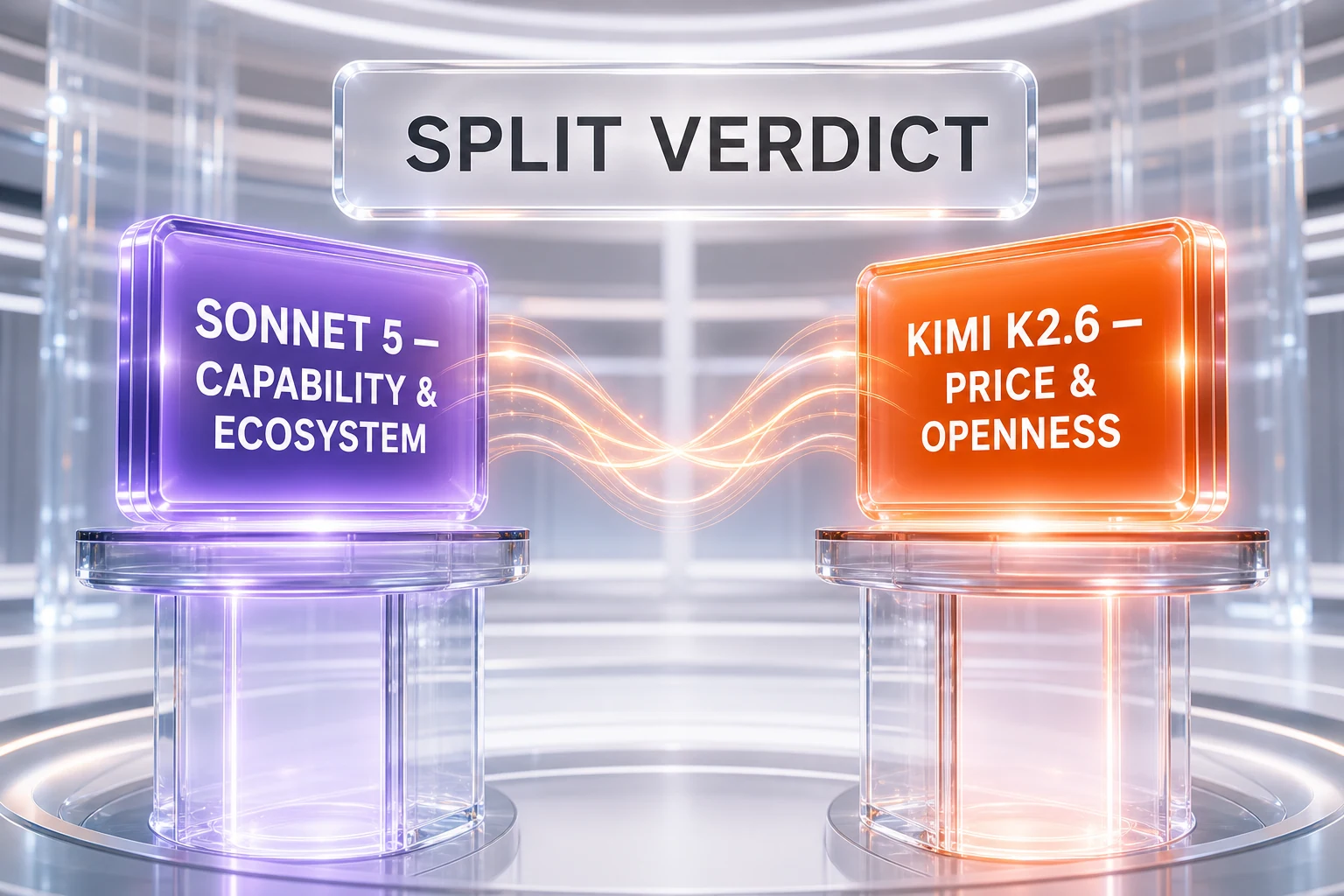
This comparison does not have a knockout winner, and pretending otherwise would be dishonest. Claude Sonnet 5 is the narrow overall pick on the stated axis of capability plus distribution: it leads the one clean shared benchmark by 4.6 points, it is the only one of the two with a published computer-use score, it carries a documented safety profile, and it plugs into the most mature ecosystem in the category — Claude Code, the Claude API, and default availability on Claude.ai. If your decision hinges on getting the highest documented agentic quality from a single managed model, Sonnet 5 is the answer.
But Kimi K2.6 wins the two axes it targets — price and openness — decisively. At $0.95 input and $4.00 output per million tokens, with an 83% cache-hit discount, self-hostable open weights under Modified MIT, and an Agent Swarm that no closed model here matches, it is the rational choice for cost-sensitive, high-volume, or control-conscious teams. The question the whole comparison comes down to is the one in the brief: how large a capability gap justifies giving up openness and paying two to three times more per token? A 4.6-point SWE-bench Pro edge is real but modest. For many teams it will not be enough to outweigh Kimi's economics; for others, the ecosystem, computer-use, and safety documentation will be worth every extra cent. Measure both on your own workload, and let your actual priorities — not a single benchmark number — make the call.
Last compared: July 2026. Claude Sonnet 5 launched June 30, 2026; Kimi K2.6 launched April 20, 2026. Our Sonnet 5 assessment reflects limited first-day hands-on time plus Anthropic's published system card; our Kimi K2.6 assessment is research-led, as we have not run K2.6 in production. All benchmark figures are vendor-reported (Anthropic's system card for Sonnet 5, Moonshot's release for Kimi K2.6) and not independently reproduced by our team. Pricing verified directly from Anthropic's and Moonshot's pricing pages at the time of writing.
Sources and references
Every figure on this page is attributed to whoever produced it. Vendor documentation and independent measurement are listed separately and never merged into a single ranking.
- Artificial Analysis — Claude Sonnet 5 (independent index score and cost per task)
- Moonshot AI — Platform documentation (model family, API reference and limits)
- Artificial Analysis — Model leaderboard (Intelligence Index scores and cost per task across configurations)
Our Verdict
Claude Sonnet 5 is the narrow overall winner on capability and distribution: it leads the one clean shared benchmark, SWE-bench Pro, at 63.2% versus Kimi K2.6’s 58.6% (a 4.6-point edge), is the only one of the two with a published computer-use score (81.2% OSWorld-Verified), carries a documented safety profile, and plugs into the mature Claude ecosystem. But Kimi K2.6 wins price and openness decisively — roughly two to three times cheaper per token ($0.95 input / $4.00 output per 1M) with open weights under Modified MIT you can self-host and an Agent Swarm scaling to 300 sub-agents. The choice comes down to how large a capability gap justifies giving up openness and paying more: a 4.6-point edge is real but modest, so cost-sensitive and control-conscious teams should lean Kimi K2.6, while teams that value documented capability, computer use, safety, and ecosystem should lean Claude Sonnet 5.
Choose Claude Sonnet 5
Anthropic's most agentic midsize model — near-Opus 4.8 coding and computer use at $2 per million input tokens.
Try Claude Sonnet 5 →Choose Kimi K2.6
Moonshot AI's open-weight 1T-parameter MoE flagship that scales to 300 sub-agents and 4,000 coordinated steps for long-horizon coding.
Try Kimi K2.6 →Frequently Asked Questions
Is Claude Sonnet 5 better than Kimi K2.6?
Claude Sonnet 5 is the narrow overall winner on capability and distribution: it leads the one clean shared benchmark, SWE-bench Pro, at 63.2% versus Kimi K2.6’s 58.6% (a 4.6-point edge), is the only one of the two with a published computer-use score (81.2% OSWorld-Verified), carries a documented safety profile, and plugs into the mature Claude ecosystem. But Kimi K2.6 wins price and openness decisively — roughly two to three times cheaper per token ($0.95 input / $4.00 output per 1M) with open weights under Modified MIT you can self-host and an Agent Swarm scaling to 300 sub-agents. The choice comes down to how large a capability gap justifies giving up openness and paying more: a 4.6-point edge is real but modest, so cost-sensitive and control-conscious teams should lean Kimi K2.6, while teams that value documented capability, computer use, safety, and ecosystem should lean Claude Sonnet 5.
Which is cheaper, Claude Sonnet 5 or Kimi K2.6?
Claude Sonnet 5 starts at $2 in / $10 out per M tokens (free plan available). Kimi K2.6 offers a free plan (free plan available). Check the pricing comparison section above for a full breakdown.
What are the main differences between Claude Sonnet 5 and Kimi K2.6?
The key differences span across 9 features we compared. For SWE-bench Pro (vendor-reported), Claude Sonnet 5 offers 63.2% while Kimi K2.6 offers 58.6%. For Computer use (OSWorld-Verified), Claude Sonnet 5 offers 81.2% while Kimi K2.6 offers Not published. For Input price per 1M tokens, Claude Sonnet 5 offers $2 while Kimi K2.6 offers $0.95 ($0.16 cached). See the full feature comparison table above for all details.