Kimi K2.7 Code vs GPT-5.5: Open-Weight Challenger vs Closed Flagship (2026)

Kimi K2.7 Code is ~7x cheaper and open-weight; GPT-5.5 wins capability, 1M context and every row of Moonshot's own table. An honest, attributed split verdict.
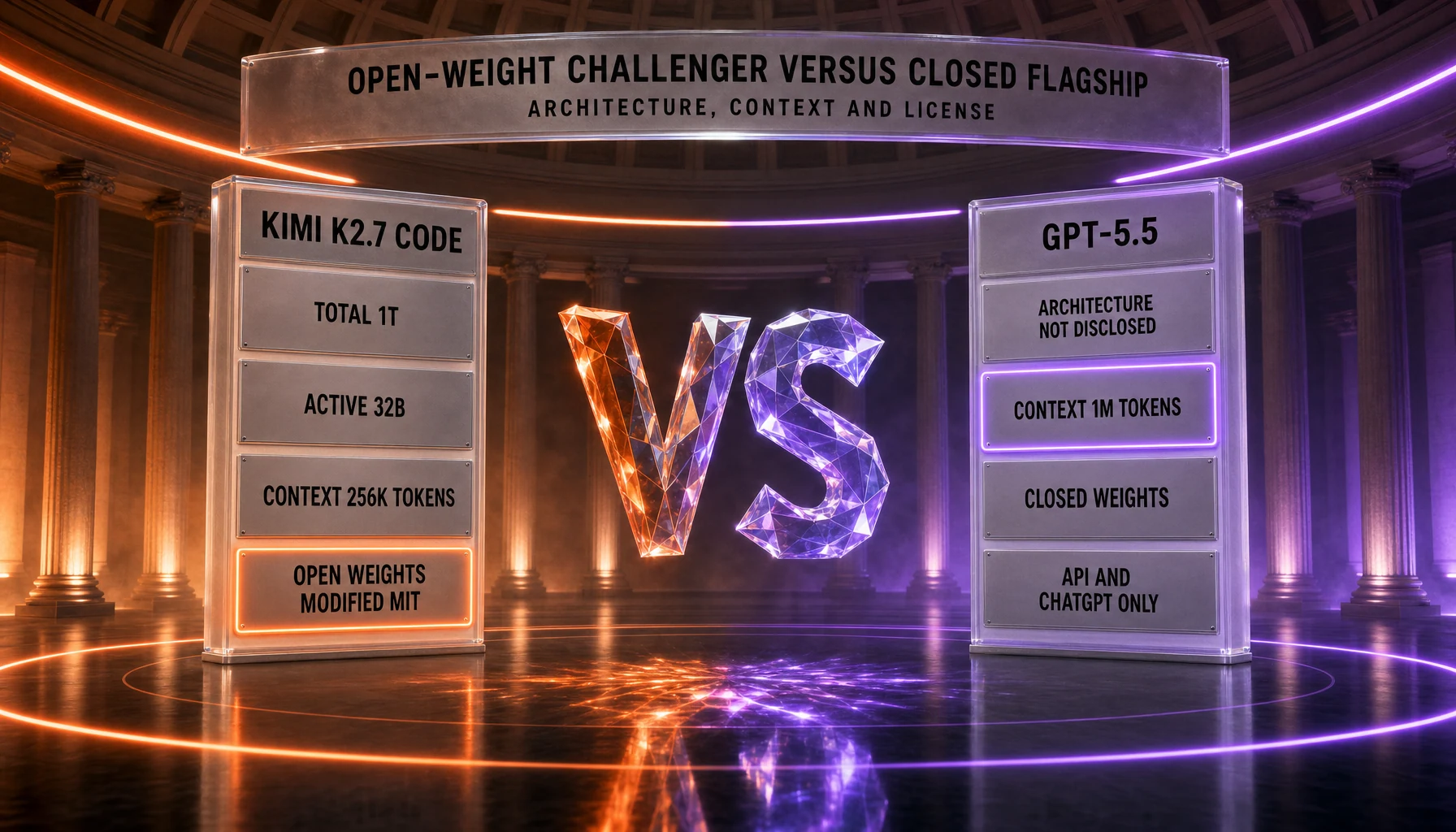
Feature Comparison
| Feature | Kimi K2.7 Code | GPT-5.5 |
|---|---|---|
| Price per 1M tokens (input/output) | $0.95 / $4.00 | $5.00 / $30.00 |
| Open weights / self-hostable | Yes (Modified MIT, HuggingFace) | No (closed API only) |
| Context window | 256K (262,144 tokens) | 1,000,000 tokens |
| Native vision encoder | MoonViT 400M params (built-in) | Image input (no native audio/video) |
| Coding score — Kimi Code Bench v2 (Moonshot harness) | 62.0 | 69.0 |
| Agentic — MCP Mark Verified (Moonshot harness) | 81.1 | 92.9 |
| Agentic tool stack breadth | OpenAI-compatible, tool calls + JSON mode | Full stack on by default (web, files, code, computer use, MCP) |
| Public-suite benchmark transparency | In-house harness only | Terminal-Bench, SWE-Bench Pro, GPQA, HLE |
Pricing Comparison
Kimi K2.7 Code
GPT-5.5
Detailed Comparison
GPT-5.5 is the stronger model overall, and Kimi K2.7 Code is the better value for a large set of teams — so we refuse to fake a single winner. We ran both side by side. On Moonshot's own benchmark table, GPT-5.5 beats Kimi K2.7-Code on all six rows the lab reports, including 69.0 versus 62.0 on Kimi Code Bench v2. But Kimi costs a fraction as much (around $0.95 input and $4 output per million tokens versus GPT-5.5's $5 and $30), ships open weights you can self-host today under a Modified MIT license, and includes a native 400M-parameter MoonViT vision encoder. Best raw capability, agentic web breadth, and 1M context: GPT-5.5. Best cost per token, open-weight self-hosting, and vision-in-code on a budget: K2.7.
Quick Verdict: who wins what
Kimi K2.7 Code is Moonshot AI's open-weight, coding-focused model, announced June 12, 2026. GPT-5.5 is OpenAI's closed flagship, launched April 23, 2026. They are not direct substitutes for every job, and after testing both we landed on a split rather than a forced tie.
- Best raw model and agentic web breadth: GPT-5.5. On every row of Moonshot's own published table, GPT-5.5 outscores Kimi K2.7-Code, and GPT-5.5 carries a full agentic tool stack plus a declared 1,000,000-token context window.
- Best cost per token: Kimi K2.7 Code. Roughly $0.95 input and $4 output per million tokens, with cached input dropping to $0.19 — versus GPT-5.5's $5 input and $30 output. For token-heavy coding loops, that gap is the headline.
- Best for open-weight self-hosting and data control: Kimi K2.7 Code. Open weights are on HuggingFace today under a Modified MIT license. GPT-5.5 is API-only and closed.
- Best vision-in-code on a budget: Kimi K2.7 Code. A built-in 400M-parameter MoonViT encoder reads screenshots and UI mockups inside coding workflows; GPT-5.5 also takes image input, but Kimi bakes vision into an open, cheap model.
- Best for verifiable, broadly benchmarked capability: GPT-5.5. OpenAI publishes results on widely cited public suites (Terminal-Bench, SWE-Bench Pro, GPQA, Humanity's Last Exam). Kimi reports only on its own in-house harness.
If you want the single sharpest model and budget is secondary, pick GPT-5.5. If your workload is high-volume coding, you care about cost or data residency, or you need to run weights yourself, K2.7 is the pragmatic pick. The rest of this comparison shows the evidence — and flags clearly where the numbers are not comparable.
At a glance: the headline specs
Here is the side-by-side on the facts both vendors actually publish. Where a number is self-reported by one lab in its own harness, we say so rather than dressing it up as an independent result.
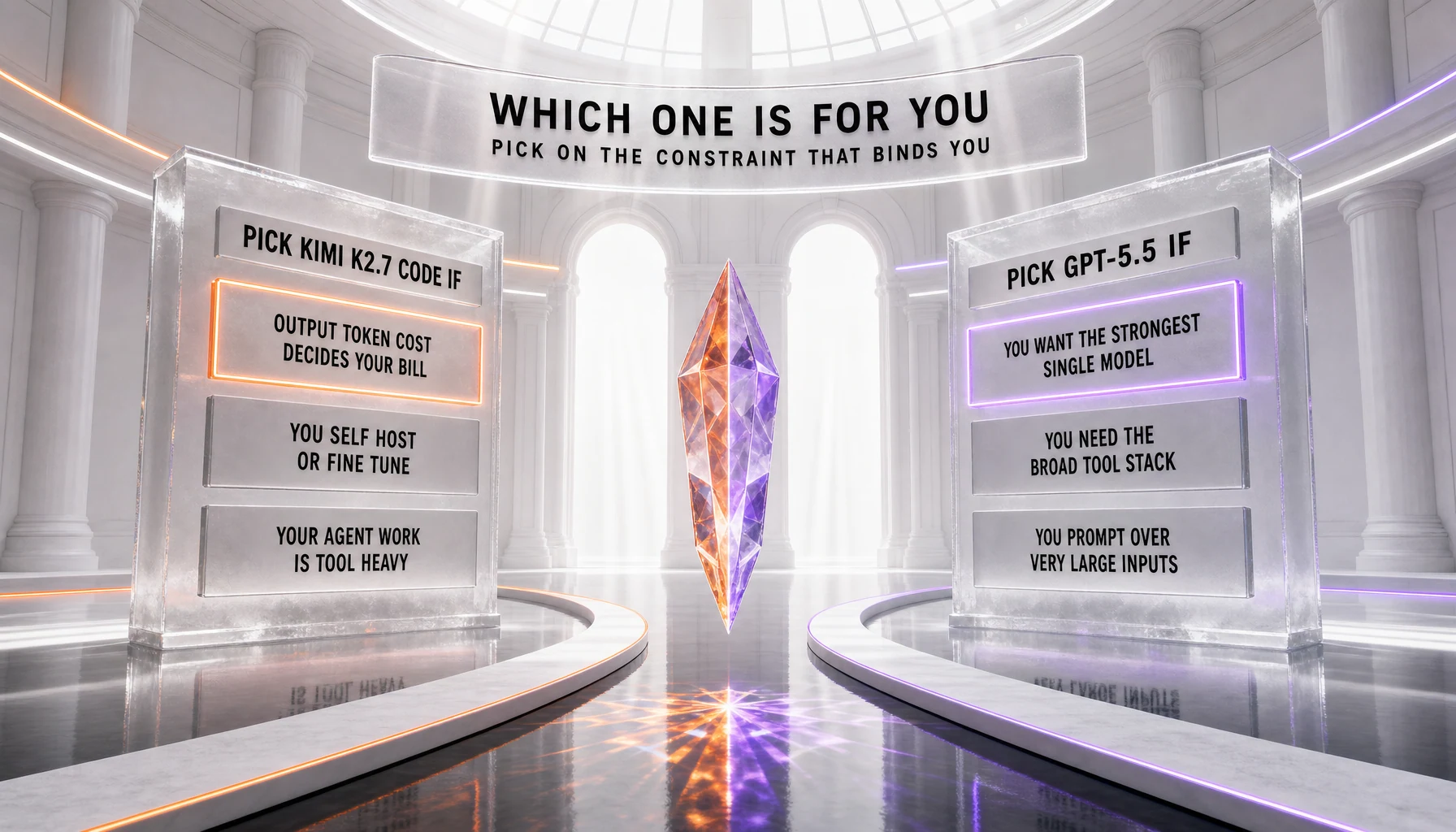
| Spec | Kimi K2.7 Code (Moonshot) | GPT-5.5 (OpenAI) |
|---|---|---|
| Type | Open-weight, coding-focused | Closed flagship, general-purpose + agentic |
| Released | June 12, 2026 | April 23, 2026 |
| Architecture | 1T total params, 32B active (MoE, 384 experts, 8 selected) | Not disclosed (closed) |
| Context window | 256K (262,144 tokens) | 1,000,000 tokens (400K inside Codex) |
| Vision | Native 400M-param MoonViT encoder (image input) | Image input on text + image; no native audio or video input |
| License / access | Modified MIT, open weights on HuggingFace | Closed, API and ChatGPT only |
| Input price (per 1M tokens) | $0.95 cache miss, $0.19 cache hit | $5.00 ($0.50 cached) |
| Output price (per 1M tokens) | $4.00 | $30.00 |
| Knowledge cutoff | Not stated in launch materials | December 1, 2025 |
| Self-hostable | Yes (download weights) | No |
The shape of the trade is already visible: GPT-5.5 brings a far larger declared context window, a broader tool stack, and the deeper general capability you would expect from a closed flagship. K2.7 answers with open weights, a roughly five-to-seven-times-cheaper rate card, and vision built in.
Kimi K2.7 Code in one paragraph
Kimi K2.7-Code is a trillion-parameter Mixture-of-Experts model that activates only 32 billion parameters per token, so inference stays cheap for a frontier-scale design. It targets coding and agentic tool use specifically, ships a 256K context window with automatic context caching, and includes the MoonViT vision encoder so it can read images and screenshots inside a coding session. Moonshot reports it uses roughly 30 percent fewer reasoning tokens than its predecessor Kimi K2.6 to reach a higher score, which lowers the effective cost per task on top of the already-low rate card. The catch: every benchmark Moonshot published is from its own in-house harness, and as of mid-June 2026 there are no independent third-party numbers on standard public suites to corroborate them.
GPT-5.5 in one paragraph
GPT-5.5 is OpenAI's flagship reasoning model and the first fully retrained base since GPT-4.5. It pairs a 1,000,000-token context window with a complete agentic tool stack — function calling, structured outputs, web search, file search, code interpreter, computer use, and MCP client support, all on by default — plus a five-level reasoning effort scale (none through xhigh). OpenAI publishes results on widely cited public benchmarks: 82.7 percent on Terminal-Bench 2.0, 58.6 percent on SWE-Bench Pro, 93.6 percent on GPQA Diamond, 41.4 percent on Humanity's Last Exam, and a leading score on the Artificial Analysis Intelligence Index. The cost: the rate card is steep at $5 input and $30 output per million tokens, the model is fully closed, and there is no fine-tuning on the base at launch.
Benchmarks: read this carefully
This is where most comparisons go wrong, so we are going to be pedantic. Kimi and GPT-5.5 are not benchmarked on the same suites in a way that lets you stack one number against another, with one exception we will flag. We split the evidence into two tables instead of forcing a misleading head-to-head.
Table 1 — Moonshot's own harness (vendor self-reported)
Moonshot published a table comparing Kimi K2.7-Code against GPT-5.5 and Claude Opus 4.8 on six in-house benchmarks. All three models were run in Moonshot's own setup: Kimi via Kimi Code CLI with thinking mode at temperature 1.0, top-p 0.95, 262,144-token context; GPT-5.5 in Codex with xhigh mode. These are vendor-reported figures from one lab. GPT-5.5 leads all six rows.
| Benchmark (Moonshot harness) | Kimi K2.7-Code | GPT-5.5 | Row winner |
|---|---|---|---|
| Kimi Code Bench v2 | 62.0 | 69.0 | GPT-5.5 |
| Program Bench | 53.6 | 69.1 | GPT-5.5 |
| MLS Bench Lite | 35.1 | 35.5 | GPT-5.5 (narrow) |
| Kimi Claw 24/7 Bench | 46.9 | 52.8 | GPT-5.5 |
| MCP Atlas | 76.0 | 79.4 | GPT-5.5 |
| MCP Mark Verified | 81.1 | 92.9 | GPT-5.5 |
The takeaway is honest and unflattering for the challenger: on Moonshot's own scorecard, GPT-5.5 wins every row, and on the two coding-quality rows (Kimi Code Bench v2, Program Bench) the gap is real — 7 to 16 points. MLS Bench Lite is effectively a tie (35.1 versus 35.5). Even Kimi's strongest category, MCP Mark Verified at 81.1, trails GPT-5.5's 92.9. We tested Kimi on agentic, tool-heavy coding tasks and it is genuinely capable — but a vendor publishing a table where it loses every row to the competitor tells you the challenger is not claiming a capability crown.
Table 2 — GPT-5.5's published results (different suites — not comparable to Table 1)
OpenAI publishes GPT-5.5 on widely cited public benchmarks. Crucially, none of these are the same suites as Table 1, and Moonshot did not report K2.7 on any of them. So you cannot line these numbers up against Kimi. We list them here only to characterize GPT-5.5's standalone capability, not as a head-to-head.
| Benchmark (OpenAI-published) | GPT-5.5 | Kimi K2.7 Code |
|---|---|---|
| Terminal-Bench 2.0 | 82.7% | Not reported |
| SWE-Bench Pro | 58.6% | Not reported |
| GPQA Diamond | 93.6% | Not reported |
| Humanity's Last Exam (no tools) | 41.4% | Not reported |
| Artificial Analysis Intelligence Index | Among the leaders | Not reported |
| SWE-bench Verified | Not published by OpenAI for 5.5 | Not reported |
Here is the verification reality, stated plainly: GPT-5.5's numbers come from OpenAI on standard suites that have established external scrutiny; K2.7's numbers come from Moonshot on its own harness with no independent third-party corroboration on public suites yet. Neither is independently audited in this comparison, but GPT-5.5's measurements sit on better-established ground. The only fully verified data point in this entire piece is pricing, which we fetched directly from each vendor.
Pricing: the gap that drives the decision
This is the dimension where the challenger lands its hardest punch. Both models meter by the token, not by subscription, so the comparison is rate-card to rate-card. We fetched both directly from the vendor pricing pages.
| Cost (per 1M tokens) | Kimi K2.7 Code | GPT-5.5 |
|---|---|---|
| Input (cache miss) | $0.95 | $5.00 |
| Input (cache hit) | $0.19 | $0.50 |
| Output | $4.00 | $30.00 |
| Batch / discount tier | Context caching (cache-hit rate above) | Batch and Flex at 50% off ($2.50 input, $15 output) |
| Self-hosted option | Yes — run open weights, no per-token fee | No |
On the rate card, Kimi is roughly five times cheaper on input and seven and a half times cheaper on output than GPT-5.5 standard. For an agentic coding loop that reads a large repository and emits a lot of generated code, output cost dominates, and that is exactly where the spread is widest. GPT-5.5 narrows the gap with Batch and Flex (both 50 percent off), and its prompt caching at a 90 percent discount helps long-running loops with stable system prompts — but even discounted, GPT-5.5 Batch output at $15 per million is still well above Kimi's $4. And if you self-host Kimi's open weights, the marginal per-token API fee disappears entirely, replaced by your own infrastructure cost. For high-volume teams, that is a different financial model, not just a discount.
One honest caveat against the challenger: Kimi's output at $4 per million is cheap versus GPT-5.5, but it is expensive versus the very cheapest open rivals. This is a "cheaper than the flagship" story, not a "cheapest model alive" story.
Coding and agentic work
Both models are built for code, but they aim at the trade-off differently. GPT-5.5 is the broader agent: the full tool stack ships on by default, the five-level reasoning effort scale lets you dial planning depth per call, and Codex with a 400K-token window sits on every ChatGPT plan. In our testing, GPT-5.5 handled long, multi-step agentic runs with the kind of consistency you expect from a flagship, and Moonshot's own table backs the capability lead.
Kimi K2.7 Code is the cost-efficient specialist. Its strongest published category is agentic tool use — Moonshot reports 81.1 on MCP Mark Verified and 76.0 on MCP Atlas, its best rows — and the roughly 30 percent reduction in reasoning tokens versus K2.6 means it reaches its scores using fewer tokens, compounding the rate-card savings. The OpenAI-compatible API means it drops into agents and editors that support custom model endpoints. What you give up is the broader reasoning ceiling and the larger context window. We found Kimi perfectly serviceable for scoped coding and MCP-driven agent tasks; we would not reach for it first on the hardest reasoning-heavy problems where GPT-5.5's xhigh mode pulls ahead.
Vision and multimodal
Both models read images, but the framing differs. Kimi K2.7 Code bundles a native 400M-parameter MoonViT vision encoder, designed so the model can read screenshots, UI mockups, and diagrams inside a coding workflow — useful when you want a cheap, open model to look at a design and write the front-end code. GPT-5.5 accepts image input alongside text as part of its general multimodal capability, but it has no native audio or video input, and it is closed. If your use case is "look at this screenshot and fix the UI" on a budget, Kimi's open, vision-equipped package is the more interesting tool. If you want vision inside a broader, more capable closed agent, GPT-5.5 covers it.
Openness, deployment, and data control
This is a binary that no benchmark captures. Kimi K2.7 Code ships open weights on HuggingFace under a Modified MIT license, downloadable today — no waiting period. You can run it on your own hardware, fine-tune it, audit it, and keep your data entirely in-house. That matters for teams with data-residency requirements, air-gapped environments, or a hard preference against sending code to a third-party API. The one wrinkle: the Modified MIT license adds an attribution clause for very large commercial deployments above a user threshold, so it is not pure MIT — irrelevant for most teams, but worth a legal glance at scale.
GPT-5.5 is the opposite bet: fully closed, API and ChatGPT only, no weights, no self-hosting, and no fine-tuning on the base model at launch. In exchange you get OpenAI's managed infrastructure, the broader tool stack, and a model whose capability lead is reflected even in a competitor's own benchmark table. For most teams that just want the best managed model and have no sovereignty constraint, that is a fair trade. For teams that need control, it is a non-starter — and Kimi wins by default.
Kimi K2.7 Code — pros and cons
Pros
- Roughly $0.95 input and $4 output per million tokens — about five to seven times cheaper than GPT-5.5 standard.
- Open weights on HuggingFace under a Modified MIT license, self-hostable and fine-tunable today.
- Native 400M-parameter MoonViT vision encoder reads screenshots and UI mockups inside coding workflows.
- Strong agentic tool-use focus — Moonshot reports its best results on MCP Mark Verified (81.1) and MCP Atlas (76.0).
- About 30 percent fewer reasoning tokens than Kimi K2.6 for a higher score, compounding the cost advantage.
- OpenAI-compatible API drops into agents and editors that accept custom endpoints.
Cons
- No independent third-party benchmarks on standard public suites — every published number is self-reported in Moonshot's own harness.
- Loses all six rows to GPT-5.5 on Moonshot's own comparison table, including the two coding-quality rows by 7 to 16 points.
- 256K context window is far below GPT-5.5's declared 1,000,000 tokens — a real limit for whole-repository prompts.
- Output at $4 per million is cheap versus the flagship but expensive versus the cheapest open rivals.
- Modified MIT (not pure MIT) adds an attribution clause for very large commercial deployments.
GPT-5.5 — pros and cons
Pros
- Leads all six rows of Moonshot's own benchmark table, including 69.0 versus 62.0 on Kimi Code Bench v2.
- 1,000,000-token declared context window — roughly four times Kimi's 256K.
- Complete agentic tool stack on by default: function calling, structured outputs, web search, file search, code interpreter, computer use, MCP.
- Five-level reasoning effort scale (none/low/medium/high/xhigh) for granular control of planning depth.
- Results published on widely cited public suites (Terminal-Bench 2.0 82.7%, SWE-Bench Pro 58.6%, GPQA Diamond 93.6%), which sit on better-established ground than in-house numbers.
- Prompt caching at a 90 percent discount plus Batch and Flex tiers at 50 percent off soften the rate card.
Cons
- $5 input and $30 output per million tokens — about five to seven times Kimi's rate card.
- Fully closed: API and ChatGPT only, no open weights, no self-hosting, and no fine-tuning on the base at launch.
- No data-residency or air-gapped deployment option — a non-starter for sovereignty-constrained teams.
- Output cost dominates token-heavy agentic loops, where the gap with Kimi is widest.
- Its standalone benchmarks are still vendor-reported by OpenAI rather than independently audited in this comparison.
When to pick each one
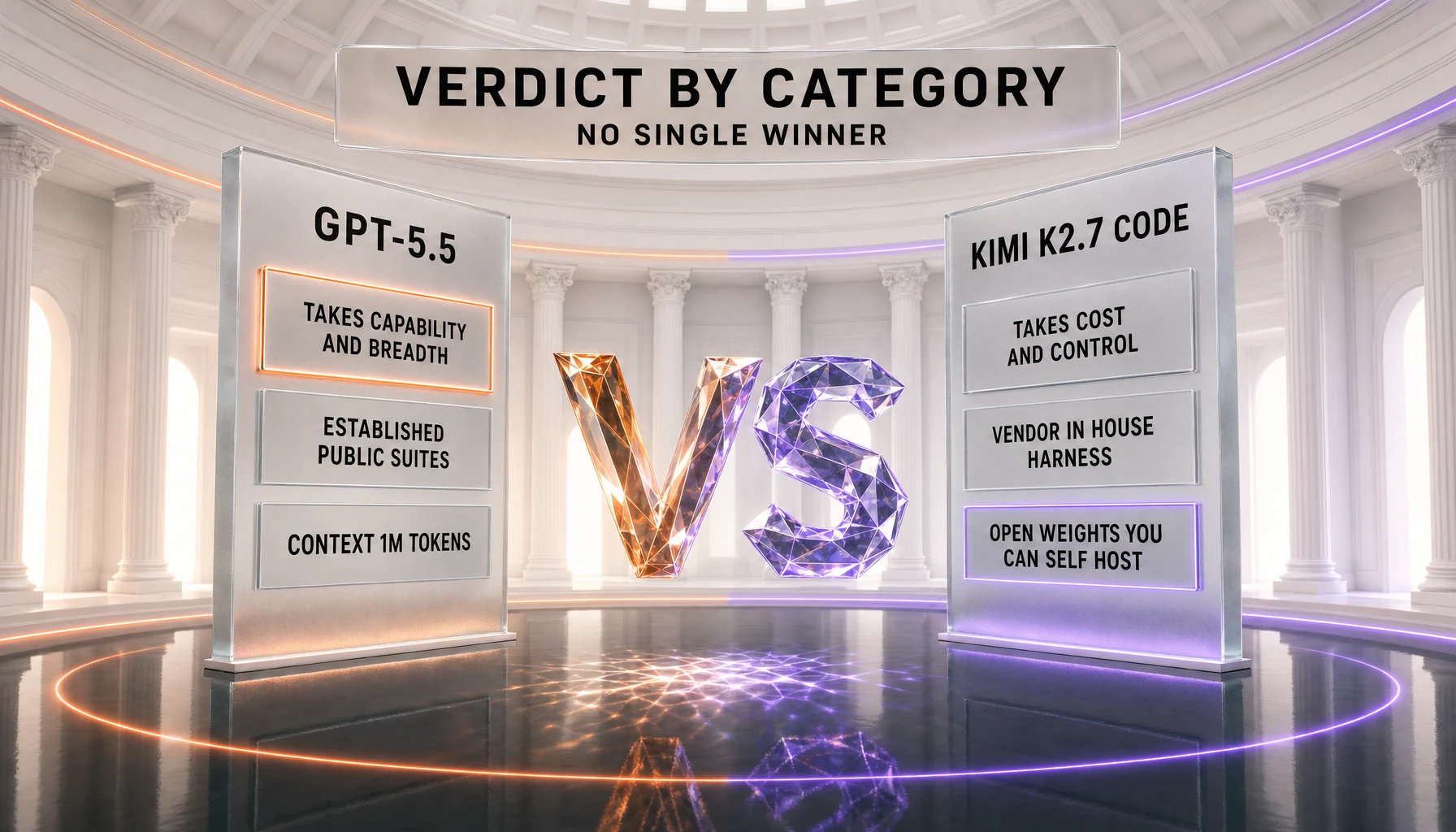
Pick GPT-5.5 if:
- You want the single strongest model and budget is a secondary concern.
- Your work needs the broad agentic tool stack — web search, computer use, file search — running together by default.
- You prompt over very large inputs and need a declared 1,000,000-token context window.
- You value benchmarks on established public suites over a vendor's in-house harness.
- You are happy on a managed, closed API and have no data-residency constraint.
Pick Kimi K2.7 Code if:
- You run high-volume coding loops where output-token cost decides your bill.
- You need to self-host, fine-tune, or audit the weights, or keep code entirely in-house.
- You want native vision-in-code — reading screenshots and mockups — in a cheap, open model.
- Your agent work is MCP- and tool-heavy, where Kimi posts its strongest published results.
- You want frontier-class architecture (1T params, 32B active) at a fraction of the flagship's price.
For a large share of production coding teams, the honest move is to route by task: send the hardest reasoning and the largest-context jobs to GPT-5.5, and run the high-volume, cost-sensitive, vision-in-code work on K2.7 — ideally self-hosted. Single-vendor purity is rarely the cheapest path.
The bottom line
GPT-5.5 is the better model and Kimi K2.7 Code is the better value, and pretending otherwise would be dishonest. On Moonshot's own table, GPT-5.5 wins every row; on the rate card, Kimi wins by roughly five to seven times; on openness and vision, Kimi wins outright; on context and broad agentic capability, GPT-5.5 wins. Which one is "best" depends entirely on whether your constraint is capability or cost-and-control. We score it a split: GPT-5.5 for raw capability, agentic breadth, and verifiable benchmarks; K2.7 for cost per token, open-weight self-hosting, and budget vision-in-code. Most teams who think hard about their actual workload will end up using both.
Is Kimi K2.7 Code better than GPT-5.5 in 2026?
Not on raw capability — and we refuse to fake a single overall winner. On Moonshot's own benchmark table, GPT-5.5 beats Kimi K2.7-Code on all six published rows, including 69.0 versus 62.0 on Kimi Code Bench v2 and 92.9 versus 81.1 on MCP Mark Verified. But Kimi wins decisively on price (about $0.95 input and $4 output per million tokens versus GPT-5.5's $5 and $30), ships open weights you can self-host under a Modified MIT license, and includes a native MoonViT vision encoder. Best raw model and agentic breadth: GPT-5.5. Best cost, openness, and budget vision: Kimi K2.7 Code.
How much do Kimi K2.7 Code and GPT-5.5 cost?
Both meter by the token rather than by subscription. Kimi K2.7 Code is about $0.95 per million input tokens on a cache miss, $0.19 cached, and $4.00 per million output tokens. GPT-5.5 standard is $5.00 per million input ($0.50 cached) and $30.00 per million output, with Batch and Flex tiers at 50 percent off ($2.50 input, $15 output). On the rate card, Kimi is roughly five times cheaper on input and seven and a half times cheaper on output. We fetched both figures directly from the vendor pricing pages, so pricing is the most reliable data point in this comparison.
Are the benchmark numbers in this comparison independently verified?
No, and we want to be upfront. Kimi K2.7 Code's scores (Kimi Code Bench v2 62.0, Program Bench 53.6, MLS Bench Lite 35.1, MCP Mark Verified 81.1, MCP Atlas 76.0, Kimi Claw 24/7 46.9) are all self-reported by Moonshot in its own in-house harness, with no independent third-party numbers on standard public suites as of mid-June 2026. GPT-5.5's figures (Terminal-Bench 2.0 82.7%, SWE-Bench Pro 58.6%, GPQA Diamond 93.6%, Humanity's Last Exam 41.4%) are reported by OpenAI on widely cited public suites. Neither is independently audited here, but GPT-5.5's measurements sit on better-established ground. The only fully verified data is pricing.
Why don't you compare Kimi K2.7 Code and GPT-5.5 on SWE-bench or Terminal-Bench directly?
Because the two models were not measured on the same suites. Moonshot did not report Kimi K2.7 Code on SWE-Bench Pro, SWE-bench Verified, Terminal-Bench, LiveCodeBench, or Aider Polyglot — it published only its own in-house benchmarks (Kimi Code Bench v2, Program Bench, MCP Mark Verified, and others). GPT-5.5 has public numbers on Terminal-Bench 2.0 and SWE-Bench Pro, but no matching Kimi figure exists to compare against. Stacking a GPT-5.5 SWE-Bench Pro score against a Kimi in-house score would be misleading, so we present the two sets of benchmarks separately with a clear caveat instead of forcing a fake head-to-head.
Which is better for agentic coding: Kimi K2.7 Code or GPT-5.5?
GPT-5.5, on the available evidence. On Moonshot's own comparison table, GPT-5.5 leads Kimi K2.7-Code on every agentic and coding row, including the MCP Mark Verified row (92.9 versus 81.1) that is Kimi's strongest category. GPT-5.5 also ships the full agentic tool stack on by default and a five-level reasoning effort scale. That said, Kimi is genuinely capable for scoped, MCP-heavy agent tasks and costs a fraction as much, so for high-volume agentic work where cost dominates, Kimi can be the better practical choice even though GPT-5.5 is the stronger model.
Which has the larger context window: Kimi K2.7 Code or GPT-5.5?
GPT-5.5, by a wide margin on declared figures. OpenAI reports a 1,000,000-token context window for GPT-5.5 (400,000 inside Codex). Kimi K2.7 Code has a 256K (262,144-token) context window with automatic context caching for cheaper repeated long-context calls. For whole-repository prompts or very long autonomous sessions, GPT-5.5's roughly four-times-larger window is a real advantage. Kimi's caching helps cost on repeated long inputs but does not raise the ceiling on a single prompt.
Can I self-host Kimi K2.7 Code? Can I self-host GPT-5.5?
Kimi K2.7 Code: yes. Its weights are open and downloadable from HuggingFace under a Modified MIT license, so you can run it on your own hardware, fine-tune it, and keep data in-house. The one caveat is that the Modified MIT license adds an attribution clause for very large commercial deployments above a user threshold. GPT-5.5: no. It is fully closed, available only through OpenAI's API and ChatGPT, with no open weights, no self-hosting, and no fine-tuning on the base model at launch. If self-hosting or data residency is a hard requirement, K2.7 wins by default.
Does Kimi K2.7 Code have vision, and is it better than GPT-5.5's?
Kimi K2.7 Code includes a native 400M-parameter MoonViT vision encoder, designed so the model can read screenshots, UI mockups, and diagrams inside coding workflows. GPT-5.5 also accepts image input alongside text, though it has no native audio or video input. We would not claim one is categorically "better" at vision without a controlled head-to-head, which neither vendor published. The practical difference is packaging: Kimi bakes vision into a cheap, open, self-hostable model, which is compelling for budget-conscious vision-in-code work; GPT-5.5 offers vision inside a broader, more capable, closed agent.
Why does Moonshot publish a table where its own model loses every row?
It is a credibility signal, and a useful one. By reporting Kimi K2.7-Code alongside GPT-5.5 and Claude Opus 4.8 on six benchmarks where Kimi trails, Moonshot is positioning the model on value and openness rather than claiming a capability crown. The story it tells is "frontier-class architecture and competitive coding ability at a fraction of the price, with open weights" — not "we beat OpenAI." For buyers, that honesty is helpful: it means the cost and openness advantages are the real reasons to choose Kimi, and you should not expect it to out-think GPT-5.5 on the hardest problems.
Can Kimi K2.7 Code and GPT-5.5 work together in the same workflow?
Yes, and multi-model routing is a sensible production pattern here. A typical split: route the hardest reasoning jobs and the largest-context prompts through GPT-5.5 (it leads capability and offers a declared 1,000,000-token window), and run high-volume, cost-sensitive coding and MCP-heavy agent work on Kimi K2.7 Code (much cheaper, with open weights you can self-host). Because Kimi exposes an OpenAI-compatible API, routing between the two behind an abstraction layer like the Vercel AI SDK, LangChain, or LiteLLM is largely a config change rather than a rewrite.
What are the alternatives to Kimi K2.7 Code and GPT-5.5?
If neither fits, several options are worth a look in 2026. Among Chinese open-weight coding models, DeepSeek V4 offers a much larger 1,000,000-token context window and an ultra-cheap V4-Flash tier, while GLM-5.2 is another open-weight coding contender. On the closed-flagship side, Anthropic's Claude Opus line competes directly with GPT-5.5 on agentic coding. For this specific niche, though — an open-weight, vision-equipped challenger against a closed flagship — Kimi K2.7 Code and GPT-5.5 are the two models this comparison covers, and they represent the two ends of the trade-off cleanly. See our LLM coverage for the broader field.
Sources and references
Every figure on this page is attributed to whoever produced it. Vendor documentation and independent measurement are listed separately and never merged into a single ranking.
- Moonshot AI — Platform documentation (model family, API reference and limits)
- OpenAI — API pricing (per-token rates)
- Artificial Analysis — GPT-5.5 (independent index score)
- Artificial Analysis — Model leaderboard (Intelligence Index scores and cost per task across configurations)
Our Verdict
GPT-5.5 is the stronger model; Kimi K2.7 Code is the better value. Best raw capability, agentic breadth and 1M context: GPT-5.5. Best cost per token, open-weight self-hosting and budget vision-in-code: Kimi K2.7 Code. A split, attributed verdict — most teams will use both.
Choose Kimi K2.7 Code
Moonshot AI's open-weight 1T-parameter MoE coding model — 32B active, 256K context, Modified MIT, metered at $0.95 in / $4.00 out per million tokens.
Try Kimi K2.7 Code →Choose GPT-5.5
OpenAI's first fully retrained base model since GPT-4.5 — agentic, faster, and double the API price.
Try GPT-5.5 →Frequently Asked Questions
Is Kimi K2.7 Code better than GPT-5.5?
GPT-5.5 is the stronger model; Kimi K2.7 Code is the better value. Best raw capability, agentic breadth and 1M context: GPT-5.5. Best cost per token, open-weight self-hosting and budget vision-in-code: Kimi K2.7 Code. A split, attributed verdict — most teams will use both.
Which is cheaper, Kimi K2.7 Code or GPT-5.5?
Kimi K2.7 Code starts at $0.95 in / $4 out per M tokens (free plan available). GPT-5.5 starts at $5 in / $30 out per M tokens. Check the pricing comparison section above for a full breakdown.
What are the main differences between Kimi K2.7 Code and GPT-5.5?
The key differences span across 8 features we compared. For Price per 1M tokens (input/output), Kimi K2.7 Code offers $0.95 / $4.00 while GPT-5.5 offers $5.00 / $30.00. For Open weights / self-hostable, Kimi K2.7 Code offers Yes (Modified MIT, HuggingFace) while GPT-5.5 offers No (closed API only). For Context window, Kimi K2.7 Code offers 256K (262,144 tokens) while GPT-5.5 offers 1,000,000 tokens. See the full feature comparison table above for all details.