Muse Spark 1.1
Meta Superintelligence Labs' closed agentic model: Artificial Analysis Intelligence Index 51 and a 1,000,000-token context, at $1.25 input and $4.25 output per million tokens — about a quarter of frontier input rates.

Quick Summary
Muse Spark 1.1 is Meta Superintelligence Labs' second model and its first paid API, released July 9, 2026. It scores 51 on the independent Artificial Analysis Intelligence Index v4.1, carries a 1,000,000-token context, and is built for agentic work, at $1.25 per million input and $4.25 per million output tokens. Closed weights. Research-led review. Score 8.3 out of 10.
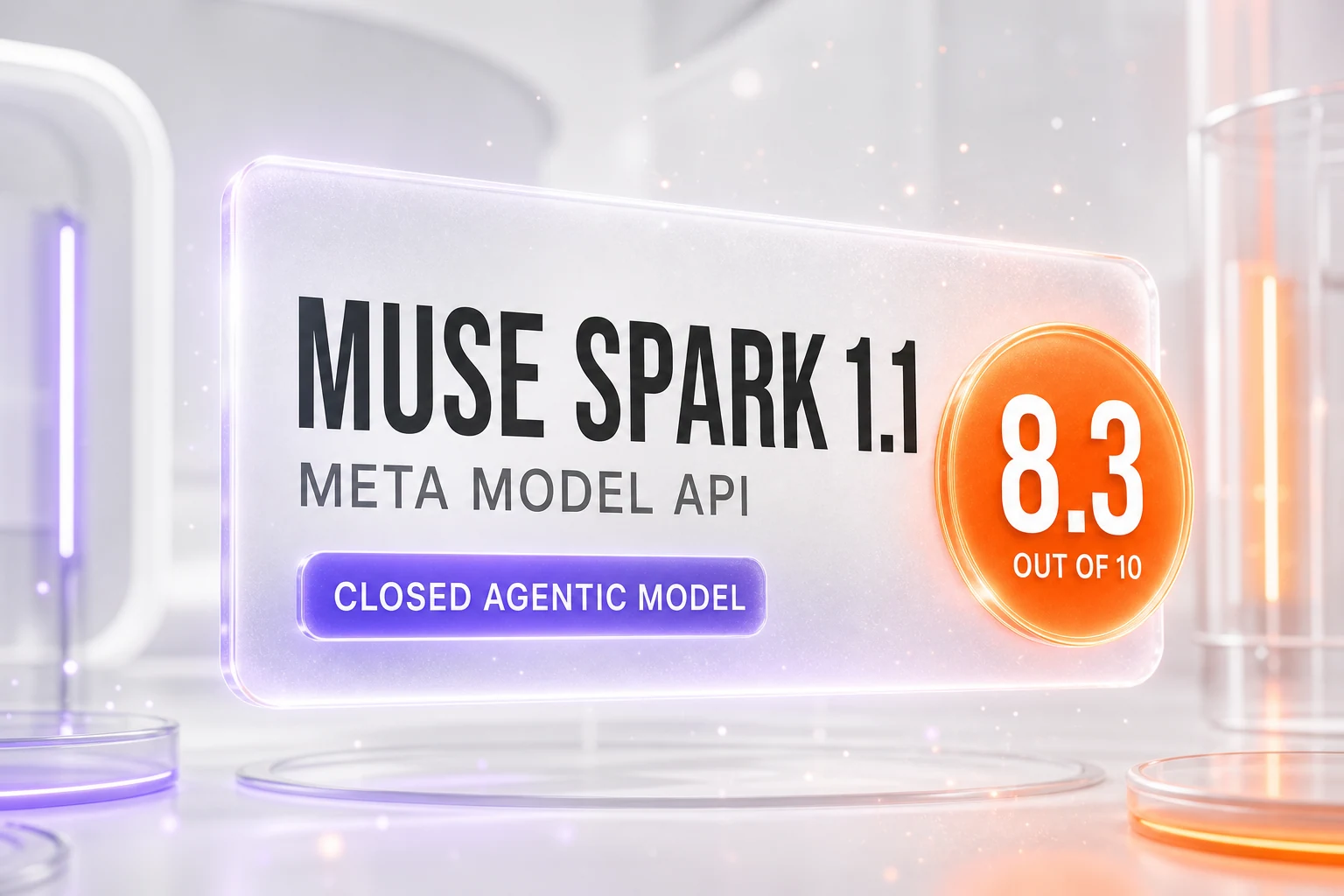
Muse Spark 1.1 is Meta Superintelligence Labs' second model and its first paid API, released July 9, 2026. It scores 51 on the independent Artificial Analysis Intelligence Index v4.1, carries a 1,000,000-token context window, and is built for agentic work — tool use, computer use, and coding — through an OpenAI-compatible Meta Model API. It costs $1.25 per million input tokens and $4.25 per million output tokens, with $20 in free credits for new accounts, roughly a quarter of comparable Anthropic and OpenAI rates. Crucially, its weights are closed: this is Meta's pivot away from the open-weight Llama line. We reviewed it research-led, since the preview is US-only. Score 8.3 out of 10.
Quick Verdict
Score: 8.3 out of 10. Muse Spark 1.1 is the moment Meta stopped giving models away and started selling access to a good one. It is the second release from Meta Superintelligence Labs, an upgrade of the April 2026 original, and it lands at a genuinely competitive spot: an independent Artificial Analysis Intelligence Index of 51 — level with GPT-5.6 Luna and GLM-5.2 — a full 1,000,000-token context, and an agentic feature set, all priced at about a quarter of what the frontier labs charge. The catch is philosophical and practical at once: the weights are closed, the exact reversal of the open Llama 4 era, and at launch the Meta Model API is a US-only public preview behind a waitlist. It is a strong value model with a short track record.
- ✅ Aggressive pricing — $1.25 per million input tokens and $4.25 per million output tokens, plus $20 in free credits, roughly a quarter of comparable Anthropic and OpenAI input rates
- ✅ Independent score of 51 on the Artificial Analysis Intelligence Index v4.1, a clear jump from the original Muse Spark's 43
- ✅ Full 1,000,000-token context window, up from the original's 262,000, built for agentic tool use, computer use, and coding
- ❌ Closed weights — no self-hosting and no download, a sharp break from Meta's open-weight Llama heritage
- ❌ US-only public preview with a waitlist at launch, and Meta's first paid API, so access is gated and the reliability track record is thin
Best for: developers and teams who want a low-cost, frontier-adjacent agentic model behind a familiar API and are comfortable with a hosted, closed model. It is a natural fit for high-volume tool-use, coding, and long-context automation where price per token decides the budget, and a poor fit for anyone who needs open weights, self-hosting, or availability outside the United States on day one.
Muse Spark 1.1 at a Glance
| Metric | Muse Spark 1.1 |
|---|---|
| Maker | Meta Superintelligence Labs |
| Released | July 9, 2026 |
| Input (per 1M tokens) | $1.25 |
| Output (per 1M tokens) | $4.25 |
| Free credits | $20 for new accounts |
| Context window | 1,000,000 tokens |
| AA Intelligence Index v4.1 | 51 (independent) |
| Weights | Closed — hosted Meta Model API only |
How We Reviewed Muse Spark 1.1
This is a research-led review, not a hands-on one, and we want to be transparent about that up front. Muse Spark 1.1 reached general availability on July 9, 2026 through the Meta Model API, but Meta opened that API as a US-only public preview with a waitlist. From our base outside the United States we have not been able to run the production model ourselves yet, so we have not measured its latency, tested its outputs, or stress-tested its tool calling firsthand. We will not pretend otherwise, and we will not invent benchmark numbers or test transcripts to fill the gap.
Instead, this assessment compiles what can be verified: Meta's official Meta Model API documentation and launch announcement, the independent scores published by Artificial Analysis, and contemporaneous reporting on pricing and availability. We track every major model release for ThePlanetTools and have benchmarked dozens of frontier models this year, so our score reflects documented capabilities, independent third-party benchmarks, and a hard look at value and access — not a personal test run. Where a figure comes from Meta rather than an independent lab, we label it. We will update this review with hands-on results once we clear the waitlist. Last reviewed: July 16, 2026.
What Is Muse Spark 1.1?
Muse Spark 1.1 is a large language model from Meta Superintelligence Labs, released July 9, 2026 as the second model in the Muse Spark line and the lab's first commercial API. It is a multimodal reasoning model designed for agentic work — using tools, operating a computer, and writing code — rather than a plain chatbot. Access is through the Meta Model API, and the model's weights are not published: this is a closed model, and that single fact is the story of the release.
To understand why, you have to look at where Meta came from. For years Meta's AI strategy was open weights: the Llama family was downloadable, self-hostable, and free, and it anchored a huge open-source ecosystem. Muse Spark reverses that. The original Muse Spark arrived in April 2026 as the first output of the reorganized Superintelligence Labs, and version 1.1 is the moment Meta puts a price tag on it and keeps the weights in-house. We covered the strategic shift in detail in our reports on the Muse Spark Superintelligence launch and on Meta abandoning the open-source Llama line. If you built on Llama expecting an open successor, Muse Spark 1.1 is not it.
What Meta is selling instead is a competitive, cheap, hosted model. On the independent Artificial Analysis Intelligence Index v4.1 it scores 51 in its highest reasoning mode, which puts it shoulder to shoulder with OpenAI's economy tier and a rung below the frontier. It carries a 1,000,000-token context window and an agentic toolkit, and it undercuts the incumbents on price. That combination — near-Luna intelligence, a bigger context, a lower price, and a closed license — is what you are evaluating here.
Key Features
1,000,000-token context window
Muse Spark 1.1 ships a 1,000,000-token context window, a large jump from the original Muse Spark's 262,000 tokens. That is a meaningful upgrade for the agentic and long-document work the model targets: a million tokens is enough to hold large codebases, long transcripts, or multi-document bundles in a single call without fragmenting the input. For repository-scale coding assistants and long-horizon agents, context length is often the binding constraint, and Muse Spark 1.1 removes it at the same level as the frontier models. Meta documents the window on the Meta Model API product page; independent capability scoring is tracked by Artificial Analysis.
Artificial Analysis Intelligence Index of 51
On the independent Artificial Analysis Intelligence Index v4.1, Muse Spark 1.1 scores 51 in its high-effort xhigh mode. That is the clearest third-party read on the model, and it matters because it is not a Meta number — Artificial Analysis runs its own evaluations. A 51 places Muse Spark 1.1 level with GPT-5.6 Luna and GLM-5.2, above open-weight leaders like DeepSeek V4 and MiniMax M3 at 44, and below the frontier tier occupied by Claude Opus 4.8 at 56. It is a strong economy-to-mid result, and it is the number we weight most heavily because it is independent. Source: Artificial Analysis.
Built for agentic work: tool use, computer use, and coding
Meta positions Muse Spark 1.1 as an agentic model rather than a conversational one. It supports tool use, computer use, and coding, and the Meta Model API exposes structured output and parallel tool calling so the model can orchestrate several actions at once. This is the workload the whole release is aimed at: agents that call functions, drive software, and edit code, not just answer questions. According to Artificial Analysis, the biggest measured gains over the original are in exactly this territory — a 12-point higher Coding Index and a SciCode result that rose from 52 to 58 percent. For a fuller introduction to the category, see our explainer distinguishing an agentic coding model from a chatbot.
Multimodal reasoning
Muse Spark 1.1 is a multimodal reasoning model, meaning it reasons over more than plain text. For agentic and computer-use tasks that matters, because an agent operating software needs to interpret screens, diagrams, and documents, not only prose. Meta describes multimodal understanding as one of the areas improved over the original Muse Spark. We are labeling the depth of the multimodal support as documented rather than measured, since we have not run vision or mixed-input tasks against the production API ourselves. Details are on the Meta Model API documentation.
OpenAI-compatible Meta Model API
Access runs entirely through the Meta Model API, which Meta describes as OpenAI-compatible with support for structured output and parallel tool calling. Compatibility is a real convenience: teams already calling an OpenAI-style endpoint can point their existing code at Meta's API with minimal changes, swap the base URL and key, and start testing. New accounts get $20 in free credits to do exactly that. The portal launched as a public preview, with early partners already live and other developers able to join a waitlist. Reference: Meta Model API.
Closed weights, hosted access only
The defining feature is what is missing. Muse Spark 1.1 is closed: there is no weight download, no self-hosting, and no permissive license. Everything runs on Meta's infrastructure, billed per token. For a company whose entire AI reputation was built on open Llama releases, this is a deliberate and consequential choice, and it is the single biggest thing to weigh before adopting the model. If your architecture depends on running weights on your own hardware — for privacy, cost control at scale, or air-gapped deployment — Muse Spark 1.1 rules itself out, and an open model like DeepSeek V4 is the closer fit.
Muse Spark 1.1 Pricing in 2026
Pricing is the headline argument for Muse Spark 1.1, and it is simple: one flat per-token rate on the Meta Model API, with free credits to start. Every figure below reflects Meta's launch pricing as reported on July 9, 2026.
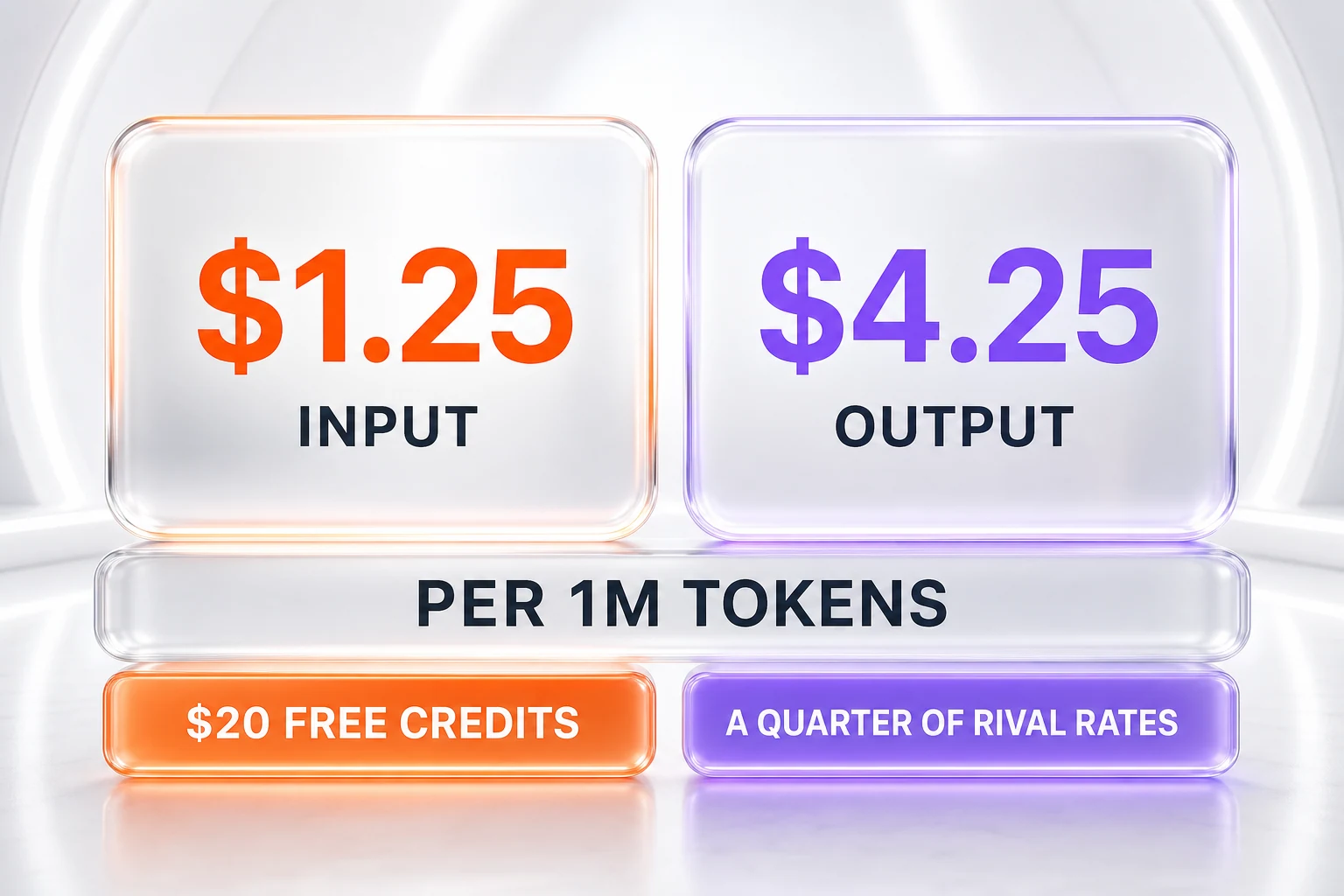
Meta Model API pricing (per million tokens)
| Item | Muse Spark 1.1 |
|---|---|
| Input | $1.25 |
| Output | $4.25 |
| Free credits (new accounts) | $20 |
| Weights / self-hosting | Not available (closed) |
Meta CEO Mark Zuckerberg framed the pricing as roughly 25 percent of what Anthropic and OpenAI charge for comparable models, and the input rate bears that out: at $1.25 per million input tokens, Muse Spark 1.1 costs a quarter of Claude Opus 4.8's $5.00 input, while its $4.25 output is well under Opus 4.8's $25.00. Against the closest peer on intelligence, GPT-5.6 Luna, Muse Spark 1.1 is now the more expensive option on both axes: $1.25 versus $0.20 on input and $4.25 versus $1.20 on output, after OpenAI cut Luna's list rates on July 30, 2026. For output-heavy agentic workloads that generate a lot of tokens, that output gap is the number that moves the budget, and it no longer favors Muse Spark 1.1. For a plain-English explainer on how input and output token rates work, see our guide on AI model pricing explained. Source: Meta Model API.
Best for: cost-sensitive teams running high-volume, output-heavy agentic and coding traffic who want a competitive model without frontier-tier bills. The $20 in free credits makes it cheap to prototype an agent before committing, and the low output rate is where the saving compounds at scale.
Muse Spark 1.1 vs the Original Muse Spark
The most direct comparison is to the model it replaces. The original Muse Spark shipped in April 2026 as Meta Superintelligence Labs' first release; version 1.1 is the July upgrade that both improves the model and monetizes it. The gains below are from Artificial Analysis, comparing the two versions.
| Attribute | Original Muse Spark (April 2026) | Muse Spark 1.1 (July 2026) |
|---|---|---|
| AA Intelligence Index | 43 | 51 (v4.1) |
| Context window | 262,000 tokens | 1,000,000 tokens |
| Access | Preview, no paid API | Paid Meta Model API |
| SciCode (Artificial Analysis) | 52% | 58% |
| Humanity's Last Exam (Artificial Analysis) | 40% | 45% |
| GDPval-AA v2 (Artificial Analysis) | 1,144 Elo | 1,376 Elo |
Read of the table: version 1.1 is a real step up, not a point release. The Artificial Analysis Intelligence Index climbs from 43 to 51 (the current figure is on the v4.1 index), the context window nearly quadruples from 262,000 to 1,000,000 tokens, and the measured benchmarks all move in the right direction — SciCode from 52 to 58 percent, Humanity's Last Exam from 40 to 45 percent, and GDPval-AA v2 from 1,144 to 1,376 Elo, alongside a 12-point higher Coding Index. Those are all Artificial Analysis figures, which is why we trust them. The other change is commercial: the original had no paid API, and 1.1 does. If you tried the original and set it aside, the intelligence, context, and coding gains here are large enough to warrant a fresh look — provided the closed license and US-only access fit your constraints. Source: Artificial Analysis.
Benchmarks: Independent vs Vendor
Independent numbers matter more than vendor slides, so we separate the two carefully. The clearest third-party read is the Artificial Analysis Intelligence Index, which places Muse Spark 1.1 at 51 on its v4.1 scale.
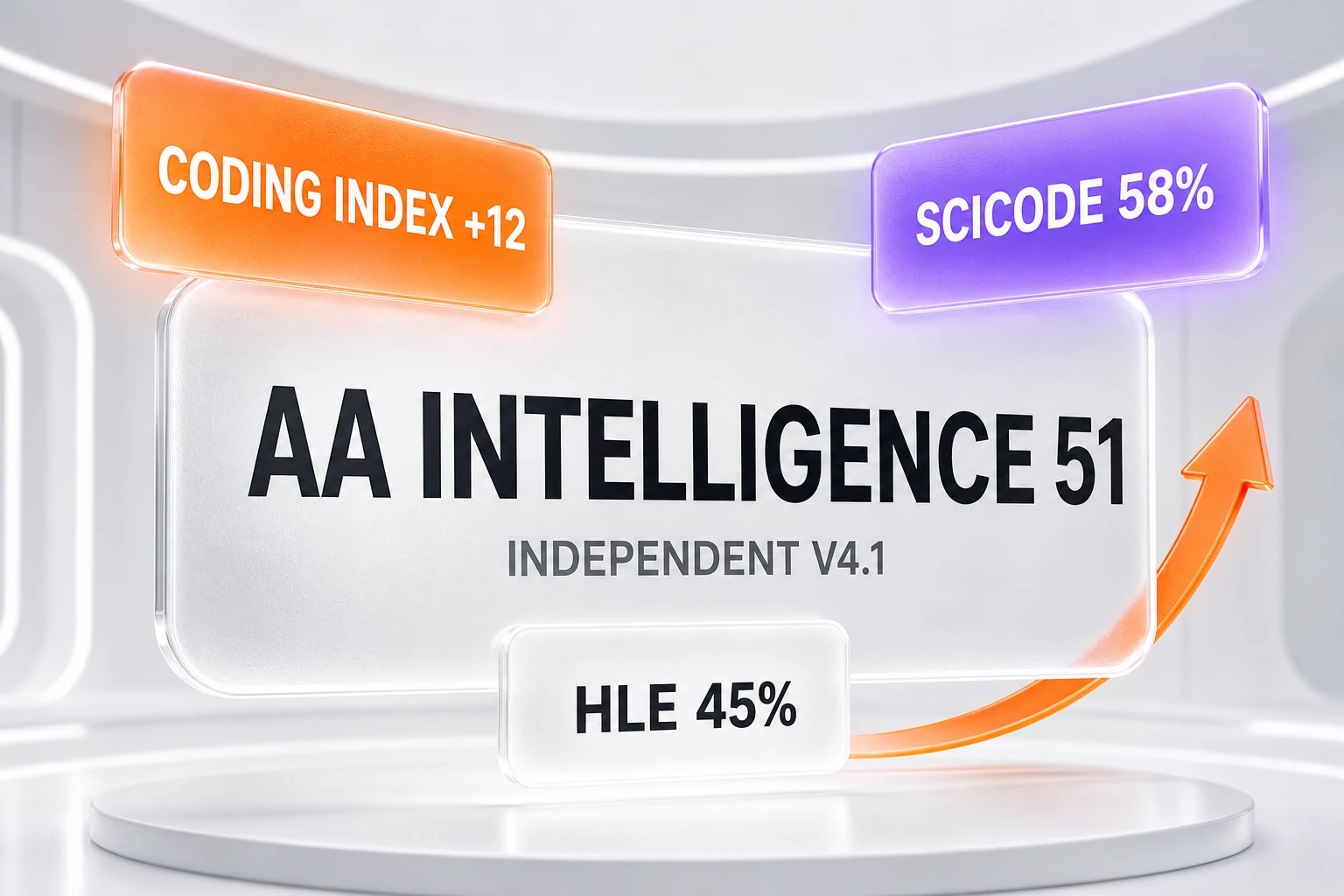
| Benchmark (source) | Muse Spark 1.1 | Reference |
|---|---|---|
| AA Intelligence Index v4.1 (independent) | 51 | Luna 51, GLM-5.2 51, Opus 4.8 56 |
| SciCode (independent, Artificial Analysis) | 58% | Up from 52% on the original |
| Humanity's Last Exam (independent, Artificial Analysis) | 45% | Up from 40% on the original |
| Coding Index (independent, Artificial Analysis) | +12 points vs original | Its strongest area of gain |
| GDPval-AA v2 (independent, Artificial Analysis) | 1,376 Elo | Up from 1,144 on the original |
Read of the table: every figure above comes from Artificial Analysis, an independent evaluator, which is why we lead with them and why the image on this page reads "AA Intelligence 51 — Independent v4.1." On general intelligence, Muse Spark 1.1's 51 ties GPT-5.6 Luna and GLM-5.2 and sits five points below Claude Opus 4.8's 56, so it is a capable mid-tier model rather than a frontier one. Its sharpest improvements are in coding and hard reasoning, where the Coding Index rose 12 points and SciCode and Humanity's Last Exam each climbed several points over the original. We deliberately do not cite Meta's own marketing benchmark claims as if they were independent; where Meta reports a number the independent labs have not reproduced, we would label it self-reported, and at the time of writing the Artificial Analysis figures are the reliable public reference. Source: Artificial Analysis.
How Muse Spark 1.1 Compares
The useful comparison for Muse Spark 1.1 is against the models that share its intelligence tier and its price band. All four below are within a few points of it on the independent index, and the contrast is really about license and cost.
| Model | Input (per 1M) | Output (per 1M) | AA Index v4.1 |
|---|---|---|---|
| Muse Spark 1.1 | $1.25 | $4.25 | 51 |
| GPT-5.6 Luna | $0.20 | $1.20 | 51 |
| GLM-5.2 | $1.40 | $4.40 | 51 |
| Claude Opus 4.8 | $5.00 | $25.00 | 56 |
| DeepSeek V4 | $0.66 off-peak, $1.32 peak | $1.98 off-peak, $3.96 peak | 44 |
Three of these models — Muse Spark 1.1, GPT-5.6 Luna, and GLM-5.2 — score an identical 51 on the independent index, so the decision comes down to price, ecosystem, and license. GPT-5.6 Luna is the cheapest of the three on both axes since OpenAI's July 30, 2026 price cut, at $0.20 input and $1.20 output. Muse Spark 1.1 undercuts GLM-5.2 on both ($1.25 versus $1.40 on input, $4.25 versus $4.40 on output) but sits well above Luna, so on price alone Luna is the default of the three and Muse Spark 1.1 has to win on context, agentic tooling, or ecosystem instead. Muse Spark 1.1 and Luna are both closed, hosted-only APIs. If open weights and self-hosting are the priority, DeepSeek V4 ships under a permissive MIT license at $0.66 input and $1.98 output per million tokens off-peak, doubling to $1.32 and $3.96 during peak hours since August 16, 2026. Off-peak that still undercuts Muse Spark 1.1 on both axes, but it no longer undercuts Luna on either one, and at peak it rises above Muse Spark 1.1 on input as well — at the cost of a lower 44 on the intelligence index. And if you simply need the strongest reasoning and can absorb the bill, Claude Opus 4.8's 56 is five points clear of this whole cluster. As always, run your own LLM evaluation on your real prompts before committing. Independent scores via Artificial Analysis.
Each of those pairings has its own head-to-head. Muse Spark 1.1 against GPT-5.6 Luna and Muse Spark 1.1 against GLM-5.2 both start from the same 51 and end up decided by access and license rather than by score — Luna on current list prices and worldwide availability, GLM-5.2 on open MIT weights you can self-host. Muse Spark 1.1 against Claude Sonnet 5 is the pairing where Muse Spark 1.1 trades measured intelligence away to keep its price advantage, and Gemini 3.5 Flash against Muse Spark 1.1 is the mirror image: Muse Spark 1.1 wins on paper, Flash is the one you can deploy worldwide today. Muse Spark 1.1 against MiniMax M3 is the widest gap of the five — seven index points, bought at several times the input price.
Pros and Cons
What stands out
- Aggressive, simple pricing. At $1.25 per million input tokens and $4.25 per million output tokens, plus $20 in free credits, Muse Spark 1.1 costs roughly a quarter of comparable frontier input rates — the clearest reason to try it.
- A strong independent score. Artificial Analysis puts it at 51 on the v4.1 Intelligence Index, level with GPT-5.6 Luna and GLM-5.2, and a clear eight-point jump from the original Muse Spark's 43.
- Full 1,000,000-token context. Nearly four times the original's 262,000, large enough for repository-scale coding and long-document agentic work in a single call.
- Genuinely agentic. Tool use, computer use, and coding, with structured output and parallel tool calling exposed through the API — and its biggest measured gains are in coding.
- OpenAI-compatible API. Existing OpenAI-style code can point at the Meta Model API with minimal changes, lowering the switching cost of a trial.
Where it falls short
- Closed weights. No self-hosting and no download — a sharp reversal of Meta's open-weight Llama heritage, and disqualifying for anyone who needs to run the model on their own hardware.
- US-only waitlist at launch. The Meta Model API opened as a US-only public preview with a waitlist, so access is gated and unavailable in most regions on day one.
- No track record. This is Meta's first paid API, so there is no history yet for uptime, rate limits, or long-term pricing stability.
- Not a frontier model. A 51 on the intelligence index trails Claude Opus 4.8 (56) and Claude Fable 5 (60) on the hardest, multi-step reasoning.
- Thinly tested in the wild. Independent benchmarks exist, but broad third-party validation across diverse real-world workloads is still limited a week after launch.
Real-World Use Cases
Agentic automation
Tool use, computer use, and parallel tool calling make Muse Spark 1.1 a fit for agents that call functions, drive software, and chain actions. The low output rate helps here, because agentic runs generate a lot of tokens as the model reasons and acts across many steps.
Repository-scale coding assistants
The million-token context plus the model's strongest measured gains — a 12-point Coding Index jump over the original — point it at multi-file and repository-scale coding, where the assistant needs to hold a lot of code in view at once.
Long-document analysis
A 1,000,000-token window lets Muse Spark 1.1 read long transcripts, contracts, and document bundles in a single call, which suits summarization and retrieval work at a lower price than the frontier tier.
Multimodal reasoning tasks
As a multimodal model it can reason over mixed text and visual input, useful for computer-use agents that must interpret screens and documents rather than plain prose. We flag this as a documented capability we have not yet measured firsthand.
High-volume, cost-sensitive API traffic
For teams pushing large token volumes where cost per token decides the budget, Muse Spark 1.1's rates — especially its $4.25 output — make a mid-tier intelligence level affordable at scale.
Migrating OpenAI-compatible workloads
Because the Meta Model API is OpenAI-compatible, teams can repoint existing code, test on the $20 in free credits, and compare quality and cost against their current provider with little engineering effort.
Prototyping agents on free credits
The $20 in free credits is enough to build and evaluate a working agent before spending real money, making Muse Spark 1.1 a cheap sandbox for teams weighing a move off a pricier model.
Frequently Asked Questions
What is Muse Spark 1.1?
Muse Spark 1.1 is a large language model from Meta Superintelligence Labs, released July 9, 2026 as the lab's second model and its first paid API. It is a multimodal reasoning model built for agentic work — tool use, computer use, and coding — with a 1,000,000-token context window. It scores 51 on the independent Artificial Analysis Intelligence Index v4.1, and it is accessed through the Meta Model API. Its weights are closed, marking Meta's pivot away from the open-weight Llama line.
How much does Muse Spark 1.1 cost?
Muse Spark 1.1 costs $1.25 per million input tokens and $4.25 per million output tokens on the Meta Model API, with $20 in free credits for new accounts. Meta's leadership framed that as roughly 25 percent of what Anthropic and OpenAI charge for comparable models. There is no open-weight or self-hosting option, so all usage is billed per token through the hosted API. These figures reflect Meta's launch pricing announced on July 9, 2026.
Is Muse Spark 1.1 open-weight?
No. Muse Spark 1.1 is a closed model: Meta does not publish the weights, and there is no download or self-hosting option. Access is only through the hosted Meta Model API, billed per token. This is a deliberate reversal of Meta's open-weight Llama strategy — Muse Spark is the closed pivot of Meta Superintelligence Labs. If you need open weights you should look at an open model such as DeepSeek V4 instead.
How is Muse Spark 1.1 different from the original Muse Spark?
Version 1.1 is a substantial upgrade of the April 2026 original. Its Artificial Analysis Intelligence Index rose from 43 to 51, its context window grew from 262,000 to 1,000,000 tokens, and it gained a paid Meta Model API where the original had none. Artificial Analysis also measured a 12-point higher Coding Index, SciCode up from 52 to 58 percent, Humanity's Last Exam up from 40 to 45 percent, and GDPval-AA v2 up from 1,144 to 1,376 Elo. It is a real step up, not a point release.
What is Muse Spark 1.1's context window?
Muse Spark 1.1 has a 1,000,000-token context window, nearly four times the original Muse Spark's 262,000 tokens. That is large enough to hold big codebases, long transcripts, or multi-document bundles in a single call, which suits the agentic, coding, and long-document work the model is built for. The larger window is one of the headline upgrades in version 1.1.
What did Muse Spark 1.1 score on independent benchmarks?
On the independent Artificial Analysis Intelligence Index v4.1, Muse Spark 1.1 scores 51 in its high-effort xhigh mode — level with GPT-5.6 Luna and GLM-5.2, above open-weight leaders like DeepSeek V4 at 44, and below Claude Opus 4.8 at 56. Artificial Analysis also reports a 12-point higher Coding Index, SciCode at 58 percent, Humanity's Last Exam at 45 percent, and GDPval-AA v2 at 1,376 Elo, all improvements over the original. These are independent figures, not Meta's own.
Who makes Muse Spark 1.1?
Muse Spark 1.1 is made by Meta Superintelligence Labs, the AI research group inside Meta. It is the lab's second model, following the original Muse Spark in April 2026, and its first commercial API. The release marks a strategic shift for Meta, from the downloadable open-weight Llama family to a closed, paid, hosted model sold through the Meta Model API.
Can I use Muse Spark 1.1 outside the United States?
Not at launch. Meta opened the Meta Model API as a US-only public preview with a waitlist on July 9, 2026, so availability is limited to United States developers first, with others able to join a waitlist over time. Access outside the US was not available on day one. Meta has not published a firm timeline for broader regional rollout, so international teams should expect to wait.
Is Muse Spark 1.1 good for agentic and coding work?
Yes, that is its design target. Muse Spark 1.1 supports tool use, computer use, and coding, with structured output and parallel tool calling through the API. Its largest measured gains over the original are in coding — a 12-point higher Artificial Analysis Coding Index and SciCode up from 52 to 58 percent. Combined with the 1,000,000-token context, that makes it well suited to repository-scale coding assistants and multi-step agents, at a mid-tier intelligence level rather than a frontier one.
Does Muse Spark 1.1 have a free tier?
There is no permanent free plan, but new accounts receive $20 in free credits to start, which is enough to build and evaluate a working agent before paying. After the credits are used, all usage is billed at $1.25 per million input tokens and $4.25 per million output tokens. Because the model is closed, there is no free self-hosting alternative — everything runs through the paid Meta Model API.
Is the Muse Spark 1.1 API OpenAI-compatible?
Yes. Meta describes the Meta Model API as OpenAI-compatible, with support for structured output and parallel tool calling. In practice that means teams already using an OpenAI-style endpoint can point their existing code at Meta's API with minimal changes — typically swapping the base URL and key — and start testing on the $20 in free credits. That compatibility lowers the switching cost of trialing Muse Spark 1.1 against a current provider.
Should I choose Muse Spark 1.1 or GPT-5.6 Luna?
Both score 51 on the independent Artificial Analysis Intelligence Index and both are closed, hosted-only APIs, so the choice comes down to price and ecosystem. Since OpenAI's July 30, 2026 price cut, GPT-5.6 Luna is cheaper on both axes — $0.20 versus $1.25 per million input tokens and $1.20 versus $4.25 on output — and it is globally available today rather than US-only, with OpenAI's mature tooling and track record. Muse Spark 1.1 answers with a 1,000,000-token context, agentic tooling, and $20 in free credits. On cost alone Luna wins; run both on your own workload before committing.
Verdict: 8.3 out of 10
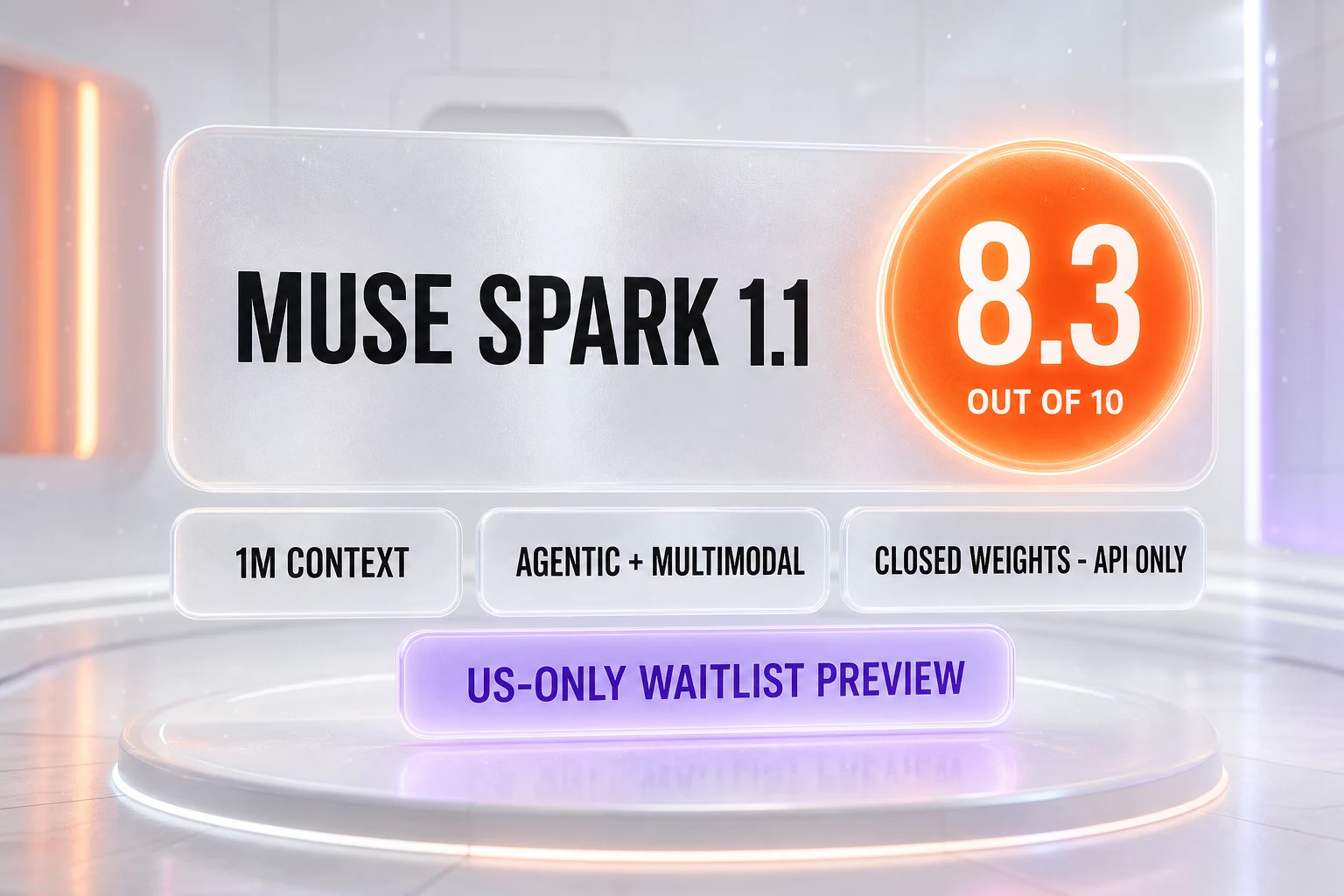
Muse Spark 1.1 earns an 8.3 out of 10 as a research-led assessment. On the documented facts and independent benchmarks it is a genuinely good deal: an Artificial Analysis Intelligence Index of 51 that ties GPT-5.6 Luna and GLM-5.2, a full 1,000,000-token context, real coding and reasoning gains over the original, and an agentic feature set — all for about a quarter of frontier input rates, with $20 in free credits to start. What holds it back is not the model's quality but its terms and its youth: the weights are closed, reversing Meta's open Llama legacy; the API is a US-only public preview behind a waitlist; and as Meta's first paid API it has no track record for reliability. We have not run it hands-on yet, and we have priced that uncertainty into the score honestly.
Score breakdown:
- Features: 8.4 out of 10 — a 1,000,000-token context, agentic tool use, computer use, coding, multimodal reasoning, and an OpenAI-compatible API. Held back mainly by closed weights and a mid-tier rather than frontier ceiling.
- Ease of Use: 8.0 out of 10 — OpenAI-compatible endpoints and $20 in free credits make trialing easy, but the US-only waitlist and a brand-new developer portal gate access.
- Value: 9.2 out of 10 — the strongest column: an independent 51 at roughly a quarter of comparable frontier input rates, with the cheapest output in its intelligence tier and free starting credits.
- Support: 7.6 out of 10 — documentation exists and the API is OpenAI-compatible, but this is Meta's first paid API in public preview, with no reliability track record and thin real-world validation.
Final word: Muse Spark 1.1 is the clearest sign yet that Meta intends to compete on price in the closed-model market rather than lead the open one. For cost-sensitive, output-heavy agentic and coding workloads behind a familiar API, it is one of the best-value models at its intelligence level — provided you are in the United States, comfortable with a closed license, and willing to accept a young API's growing pains. If you need open weights or self-hosting, look at DeepSeek V4; if you need the strongest reasoning, step up to Claude Opus 4.8; and if you want the same 51 with global availability, weigh GPT-5.6 Luna. We will revisit this score with hands-on results once we clear the waitlist. Last reviewed: July 16, 2026.
Sources
- Meta — Meta Model API product and documentation
- Artificial Analysis — Muse Spark 1.1 independent benchmarks (Intelligence Index v4.1, coding, reasoning)
- Artificial Analysis — independent LLM benchmark methodology
- ThePlanetTools.ai research-led review compiled July 16, 2026 from Meta's launch materials and independent third-party benchmarks. Hands-on testing pending Meta Model API waitlist access.
Key Features
Pros & Cons
Pros
- Aggressive pricing: $1.25 per million input tokens and $4.25 per million output tokens, plus $20 in free credits for new accounts — roughly a quarter of frontier input rates such as Claude Opus 4.8's $5.00, though OpenAI's GPT-5.6 Luna undercuts it at $0.20 since July 30, 2026.
- A strong independent score of 51 on the Artificial Analysis Intelligence Index v4.1, level with GPT-5.6 Luna and GLM-5.2, and a clear jump from the original Muse Spark's 43.
- A full 1,000,000-token context window, nearly four times the original Muse Spark's 262,000, suited to long documents and repository-scale agentic work.
- Built for agentic work with tool use, computer use, and coding, exposed through an OpenAI-compatible Meta Model API with structured output and parallel tool calling.
- Meaningful measured gains over the original: Artificial Analysis reports a 12-point higher Coding Index, SciCode up from 52 to 58 percent, and Humanity's Last Exam up from 40 to 45 percent.
- OpenAI-compatible endpoints let teams point existing code at the Meta Model API with minimal changes and test on the free credits.
Cons
- Closed weights: there is no self-hosting and no model download, a sharp reversal of Meta's open-weight Llama heritage — only the hosted Meta Model API.
- US-only public preview with a waitlist at launch, so access is gated and unavailable in most regions on day one.
- Meta's first paid API, with no track record yet for uptime, rate limits, or long-term pricing stability.
- Not a frontier model: at 51 on the Artificial Analysis Intelligence Index it trails Claude Opus 4.8 (56) and Claude Fable 5 (60) on the hardest reasoning.
- Thinly validated in the wild: independent benchmarks exist, but broad third-party testing across diverse real-world workloads is still limited a week after launch.
Best Use Cases
Platforms & Integrations
Available On
Integrations
Compare Muse Spark 1.1

We're developers and SaaS builders who use these tools daily in production. Every review comes from hands-on experience building real products — DealPropFirm, ThePlanetIndicator, PropFirmsCodes, and many more. We don't just review tools — we build and ship with them every day.
Written and tested by developers who build with these tools daily.
Frequently Asked Questions
What is Muse Spark 1.1?
Meta Superintelligence Labs' closed agentic model: Artificial Analysis Intelligence Index 51 and a 1,000,000-token context, at $1.25 input and $4.25 output per million tokens — about a quarter of frontier input rates.
How much does Muse Spark 1.1 cost?
Muse Spark 1.1 costs $1.25/month.
Is Muse Spark 1.1 free?
No, Muse Spark 1.1 starts at $1.25/month.
What are the best alternatives to Muse Spark 1.1?
Top-rated alternatives to Muse Spark 1.1 can be found in our WebApplication category, where we've reviewed and scored every tool on ThePlanetTools.ai.
Is Muse Spark 1.1 good for beginners?
Muse Spark 1.1 is rated 8/10 for ease of use.
What platforms does Muse Spark 1.1 support?
Muse Spark 1.1 is available on REST API, Meta Model API, Developer Portal (public preview).
Does Muse Spark 1.1 offer a free trial?
Yes, Muse Spark 1.1 offers a free trial.
Is Muse Spark 1.1 worth the price?
Muse Spark 1.1 scores 9.2/10 for value. We consider it excellent value.
Who should use Muse Spark 1.1?
Muse Spark 1.1 is ideal for: Agentic automation with tool use and computer use, Repository-scale and multi-file coding assistants, Long-document analysis across the 1,000,000-token context, Multimodal reasoning over text and visual input, High-volume, cost-sensitive API workloads, Migrating OpenAI-compatible code to a lower-cost backend, Prototyping agents on the $20 in free credits before committing, Evaluating a low-cost, frontier-adjacent closed model.
What are the main limitations of Muse Spark 1.1?
Some limitations of Muse Spark 1.1 include: Closed weights: there is no self-hosting and no model download, a sharp reversal of Meta's open-weight Llama heritage — only the hosted Meta Model API.; US-only public preview with a waitlist at launch, so access is gated and unavailable in most regions on day one.; Meta's first paid API, with no track record yet for uptime, rate limits, or long-term pricing stability.; Not a frontier model: at 51 on the Artificial Analysis Intelligence Index it trails Claude Opus 4.8 (56) and Claude Fable 5 (60) on the hardest reasoning.; Thinly validated in the wild: independent benchmarks exist, but broad third-party testing across diverse real-world workloads is still limited a week after launch..
Ready to try Muse Spark 1.1?
Start your free trial
Try Muse Spark 1.1 Free →