Muse Spark 1.1 vs GPT-5.6 Luna: Same Intelligence, Different Access (2026)


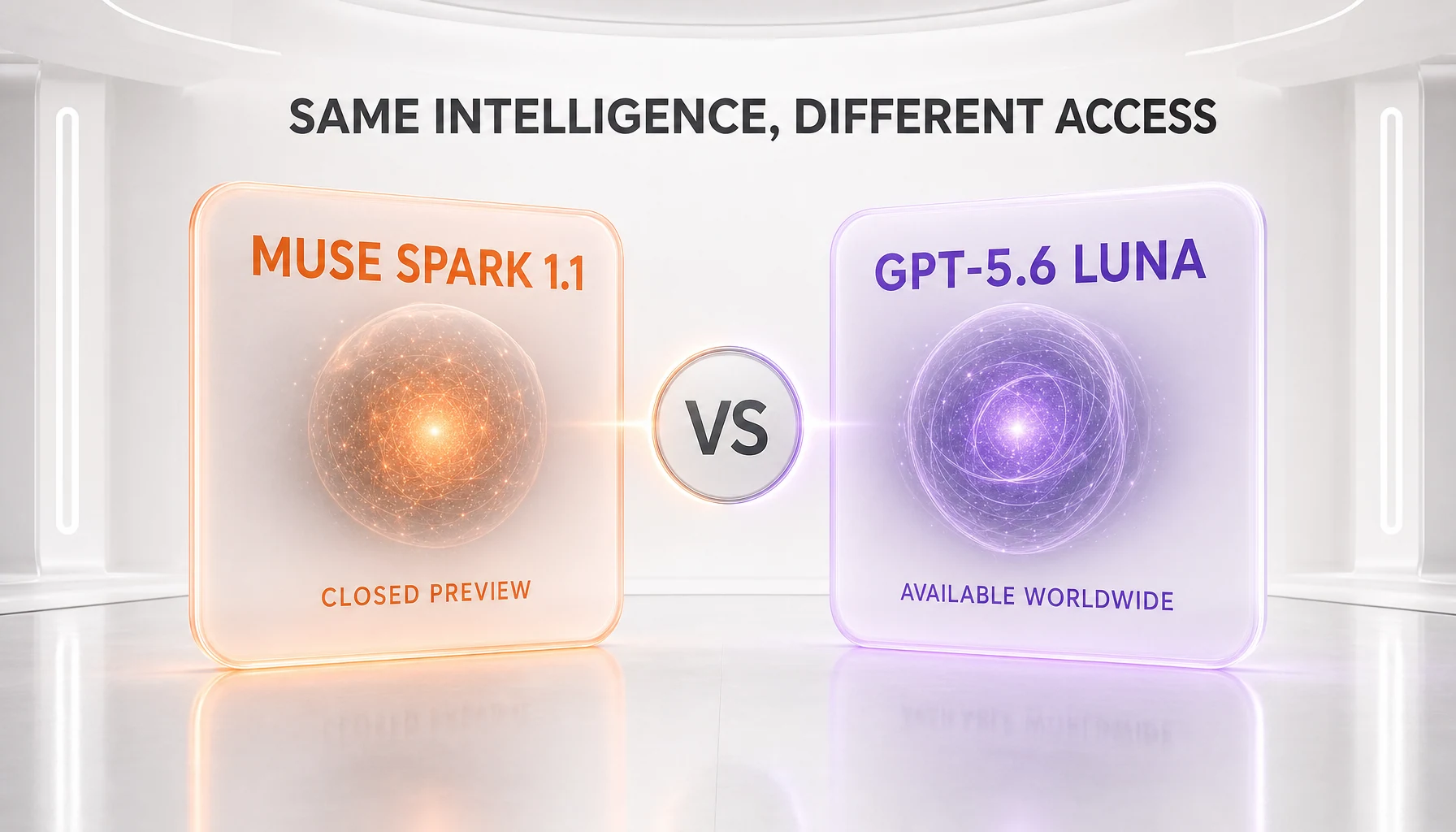
Muse Spark 1.1 and GPT-5.6 Luna both score 51 on intelligence. After OpenAI's price cut Luna is cheaper on input and output, and available worldwide.
Feature Comparison
| Feature | Muse Spark 1.1 | GPT-5.6 Luna |
|---|---|---|
| Availability | Closed preview, United States-only waitlist | General availability worldwide (OpenAI API) |
| Input price per million tokens | $1.25 | $0.20 |
| Output price per million tokens | $4.25 | $1.20 |
| Artificial Analysis Intelligence Index (v4.1) | 51 | 51 |
| Context window | 1,000,000 tokens | 1,050,000 tokens |
| Model weights | Closed | Closed (proprietary API) |
| Maker | Meta Superintelligence Labs | OpenAI |
Pricing Comparison
Muse Spark 1.1
GPT-5.6 Luna
Detailed Comparison
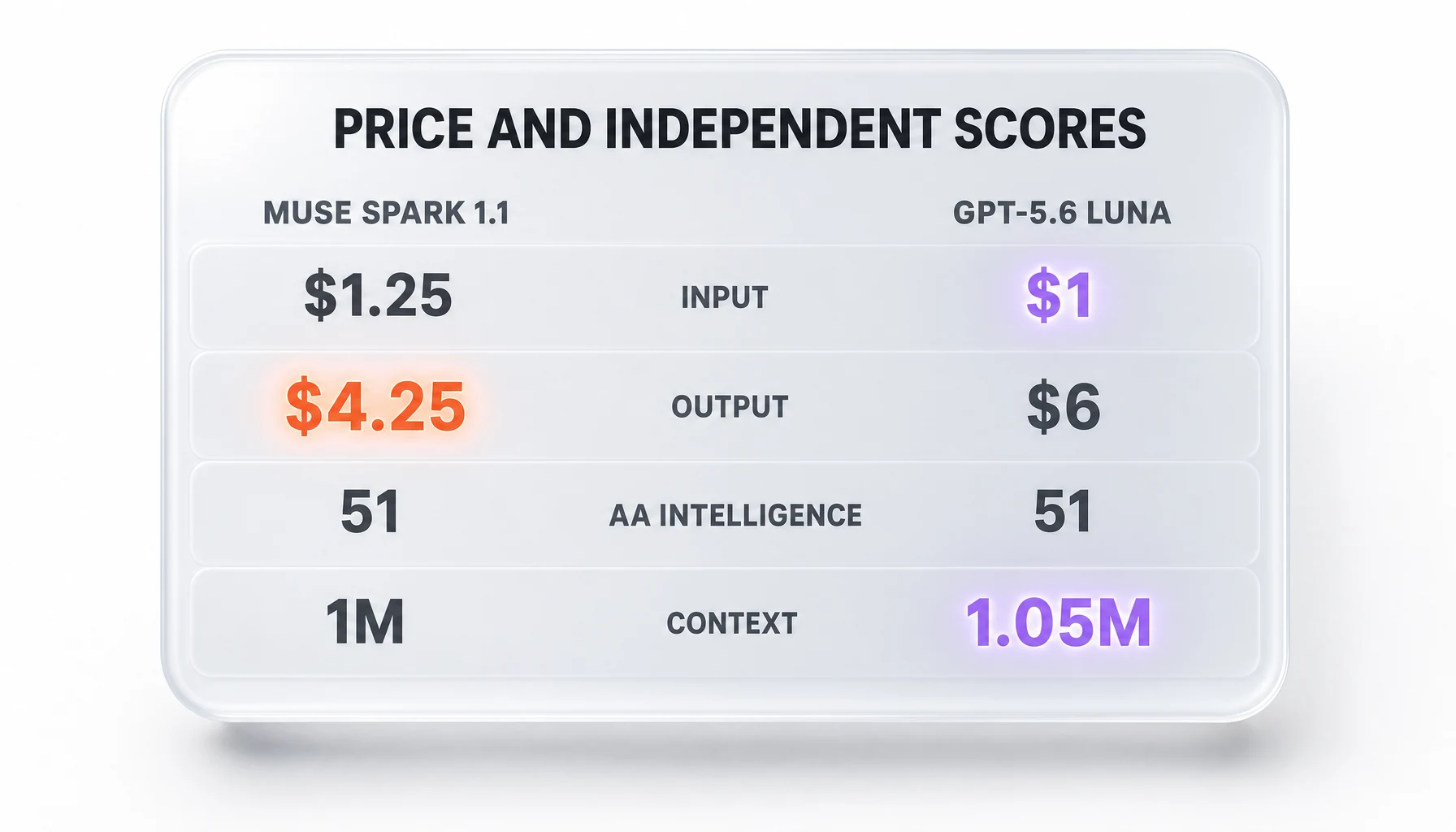
Muse Spark 1.1 and GPT-5.6 Luna both score 51 on the Artificial Analysis Intelligence Index (v4.1), so measured intelligence is a genuine tie. After OpenAI's July 30, 2026 price cut, GPT-5.6 Luna is cheaper on input at $0.20 per million tokens versus $1.25 and cheaper on output at $1.20 versus $4.25, carries a slightly larger context of 1.05 million tokens versus 1 million, and is generally available worldwide. Muse Spark 1.1 ships only as a closed, United States-only preview. With intelligence level and Luna now cheaper on both price lines, access and cost point the same way, and Luna wins.
Quick Verdict
Same intelligence, different access — and access decides it. This is the rare comparison where the two models are tied on the number most people reach for first. Muse Spark 1.1 from Meta Superintelligence Labs and GPT-5.6 Luna from OpenAI both post a 51 on the Artificial Analysis Intelligence Index (v4.1). When the intelligence line is flat, the duel moves to the things that usually get treated as footnotes: the exact price of input tokens versus output tokens, the size of the context window, and, most decisively, whether you can actually run the model at all. We ran GPT-5.6 Luna hands-on through the OpenAI API and compared it against the public, independent record for Muse Spark 1.1, which is still a closed preview.
- 🏆 Muse Spark 1.1 wins for: teams already inside the United States preview who want Meta's multimodal, agentic model — it no longer wins on price, having lost its output-rate advantage on July 30, 2026.
- 🏆 GPT-5.6 Luna wins for: availability today anywhere in the world, cheaper input tokens, retrieval-heavy and long-context pipelines, and any team that needs to ship on a model it can reliably access.
- 💰 Cheaper on both lines: GPT-5.6 Luna, since OpenAI's July 30, 2026 price cut — $0.20 versus $1.25 on input and $1.20 versus $4.25 on output. Your token mix no longer changes the answer.
- ⚡ Available right now: GPT-5.6 Luna, in general availability through the OpenAI API worldwide. Muse Spark 1.1 is a closed, United States-only preview behind a waitlist.
Muse Spark 1.1 vs GPT-5.6 Luna: Overview
Both models sit in the same commercial niche: fast, low-cost, high-context models built for high-volume production work rather than for topping a leaderboard. They arrive at that niche from opposite directions. Muse Spark 1.1 is Meta Superintelligence Labs pushing a closed, agentic, multimodal model into a controlled preview. GPT-5.6 Luna is OpenAI's cheapest, most economical tier of the GPT-5.6 family, already shipping to everyone. The fact that they land on the same independent intelligence score makes the comparison unusually clean: for once, you can hold intelligence constant and look at everything else.
What Is Muse Spark 1.1?
Muse Spark 1.1 is a closed-weights model released by Meta Superintelligence Labs on July 9, 2026. It is multimodal and agentic, built to handle tool use and long, structured tasks, and it ships with a 1,000,000-token context window. On the Artificial Analysis Intelligence Index (v4.1) it scores 51. Artificial Analysis also reports component results for it, including 58 percent on SciCode and 45 percent on Humanity's Last Exam. Its API pricing is $1.25 per million input tokens and $4.25 per million output tokens — a low output rate when it launched, though OpenAI's July 30, 2026 cut has since taken Luna below it. The catch is availability: at the time of writing, Muse Spark 1.1 is a preview limited to the United States and gated behind a waitlist, so most teams cannot yet build on it. You can read our full breakdown in the Muse Spark 1.1 review.
What Is GPT-5.6 Luna?
GPT-5.6 Luna is the fastest and most economical tier in OpenAI's GPT-5.6 family, positioned for high-volume, routine work rather than frontier reasoning. It scores 51 on the Artificial Analysis Intelligence Index (v4.1) — the same figure as Muse Spark 1.1. Luna's API pricing is $0.20 per million input tokens and $1.20 per million output tokens after OpenAI's July 30, 2026 cut, and it carries a 1,050,000-token context window, marginally larger than Muse Spark 1.1's. Its defining advantage is distribution: Luna is generally available through the OpenAI API worldwide, with no waitlist and no regional gate. Our GPT-5.6 Luna review covers the wider family context and where Luna sits against its own siblings.
Feature Comparison: Muse Spark 1.1 vs GPT-5.6 Luna
The table below lines up the two models on the facts that actually differ. Note that the intelligence row is a tie, not a rounding-off of a small gap: both models are measured at 51 on the same independent index, in the same version.
| Feature | Muse Spark 1.1 | GPT-5.6 Luna | Winner |
|---|---|---|---|
| Availability | Closed preview, United States-only waitlist | General availability worldwide (OpenAI API) | GPT-5.6 Luna |
| Input price per million tokens | $1.25 | $0.20 | GPT-5.6 Luna |
| Output price per million tokens | $4.25 | $1.20 | GPT-5.6 Luna |
| Artificial Analysis Intelligence Index (v4.1) | 51 | 51 | Tie |
| Context window | 1,000,000 tokens | 1,050,000 tokens | GPT-5.6 Luna |
| Model weights | Closed | Closed (proprietary API) | Tie |
| Maker | Meta Superintelligence Labs | OpenAI | Tie |
Tally: GPT-5.6 Luna takes four rows (availability, input price, output price, context), Muse Spark 1.1 takes none, and three rows are ties (intelligence, weights, maker). Until July 30, 2026 Muse Spark 1.1 held the output-price row, which was the one line that could flip the economics for a generation-heavy workload; OpenAI's price cut took it away, so the pricing section below now reinforces the tally instead of complicating it.
The Intelligence Tie, Explained
It is worth being precise about what "tied on intelligence" means here, because it is easy to misread. The 51 for each model comes from the Artificial Analysis Intelligence Index at version 4.1 — the same benchmark suite, the same version, run by the same independent evaluator. That is a real equality, not a marketing rounding of a two-point gap. We are not aware of any independent number that separates the two models on aggregate intelligence at the time of writing.
What a matching aggregate score does not tell you is that the two models are interchangeable on every task. Artificial Analysis reports component results for Muse Spark 1.1, including 58 percent on SciCode and 45 percent on Humanity's Last Exam, which give a sense of its coding and hard-reasoning profile. We deliberately do not line those up against a single Luna number, because pairing one independent component score against a different one invites a false-precision comparison. The honest reading is narrower and more useful: on the headline independent measure of aggregate intelligence, these two models are level, so you should choose on the things that are not level — price mix, context, and access.
Pricing — Muse Spark 1.1 vs GPT-5.6 Luna in 2026
Muse Spark 1.1 uses flat, per-token API pricing across its 1,000,000-token context. GPT-5.6 Luna does not: OpenAI bills prompts above 272,000 input tokens at twice the input rate and 1.5 times the output rate, applied to the entire request rather than the excess alone, which puts Luna at $0.40 input and $1.80 output on long-context calls. Even surcharged, Luna stays below Muse Spark 1.1 on both lines. The two used to split the price lines — Luna cheaper to feed, Muse Spark 1.1 cheaper to generate — and that split was the whole pricing story. OpenAI's July 30, 2026 price cut ended it: Luna now undercuts Muse Spark 1.1 on input and output alike, so the "cheaper" label no longer depends on how many tokens you read in versus write out.
Muse Spark 1.1 Pricing
| Mode | Input | Output | Notes |
|---|---|---|---|
| Standard | $1.25 per million tokens | $4.25 per million tokens | Flat rate, 1,000,000-token context |
Muse Spark 1.1's output rate of $4.25 per million tokens was its standout number, about 29 percent under Luna's old $6. Since OpenAI's July 30, 2026 cut took Luna to $1.20, that advantage is gone: Muse Spark 1.1 now costs roughly 3.5 times more per output token. It is also higher on input, and gated by the access restriction we cover below.
GPT-5.6 Luna Pricing
| Mode | Input | Output | Notes |
|---|---|---|---|
| Standard | $0.20 per million tokens | $1.20 per million tokens | Prompts up to 272,000 input tokens |
| Long context (over 272K input) | $0.40 per million tokens | $1.80 per million tokens | 2x input, 1.5x output on the whole request |
Luna's $0.20 per million input tokens is the lowest input rate in this matchup, about 84 percent under Muse Spark 1.1, and its $1.20 output rate is the lowest here too. That makes Luna the cheaper pick for every workload shape — retrieval-augmented generation, long-document analysis, classification, and generation-dominated pipelines alike.
Blended Cost — Where Each Model Wins
The two models used to invert the price lines, which made workload shape the deciding factor. Since OpenAI's July 30, 2026 cut they no longer do. The table below shows the three common token mixes, holding volume constant.
| Workload shape | Muse Spark 1.1 | GPT-5.6 Luna | Cheaper |
|---|---|---|---|
| Input-heavy (read a lot, write a little) | $1.25 input | $0.20 input, lowest in class | GPT-5.6 Luna |
| Balanced read and write | Higher on both lines | Lower on both lines | GPT-5.6 Luna |
| Output-heavy (write a lot, read a little) | $4.25 output | $1.20 output, cheapest here | GPT-5.6 Luna |
Verdict on pricing: there is now a single cheaper model, and it is GPT-5.6 Luna, on every workload shape. It reads for about 84 percent less and writes for about 72 percent less than Muse Spark 1.1. Before July 30, 2026 this section ended by telling you to decide on access rather than price, because the price lines cancelled out; they no longer cancel out, and price and access now point at the same model.
How We Compared Them (and What We Could Not Test)
Methodology and the Access Asymmetry
We owe you a plain disclosure, because it shapes how much weight to put on each half of this comparison. We ran GPT-5.6 Luna hands-on through the OpenAI API: it is generally available, so we could put it through real prompts and observe its behavior directly. Muse Spark 1.1 is a different situation. At the time of writing it is a closed preview, limited to the United States and gated behind a waitlist, so our read on it is research-led rather than hands-on. That read is built from Meta's published model documentation and from the independent benchmarks that Artificial Analysis has run on it, not from our own sustained production use.
That asymmetry is not a footnote — it is arguably the headline. When two models are tied on measured intelligence, the practical question is not "which is smarter" but "which can I actually deploy," and only one of them answers that question with a yes for teams outside a narrow preview. We have kept every factual claim about Muse Spark 1.1 anchored to its published numbers and avoided any experiential claim we could not stand behind.
Measured Intelligence: A Genuine Tie
On aggregate intelligence, the independent record puts these two models level at 51 on the Artificial Analysis Intelligence Index (v4.1). Nothing in Luna's hands-on behavior contradicts that placement for the kind of routine, high-volume work both models target — it is quick, coherent, and comfortable with long context. We cannot report the same first-hand impression for Muse Spark 1.1, but its independent score sits exactly where Luna's does, and its published component results (58 percent on SciCode, 45 percent on Humanity's Last Exam, per Artificial Analysis) suggest a capable, coding-and-reasoning-oriented profile. Treat intelligence as a wash and spend your decision budget elsewhere.
Price Behavior: Input vs Output
This is the most consequential difference after access, and it moved on July 30, 2026. The two models used to invert the price lines: Luna read for less and wrote for more. Now Luna reads for less ($0.20 versus $1.25 per million input tokens) and also writes for less ($1.20 versus $4.25 per million output tokens). In practice that means your architecture no longer decides which model is cheaper — summarization, extraction, drafting, and code generation all run cheaper on Luna. Your input-to-output ratio still decides the size of the bill, but not its direction.
Context Window: A Narrow Luna Edge
Both models are firmly in million-token territory, so for the overwhelming majority of prompts this row is a non-issue. Luna's 1,050,000-token window is 50,000 tokens larger than Muse Spark 1.1's 1,000,000, a roughly 5 percent edge. That margin only matters at the extreme tail — packing an entire large codebase or a very long document set into a single call — and even then it is a small buffer, not a category difference. We score it a narrow Luna win because more headroom is strictly better, but it should rarely be a deciding factor on its own.
Access: The Real Divider
Everything above is decided by the fact underneath it: you can call GPT-5.6 Luna today, from anywhere, through the OpenAI API, and you probably cannot call Muse Spark 1.1 at all unless you are inside its United States preview. A model you cannot access has an effective cost of infinity, no matter how good its output rate looks. This is why, despite the price lines splitting and the intelligence scores tying, our overall lean is toward Luna: availability is not a feature you can bolt on later, and for most readers it is the difference between shipping and waiting.
What Would Change This Verdict
We hold verdicts loosely when a preview is involved, and this one has a clear trigger. If Meta widens Muse Spark 1.1 beyond its United States preview to general, worldwide availability, the access advantage that carries Luna's win evaporates, and the comparison collapses back onto price and context — where Luna now leads on both price lines, so Muse Spark 1.1 would need a rate cut of its own to compete. Two other things could move it. Pricing has already moved once here — OpenAI cut Luna's rates on July 30, 2026 and reversed the output-price row — so treat it as the most volatile variable on this page. And if a future revision of the Artificial Analysis Intelligence Index separates the two models — remember that a score only means something paired with its version — the intelligence tie that frames this entire piece would no longer hold. Until any of that happens, the read stands: tied on measured intelligence, split on price, and decided by who you can actually deploy today.
Winner per Category
🏆 Best Overall (for this niche): GPT-5.6 Luna, narrowly
With intelligence tied, Luna wins the overall call on availability, a cheaper rate on both price lines, and a marginally larger context. Until July 30, 2026 this was a narrow lean resting mainly on deployability; OpenAI's price cut turned it into a clear win, because the one row Muse Spark 1.1 held — output price — now belongs to Luna as well.
Best for Output-Heavy Generation: GPT-5.6 Luna
For workloads that write far more than they read — long-form content, code generation, synthetic data — Luna's $1.20 per million output tokens is the best rate in this matchup, roughly 72 percent under Muse Spark 1.1's $4.25. This category belonged to Muse Spark 1.1 until OpenAI's July 30, 2026 price cut; it does not any more.
Best for Input-Heavy and RAG Workloads: GPT-5.6 Luna
Retrieval-augmented generation, long-document analysis, and classification all push large prompts in and short answers out. Luna's $0.20 per million input tokens is the cheapest input rate here — about 84 percent under Muse Spark 1.1 — so input-dominated pipelines run far cheaper on it, on top of being deployable today.
Best for Availability Today: GPT-5.6 Luna
This one is not close. Luna is generally available worldwide through the OpenAI API. Muse Spark 1.1 is a United States-only preview behind a waitlist. If you need to build now, and especially if you are outside the United States, Luna is the only one of the two you can actually use.
Best for the Longest Context: GPT-5.6 Luna
Luna's 1,050,000-token window edges Muse Spark 1.1's 1,000,000. Both are enormous, so this matters only at the extreme tail, but when it does, the extra 50,000 tokens of headroom go to Luna.
Best for Raw Intelligence: A Tie
Neither model wins this. Both sit at 51 on the Artificial Analysis Intelligence Index (v4.1). If your decision is driven purely by aggregate intelligence, this comparison gives you no reason to prefer one over the other — which is precisely why the other rows carry the verdict.
Pros and Cons
Muse Spark 1.1 Pros and Cons
What stands out about Muse Spark 1.1
- Multimodal and agentic from a major lab. Meta builds it for tool use and structured, multi-step tasks rather than for leaderboard placement.
- Tied on independent intelligence. A 51 on the Artificial Analysis Intelligence Index (v4.1) puts it exactly level with Luna, so you give up nothing on measured aggregate capability.
- Multimodal and agentic by design. Meta positions it for tool use and structured, multi-step tasks, with a full 1,000,000-token context to work in.
- Backed by Meta Superintelligence Labs. It carries the research weight and roadmap of a major lab, which matters for longer-term bets if the preview opens up.
Where Muse Spark 1.1 falls short
- Closed, United States-only preview. Most teams cannot use it at all yet, and teams outside the United States are excluded entirely by the current gate.
- Higher on both price lines. At $1.25 input and $4.25 output per million tokens it costs about 6.25 times more to feed and about 3.5 times more to generate than Luna, since OpenAI's July 30, 2026 cut.
- Slightly smaller context. Its 1,000,000-token window is marginally under Luna's, a minor but real disadvantage at the extreme tail.
- Closed weights. There is no self-hosting path, so you are tied to Meta's endpoint and terms once the preview widens.
GPT-5.6 Luna Pros and Cons
What stands out about GPT-5.6 Luna
- Available worldwide right now. General availability through the OpenAI API, with no waitlist and no regional gate, means you can ship on it today.
- Cheapest on both price lines. At $0.20 input and $1.20 output per million tokens it beats Muse Spark 1.1 by about 84 percent and 72 percent respectively.
- Largest context in the matchup. Its 1,050,000-token window gives a little extra headroom over Muse Spark 1.1 for the biggest prompts.
- Tied on independent intelligence. A 51 on the Artificial Analysis Intelligence Index (v4.1) matches Muse Spark 1.1, so its availability advantage does not come at the cost of measured capability.
Where GPT-5.6 Luna falls short
- Economy-tier ceiling on hard reasoning. Luna is tuned for volume, so genuinely difficult reasoning belongs a tier up rather than here.
- Economy tier, not a frontier model. Luna is OpenAI's fast, cheap tier; if you need peak reasoning you would step up within the GPT-5.6 family, not reach for Luna.
- Closed and proprietary. Like Muse Spark 1.1, there is no self-hosting option, so you are on OpenAI's endpoint and terms.
- Rate card is freshly cut and unproven. The $0.20 and $1.20 rates date from July 30, 2026, so there is no long track record of OpenAI holding them.
When to Pick Each Model
When to Pick Muse Spark 1.1
Pick Muse Spark 1.1 if you are inside its United States preview and specifically want a multimodal, agentic model from Meta, and you are comfortable betting on a preview that may widen. Note that the cost case for it has gone: its $4.25 per million output tokens was the cheapest here until OpenAI's July 30, 2026 cut took Luna to $1.20. What you must not do is plan a production launch around a model you cannot yet reliably access; treat Muse Spark 1.1 as a strong option for the day the gate opens, and for output-heavy teams already inside it.
When to Pick GPT-5.6 Luna
Pick GPT-5.6 Luna if you need to ship now, if you are anywhere outside the United States preview, or if your workload reads more than it writes. Its $0.20 per million input tokens and $1.20 output make it the cost winner on every workload shape, and its worldwide general availability makes it the only deployable choice of the two for most teams. For a startup that needs a cheap, capable, long-context model on tap this week, Luna is the safe default — you can revisit Muse Spark 1.1 once it opens up, though it would need a price cut of its own to compete on cost. If you are weighing this against other budget tiers, our roundup of the best AI coding tools of 2026 puts both in wider context, and our GPT-5.6 Luna vs Claude Sonnet 5 comparison covers Luna against a different rival. For how Luna sits inside its own lineup, see GPT-5.6 Sol vs GPT-5.6 Terra.
Frequently Asked Questions
Is Muse Spark 1.1 better than GPT-5.6 Luna in 2026?
Neither is clearly better overall, because they tie on measured intelligence at 51 on the Artificial Analysis Intelligence Index (v4.1). GPT-5.6 Luna wins the practical call for most teams because it is generally available worldwide, cheaper on input at $0.20 per million tokens and on output at $1.20, and carries a marginally larger context. Muse Spark 1.1 held the output-price advantage at $4.25 per million tokens until OpenAI's July 30, 2026 cut, and it remains a closed, United States-only preview. With price and access both favoring Luna, it is the clearer pick.
Do Muse Spark 1.1 and GPT-5.6 Luna have the same intelligence?
On the headline independent measure, yes. Both models score 51 on the Artificial Analysis Intelligence Index at version 4.1, run by the same independent evaluator. That is a genuine tie on aggregate intelligence, not a rounding of a small gap. A matching aggregate score does not guarantee identical results on every task, but it does mean you should not choose between them on intelligence alone.
Which is cheaper, Muse Spark 1.1 or GPT-5.6 Luna?
GPT-5.6 Luna, on both lines, since OpenAI's July 30, 2026 price cut. Luna is cheaper on input at $0.20 per million tokens versus $1.25 for Muse Spark 1.1, and cheaper on output at $1.20 versus $4.25. The two models used to invert the price lines, which made your token mix the deciding factor; they no longer do, so retrieval, extraction, and long-form generation all run cheaper on Luna.
Can I use Muse Spark 1.1 right now?
Only if you are inside its preview. At the time of writing, Muse Spark 1.1 is a closed preview limited to the United States and gated behind a waitlist, so most teams cannot access it yet, and teams outside the United States are excluded by the current gate. GPT-5.6 Luna, by contrast, is generally available worldwide through the OpenAI API with no waitlist.
What is the context window of Muse Spark 1.1 versus GPT-5.6 Luna?
Muse Spark 1.1 has a 1,000,000-token context window. GPT-5.6 Luna has a 1,050,000-token window, about 50,000 tokens larger. Both are firmly in million-token territory, so the difference matters only for the very largest prompts, such as packing an entire large codebase or document set into a single call. For everyday work the two are effectively equivalent on context.
Which model is better for output-heavy generation?
GPT-5.6 Luna, on price. Its output rate of $1.20 per million tokens is about 72 percent cheaper than Muse Spark 1.1's $4.25 per million tokens, so any workload that writes far more than it reads — long-form drafting, code generation, synthetic data — costs less on Luna at volume. Muse Spark 1.1 held this category until OpenAI's July 30, 2026 price cut reversed it.
Which model is better for input-heavy or RAG workloads?
GPT-5.6 Luna. Retrieval-augmented generation, long-document analysis, and classification push large prompts in and short answers out, so input price dominates the bill. Luna's $0.20 per million input tokens is the cheapest input rate in this matchup, about 84 percent under Muse Spark 1.1, and Luna is also available worldwide today, which makes it the practical choice for these pipelines.
Is Muse Spark 1.1 open source?
No. Muse Spark 1.1 ships with closed weights, so there is no self-hosting path; you access it through Meta's endpoint. GPT-5.6 Luna is also closed and proprietary, available only through the OpenAI API. Neither model in this comparison is open-weight, so if self-hosting is a requirement, you would need to look outside this pairing.
Who makes Muse Spark 1.1 and GPT-5.6 Luna?
Muse Spark 1.1 is made by Meta Superintelligence Labs and was released on July 9, 2026. GPT-5.6 Luna is made by OpenAI as the fastest, most economical tier of its GPT-5.6 family. Both are commercial, closed models aimed at high-volume, low-cost production work rather than at topping frontier leaderboards.
Does the Artificial Analysis Intelligence Index of 51 mean they perform identically?
No. A tied aggregate score of 51 means the two models are level on the overall independent measure of intelligence, but the index is a composite. Individual tasks — coding, hard reasoning, long-context recall — can still favor one model or the other. The tie is a strong signal that neither is broadly smarter, so you should decide on price mix, context, and access rather than expecting identical behavior on every prompt.
Which model should a startup outside the United States choose?
GPT-5.6 Luna, without much debate. Muse Spark 1.1's preview is limited to the United States, so a startup elsewhere cannot access it at the time of writing. Luna is generally available worldwide through the OpenAI API, ties Muse Spark 1.1 on measured intelligence, and is cheaper on input, which suits most early-stage workloads. Revisit Muse Spark 1.1 only if and when it opens up in your region.
What is the final verdict on Muse Spark 1.1 versus GPT-5.6 Luna?
With intelligence tied at 51 and Luna now cheaper on both price lines, GPT-5.6 Luna takes the overall win on availability, cost, and a slightly larger context. Muse Spark 1.1 was the better value for output-heavy teams inside its United States preview until OpenAI's July 30, 2026 price cut removed its output-rate advantage. For everyone else — especially teams outside the United States — Luna is the deployable, cheaper default today.
Final Verdict: Same Intelligence, Luna Wins on Access
This comparison is a useful reminder that the first number people quote — an intelligence score — is often the one that decides the least. Muse Spark 1.1 and GPT-5.6 Luna both measure 51 on the Artificial Analysis Intelligence Index (v4.1), so on the metric that usually settles these arguments, they are level. The real separation is elsewhere: since OpenAI's July 30, 2026 price cut Luna reads for less and writes for less, and only one of the two is available to you today. Price and availability now point at the same model, so GPT-5.6 Luna takes the overall verdict for most readers — and the carve-out that used to exist for output-heavy teams inside Muse Spark 1.1's preview no longer holds on cost.
- Measured intelligence: tie — both at 51 on the Artificial Analysis Intelligence Index (v4.1).
- Input price: GPT-5.6 Luna, at $0.20 per million tokens versus $1.25.
- Output price: GPT-5.6 Luna, at $1.20 per million tokens versus $4.25.
- Context window: GPT-5.6 Luna, at 1,050,000 tokens versus 1,000,000.
- Availability: GPT-5.6 Luna, generally available worldwide versus a United States-only preview.
- Overall: GPT-5.6 Luna, on access and on both price lines since July 30, 2026.
Final word: when two models tie on intelligence, buy the one you can actually run — and here that is also the cheaper one. For most teams that is GPT-5.6 Luna today. Keep Muse Spark 1.1 on your shortlist for the day its preview opens, but note it would need a rate cut of its own to make this a close call again.
Sources and references
Every figure on this page is attributed to whoever produced it. Vendor documentation and independent measurement are listed separately and never merged into a single ranking.
- OpenAI — API pricing (per-token, cached and batch rates)
- Artificial Analysis — GPT-5.6 Luna (independent index score)
- Artificial Analysis — Muse Spark 1.1 (independent index score)
- Artificial Analysis — Model leaderboard (Intelligence Index scores and cost per task across configurations)
Our Verdict
Muse Spark 1.1 and GPT-5.6 Luna tie at 51 on the Artificial Analysis Intelligence Index (v4.1), so intelligence is a wash. The split now comes down to price and access, and both point the same way. After OpenAI's July 30, 2026 price cut, GPT-5.6 Luna is cheaper on input at $0.20 per million tokens against $1.25 — about 6.25 times less — and cheaper on output at $1.20 against $4.25, roughly 72 percent less. It also carries a slightly larger 1,050,000-token context and is generally available worldwide, while Muse Spark 1.1 ships only as a closed, United States-only preview. GPT-5.6 Luna takes the overall win outright: it is no longer a trade between input price and output price, because Luna now wins both.
Choose Muse Spark 1.1
Meta Superintelligence Labs' closed agentic model: Artificial Analysis Intelligence Index 51 and a 1,000,000-token context, at $1.25 input and $4.25 output per million tokens — about a quarter of frontier input rates.
Try Muse Spark 1.1 →Choose GPT-5.6 Luna
OpenAI's fastest, most economical GPT-5.6 tier — $0.20 per million input tokens, sub-second warm latency, and a 1.05M-token context for high-volume routine work.
Try GPT-5.6 Luna →Frequently Asked Questions
Is Muse Spark 1.1 better than GPT-5.6 Luna?
Muse Spark 1.1 and GPT-5.6 Luna tie at 51 on the Artificial Analysis Intelligence Index (v4.1), so intelligence is a wash. The split now comes down to price and access, and both point the same way. After OpenAI's July 30, 2026 price cut, GPT-5.6 Luna is cheaper on input at $0.20 per million tokens against $1.25 — about 6.25 times less — and cheaper on output at $1.20 against $4.25, roughly 72 percent less. It also carries a slightly larger 1,050,000-token context and is generally available worldwide, while Muse Spark 1.1 ships only as a closed, United States-only preview. GPT-5.6 Luna takes the overall win outright: it is no longer a trade between input price and output price, because Luna now wins both.
Which is cheaper, Muse Spark 1.1 or GPT-5.6 Luna?
Muse Spark 1.1 starts at $1.25 in / $4.25 out per M tokens. GPT-5.6 Luna starts at $0.2 in / $1.2 out per M tokens. Check the pricing comparison section above for a full breakdown.
What are the main differences between Muse Spark 1.1 and GPT-5.6 Luna?
The key differences span across 7 features we compared. For Availability, Muse Spark 1.1 offers Closed preview, United States-only waitlist while GPT-5.6 Luna offers General availability worldwide (OpenAI API). For Input price per million tokens, Muse Spark 1.1 offers $1.25 while GPT-5.6 Luna offers $0.20. For Output price per million tokens, Muse Spark 1.1 offers $4.25 while GPT-5.6 Luna offers $1.20. See the full feature comparison table above for all details.