Muse Spark 1.1 vs GLM-5.2: Same Intelligence Score, Opposite Access (2026)
Muse Spark 1.1 vs GLM-5.2 both score 51 on Artificial Analysis and cost within cents. We lean GLM-5.2 — open MIT weights and global access break the tie.
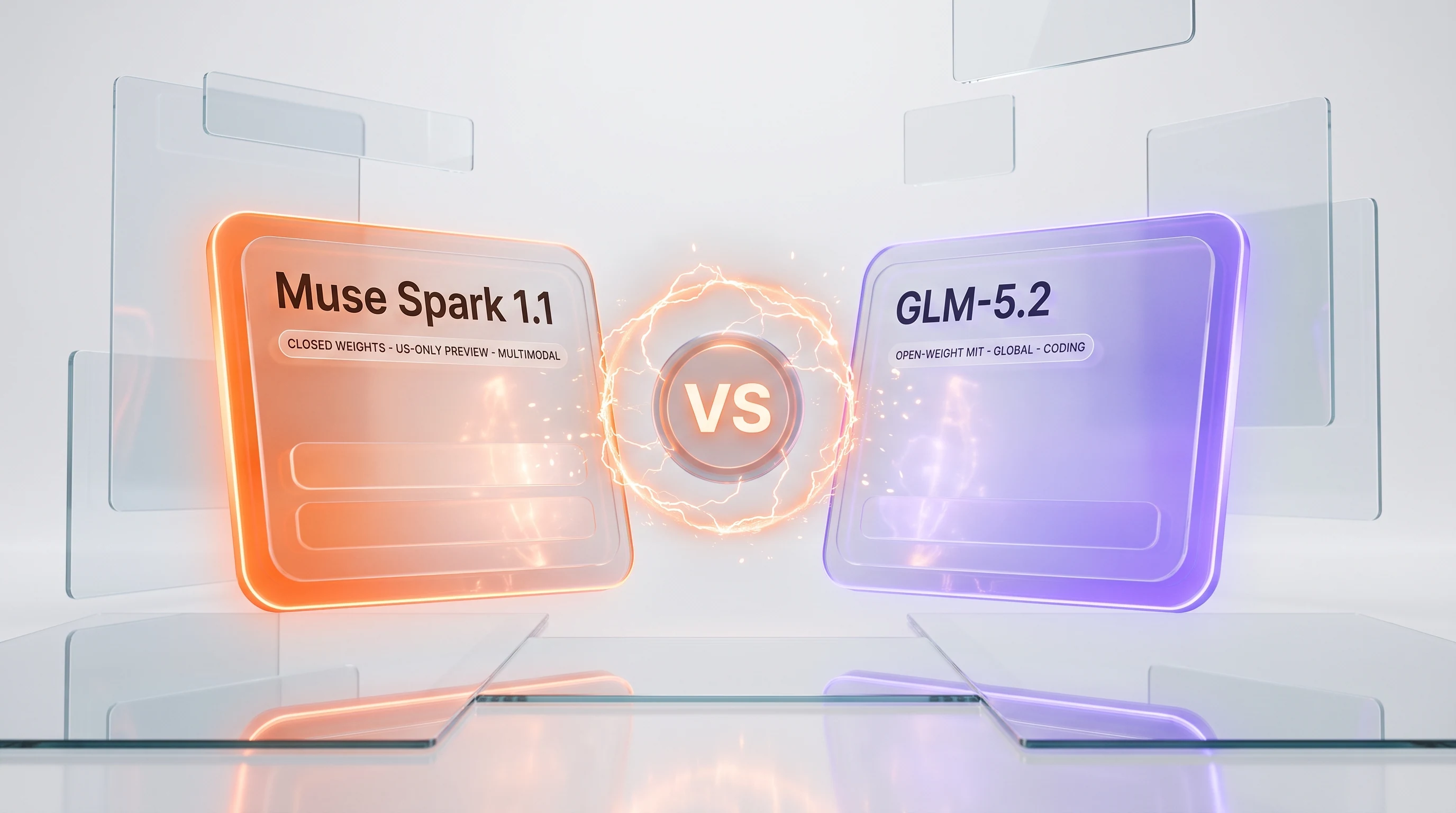
Feature Comparison
| Feature | Muse Spark 1.1 | GLM-5.2 |
|---|---|---|
| Model type | Closed weights, API preview only | Open-weight MoE, MIT license |
| Weights availability | Not released (closed) | Downloadable on Hugging Face (MIT) |
| Access | US-only preview waitlist | Global API plus self-host anywhere |
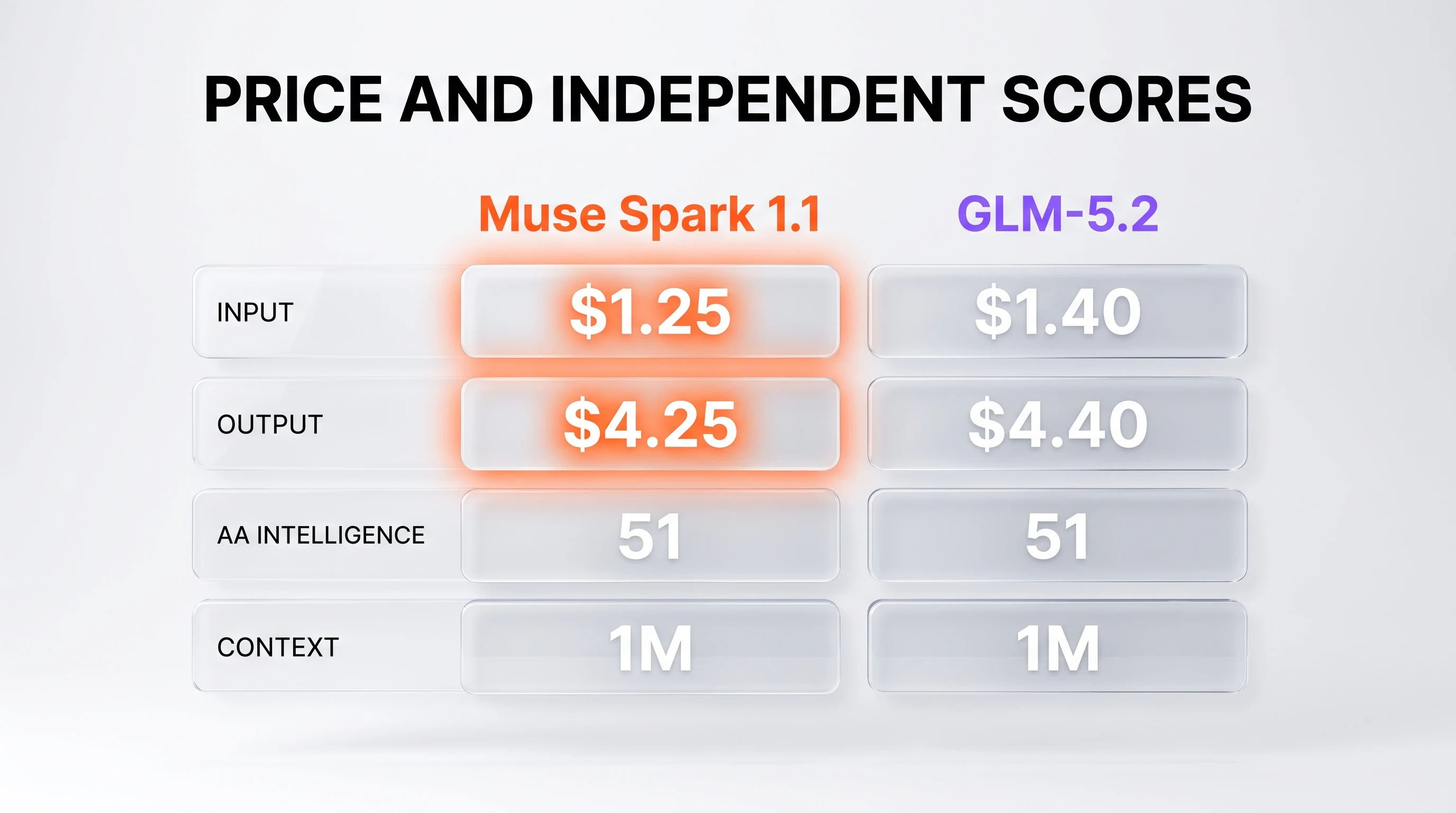
| API input price (per million tokens) | $1.25 (verified) | $1.40 (verified) |
| API output price (per million tokens) | $4.25 (verified) | $4.40 (verified) |
| Flat subscription option | None (metered preview only) | GLM Coding Plan from around $18 per month |
| AA Intelligence Index (v4.1, independent) | 51 | 51 |
| Context window | 1,000,000 tokens | 1,000,000 tokens |
| Max output tokens | Not published | 131,072 tokens |
| Independent AA sub-score coverage | SciCode 58%, Humanity’s Last Exam 45% (Artificial Analysis) | Not published at this granularity |
| Coding specialization | General multimodal and agentic | Coding-specialized model |
| SWE-bench Pro (coding) | Not reported | About 62% (Zhipu self-reported, unverified) |
| Multimodal input | Yes | Text and code focus |
| Fine-tuning | Not supported (closed) | Supported (self-host MIT weights) |
| Data residency | Meta, US-hosted | Production API in China; self-host to control |
| Availability date | July 9, 2026 | June 13, 2026 |
Pricing Comparison
Muse Spark 1.1
GLM-5.2
Detailed Comparison
Muse Spark 1.1 and GLM-5.2 land in the rarest spot in a model comparison: a real tie on measured intelligence. Both score 51 on the independent Artificial Analysis v4.1 Intelligence Index, and their token prices sit within cents of each other — Muse Spark 1.1 at $1.25 per million input tokens and $4.25 per million output, GLM-5.2 at $1.40 and $4.40. We ran GLM-5.2 hands-on through its open API and studied Muse Spark 1.1 through Artificial Analysis benchmarks and Meta's preview documentation, because Muse is a closed, US-only preview we could not fully test. When intelligence and price both come out even, what actually decides is access. GLM-5.2 ships open-weight under the MIT license, runs globally, and can be self-hosted and fine-tuned; Muse Spark 1.1 is closed and gated to a United States waitlist. We lean GLM-5.2 overall. Pick Muse Spark 1.1 if you are in the US and want multimodal, agentic work at a marginally lower token price; pick GLM-5.2 for openness, global access, self-hosting, and cheaper heavy-usage coding.
Quick verdict: a near-tie that access breaks
This is not a comparison where one model is smarter or dramatically cheaper. On the only independent yardstick that covers both, the Artificial Analysis v4.1 Intelligence Index, Muse Spark 1.1 and GLM-5.2 both score 51. On price, Muse Spark 1.1 is about 5 percent cheaper per token. Everything meaningful after that is about how you can get the model and what you can do with it once you have it.
Pick Muse Spark 1.1 if you are inside the United States, your work is multimodal or agentic, and you want the lowest metered token price by a small margin. It is the more clearly multimodal model, from Meta Superintelligence Labs, and it undercuts GLM-5.2 on both input and output token rates.
Pick GLM-5.2 if you want open MIT weights, global availability, self-hosting, fine-tuning, a cheap flat coding subscription, or a coding-specialized model — and especially if you are outside the US, where Muse Spark 1.1's closed preview may simply be unavailable. At equal intelligence and near-equal price, that bundle of freedoms is why we lean GLM-5.2 overall.
Muse Spark 1.1 at a glance
Muse Spark 1.1 is Meta Superintelligence Labs' entry in the mid-2026 frontier race, launched on July 9, 2026. It is a multimodal, agentic model with a one-million-token context window, priced at $1.25 per million input tokens and $4.25 per million output tokens. On the independent Artificial Analysis v4.1 Intelligence Index it scores 51, with additional Artificial Analysis sub-scores of 58 percent on SciCode and 45 percent on Humanity's Last Exam.
The defining fact about Muse Spark 1.1 is not a benchmark, it is its availability. The model is closed — Meta has not released weights — and access is restricted to a preview waitlist limited to the United States. We could not put it through the same hands-on API testing we ran on GLM-5.2, so our read on Muse Spark 1.1 is research-led: it rests on Artificial Analysis's independent measurements and Meta's own documentation rather than on our own extended production use. We flag that openly, because it shapes how much weight the two sides of this comparison can carry.
GLM-5.2 at a glance
GLM-5.2 is Zhipu AI's coding-specialized flagship, released on June 13, 2026, with MIT-licensed weights published to Hugging Face around June 17. Architecturally it is a large mixture-of-experts model, roughly 753 billion total parameters with about 40 billion active per token, which is what lets an open model this capable stay affordable to serve. It offers a one-million-token context window and a maximum output of 131,072 tokens per response.
On the Artificial Analysis v4.1 Intelligence Index, GLM-5.2 scores 51 — identical to Muse Spark 1.1. Its metered API costs $1.40 per million input tokens and $4.40 per million output tokens, and Zhipu also sells a flat GLM Coding Plan starting around $18 per month. Zhipu self-reports about 62 percent on SWE-bench Pro; that number is vendor-reported and not independently verified, so we treat it as a claim. Because GLM-5.2 is open and globally reachable, we tested it directly through its API, which is why our confidence in the GLM side of this comparison is higher than on the Muse side.
The core tension: a closed US preview vs an open global model
Most model comparisons turn on a capability gap or a price gap. This one does not, and that is precisely what makes it interesting. Muse Spark 1.1 and GLM-5.2 arrive at the same independent intelligence score and sit cents apart on price. When the two headline axes — how smart, how expensive — come out even, the decision falls to the axis that usually plays a supporting role: how open the model is and who is allowed to use it.
On that axis the two models could hardly be further apart. Muse Spark 1.1 is closed weights behind a United States-only preview waitlist, hosted by Meta, tuned for multimodal and agentic work. GLM-5.2 is open weights under the MIT license, downloadable and self-hostable by anyone, globally reachable through Z.ai's API, and specialized for coding. Same measured intelligence, near-identical price — so openness and access decide. That is the thesis of this comparison, and everything below is the evidence for it.
Head-to-head: the full comparison
| Dimension | Muse Spark 1.1 | GLM-5.2 | Edge |
|---|---|---|---|
| Vendor | Meta Superintelligence Labs (US) | Zhipu AI / Z.ai (China) | Depends on buyer |
| Model type | Closed weights, API preview only | Open-weight MoE, MIT license | GLM-5.2 |
| Weights availability | Not released | Downloadable on Hugging Face (MIT) | GLM-5.2 |
| Access | US-only preview waitlist | Global API plus self-host anywhere | GLM-5.2 |
| Input price (per million tokens) | $1.25 | $1.40 | Muse Spark 1.1 |
| Output price (per million tokens) | $4.25 | $4.40 | Muse Spark 1.1 |
| Balanced job (1M in plus 1M out) | About $5.50 | About $5.80 | Muse Spark 1.1 (marginal) |
| Flat subscription | None (metered preview only) | GLM Coding Plan from around $18 per month | GLM-5.2 |
| AA Intelligence Index (v4.1, independent) | 51 | 51 | Tie |
| Context window | 1,000,000 tokens | 1,000,000 tokens | Tie |
| Max output | Not published | 131,072 tokens | GLM-5.2 (disclosed) |
| Independent AA sub-scores | SciCode 58%, Humanity's Last Exam 45% (Artificial Analysis) | Not published at this granularity | Muse Spark 1.1 (coverage) |
| Coding specialization | General multimodal and agentic | Coding-specialized model | GLM-5.2 |
| SWE-bench Pro (coding) | Not reported | About 62% (Zhipu self-reported, unverified) | Too close to call |
| Multimodal input | Yes | Text and code focus | Muse Spark 1.1 |
| Fine-tuning | Not supported (closed) | Supported (self-host MIT weights) | GLM-5.2 |
| Data residency | Meta, US-hosted | Production API in China; self-host to control | Depends on buyer |
| Released | July 9, 2026 | June 13, 2026 | Tie |
Read the table top to bottom and a pattern emerges: the two columns are close wherever the measurement is neutral and independent, and they diverge wherever the question is about openness. That is not an accident of this particular pair — it is the whole story. For a broader field, our best AI coding tools of 2026 roundup places both models against the wider market.
Pricing: a margin measured in cents
Muse Spark 1.1 wins the sticker price, but only just. Its $1.25 per million input tokens is about 11 percent below GLM-5.2's $1.40, and its $4.25 per million output tokens is about 3 percent below GLM-5.2's $4.40. Run a balanced job of one million input and one million output tokens and you pay roughly $5.50 on Muse Spark 1.1 against $5.80 on GLM-5.2 — a difference of about 30 cents, close to 5 percent. At small scale this is a rounding error; at very large scale it is a real but modest saving that favors Muse Spark 1.1.
The catch is that per-token sticker price is not where either model's true cost is decided for heavy users. GLM-5.2 sells a flat GLM Coding Plan from around $18 per month, which for a developer coding against the model all day can be far cheaper than metering on either side. And because GLM-5.2's weights are open, you can self-host and pay only for compute, driving marginal token cost toward zero at scale. Muse Spark 1.1 has neither lever: no flat plan, no self-hosting, metered preview only. So Muse Spark 1.1 owns the headline number, while GLM-5.2 owns the pricing structures that actually lower large bills.
It helps to put the gap in monthly terms. A team pushing 50 million input and 50 million output tokens a month — a busy but realistic mid-size workload — pays roughly $275 on Muse Spark 1.1 against about $290 on GLM-5.2, a difference of around $15 a month. That is essentially the entire metered advantage Muse Spark 1.1 holds, and a single GLM Coding Plan seat at around $18 per month can erase it for a developer who codes against the model daily. Scale further and the logic tilts harder toward GLM-5.2: self-hosting the open weights means you stop paying per token altogether and pay only for hardware you may already run. In short, Muse Spark 1.1's price edge is real at the metered margin but shrinks or reverses exactly when spend gets large enough to matter.
Benchmarks: one shared independent score, two different sourcing stories
The cleanest comparison here is also the most important, and it is a tie. Artificial Analysis, an independent third party, scores both Muse Spark 1.1 and GLM-5.2 at 51 on its v4.1 Intelligence Index. Same methodology, same index version, same number. When a neutral evaluator lands two models on an identical score, the honest conclusion is that they are equally intelligent by that measure, and we are not going to manufacture a difference the evidence does not support.
Beyond that shared number, the two models' benchmark records come from different places, and mixing them would mislead. Muse Spark 1.1's other headline figures — 58 percent on SciCode and 45 percent on Humanity's Last Exam — are also from Artificial Analysis, so they carry the same independent weight. GLM-5.2's coding headline, about 62 percent on SWE-bench Pro, is self-reported by Zhipu and has not been independently confirmed. An independent Intelligence Index score and a vendor-reported coding percentage are not the same kind of evidence, and they do not even measure the same thing, so we deliberately do not stack them against each other. The one apples-to-apples, independent-to-independent comparison — the Intelligence Index — says tie, and that is the number to anchor on.
One methodological point is worth making explicit, because it is a common source of bad comparisons: both 51 scores come from the same version of the index, Artificial Analysis v4.1. Benchmark numbers only mean something when the index version matches, since methodology and difficulty shift between releases — a 51 on one version is not comparable to a 51 on another. Here the versions line up, which is what lets us call the intelligence a genuine tie rather than an artifact of mismatched measurement. That single well-matched comparison is worth more than any lone vendor-reported headline on either side.
Capabilities: multimodal and agentic vs coding-specialized
Where the two models genuinely differ in design is intent. Muse Spark 1.1 is built as a multimodal, agentic model — Meta positions it for mixed-media inputs and autonomous, tool-using workflows. If your product reasons over images alongside text, or orchestrates multi-step agentic tasks, Muse Spark 1.1's framing fits more naturally, and this is one of the few places it holds a clean, uncontested edge over GLM-5.2.
GLM-5.2 is tuned in the opposite direction: it is a coding and reasoning specialist. Its documented 131,072-token maximum output makes it comfortable emitting very large artifacts — full files, sweeping refactors, long structured documents — in a single response, and its whole positioning, down to the dedicated GLM Coding Plan, is aimed at developers. For pure software work, GLM-5.2 is the more purpose-built tool; for multimodal and agentic breadth, Muse Spark 1.1 is. Neither is a general-purpose loser here — they are simply optimized for different jobs, which is exactly why the choice should follow your workload.
Open vs closed: licensing, deployment, and access
This is the section that decides the comparison. GLM-5.2 is open-weight under the MIT license, one of the most permissive licenses in software: you can download the weights from Hugging Face, run them on your own infrastructure, fine-tune them on your own data, and ship them in commercial products with minimal restriction. That translates into three concrete freedoms — data control through self-hosting, customization through fine-tuning, and cost control through owning the compute — none of which depend on Zhipu's continued goodwill.
Muse Spark 1.1 offers none of these. It is closed weights, hosted only by Meta, and its preview is gated to a United States waitlist. For a team outside the US, that is not a minor inconvenience; it can be a hard wall, because the model may not be reachable at all. Even inside the US, closed-and-hosted means no self-hosting, no fine-tuning of the base weights, and no way to guarantee data never leaves a third party's servers. There is a mirror-image caveat on the GLM side worth stating plainly: GLM-5.2's production API is hosted in China, which some buyers will treat as its own data-residency concern — but the open weights give those buyers an escape hatch Muse Spark 1.1 cannot match, because they can self-host and keep every token in-house. At equal intelligence and near-equal price, that escape hatch is decisive.
The architecture underneath GLM-5.2 is part of why open is viable here at all. As a mixture-of-experts model with roughly 753 billion total parameters but only about 40 billion active per token, it delivers frontier-level intelligence while keeping per-token compute — and therefore serving cost — far below what a dense model of similar quality would demand. That efficiency is what turns self-hosting from a theoretical option into a practical one: you can stand up GLM-5.2 on your own accelerators without the runaway costs a dense 753-billion-parameter model would impose. Muse Spark 1.1 gives you no window into its architecture and no way to run it yourself, so none of that flexibility is on the table — you take the hosted preview as it is shipped, or you go without.
Winner by category
Best independent intelligence: tie. Both score 51 on the Artificial Analysis v4.1 Intelligence Index — the fairest single comparison, and a dead heat.
Best metered token price: Muse Spark 1.1. Cheaper on both input ($1.25 vs $1.40) and output ($4.25 vs $4.40), by roughly 5 percent overall on a balanced job.
Best value for heavy usage: GLM-5.2. The flat GLM Coding Plan from around $18 per month and free self-hosting beat per-token metering once volume climbs.
Best for multimodal and agentic work: Muse Spark 1.1. The clearer multimodal, agentic design of the two.
Best for coding: GLM-5.2. A coding-specialized model with a 131,072-token max output and a developer-focused subscription, even setting its unverified SWE-bench Pro claim aside.
Best openness and access: GLM-5.2. Open MIT weights, global availability, self-hosting, and fine-tuning versus a closed, US-only preview.
Best overall: GLM-5.2. At equal measured intelligence and near-identical price, openness and access break the tie in GLM-5.2's favor.
Pros and cons
Muse Spark 1.1
Strengths:
- Same independent intelligence as GLM-5.2 (Artificial Analysis v4.1 Intelligence Index 51)
- Marginally cheaper metered tokens — $1.25 input and $4.25 output per million
- Clearly multimodal and agentic, from Meta Superintelligence Labs
- Independent Artificial Analysis coverage, including SciCode 58 percent and Humanity's Last Exam 45 percent
- One-million-token context window
Weaknesses:
- Closed weights — no self-hosting and no base-model fine-tuning
- Gated to a United States preview waitlist; often unavailable outside the US
- No flat subscription; metered preview only
- No published maximum output figure
GLM-5.2
Strengths:
- Open-weight MoE under the permissive MIT license — self-host and fine-tune freely
- Globally available today, with no US-only gate
- Same independent intelligence as Muse Spark 1.1 (Artificial Analysis v4.1 Intelligence Index 51)
- Cheap flat GLM Coding Plan from around $18 per month
- Coding-specialized, with a 131,072-token maximum output
Weaknesses:
- Marginally pricier metered tokens — $1.40 input and $4.40 output per million
- Coding headline (about 62 percent on SWE-bench Pro) is vendor self-reported, not independently verified
- Production API hosted in China — self-host to control data residency
- Less clearly multimodal than Muse Spark 1.1
When to pick each model
Pick Muse Spark 1.1 when you are based in the United States and can get preview access, your workload is genuinely multimodal or agentic, and you want the lowest metered token price by a small margin. It suits US teams building mixed-media or tool-using agents who value Meta's ecosystem and are comfortable with a closed, hosted model. If you will never self-host and never need fine-tuning, its closed nature costs you little, and its cents-per-million-tokens edge is a genuine, if modest, saving at scale.
Pick GLM-5.2 when you want openness, global access, or lower heavy-usage cost — which covers most teams, and nearly every team outside the US. It is the right call if you need to self-host for data control, fine-tune on your own data, cap costs with a flat coding plan, or run a coding-specialized model. Given that it matches Muse Spark 1.1's independent intelligence score and trails its token price by only a few cents, the freedoms it adds make it the safer default for the majority of buyers. If you are comparing GLM-5.2 against other frontier options, our GPT-5.6 Sol vs GLM-5.2, Claude Sonnet 5 vs GLM-5.2, and GLM-5.2 vs DeepSeek V4 comparisons cover the closest alternatives, and GLM-5.2 vs GPT-5.5 pits it against another closed flagship.
One caveat cuts both ways. Do not pick Muse Spark 1.1 if guaranteed availability, data control, or fine-tuning are non-negotiable — its closed, US-gated preview cannot promise any of them. And do not pick GLM-5.2 purely on its self-reported coding score; choose it for its openness, cheaper heavy-usage pricing, and global reach, and treat the roughly 62 percent SWE-bench Pro figure as an unconfirmed bonus rather than the reason to switch. The honest framing on both sides is the same one that runs through this whole comparison: buy the model for what you can verify and actually use, not for the number that looks best in isolation.
Frequently asked questions
Is Muse Spark 1.1 or GLM-5.2 cheaper?
On raw metered tokens, Muse Spark 1.1 is marginally cheaper. It lists $1.25 per million input tokens and $4.25 per million output tokens, against GLM-5.2's $1.40 and $4.40. A balanced job of one million input and one million output tokens costs about $5.50 on Muse Spark 1.1 versus $5.80 on GLM-5.2 — roughly a 5 percent difference, or about 30 cents. That gap is small enough to disappear the moment you factor in access: GLM-5.2 also offers a flat GLM Coding Plan from around $18 per month and MIT-licensed weights you can self-host, so heavy or self-hosted usage can cost far less than either metered rate. Muse Spark 1.1 has no flat plan and no downloadable weights.
Which is smarter, Muse Spark 1.1 or GLM-5.2?
By the one independent measure that covers both, they are tied. Artificial Analysis scores each model 51 on its v4.1 Intelligence Index — the same number, from the same third-party methodology, run on the same index version. Neither is measurably smarter than the other on that benchmark. Muse Spark 1.1 has a few additional Artificial Analysis sub-scores on record, 58 percent on SciCode and 45 percent on Humanity's Last Exam, but those measure narrower skills and do not change the headline: on general intelligence, this is a genuine tie, and we will not invent a gap that the data does not show.
Can I self-host Muse Spark 1.1 or GLM-5.2?
Only GLM-5.2. Zhipu released it as an open-weight mixture-of-experts model, roughly 753 billion total parameters with about 40 billion active, under the permissive MIT license, with weights downloadable from Hugging Face. You can run it on your own hardware, keep every token in your own environment, and fine-tune it. Muse Spark 1.1 is closed: Meta ships it as a hosted preview only, with no downloadable weights, so self-hosting is not an option. If on-premise deployment or data control is a hard requirement, GLM-5.2 is the only one of the two that qualifies.
Is Muse Spark 1.1 available outside the United States?
Not yet. At the time of writing, Muse Spark 1.1 is a closed preview limited to a United States waitlist, so teams outside the US generally cannot access it at all. GLM-5.2, by contrast, is globally available: you can call it through Z.ai's API from most countries, or download the MIT-licensed weights and run it anywhere. For any team based outside the US, this asymmetry is often the whole decision — you can use GLM-5.2 today, and you may not be able to use Muse Spark 1.1 at all.
Which is better for coding, Muse Spark 1.1 or GLM-5.2?
GLM-5.2 is the coding-specialized model of the two and is the more natural pick for heavy software work, especially given its cheaper flat GLM Coding Plan and self-hosting. Zhipu self-reports about 62 percent on SWE-bench Pro, but that figure is vendor-reported and not yet independently verified, so treat it as a claim rather than a settled result. Muse Spark 1.1 is a general multimodal, agentic model rather than a coding specialist; its strongest published coding signal is an Artificial Analysis SciCode score of 58 percent, which is independent but measures a different task. Because the two numbers come from different sources and different benchmarks, we do not stack them against each other.
Are the Muse Spark 1.1 and GLM-5.2 benchmark scores independently verified?
Partly, and unevenly. The Artificial Analysis Intelligence Index score of 51 is independent for both models, which is why it is the fairest single comparison. Muse Spark 1.1's other headline numbers, SciCode 58 percent and Humanity's Last Exam 45 percent, also come from Artificial Analysis. GLM-5.2's coding headline, about 62 percent on SWE-bench Pro, is self-reported by Zhipu and has not been independently confirmed. When you read the two side by side, keep the sourcing straight: an independent score and a vendor score are not the same kind of evidence, and mixing them produces a misleading picture.
What context window do Muse Spark 1.1 and GLM-5.2 offer?
Both offer a one-million-token context window, which is another genuine tie. GLM-5.2 additionally documents a maximum output of 131,072 tokens per response, useful for very long generations such as large refactors or full documents. Muse Spark 1.1 does not publish a specific maximum output figure in its preview documentation, so we do not quote one. On the headline context number that both vendors state, they match at one million tokens.
Does GLM-5.2 have a flat subscription plan?
Yes. Alongside its metered API pricing of $1.40 per million input tokens and $4.40 per million output tokens, GLM-5.2 offers a flat GLM Coding Plan starting around $18 per month. For developers who code against the model all day, that flat plan can be dramatically cheaper than paying per token on either model. Muse Spark 1.1 has no equivalent: its preview is metered-only, with no subscription tier and no self-hosting to cap costs. So while Muse Spark 1.1 wins the per-token sticker price by cents, GLM-5.2 has the pricing structures that actually lower heavy-usage bills.
Is Muse Spark 1.1 multimodal? Is GLM-5.2?
Muse Spark 1.1 is the more clearly multimodal and agentic model of the two — Meta positions it for multimodal input and agentic workflows out of the box. GLM-5.2 is focused on text and code, tuned as a coding and reasoning model rather than a general multimodal system. If your workload centers on images or mixed-media agentic tasks, Muse Spark 1.1 is the better conceptual fit; if it centers on code, reasoning, and self-hosted deployment, GLM-5.2 is. This is one of the few dimensions where Muse Spark 1.1 has a clean, uncontested edge.
Who makes Muse Spark 1.1 and GLM-5.2?
Muse Spark 1.1 comes from Meta Superintelligence Labs and launched on July 9, 2026 as a closed United States preview. GLM-5.2 comes from Zhipu AI, a Beijing-based lab that ships through the Z.ai brand, and was released on June 13, 2026, with MIT-licensed weights appearing on Hugging Face shortly after, around June 17. The two labs sit on opposite sides of the current open-versus-closed divide: one keeps the model closed and US-gated, the other releases the weights globally under a permissive license.
Which model should a startup outside the US choose?
For a startup based outside the United States, GLM-5.2 is the pragmatic default, largely because Muse Spark 1.1's US-only preview may not be available to you at all. GLM-5.2 gives you a globally reachable API, a cheap flat GLM Coding Plan, MIT weights you can self-host for data control, and the same independent Artificial Analysis intelligence score of 51. The only thing you give up is Muse Spark 1.1's roughly 5 percent lower metered token price and its stronger multimodal, agentic positioning — a trade most non-US teams will happily make for guaranteed access.
Which one wins overall, Muse Spark 1.1 or GLM-5.2?
We lean GLM-5.2, without pretending the intelligence is anything but tied. Both score 51 on the independent Artificial Analysis Intelligence Index, and Muse Spark 1.1 is about 5 percent cheaper per token. But at equal measured intelligence and near-identical price, what breaks the tie is access and openness — and there GLM-5.2 is decisively ahead: open MIT weights, global availability, self-hosting, fine-tuning, a cheap flat coding plan, and a coding specialization. Muse Spark 1.1's advantages, a few cents per million tokens and stronger multimodal-agentic framing, are real but narrow, and they are wrapped inside a closed, US-only preview many teams cannot even use. Pick Muse Spark 1.1 if you are in the US, need multimodal agentic work, and want the marginally lower token price; pick GLM-5.2 for everything else.
Final verdict
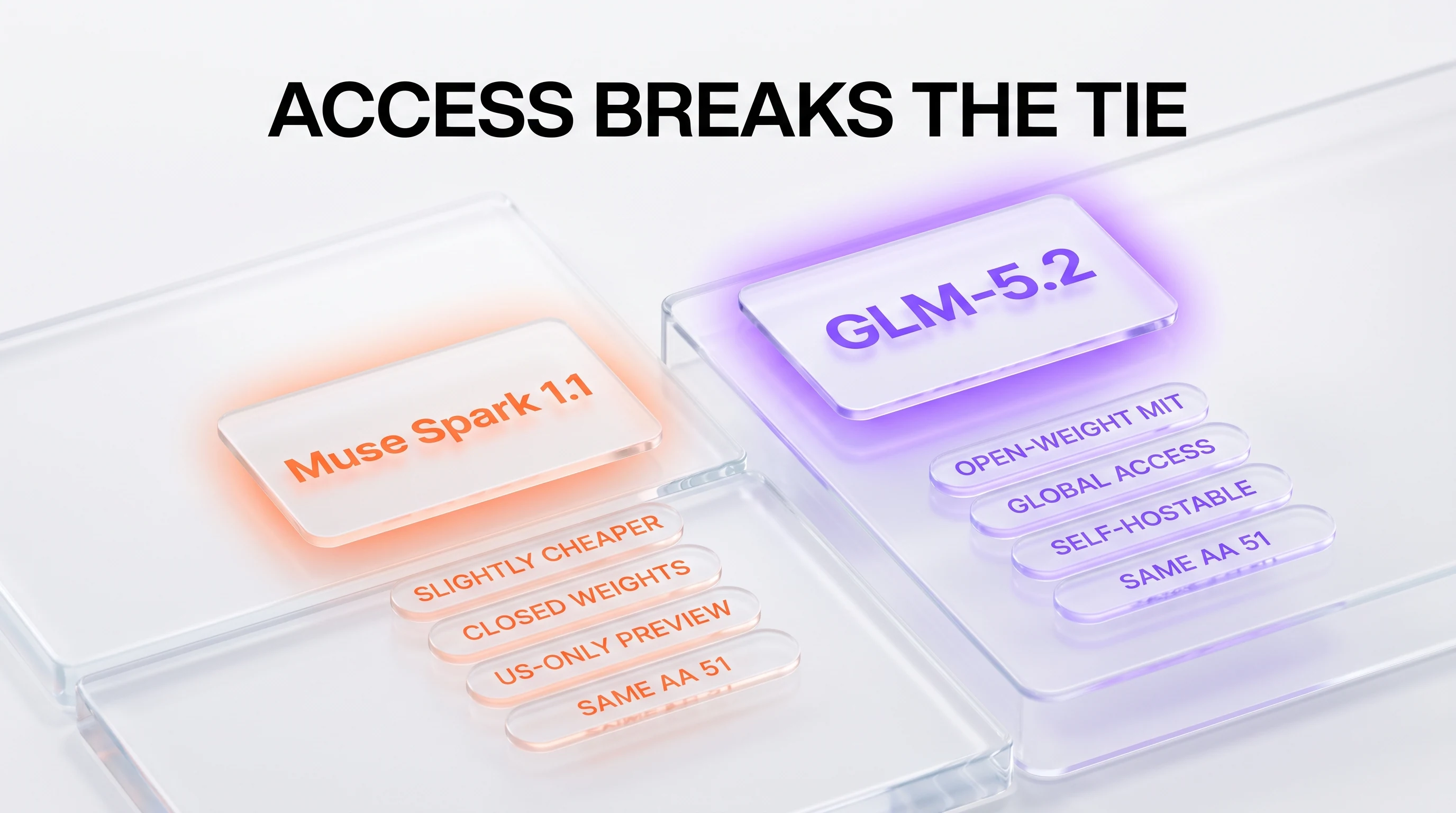
Muse Spark 1.1 versus GLM-5.2 is that rare comparison where the two headline numbers refuse to separate the models. Both earn a 51 on the independent Artificial Analysis v4.1 Intelligence Index, and Muse Spark 1.1's token prices undercut GLM-5.2's by only cents — about 5 percent on a balanced job. If the decision stopped at intelligence and sticker price, it would be a coin flip that leaned, very slightly, toward Muse Spark 1.1.
But it does not stop there, and the tiebreaker is decisive. GLM-5.2 is open-weight under the MIT license, globally available, self-hostable, fine-tunable, coding-specialized, and backed by a cheap flat plan. Muse Spark 1.1 answers with a few cents of savings and stronger multimodal-agentic framing, wrapped inside a closed, US-only preview that many teams cannot access at all. At equal measured intelligence and near-identical price, openness and access are what remain to choose between — and they point clearly at GLM-5.2. Best for US-based multimodal or agentic work at the lowest token price: Muse Spark 1.1. Best for openness, global access, self-hosting, and heavy-usage coding value — and our overall pick: GLM-5.2. No fabricated intelligence gap, no invented winner where the data ties; just a tie on the numbers, broken by who can actually use the model and on what terms.
Sources
- Artificial Analysis — v4.1 Intelligence Index scores (51 for both), plus Muse Spark 1.1 SciCode and Humanity's Last Exam sub-scores
- Meta Superintelligence Labs — Model API — Muse Spark 1.1 availability, pricing, and multimodal, agentic positioning
- Z.ai (Zhipu AI) — GLM-5.2 release, GLM Coding Plan, and product details
- Z.ai pricing documentation — GLM-5.2 metered token rates ($1.40 input, $4.40 output per million)
- Hugging Face — GLM-5.2 open-weight MIT release
Last compared: July 2026. Pricing and specifications for both models were verified at their primary sources. Muse Spark 1.1 is a closed, United States-only preview, so our assessment of it is research-led — based on independent Artificial Analysis benchmarks and Meta's documentation — rather than on extended hands-on production testing, whereas GLM-5.2 was tested directly through its open API. Independent scores (Artificial Analysis) and vendor self-reported scores (Zhipu's SWE-bench Pro figure) are labeled as such throughout and never stacked against each other.
Our Verdict
A genuine tie on measured intelligence, broken by openness and access, and we will not invent an overall winner where the numbers refuse to separate. Muse Spark 1.1 and GLM-5.2 both score 51 on the independent Artificial Analysis v4.1 Intelligence Index, and Muse Spark 1.1's token prices undercut GLM-5.2's by cents — $1.25 input and $4.25 output per million against $1.40 and $4.40, roughly 5 percent cheaper on a balanced job. If intelligence and sticker price were the whole story it would lean, faintly, to Muse Spark 1.1. But Muse Spark 1.1 is closed weights behind a United States-only preview waitlist, while GLM-5.2 is open-weight under the MIT license, globally available, self-hostable, fine-tunable, coding-specialized, and backed by a flat GLM Coding Plan from around $18 per month. GLM-5.2's own caveats are real — its production API is hosted in China and its 62 percent SWE-bench Pro figure is Zhipu self-reported and unverified, never to be stacked against Muse Spark 1.1's independent scores — but its open weights give buyers an escape hatch Muse Spark 1.1 cannot match. Best for US-based multimodal or agentic work at the lowest metered token price: Muse Spark 1.1. Best for openness, global access, self-hosting, and heavy-usage coding value, and our overall pick: GLM-5.2. At equal measured intelligence and near-identical price, access decides.
Choose Muse Spark 1.1
Meta Superintelligence Labs' closed agentic model: Artificial Analysis Intelligence Index 51 and a 1,000,000-token context, at $1.25 input and $4.25 output per million tokens — about a quarter of frontier input rates.
Try Muse Spark 1.1 →Choose GLM-5.2
Zhipu AI open-weight coding flagship: 753B MoE (~40B active), 1M context, MIT license, headline SWE-bench Pro 62.1 (vendor self-reported); GLM Coding Plan from around $18 per month or $1.40 in / $4.40 out per million tokens.
Try GLM-5.2 →Frequently Asked Questions
Is Muse Spark 1.1 better than GLM-5.2?
A genuine tie on measured intelligence, broken by openness and access, and we will not invent an overall winner where the numbers refuse to separate. Muse Spark 1.1 and GLM-5.2 both score 51 on the independent Artificial Analysis v4.1 Intelligence Index, and Muse Spark 1.1's token prices undercut GLM-5.2's by cents — $1.25 input and $4.25 output per million against $1.40 and $4.40, roughly 5 percent cheaper on a balanced job. If intelligence and sticker price were the whole story it would lean, faintly, to Muse Spark 1.1. But Muse Spark 1.1 is closed weights behind a United States-only preview waitlist, while GLM-5.2 is open-weight under the MIT license, globally available, self-hostable, fine-tunable, coding-specialized, and backed by a flat GLM Coding Plan from around $18 per month. GLM-5.2's own caveats are real — its production API is hosted in China and its 62 percent SWE-bench Pro figure is Zhipu self-reported and unverified, never to be stacked against Muse Spark 1.1's independent scores — but its open weights give buyers an escape hatch Muse Spark 1.1 cannot match. Best for US-based multimodal or agentic work at the lowest metered token price: Muse Spark 1.1. Best for openness, global access, self-hosting, and heavy-usage coding value, and our overall pick: GLM-5.2. At equal measured intelligence and near-identical price, access decides.
Which is cheaper, Muse Spark 1.1 or GLM-5.2?
Muse Spark 1.1 starts at $1.25 in / $4.25 out per M tokens. GLM-5.2 starts at $1.4 in / $4.4 out per M tokens. Check the pricing comparison section above for a full breakdown.
What are the main differences between Muse Spark 1.1 and GLM-5.2?
The key differences span across 16 features we compared. For Model type, Muse Spark 1.1 offers Closed weights, API preview only while GLM-5.2 offers Open-weight MoE, MIT license. For Weights availability, Muse Spark 1.1 offers Not released (closed) while GLM-5.2 offers Downloadable on Hugging Face (MIT). For Access, Muse Spark 1.1 offers US-only preview waitlist while GLM-5.2 offers Global API plus self-host anywhere. See the full feature comparison table above for all details.