GPT-5.6 Sol
OpenAI's flagship GPT-5.6 capability tier, with Programmatic Tool Calling and a 1.05M-token context.

Quick Summary
GPT-5.6 Sol is OpenAI's flagship GPT-5.6 model, generally available July 9, 2026 across ChatGPT, Codex, and the API. 1.05M-token context, $4 per million input and $20 per million output tokens under promotional pricing, and ranked second on the independent Artificial Analysis Coding Agent Index v1.3 at 66.57, measured through the Codex harness at max reasoning effort and read August 2, 2026. We tested it hands-on. Score 8.8 out of 10.
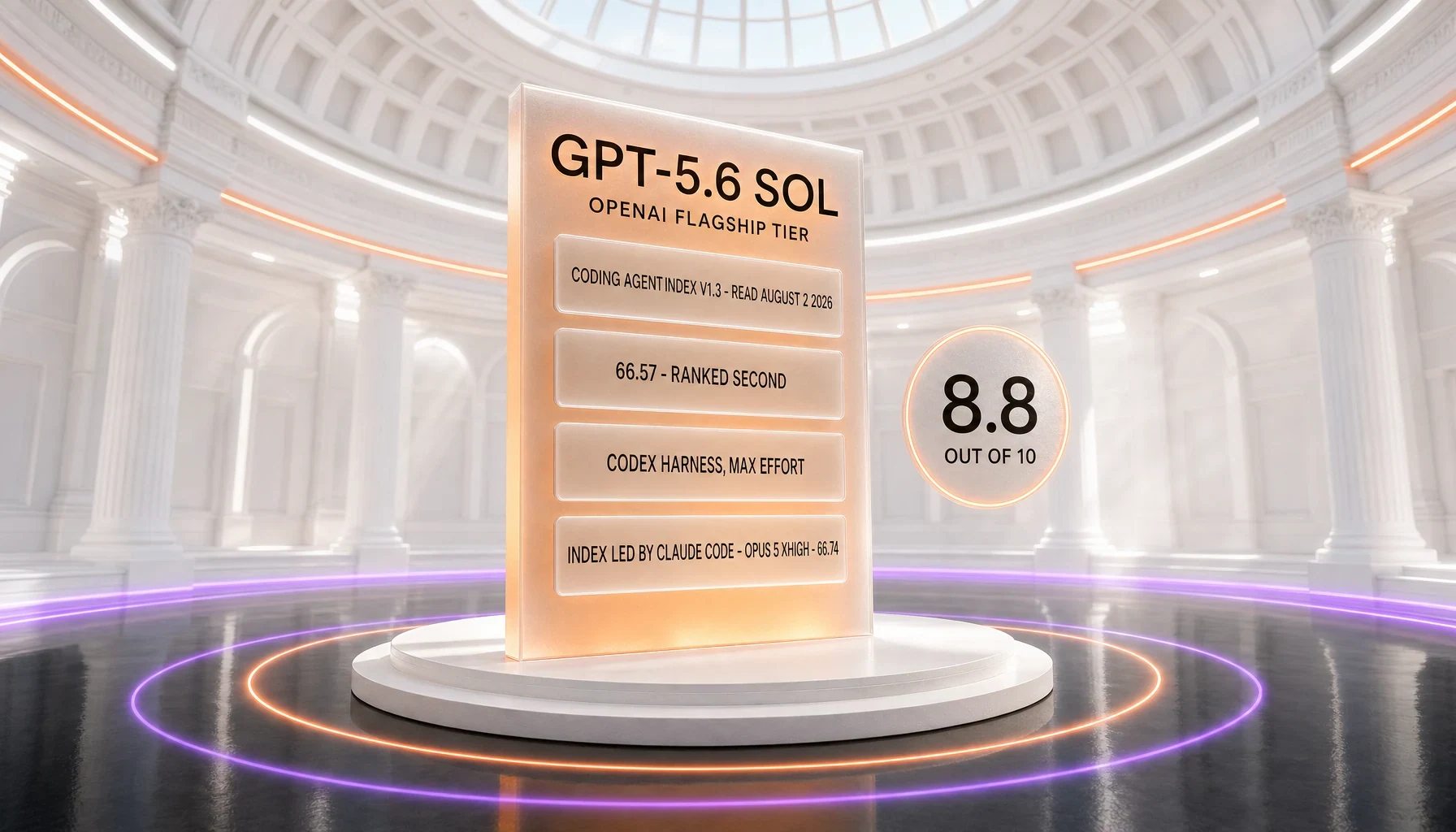
GPT-5.6 Sol is OpenAI's flagship AI model in the GPT-5.6 family, generally available on July 9, 2026, across ChatGPT, Codex, and the API. Sol is the top "capability tier" for the hardest coding, agentic, and research work. Pricing is $4 per million input tokens, $0.40 per million cached input tokens, and $20 per million output tokens on requests up to 272,000 input tokens — promotional rates, detailed below — rising to $8 input and $30 output above that threshold, on a 1,050,000-token context window with a February 16, 2026 knowledge cutoff. We tested it hands-on through the API. Our score: 8.8 out of 10.
Quick Verdict: 8.8 out of 10
Score: 8.8 out of 10. GPT-5.6 Sol is the strongest agentic-coding model OpenAI has shipped, and it sits second on an independent coding leaderboard — 0.17 point behind Claude Code running Opus 5 — while costing meaningfully less per task than Claude Fable 5, the model above it on raw intelligence. In our own hands-on testing it wrote a correct hard algorithm on the first try, reasoned cleanly through a logic puzzle, held a fixed JSON schema without hallucinating, and retrieved a buried fact from a long document in about two seconds. It is the right pick if your work is agentic coding, long-horizon tool use, or research on the OpenAI stack. It is the wrong pick if you need the single highest raw-intelligence score, native audio or image generation, or fine-tuning — none of which Sol offers today.
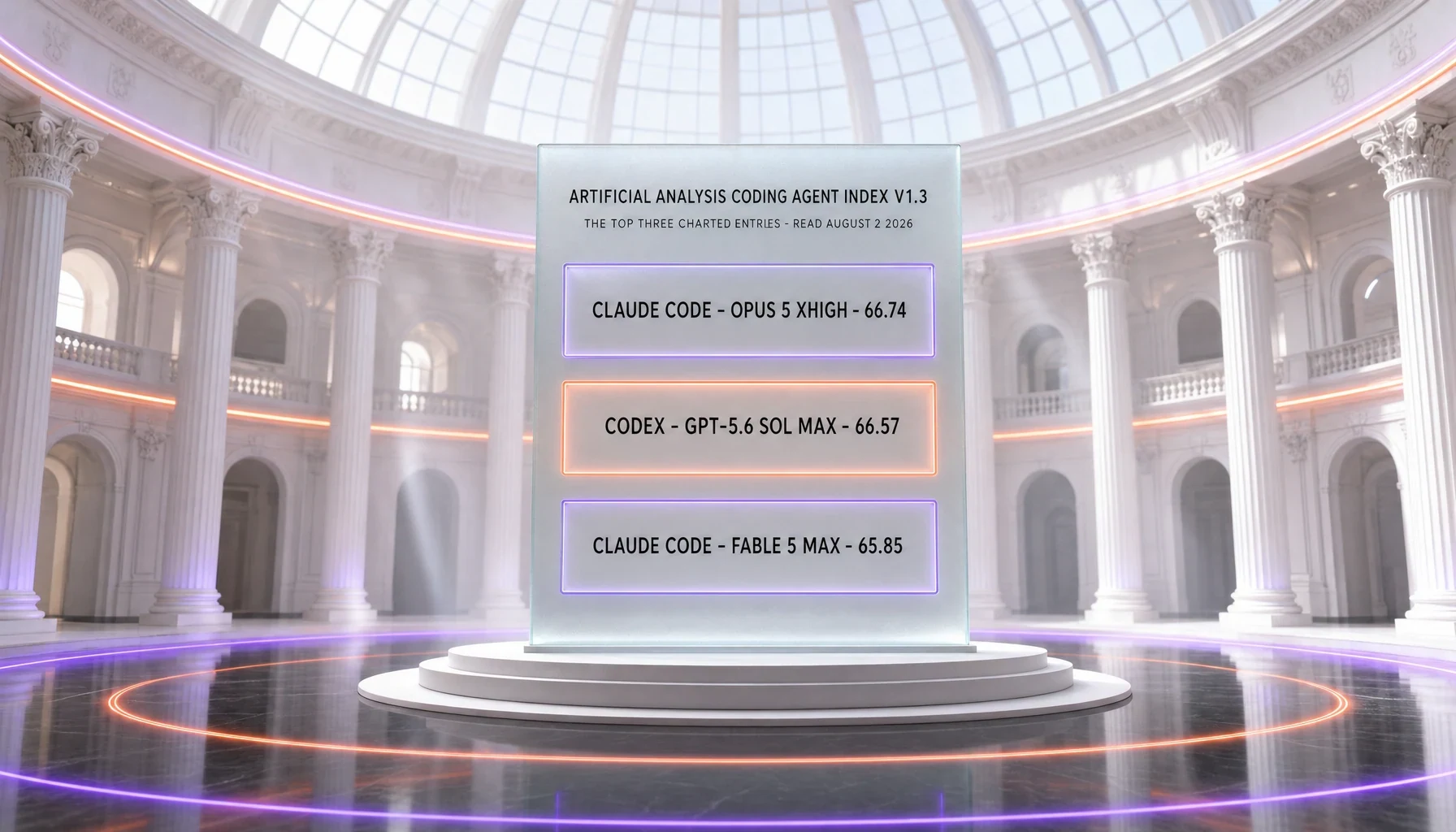
- Best independent result: 66.57 on the Artificial Analysis Coding Agent Index v1.3, ranked second — ahead of Claude Fable 5 at 65.85, behind Claude Code running Opus 5 at 66.74. Measured through the Codex harness at max reasoning effort; read August 2, 2026.
- New "durable capability tier" naming — Sol, Terra, and Luna are permanent tiers, not model sizes, sitting inside the GPT-5.6 generation.
- Programmatic Tool Calling lets the model write and run JavaScript in an isolated sandbox to orchestrate tools; a new "ultra" reasoning effort spins up multi-agent orchestration.
- Honest data gap: Sol is absent from SWE-bench Verified because OpenAI did not submit it to the independent tracker.
- No free plan, no fine-tuning, and no native audio or image output — image generation is a callable tool, not a built-in modality.
What Is GPT-5.6 Sol?
GPT-5.6 Sol is the flagship member of OpenAI's GPT-5.6 model family, announced in a gated preview to trusted partners on June 26, 2026 and released to the public on July 9, 2026 across ChatGPT, Codex, and the API. Its API model identifier is gpt-5.6-sol, with the short alias gpt-5.6. OpenAI positions it as the tier "for the hardest problems" — complex coding, long-horizon agentic work, research, cybersecurity, science, computer use, and design.
The launch also introduced a new naming system worth understanding, because it changes how you read OpenAI's lineup. The number — 5.6 — is the generation. The names Sol, Terra, and Luna are what OpenAI calls "durable capability tiers": persistent quality levels rather than parameter counts or context sizes. Sol is the flagship tier; Terra and Luna sit below it for lighter or cheaper workloads. This is a deliberate move away from the size-implying "mini" and "nano" suffixes, and it means a future GPT-5.7 Sol would be the flagship of that generation. To be explicit, because the internet keeps getting this wrong: this model is GPT-5.6 Sol, not "GPT-6." OpenAI's announcement calls it a "step change in design judgment" that "sets a new standard for both intelligence and efficiency," per its official introduction post and the model documentation.
Crucially, GPT-5.5 is not deprecated. GPT-5.6 is an addition to the lineup, not a forced migration — teams pinned to GPT-5.5 or GPT-5.4 can stay put. One naming caveat: "GPT-5.6 Sol Pro" exists only as a feature of the ChatGPT Business and Enterprise plans, not as a separately billed API model. There is no sol-pro price on the API rate card, so treat any listing that sells it as a distinct model with suspicion.
How We Tested GPT-5.6 Sol
Because Sol shipped only two days before this review, what follows is early hands-on, not a multi-week production burn-in — we want to be upfront about that. On July 11, 2026 we ran gpt-5.6-sol directly through the Chat Completions API on four representative probes: a hard algorithm, a logic puzzle, a strict structured-output extraction, and a long-context retrieval. These are small, deliberate tests, not a full evaluation suite, and we report exactly what we saw. Last tested: July 11, 2026.
Coding. We asked Sol to implement the median of two sorted arrays in O(log(min(m,n))) time using partition binary search — explicitly not the easier merge approach — plus three assert-based tests including an empty-array edge case. Sol returned a correct, idiomatic implementation in about seven seconds, all three asserts passing, and it used the harder partition method we asked for rather than the merge shortcut. Only 76 of its output tokens were reasoning tokens, so it did not overthink a problem it clearly knew.
Reasoning. On the classic three-mislabeled-boxes puzzle, run at "high" reasoning effort, Sol correctly chose to draw from the box labeled "Apples and Oranges" and laid out the full deductive chain — every label wrong means that box must be single-fruit — in under five seconds. Clean logic, no filler.
Structured output. We asked for extraction into a fixed JSON schema. Sol produced schema-perfect JSON, correctly parsing "about 1.05 million tokens" into 1050000 and prose dollar amounts into 5 and 30. Notably, it refused to name a vendor the source text deliberately withheld, returning "unspecified" instead of guessing "OpenAI" — a good anti-hallucination signal. One operational caveat we hit firsthand: reasoning tokens are billed from the same completion-token budget as the answer, so our first run with a low cap returned an empty completion (finish reason "length") before any JSON emitted. Raising the token budget fixed it. If you wire Sol into production agentic loops, budget output tokens generously above the expected answer length.
Long context. We pasted sixty release notes — roughly 1,700 prompt tokens — with a single critical fact buried near the middle. Sol retrieved the exact detail (a token-rotation cadence changed to 37 days, effective a specific build) plus the owner team, and correctly identified two other notes touching the same subsystem, in about 2.3 seconds. Fast and accurate on a needle-in-haystack task. For the underlying speed claim, the third-party evaluator Artificial Analysis measures Sol at roughly 74.5 tokens per second; our single-digit-second latencies on small tasks were consistent with that.
Net read: on the substance we tested, Sol behaved like a disciplined, fast flagship — strong first-try coding, clean reasoning, tight instruction-following, and low hallucination. The one thing to internalize before deploying is the shared reasoning-and-output token budget.
Key Features
Sol's headline additions over the GPT-5.5 generation are a new top reasoning tier, a code-driven tool-orchestration mode, and a broad native tool stack. Here is what actually matters, verified against OpenAI's model documentation and announcement.
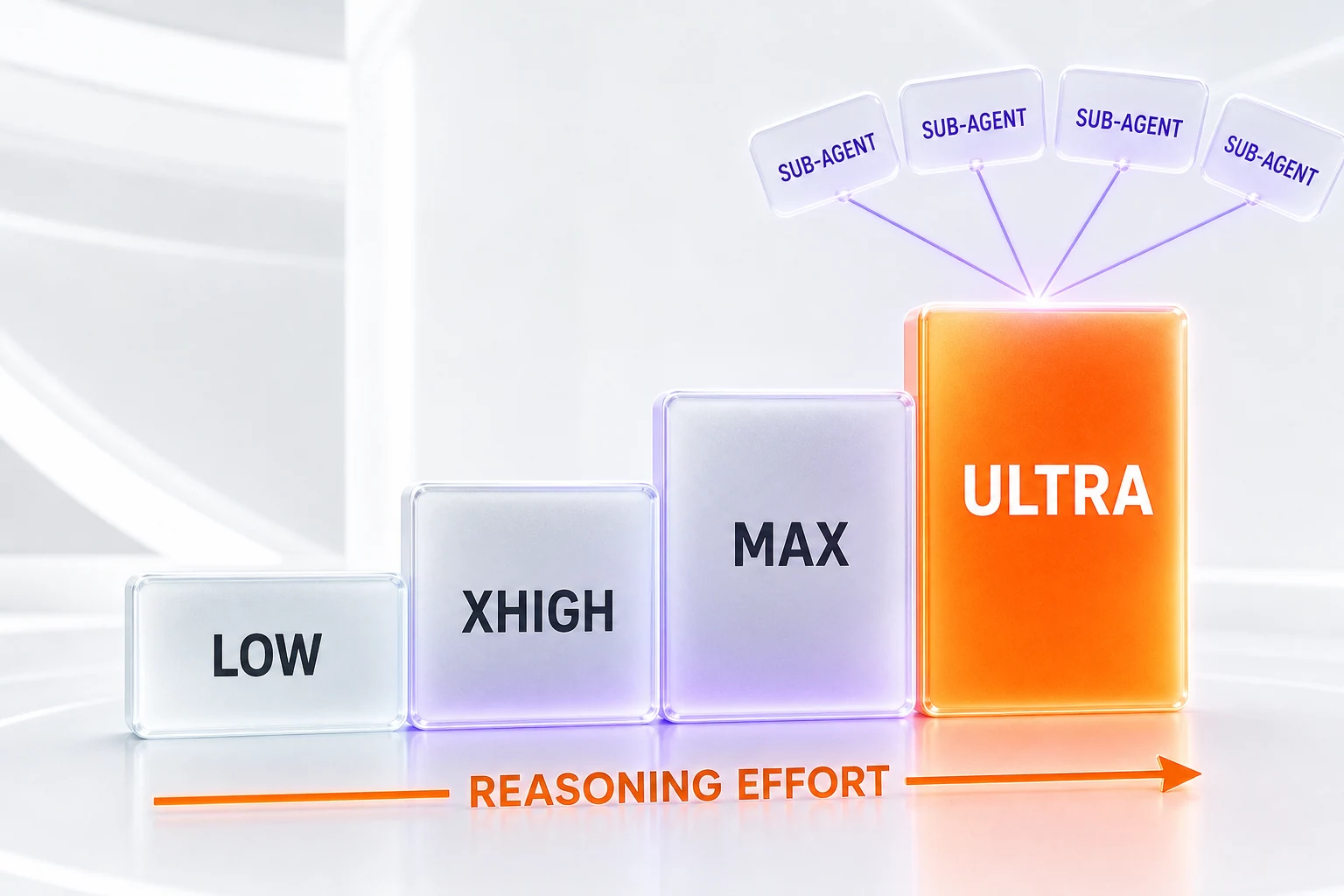
Reasoning effort from low to ultra
Sol extends the reasoning effort ladder well beyond prior GPT-5 models. It now runs from low up through xhigh, then two new levels: "max," and "ultra." The ultra level is the interesting one — it enables multi-agent orchestration, spinning up four sub-agents by default and configurable up to sixteen, so a single request can fan work out and reconcile it internally. In our reasoning test at "high" effort the model spent about 105 reasoning tokens; ultra is a different animal aimed at problems where you want the model to plan, delegate, and verify on its own.
Programmatic Tool Calling
The most genuinely new capability is Programmatic Tool Calling. Instead of emitting one tool call at a time and waiting for each result, Sol can write and execute JavaScript inside an isolated, ephemeral V8 runtime to orchestrate multiple tool calls in code — looping, branching, and aggregating results before returning. It is compatible with Zero Data Retention, so the sandbox does not persist your data. For complex agent workflows that today require a lot of glue code around the model, this pushes orchestration logic into the model itself.
Improved prompt caching
Prompt caching is upgraded: cache writes are billed at 1.25 times the input rate, cache reads land a 90% discount, and the minimum cache lifetime is 30 minutes. For long-running agentic loops that re-send a large stable system prompt or codebase, the read discount is what keeps the economics sane at Sol's $20-per-million output rate. Our guide to input, output, and cached token pricing explains why cached reads matter more than headline input price for most agent workloads.
Native tool stack
Sol ships with a wide set of built-in tools callable directly: web search, file search, image generation, code interpreter, a hosted shell, computer use, MCP (Model Context Protocol) client support, and skills. It also supports function calling, structured outputs, streaming, and the Batch API. Two things to be precise about: image generation is a tool the model can invoke, not a native output modality, and there is no native audio in or out. Sol accepts text and image input and returns text.
Core specifications
The hard numbers, from the model reference: a 1,050,000-token context window, up to 128,000 output tokens, and a knowledge cutoff of February 16, 2026. Modalities are text plus image in, text out. Fine-tuning is not supported. If your stack depends on a tuned variant, Sol will not serve it today, and that is a real limitation for teams with custom-trained production models.
GPT-5.6 Sol Pricing in 2026
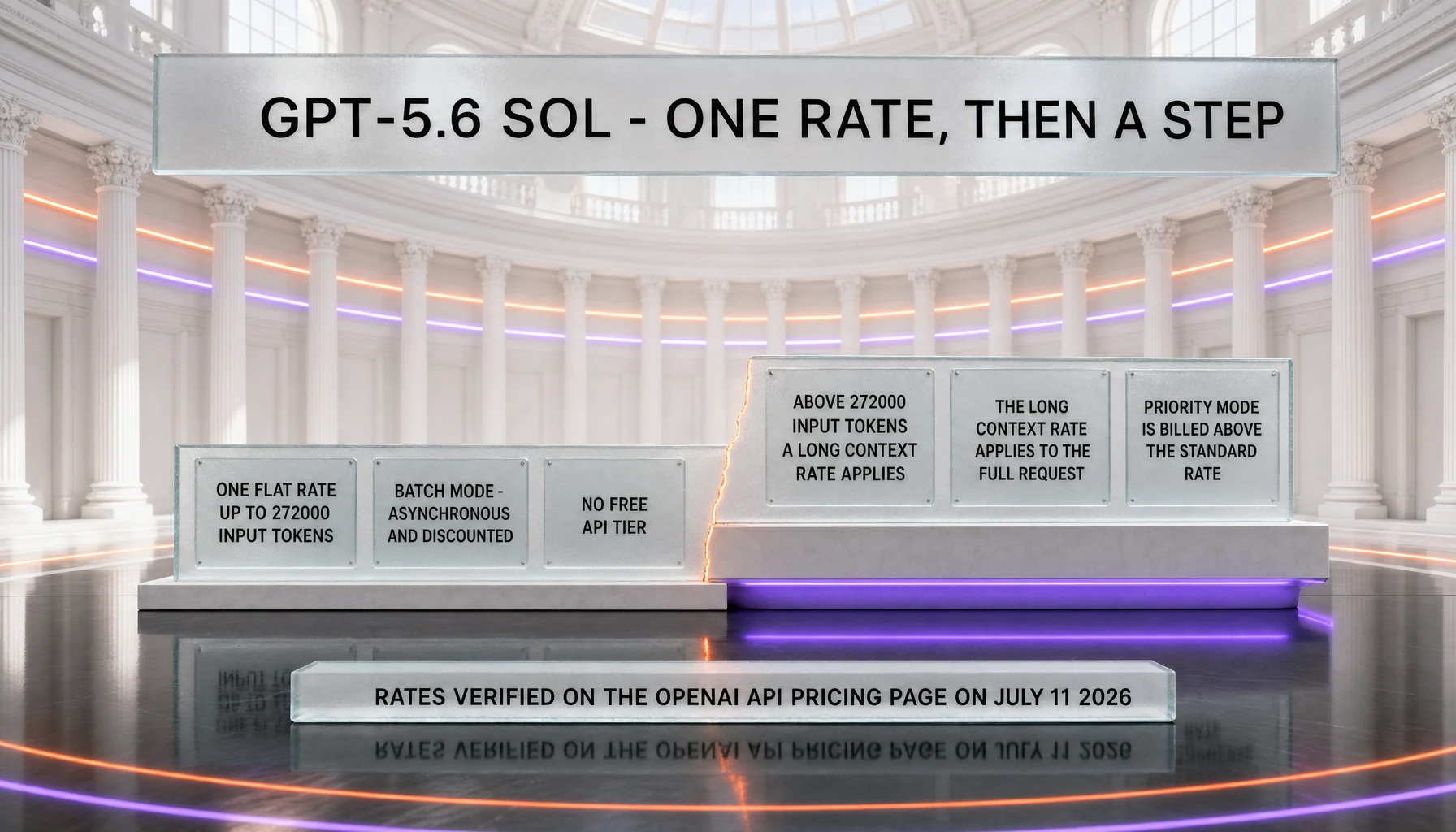
Sol uses one flat per-token rate up to 272,000 input tokens. Above that threshold OpenAI applies a long-context rate — twice the input and 1.5 times the output — to the full request, not just the excess. We verified every figure below directly on OpenAI's API pricing page on July 11, 2026, and re-verified them there on August 28, 2026.
API pricing (per 1M tokens)
| Mode | Input (short) | Cached input (short) | Output (short) | Input (long) | Output (long) |
|---|---|---|---|---|---|
| Standard | $4.00 | $0.40 | $20.00 | $8.00 | $30.00 |
| Batch | $2.00 | $0.20 | $10.00 | $4.00 | $15.00 |
| Flex | $2.00 | $0.20 | $10.00 | $4.00 | $15.00 |
"Short" and "long" above are the two sides of one threshold: 272,000 input tokens. Up to it, the same rate applies whether you send one thousand tokens or two hundred thousand. Past it, the long-context rate applies to the full request rather than the excess, which is why a single oversized prompt doubles your input cost and adds half again to output. Cache writes cost 1.25 times the input rate ($5.00 per million at the current short-context rate), cache reads are discounted 90%, and Batch and Flex both halve input and output. For overnight and non-latency-sensitive workloads, Batch brings Sol down to $2.00 per million input and $10 per million output, which is a serious discount at volume. Fast mode — the tier OpenAI renamed from Priority on July 30, 2026 — is billed above the standard rate; check the rate card for its current figures.
These are promotional rates. OpenAI cut Sol's API and credit pricing on August 21, 2026, and the company's two published descriptions of how long the cut lasts do not say the same thing. The GPT-5.6 launch page carries an update reading: "OpenAI dropped the API and credit pricing of GPT-5.6 Sol by over 20% for the next 3 months." The API pricing page states: "GPT-5.6 Sol's promotional pricing is available at least through November 21, 2026." One phrasing closes a window; the other sets a floor and leaves the end open. We are not going to pick between them. Budget for both readings, and do not plan around the rate reverting on a specific date — neither page says it will. Sol's standard rate before the cut was $5 input and $30 output per million tokens.
Two clarifications on plans. First, there is no free API tier for Sol; access on ChatGPT depends on a paid plan, and the API is pay-as-you-go. Second, "GPT-5.6 Sol Pro" is a ChatGPT Business and Enterprise feature, not a separate API SKU — you will not find a Pro rate on the API card. If you are new to how input, output, and cached rates combine into a real per-task cost, our pricing explainer walks through the math.
Benchmarks: Independent vs OpenAI-Reported
This is the section where model reviews usually go wrong, so we are splitting it cleanly. Independent numbers come from third-party evaluators that OpenAI does not control. Self-reported numbers come from OpenAI's own launch materials and are labeled as such. Treat the two groups very differently.
Independent benchmarks (third-party evaluators)
| Benchmark (independent) | GPT-5.6 Sol | Context |
|---|---|---|
| Artificial Analysis Coding Agent Index v1.3 (Codex harness, max effort) | 66.57 — ranked 2nd | Ahead of Fable 5 at 65.85, behind Claude Code with Opus 5 at 66.74; read August 2, 2026 |
| Artificial Analysis Intelligence Index v4.1 | 59 | Claude Fable 5 leads by one point at 60; at max reasoning effort Sol runs $1.86 per task versus $3.15 for Fable 5 — about 40 percent less, measured August 2, 2026 |
| Output speed (Artificial Analysis) | ~74.5 tokens per second | Consistent with our own latencies |
| LMArena Elo — Sol Xhigh (human preference) | 1486 (rank 8) | Fable 5 leads at 1509; Sol sits just ahead of Gemini 3 Pro and ahead of Opus 4.8 Thinking (1482) |
| SWE-bench Verified | Not submitted | OpenAI did not enter Sol into the independent tracker |
The independent read is nuanced and, we think, more useful than the marketing. On aggregate intelligence, Claude Fable 5 is still one point ahead on the Artificial Analysis Intelligence Index (60 to 59) and leads human-preference voting on LMArena. But on the thing Sol is built for — agentic coding — it ranks second on the Coding Agent Index v1.3, 0.17 point behind Claude Code running Opus 5 and 0.72 ahead of Claude Fable 5, and on that same index it costs $7.08 per task against Fable 5's $11.71. Read that ranking carefully: each entry pairs a model with a coding harness — Sol through Codex, Opus 5 through Claude Code — so part of the gap belongs to the harness, not the model. The glaring gap is SWE-bench Verified: for a model marketed on coding, Sol's absence from the most-watched independent coding benchmark is a genuine hole, and we would want it filled before treating Sol as the undisputed coding leader.
OpenAI-reported benchmarks (self-reported)
These figures are from OpenAI's own announcement. We report them because they are the vendor's claims, but they are not independently verified, and in one case OpenAI itself flags the benchmark as unreliable.
| Benchmark (OpenAI-reported) | GPT-5.6 Sol | OpenAI's cited comparison |
|---|---|---|
| Terminal-Bench 2.1 | 88.8% (Sol Ultra 91.9%) | OpenAI cites Claude Fable 5 at 88% |
| DeepSWE v1.1 | 72.7% | OpenAI cites Claude Opus 4.8 at 59% |
| SWE-Bench Pro | 64.6% | OpenAI cites Fable 5 at 80% — and disputes this benchmark's validity itself |
| Agents' Last Exam | 53.6% | — |
| BrowseComp | 90.4% | — |
| OSWorld 2.0 | 62.6% | — |
Read these as directional, not decisive. The SWE-Bench Pro row is the clearest example of why: OpenAI reports Sol at 64.6% while citing Fable 5 at 80%, then in the same breath questions whether that benchmark measures what it claims to. When a vendor publishes a number and simultaneously undercuts it, that is a signal to wait for third-party replication. If you want to understand why SWE-Bench Pro and SWE-bench Verified are not interchangeable scores, we broke that down in this explainer on the two SWE-bench variants. Note also what is absent: there is no reliable, sourced standalone GPQA Diamond, AIME 2026, or MMLU figure for Sol, so we deliberately do not cite one — despite content farms that invent them.
Pros and Cons After Testing
What we liked
- Top-two on an independent coding leaderboard. The Artificial Analysis Coding Agent Index v1.3 puts Sol at 66.57, ranked second — ahead of Fable 5 at 65.85, behind Claude Code with Opus 5 at 66.74. Measured through the Codex harness at max reasoning effort; read August 2, 2026.
- Strong, disciplined hands-on behavior. In our tests it wrote a correct hard algorithm first try, reasoned cleanly, and refused to hallucinate a withheld fact in structured extraction.
- Programmatic Tool Calling is a real capability, not a rename. Writing and running JavaScript in an isolated sandbox to orchestrate tools moves genuine glue-code logic into the model, and it is Zero Data Retention compatible.
- Cost-efficiency relative to the frontier. About 40 percent less per task than the model one point above it on the Intelligence Index — $1.86 versus $3.15, measured August 2, 2026 — keeps Sol the efficient choice for coding-heavy work.
- Legible pricing. A straightforward $4 and $20 rate card up to 272,000 input tokens — promotional, and $5 and $30 at the standard rate — with Batch cutting both in half for non-urgent jobs; past the threshold the long-context rate of $8 and $30 applies.
Where it falls short
- Absent from SWE-bench Verified. OpenAI did not submit Sol to the most-watched independent coding benchmark, leaving a real hole under a coding-first pitch.
- Not the raw-intelligence leader. Fable 5 is one point ahead on the Intelligence Index and leads human-preference voting on LMArena; Sol ranks eighth there.
- No fine-tuning. Teams with tuned production variants cannot bring them to Sol.
- No native audio or image generation. Image generation is a callable tool, not a modality, and there is no audio in or out — multimodal-heavy products need other models alongside it.
- The shared token-budget gotcha. Reasoning tokens draw from the same completion budget as the answer, which can silently truncate outputs if you cap tokens too tightly, as we hit in testing.
Real-World Use Cases
Agentic coding on the OpenAI stack
Sol's second-place Coding Agent Index v1.3 result — 66.57 through the Codex harness at max effort — and its Programmatic Tool Calling make it the strongest fit for multi-file edits, dependency resolution, and tool-driven coding through Codex and the Responses API. If you already run ChatGPT and Codex, this is the immediate upgrade path for coding agents. If the term is new to you, our explainer on what separates an agentic coding model from a chatbot is worth a read first.
Long-horizon autonomous agents
The "ultra" reasoning tier with built-in multi-agent orchestration (four sub-agents by default, up to sixteen) targets tasks you want the model to decompose, delegate, and verify on its own. Pair it with MCP to expose your own tools without writing custom call shims.
Research and analysis
With web search and file search as native tools and a 1.05M-token window, Sol suits literature synthesis, competitive research, and document-grounded analysis. Its strong long-context retrieval in our testing supports this directly.
Computer use and browser automation
Native computer use lets Sol drive a browser or OS surface as part of a plan — scheduled extraction, form-filling at scale, headed-browser QA. OpenAI reports 62.6% on OSWorld 2.0, though that figure is self-reported.
Structured data extraction pipelines
Structured outputs plus Sol's tight schema adherence — and its refusal to invent withheld fields in our test — make it a solid choice for extraction into fixed schemas, provided you budget output tokens generously.
Cost-sensitive frontier coding via Batch
For overnight or non-urgent coding and analysis jobs, Batch mode at $2.50 per million input and $15 per million output makes frontier-tier coding affordable at scale.
GPT-5.6 Sol vs Fable 5, Opus 4.8, Gemini 3.1 Pro, and GPT-5.5
The mid-2026 frontier is a tight race, and the right model depends on whether you optimize for raw intelligence, coding, price, or ecosystem. All API prices below are per 1M tokens and verified in our own database.
| Model | Vendor | Input | Output | Independent standing |
|---|---|---|---|---|
| GPT-5.6 Sol | OpenAI | $4.00 | $20.00 | Coding Agent Index v1.3 66.57 (ranked 2nd); Intelligence Index 59 |
| Claude Fable 5 | Anthropic | $10.00 | $50.00 | Intelligence Index 60 (number 1); LMArena number 1 (1509) |
| Claude Opus 4.8 | Anthropic | $5.00 | $25.00 | LMArena 1482 (Thinking) |
| Gemini 3.1 Pro Preview | Google DeepMind | $2.00 | $12.00 | 94.3% GPQA Diamond (Google-reported) |
| GPT-5.5 | OpenAI | $5.00 | $30.00 | Prior OpenAI flagship |
When to pick which
Pick GPT-5.6 Sol for agentic coding near the top of the index, Programmatic Tool Calling, and long-horizon agents on the OpenAI stack — especially if you are already on Codex and the Responses API. It is the efficient frontier for coding-heavy work.
Pick Claude Fable 5 if you want the single highest raw-intelligence and human-preference scores and can absorb $10 and $50 per million — it leads the Intelligence Index and LMArena, though at two and a half times Sol's current price. The full side-by-side is in GPT-5.6 Sol versus Claude Fable 5.
Pick Claude Opus 4.8 if you want an Anthropic flagship for agentic coding and computer use at $5 and $25 per million — above Sol on both input and output for as long as Sol's promotional rate holds, but with strong multi-agent orchestration of its own. We work through that trade-off in Sol against Claude Opus 4.8.
Pick Gemini 3.1 Pro Preview if price-to-intelligence is your binding constraint at $2 and $12 per million, or if you need Google's multimodal breadth. Grok 4.3 goes even cheaper at $1.25 and $2.50 with a free tier if budget dominates. Sol versus Gemini 3.1 Pro has the head-to-head detail, including the single point that separates them on LMArena.
Stay on GPT-5.5 if it already meets your needs — it is not deprecated and switching mid-project rarely pays off for marginal gains — though it no longer prices identically, since Sol's promotional rate now undercuts GPT-5.5 on both input and output. Sol versus GPT-5.5 lays out both sides of that call.
Every head-to-head with GPT-5.6 Sol
We have put Sol against the rest of the 2026 field one model at a time. The direct matchups not already covered above, grouped by what each one settles:
- Claude Opus 5 versus GPT-5.6 Sol — the frontier matchup, and whether Opus 5's index lead survives contact with the invoice.
- Sol versus Grok 4.5 — two models that reached general availability on the same day, and which one is actually cheaper per task.
- Sol versus GPT-5.6 Terra — how much capability you give up moving one rung down inside the same family.
- Sol versus Claude Sonnet 5 — where Anthropic's value tier answers on price, speed, and platform reach.
- Sol versus Kimi K3 — the tightest an open-weight model has come to Sol on the Intelligence Index.
- Sol versus Kimi K2.7 Code — the previous Moonshot flagship, seventeen index points back but several times cheaper per token.
- Sol versus Kimi K2.6 — the same trade one generation earlier, at seven and a half times cheaper on output.
- Sol versus DeepSeek V4 — MIT-licensed weights you can self-host, against a fifteen-point gap on measured intelligence.
- Sol versus GLM-5.2 — an open-weight coder at a fraction of Sol's output price.
- Sol versus MiniMax M3 — a matching million-token context with native video input for a fraction of the cost.
- Sol versus Qwen 3.6 — Apache 2.0 weights against the widest measured capability gap in the group.
Frequently Asked Questions
How much does GPT-5.6 Sol cost in 2026?
GPT-5.6 Sol costs $4.00 per million input tokens, $0.40 per million cached input tokens, and $20.00 per million output tokens on the standard API tier, for requests up to 272,000 input tokens. Above that threshold the long-context rate of $8.00 input and $30.00 output applies to the full request, not just the excess. Batch and Flex halve both sides, at $2.00 input and $10.00 output. These are promotional rates: OpenAI cut them on August 21, 2026, describing the cut as "for the next 3 months" on its launch page and as "available at least through November 21, 2026" on its pricing page. The standard rate before the cut was $5.00 and $30.00. There is no free API tier.
When was GPT-5.6 Sol released?
GPT-5.6 Sol became generally available on July 9, 2026, across ChatGPT, Codex, and the API, following a gated preview to trusted partners that began on June 26, 2026. It is part of the GPT-5.6 family alongside the Terra and Luna capability tiers.
Is GPT-5.6 Sol the same as GPT-6?
No. There is no model called "GPT-6." The correct name is GPT-5.6 Sol. In OpenAI's naming system the number 5.6 is the generation, and Sol is a "durable capability tier" — the flagship tier for the hardest problems — sitting alongside the Terra and Luna tiers within the same GPT-5.6 generation.
What is GPT-5.6 Sol's context window?
GPT-5.6 Sol has a 1,050,000-token context window and can produce up to 128,000 output tokens. Its knowledge cutoff is February 16, 2026. It accepts text and image input and returns text output, with no native audio input or output.
What are Sol, Terra, and Luna in the GPT-5.6 family?
Sol, Terra, and Luna are OpenAI's "durable capability tiers" — persistent quality levels rather than model sizes or context lengths. Sol is the flagship tier for the hardest coding, agentic, and research work. Terra and Luna sit below Sol for lighter or more cost-sensitive workloads within the same GPT-5.6 generation.
How does GPT-5.6 Sol compare to Claude Fable 5?
On the independent Artificial Analysis Intelligence Index, Claude Fable 5 leads by one point (60 to 59) and ranks first on LMArena human-preference voting at 1509 versus Sol's 1486. However, GPT-5.6 Sol ranks second on the Artificial Analysis Coding Agent Index v1.3 at 66.57, ahead of Fable 5 at 65.85 but behind Claude Code running Opus 5 at 66.74, and on that index it costs $7.08 per task against Fable 5's $11.71. Sol is $4 and $20 per million tokens under promotional pricing versus Fable 5 at $10 and $50.
What is Programmatic Tool Calling in GPT-5.6 Sol?
Programmatic Tool Calling lets GPT-5.6 Sol write and execute JavaScript inside an isolated, ephemeral V8 runtime to orchestrate multiple tool calls in code — looping, branching, and aggregating results before responding. It is compatible with Zero Data Retention, so the sandbox does not persist your data. It moves orchestration logic that normally lives in your application into the model itself.
What is the "ultra" reasoning effort level?
Ultra is the highest reasoning effort level on GPT-5.6 Sol, above low, xhigh, and max. It enables multi-agent orchestration, spinning up four sub-agents by default and configurable up to sixteen, so a single request can decompose work, delegate it, and reconcile the results internally. It targets the hardest long-horizon problems rather than routine queries.
Does GPT-5.6 Sol support fine-tuning?
No. Fine-tuning is not supported on GPT-5.6 Sol. Teams that depend on custom-trained variants cannot bring them to Sol today and will need to keep those workloads on a fine-tunable model. OpenAI has not announced a timeline for fine-tuning support on Sol.
Is GPT-5.6 Sol on SWE-bench Verified?
No. GPT-5.6 Sol is absent from SWE-bench Verified because OpenAI did not submit it to that independent tracker. This is a notable data gap for a model marketed on coding. OpenAI does self-report a 64.6% score on the separate SWE-Bench Pro benchmark, but it questions that benchmark's validity itself, so those numbers should be treated as directional rather than verified.
Can GPT-5.6 Sol generate images or audio?
Not natively. GPT-5.6 Sol accepts text and image input and returns text output. Image generation is available as a callable tool the model can invoke, not a built-in output modality, and there is no native audio input or output. Products that need native multimodal generation should pair Sol with dedicated image or audio models.
Is GPT-5.6 Sol Pro a separate API model?
No. "GPT-5.6 Sol Pro" exists only as a feature of the ChatGPT Business and Enterprise plans, not as a separately billed API model. There is no Sol Pro rate on the API pricing card. Any listing that sells Sol Pro as a distinct API model with its own price should be treated with suspicion.
Verdict: 8.8 out of 10
GPT-5.6 Sol earns an 8.8 out of 10. It is the most convincing agentic-coding flagship OpenAI has shipped: second on an independent coding leaderboard, 0.17 point behind Claude Code running Opus 5, about 40 percent less per task than Claude Fable 5 ($1.86 versus $3.15 on Artificial Analysis's Intelligence Index runs, measured August 2, 2026), the model above it on raw intelligence, and — in our own early hands-on — disciplined, fast, and resistant to hallucination. Programmatic Tool Calling and the ultra multi-agent tier are substantive additions, not marketing. What keeps it from a higher score is honest: Sol is absent from SWE-bench Verified, it trails Claude Fable 5 by a point on aggregate intelligence and sits eighth on LMArena, it offers no fine-tuning and no native audio or image generation, and its reasoning tokens quietly share the output budget.
Score breakdown:
- Features: 9.3 out of 10 — Programmatic Tool Calling, ultra multi-agent reasoning, a 1.05M context window, and a broad native tool stack. The gaps are fine-tuning and native audio or image output.
- Ease of Use: 8.6 out of 10 — a clean drop-in on the Chat Completions and Responses APIs, with reasoning effort accepted as expected. The shared reasoning-and-output token budget is the one thing to learn before production.
- Value: 8.2 out of 10 — the efficient frontier for coding at $4 and $20 per million under promotional pricing, with Batch halving both. Held back by no free tier, and by a headline rate OpenAI has only committed to for a limited window.
- Support: 9.0 out of 10 — OpenAI's model documentation, pricing pages, and API tooling remain best-in-class and clearly versioned.
Final word: buy GPT-5.6 Sol if your work is agentic coding, long-horizon tool use, or research on the OpenAI stack — it is the strongest and most cost-efficient option for that profile in mid-2026. Choose Claude Fable 5 instead if you need the single highest raw-intelligence score, or Gemini 3.1 Pro Preview and Grok 4.3 if price-to-intelligence dominates. And wait for a SWE-bench Verified number before crowning Sol the outright coding champion — the independent Coding Agent Index v1.3 ranks it second, but the most-watched verified benchmark still has an empty seat where Sol should be.
Sources
Key Features
Pros & Cons
Pros
- Ranked second on the independent Artificial Analysis Coding Agent Index v1.3 at 66.57, ahead of Claude Fable 5 at 65.85 — measured through the Codex harness at max reasoning effort, read August 2, 2026.
- Disciplined hands-on behavior: in our own API testing it wrote a correct hard algorithm on the first try, reasoned cleanly through a logic puzzle, and refused to hallucinate a fact the source text deliberately withheld.
- Programmatic Tool Calling writes and runs JavaScript in an isolated, Zero Data Retention-compatible sandbox to orchestrate tool calls in code, moving real glue-code logic into the model.
- New ultra reasoning tier adds built-in multi-agent orchestration — four sub-agents by default, configurable up to sixteen — for long-horizon problems.
- Cost-efficient relative to the frontier: about 40 percent less per task than the model one point above it on the Intelligence Index — $1.86 versus $3.15 for Claude Fable 5, measured August 2, 2026.
- Flat, legible pricing up to 272,000 input tokens, and Batch mode halves both input and output rates for non-urgent jobs.
Cons
- Absent from SWE-bench Verified because OpenAI did not submit it — a real data gap under a coding-first pitch.
- Not the raw-intelligence leader: Claude Fable 5 is one point ahead on the Intelligence Index and leads LMArena human-preference voting, where Sol ranks eighth.
- No fine-tuning support, so teams with custom-trained production variants cannot bring them to Sol.
- No native audio or image generation — image generation is a callable tool, not an output modality.
- Reasoning tokens share the same completion-token budget as the answer, which can silently truncate outputs if the token cap is set too low.
Best Use Cases
Platforms & Integrations
Available On
Integrations
Compare GPT-5.6 Sol

We're developers and SaaS builders who use these tools daily in production. Every review comes from hands-on experience building real products — DealPropFirm, ThePlanetIndicator, PropFirmsCodes, and many more. We don't just review tools — we build and ship with them every day.
Written and tested by developers who build with these tools daily.
Frequently Asked Questions
What is GPT-5.6 Sol?
OpenAI's flagship GPT-5.6 capability tier, with Programmatic Tool Calling and a 1.05M-token context.
How much does GPT-5.6 Sol cost?
GPT-5.6 Sol costs $4/month.
Is GPT-5.6 Sol free?
No, GPT-5.6 Sol starts at $4/month.
What are the best alternatives to GPT-5.6 Sol?
Top-rated alternatives to GPT-5.6 Sol can be found in our WebApplication category, where we've reviewed and scored every tool on ThePlanetTools.ai.
Is GPT-5.6 Sol good for beginners?
GPT-5.6 Sol is rated 8.6/10 for ease of use.
What platforms does GPT-5.6 Sol support?
GPT-5.6 Sol is available on Web, REST API, iOS, Android, macOS, Windows.
Does GPT-5.6 Sol offer a free trial?
No, GPT-5.6 Sol does not offer a free trial.
Is GPT-5.6 Sol worth the price?
GPT-5.6 Sol scores 8.2/10 for value. We consider it excellent value.
Who should use GPT-5.6 Sol?
GPT-5.6 Sol is ideal for: Agentic coding on the OpenAI stack via Codex and the Responses API, Long-horizon autonomous agents using the ultra multi-agent reasoning tier, Research and analysis over long documents with native web and file search, Computer use and browser automation (scheduled extraction, form-filling, headed QA), Structured data extraction into fixed JSON schemas, Cost-sensitive frontier coding and analysis via Batch mode, Tool-heavy workflows orchestrated with Programmatic Tool Calling, Multi-step planning and task decomposition for orchestrators via MCP.
What are the main limitations of GPT-5.6 Sol?
Some limitations of GPT-5.6 Sol include: Absent from SWE-bench Verified because OpenAI did not submit it — a real data gap under a coding-first pitch.; Not the raw-intelligence leader: Claude Fable 5 is one point ahead on the Intelligence Index and leads LMArena human-preference voting, where Sol ranks eighth.; No fine-tuning support, so teams with custom-trained production variants cannot bring them to Sol.; No native audio or image generation — image generation is a callable tool, not an output modality.; Reasoning tokens share the same completion-token budget as the answer, which can silently truncate outputs if the token cap is set too low..
Ready to try GPT-5.6 Sol?
Get started today
Try GPT-5.6 Sol Now →