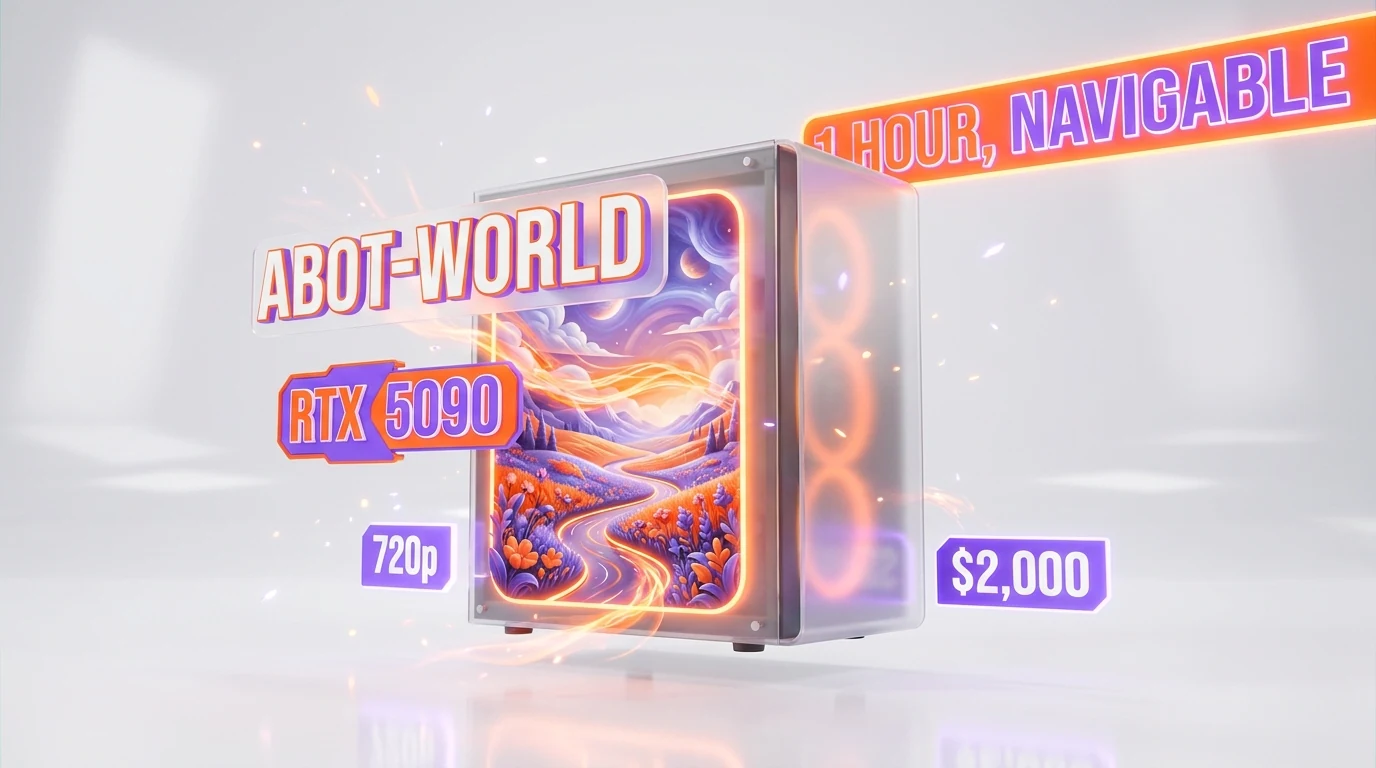
You can now run a navigable, hour-long AI world on a single consumer gaming GPU. Between July 9 and July 18, 2026, three Chinese labs open-sourced interactive world models that generate explorable environments in real time — and one of them, Amap's ABot-World, does it on a single NVIDIA RTX 5090, the roughly $2,000 desktop card gamers already own. Amap reports 720p output at 16 frames per second, 1.2 seconds of latency, 19 GB of VRAM, and continuous rollout its own tests held stable for over an hour, all from a distilled 0.5-billion-parameter model released under a permissive Apache 2.0 license. Ant Group's LingBot-World 2.0 and Shanda's AlayaWorld landed in the same window. Until weeks ago, this class of model lived on cloud accelerators and data-center H100s. As of late July 2026, it fits under a desk.
Key Takeaways
- One release actually hits the consumer-GPU mark. Amap's ABot-World reports a navigable world on a single RTX 5090 at 720p and 16 frames per second, with rollouts its own tests held stable for over an hour — shipped under a permissive Apache 2.0 license with downloadable weights.
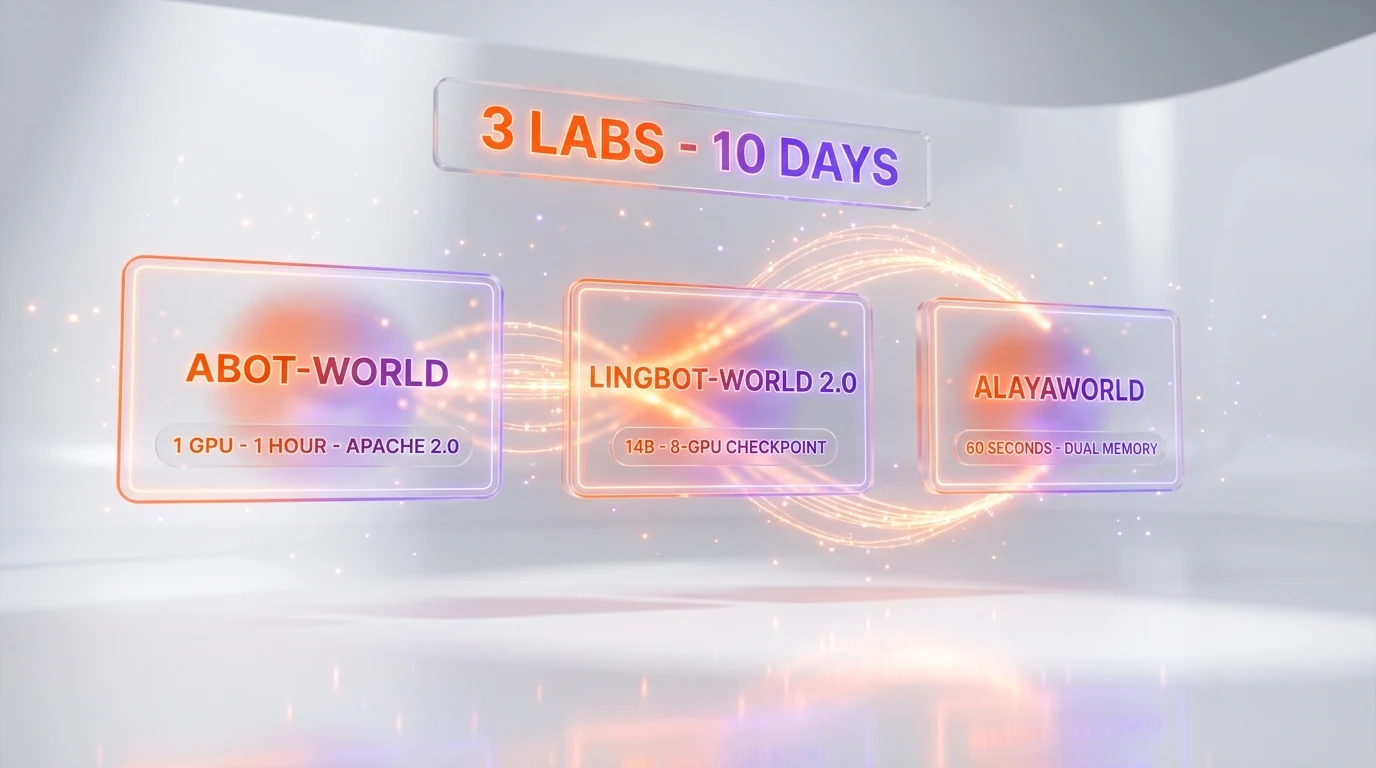
- Three labs, ten days. Amap (Alibaba), Robbyant (tied to Ant Group), and Shanda's Alaya Lab all open-sourced navigable world models between July 9 and July 18, 2026 — a cluster, not a coincidence.
- LingBot's 60-frames-per-second headline has an eight-GPU footnote. The advertised 720p at 60 frames per second needs a deployment stack Robbyant says it will not release; the public checkpoint runs at 480p on eight GPUs and is non-commercial.
- AlayaWorld buys coherence with memory. A dual-memory design plus an "error bank" hold a scene together for about a minute — impressive engineering, but research-licensed and short-session.
- Every number here is vendor-reported. World models are not yet on independent leaderboards, so treat the frame rates and durations as engineering claims — and weigh ABot-World's downloadable, Apache 2.0 weights as the strongest evidence of all.
What Happened: Three Navigable Worlds in Ten Days
In roughly ten days in mid-July 2026, three Chinese labs shipped interactive world models — generative systems that let you walk through an AI-imagined 3D scene in real time rather than watch a fixed clip. Amap, Alibaba's mapping division, released ABot-World on July 9. Robbyant, a team associated with Ant Group, pushed LingBot-World 2.0 (branded "Infinity") to open source. And Shanda's Alaya Lab published AlayaWorld, with an arXiv paper dated July 7. Three labs, three architectures, one shared ambition: keep a generated world coherent long enough to be useful, on hardware people can actually get.
This did not come from nowhere. Chinese labs have been steadily open-sourcing world-generation research all year — Tencent's move to open-source HY-World 2.0 for text-to-3D worlds set the tone in the spring. What changed in July is the target hardware. Where earlier systems assumed a cloud cluster, this cohort is racing to shrink the footprint — and the framing has shifted from "can a model imagine a world" to "how long, at what fidelity, on what card." That is exactly the question investors like Yann LeCun's AMI Labs have been betting the post-language-model era turns on.
ABot-World: The One That Actually Hits the Consumer-GPU Mark
ABot-World is the release that matches the hype, because its numbers and its license line up. Amap says the model turns a single RTX 5090 into a real-time world simulator, producing 720p video at 16 frames per second with 1.2 seconds of latency while using 19 GB of VRAM — comfortably inside the 32 GB the card carries. The engine is a distilled 0.5-billion-parameter "causal student" model, ABot-World-0-5B-LF, trained with a technique Amap calls LongForcing to enable what it describes as open-ended, action-conditioned world rollout without the scene lock-in that plagues shorter models.
The standout claim is duration. Amap reports that in official tests, continuous inference ran stably for over an hour with no crashes or quality degradation and no built-in upper limit on rollout length — against roughly the one-minute ceiling typical of prior work. It also adds a "spatial teleport" mechanism: you can place anchor points between two generated 3D worlds and traverse them, with the system unloading the current scene and loading the target while keeping perspective and lighting continuous. Amap released the model, inference code, a Gradio demo, and a browser Studio starting July 9, announced a 500-hour action-annotated video dataset the next day, and added a Reactor integration on July 13 — all under Apache 2.0. Downloadable weights plus a commercial-friendly license is the combination that makes this more than a demo.
LingBot-World 2.0: A 60-Frames-Per-Second Headline With an Eight-GPU Footnote
LingBot-World 2.0 has the most aggressive headline and the widest gap between claim and shipped artifact. Robbyant advertises an unbounded interaction horizon at consistent quality and says its pipeline can drive 720p video at 60 frames per second, orchestrated by a "Director-Pilot" harness in which a pilot agent plans and executes character behavior while a director agent synthesizes new environmental elements. On paper, it is the most cinematic of the three.
The footnotes matter. That 720p, 60-frames-per-second figure depends on a deployment stack the team states plainly it does not plan to release. The checkpoint you can actually download — lingbot-world-v2-14b-causal-fast, a 14-billion-parameter model — runs at 480p, and its reference inference command spins up eight GPUs, not one. The 1.3-billion-parameter "single consumer GPU" variant that would match the consumer-hardware story is still listed as TODO, alongside the 14-billion pretrain weights. And the whole release is Creative Commons BY-NC-SA 4.0, which bars commercial use. LingBot may well get to a consumer-grade, high-frame-rate world — but as of late July 2026, the shipped version is an eight-GPU, 480p, non-commercial research artifact, and the polished number is a target, not a download.
AlayaWorld: The Research-Grade Minute
AlayaWorld is the most academically detailed of the three, and the most honest about its limits. Shanda's Alaya Lab fine-tuned it from the LTX-2.3 video model and runs it autoregressively at 24 frames per second, generating in chunks of roughly 1.3 seconds. A rollout holds coherent for about 45 chunks — close to a minute — which the paper treats as the practical horizon rather than an hour-long promise.
What is interesting is how it gets there. AlayaWorld pairs two forms of memory: an explicit 3D cache that is reprojected to whatever view you are currently looking at, giving it spatial recall so a chair stays put when you turn back, plus a compressed frame-history embedding for temporal continuity. On top of that sits an "error bank" that re-injects accumulated visual artifacts back into both memory and the generation target, so small errors are corrected instead of compounding into drift. It is a clean answer to the core world-model failure mode. The catch is the same as LingBot's: the released weights sit under the LTX-2 Community License, which is academic and non-commercial. AlayaWorld is a strong research contribution — just not something you can ship a product on.
Why Consumer-GPU Worlds Change the Game
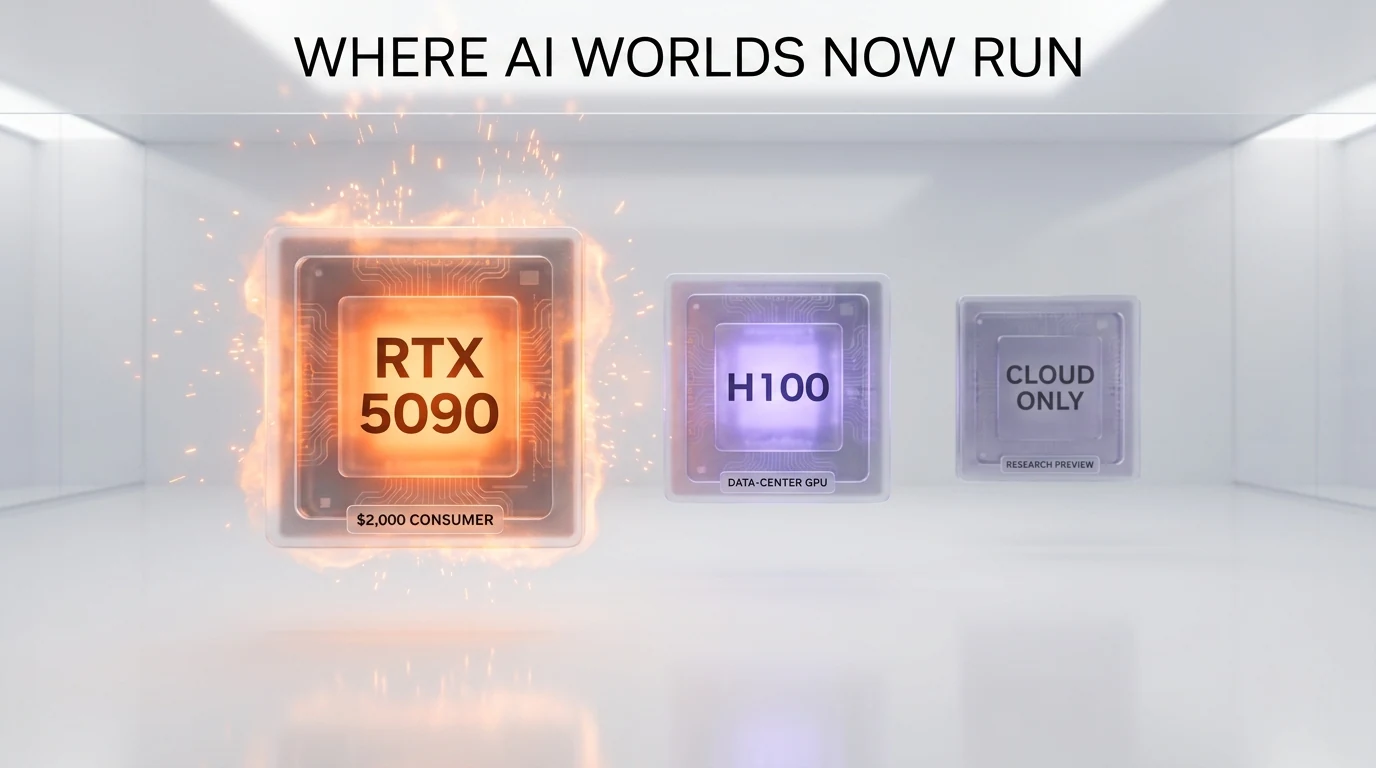
The significance is not that a world model exists — it is where one now runs. A year ago, the reference points were locked behind cloud access or data-center silicon. Google DeepMind's Genie 3, unveiled in August 2025, produced striking interactive worlds at 720p and 24 frames per second but supported only a few minutes of continuous interaction and shipped as a closed research preview you could not download. World Labs' RTFM, from Fei-Fei Li's team that October, was celebrated for running a persistent world model on a single GPU — but that GPU was an H100, a roughly $25,000 data-center part.
ABot-World's claim collapses that hardware ladder by an order of magnitude, onto a card that sits in gaming PCs today. That matters for two audiences. For creators and game developers, it means an explorable world generator that runs locally, privately, and without per-hour cloud metering. For the deeper bet — the one behind Runway's world-models pivot and Jeff Bezos's Project Prometheus — it means the simulation substrate for training embodied AI, robots, and autonomous vehicles gets dramatically cheaper to iterate on. When the environment generator drops from a cluster to a consumer card, far more teams can start building.
The Caveats: Vendor Claims vs What Actually Ships
A necessary reality check: none of these numbers has been independently verified. Every frame rate, latency figure, VRAM reading, and duration claim above comes from the labs themselves — project pages, GitHub READMEs, and papers. Unlike large language models, which get scored on neutral aggregates, world models have no widely accepted independent leaderboard as of late July 2026, so there is no third-party benchmark to check these against. That does not make the claims false; it makes them unaudited.
The asymmetry between the three releases is the useful signal. ABot-World backs its claims with downloadable Apache 2.0 weights, which anyone can run and inspect — the strongest form of evidence available. LingBot-World 2.0's best number, 720p at 60 frames per second, is precisely the part that is not in the box, gated behind unreleased deployment code, while the shipped checkpoint is 480p on eight GPUs. AlayaWorld is transparent about its roughly one-minute horizon but ships under a non-commercial license. The honest read is that the consumer-GPU, long-session, commercially-usable world model is real in exactly one of the three cases — and even there, the hour-long figure is Amap's own, awaiting outside confirmation.
What to Watch Next
Three things will tell us whether this cluster is an inflection point or a burst of well-timed releases. First, independent verification: when outside researchers run ABot-World on their own RTX 5090s and publish latency and stability numbers, we will know how close the hour-long claim holds in the wild. Second, LingBot's deployment stack — if Robbyant or the community closes the gap to a genuine single-GPU, high-frame-rate build, the 60-frames-per-second headline becomes real; if not, it stays marketing. Third, licensing: LingBot and AlayaWorld are non-commercial today, so watch for commercial terms or Apache-style re-releases that would let startups build on them.
The larger pattern is hard to miss. Chinese labs have turned world models into an open-source race the way they did with large language models, and the competitive axis has already moved from "does it work" to "how long, how cheap, how open." If the next ten days look anything like the last ten, the interesting question by August 2026 will not be whether AI worlds run on your gaming PC — it will be which one you download first.
Frequently Asked Questions
What is ABot-World and what hardware does it run on?
ABot-World is an open-source interactive world model from Amap, Alibaba's mapping unit, released in July 2026. It turns a starting image and a text prompt into a continuous, action-controlled 3D world you can walk through in real time. Amap reports it runs on a single NVIDIA RTX 5090 — a roughly $2,000 consumer desktop GPU — at 720p, 16 frames per second, 1.2 seconds of latency, and 19 GB of VRAM, from a distilled 0.5-billion-parameter model. It is published under a permissive Apache 2.0 license, so the weights are downloadable from Hugging Face and ModelScope.
Can you really run an AI world for an hour on a consumer GPU?
According to Amap's own project page, yes: the team says continuous inference has run stably for over an hour without crashes or quality degradation, with no built-in upper limit on rollout length. That is the headline claim, and it far exceeds the roughly one-minute ceiling most prior world models hit. It is important to read this as a vendor-reported figure from Amap's official tests, not an independently measured benchmark — no neutral third party has yet published latency or stability numbers for these models as of late July 2026.
What is an AI world model?
A world model is a generative system that produces an interactive environment rather than a single video clip. Given a starting frame and user inputs — move forward, turn, look up — it predicts the next frames of a coherent 3D scene in real time, so a person or an AI agent can navigate it. The hard part is consistency over time: keep exploring and most models drift, warp, or reset. The 2026 wave of Chinese world models is defined by how long they hold a scene together and on what hardware.
Which three Chinese labs released navigable world models in July 2026?
Three landed inside about ten days. Amap (Alibaba) shipped ABot-World on July 9, 2026. Robbyant, a team tied to Ant Group, released LingBot-World 2.0 (also called Infinity). And Shanda's Alaya Lab published AlayaWorld, with an arXiv paper dated July 7, 2026. All three are open-source and all three target real-time, navigable environments, but they differ sharply on hardware footprint, session length, and licensing.
Is LingBot-World 2.0's 720p, 60-frames-per-second output available on a single consumer GPU?
No — not from the public release. Robbyant advertises an unbounded interaction horizon and says its system can drive 720p video at 60 frames per second, but that depends on a deployment stack the team has explicitly said it will not release. The checkpoint you can actually download, lingbot-world-v2-14b-causal-fast, runs at 480p and its reference inference uses eight GPUs, not one. Several weights, including the 1.3-billion-parameter single-GPU variant, are still marked TODO, and the license is Creative Commons BY-NC-SA 4.0, which forbids commercial use.
What is AlayaWorld and how long does it stay coherent?
AlayaWorld is a full-stack open-source world model from Shanda's Alaya Lab, fine-tuned from the LTX-2.3 video model. It generates roughly one-second chunks and holds a scene coherent for about 45 chunks, or close to a minute, before quality would otherwise degrade. It keeps that consistency with a dual-memory design — an explicit 3D cache reprojected to your current view plus a compressed frame-history embedding — and an error bank that re-injects accumulated artifacts to stop errors from compounding. It ships under the LTX-2 Community License, which is academic and non-commercial.
How do these compare to Google DeepMind's Genie 3?
Genie 3, unveiled August 5, 2025, generates interactive worlds at 720p and 24 frames per second, but DeepMind said it supports only a few minutes of continuous interaction, not extended hours, and it shipped as a limited research preview for a small cohort of academics and creators. You cannot download it. The 2026 Chinese releases invert both constraints: ABot-World claims hour-long sessions and, crucially, ships downloadable weights you can run yourself — the difference between a demo and a tool.
How do these compare to World Labs' RTFM?
RTFM, released by Fei-Fei Li's World Labs on October 17, 2025, was a landmark for running a persistent, 3D-consistent world model on a single GPU — but that GPU is an NVIDIA H100, a data-center accelerator that costs on the order of $25,000. ABot-World's contribution is pushing the same real-time, single-GPU idea down onto a consumer RTX 5090 at roughly one-tenth the hardware cost. RTFM proved one GPU was enough; ABot-World argues that GPU can be one you already own.
Are the ABot-World weights actually downloadable?
Yes. Amap released the causal student model (ABot-World-0-5B-LF), inference code, an interactive Gradio demo, and a browser-based Studio playground starting July 9, 2026, with the training dataset — 500 hours of video with action annotations — announced the following day, and a Reactor integration on July 13. Everything is Apache 2.0, which permits commercial use. That combination of downloadable weights and a permissive license is what separates ABot-World from the non-commercial LingBot and AlayaWorld releases.
Are these world models free for commercial use?
Only ABot-World. Its Apache 2.0 license allows commercial use with no royalty. LingBot-World 2.0 is under Creative Commons BY-NC-SA 4.0, and AlayaWorld is under the LTX-2 Community License — both restrict use to non-commercial and research contexts, and commercial deployment would require separate agreements. So of the three, only Amap's release is something a startup could legally build a product on today.
What can you actually do with a navigable AI world?
In the near term: game prototyping, virtual sets, and interactive concept art, where an explorable scene beats a fixed clip. The bigger bet is simulation infrastructure. A world model that stays coherent long enough becomes a cheap, endlessly variable training and evaluation ground for embodied AI — robots, autonomous vehicles, and agents that need to practice in environments no hand-built simulator can match in volume or variety. That is the same thesis behind Runway's and Jeff Bezos's world-model investments, now with hardware requirements collapsing.
Are these specifications independently verified?
No. Every frame rate, latency figure, VRAM number, and duration claim in this wave is vendor-reported by the labs themselves, drawn from project pages, GitHub READMEs, and papers. World models do not yet appear on independent aggregate leaderboards the way large language models do on the Artificial Analysis Intelligence Index, so there is no neutral score to check them against. Treat the numbers as credible engineering claims worth verifying, and weigh downloadable, permissively licensed weights — like ABot-World's — as the strongest evidence, because anyone can run them and see for themselves.
Sources
- ABot-World — official project page (Amap / Alibaba): RTX 5090, 720p, 16 fps, 1.2s latency, 19 GB VRAM, spatial teleport)
- ABot-World — GitHub repository (Apache 2.0, 0.5B student model, 500-hour dataset, July 9-13 release timeline)
- ABot-World-0-5B-LF — Hugging Face model card (weights, Apache 2.0)
- LingBot-World 2.0 / Infinity — GitHub (Robbyant / Ant Group): 720p/60fps claim, 480p 8-GPU checkpoint, CC BY-NC-SA 4.0, TODO weights)
- AlayaWorld: Long-Horizon and Playable Video World Generation — arXiv paper (Shanda Alaya Lab)
- AlayaWorld — GitHub (LTX-2.3 fine-tune, dual-memory, error bank, LTX-2 Community License)
- Genie 3: A new frontier for world models — Google DeepMind (720p/24fps, a few minutes, research preview)
- RTFM: A Real-Time Frame Model — World Labs (single H100, pose-aware frame-space memory)