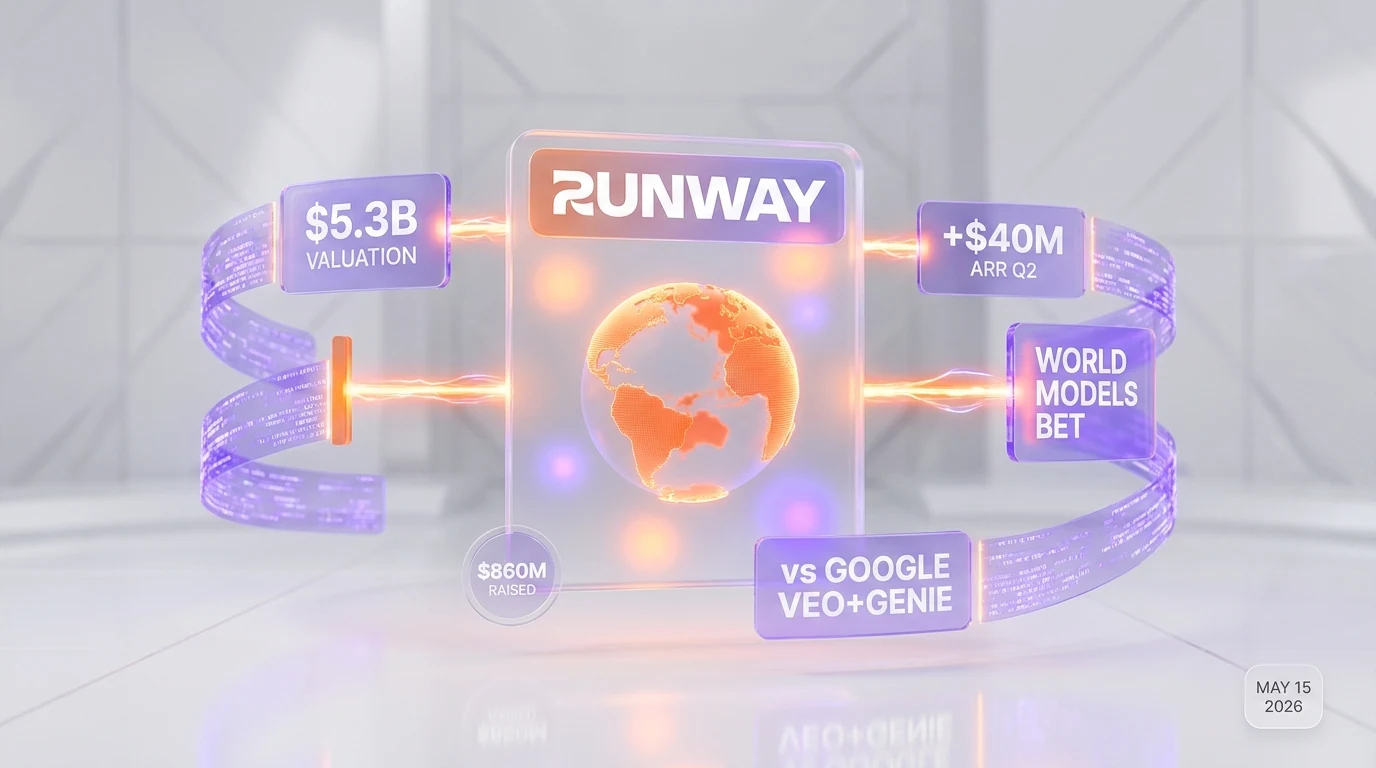
Runway is an AI research company that builds generative video and world models, profiled by TechCrunch on May 15, 2026. It is valued at $5.3 billion, added $40 million in annual recurring revenue in Q2 2026, and has raised $860 million total — including a $315 million Series C in February 2026 from AMD Ventures and Nvidia. Co-CEO Anastasis Germanidis is positioning Runway explicitly against Google's Veo video model and Genie world model, arguing that world models — not large language models — are the real frontier of AI.
Disclosure: ThePlanetTools.ai has no affiliate relationship, commercial partnership, or financial stake in Runway, Google, Luma AI, or World Labs. We do not earn a commission from anything mentioned here. This is an editorial strategy analysis, not a sponsored review. Figures are sourced from the May 15, 2026 TechCrunch profile and cited inline.
The Contrarian Bet Nobody Else Is Making at This Scale
Most of the AI industry has spent three years converging on a single thesis: scale language models, wrap them in agents, and ship. Runway is doing the opposite. In its TechCrunch profile published May 15, 2026, the company laid out a position that, in my read, is the most genuinely contrarian strategy bet held by any AI company above a $5 billion valuation right now: that the path to general intelligence runs through world models trained on video, audio, and sensor data — not through more text tokens.
This is not a marketing posture. Runway shipped its first world model in December 2025 and has a second one scheduled for 2026. It spun up a robotics unit in 2025 that co-CEO Anastasis Germanidis says "has already resulted in real-world testing and deployments." And it has the balance sheet to fund a long bet: $860 million raised, a $5.3 billion valuation, and $40 million in fresh ARR added in Q2 2026 alone.
The strategic question this article digs into is not "does Runway have good models?" — it's a sharper one: is refusing the LLM game a defensible position, or a positioning trap against an opponent with infinitely deeper pockets? The opponent, named explicitly by Runway itself, is Google.
Why This Matters Beyond Runway
Runway is now one of three well-funded labs publicly anchoring their entire identity to the post-LLM world-models thesis. That clustering is the story. When a $5.3B company, Yann LeCun's new venture, and Jeff Bezos's secret lab all converge on the same contrarian frontier in the same quarter, it stops being a fringe view and starts being a fault line in the industry. We covered the adjacent moves in our coverage of AMI Labs' $1.03B seed round on world models and Jeff Bezos's Project Prometheus physical world-models lab. Runway is the only one of the three already shipping commercial product and booking ARR against the bet.
What a "World Model" Actually Means Here
A world model is a system that learns a predictive, simulatable representation of how the physical or visual world behaves — so it can generate, anticipate, and reason about scenes, motion, and consequences, rather than just predict the next word. Where an LLM models language, a world model models reality. Runway's framing, per Germanidis in the TechCrunch piece, is that "we need to leverage less biased data" — video and sensor streams — instead of language models trained on internet text.
That phrase, "less biased data," is the strategic core. Internet text is a heavily curated, opinionated, lossy compression of the world. Video and sensor data, the argument goes, encode physics, causality, and continuity that text never captures. If that thesis is right, the labs that own the world-modeling stack inherit robotics, simulation, autonomous systems, and embodied AI — markets an order of magnitude larger than chatbots.
From Filmmaker Tool to Frontier Lab
Runway's three co-founders — Anastasis Germanidis (co-CEO, Greece), Cristóbal Valenzuela (co-CEO, Chile), and Alejandro Matamala Ortiz (chief innovation officer, Chile) — met in 2016 at NYU's ITP program. The company started as a creative tool for filmmakers and video editors. The reframe from "AI video app" to "world models research lab" is, in my view, the single most important narrative move Runway has made — and it is what separates this profile from a routine funding story.

The Multimodal Training Argument
Runway trains across "text, video, voice, and other sensors," per the profile. The strategic logic is that a model exposed to continuous, grounded, multi-sensory streams develops a representation of cause and effect that a text-only model structurally cannot. This is the same intuition driving the broader post-LLM camp — but Runway is the one monetizing it today through its generative video products while the research compounds.
The Real Frontier: Runway's Implicit Critique of the LLM-Centric Industry
Strip away the polite framing and Runway's TechCrunch positioning is a strategic critique of the entire LLM-centric industry. The implicit claim: the field has over-indexed on language because language was the cheapest modality to scale, not because it was the most general path to intelligence. That is a defensible strategic argument, and it is worth taking seriously precisely because the people making it are shipping product, not just publishing papers.
In my read, the strength of this position is asymmetry. If LLM scaling continues to deliver, Runway still has a strong generative-media business. If LLM scaling hits a wall — and a non-trivial slice of the research community thinks it might — Runway is one of the very few companies already three years into the alternative. That is a structurally smart hedge for a company this size, regardless of whether you buy the thesis.

Where the Critique Gets Weaker
The position has a real vulnerability, and it is not technical — it is competitive. The moment you declare world models the frontier and name Google as your benchmark, you are competing on Google's terms on Google's turf. Google has Veo, Genie, DeepMind, TPUs, YouTube-scale video data, and effectively unlimited capital. Runway has $860 million and a sharper focus. Focus beats scale often enough in startups that this is not hopeless — but the framing raises the stakes deliberately, and that is a strategic choice worth scrutinizing.
The Narrative Risk
There is also a narrative-timing risk. Runway is making this bet loud at a moment when "world models" is becoming a crowded thesis. Being early and contrarian is valuable; being one of several voices in a suddenly fashionable category is less differentiating. Runway's defensible answer is execution: it is the only one of the cohort booking commercial ARR against the thesis right now. Whether that translates into a durable moat is the open question.
The Financial Picture: $5.3B Valuation, +$40M ARR in One Quarter
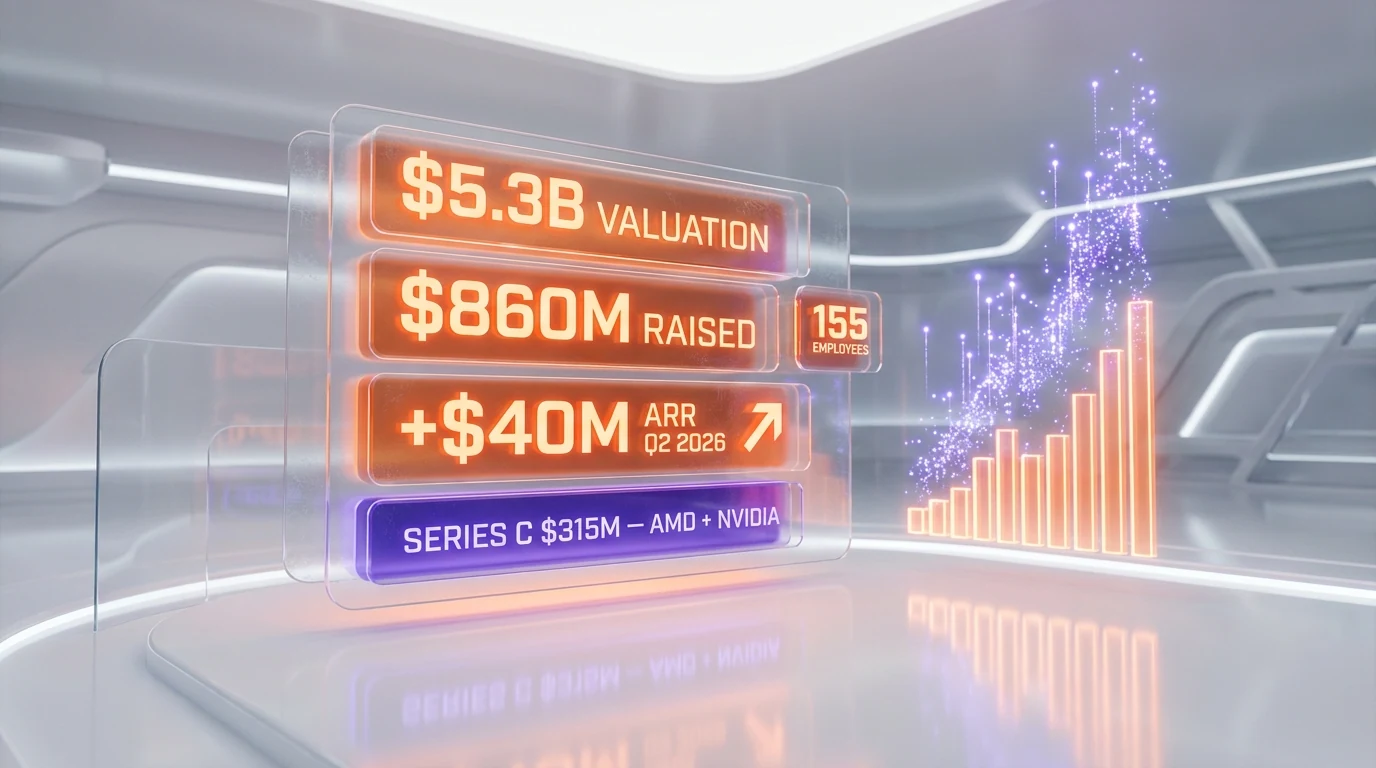
The numbers in the TechCrunch profile are the part of this story that is not interpretive — they are reported facts, and they are strong. Here is the full financial snapshot as of May 15, 2026.
Funding & Valuation Table
| Metric | Figure (May 15, 2026) | Source |
|---|---|---|
| Valuation | $5.3 billion | TechCrunch profile |
| Total raised | $860 million | TechCrunch profile |
| Latest round (Series C) | $315 million, February 2026 | TechCrunch profile |
| Series C investors | AMD Ventures, Nvidia | TechCrunch profile |
| ARR added in Q2 2026 | $40 million | TechCrunch profile |
| Headcount | 155 employees | TechCrunch profile |
Reading the Q2 ARR Number Strategically
The headline financial signal is not the valuation — valuations are sentiment. It is the $40 million in ARR added in a single quarter. That is a real demand signal showing the generative-video business is funding the world-models research, not the other way around. Strategically, this matters enormously: it means Runway can run a long-horizon research bet without being forced into a fundraising treadmill or a premature exit. Self-funding the contrarian thesis is the difference between a strategy and a wish.
Why AMD Ventures and Nvidia Both Wrote Checks
The Series C investor list is its own signal. Having both AMD Ventures and Nvidia on the cap table is unusual — these are competing silicon vendors. In my read, that tells you world-model training is compute-hungry enough that both chipmakers want strategic exposure to whoever ends up owning the workload. It is an indirect endorsement of the thesis from the two companies who would know the compute economics best.
The Robotics Unit: Where the Thesis Gets Tested in the Physical World
Runway launched a robotics unit in 2025. Per Germanidis in the profile, it "has already resulted in real-world testing and deployments." This is the part of the strategy that, if it holds, validates everything else — because robotics is the domain where world models either work or visibly fail.
A language model that hallucinates produces a wrong sentence. A world model controlling a robot that hallucinates produces a physical failure you can see. Robotics is therefore the highest-stakes proving ground for the entire thesis, and the fact that Runway is already in real-world deployments — not just demos — is, in my read, the most underrated detail in the TechCrunch piece. It moves the world-models claim from "interesting research" to "tested against reality."
What "Deployments" Does and Doesn't Tell Us
I want to be precise about claims here. "Real-world testing and deployments" is the founder's characterization; the profile does not detail scale, customers, or revenue from the robotics unit. So the honest read is: Runway has crossed from simulation into physical testing, which is strategically significant, but the robotics unit's commercial weight is unproven. It is a credibility marker, not yet a business line — and treating it as more than that would be over-reading the source.
Runway vs Google: The Positioning That Defines the Story
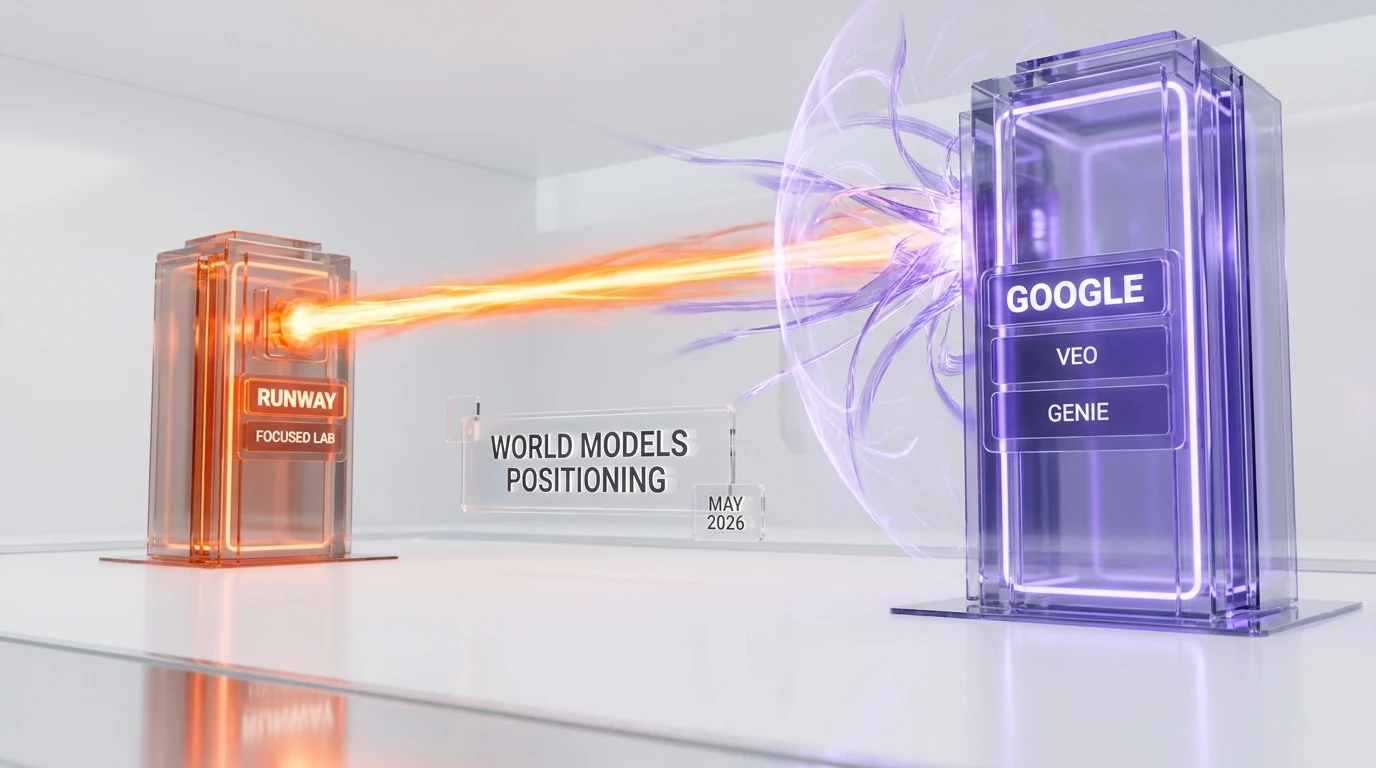
Runway named its opponent. The profile frames Google as the biggest competitive threat — specifically Veo (video) and Genie (world model). Choosing to be measured against Google is a deliberate, high-conviction positioning move, and it is worth analyzing on its own terms.
The Case For Runway's Positioning
The strategic upside of naming Google is clarity. It tells investors, talent, and customers exactly what game Runway is playing and why it thinks it can win: focus, speed, and a single-thesis organization versus a diversified giant where world models are one of dozens of priorities. In frontier categories, a focused challenger that ships fast has repeatedly out-maneuvered incumbents distracted by everything else. Runway is betting that pattern holds again.
The Case Against It
The strategic risk is equally clear. Google's Veo and Genie are backed by DeepMind's research depth, YouTube's video corpus, TPU infrastructure, and a balance sheet Runway cannot match by orders of magnitude. When you set the giant as your benchmark, every comparison becomes a referendum on whether $860 million of focus can beat effectively unlimited capital and data. That is a narrative Runway has chosen to live or die by — which is brave, and which I think is the single most consequential strategic decision in the profile.
How Runway Stacks Up Against the Video Field
Google is the named rival, but Runway's commercial generative-video product competes in a crowded field. We've benchmarked the leading models hands-on across several comparisons: Runway Gen-4.5 vs Veo 3.1 covers the head-to-head with Google's flagship; Runway vs Kling AI looks at the filmmaker use case; Veo 3.1 vs Kling 3 Omni maps the frontier video tier; and Higgsfield AI vs Leonardo.ai covers the broader creative-suite landscape. The product reviews are also worth reading alongside this analysis: Runway (Gen-4.5), Veo 3.1, Kling 3.0 Omni, and Pika.
The Google Leak Context
Runway's Google framing also lands at a charged moment for Google's own video roadmap. We covered the pre-I/O surfacing of Google's unified video play in the Gemini Omni leak analysis. Runway choosing to name Google in the same window is, in my read, not accidental — it is a company planting its flag before the giant fully shows its hand.
The Second World Model: The 2026 Catalyst to Watch
Runway shipped its first world model in December 2025. A second is scheduled for 2026. That launch is the single most important upcoming catalyst for evaluating whether the thesis is compounding or stalling. The strategic question is not whether it ships — it's whether the second model demonstrates a capability jump that text-trained systems structurally cannot match. If it does, the contrarian bet starts looking prescient. If it is incremental, the "world models are the frontier" narrative gets harder to sustain against Google's resources.
What I'll Be Watching
Concretely, the signals that matter: whether the second world model shows measurable gains in physical consistency and long-horizon prediction; whether the robotics unit moves from "deployments" to named customers; and whether ARR keeps compounding at the Q2 pace. Those three together would convert the thesis from a confident claim into a demonstrated trajectory.
What Would Prove Me Wrong
I have argued that Runway's contrarian, self-funded, single-thesis bet is a structurally smart hedge. Here is what would make that read wrong. First: if Google's Veo and Genie open a capability gap that focus cannot close — capital and data advantages do compound, and "focused challenger beats giant" is a pattern, not a law. Second: if the second 2026 world model is incremental rather than a step-change, the thesis loses its strongest evidence. Third: if the Q2 ARR surge proves to be a one-quarter spike rather than a trend, the self-funding argument collapses and the long bet becomes fundraising-dependent. Fourth: if "world models" becomes so crowded that Runway's early-mover advantage erodes before it converts to a moat. I think the hedge is sound today; I would change that view fast on any of those four signals.
Our Take
In my read, Runway is making one of the more intellectually honest strategic bets in AI right now: it has picked a thesis, named its opponent, declined the consensus game, and — critically — is funding the bet with real revenue rather than narrative. That last point is what separates it from most contrarian positioning. The vulnerability is not the thesis; it is the deliberate choice to be benchmarked against an opponent with structurally unlimited resources. That is a brave framing, and it makes the next world-model launch the most consequential single event on Runway's 2026 roadmap. We are not affiliated with Runway, Google, or any company named here — this is our independent strategic read of the May 15, 2026 TechCrunch profile, and we will revisit it when the second world model ships.
Disclosure (repeat): No affiliate links, no sponsorship, no financial stake in Runway, Google, or any company mentioned. Independent editorial analysis. Source: TechCrunch — "Runway started by helping filmmakers. Now it wants to beat Google at AI" (May 15, 2026).
Frequently Asked Questions
What is Runway and what does it build?
Runway is an AI research company that builds generative video and world models. As of the May 15, 2026 TechCrunch profile, it is valued at $5.3 billion, has raised $860 million total, and added $40 million in annual recurring revenue in Q2 2026. It started as a creative tool for filmmakers and has repositioned as a world-models research lab.
What is Runway's valuation in 2026?
Runway is valued at $5.3 billion as of May 15, 2026, per TechCrunch. It has raised $860 million in total funding, including a $315 million Series C in February 2026 led by AMD Ventures and Nvidia.
What is a world model and why is Runway betting on it?
A world model is an AI system that learns a predictive, simulatable representation of how the physical or visual world behaves, rather than predicting the next word like a language model. Runway is betting on world models because co-CEO Anastasis Germanidis argues AI needs "less biased data" — video, voice, and sensor streams — instead of language models trained on internet text.
How is Runway competing against Google?
Runway explicitly names Google as its biggest competitive threat, specifically Google's Veo video model and Genie world model. Runway's strategy is focus and speed as a single-thesis lab versus Google's diversified scale. It also competes with startups Luma AI ($900M raised) and World Labs ($1.29B raised).
How much ARR did Runway add in Q2 2026?
Runway added $40 million in annual recurring revenue in Q2 2026, per the TechCrunch profile. This revenue from its generative-video products is what allows Runway to self-fund its long-horizon world-models research without a fundraising treadmill.
Who founded Runway?
Runway was founded by Anastasis Germanidis (co-CEO, from Greece), Cristóbal Valenzuela (co-CEO, from Chile), and Alejandro Matamala Ortiz (chief innovation officer, from Chile). They met in 2016 at NYU's ITP program.
Does Runway have a robotics unit?
Yes. Runway launched a robotics unit in 2025. Co-CEO Anastasis Germanidis says it "has already resulted in real-world testing and deployments." The profile does not disclose scale, customers, or revenue, so the robotics unit is a credibility marker rather than a proven business line as of May 2026.
When is Runway's second world model launching?
Runway shipped its first world model in December 2025 and has a second world model scheduled to launch in 2026. That launch is the key catalyst for judging whether Runway's contrarian thesis is compounding or stalling against Google's resources.
Is Runway better than Google Veo for video generation?
It depends on use case. Runway Gen-4.5 and Google Veo 3.1 sit in the same top tier of AI video models. We compare them hands-on in our Runway Gen-4.5 vs Veo 3.1 analysis. Runway's strategic differentiator is its world-models research direction, not just per-clip video quality.
Who else is betting on world models in 2026?
Runway is one of several well-funded labs anchored to the post-LLM world-models thesis. Others include Yann LeCun's AMI Labs ($1.03B seed) and Jeff Bezos's Project Prometheus (targeting ~$10B). Runway is the only one of the cohort already booking commercial ARR against the bet.
Why did both AMD and Nvidia invest in Runway?
Runway's $315 million February 2026 Series C included both AMD Ventures and Nvidia — competing silicon vendors. The likely read is that world-model training is compute-intensive enough that both chipmakers want strategic exposure to whoever ends up owning that workload.
How many employees does Runway have?
Runway has 155 employees as of May 2026, with offices in New York, London, San Francisco, Seattle, Tel Aviv, and Tokyo, per the TechCrunch profile.