Jeff Bezos is closing in on a $10 billion funding round for Project Prometheus at a $38 billion post-money valuation, with JPMorgan Chase and BlackRock leading the deal, according to Bloomberg and the Financial Times on April 21, 2026. Co-founded by Bezos and Vik Bajaj (former Google X, Verily, Foresite Labs) in November 2025, Prometheus builds physical AI models that learn engineering, manufacturing, aerospace, and automotive dynamics from real-world data rather than text. The lab already employs 120+ researchers recruited from OpenAI, Google DeepMind, Meta, and xAI across San Francisco, London, and Zurich, and previously raised $6.2 billion at launch.
What Just Happened: The $10 Billion Scoop
On April 21, 2026, Bloomberg broke the story that Jeff Bezos is nearing the close of a $10 billion funding round for his secretive AI lab, codenamed Project Prometheus. The Financial Times confirmed the reporting the same day. The round would value Prometheus at $38 billion post-money — a number that puts the roughly five-month-old company ahead of every pure-play AI startup in the world except OpenAI, Anthropic, xAI, and SSI.
The two lead investors are not Silicon Valley venture firms. They are JPMorgan Chase and BlackRock — the largest bank and the largest asset manager in the United States. This is unusual. Most AI labs at this stage raise from Andreessen Horowitz, Sequoia, Founders Fund, or sovereign wealth vehicles. JPMorgan and BlackRock are institutional, conservative, and rarely write single-line-item checks this early in a technology cycle. Our read is that Bezos is deliberately routing around traditional VC to plug Prometheus directly into the deepest pools of institutional capital on the planet. If the company needs $50 billion, $100 billion, or more to build physical AI infrastructure at industrial scale, JPMorgan and BlackRock are the only two names that can underwrite that without blinking.
Total capital raised by Prometheus now stands above $16 billion, including the $6.2 billion that Bezos personally anchored at the November 2025 launch. This is the single largest AI funding trajectory of any company outside the frontier lab top three, achieved in under six months, by a startup that has shipped zero public products.
The Deal at a Glance
| Metric | Value | Source |
|---|---|---|
| Current round | $10 billion | Bloomberg, April 21, 2026 |
| Post-money valuation | $38 billion | Bloomberg / FT |
| Lead investors | JPMorgan Chase + BlackRock | Bloomberg / FT |
| Launch funding (Nov 2025) | $6.2 billion (Bezos-anchored) | Wikipedia / TFN |
| Total raised to date | $16+ billion | Cumulative |
| Headcount | 120+ researchers (as of Dec 2025) | Public reporting |
| Headquarters | San Francisco (plus London, Zurich) | Corporate filings |
| Products shipped | 0 public | — |
For context: the current round alone is almost 10x the size of AMI Labs' entire $1.03 billion seed, and the $38 billion valuation is roughly 11x AMI Labs' $3.5 billion pre-money mark. Fei-Fei Li's World Labs sits at $1 billion. Prometheus has, in five months, become larger on paper than both LeCun and Li combined — by an order of magnitude. That is the scoop.
What Is Project Prometheus?
Project Prometheus is an AI lab incorporated in November 2025 in San Francisco, co-founded and co-led by Jeff Bezos and Vik Bajaj. The stated mission is to build AI systems that understand the physical world — engineering, manufacturing, aerospace, automotive, and pharmaceutical workflows — by training on experimental data, robotics interactions, and machine-readable engineering artifacts rather than on text corpora.
The name is not accidental. In Greek mythology, Prometheus stole fire from the gods and gave it to humanity. Bezos has spent a decade positioning Amazon, Blue Origin, and Kuiper around industrial automation and space manufacturing. Prometheus is the software brain those verticals have been missing. The codename signals ambition at civilizational scale — AI for the physical economy, not AI for chatbots.
The Founders
Jeff Bezos — Founder of Amazon, Blue Origin, Kuiper, and Bezos Expeditions. Serves as co-CEO of Prometheus and has been personally leading the $10 billion fundraising conversations with JPMorgan and BlackRock. This is his first operational AI lab role, and the first time since Amazon that he is listed as a co-CEO of an early-stage company.
Vik Bajaj (Vikram Bajaj) — Co-CEO. PhD in physical chemistry from MIT. Led early work on Wing (drone delivery) and Waymo (self-driving) inside Google X, Alphabet's moonshot factory. Co-founded Alphabet's Verily and later Foresite Labs and Xaira Therapeutics, an AI drug discovery company. Bajaj is one of a small handful of operators in the world who has actually shipped physical-world AI products at scale. His presence is what gives JPMorgan and BlackRock the comfort to write this check.
Sherjil Ozair — Technical co-founder. Former Google DeepMind researcher. Founded General Agents, an agentic computing startup that Prometheus acquired in November 2025 as its technical backbone.
William Guss — Technical co-founder. Formerly at OpenAI. Joined via the General Agents acquisition.
This is not a typical AI lab. Bezos + Bajaj is the rarest combination in tech: the most successful physical-world operator of the last thirty years paired with one of the most credentialed moonshot scientists in the industry. It is, on paper, a dream team. Our analysis is that the founders' profile is what justifies the $38 billion valuation far more than any product roadmap that could possibly exist at month five.
The Post-LLM Wars: Bezos vs LeCun vs Li
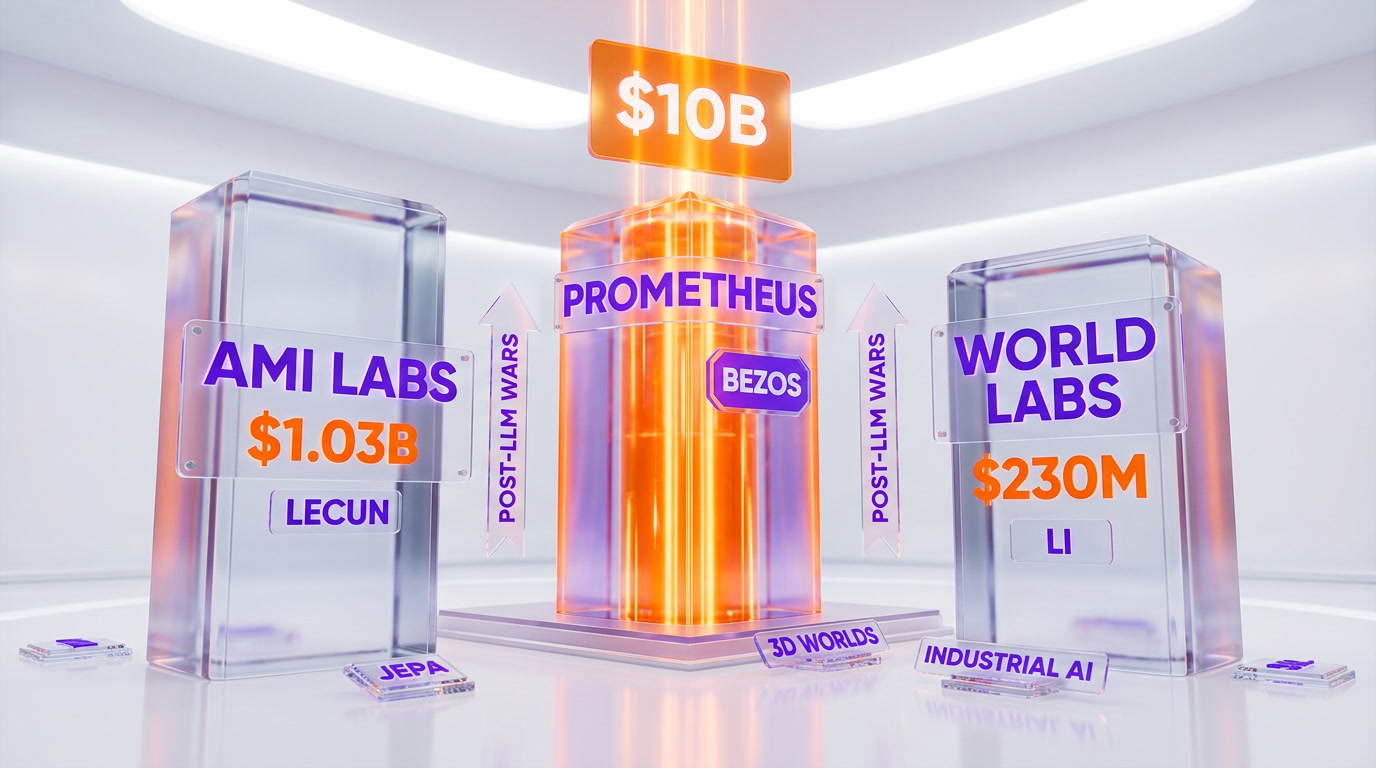
Three of the most important figures in artificial intelligence have, in the span of six months, made the same bet with different vehicles. All three believe that large language models have hit a structural ceiling on the road to general intelligence — that scaling next-token prediction will not, by itself, produce systems that understand physics, causality, or embodied action. All three are building world models. The difference is scale, thesis, and strategy.
The Three Bets Compared
| Lab | Founder | Raised | Valuation | Focus | Strategy |
|---|---|---|---|---|---|
| Project Prometheus | Jeff Bezos + Vik Bajaj | $16B+ | $38B | Physical AI for industry (aerospace, auto, manufacturing, pharma) | Closed. Industrial acquisitions. |
| AMI Labs | Yann LeCun | $1.03B (seed) | $3.5B | JEPA world models, spatial reasoning, physics | Open-source committed. Academic-style. |
| World Labs | Fei-Fei Li | $230M (Series A) | $1B | 3D spatial intelligence, generative worlds, mixed reality | Selective / product-first |
Read the table carefully. Prometheus has raised roughly 16 times more than AMI Labs and 70 times more than World Labs. Its valuation is 11x AMI Labs' and 38x World Labs'. And it started five months after LeCun's lab. This is not a competition — it is a different category of bet. LeCun and Li are building research-first labs that ship open weights or developer platforms. Prometheus is building an industrial operating system.
One detail matters enormously: Bezos is a personal investor in AMI Labs (through Bezos Expeditions, as disclosed in AMI's $1.03 billion seed roster), while simultaneously co-running Prometheus. Our read is that he is deliberately hedging — if LeCun's JEPA approach wins the research race, Bezos already owns equity. If Prometheus wins the industrial race, he owns the category. If both win in their respective niches, he owns both. It is the same playbook he used with Amazon, Blue Origin, and The Washington Post: concentrated bets across adjacent frontiers.
Why All Three Reject LLMs for AGI
The shared thesis across Bezos, LeCun, and Li is that large language models are fundamentally incapable of general physical intelligence, regardless of scale. The reasoning is technical and consistent:
- LLMs predict text tokens, not reality. Next-token prediction is a proxy for probability distributions over language, not over physical dynamics. No amount of scaling converts a language model into a physics simulator.
- LLMs have no persistent world state. They forget context between sessions and cannot maintain object permanence across interactions.
- LLMs learn from text about physics, not physics itself. Reading descriptions of how a piston works does not enable a model to diagnose a misfiring engine from sensor data.
- Industrial workflows are not sequences of tokens. They are graphs of operations, constraints, materials, and tolerances — a representation that transformer architectures handle poorly.
Prometheus, AMI Labs, and World Labs each propose a different architectural fix. LeCun bets on JEPA (Joint Embedding Predictive Architecture). Li bets on 3D scene generation. Bezos and Bajaj bet on multi-modal trial-and-error learning grounded in real-world engineering data. The industry has not yet decided which approach wins.
Why JPMorgan and BlackRock Changed the Game

The identity of the lead investors is the most underappreciated signal in this story. JPMorgan Chase manages roughly $4 trillion in assets. BlackRock manages approximately $11.5 trillion. Together they represent more institutional capital than the entire global venture capital industry combined, multiple times over.
Historically, neither firm has led an early-stage AI round. They participate in late-stage pre-IPO deals once a company has revenue and governance. That is the standard playbook. The Prometheus round breaks that pattern in three ways:
- Stage mismatch. Prometheus has no product and roughly five months of operating history. Traditional institutional checks happen at Series C or later.
- Valuation mismatch. A $38 billion valuation is normally reserved for companies with several hundred million dollars in annual recurring revenue. Prometheus has zero.
- Sector mismatch. Institutional capital usually approaches AI through public markets (NVIDIA, Microsoft, Meta equity) rather than private primary rounds.
Our read is that JPMorgan and BlackRock are not underwriting a startup. They are underwriting Jeff Bezos and Vik Bajaj as a management team, and they are positioning to become the anchor financiers of a vertical that could absorb hundreds of billions of dollars over the next decade. The signal to the market is that industrial AI is now an institutional asset class, not a venture asset class. That reframing changes everything about how future physical AI companies will be funded.
The Physical World Thesis

Prometheus' technical bet is that the next generation of industrial AI must be trained on data that reflects physical reality: sensor readings, CAD files, manufacturing tolerances, flight telemetry, supply-chain constraints, pharmaceutical assay data, and robotic interaction logs. Text-trained LLMs, no matter how large, have never seen a tolerance stack-up, a material phase diagram, or a real-world aerodynamic load.
Based on public reporting, the company's priority verticals are:
- Aerospace and spacecraft design — a direct adjacency to Blue Origin, which Bezos controls
- Automotive engineering — Tesla, Ford, and the legacy OEMs are all racing to retrofit AI into design cycles
- Advanced manufacturing — factory floors, robotic cells, process automation
- Pharmaceutical discovery — a direct adjacency to Bajaj's prior company Xaira Therapeutics
- Agentic engineering workflows — the asset from the General Agents acquisition
The strategic implication is that Prometheus is not competing with OpenAI or Anthropic on chatbots, coding copilots, or general-purpose APIs. It is competing with industry itself — or rather, selling into it. Bezos has reportedly floated the idea of raising up to $100 billion for a parallel holding company that would acquire legacy industrial firms, install Prometheus as their AI operating system, and use their proprietary operational data as a proprietary training moat. If that plan executes, Prometheus becomes the most vertically integrated AI company in history.
Amazon, Blue Origin, Kuiper: The Bezos Industrial Flywheel
Prometheus does not exist in a vacuum. Jeff Bezos already owns or controls four of the most data-rich industrial businesses on the planet:
- Amazon — 1.5 million+ warehouse robots, the largest logistics network in the world, a decade of fulfillment-center telemetry
- Blue Origin — rocket engines, reusable boosters, spacecraft manufacturing data
- Kuiper — low-earth-orbit satellite network (Amazon's Starlink competitor)
- Zoox — Amazon-owned autonomous vehicle company with millions of miles of driving data
Each of these generates the exact type of proprietary physical-world data that Prometheus needs to train on. None of this data is in GPT-4's training set. None of it can be obtained by scraping the web. Our read is that Prometheus has quietly secured — or is in the process of securing — privileged data-access agreements with Amazon, Blue Origin, and Zoox. If that turns out to be the case, Prometheus inherits a data moat that no other AI lab in the world can replicate. OpenAI cannot scrape warehouses. Anthropic cannot read rocket telemetry. Google DeepMind does not have a satellite constellation.
The $38 billion valuation starts to look less absurd when you model it as a holding-company vehicle that monetizes the AI layer across the entire Bezos industrial stack. It is closer in spirit to Palantir + Amazon Robotics + SpaceX combined than to a conventional AI startup.
The Hiring Blitz: 120+ From OpenAI, DeepMind, Meta, xAI
Public reporting confirms that Prometheus crossed 120 employees by December 2025 — less than 45 days after incorporation. That is an aggressive hiring pace by any standard. The talent is sourced from OpenAI, Google DeepMind, Meta FAIR, and xAI, with offices in San Francisco, London, and Zurich.
Two hiring patterns stand out. First, Prometheus appears to target researchers with robotics, reinforcement learning, and simulation backgrounds rather than pure-play language model engineers. This is consistent with the physical-world thesis. Second, the London and Zurich offices suggest the company is going after European talent pools that OpenAI and Anthropic have historically underserved — and that LeCun's AMI Labs (Paris) is also competing for.
Compensation data is not public, but sources suggest offers in the multi-million-dollar range for senior research hires, in line with the frontier-lab market rate. With $16 billion in capital on hand and limited product urgency, Prometheus can afford to outbid almost anyone for the researchers it wants.
The General Agents Acquisition
In November 2025, shortly after incorporation, Prometheus acquired General Agents, an agentic computing startup founded by Sherjil Ozair (ex-Google DeepMind) and William Guss (ex-OpenAI). The acquisition terms were not disclosed, but sources reported the deal was cash-and-stock and fully absorbed the General Agents team into Prometheus' technical leadership.
General Agents was building autonomous software agents capable of executing multi-step engineering and computing tasks. The technology stack — agentic reasoning layered on top of foundation models — is a credible starting point for the kind of industrial AI systems Prometheus is now positioned to build. More importantly, the acquisition bought Prometheus two things it could not build in six months: (1) a working technical foundation, and (2) the trust of two respected AI research lineages (DeepMind and OpenAI) via the founders. Our analysis is that General Agents was less about the product and more about compressing time — buying 12 to 18 months of R&D for whatever the deal cost.
Our Analysis: What $38 Billion Actually Buys

A $38 billion valuation at month five with zero revenue is only rational under one of three theses. We walk through each.
Thesis 1 — Prometheus becomes the AGI winner
If you believe physical-world AI is the only credible path to AGI, and if you believe Prometheus is the best-resourced bet on that path, then $38 billion is a reasonable entry point to what could become a trillion-dollar company. This is the LeCun-thesis investment framing. The risk is high — AGI timelines are uncertain, and neither Prometheus nor its peers have shown a working world model at scale.
Thesis 2 — Prometheus captures industrial AI revenue
If Prometheus becomes the dominant AI platform for aerospace, automotive, manufacturing, and pharma — charging licensing fees, running agentic workflows, and monetizing proprietary data — it could plausibly generate $5 billion to $20 billion in annual revenue within five to seven years. At a 10-20x revenue multiple, that maps to a $50-400 billion enterprise value. A $38 billion entry valuation is aggressive but defensible under this framing.
Thesis 3 — Prometheus is the Bezos holding-company play
The most compelling read, in our view, is that Prometheus is not a startup at all. It is the AI operating system for a multi-decade industrial roll-up that Bezos intends to execute with institutional capital. Under this framing, $38 billion today is a down payment on a $100 billion-plus capital stack that will acquire and AI-ify portions of the industrial economy. The comparables are not OpenAI or Anthropic. They are Berkshire Hathaway, BlackRock's own GIP infrastructure arm, or Brookfield. This thesis explains why JPMorgan and BlackRock wrote the lead check. It also explains the Bezos-Expeditions investment in AMI Labs — a research hedge on the purely technical wing of the same bet.
The Risks Worth Naming
- Execution. Bezos has never run an AI lab. Bajaj has shipped physical-world products but not foundation models. The team is world-class, but untested at this specific intersection.
- Valuation pre-product. Zero revenue at $38 billion leaves no margin for error. A single public technical failure could halve the valuation in a future round.
- Competition. OpenAI, Anthropic, Google DeepMind, and xAI all have multi-billion-dollar physical-AI research programs. Prometheus is not alone in this space.
- Antitrust. A Bezos-linked AI lab with privileged data access to Amazon, Blue Origin, and Zoox could attract early regulatory attention, particularly in the EU and under a restructured FTC.
- Talent concentration risk. 120+ researchers is a small team to justify $38 billion. Key-person risk is elevated.
What Happens Next
The $10 billion round has not formally closed as of April 23, 2026. Bloomberg and FT report it is close to closing. The next milestones to watch, in rough order of likelihood:
- Round close announcement — expected within weeks, likely paired with a hiring or product teaser.
- First public demo or benchmark — the market will want evidence that the $38 billion valuation is backed by working technology.
- Holding-company announcement — if Bezos formalizes the rumored $100 billion industrial-acquisition vehicle, Prometheus' category redefines in real time.
- Amazon / Blue Origin partnership disclosures — the data-flywheel thesis becomes credible or falsifiable based on these filings.
- Response from OpenAI and Anthropic — both will feel pressure to articulate a physical-AI strategy, either by partnership, acquisition, or dedicated product lines.
For context on the broader post-LLM landscape, see our coverage of AMI Labs' $1.03B seed round and Yann LeCun's JEPA thesis, the Anthropic $800B IPO and revenue race against OpenAI, the leaked OpenAI memo accusing Anthropic of inflating revenue by $8 billion, and how Meta killed open-source with Muse Spark. For the current frontier model leader on the closed-source side, our ongoing Claude coverage tracks the state of the art in reasoning and agentic workflows.
The Bottom Line
Project Prometheus is the most significant AI funding story of April 2026, and arguably of the post-LLM era. Our read: this is not a research lab, it is the beginning of an industrial roll-up disguised as a startup. Jeff Bezos is using Vik Bajaj's scientific credibility and JPMorgan plus BlackRock's institutional firepower to position the AI operating system for the physical economy, not the digital one. The $38 billion valuation is aggressive, but the founders and the data-flywheel thesis justify serious attention. The three-way post-LLM race — Bezos, LeCun, Li — is now the main event of 2026, and Prometheus has just taken the capital lead by an order of magnitude.
If you are an operator in aerospace, automotive, manufacturing, or pharma, assume Prometheus is coming for your vertical within 24 months. If you are an AI engineer, the physical-AI hiring market just got multi-billion-dollar backstops. If you are an investor, the signal from JPMorgan and BlackRock is that industrial AI is now an institutional asset class — start repositioning accordingly.
Frequently Asked Questions
What is Project Prometheus and who founded it?
Project Prometheus is a San Francisco-based AI lab incorporated in November 2025, co-founded and co-led by Jeff Bezos and Vik Bajaj (a physical chemist who previously led early work on Wing and Waymo at Google X and co-founded Verily, Foresite Labs, and Xaira Therapeutics). Technical co-founders Sherjil Ozair (ex-Google DeepMind) and William Guss (ex-OpenAI) joined via the November 2025 acquisition of their agentic computing startup General Agents. The company builds AI models that understand the physical world — aerospace, automotive, manufacturing, and pharmaceutical workflows — trained on real-world engineering data rather than text.
How much is Prometheus raising and at what valuation?
Bloomberg and the Financial Times reported on April 21, 2026 that Prometheus is close to closing a $10 billion funding round at a $38 billion post-money valuation, with JPMorgan Chase and BlackRock leading the deal. Combined with the $6.2 billion that Bezos anchored at the November 2025 launch, total capital raised stands above $16 billion. The round has not yet formally closed as of April 23, 2026.
Why are JPMorgan and BlackRock leading an early-stage AI round?
JPMorgan manages roughly $4 trillion in assets and BlackRock manages about $11.5 trillion. Neither firm traditionally leads pre-product Series B rounds in AI — those checks usually come from Andreessen Horowitz, Sequoia, or sovereign wealth funds. Our read is that Bezos is deliberately routing around traditional VC to plug Prometheus directly into institutional capital capable of underwriting the $50-100 billion Prometheus will likely need over the next decade. The signal to the market is that industrial AI is now an institutional asset class, not a venture one.
How does Project Prometheus compare to AMI Labs and World Labs?
All three are post-LLM world-model bets, but at radically different scales. Project Prometheus has raised $16+ billion at a $38 billion valuation (Bezos + Bajaj, industrial AI). AMI Labs raised a $1.03 billion seed at a $3.5 billion valuation (Yann LeCun, JEPA architecture, open-source). World Labs raised a $230 million Series A at a $1 billion valuation (Fei-Fei Li, 3D spatial intelligence). Prometheus is roughly 16x larger than AMI Labs and 70x larger than World Labs, and covers a different category — industrial operating system versus research labs. Notably, Bezos is also an investor in AMI Labs through Bezos Expeditions, hedging both technical directions.
What is Prometheus' business model and which industries is it targeting?
Prometheus targets aerospace (adjacent to Blue Origin), automotive engineering, advanced manufacturing, pharmaceutical discovery (adjacent to Bajaj's Xaira Therapeutics), and agentic engineering workflows (from the General Agents acquisition). Public reporting suggests Bezos is considering raising up to $100 billion for a parallel industrial holding company to acquire legacy firms, install Prometheus as their AI operating system, and use their proprietary operational data as a training moat. This positions Prometheus closer to Palantir + Amazon Robotics + Berkshire Hathaway than to OpenAI or Anthropic.
Does Prometheus have a data advantage over OpenAI and Anthropic?
Potentially yes. Jeff Bezos controls Amazon (1.5M+ warehouse robots, global logistics telemetry), Blue Origin (rocket engines, reusable booster data), Kuiper (low-earth-orbit satellite constellation), and Amazon-owned Zoox (autonomous vehicle driving data). This is exactly the type of proprietary physical-world data that LLM-trained labs cannot scrape from the web. If Prometheus secures privileged data-access agreements with these Bezos companies — which is our strong read — it inherits a training moat that OpenAI and Anthropic cannot replicate. That data flywheel is arguably what justifies the $38 billion valuation.
How many engineers does Prometheus employ and where are they from?
By December 2025, less than 45 days after incorporation, Prometheus had crossed 120 employees, recruited from OpenAI, Google DeepMind, Meta FAIR, and xAI. The company operates from San Francisco (headquarters), London, and Zurich. The London and Zurich offices compete directly with Yann LeCun's Paris-based AMI Labs for European AI talent pools. With $16 billion in capital on hand and limited product urgency, Prometheus can outbid almost any competitor for senior research hires at the multi-million-dollar compensation level.
Why is Project Prometheus named after the Greek titan?
In Greek mythology, Prometheus stole fire from the gods and gave it to humanity, enabling civilization-scale transformation. The codename signals the founders' ambition — Jeff Bezos and Vik Bajaj position Prometheus as the lab that brings AI-level intelligence to physical industries (aerospace, automotive, manufacturing, pharma), not just chatbots. The framing contrasts deliberately with OpenAI's safety-and-mission framing, Anthropic's alignment focus, and Google's consumer-and-enterprise approach. It also aligns with Bezos' broader industrial portfolio — Blue Origin, Kuiper, Zoox — where the company's output would function as the software layer on top of physical assets.
What is the General Agents acquisition and why does it matter?
In November 2025, shortly after incorporation, Prometheus acquired General Agents, an agentic computing startup founded by Sherjil Ozair (ex-Google DeepMind) and William Guss (ex-OpenAI). General Agents was building autonomous software agents capable of executing multi-step engineering tasks. Terms were not disclosed but sources reported a cash-and-stock deal. Our analysis is that the acquisition compressed 12-18 months of R&D by buying a working technical foundation and the trust of two respected AI research lineages. It also explains how Prometheus reached 120+ engineers within 45 days of incorporation — the General Agents team became the technical seed.
What are the biggest risks to Project Prometheus?
Five major risks. First, execution: Bezos has never run an AI lab, and Bajaj has shipped physical-world products but not foundation models. Second, valuation pre-product: zero revenue at $38 billion leaves no margin for a technical misstep. Third, competition: OpenAI, Anthropic, Google DeepMind, and xAI all have multi-billion-dollar physical-AI programs. Fourth, antitrust: a Bezos-linked AI lab with privileged data access to Amazon, Blue Origin, and Zoox could attract regulatory scrutiny in the EU and under a restructured FTC. Fifth, key-person risk: 120 researchers concentrating $38 billion of enterprise value is a tight constraint.
How does Prometheus compare to OpenAI and Anthropic in strategy?
OpenAI targets general-purpose consumer and developer AI with ChatGPT and the GPT API — its revenue model is usage-based subscriptions and enterprise licensing. Anthropic focuses on safety-forward enterprise AI with Claude — higher margins, more enterprise governance, and on track for an $800 billion IPO. Prometheus is categorically different: it does not plan to compete on chatbots or coding copilots. Instead, it targets the physical economy — aerospace, automotive, manufacturing, pharma — with proprietary industrial data as the moat and potentially a $100 billion acquisition vehicle as the distribution layer. It is the first major AI lab structured more like a Berkshire Hathaway than a SaaS company.
Will Prometheus go public or stay private?
No IPO plans have been publicly announced as of April 2026. Given the rumored $100 billion industrial holding-company plan, Prometheus is likely to remain private for years — institutional capital from JPMorgan and BlackRock gives it enough runway to skip traditional IPO timing. By contrast, Anthropic is reportedly targeting an $800 billion IPO, and OpenAI has repeatedly explored public-market structures. Our read is that Prometheus will remain private through at least 2028-2030 while it executes the industrial roll-up thesis, and will only consider an IPO once its revenue base and regulatory posture are fully formed.