
On August 24 and August 25, 2026, Nvidia and OpenAI each published efficiency results for a new inference system, one day apart. Nvidia said Vera Rubin NVL72 delivers up to 30 times higher throughput per megawatt than GB300 NVL72. OpenAI said its Jalapeño chip delivered 1.5 to 1.9 times more work per watt at peak throughput than the systems it was compared against. Both figures come from SemiAnalysis InferenceX, but from two different workload scenarios inside it, measured against two different baselines. Neither measurement was performed by SemiAnalysis: OpenAI ran its own, and Nvidia states its results are pending SemiAnalysis review. The two numbers cannot be placed side by side, and this article explains exactly why.
The temptation this week is obvious. Two efficiency announcements, a day apart, from the two companies whose rivalry defines the AI compute story. One says 30 times. The other says 1.9 times. The arithmetic writes itself, and it is wrong.
We went to the primary sources for both announcements, then to the benchmark that both cite, and the picture that emerged is more interesting than a scoreboard. The two companies did not use two unrelated benchmarks, which would be the easy explanation. They used the same benchmark in two different modes, against two different reference systems, to answer two different questions. That is a harder thing to see, and it is precisely why the numbers will end up next to each other in a lot of coverage.
What Each Company Actually Published
Start with what is on the pages, because the framing on each is more careful than the headline numbers suggest.
Nvidia, August 24
Nvidia's post, published on the company blog on August 24, 2026 and bylined Shruti Koparkar, is titled around the phrase "up to 30x more work per watt." The body describes "new on-silicon performance data measured by NVIDIA using real-world agentic coding trajectories." Two claims carry the post: up to 30 times higher throughput per megawatt, and up to 35 times lower cost per million tokens, both against Nvidia's own GB300 NVL72.
Three qualifiers in that post matter more than the headline, and Nvidia states all three itself:
- The 30 times figure is model-specific. Nvidia writes that Vera Rubin delivers "as much as 30x higher throughput per megawatt than GB300 NVL72 on the DeepSeek V4 Pro model." It is not an average across the models tested.
- It is vendor-measured and not yet reviewed. The post says the results are "measured using the SemiAnalysis AgentX workload and currently pending SemiAnalysis review."
- The system was not measured whole. The same sentence adds that the results "don't yet reflect Vera CPU performance for tool calling."
That third point deserves a second read. Nvidia's argument for why agentic workloads need new silicon is that agents spend their time on tool calls, orchestration, and long-context retrieval. Nvidia's own Vera CPU page makes that case directly: "AI agents don't run on GPUs alone. Every agentic sandbox, every tool call, every orchestration layer, every long-context retrieval operation — that's CPU work." The agentic efficiency figure published on August 24 excludes the contribution of the component built for the part of the workload the post says defines it. That is not a contradiction Nvidia hides; it is a caveat Nvidia writes down. It is also a caveat that will not survive being quoted.
OpenAI, August 25
OpenAI's post, dated August 25, 2026, reports the first measured results from Jalapeño, the custom inference chip the company unveiled with Broadcom in June. Across GPT-OSS 120B, DeepSeek R1 670B, and Kimi K2.5 1T, OpenAI reports 1.5 to 1.9 times more AI work per watt at peak throughput and 1.7 to 3.6 times lower end-to-end latency than the comparison systems, with 2.1 to 4.1 times higher performance on what it calls highly interactive workloads. On Kimi K2.5 1T, the largest public model tested, the figures are approximately 1.5 times higher peak performance per watt and 3.4 times lower end-to-end latency.
OpenAI names its instrument plainly, saying it tested the chip "on InferenceX, a public benchmark from SemiAnalysis." It also names its normalization method, which is unusually transparent and worth quoting: the company "normalized the results using each accelerator's published chip power rating. Jalapeño is rated at 700 watts, although its measured sustained power remained at or below 550 watts on the workloads tested."
The appendix is where the comparison becomes legible. OpenAI publishes the reference systems by name: GPT-OSS 120B was measured against GB200 rated at 1,200 watts, and DeepSeek R1 and Kimi K2.5 against GB300 rated at 1,400 watts. All three appendix panels carry the same configuration label, a nominal 8K-input, 1K-output sequence profile.
One sentence in the OpenAI post is not verifiable from outside and we are flagging it rather than repeating it: "In our internal testing, Jalapeño's advantage widened further on frontier OpenAI models." No public benchmark covers frontier OpenAI models on this hardware. That claim rests entirely on measurements nobody outside OpenAI can inspect, and it should be read as a statement of expectation, not a result.
One Benchmark, Two Workloads: The Distinction Everyone Will Miss
Here is the part that changes how both announcements should be read, and it is documented on the benchmark's own site rather than in either press release.
AgentX is not a separate benchmark from InferenceX. It is a scenario inside it. SemiAnalysis describes InferenceX, formerly InferenceMAX, as "our independent, vendor neutral, reproducible benchmark" that "measures both fixed-sequence serving and AgentX, our long-context, multi-turn agentic coding workload, across AI accelerators and serving stacks available to the ML community." The site's structured metadata repeats the same definition: InferenceX "compares the AgentX long-context, multi-turn coding scenario with fixed-sequence serving."
So both companies used the same benchmark. Nvidia ran the AgentX scenario. OpenAI's published panels all carry the nominal 8K-input, 1K-output label, which is the fixed-sequence side. Same instrument, opposite settings.
How far apart are those two settings? The benchmark publishes the answer. The AgentX v1.0 methodology page reports a trace profile built from 393 opt-in Claude Code sessions, with a median of 142,000 input tokens per request, a median of 444 output tokens per request, and subagents present in 44 percent of sessions. Against that, the fixed-sequence profile OpenAI published runs at a nominal 8,000 input tokens. The median AgentX request carries roughly eighteen times the input context of the fixed-sequence profile, and produces less than half the output.
Nvidia says the same thing in its own words, which is the strongest available evidence that these are different workloads. Its August 24 post draws the line explicitly: "Agentic workloads look fundamentally different from chat or document summarization, where input and output sequences typically range from 1K to 8K tokens." The profile Nvidia classifies as chat-or-summarization is the profile on which OpenAI's published ratios were measured. Neither company is doing anything improper. They are simply answering different questions, and the answers are not interchangeable.
The benchmark's authors are blunter still about single-number reporting. The AgentX page instructs: "Report throughput with time to first token (TTFT) and interactivity; a single latency statistic does not describe the full run." Both announcements lead with a single statistic.

The Baselines Differ Too, and That Alone Breaks the Comparison
Even if the workloads matched, the reference points do not. A multiplier is a ratio, and a ratio is meaningless without its denominator.
| Nvidia, Aug 24 | OpenAI, Aug 25 | |
|---|---|---|
| Headline figure | Up to 30x throughput per megawatt; up to 35x lower cost per million tokens | 1.5x to 1.9x work per watt at peak throughput; 1.7x to 3.6x lower end-to-end latency |
| Benchmark | SemiAnalysis InferenceX | SemiAnalysis InferenceX |
| Scenario | AgentX, long-context multi-turn agentic coding | Fixed-sequence, nominal 8K input and 1K output |
| Model behind the headline | DeepSeek V4 Pro | GPT-OSS 120B, DeepSeek R1 670B, Kimi K2.5 1T |
| Baseline compared against | Nvidia GB300 NVL72 | GB200 for GPT-OSS; GB300 for DeepSeek R1 and Kimi K2.5 |
| Who ran the measurement | Nvidia | OpenAI |
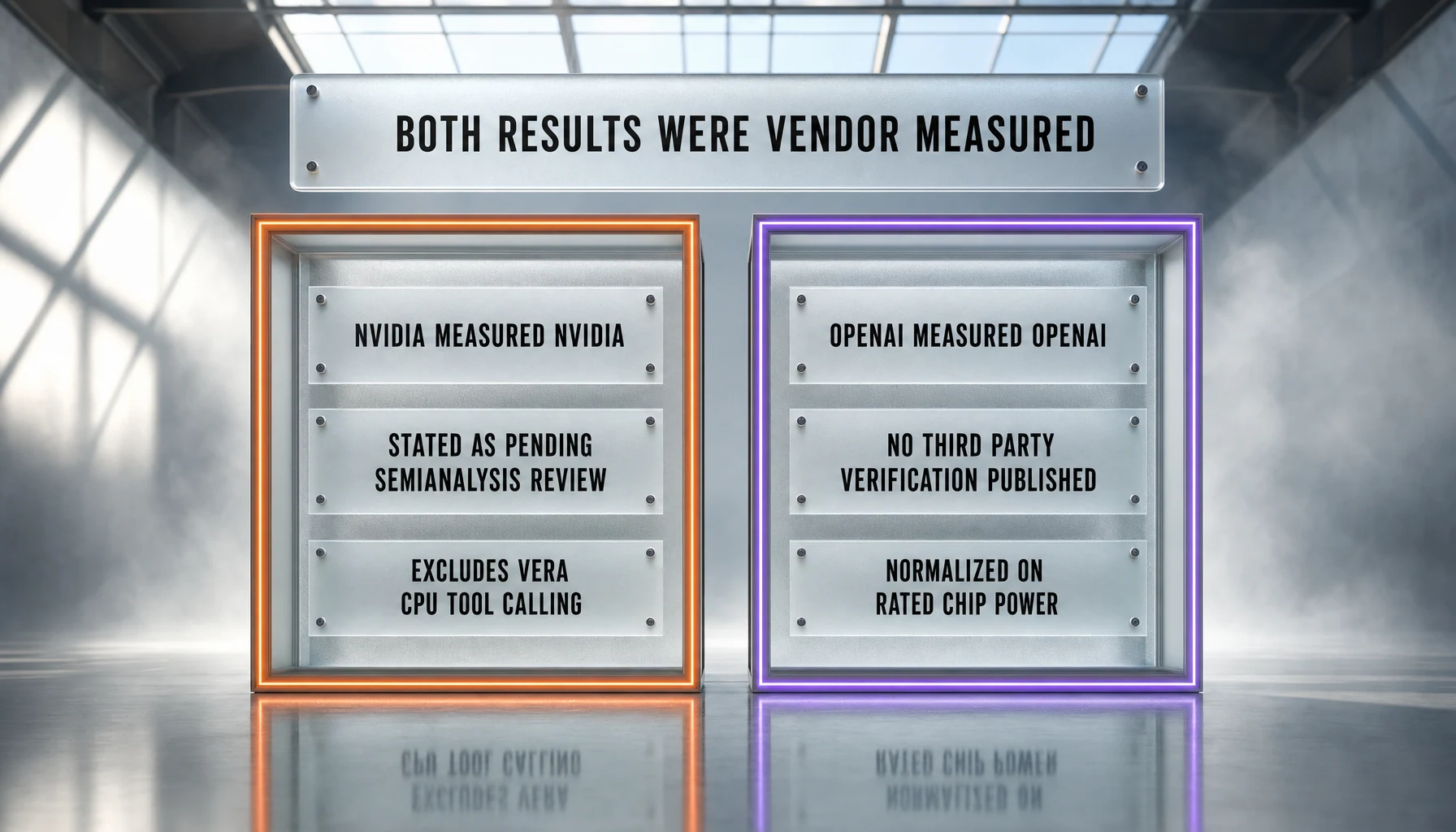
| Independent review status | Stated as pending SemiAnalysis review | Not stated; no third-party verification published |
| Stated exclusions | Does not yet reflect Vera CPU tool-calling performance | Normalized on published chip power rating, not measured draw |
Nvidia's 30 measures a new rack generation against the company's previous rack generation. OpenAI's 1.9 measures a new single-purpose accelerator against currently shipping Nvidia systems. One is a generational step inside one vendor's roadmap. The other is a cross-vendor comparison. Those are different kinds of claim before you even reach the workload question, and the larger number is the one making the narrower claim.
Nvidia's post supplies the chained figure that makes this concrete: GB300 NVL72 itself delivers up to 15 times better throughput per megawatt than Hopper on DeepSeek V4 Pro. Generational multipliers in this benchmark compound quickly because the baseline keeps moving. That is a statement about how far rack architectures have traveled, not a statement about how Vera Rubin compares to anything OpenAI built.
The Range Problem: OpenAI's Own Appendix Reports Ratios From 1.5x to 104x
If one exhibit proves that a multiplier without an operating point is not information, it is OpenAI's appendix, and it argues against OpenAI's own headline.
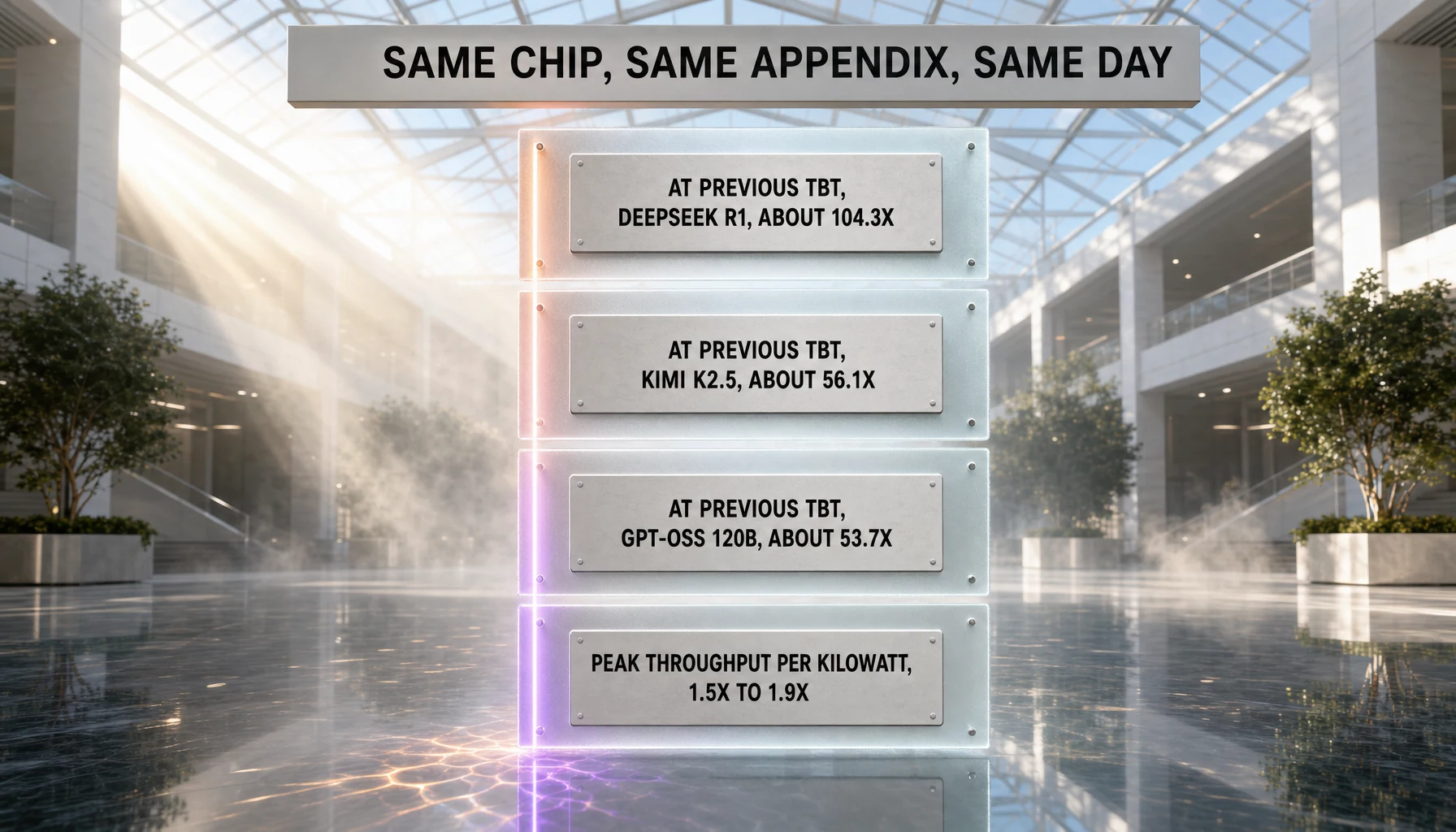
The published appendix panels report, alongside the 1.5x to 1.9x peak throughput-per-kilowatt figures, a metric OpenAI calls "more throughput at previous TBT," where TBT is time between tokens. On that metric the reported values are approximately 53.7 times on GPT-OSS 120B, approximately 104.3 times on DeepSeek R1, and approximately 56.1 times on Kimi K2.5. Same chip, same benchmark, same appendix, same day. The ratio moves between roughly 1.5 and roughly 104 depending on which point of the performance curve you read it from.
OpenAI did not hide those numbers, and it did not lead with them either. It led with the conservative ones. That is a defensible editorial choice, and it also demonstrates the point: anyone quoting a single multiplier from either company is quoting a choice of operating point as much as a property of the silicon.
The same caution applies to Nvidia's phrasing, and here the post is inconsistent with itself. The figure 30x appears six times. Three of those carry a ceiling qualifier: the title reads "Up to 30x More Work Per Watt," the key measured-data sentence says "up to 30x higher throughput per megawatt," and the model-specific claim says "as much as 30x." The other three drop it entirely. The standfirst states that the systems "deliver 30x higher throughput per megawatt and 35x lower token costs." A section heading reads "30x Higher Throughput per Megawatt and 35x Lower Token Cost." And one line converts the ceiling into a flat promise: "that translates directly into 30x more agentic work for the same energy footprint."
An upper bound tells you the best observed case and nothing about the distribution behind it. Watching one become a round number inside a single post, three sentences at a time, is a useful reminder of how the qualifier disappears long before anyone quotes it.
Neither Number Is Independently Reviewed
This is the second fact of the week, and it is as important as the first.
InferenceX is designed to make vendor self-reporting unnecessary. Its front page states that "every data point on the dashboard is produced by a public GitHub Actions workflow run," that "the recipe lives in the repo, the run executes on the actual target hardware, and the full logs and artifacts are publicly viewable," and that weekly database snapshots are published as public GitHub releases. SemiAnalysis explains why it built the benchmark that way: existing benchmarks go stale, and "participants often submit software images purpose-built for the benchmark itself which do not reflect real world performance."
Both announcements this week step outside that default. Nvidia measured its own silicon and says so, and says the results await review. OpenAI measured its own silicon on a public benchmark and does not claim third-party verification. Using a public, reproducible benchmark is meaningfully better than publishing an unlabeled internal number, and it is not the same thing as an independent result. The benchmark is public. The runs are not.
Readers of our June coverage will recognize the shape of this. When OpenAI announced Jalapeño, the efficiency claim was a bare assertion with no benchmark attached, and we wrote at the time that the milestone to watch was a technical report with real numbers and whether independent reviewers could reproduce them. Half of that has now happened. Real numbers exist, on a named public benchmark, with the reference systems and power ratings disclosed. The other half has not. This is genuine progress in transparency, and it is not verification.
For contrast, our coverage of the first independent Phoronix benchmarks of the Vera CPU shows what the other posture looks like: a third party running the tests, publishing the configuration, and taking responsibility for the result. That is the standard both of this week's numbers will eventually be measured against.
The Comparison That Does Exist Is Not the One Either Company Made
There is a direct comparison of the two new systems available, and neither press release points to it.
The InferenceX front page currently carries a banner promoting "OpenAI's Latest In House Chip" against Rubin NVL72, linking a view that compares Jalapeño with Vera Rubin NVL72 on DeepSeek R1. Its parameters are visible in the link itself: the DeepSeek-R1-0528 model, an 8K-input and 1K-output sequence, FP4 precision, and output throughput per megawatt as the metric. That is a like-for-like view, on one model, at one operating point, from the party that owns the benchmark.
Two things follow. First, the head-to-head that readers want exists, and it sits in the fixed-sequence scenario, which is the one Nvidia did not use for its announcement. Second, we are deliberately not reproducing the values from that dashboard here. InferenceX adds more than a thousand new data points per week by its own account, entries are versioned by date, and the Vera Rubin entry on that view is labeled by month. A number copied from a live dashboard into a static article is wrong the moment the dashboard moves, and it would invite exactly the ranking behavior this piece argues against. If you want the current state, the right move is to open the dashboard and read it with its date attached.
Why Agentic Workloads Genuinely Are a Different Measurement Problem
The workload split is not a technicality invented to excuse a bad comparison. It reflects a real change in how models are used, and both companies are responding to it.
Nvidia cites OpenRouter data that agentic AI workloads consume 15 times more tokens than a simple chat request, and describes the mechanism: context accumulates across steps, each step's output becomes the next step's input, and sub-agents fan out and return. Anyone who has watched a coding agent work through a task has seen the pattern. It is why we wrote separately about what actually separates an agentic coding model from a chatbot.
AgentX is built around that behavior rather than around request counts. Its methodology page describes capturing opt-in sessions through an HTTP proxy, stripping prompts, source code, tool arguments and tool results, replacing inputs with session-scoped chained hashes in 64-token blocks so that matching prefixes survive without content, then reconstructing each session as a directed acyclic graph of main-agent turns, parallel subagents, auxiliary requests and inter-turn tool time. Concurrency counts live session trees, not in-flight requests. A valid run lasts at least 900 seconds. The models covered on the agentic side include Kimi K3, DeepSeek V4 Pro, GLM5.3, MiniMax M3, and Qwen 3.5.
SemiAnalysis is also explicit about what AgentX does not do: "AgentX measures serving-system performance. Its synthetic payloads do not support model-quality evaluation." It measures how well a system serves a workload. It does not measure whether the answers are any good.
The fixed-sequence scenario has not become obsolete because agents exist. Plenty of production traffic still looks like a short prompt and a short completion. It is a legitimate thing to optimize for and a legitimate thing to measure. It is simply a different thing, and a chip can lead on one profile without that telling you where it lands on the other.
What We Are Not Saying
We are not declaring a winner, and the reason is not diplomacy. There is no defensible basis for one. The two published results share a benchmark and share nothing else that a comparison would require: not the workload scenario, not the baseline system, not the model, not the operating point, and not the party holding the stopwatch. Ranking them would reproduce the error this article exists to name.
Nor is either announcement an attack on the other. OpenAI's post states that the company "will continue to widely deploy accelerators from NVIDIA and other partners for both training and inference workloads." The companion post published the same day by Sarah Friar frames Jalapeño as "a credible first-party path alongside the accelerators we use from other partners," and lists a compute portfolio that includes Microsoft, Nvidia, AWS, AMD, Broadcom, Cerebras, CoreWeave, Oracle, SB Energy and SoftBank. Nvidia's own Vera CPU page, meanwhile, says the company hand-delivered Vera CPU systems to Oracle Cloud Infrastructure and to three AI labs, naming Anthropic, OpenAI and SpaceXAI among them.
The customer relationship runs in both directions in the same week that the "duel" framing was available. That framing was always thinner than it looked, as we argued when Jalapeño was first announced and again when we traced what "trained without Nvidia" actually meant for DeepSeek.
Why This Matters Beyond These Two Posts
Efficiency numbers are becoming the currency of AI infrastructure the way parameter counts once were, and for a sound reason: at gigawatt scale, power is the binding constraint, which is the argument we made in detail on where the money actually goes between training and inference. Throughput per megawatt determines how much work a constrained facility can do. Cost per million tokens determines whether serving that work is profitable. Nvidia states that relationship directly in its post.
Because those metrics now carry commercial weight, they will be produced in volume, and most of them will be vendor-run. The defense is not cynicism. It is a habit: for any multiplier, ask what workload, against what baseline, at what operating point, measured by whom, and reviewed by whom. This week supplies a clean worked example because both companies disclosed enough to answer all five questions, which is more than most announcements allow. The failure mode is not that either company lied. It is that the qualifiers do not survive the trip into a headline.
We have made this argument before in a different setting, when a small model's reasoning benchmark claims turned on how the comparison was configured. The pattern repeats because the incentive repeats.

What to Watch
Four things would change the picture, and all four are concrete:
- SemiAnalysis completing its review of Nvidia's AgentX submission. Nvidia has flagged the results as pending. Whether the reviewed figures match the announced ones, and whether the review is published, is the single most informative outcome ahead.
- An AgentX result for Jalapeño. OpenAI published fixed-sequence results. The agentic scenario is where Nvidia's claim lives, and where OpenAI says its architecture is aimed, since its post argues the design targets "a defining feature of agentic workloads."
- Vera CPU included in the measurement. Nvidia's agentic number currently excludes the CPU's tool-calling contribution. Nvidia says Vera is now shipping, so a complete system measurement should follow.
- Jalapeño actually deploying. OpenAI writes that it plans "to begin deploying Jalapeño within OpenAI's compute infrastructure by the end of the year," and describes ongoing production qualification. That is the same end-of-2026 target given at announcement in June, which is a schedule holding rather than slipping, at least so far. Custom silicon roadmaps slip routinely, and this one has not yet.
Until then, the honest summary of this week is short. Two credible efficiency results were published a day apart. Both are grounded in a real, public, reproducible benchmark, which is a step up from the unlabeled vendor claims that preceded them. Both were run by the vendor whose hardware they flatter. And they measure different workloads against different baselines, which means the only thing you can safely conclude from seeing 30 and 1.9 in the same week is that two companies had good news to share.
Frequently Asked Questions
Can OpenAI's 1.9x and Nvidia's 30x be compared directly?
No. Both figures come from SemiAnalysis InferenceX, but from different workload scenarios inside it and against different baselines. Nvidia's up-to-30x is throughput per megawatt in the AgentX long-context agentic coding scenario, measured against Nvidia's own GB300 NVL72. OpenAI's 1.5x to 1.9x is work per watt at peak throughput on a fixed-sequence profile with nominal 8K input and 1K output, measured against GB200 and GB300 systems. Different workload, different baseline, different question.
Are InferenceX and AgentX two different benchmarks?
No, and this is the most common misreading. SemiAnalysis describes InferenceX, formerly InferenceMAX, as one benchmark that measures both fixed-sequence serving and AgentX, its long-context multi-turn agentic coding workload. AgentX is a scenario inside InferenceX, not a separate benchmark. That is why both companies can cite SemiAnalysis while measuring entirely different things.
Has either result been independently verified?
No. Nvidia states its results were measured by Nvidia and are "currently pending SemiAnalysis review." OpenAI ran its own measurements on the public InferenceX benchmark and does not claim third-party verification. Using a public, reproducible benchmark is more transparent than an unlabeled internal claim, but neither figure has been reproduced or reviewed by an independent party as of publication.
What exactly does the AgentX workload measure?
AgentX replays real agentic coding sessions rather than sending unrelated single-turn prompts. SemiAnalysis builds it from opt-in Claude Code sessions with prompts, source code and tool payloads stripped out, preserving request lengths, prefix reuse, subagent branches and timing. The v1.0 dataset uses 393 sessions with a median of 142,000 input tokens per request and a median of 444 output tokens per request, and 44 percent of sessions include subagents. SemiAnalysis states that AgentX measures serving-system performance and does not support model-quality evaluation.
Why does the 8K input and 1K output configuration matter so much?
Because it is roughly eighteen times smaller on input than the median AgentX request. Nvidia's own post classifies sequences in the 1K to 8K range as characteristic of chat or document summarization rather than agentic work. OpenAI's published appendix panels all carry the nominal 8K-input, 1K-output label. A system tuned for one profile does not automatically hold its advantage on the other, which is the whole reason the two scenarios exist.
Is Nvidia's 30x figure an average across models?
No. Nvidia writes that Vera Rubin NVL72 delivers as much as 30 times higher throughput per megawatt than GB300 NVL72 specifically on the DeepSeek V4 Pro model. Nvidia also frames it as "up to 30x" rather than a central estimate. Separately, Nvidia says GB300 NVL72 delivers up to 15 times better throughput per megawatt than Hopper on the same model, so the generational multipliers compound against a moving baseline.
What did OpenAI exclude or qualify in its own results?
OpenAI normalized results using each accelerator's published chip power rating rather than measured draw, and disclosed that Jalapeño is rated at 700 watts while its measured sustained power stayed at or below 550 watts on the workloads tested. It also states that AI-generated kernel implementations ran 1.5 to 1.8 times faster than human-written ones on selected GPT-OSS attention and mixture-of-experts blocks, explicitly noting those figures apply to the selected blocks and not the full model.
Which claim in the OpenAI post cannot be checked?
The sentence stating that in internal testing, Jalapeño's advantage widened further on frontier OpenAI models. No public benchmark covers frontier OpenAI models on this hardware, so the claim rests entirely on measurements nobody outside OpenAI can inspect. It should be read as an expectation rather than a result.
Why does Nvidia's agentic result exclude the Vera CPU?
Nvidia states that the published results "don't yet reflect Vera CPU performance for tool calling." Nvidia's own case for Vera is that agentic work is CPU-heavy, covering tool calls, orchestration and long-context retrieval. So the agentic efficiency figure currently omits the component built for the part of the workload the post uses to justify the platform. Nvidia discloses this; it is a caveat, not a hidden flaw.
Is there a direct head-to-head between Jalapeño and Vera Rubin NVL72?
Yes, on the InferenceX site itself. Its front page links a view comparing Jalapeño with Vera Rubin NVL72 on DeepSeek R1 at an 8K-input, 1K-output sequence in FP4 precision, using output throughput per megawatt as the metric. That comparison sits in the fixed-sequence scenario, not the AgentX one Nvidia used for its announcement. We are not reproducing the values here because the dashboard adds more than a thousand data points per week and entries are versioned by date.
Does this mean Jalapeño replaces Nvidia hardware at OpenAI?
No, and OpenAI says so directly: the company "will continue to widely deploy accelerators from NVIDIA and other partners for both training and inference workloads." Sarah Friar's companion post describes Jalapeño as a first-party path alongside partner accelerators, within a compute portfolio that also includes Microsoft, Nvidia, AWS, AMD, Broadcom, Cerebras, CoreWeave, Oracle, SB Energy and SoftBank. Nvidia's Vera CPU page lists OpenAI among the labs receiving Vera systems.
When will Jalapeño actually be deployed?
OpenAI writes that it plans to begin deploying Jalapeño within its own compute infrastructure by the end of the year, and says it is continuing production qualification, maturing software, and validating performance across more models. That matches the end-of-2026 target given when the chip was announced in June 2026. OpenAI also describes Jalapeño as the first generation of a multigenerational roadmap, with a second generation in development and a third taking shape.
Sources
- OpenAI, "Jalapeño's first results show industry-leading speed and efficiency in AI inference," August 25, 2026
- OpenAI, Sarah Friar, "The full stack behind abundant intelligence," August 25, 2026
- NVIDIA Blog, Shruti Koparkar, "Up to 30x More Work Per Watt: NVIDIA Vera Rubin NVL72 Sets a New Efficiency Standard for AI Agents," August 24, 2026
- NVIDIA Blog, "Delivering Vera: NVIDIA's First CPU Built for Agents Is Shipping Now" (originally published May 18, 2026; updated August 27, 2026)
- SemiAnalysis, InferenceX — About and AgentX FAQ
- SemiAnalysis, AgentX v1.0 methodology and datasets
Editorial note: this is analysis and commentary, not sponsored content. ThePlanetTools.ai has no commercial relationship with OpenAI, Nvidia, Broadcom or SemiAnalysis. All performance figures cited are the measuring party's own published results and, as of publication, none has been independently verified. Figures were read directly from the primary sources listed above on August 28, 2026.