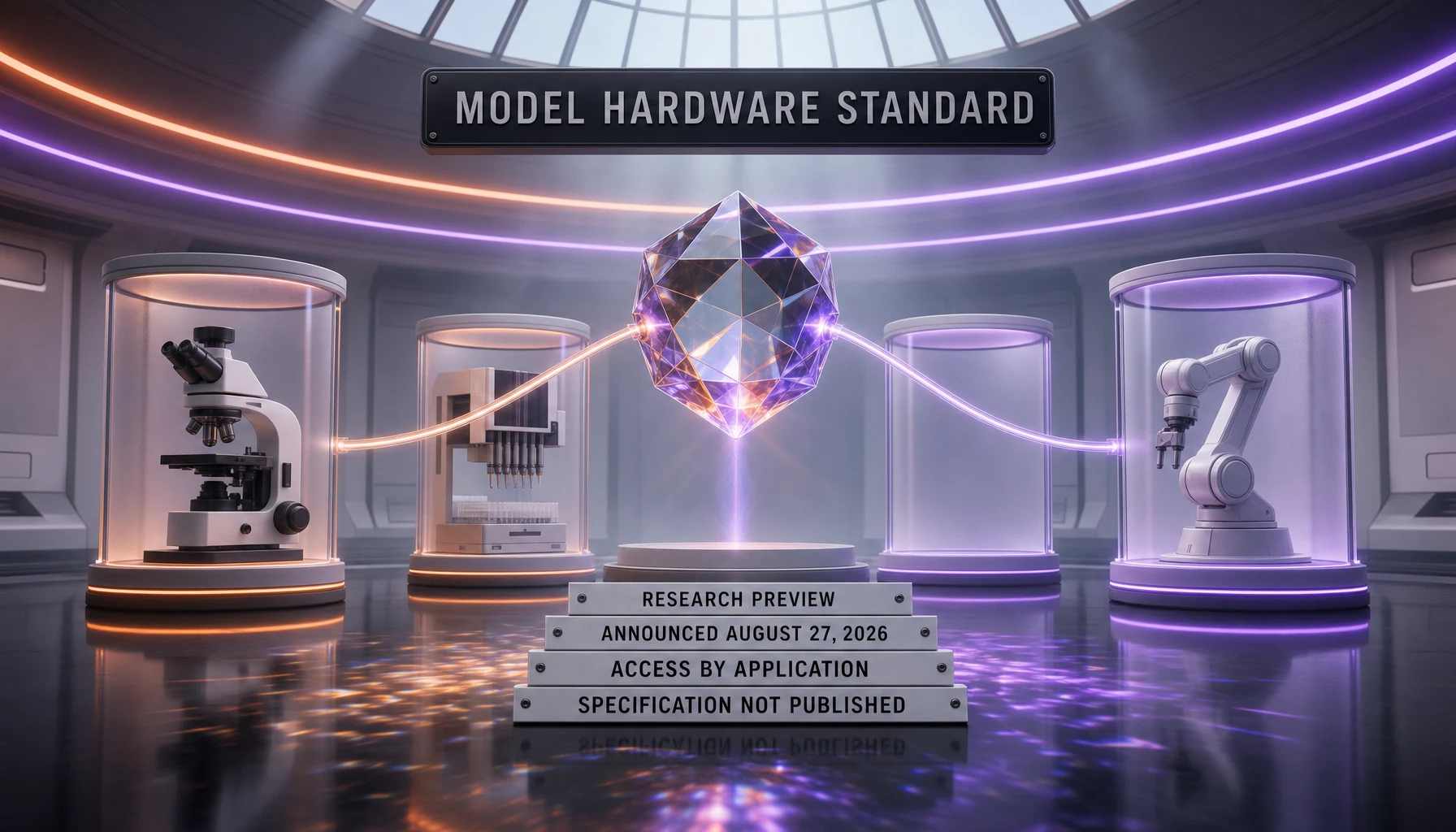
The Model Hardware Standard (MHS) is a shared specification from Anthropic, opened as a research preview on August 27, 2026, that lets AI agents safely operate physical devices such as microscopes, liquid handlers, and robotic arms. It began as a collaboration between Anthropic and the HHMI Janelia Research Campus, works with any device that has a programmable interface, and is model-agnostic: any agent harness can reach it through standard protocols, including the Model Context Protocol. Anthropic says MHS cuts hardware integration work that normally takes weeks or months down to hours or minutes. Access is by application only, limited to a first group of scientific research labs and advanced manufacturers, and the specification is not public: Anthropic states it is collecting safety evaluations with partners "ahead of making the standard open source."
Two years ago, Anthropic published a specification that changed how AI products get built. The Model Context Protocol gave models a single, universal way to reach software — files, databases, business tools — instead of forcing every vendor to write a bespoke connector. MHS is recognizably the same move, aimed at a different target: not software, but machines with motors, pipettes, and lasers. The gesture is familiar. The opening posture is not, and that difference is the most concrete thing to understand about this announcement.
What Anthropic Actually Announced
On August 27, 2026, Anthropic opened a research preview of the Model Hardware Standard to what it calls "a first group of scientific research labs and advanced manufacturers." The company describes MHS as "a shared specification for AI agents to safely operate physical devices." The stated capability is orchestration in parallel: MHS is meant to let agents drive multiple lab and manufacturing instruments at once — microscopes, liquid handlers, robotic arms — and carry out tasks that range, in Anthropic's own framing, "from routine drug discovery experiments to laser calibration on a quantum computer."
At a glance
- What it is: a shared specification plus a standardized hardware driver, not a product or a model.
- Announced: August 27, 2026, as a research preview.
- Origin: a collaboration between Anthropic and the HHMI Janelia Research Campus.
- Who can use it: a first group of scientific research labs and advanced manufacturers, by application.
- Device scope: any device with a programmable interface.
- Model scope: model-agnostic; any agent harness, over standard protocols such as MCP.
- Claimed effect: integration work reduced from weeks or months to hours or minutes.
- Open source status: not yet. Anthropic says it is working with partners "ahead of making the standard open source."
That last line is the one worth holding onto. A specification shared under application with a selected group is not a published standard, and Anthropic does not claim otherwise. The dedicated site for the project states the same thing in plainer words: MHS "is starting as a limited research preview," and the company is inviting stakeholders to test it "before we open-source it."
The Problem MHS Is Aimed At
The bottleneck Anthropic describes is unglamorous and very real. Instruments in a lab or on a factory floor mostly do not talk to each other. Each device ships with its own programming interface, its own data format, and its own driver, and there has been no standardized way to join them. Even once they are physically connected, Anthropic notes, "there is no common way for them to share data with an AI agent, nor to let the agent operate them safely." Building the glue is specialist work, and it is the reason a lab can spend weeks or months standing up a workflow before running a single experiment.
This is the same class of problem MCP was built for, one layer down in the stack. Where MCP normalized the connection between a model and a piece of software, MHS aims at the connection between an agent and a machine that can spill a reagent or swing a robot arm into a plate. The safety framing is not decorative: the standard is described from the first sentence as a way for agents to operate devices safely, and safety limits are part of what the specification asks each device to declare.
How MHS Works
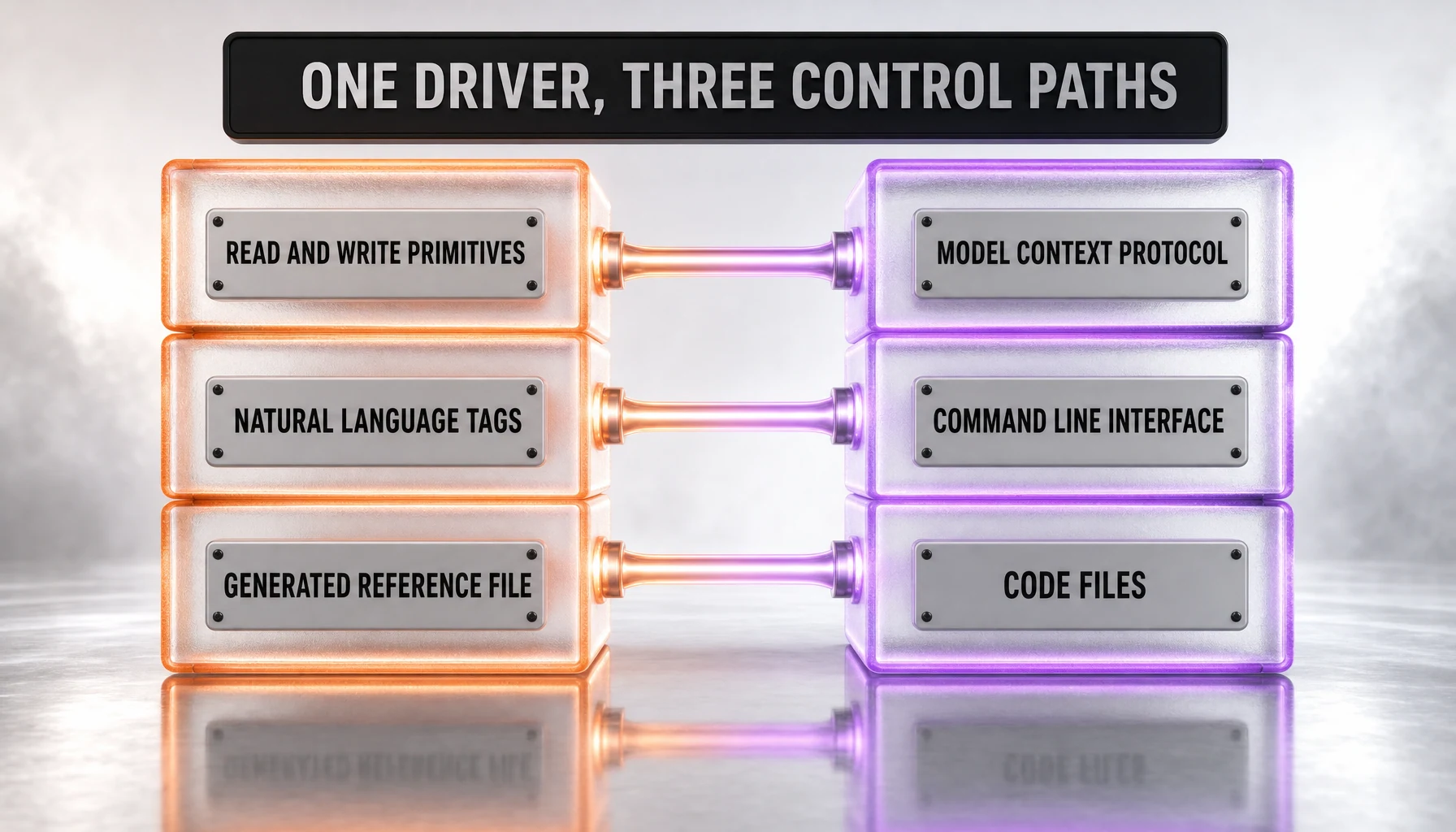
MHS introduces a standardized driver — software that translates between a computer's operating system and a hardware device. Anthropic describes three pieces that make it work.
A small set of primitives. The driver exposes commands like "read" (for example, "get temperature") and "write" (for example, "set temperature") that any hardware device can understand and act on. Devices are also made discoverable in a standard format, so that agents and instruments can find each other across a network without a bespoke translator program sitting in between.
Natural-language tags that produce a machine reference file. This is the more unusual part. A lot of what an agent needs to know about a device has historically lived in paper manuals, on someone's laptop, or purely as tacit knowledge — the weight of a robot arm, for instance, which matters for handling it safely. MHS lets a user write that information directly into the driver in natural language, either by hand or by chatting with an agent that interviews them about the setup. The driver then generates a reference file describing what the device can measure, what can be adjusted, and what safety limits will be enforced.
Three control mechanisms. Once an agent knows how to use a device, it needs a way to drive it. MHS offers MCP, a command line interface, and code files (APIs). Anthropic says these work together to enable orchestration across multiple devices from a single line of code. The division of labor matters: for long-running tasks, or for operations that need to move faster than an agent's online reasoning allows, the agent can chain driver commands into code files so the devices execute on their own without the model reasoning at every step.
Anthropic reports that Claude tends to approach hardware the way a scientist would. In one described episode, the model adjusted a laser, watched the result through a camera to see how the beam moved, and repeated the loop — then packaged what it had learned into a deterministic script so the alignment could run as a single command afterward. That pattern, explore first and then compile the result into something repeatable, shows up again in the partner projects.
Genentech: Automating a Protein Assay, Bubbles Included
The most detailed early project comes from Genentech, which implemented MHS as a proof of concept for automating the BCA protein assay — a standard procedure for measuring total protein concentration in a sample. The assay requires coordinating three instruments: a liquid handler for precise fluid transfers, a robotic arm to move labware, and a microplate reader to measure optical absorbance. Genentech deployed MHS across all three and used Claude to orchestrate the protocol and act as a central communication hub. All experiments ran in standard 96-well microplates.
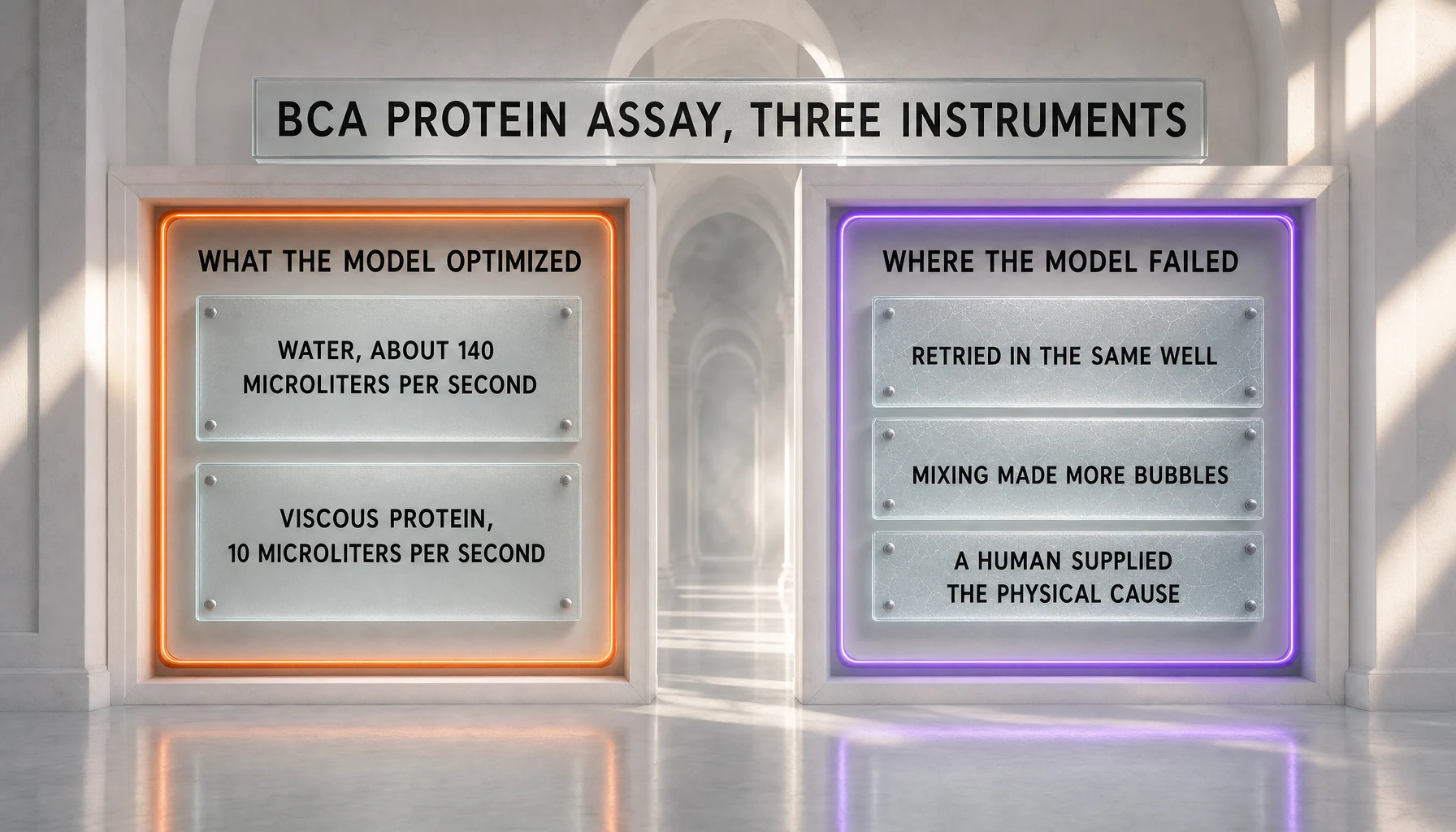
The interesting part is what happened when Claude was asked to optimize rather than execute. Given the standard protocol first, Claude ran the steps but picked generic liquid handling parameters, using the same flow rate for aqueous and viscous solutions — which created bubbles in the viscous sample and produced inaccurate transfers. Genentech then asked the model to autonomously optimize flow rates for both plain water and viscous bovine serum albumin, exploring an expert-defined range through trial transfers with dyed liquid and absorbance readings, with a human expert's transfer available as ground truth to minimize error against.
Claude converged on approximately 140 microliters per second for water, scoring 0.016 root mean square error, and 10 microliters per second for the viscous protein sample, scoring 0.181. Genentech's automation experts confirmed both were reasonable for the setup. Ordinarily, the company notes, this kind of optimization requires an automation specialist to write custom programming logic for every parameter set and iterate through the data by hand.
Where the model hit a wall
Anthropic and Genentech published the failures alongside the wins, which is worth noting given how rarely vendor announcements do. Claude recovered on its own from several unexpected errors during the run, including tip pickup failures and fluid detection errors — a capability Genentech says current scientific instruments mostly lack. But the experiments also exposed a specific limit: the model reasons well in general and poorly about physics.
Bubbles are the example. When mixing produced bubbles and threw runtime errors, Claude's instinct was to retry in the same plate well with different parameters, which agitated the fluid further and made more bubbles. It did not understand the physical cause of its own failure. Once a human told it that the error came from bubbles and that the fix was to move to a clean well and reduce mixing cycles, it held that context for the rest of the run. Genentech then codified the lesson into reusable liquid handling skills so the model would pick sensible defaults for liquids of different physical properties.
That sequence — model fails on physical intuition, human supplies the reason, lesson gets frozen into a reusable skill — is a fair description of where agentic lab automation actually stands in August 2026. It is not autonomy. It is a loop that gets shorter each time someone closes it.
The Academic Lab: Six Instruments in Under a Week
The second published project comes from Zihao Song, a PhD student in the Baker and Pinglay labs at the University of Washington, and it reads differently because the constraint is money rather than scale. Song works on de novo protein design — building proteins that have never existed in nature. Designing a protein such as PETase, the enzyme that breaks down plastic, can now cost as little as one cent. Testing that protein at the bench costs around one hundred dollars and a week of labor per candidate, and his group tests a thousand candidates at a time. The design step got cheap; the physical step did not.
The obvious answer is automation, and the reason academic labs do not have it is equally plain: wiring instruments from different vendors together is an integration project that runs from months to years and costs anywhere from thousands to millions of dollars. Traditional automation also assumes repetition — a factory line runs one protocol ten thousand times, while Song's lab runs dozens of protocols a year, half of them new, and revises them mid-run when a yield comes back low.
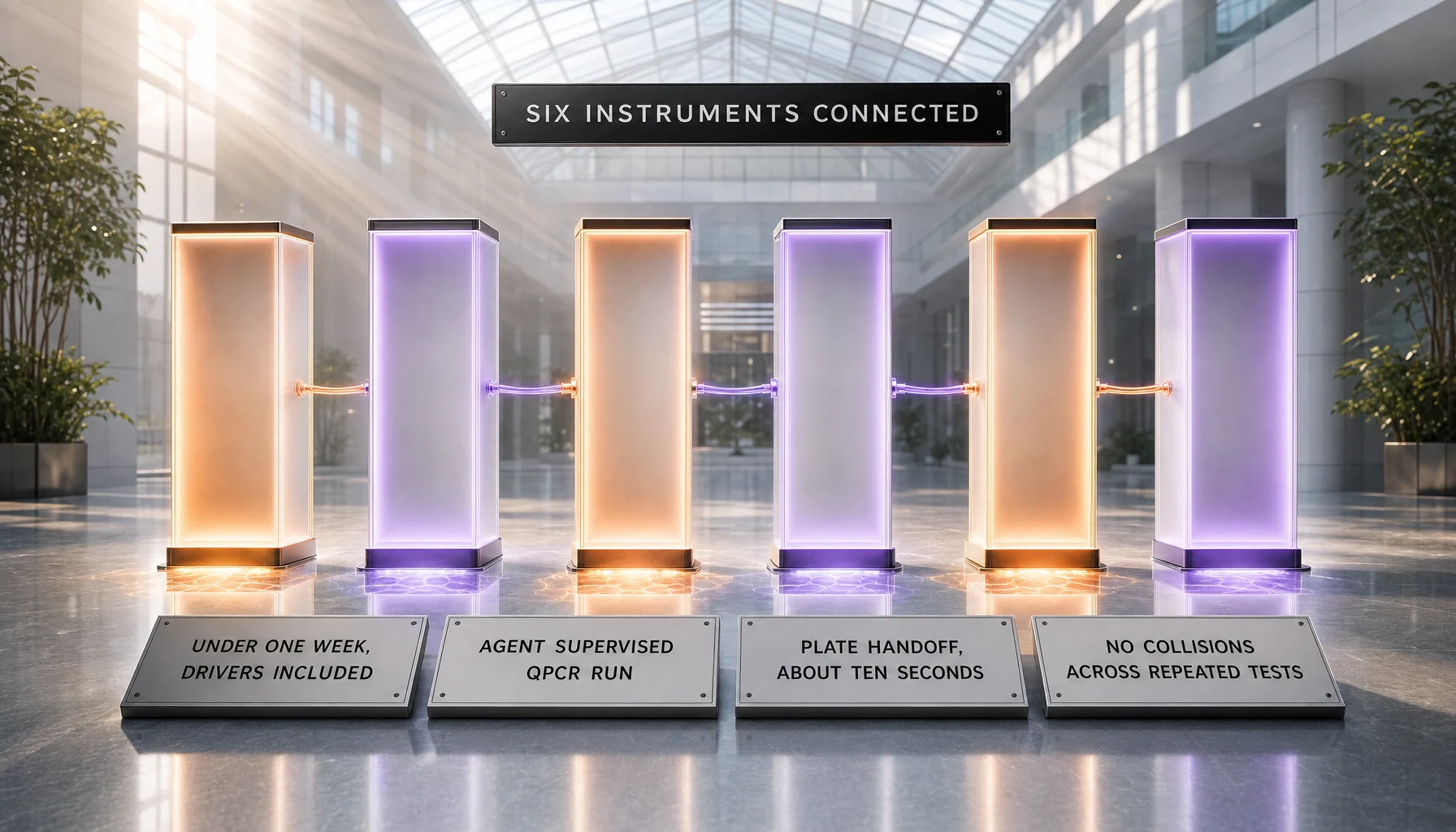
Song reports connecting six instruments through MHS in under a week, including the time spent writing their drivers, after earlier automation attempts had ended in giving up. He describes three results. A dashboard that reports every connected instrument's status to one screen, replacing walks around the lab and checkable from a laptop or by asking an agent from a phone. An agent-supervised qPCR run, where the model watches DNA amplification curves in real time, asks the researcher at the right junctures whether to stop, and on command halts the reaction and advances the instrument to a 4 °C hold so the DNA stays usable. And a plate handoff between a liquid handler and an open-source robotic arm built on LeRobot, coordinated by Claude Code through MHS: the agent picked up the completion signal and triggered the arm roughly ten seconds later, and across repeated tests the two instruments never collided.
The candid detail is the one about sleep. Song notes that his PCR step handles one plate at a time and needs a plate change every ninety minutes, which is how he sometimes ends up moving plates at 4 a.m. That is the kind of problem a standard either solves or does not, and it is a more useful measure of the thing than any benchmark.
Song is explicit about the ceiling, too: these are proofs of concept, more complex protocols will need significant optimization, and running an agent continuously over long monitoring windows carries compute costs that have to be weighed against the researcher time saved.
What MHS Shares With MCP — and Where the Comparison Stops
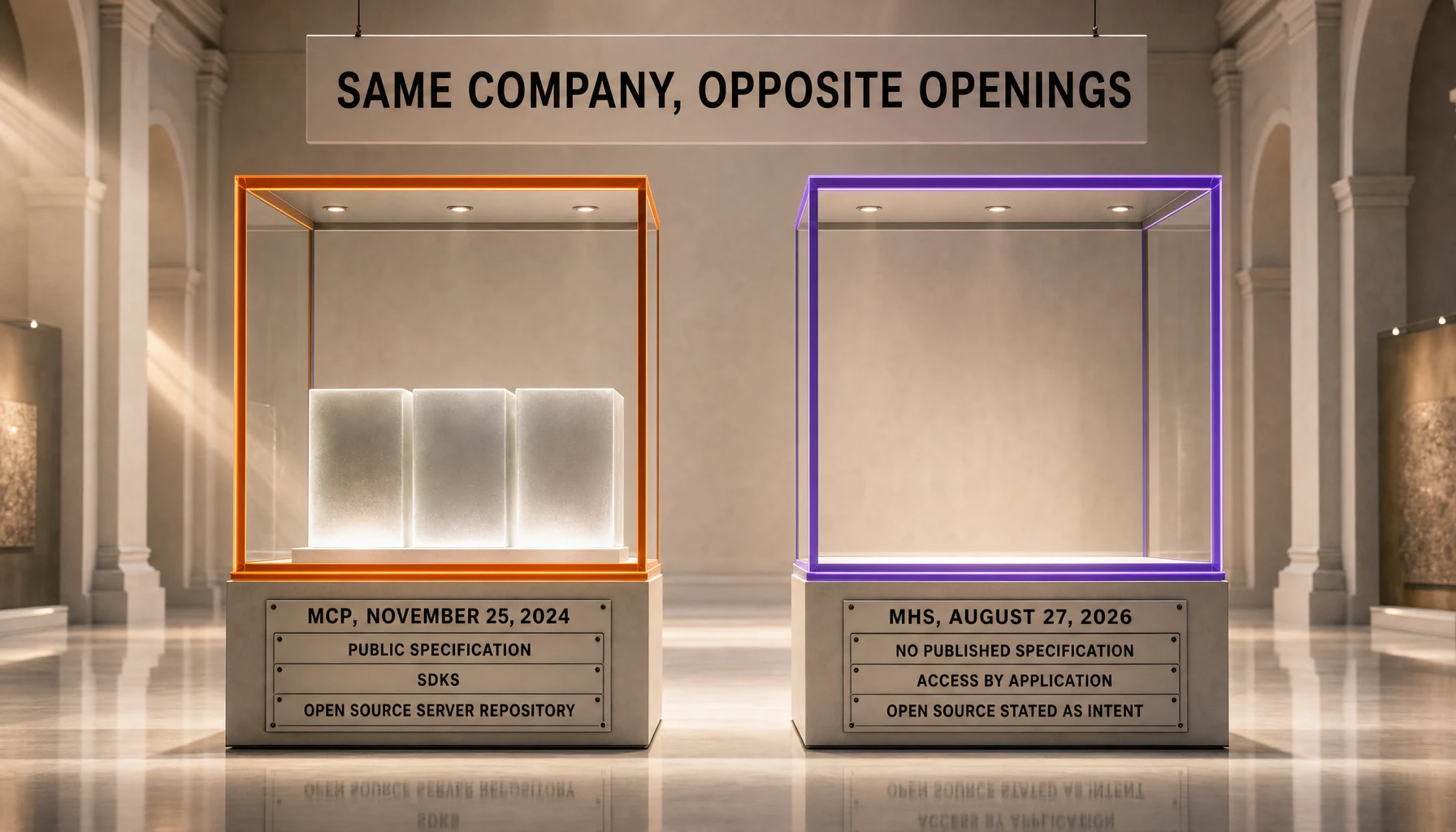
The parallel is real and Anthropic invites it: the same company, twice, choosing to define a shared interface rather than ship a closed product. MCP arrived on November 25, 2024 as an open standard for connecting assistants to the systems where data lives, and it has since been adopted well beyond Anthropic — a shift we traced across the wider re-architecture of the web for agents, and one visible in places as far from a lab as brokerage accounts exposed to agents over MCP. MHS even leans on that work directly: MCP is one of its three control mechanisms.
The comparison stops at the opening posture, and the difference is documented rather than speculative. MCP shipped public on day one. Anthropic's launch post lists what developers got immediately: the specification itself, SDKs, local server support in the Claude desktop apps, and an open-source repository of MCP servers. Anyone could read it and implement it that afternoon.
MHS shipped the opposite way. There is no public specification, access runs through an application form, and open-sourcing is stated as an intention rather than a fact. Anthropic's reason is coherent — it wants to build safety evaluations and best practices with partners before releasing a standard that moves physical equipment, and the failure modes of a mistaken robot arm are not the failure modes of a mistaken file read. But a specification that a few labs can apply for is not yet a standard the field has adopted, and the two should not be scored as if they were the same event. MCP's trajectory tells you nothing about what MHS will do; it only tells you what this company has done once before.
Three Announcements in Three Days
MHS did not arrive alone. It landed inside a cluster of Anthropic announcements pointed at the same audience.
On the same day, August 27, Anthropic announced an expansion of its support for researchers: 10,000 seats for scientists worldwide to access Claude subscriptions for a year through a new Claude team plan for scientists, with standard seats free and premium seats carrying five times the usage limits at fifteen dollars per month. The company says it intends to extend the program beyond the initial 10,000 seats over the coming months. That builds on Claude Science, the research workbench launched in June 2026, and on the existing AI for Science program that provides free credits to researchers.
Two days earlier, on August 25, Anthropic launched a five million dollar grant program funding independent research into how AI affects user wellbeing. The terms are notable for what they give away: grantees work fully independently and publish their work as open-source projects that any developer can use, and the money is aimed at open-source evaluations that let the industry measure how models affect the people using them.
Read together, the three announcements share a direction — scientific research, and evaluation work done by people who do not answer to the vendor. That is a description of what was published in one week, not a forecast. The MHS preview is gated, the seats program is capped at a number Anthropic says it plans to raise, and the grants have not funded anything yet. What the cluster shows is where a company is spending attention, which is a weaker claim than a strategy and a more defensible one. Anthropic has been building toward this for a while: the Nobel laureate who led AlphaFold left Google DeepMind for Anthropic earlier this year, and it is not the only lab making the bet — OpenAI has been pushing its own life-sciences stack on a similar timeline.
What We Could Not Verify
Several things a reader might reasonably want are not available as of August 28, 2026, and it is worth being precise about the difference between "we did not find it" and "it does not exist."
No public specification. We looked for one on the announcement page, on the project's own site at modelhardwarestandard.com, and in Anthropic's developer documentation at platform.claude.com. The announcement page links out to the project site and to an application form, and nothing else. The project site's own text confirms the state of things rather than contradicting it: access is by application during the preview.
No official repository. We searched the anthropics organization on GitHub across its public repositories and ran keyword searches for the standard's name. Nothing published by Anthropic came back. Several third-party repositories referencing MHS appeared, all created or updated within roughly a day of the announcement; none is an Anthropic project, and we have not treated them as sources.
No named partner list beyond the two published case studies. Anthropic says it shared MHS with "a handful of labs and hardware manufacturers in biotech, robotics, quantum computing, and other fields," and describes partners across science, robotics, electronics, and manufacturing. Only Genentech and the University of Washington labs published details. How many organizations are in the preview, and which ones, is not stated.
No independent measurement of any kind. Every number in this article — the flow rates, the error scores, the six instruments in under a week, the ten-second handoff — comes from Anthropic or from a partner writing on Anthropic's site. None of it has been reproduced by a third party, and there is no benchmark here to compare against. The claims are specific and checkable in principle, which is better than vague ones, but they are first-party claims.
The Bottom Line
MHS is a serious piece of engineering aimed at a bottleneck that anyone who has worked in a lab will recognize instantly, and the published case studies are unusually honest about where the model still fails. The technical design is the interesting part: a small read-and-write primitive set, natural-language tags that let a human describe a machine's physical reality in words, and three separate control paths so the agent can drop out of the loop when speed or duration demands it. The willingness to publish the bubble failure alongside the flow-rate win says something about how early this is.
What it is not, yet, is a standard. It is a specification held by one company, shared with an unnamed handful of partners under application, with open-sourcing promised but not scheduled. The right thing to watch is not adoption metrics — there are none to watch — but whether the specification actually gets published, and on what terms. Until then, MHS is a well-documented research preview from a company that has done this once before, and the second time is not the first time.
Sources
- Anthropic — Previewing the Model Hardware Standard (August 27, 2026)
- Model Hardware Standard — project site
- Anthropic — Expanding our support for scientists (August 27, 2026)
- Anthropic — Funding better evaluations of AI's impact on wellbeing (August 25, 2026)
- Anthropic — Introducing the Model Context Protocol (November 25, 2024)
- HHMI — Janelia Research Campus
Frequently Asked Questions
What is the Model Hardware Standard (MHS)?
The Model Hardware Standard is a shared specification from Anthropic that lets AI agents safely operate physical devices such as microscopes, liquid handlers, and robotic arms. It introduces a standardized driver that translates between a computer's operating system and a hardware device, using a small set of primitives like read and write. Anthropic opened it as a research preview on August 27, 2026.
Is the Model Hardware Standard open source?
No, not as of August 28, 2026. Anthropic states that it is sharing an early version of MHS with partners to build safety evaluations and best practices ahead of making the standard open source. There is no public specification and no official Anthropic repository, and access to the research preview is granted by application.
How is MHS different from MCP?
MCP standardizes how an AI model connects to software such as files, databases, and business tools, while MHS standardizes how an agent connects to physical devices. They are complementary rather than competing: MCP is one of the three control mechanisms MHS supports, alongside a command line interface and code files. The two also launched very differently. MCP shipped publicly on November 25, 2024 with its specification, SDKs, and an open-source repository of servers, while MHS is currently an application-gated research preview with no published specification.
Who can access the MHS research preview?
Anthropic opened the preview to a first group of scientific research labs and advanced manufacturers. Access is by application through a form linked from the project site. Anthropic has not published how many organizations are in the preview or named them beyond the two partners who published case studies, Genentech and the University of Washington Baker and Pinglay labs.
What kinds of hardware does MHS work with?
Anthropic says MHS works with any device that has a programmable interface. The examples cited in the announcement include microscopes, liquid handlers, robotic arms, microplate readers, and a robotic arm built on the open-source LeRobot platform. Genentech has said it plans to extend MHS to additional hardware including centrifuges, automated incubators, analytical instruments, and sensors.
Does MHS only work with Claude?
No. Anthropic describes MHS as model-agnostic, and says any agent harness can access it using standard protocols such as the Model Context Protocol. All of the published case studies happen to use Claude, including Claude Code in the University of Washington projects, but the specification itself is not tied to a single model.
How much time does MHS actually save on integration?
Anthropic claims MHS reduces hardware integration work from the weeks or months a lab typically spends down to hours or minutes. The one first-party data point published alongside the announcement comes from a PhD student at the University of Washington, who reports connecting six instruments through MHS in under a week, including the time spent writing their drivers. No third party has independently verified either figure.
What did Genentech do with MHS?
Genentech implemented MHS as a proof of concept for automating the BCA protein assay, which measures total protein concentration and requires coordinating a liquid handler, a robotic arm, and a microplate reader. Claude orchestrated the protocol and autonomously optimized liquid transfer flow rates, converging on approximately 140 microliters per second for water at 0.016 root mean square error and 10 microliters per second for a viscous protein sample at 0.181. Genentech's automation experts confirmed both values were reasonable for the setup.
Where did the AI model fail in the Genentech experiments?
Claude struggled with physical intuition. When bubbles in a viscous solution caused runtime errors, its instinct was to retry in the same plate well with different parameters, which agitated the fluid and created more bubbles. A human had to explain that the error came from bubbles and that the fix was to move to a clean well and reduce mixing cycles. Genentech then codified that lesson into reusable liquid handling skills so the model would pick sensible defaults for different liquids.
Who created MHS?
The development of MHS began as a collaboration between Anthropic and the HHMI Janelia Research Campus. Anthropic says partners across science, robotics, electronics, and manufacturing are now helping develop the standard further, ahead of it becoming open source.
What else did Anthropic announce that week?
On August 27, 2026, the same day as MHS, Anthropic announced 10,000 seats for scientists worldwide to access Claude subscriptions for a year through a new Claude team plan for scientists, with standard seats free and premium seats carrying five times the usage limits at fifteen dollars per month. On August 25, 2026, it launched a five million dollar grant program funding independent research into how AI affects user wellbeing, with grantees working fully independently and publishing open-source evaluations.
Can MHS run experiments without a human?
Not reliably, based on what has been published. Anthropic says agents can reason through each step of an experiment, update parameters in real time, and in some cases recover from hardware errors without intervention, and Claude did recover on its own from tip pickup and fluid detection failures at Genentech. But both published case studies describe themselves as proofs of concept, human guidance was required when the model misread a physical failure, and the University of Washington write-up notes that more complex protocols will need significant optimization before they run reliably.