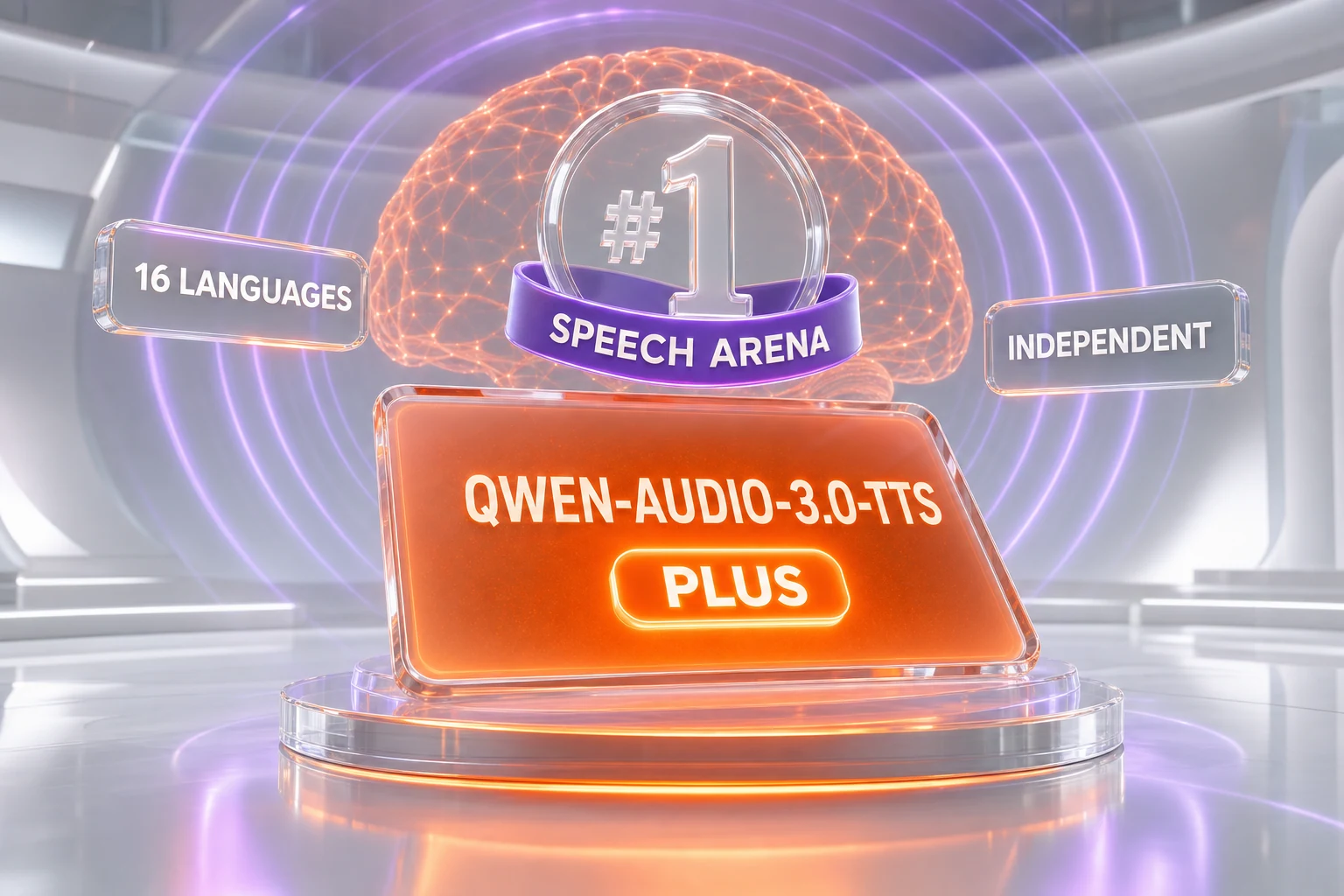
The short version — On July 20, 2026, Alibaba's Tongyi Lab released Qwen-Audio-3.0-TTS, a hosted text-to-speech model in a real-time Flash tier and a higher-quality Plus tier. The Plus tier then took the No. 1 spot on Artificial Analysis's independent Speech Arena for provider voices — the first time a Chinese, hosted-only TTS model has led that board. But it is a narrow lead: checked on July 22, 2026, Plus scored an Arena Elo of 1,238, just ahead of Speechify's Simba 3.2 at 1,229, with their confidence intervals overlapping. It sits ahead of Google's Gemini 3.1 Flash TTS (1,211) and ElevenLabs' Eleven v3 (1,172). And it lands as the middle of three straight Alibaba releases that shipped with no open weights.
For years, the interesting question about Chinese AI labs was whether their open-weight models could match Western frontier systems on independent tests. Qwen-Audio-3.0-TTS answers a narrower version of that question with a qualified yes: on one independent audio leaderboard, on one date, Alibaba's model is first. That is a real milestone, and it deserves to be reported as one. It also deserves to be reported precisely, because the margin is small enough that the words you choose — "leads," "narrowly tops," "ties at the top" — carry most of the meaning.
This piece does two things. First, it separates what is independently measured (an Elo score, with a date and a margin of error) from what is a vendor claim (latency, languages, sample rate). Second, it places the launch inside the pattern it belongs to: Alibaba, long the standard-bearer for open weights, quietly closing the tap.
Key Takeaways
- A first for a Chinese, hosted-only TTS model. Qwen-Audio-3.0-TTS Plus reached No. 1 on the independent Artificial Analysis Speech Arena for provider voices, a board previously led by Western systems.
- The lead is a statistical tie. On July 22, 2026, Plus scored 1,238 Elo (margin about 16) and Speechify's Simba 3.2 scored 1,229 (same margin). The ranges overlap, so the arena cannot call it a genuine win over the No. 2 model.
- The score is independent; the specs are not. The Elo is a third-party measurement. The 300-millisecond latency, 16 languages, and 48 kHz output are Alibaba's own claims — different evidence, and they should not be stacked as if equal.
- It is hosted-only, with no open weights. Both tiers run through Alibaba Cloud Model Studio as an API, a marked change for a lab built on open-weight releases.
- It is the middle of a three-day pattern. Qwen3.8-Max-Preview (July 19), Qwen-Audio-3.0-TTS (July 20), and Qwen-Image-3.0 (July 21) all shipped closed — no weights, and in two cases no benchmarks.
What Alibaba Actually Released
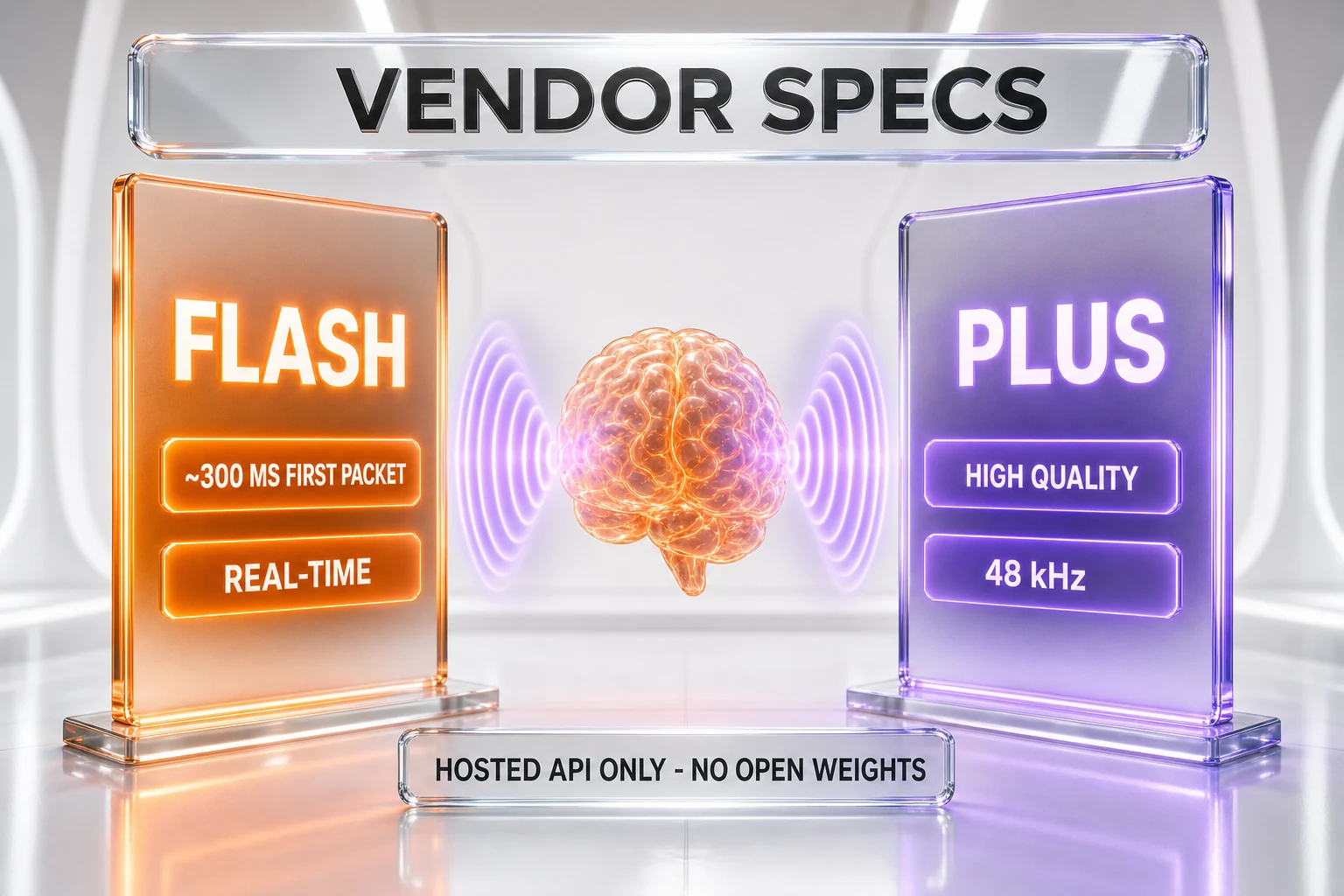
Qwen-Audio-3.0-TTS is a hosted text-to-speech model that Alibaba's Tongyi Lab released on July 20, 2026 in two tiers. Flash targets real-time interaction with first-packet latency at roughly the 300-millisecond level; Plus targets higher-quality output where naturalness matters more than speed. Alibaba says it covers 16 languages and 20 Chinese dialect regions, does one-pass long-form synthesis up to three minutes, and outputs up to 48 kHz. Both tiers are API-only, with no downloadable weights.
The two-tier split is the design story. As MarkTechPost laid out at launch, Flash is "tuned for real-time interaction, with first-packet latency at the 300 ms level," aimed at voice agents and live captioning, while Plus is "tuned for high-quality generation, where naturalness and timbre fidelity matter more than speed." That maps neatly onto how the market already thinks about TTS: one product for latency-sensitive agents, another for polished narration. The No. 1 arena ranking belongs specifically to Plus.
The technical brief on the Tongyi Lab project page adds the internals: a low-frame-rate tokenizer running at 12.5 Hz, a five-stage progressive training recipe, vocoder super-resolution, and 48 kHz output with target-voice adaptation. On languages, the page states the model "supports 16 languages, seven of them newly added" — Arabic, Indonesian, Portuguese, Thai, Vietnamese, Malay, and Tagalog — a deliberate reach into Southeast Asian and Middle Eastern markets where Alibaba Cloud is expanding. Every figure in this paragraph is a vendor statement; none of it has been independently benchmarked, and that distinction matters for the rest of this story.
The One Result That Is Actually Independent
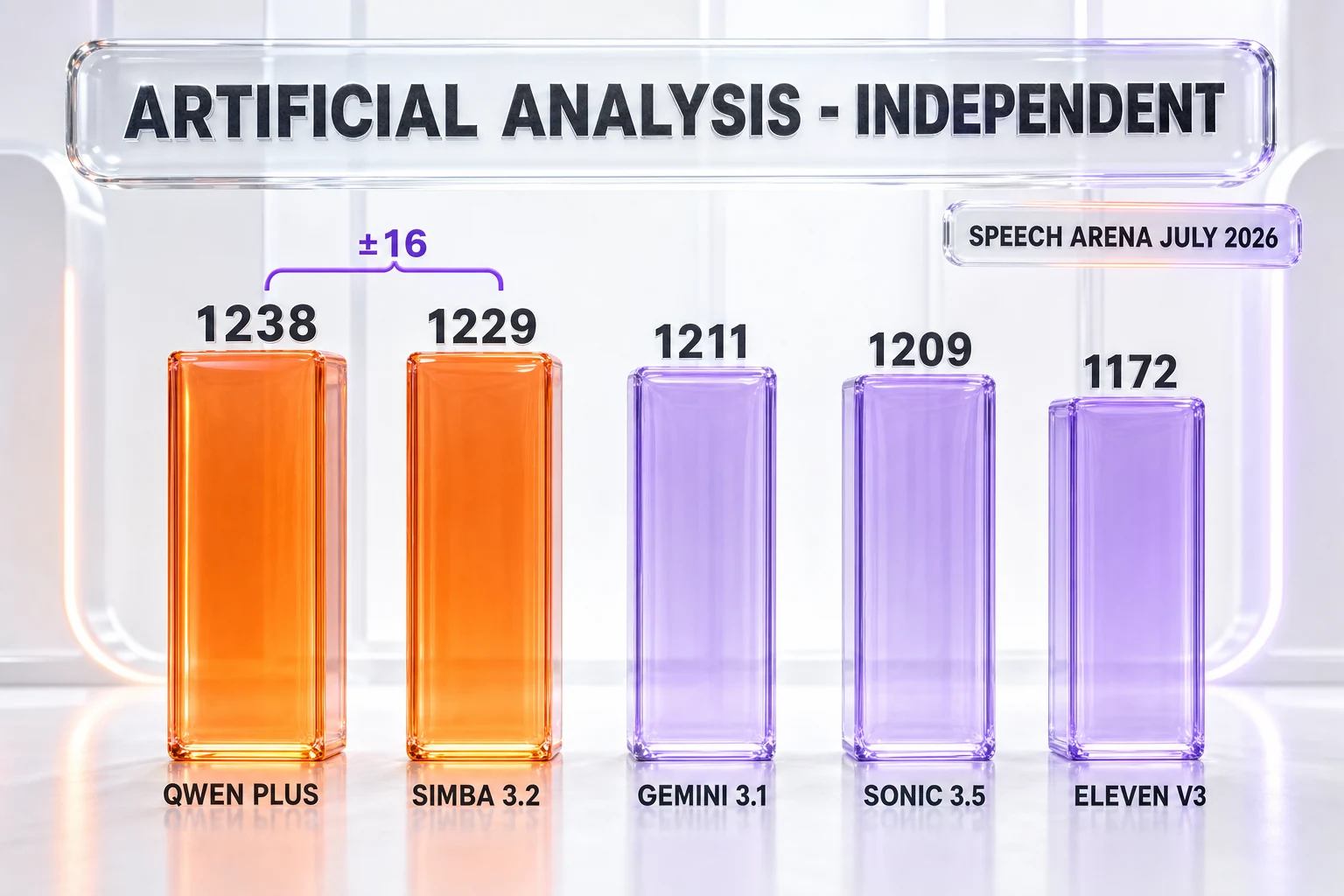
The verifiable news is the ranking. On Artificial Analysis's Speech Arena for provider voices, Qwen-Audio-3.0-TTS Plus is No. 1. As checked on July 22, 2026, it scored an Arena Elo of 1,238 with a margin of about 16 points, ahead of Speechify's Simba 3.2 at 1,229, Google's Gemini 3.1 Flash TTS at 1,211, Cartesia's Sonic 3.5 at 1,209, and ElevenLabs' Eleven v3 at 1,172. Those scores come from listeners comparing anonymized clips, not from Alibaba.
This is why the arena result carries weight that a press-release benchmark never could. The Artificial Analysis Speech Arena pits models against each other in blind listening tests and converts the votes into an Elo rating, the same rating system used to rank chess players and, increasingly, chatbots. No vendor controls the outcome. When Artificial Analysis announced the change, it wrote that Qwen-Audio-3.0-TTS Plus is "the new leading model" on the board, "narrowly surpassing Simba 3.2 and ahead of Gemini 3.1 Flash TTS, and Sonic 3.5." Note the word the evaluator chose: narrowly.
A ranking like this only exists as of a date, because the arena keeps collecting votes. When Artificial Analysis first posted the result on July 20, Plus sat at 1,236 with a margin of 17 across 1,305 arena appearances, two points ahead of Simba 3.2 at 1,234. Two days later, with more votes in, Plus had drifted to 1,238 and Simba to 1,229 — a nine-point gap instead of two. The point is not which number is "right." It is that a live leaderboard is a moving target, and any honest citation of it has to carry the date it was read.
Why "Narrowly" Is the Whole Story
The gap between first and second place is inside the margin of error. On July 22, 2026, Qwen-Audio-3.0-TTS Plus scored 1,238 give or take 16, and Simba 3.2 scored 1,229 give or take 16. Because 1,222 (Plus's floor) is below 1,245 (Simba's ceiling), the two ranges overlap. Statistically, the arena cannot say Plus is genuinely better than Simba 3.2; it can only say Plus currently sits one line higher.
This is the single most important thing to get right about the story, and it is exactly where hype tends to break. A confidence interval is not a technicality to bury in a footnote; it is the difference between "Alibaba built the best TTS model in the world" and "Alibaba built a TTS model that is statistically tied for the best on one leaderboard." The first sentence is unsupported by the data. The second is what the data actually says. Speechify, whose Simba line held the top spot before this, can accurately say its model is statistically level with the new No. 1 — and it has made similar arena claims when the order ran the other way.
Where the margin does become meaningful is further down the board. Plus at 1,238 versus Eleven v3 at 1,172 is a roughly 66-point gap, comfortably outside the confidence intervals. On this specific leaderboard, on this date, Qwen's lead over ElevenLabs' current flagship is statistically real in a way its lead over Simba 3.2 is not. Both facts are true at once, and reporting only the flattering one — "beats ElevenLabs" — while hiding the tie at the very top would be the kind of selective citation that erodes trust.
Independent Scores and Vendor Specs Are Not the Same Evidence
There are two very different kinds of claim in this launch. The Elo ranking is an independent measurement from a third party, with a date and a margin of error. The latency, language count, dialect coverage, and sample rate are vendor specifications from Alibaba. They should never be stacked in the same breath as if they carried equal weight, because one has been tested by outsiders and the other has not.
It is an easy trap to fall into. A tidy sentence like "the No. 1 model does 300-millisecond latency across 16 languages at 48 kHz" reads as one continuous set of facts, but it fuses an independent result with three unverified claims. The 300-millisecond figure, the 16 languages, and the 48 kHz output are all things Alibaba says; only the ranking has been checked by someone with no stake in the answer. None of the vendor specs are implausible, and this is not an accusation that Alibaba is lying. It is a discipline: keep the tested thing and the asserted things in separate columns, so readers can see which is which.
This launch is a useful teaching case precisely because, for once, the flagship claim is the independent one. Most model announcements lead with self-reported benchmarks and bury the fact that no third party has confirmed them — the same problem we flagged when Qwen3.8-Max-Preview claimed to be "second only to Fable 5" with no benchmark table attached. Here the order is reversed: the headline rests on an outside measurement, and the vendor specs are the softer material. Treat them accordingly.
The Pattern: Alibaba Closes the Open-Weight Tap
Qwen-Audio-3.0-TTS is the middle release in a three-day run of closed Alibaba launches. Qwen3.8-Max-Preview arrived on July 19, 2026 with no model card and no benchmarks. Qwen-Audio-3.0-TTS followed on July 20 as a hosted API with no downloadable weights. Qwen-Image-3.0 came on July 21 with no weights, no benchmark table, and no license. For a lab that built its name on open-weight models, that is a visible strategic turn.
The Qwen line was, until recently, the loudest argument that open weights and frontier quality could coexist. Its permissively licensed models powered a huge share of the open-source ecosystem, and its coding releases repeatedly went toe to toe with closed Western systems — we covered one such moment when Qwen 3.6 beat Google's Gemma 4 on coding benchmarks. That history is exactly what makes the July run notable. As Unite.AI reported, Qwen-Image-3.0 shipped with "no benchmark table, no parameter count, no license, and no downloadable weights," a sharp break from Qwen-Image 1.0, which arrived in August 2025 under Apache 2.0 with a same-day technical report.
Three data points do not prove a permanent policy, and Alibaba has promised open weights for some future models "soon." But the direction is consistent, and the incentive is obvious: hosted APIs on Alibaba Cloud Model Studio are a revenue line in a way open weights are not. The audio model fits the shift especially well, because TTS quality is easy to wrap in a metered API and hard for anyone to reproduce without the weights. It is worth remembering that this is the same Qwen team Anthropic publicly accused of industrial-scale distillation earlier this year — a reminder that the competitive stakes around these releases are anything but academic.
What It Means for ElevenLabs, Google, and the TTS Market
For buyers, the practical takeaway is that the top of the TTS market is now genuinely crowded and genuinely close. Qwen Plus, Speechify's Simba 3.2, Google's Gemini 3.1 Flash TTS, and Cartesia's Sonic 3.5 are separated by a few dozen Elo points, and ElevenLabs' Eleven v3 trails on this board despite a large voice library and strong tooling. No single model dominates blind listening tests, so the decision comes down to price, languages, controllability, and how each one handles your specific content.
ElevenLabs remains the incumbent with the broadest ecosystem — a deep voice library, mature APIs, and multilingual reach we have tested at length across dozens of languages. A single arena position does not undo that, and blind clip preference is only one axis of quality. But it does puncture the assumption that the best-sounding TTS necessarily comes from a Western lab, and it gives cost-sensitive buyers a credible new option, if they are comfortable with a hosted-only Chinese API and its data-governance implications. You can compare the incumbents on our ElevenLabs and Cartesia tool pages.
For Google, the read is subtler. Gemini 3.1 Flash TTS at 1,211 is a strong, older entrant — it dates to April 2026 on the board — and it is bundled into a broader model stack rather than sold as a standalone voice product. The competitive pressure Qwen creates is less about any one number and more about narrative: the story that frontier audio quality is a settled Western advantage no longer holds, and the labs that assumed it will have to answer a fast-moving Alibaba on price as well as on sound.
Our Take
We read this as a real milestone wrapped in an overstated headline. The milestone is genuine: for the first time, a Chinese, hosted-only TTS model sits at the top of a credible independent leaderboard, and it got there on listener preference rather than a self-graded benchmark. That is worth marking, and it is a sign of how fast the audio frontier is moving. Anyone who claimed a year ago that the best-sounding voices would stay Western has to reckon with this result.
The overstatement is in the framing that usually rides along with a result like this. "Qwen crushes ElevenLabs and Google" is not what the arena shows. What it shows is a statistical tie at the very top between Qwen Plus and Speechify's Simba 3.2, a clear lead over ElevenLabs' current flagship on this one board, and a leaderboard that moved measurably in 48 hours. The honest sentence is longer and less exciting than the hype, and it is the one we would stand behind.
What would change our read. If Plus holds or extends its lead as the arena accumulates thousands more votes, "narrowly first" becomes "durably first," and the tie caveat fades. If it slips back under Simba 3.2 or a new entrant within weeks, this was a photo finish that happened to be captured at the right moment. Either way, we would judge Alibaba's audio push less by one Elo line and more by whether it keeps the model closed and metered — because that, not the ranking, is the decision that reveals the strategy.
What to Watch Next
Three things will tell us whether this launch ages into a turning point or a footnote. First, the arena: whether Qwen Plus stays No. 1 once its vote count catches up with the thousands of appearances behind Gemini and ElevenLabs, or whether the ranking reshuffles as it settles. Second, the weights: whether Alibaba's promised open releases actually materialize, or whether the July run marks a permanent move to hosted-only, monetized audio. Third, the responders: whether ElevenLabs, Google, Speechify, and Cartesia ship updates that retake the top, which on a board this tight could happen with a single strong release.
For now, the accurate summary is the unglamorous one. Alibaba shipped a good text-to-speech model, an independent leaderboard put its Plus tier first by a margin thin enough to be a tie, and the company did it without releasing the weights. Everything that makes that historic — or merely momentary — is still being voted on.
Frequently Asked Questions
What is Qwen-Audio-3.0-TTS?
Qwen-Audio-3.0-TTS is a text-to-speech model that Alibaba's Tongyi Lab released on July 20, 2026. It ships in two tiers: Flash, tuned for real-time interaction with first-packet latency at roughly the 300-millisecond level, and Plus, tuned for higher-quality generation. Alibaba says it covers 16 languages and 20 Chinese dialect regions, handles one-pass long-form synthesis up to three minutes, and outputs audio up to 48 kHz. Both tiers are delivered as hosted models through Alibaba Cloud Model Studio, not as downloadable weights.
Did Qwen-Audio-3.0-TTS Plus really beat ElevenLabs and Google?
On the Artificial Analysis Speech Arena leaderboard for provider voices, yes, by ranking. As checked on July 22, 2026, Qwen-Audio-3.0-TTS Plus sits at the top with an Arena Elo of 1,238, ahead of Google's Gemini 3.1 Flash TTS at 1,211 and ElevenLabs' Eleven v3 at 1,172. But the model it actually edged out for the No. 1 spot is Speechify's Simba 3.2 at 1,229, and that lead sits inside overlapping confidence intervals, so the top of the table is best read as a statistical tie rather than a clear win.
What is the difference between the Flash and Plus tiers?
According to Alibaba, Flash is built for speed: real-time interaction with first-packet latency at roughly the 300-millisecond level, aimed at voice agents and live applications. Plus is built for quality, where naturalness and timbre fidelity matter more than raw latency. The No. 1 arena ranking belongs specifically to the Plus tier. Both are reached through the same hosted API on Alibaba Cloud Model Studio.
Are the weights for Qwen-Audio-3.0-TTS open or downloadable?
No. Both the Flash and Plus tiers are delivered only as hosted models through Alibaba Cloud Model Studio, described by MarkTechPost as API-only with no downloadable weights. That is a notable shift for Qwen, a line that built its reputation on permissively licensed open-weight releases, and it fits a wider pattern of closed Alibaba launches in July 2026.
What does "within the confidence interval" mean for this ranking?
Every Arena Elo score comes with a margin of error, shown as a plus-or-minus figure. On July 22, 2026, Qwen-Audio-3.0-TTS Plus scored 1,238 with a margin of about 16 points, and Simba 3.2 scored 1,229 with the same margin. Because 1,238 minus 16 (1,222) is below 1,229 plus 16 (1,245), the two ranges overlap. When ranges overlap, the arena cannot say with statistical confidence that one model is genuinely better than the other, even though one sits higher in the table.
Which model did Qwen-Audio-3.0-TTS Plus actually pass for No. 1?
Speechify's Simba 3.2, which had previously topped the Artificial Analysis Speech Arena. Artificial Analysis described Qwen-Audio-3.0-TTS Plus as "narrowly surpassing Simba 3.2 and ahead of Gemini 3.1 Flash TTS, and Sonic 3.5." So the headline is less "Qwen dethrones ElevenLabs" and more "Qwen edges past Speechify at the very top, with ElevenLabs and Google further down the board."
How many languages and dialects does Qwen-Audio-3.0-TTS support?
Alibaba says the model supports 16 languages, seven of them newly added versus the prior line: Arabic, Indonesian, Portuguese, Thai, Vietnamese, Malay, and Tagalog, alongside existing coverage of Chinese, English, French, German, Italian, Japanese, Korean, Russian, and Spanish. It also covers 20 Chinese dialect regions, including Cantonese, Sichuan, Shanghai, and Northeastern varieties. These are vendor-stated capabilities, not independently benchmarked scores.
What is the Artificial Analysis Speech Arena and why does it matter?
The Artificial Analysis Speech Arena is a third-party evaluation where listeners compare anonymized audio clips from different text-to-speech models and vote on which sounds better. Those votes are aggregated into an Elo-style rating with a confidence interval. It matters here because it is an independent measurement rather than a vendor claim, which is why a No. 1 finish on it carries more weight than a self-reported benchmark, provided you read the score with its date and margin of error.
How much does Qwen-Audio-3.0-TTS cost and how do I access it?
MarkTechPost reports the Plus tier is listed at about $27.59 per one million characters on Alibaba Cloud Model Studio, with throughput of roughly 16 characters per second. Access is through the hosted Model Studio API only; there is no self-hostable weights download. Pricing and availability can change, so confirm the current rate on Alibaba Cloud before building against it.
Is this the first Chinese text-to-speech model to top an independent leaderboard?
It is the first time a Chinese, hosted-only TTS model has taken the No. 1 position on the independent Artificial Analysis Speech Arena, a leaderboard previously led by Western models such as Speechify's Simba and, before it, systems from ElevenLabs and Google. That is the genuinely new part of the story. The caveat is that it did so by a margin small enough to fall inside the arena's confidence intervals.
Why are people saying Alibaba is closing its open-weight strategy?
Because Qwen-Audio-3.0-TTS is the second of three consecutive Alibaba releases in mid-July 2026 that shipped without open weights. Qwen3.8-Max-Preview arrived on July 19 with no model card or benchmarks, Qwen-Audio-3.0-TTS on July 20 as hosted-only, and Qwen-Image-3.0 on July 21 with no weights, no benchmark table, and no license. For a lab that made its name on Apache-2.0 open-weight models, three closed launches in three days reads as a strategic shift toward monetized, hosted APIs.
How does Qwen-Audio-3.0-TTS Plus compare to ElevenLabs Eleven v3 on the arena?
On the Artificial Analysis Speech Arena as checked on July 22, 2026, Qwen-Audio-3.0-TTS Plus leads Eleven v3 by a clear margin, 1,238 to 1,172, roughly 66 Elo points, which is well outside the confidence intervals. So while Qwen's lead over the No. 2 model is a statistical tie, its lead over ElevenLabs' current flagship is statistically meaningful on this particular leaderboard. Arena rankings measure listener preference on short clips, not every quality that matters in production, such as voice cloning, controllability, or language coverage.
Sources
- Artificial Analysis — Speech Arena Leaderboard, Provider Voices (checked July 22, 2026)
- Artificial Analysis — Qwen-Audio-3.0-TTS-Plus model page (Quality Elo, speed, price)
- Artificial Analysis — announcement of Qwen-Audio-3.0-TTS-Plus taking the lead (July 20, 2026)
- MarkTechPost — "Alibaba's Tongyi Lab Releases Qwen-Audio-3.0-TTS" (July 20, 2026)
- Tongyi Lab (FunAudioLLM) — Qwen-Audio-3.0-TTS official project page
- Unite.AI — "Alibaba Launches Qwen-Image-3.0 Without Benchmarks or Weights" (July 21, 2026)
- Speechify — "We're Number One" on the Artificial Analysis TTS leaderboard (Simba context)