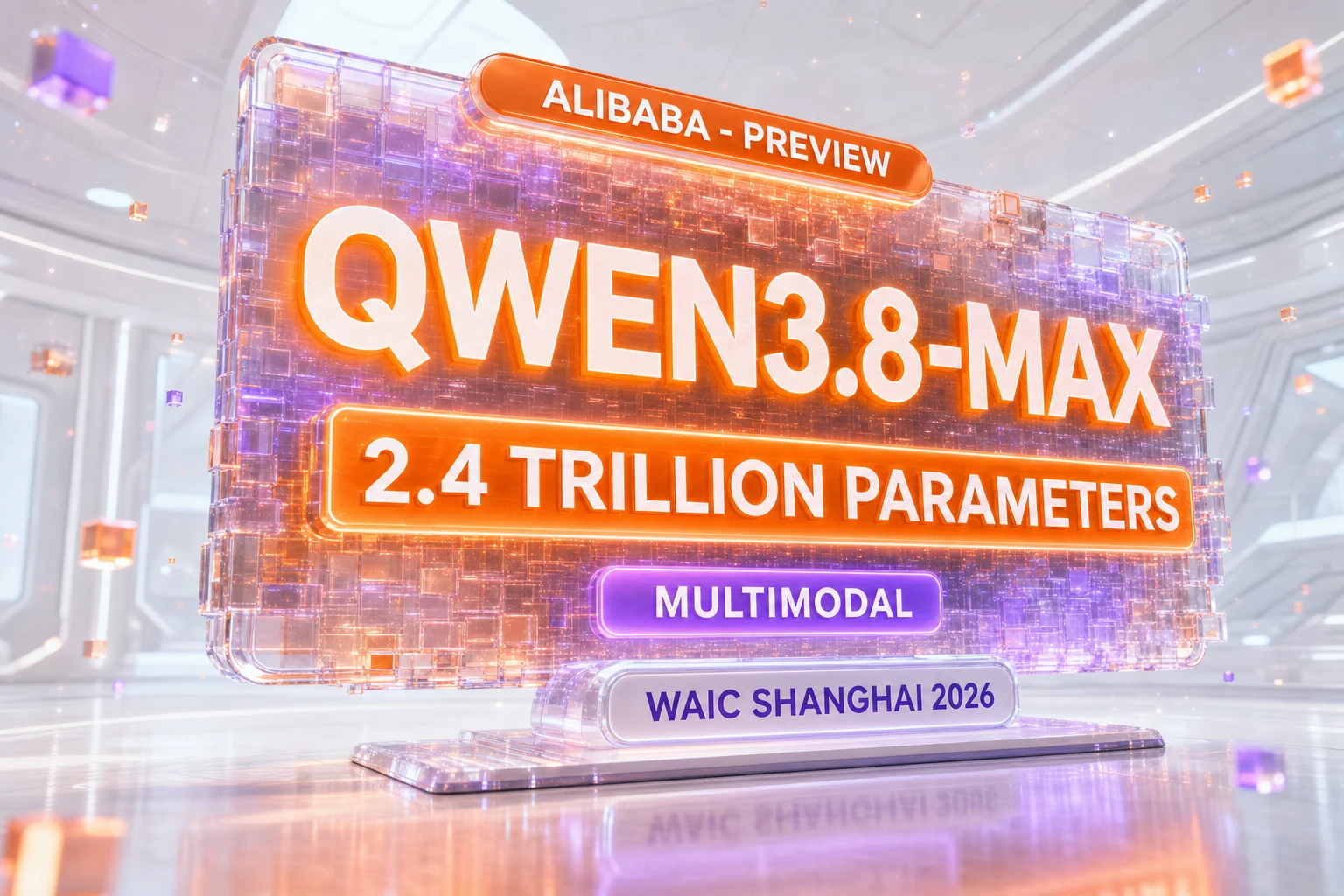
Qwen3.8-Max-Preview is the new flagship model Alibaba's Qwen team previewed on July 19, 2026 at the World Artificial Intelligence Conference in Shanghai. Alibaba says it is a sparse Mixture-of-Experts model with 2.4 trillion total parameters, the first Qwen above one trillion parameters to go multimodal across text, images, video, and documents. The company also claims it is "comparable to leading frontier AI models, second only to Fable 5" — but that ranking comes entirely from Alibaba's own testing. As of late July 2026 there is no model card, no benchmark table, no license, and no disclosed active-parameter count. The model is live only as a paid preview at 10 percent of the standard price through Token Plan, Qoder, and QoderWork, with open weights promised "soon" but no date attached. The more concrete story sits in a different device: four days earlier, China cleared Apple Intelligence to run on Alibaba's Qwen.
Key Takeaways
- A trillion-parameter arms race, now in the open. Alibaba's Qwen3.8-Max-Preview lands at 2.4 trillion total parameters, two days after Moonshot's 2.8-trillion-parameter Kimi K3. WAIC Shanghai has become a contest of who can announce the largest model.
- The headline ranking is a vendor claim. "Second only to Fable 5" is Alibaba's own line, from its own testing. There is no independent benchmark, no model card, and no score table to check it against.
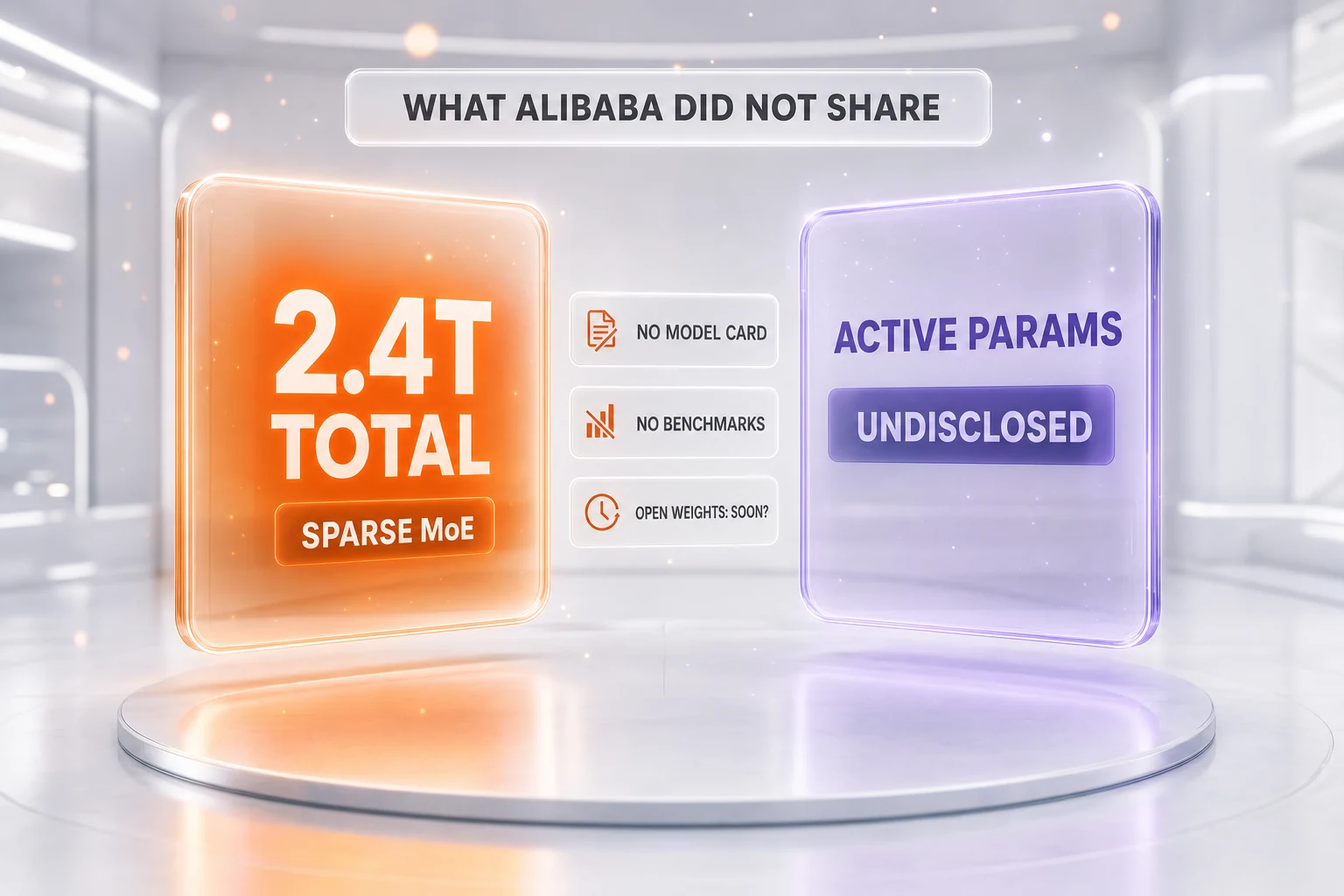
- The number that matters is missing. Alibaba disclosed 2.4 trillion total parameters but not how many are active per token. In a Mixture-of-Experts model, the active count — not the total — sets the real serving cost.
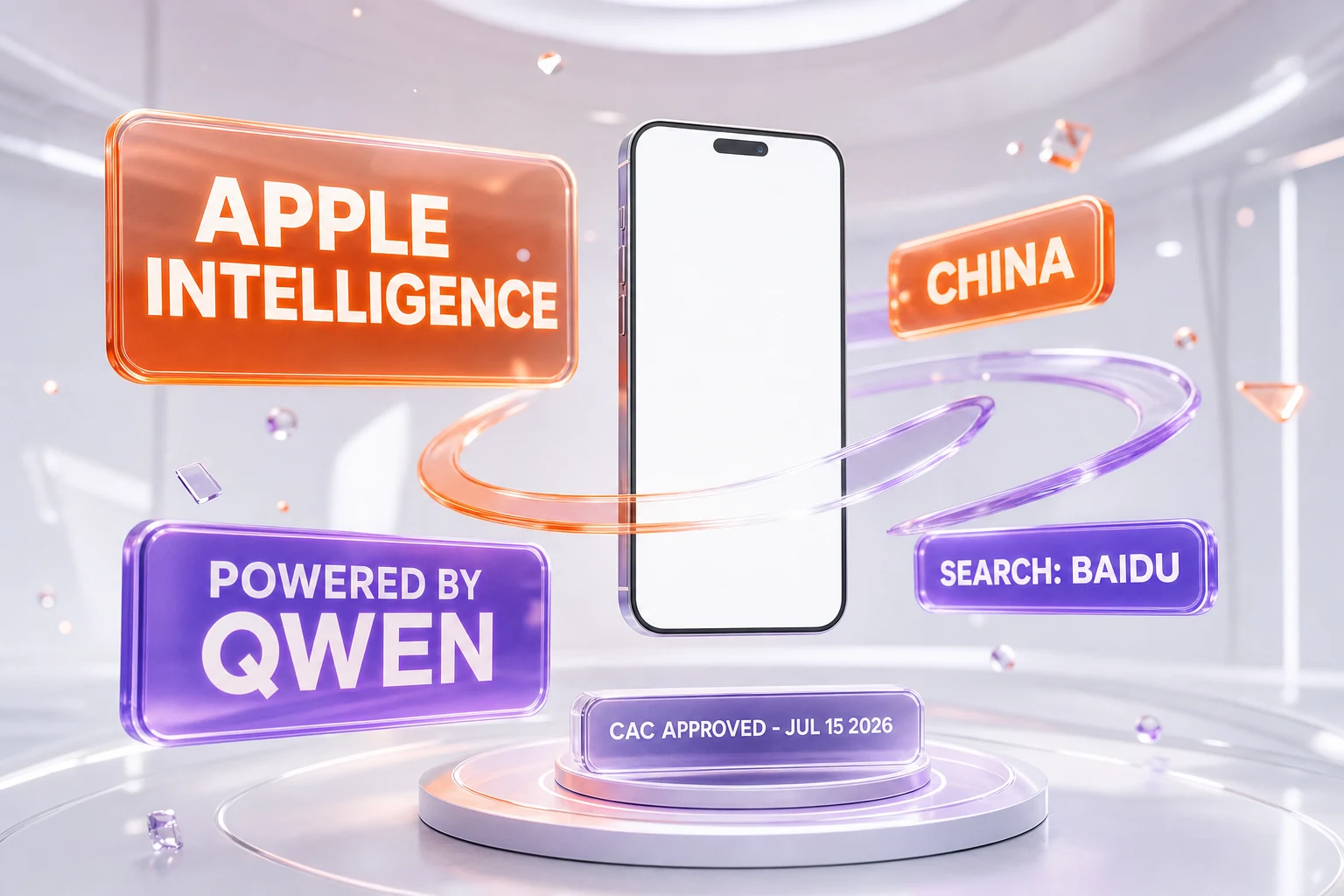
- The real, verifiable news is Apple. On July 15, 2026, China approved Apple Intelligence to run on Alibaba's Qwen, with Baidu handling visual search — ending a roughly 22-month wait for Chinese iPhone users.
- "Open weights soon" is a promise, not a product. No date, no license. For a "Max" tier that has always stayed closed, it would be a real shift — if and when it actually ships.
What Alibaba Unveiled at WAIC Shanghai
On Sunday, July 19, 2026, Alibaba's Qwen team previewed Qwen3.8-Max-Preview during the World Artificial Intelligence Conference in Shanghai. The pitch was simple and enormous: 2.4 trillion total parameters, built on the sparse Mixture-of-Experts architecture Qwen has used before, and — for the first time in a Qwen model above one trillion parameters — full multimodality. Qwen developer Shuai Bai described it as processing text, images, video, and documents in a single system.
The preview is not a paper release. It is live right now through Alibaba's Token Plan subscription and its Qoder and QoderWork coding tools, priced at 10 percent of the standard rate for the duration of the preview. Alibaba says the model beats its predecessor, Qwen3.7-Max, on coding, full-stack development, data analysis, and office workflows. Those are exactly the agentic, developer-facing tasks where Chinese labs have been pushing hardest — and where Alibaba earlier this year turned the Qwen app into an app store for AI agents.
What is striking is how much of the announcement is scale and how little is evidence. The company published a total parameter count and a ranking, and left almost everything a serious buyer would want — active parameters, evaluation results, a license — for later. Markets liked the ambition anyway: Bloomberg reported Alibaba shares rose as much as 5.4 percent on the Monday after the preview, extending a rally that had started the week before on the Apple news.
The One Number Alibaba Will Not Share
The most important figure about Qwen3.8-Max is one Alibaba did not publish: the active-parameter count. In a Mixture-of-Experts model, the total parameter count is a measure of capacity, but only a subset of "experts" fires on any given token. That active slice determines how much compute each request burns, how fast the model responds, and how much it costs to serve at scale. A 2.4-trillion-parameter total tells you the model is big; without the active count, it does not tell you whether the model is cheap or ruinously expensive to run.
The contrast with the week's other giant is instructive. Moonshot said plainly that Kimi K3 activates roughly 50 billion of its 2.8 trillion parameters per token, with 16 of 896 experts firing per pass. That single disclosure is what lets anyone reason about K3's serving economics. Alibaba offered no equivalent number, so the honest description of Qwen3.8-Max's efficiency today is: unknown. For a model being sold — even at a preview discount — that gap is not a footnote. It is the whole cost question.
"Second Only to Fable 5" Is a Claim, Not a Measurement
Alibaba's boldest line is that Qwen3.8-Max is "comparable to leading frontier AI models, second only to Fable 5." It is worth being precise about where that sentence comes from: it is Alibaba's own statement, published through the company's official channels and grounded in its internal testing. It is not the output of an independent evaluator, and it arrives with no benchmark table, no model card, and no reproducible methodology. Every performance figure attached to Qwen3.8-Max today carries that caveat.
This matters because self-reported and independent numbers are different kinds of evidence, and they should never be stacked as if they were the same. Kimi K3 launched with an independent Artificial Analysis Intelligence Index score of 57 — a third-party read that placed it near Claude Fable 5 and Claude Opus 4.8 on the same version of the same index. Qwen3.8-Max has nothing comparable. Pointing a self-graded ranking directly at Anthropic's best model is a marketing choice, not a measurement, and it should be read that way until an outside lab runs the tests.
There is a second reason for skepticism specific to Qwen. We have already reported that Anthropic accused Alibaba and Qwen of an industrial-scale effort to distill Claude. When a lab facing that accusation then benchmarks itself against Anthropic's flagship and declares it comes in a close second, the appropriate response is not applause — it is to wait for the receipts.
The Bigger Story Is Already in China's iPhones
The most consequential Qwen news of the month is not the 2.4-trillion-parameter preview at all — it is that, on July 15, 2026, China's Cyberspace Administration approved Apple Intelligence to launch in the country, running on Alibaba's Qwen. That decision ended a roughly 22-month wait for Chinese iPhone users, who had watched Apple Intelligence ship everywhere else while regulatory approval stalled at home. Reuters-cited reporting puts the approval across iOS, iPadOS, macOS, and visionOS in mainland China.
The division of labor is specific: Qwen handles language — text and image understanding and generation — while Baidu works on visual search, a parallel arrangement rather than a single-vendor deal. The China build will not use Apple's Private Cloud Compute, a structural difference from Apple Intelligence elsewhere. For Alibaba, the strategic prize is enormous. Apple generated $20.5 billion in Greater China revenue in its second quarter of 2026, up 28 percent year over year, and becoming the default intelligence layer for that install base is worth far more than any benchmark bragging right.
Here is the twist worth holding onto: the Qwen that will touch the most users is not Qwen3.8-Max. The on-device model Apple ships in China is a compact, heavily quantized Qwen — small enough to run inside an iPhone's memory — not the 2.4-trillion-parameter cloud flagship unveiled four days later. It is a useful reminder that the models that reach billions of people are usually the small, boring, shrunk-down ones, while the trillion-parameter headliners fight for status on a conference stage. Alibaba's smaller Qwen models, including the Qwen 3.6 generation that already outscored Google's Gemma 4 on coding, are the ones doing the quiet, load-bearing work.
A Two-Model Week: Qwen3.8-Max Meets Kimi K3
Qwen3.8-Max-Preview did not arrive in a vacuum. Two days earlier, on July 17, Moonshot AI released Kimi K3, a 2.8-trillion-parameter open-weight model, and the two announcements now bracket the same week at WAIC. Put side by side, they map the two strategies Chinese frontier labs are running at once.
Kimi K3 led with disclosure and receipts: an active-parameter count, an independent Intelligence Index score of 57, a published API price list, and a promised weight drop under a Modified MIT license. Qwen3.8-Max led with scale and a ranking: a bigger headline ambition, a "second only to Fable 5" claim, and a preview you can pay to use — but no independent number, no active count, and no license yet. Both are betting that "multi-trillion parameters" is now the price of admission to the frontier conversation. Only one of them has so far shown its work.
What "Open Weights, Soon" Actually Means
Alibaba says Qwen3.8-Max's weights will be released "soon." Taken at face value, that would be a genuine departure. Qwen's smaller models have long shipped as open weights and helped Alibaba build one of the most-downloaded open-model families in the world, but the top "Max" tier has stayed closed, offered only through the API. An open-weight 2.4-trillion-parameter Max model would break that pattern and hand the open-source community something no US frontier lab currently offers at that scale.
The caution is the same one that applies to Kimi K3, which was also "open" in intent and closed in practice at launch: a promise of open weights with no date and no license is not something a team can plan around. Timelines slip, licenses arrive with restrictions, and "soon" is doing a lot of work. Until Alibaba publishes the weights and the terms, the accurate description of Qwen3.8-Max is a closed, paid preview with an open-source aspiration attached.
What to Watch Next
Three things will tell us whether Qwen3.8-Max is a frontier model or a frontier press release. First, an independent score: watch for an Artificial Analysis Intelligence Index number, or any reproduced third-party evaluation, to replace Alibaba's self-graded ranking. Second, the disclosures that turn a headline into a product — an active-parameter count, a model card, and a standard price list to reveal what the model costs once the 10 percent preview discount ends. Third, the open-weight release: a real date, a real license, and actual downloadable weights would make Qwen3.8-Max the largest open model in the world, edging past Kimi K3. Until those land, the smartest read is the one the numbers support: a big, ambitious, unverified preview — and a much quieter, already-shipping Qwen sitting inside China's iPhones.
Frequently Asked Questions
What is Qwen3.8-Max-Preview?
Qwen3.8-Max-Preview is the newest flagship large language model from Alibaba's Qwen team, previewed on July 19, 2026 at the World Artificial Intelligence Conference (WAIC) in Shanghai. It is a sparse Mixture-of-Experts model that Alibaba says has 2.4 trillion total parameters, and it is the first Qwen model above one trillion parameters to handle multimodal inputs — text, images, video, and documents. As of late July 2026 it exists only as a paid preview: Alibaba has not published a model card, a benchmark table, or a license.
How many parameters does Qwen3.8-Max have?
Alibaba describes Qwen3.8-Max as a 2.4-trillion-parameter model, and that figure is the total parameter count. Because it uses a sparse Mixture-of-Experts design, only a fraction of those parameters activate on any given token — but Alibaba has not disclosed how large that fraction is. Without the active-parameter count, the 2.4 trillion headline says very little about how expensive or fast the model actually is to run.
How many active parameters does Qwen3.8-Max use per token?
Alibaba has not disclosed the active-parameter count. In a Mixture-of-Experts model, only a subset of experts fires per token, so the number of active parameters — not the total — determines serving cost and latency. Moonshot published this figure for Kimi K3 (about 50 billion active out of 2.8 trillion). Alibaba has not done the same for Qwen3.8-Max, which is one of the biggest open questions about the model as of late July 2026.
Is Qwen3.8-Max really 'second only to Fable 5'?
That is Alibaba's own claim, not an independent finding. In its announcement, Alibaba described Qwen3.8-Max as 'comparable to leading frontier AI models, second only to Fable 5,' based on its internal testing. No third-party benchmark, model card, or score table has been published to support the ranking. Until an independent evaluator such as Artificial Analysis tests the model, the comparison to Anthropic's Fable 5 should be read as marketing rather than a measured result.
Does Qwen3.8-Max have an independent benchmark score?
No. As of late July 2026 there is no independent benchmark for Qwen3.8-Max — no Artificial Analysis Intelligence Index number, no reproduced third-party evaluation, and no model card. Every performance statement so far comes from Alibaba itself. That is a sharp contrast with Kimi K3, which launched two days earlier already carrying an independent Intelligence Index score of 57.
How can I access Qwen3.8-Max-Preview, and what does it cost?
Qwen3.8-Max-Preview is live through Alibaba's Token Plan subscription and its Qoder and QoderWork coding products. During the preview window, Alibaba is charging 10 percent of the standard price. Alibaba has not published the full standard rate card for the model, so the effective long-term cost is still unknown — the 10 percent discount is a preview promotion, not a permanent price.
Will Qwen3.8-Max be open source or open weight?
Alibaba says the open weights are coming 'soon,' but it has given no date and no license. That would be a notable break: Alibaba's top 'Max' tier has historically stayed closed, while its smaller Qwen models ship as open weights. Until the weights and a license actually appear, 'open soon' is a stated intention, not something developers can download or build on today.
Is Qwen3.8-Max multimodal?
Yes. According to Qwen developer Shuai Bai, Qwen3.8-Max processes text, images, video, and documents, making it the first Qwen model above one trillion parameters to support multimodal inputs. Alibaba also says it improves on Qwen3.7-Max at coding, full-stack development, data analysis, and office workflows — though those gains, like the headline ranking, are self-reported.
Does Qwen3.8-Max power Apple Intelligence in China?
No, and this is a common point of confusion. Apple Intelligence in China is powered by Alibaba's Qwen, but by a compact, quantized version of a smaller Qwen model that runs on the device — not by the 2.4-trillion-parameter Qwen3.8-Max preview. The Max model is a cloud flagship; the phone model is a shrunk-down Qwen sized to fit inside an iPhone's memory.
Which Qwen model runs Apple Intelligence in China?
Apple uses a compact, heavily quantized Qwen model for on-device language features in mainland China — reporting points to a smaller Qwen compressed to run within an iPhone's memory, rather than the giant Max flagship. Baidu handles visual search separately. China's Cyberspace Administration approved the arrangement on July 15, 2026, ending a roughly 22-month wait for Apple Intelligence in the country.
How does Qwen3.8-Max compare to Kimi K3?
They landed the same week and tell opposite stories. Kimi K3, from Moonshot AI, is a 2.8-trillion-parameter open-weight model with a published independent Intelligence Index score of 57 and a full API price list. Qwen3.8-Max is comparable in scale (2.4 trillion total parameters) but thinner on disclosure: no active-parameter count, no independent score, no license, and only a discounted preview. One shipped receipts; the other shipped a press release.
Why did Alibaba's stock rise after the Qwen3.8-Max announcement?
Alibaba shares rose as much as 5.4 percent on Monday, July 20, 2026 after the Qwen3.8-Max preview, according to Bloomberg. The move extended a rally that had already begun the week before, when China approved Apple Intelligence to run on Alibaba's Qwen. Investors are reading Alibaba's AI momentum — a frontier-scale model plus a marquee Apple partnership — as a sign its models are becoming core infrastructure in China's AI market.
Sources
- MarkTechPost — Alibaba Previews Qwen3.8-Max, a 2.4 Trillion-Parameter Multimodal Model
- South China Morning Post — Alibaba says newest Qwen model is second only to Anthropic's Fable 5
- Bloomberg — Alibaba Shares Rise After Unveiling Upgraded Flagship AI Model
- Qwen (official) — @Alibaba_Qwen announcement thread
- TechCrunch — Apple Intelligence approved for launch in China with Alibaba's Qwen AI
- TechTimes — Apple Intelligence Wins China Approval: Qwen Handles Language, Baidu Handles Search
- eWeek — Alibaba Debuts 2.4T-Parameter Qwen3.8