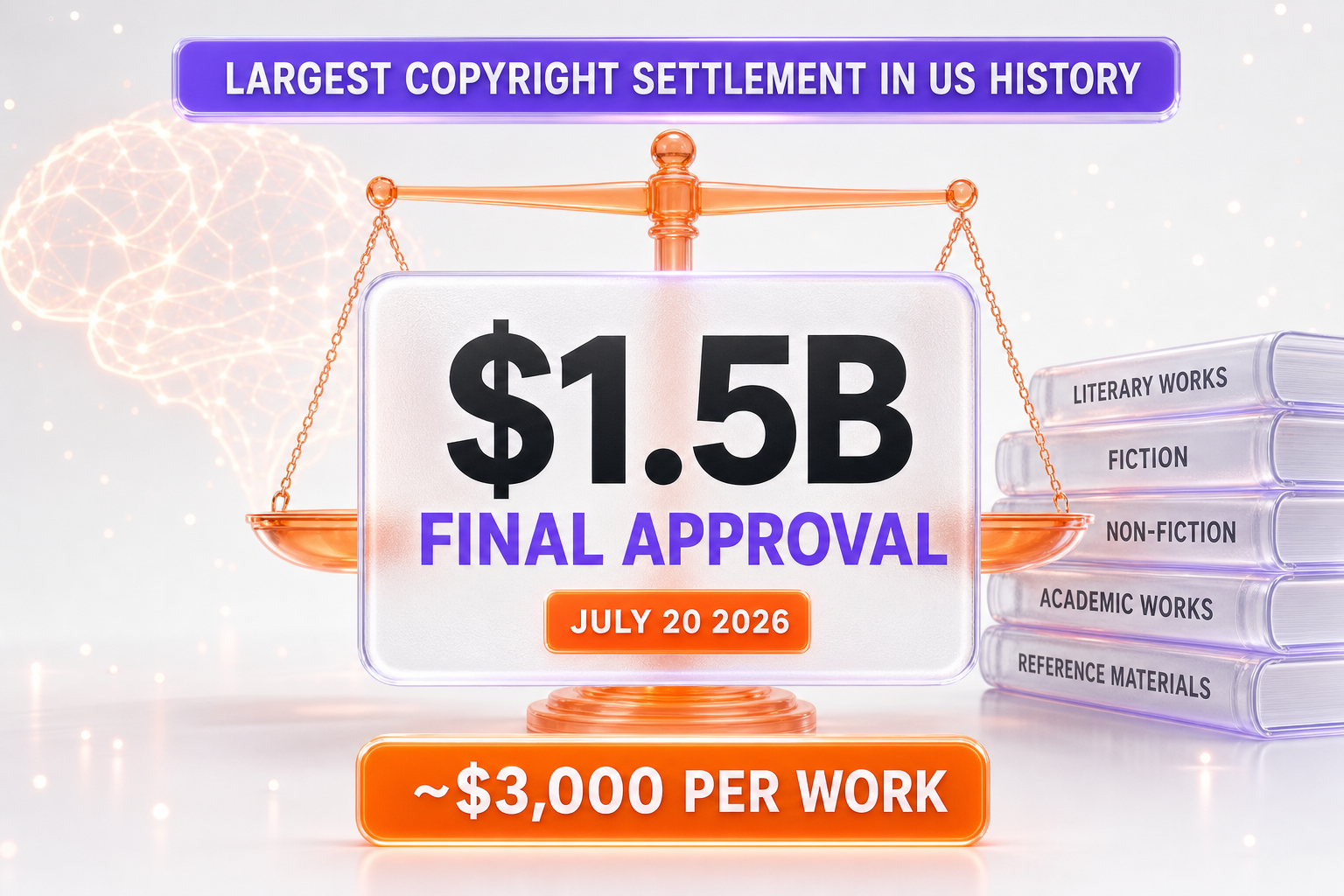
On Monday, July 20, 2026, a federal judge in San Francisco granted final approval to Anthropic's $1.5 billion copyright settlement — the largest copyright recovery in United States history, and now legally final. Judge Araceli Martínez-Olguín of the US District Court for the Northern District of California signed off on the deal in Bartz v. Anthropic, clearing objections from a handful of authors and letting the AI lab behind Claude begin paying rightsholders. The class covers roughly 500,000 works pirated from shadow libraries, at about $3,000 per work — arithmetic that lands almost exactly on the $1.5 billion total. It is the first time a US court has put a hard number on the cost of training an AI model on stolen books.
Here is the line that matters, and the one we hold throughout: this is a settlement, not a verdict. It sets no binding legal precedent. But it does something arguably more consequential for the dozens of copyright suits still pending against OpenAI, Meta, Google and Midjourney — it establishes a real, court-blessed market price for the specific act of training on pirated works. That number is now on the table for every plaintiff's lawyer in the country.
The Gist
- It's final: Judge Araceli Martínez-Olguín granted final approval on July 20, 2026, making the $1.5 billion figure legally binding and clearing Anthropic to start distributing payments.
- The math: roughly 500,000 works at about $3,000 each is approximately $1.5 billion. More than 91% of eligible works were claimed by their rightsholders, and opt-outs were, in the court's word, "miniscule."
- Piracy, not training, was the sin: a 2025 ruling found that training on lawfully bought books is fair use — but Anthropic downloaded these from pirate sites like LibGen, and that is what created the liability.
- A price, not a precedent: a settlement sets no case law, yet about $3,000 per pirated work is now a reference point the dozens of other AI copyright plaintiffs will cite.
- The timing: Anthropic clears its single largest legal liability roughly three months before the reported October window for its IPO investor meetings.
What Judge Martínez-Olguín Actually Approved
The final-approval order does three things at once: it certifies the settlement class, it approves the $1.5 billion payout as fair, and it disposes of the objections that could have unraveled the deal. According to TechCrunch and Reuters, Judge Martínez-Olguín rejected the objections outright, writing that they were "not grounded in a realistic assessment of the overall risks and rewards of a trial."
The objections were never large. Publishing Perspectives reported that only 53 objections were filed — 26 of them simply asking that additional works be folded into the settlement — while opt-outs were described as "miniscule." The judge characterized the class's response as "overwhelmingly favorable" and found the deal offered "substantial benefits to the Class in light of the novel claims asserted."
She also trimmed the lawyers' fee. Plaintiffs' counsel had requested $187.5 million — 12.5% of the fund — and were awarded roughly $101.6 million instead, on the reasoning that the customary 25% benchmark "does not necessarily apply" to a mega-fund of this size. Even reduced, it is one of the larger fee awards in recent class-action history.
The Numbers, and Whether They Add Up
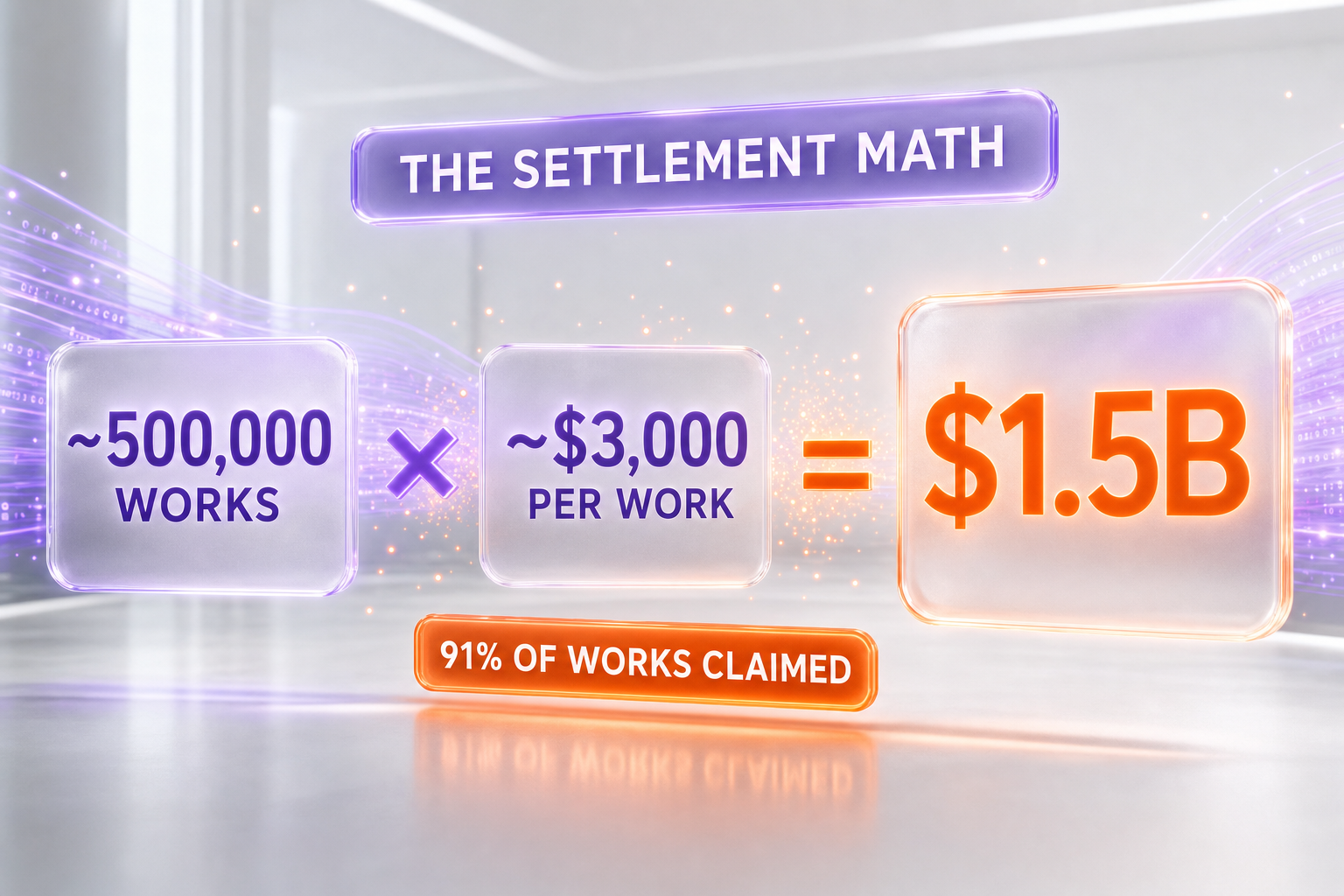
The settlement covers roughly 500,000 works, with payouts of about $3,000 per work. Multiply the two and you land within rounding distance of $1.5 billion — the arithmetic is not a coincidence, because the fund was sized against the class of pirated works in the first place. Reuters and Publishing Perspectives both anchor the per-work figure at around $3,000; the exact number floats slightly because the final count of eligible works settled near, but not exactly at, 500,000.
The participation rate is the quieter headline. Authors Alliance and Publishing Perspectives put claims at about 91.3% of eligible works — an unusually high take-up for a class action, where single-digit claim rates are common. In plain terms: the people the settlement was meant to compensate overwhelmingly showed up to collect, which is part of why the judge found the objections unpersuasive.
One number we are deliberately not inventing is a precise per-work dollar amount. Sources round to "about $3,000," and dividing $1.5 billion by a class described only as "roughly 500,000" gives a figure near $3,000 but not a clean, citable constant. We report the range the courts and reporters actually used, and leave the false precision to others.
Wait — Haven't We Covered This Already?
Partly. We wrote about this settlement when it was still a promise rather than a fact — see our earlier piece, "Anthropic's $1.5 Billion Bill Lands Tomorrow", which walked through the structure of the deal and the road to approval. That article covered the journey. This one covers the destination: the deal is now signed, sealed and enforceable.
The short version of the backstory: a trio of authors — Andrea Bartz, Charles Graeber and Kirk Wallace Johnson — sued Anthropic in 2024, alleging it had trained Claude on their books without permission. As TechCrunch notes, the case became the first major US AI copyright suit to reach a merits ruling, then the first to settle. If you want the full timeline, the May piece has it; here, we focus on what final approval changes.
Why Piracy — Not Training — Cost $1.5 Billion
The distinction that produced the $1.5 billion is the whole story, and it traces back to Judge William Alsup, who handled the case before retiring in late 2025. In June 2025, Alsup issued a split ruling that has shaped every AI copyright fight since: training a large language model on books Anthropic had lawfully purchased was "exceedingly transformative" and qualified as fair use. That part was a win for Anthropic — and for the industry.
But Alsup drew a hard line at how Anthropic got much of its training corpus. The company had downloaded millions of books from pirate repositories — Library Genesis (LibGen) and the Pirate Library Mirror among them — and kept them in a permanent internal library. Storing and using those pirated copies, Alsup held, was not fair use, and it exposed Anthropic to statutory copyright damages that, at up to $150,000 per work across millions of titles, could in theory have reached into the hundreds of billions at trial. The $1.5 billion settlement is what it cost to make that tail risk disappear.
That is why the shorthand "AI training is now legal" gets the story backwards. Training on lawful copies survived; sourcing from piracy is what got punished. As TechTimes put it, the settlement targets the specific wrong of using stolen copies — not the act of model training itself.
The First Court-Blessed "Market Price" for AI Training
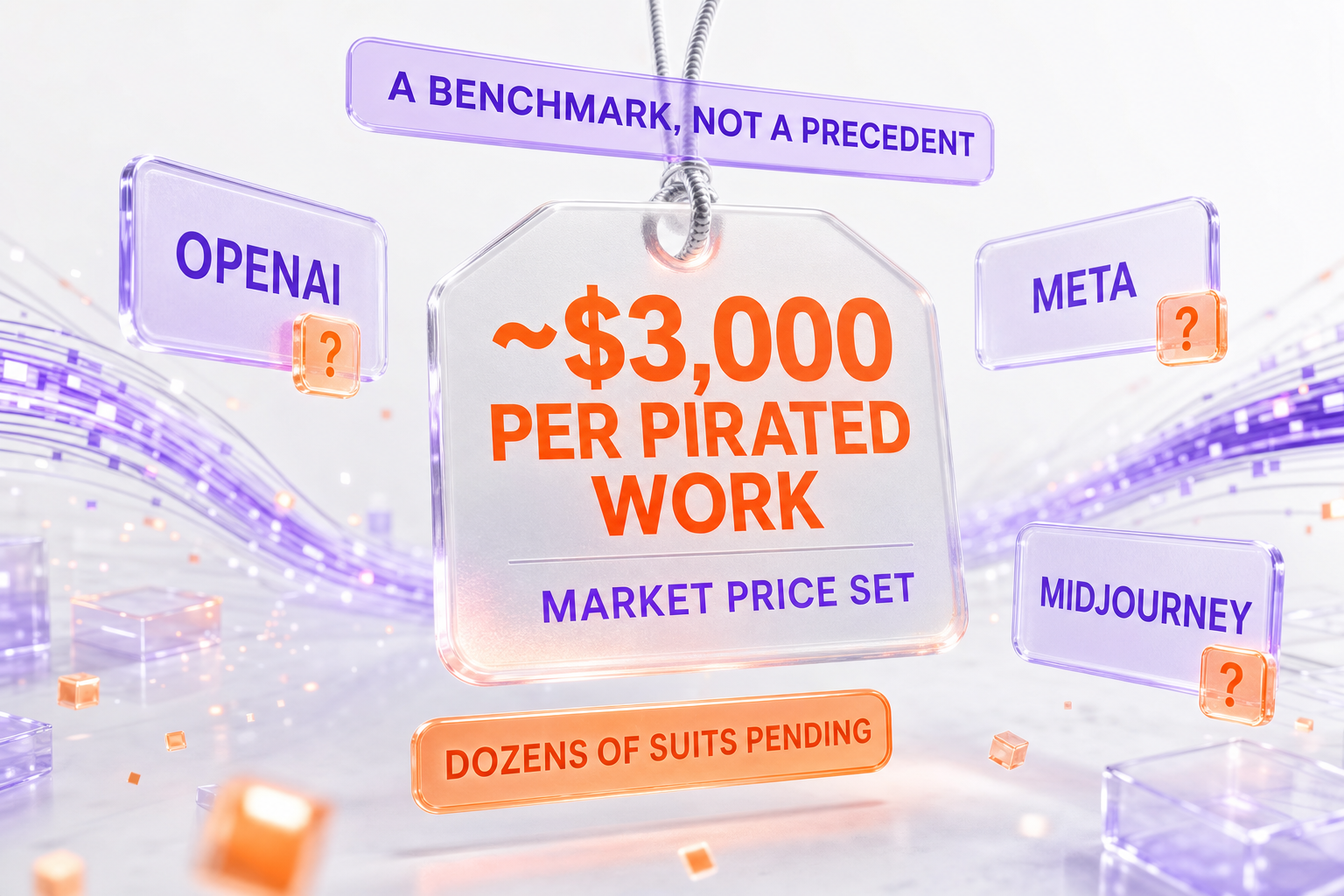
Strip away the legal machinery and what is left is a number: roughly $3,000 to make one act of book piracy go away, multiplied across a class. Before July 20, that number was hypothetical. Now it has a federal judge's signature under it. For an industry that has spent two years arguing that the value of a single scraped work is effectively zero, a court-endorsed figure in the low thousands per work is a meaningful anchor.
Rightsholders read it exactly that way. Maria Pallante, president of the Association of American Publishers, called the outcome "an important victory in the larger battle to hold big tech accountable," per Publishing Perspectives. Whether or not the figure holds as other cases play out, it reframes the negotiation: a plaintiff can now point across the table and note that a peer paid roughly $3,000 per pirated work rather than fight.
The caveat, which we will not bury: a settlement price is a floor and a reference, not a ruling. It reflects Anthropic's specific risk calculus — a very large company with a very large piracy problem and an IPO on the horizon — not a judicial finding that $3,000 is the "correct" value of a book. Read it as a data point with real gravity, not as a law.
What Final Approval Actually Unlocks
Two things change the moment the order is entered. First, money moves: Anthropic can begin distributing payments to the authors and publishers who filed claims, a process that had been frozen pending the judge's sign-off. For individual authors, that means real checks rather than a press-release promise.
Second, and less obvious, a liability comes off the books. Anthropic is reportedly weeks away from an IPO roadshow — bankers were said to be lining up investor meetings for a listing as soon as October 2026, as we covered in our look at Anthropic's IPO timeline. A publicly disclosed, judicially approved $1.5 billion settlement is a cleaner line in an S-1 than an open-ended copyright exposure of unknown size. Uncertainty is what spooks IPO investors; a fixed, final number is something bankers can model, as CNBC and other outlets tracking the listing have noted.
It is worth stating plainly that $1.5 billion is not trivial, even for a lab valued at a reported $965 billion in its Series H round. But as a share of that valuation, it is a rounding error — and a one-time, quantified rounding error is exactly the kind of risk public markets prefer to a lawsuit with no ceiling.
It Sets No Binding Precedent — Why That Still Matters
Legally, a class-action settlement resolves the parties in front of the court and nothing more. It creates no case law, binds no other judge, and cannot be cited as authority in OpenAI's or Meta's separate cases. On paper, the precedential value is zero — a point Anthropic's defenders are quick to make, and a fair one.
In practice, precedent is not the only thing that moves litigation. Settlements move it too, by pricing risk. The Alsup fair-use ruling gave every AI defendant a shield for training on lawful data; the Anthropic settlement hands every plaintiff a sword for the piracy question — a concrete, court-tested answer to "what is this worth?" As TechTimes stresses, the number binds no one — and yet expect it to be quoted in briefs for years, precedent or not.
The Other Shoe: Dozens of AI Copyright Suits Are Watching
The Anthropic case is one of dozens of copyright suits filed against AI companies since 2023, and it is the first to both survive a merits ruling and settle. Still live: The New York Times's landmark case against OpenAI and Microsoft, authors' suits against Meta over its use of LibGen-sourced books, and image-focused litigation against Midjourney and Stability AI. Days before the Anthropic approval, a fresh class action landed against Google, brought by publishers including Hachette, Cengage and Elsevier and authors including Scott Turow, per TechCrunch.
None of these will be decided by the Anthropic settlement. But each now operates in a world where a comparable defendant paid $1.5 billion rather than test the piracy question at trial. For defendants who also trained on shadow-library data, that is an uncomfortable comparison; for those who can show clean, licensed sourcing, it is a reason to fight rather than fold. The settlement does not answer the other cases — it changes their gravity.
Europe's Turn: GEMA v Suno Lands July 31
The American story just put a price on piracy. The European story may decide the underlying legality — and it arrives within days. On Friday, July 31, 2026, the Munich Regional Court's 42nd Civil Chamber is scheduled to rule in GEMA's copyright case against the AI music startup Suno, a decision pushed back from June. GEMA, the German collecting society, argues Suno trained on protected compositions without a license and can reproduce recognizable fragments of them on demand.
The venue is loaded. The same Munich chamber ruled against OpenAI in November 2025, finding that storing copyrighted content during training constituted reproduction — and under German law, a first-instance ruling can be enforced immediately even while an appeal proceeds, as Music Times has explained. A win for GEMA would be the first major European decision that AI platforms need authorization to train on copyrighted music, and it would land on a Suno already fighting on several fronts, as we detailed when the company moved to shield its Warner settlement terms from rivals. The US answered "how much." Munich may answer "is it even allowed."
What Would Prove This Read Wrong
The strong claim here is that $1.5 billion functions as a market price other cases will orbit. That read fails if the next few rulings ignore it — if a judge in the OpenAI or Meta litigation treats the Anthropic number as irrelevant to a different fact pattern, or if defendants with cleaner sourcing win outright on fair use and reset the frame. It also fails if Anthropic's payout turns out to be an outlier priced by IPO urgency rather than by the underlying value of the works.
I would also flag the piece of this that stays genuinely open: the settlement resolves the pirated-books class, but it does not license Anthropic's future training, and it does not tell us how the biggest unresolved question — training at scale on lawfully accessed but unlicensed data — will land. For the record, ThePlanetTools.ai has no affiliate relationship with Anthropic, and nothing here is legal advice. We cover Anthropic often; this is analysis of a court record, not a cheer.
Sources
- TechCrunch — Anthropic's landmark $1.5B copyright settlement is approved (July 20, 2026)
- Reuters (via U.S. News) — US judge approves Anthropic's $1.5 billion settlement of copyright lawsuit (July 20, 2026)
- Publishing Perspectives — Court Grants Final Approval to Landmark $1.5 Billion Anthropic Settlement (July 21, 2026)
- Authors Alliance — Bartz v. Anthropic Settlement Receives Final Approval (July 21, 2026)
- TechTimes — Anthropic Copyright Settlement Gets Final Approval: $3,000 Per Book, No Binding Precedent (July 21, 2026)
- MLex — GEMA, Suno copyright ruling postponed by Munich court to July 31 (2026)
- Music Times — Two Court Rulings on AI Music Are Due This Month (July 9, 2026)
Frequently Asked Questions
How much is Anthropic's copyright settlement, and is it final?
It is $1.5 billion, and yes — on July 20, 2026, a federal judge granted final approval, making it legally binding. It is the largest copyright settlement in US history. Final approval clears Anthropic to begin distributing payments to the authors and publishers whose pirated works were part of the class.
Which judge approved the Anthropic settlement, and when?
Judge Araceli Martínez-Olguín of the US District Court for the Northern District of California granted final approval on Monday, July 20, 2026, in Bartz v. Anthropic. She took over the case after Judge William Alsup, who issued the earlier fair-use ruling and preliminary approval, retired in late 2025.
Didn't a judge named Alsup handle this case?
He handled the earlier stages. William Alsup issued the June 2025 ruling that training on lawfully bought books is fair use but keeping pirated copies is not, and he granted preliminary approval in 2025. After Alsup retired late in 2025, Araceli Martínez-Olguín inherited the case and signed the final approval.
How many works does the settlement cover, and how much per work?
The class covers roughly 500,000 works, with payouts of about $3,000 per work — figures that multiply to approximately the $1.5 billion total. More than 91% of eligible works were claimed by their rightsholders, an unusually high participation rate for a class action.
Why did piracy cost $1.5 billion if training on books was ruled fair use?
Because the two are different acts. The 2025 ruling found that training a model on lawfully purchased books is fair use, but Anthropic downloaded many books from pirate sites such as LibGen and kept them in a permanent library. That unauthorized copying — not the training itself — created the statutory-damages exposure the settlement resolves.
Did authors object, and what happened to the objections?
Only 53 objections were filed, 26 of them merely asking to add works, and opt-outs were described by the court as "miniscule." Judge Martínez-Olguín rejected the objections as "not grounded in a realistic assessment of the overall risks and rewards of a trial," finding the class response "overwhelmingly favorable."
How much were the plaintiffs' lawyers paid?
Counsel requested $187.5 million (12.5% of the fund) and were awarded roughly $101.6 million. The judge reasoned that the customary 25% fee benchmark "does not necessarily apply" to a settlement fund of this size. Even reduced, it ranks among the larger class-action fee awards in recent years.
Does the settlement set a legal precedent for other AI copyright cases?
No. A class-action settlement binds only the parties and creates no case law, so it cannot be cited as authority in the OpenAI, Meta or Midjourney suits. What it does set is a de facto market price — roughly $3,000 per pirated work — that plaintiffs in those cases can reference when negotiating.
What does final approval unlock for Anthropic?
Two things: Anthropic can begin paying claimants, a process that was frozen pending sign-off, and it removes an open-ended legal liability from its books. With the amount now fixed and disclosed, it becomes a cleaner line item ahead of Anthropic's reported IPO than an unresolved lawsuit of unknown size.
Does this affect Anthropic's reported IPO?
Indirectly, yes. Anthropic is reportedly preparing for an IPO with investor meetings as soon as October 2026. Resolving its single largest legal exposure with a final, quantified number gives underwriters and investors one less uncertainty to price. It does not change the company's revenue or valuation, only its risk profile.
What other AI copyright cases should I watch?
The New York Times's case against OpenAI and Microsoft, authors' suits against Meta over LibGen-sourced books, image cases against Midjourney and Stability AI, and a new publisher class action against Google. In Europe, the Munich court is due to rule in GEMA's case against AI music startup Suno on July 31, 2026.
Is this article legal or financial advice?
No. This is editorial analysis of a public court record and related reporting. ThePlanetTools.ai has no affiliate relationship with Anthropic, and nothing here is legal advice or a recommendation to buy or sell any security. Figures and quotes are attributed to the courts and news outlets that reported them.