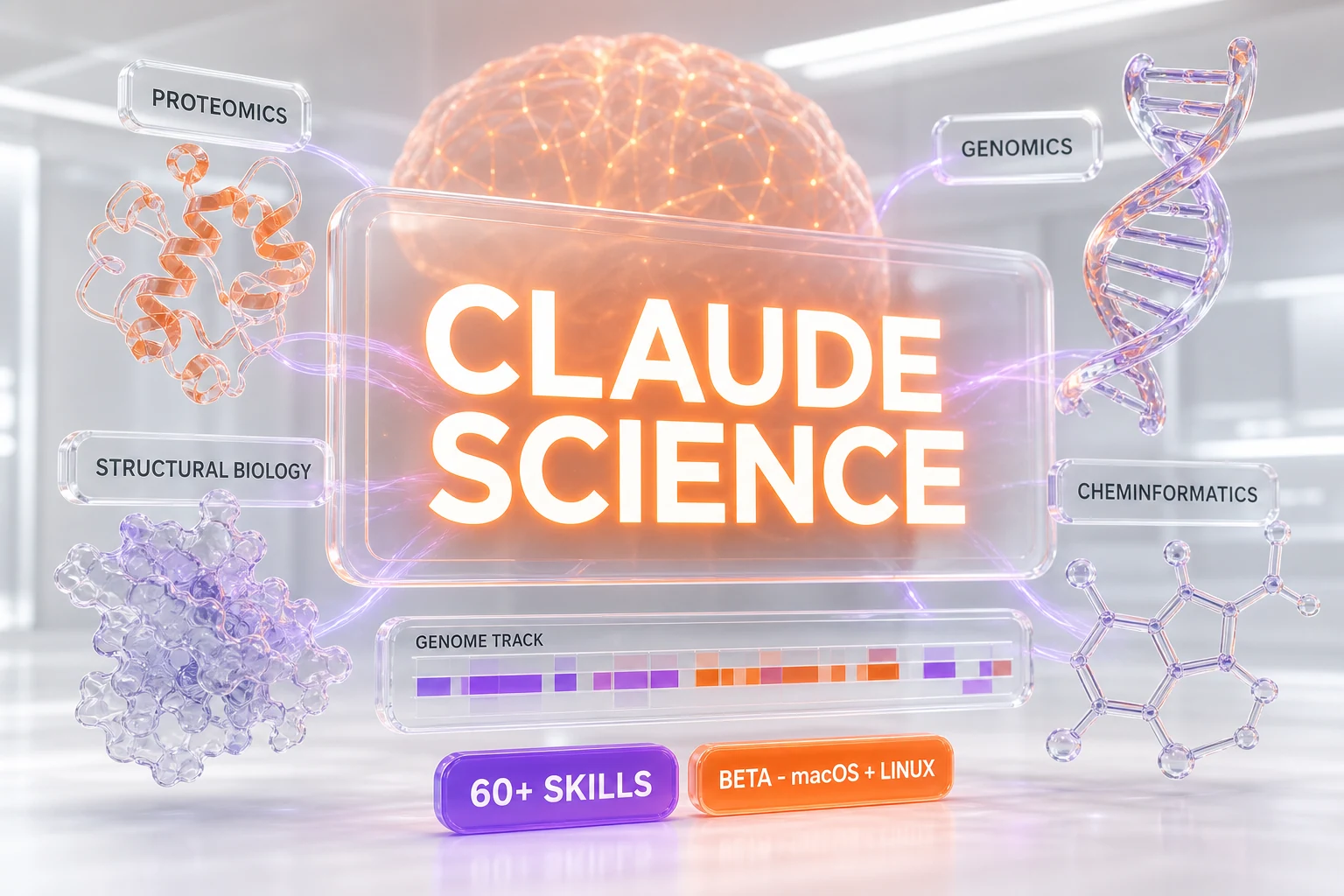
Claude Science is an AI research workbench from Anthropic, announced on June 30, 2026, that pulls scientific tools and databases into a single environment where researchers can run every stage of their work — literature analysis, data processing, visualization, and manuscript preparation. It ships in beta on macOS and Linux for Pro, Max, Team, and Enterprise plans, comes with more than 60 curated skills across genomics, single-cell, proteomics, structural biology, and cheminformatics, and pairs a coordinating agent with specialist sub-agents and a dedicated reviewer agent that flags incorrect citations, untraceable numbers, and figures that do not match their code. This is Anthropic's second vertical bet after coding: a workstation built for scientists, not a general chatbot.
For most of the last two years, Anthropic sold one shape of product: a very capable general-purpose model you could point at almost anything. The exception that changed the company was Claude Code — not a chatbot but a purpose-built environment for one profession, with its own workflows, tools, and habits. Claude Science is the same idea aimed at a different building. Instead of a terminal and a repository, the workbench speaks in genome browser tracks, 3D protein structures, and chemical diagrams. And instead of asking a scientist to copy results back and forth between a dozen disconnected tools, it tries to hold the whole research process in one place. Covered six days after the announcement, the news is less "breaking" than clarifying: it tells you where Anthropic thinks its next big market is.
What Anthropic Announced
On June 30, 2026, Anthropic introduced Claude Science as an AI workbench that "brings these fragmented tools into a single research environment where scientists can conduct all stages of their work." In the company's framing, it "helps you analyze literature and execute multi-step research, produces detailed artifacts, and lets you iteratively refine figures and manuscripts until they're ready for publication." The pitch is end-to-end: start from the papers, end at something you could submit.
The distribution details are specific. The Claude Science app is available in beta on macOS and Linux for Pro, Max, Team, and Enterprise plans. There is no Windows build named in the announcement, which is a tell about the audience — computational biology and cheminformatics run overwhelmingly on macOS laptops and Linux clusters. It arrives preloaded with more than 60 curated skills configured for scientific domains, and it can render domain-native artifacts directly: 3D protein structures, genome browser tracks, and chemical structures appear as first-class objects rather than as text a scientist has to reconstruct elsewhere.
Claude Science at a Glance
| Detail | What Anthropic confirmed |
|---|---|
| Announced | June 30, 2026 |
| Form factor | Desktop research workbench (beta) |
| Platforms | macOS and Linux (no Windows named) |
| Plans | Pro, Max, Team, and Enterprise |
| Skills | More than 60 curated science skills |
| Domains | Genomics, single-cell, proteomics, structural biology, cheminformatics |
| Native rendering | 3D protein structures, genome browser tracks, chemical structures |
| Agents | Coordinating agent, specialist sub-agents, dedicated reviewer agent |
| Compute | Runs locally or remotely; on-demand GPU via Modal; NVIDIA BioNeMo models |
| Model version | Not named in the announcement |
From Code to the Lab: The Vertical Play
The strategic read on Claude Science is that Anthropic has decided it wins by going deep in one profession at a time. Claude Code proved the model: rather than compete on being marginally better at everything, build the tools, memory, and interface a specific expert needs and let that gravity pull the whole workflow onto Claude. Science is the natural second target. It is high-value, tool-fragmented, and full of exactly the multi-step, evidence-heavy reasoning that agentic models are supposed to be good at.
It also fits a pattern of moves Anthropic has been making around the life sciences all year. The company acquired Coefficient Bio for $400 million to push into AI drug discovery, and it has been winning the AI-for-science talent war — most visibly when a Nobel laureate behind AlphaFold left DeepMind for Anthropic. Claude Science is the product surface those bets point toward: not a research paper about what models could someday do for biology, but a shipped tool a working scientist can open today.
The timing rhymes with the rest of Anthropic's summer. The workbench landed the same day the company also shipped Claude Sonnet 5, its cheaper, more agentic default model. The announcement does not name which model powers Claude Science — it could sit on the flagship Claude Opus 4.8, the newly affordable Claude Sonnet 5, or a mix — but the message is coherent either way: make the agents cheaper to run, and give a high-value profession a reason to run a lot of them.
How the Workbench Works
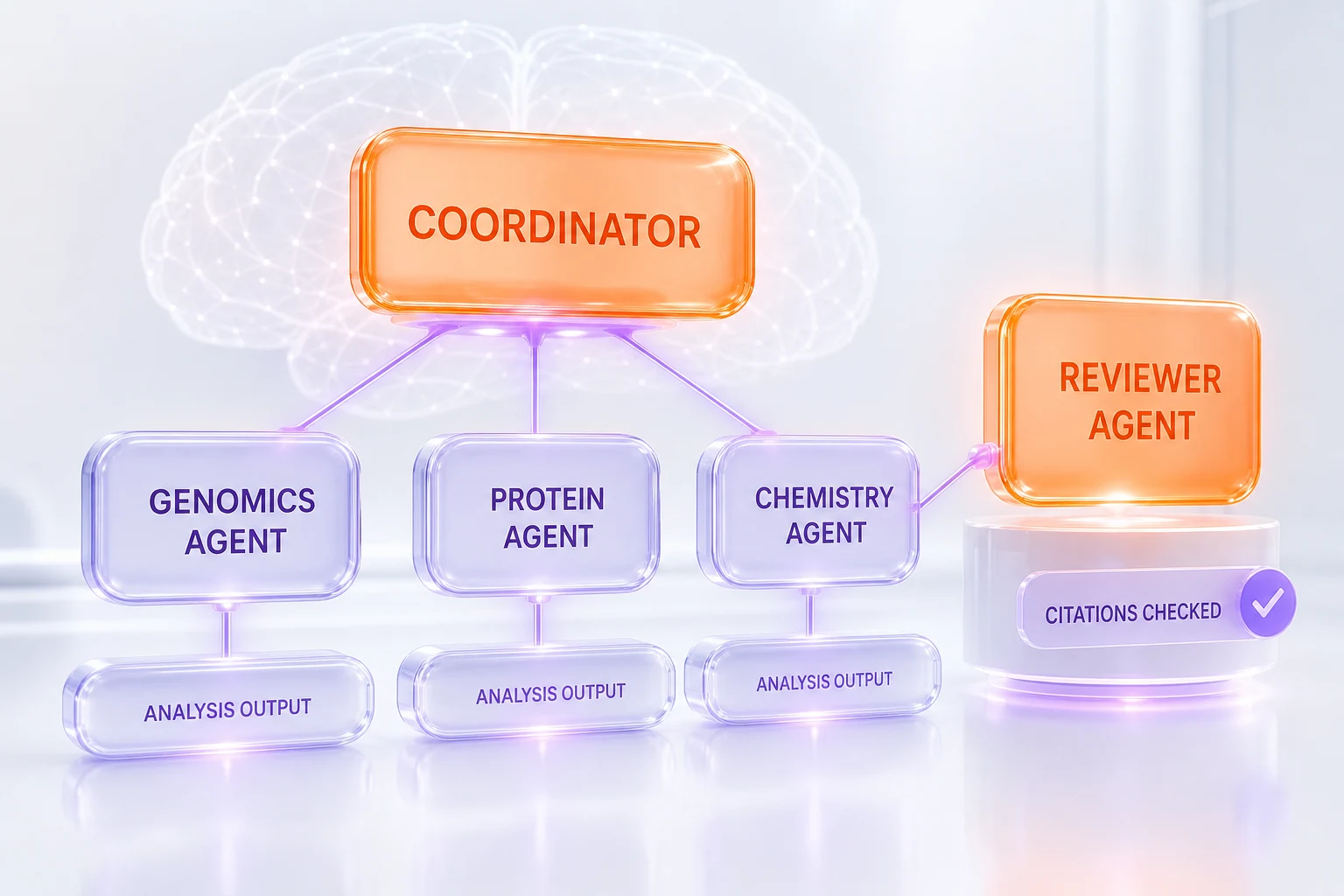
Under the hood, Claude Science is not a single model answering questions. It is a small organization of agents. A generalist coordinating agent takes the research goal and breaks it into stages, handing specialized sub-tasks to specialist agents that carry the relevant skills for a domain. Those agents call the tools, run the code, and produce intermediate artifacts — the kind of planning, tool use, and delegation that agentic models have been trending toward, now packaged for a lab instead of a codebase.
The workflow the company describes runs the full length of a research project. Claude Science "helps you analyze literature and execute multi-step research, produces detailed artifacts, and lets you iteratively refine figures and manuscripts until they're ready for publication." In practice that means the same environment carries a project from a literature question, through data analysis and visualization, to a draft figure and a section of a manuscript — the transitions that normally cost a scientist hours of manual copying between incompatible tools.
What separates this from a generic agent framework is the last member of the team. Every pipeline runs under supervision.
The Reviewer Agent Is the Differentiator
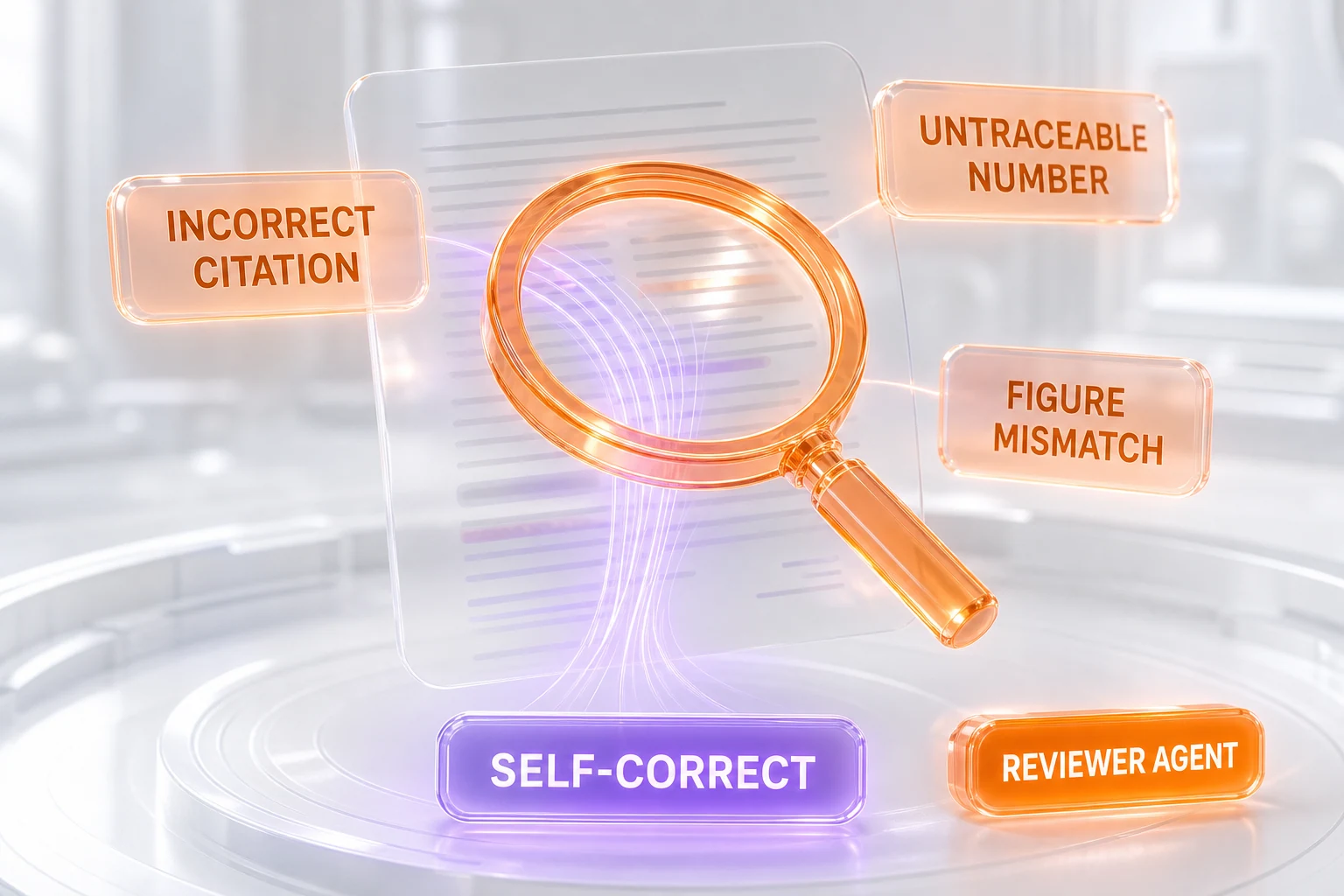
The most distinctive part of Claude Science is not the skills or the pretty protein renders. It is a dedicated reviewer agent. In Anthropic's words: "As the pipeline runs, a reviewer agent inspects the outputs, flagging incorrect citations, untraceable numbers, and figures that don't match their underlying code, and self-correcting as it goes." Read that sentence carefully, because it names the three ways AI-assisted research usually goes wrong.
Incorrect citations are the notorious one — the fabricated or mis-attributed reference that has embarrassed more than one researcher who trusted a chatbot. Untraceable numbers are subtler and arguably worse: a figure in a results section that no one can tie back to a specific computation. And "figures that don't match their underlying code" is the failure mode a peer reviewer dreads most, where the chart and the analysis quietly disagree. By building an agent whose entire job is to hunt those three problems and correct them mid-run, Anthropic is treating trust, not raw capability, as the binding constraint in scientific AI.
That is the right instinct for this market. In coding, a wrong answer usually fails loudly — the tests break, the build fails. In science, a wrong answer can pass silently into a paper and stay there for years. A model that is merely fluent is a liability in a lab; a model that shows its work and audits its own claims is the only kind that belongs there. The reviewer agent is Anthropic's bet that provenance and self-checking are what actually unlock scientific adoption, and it is the feature most likely to matter to the people deciding whether to trust the tool.
60+ Skills Across Five Domains
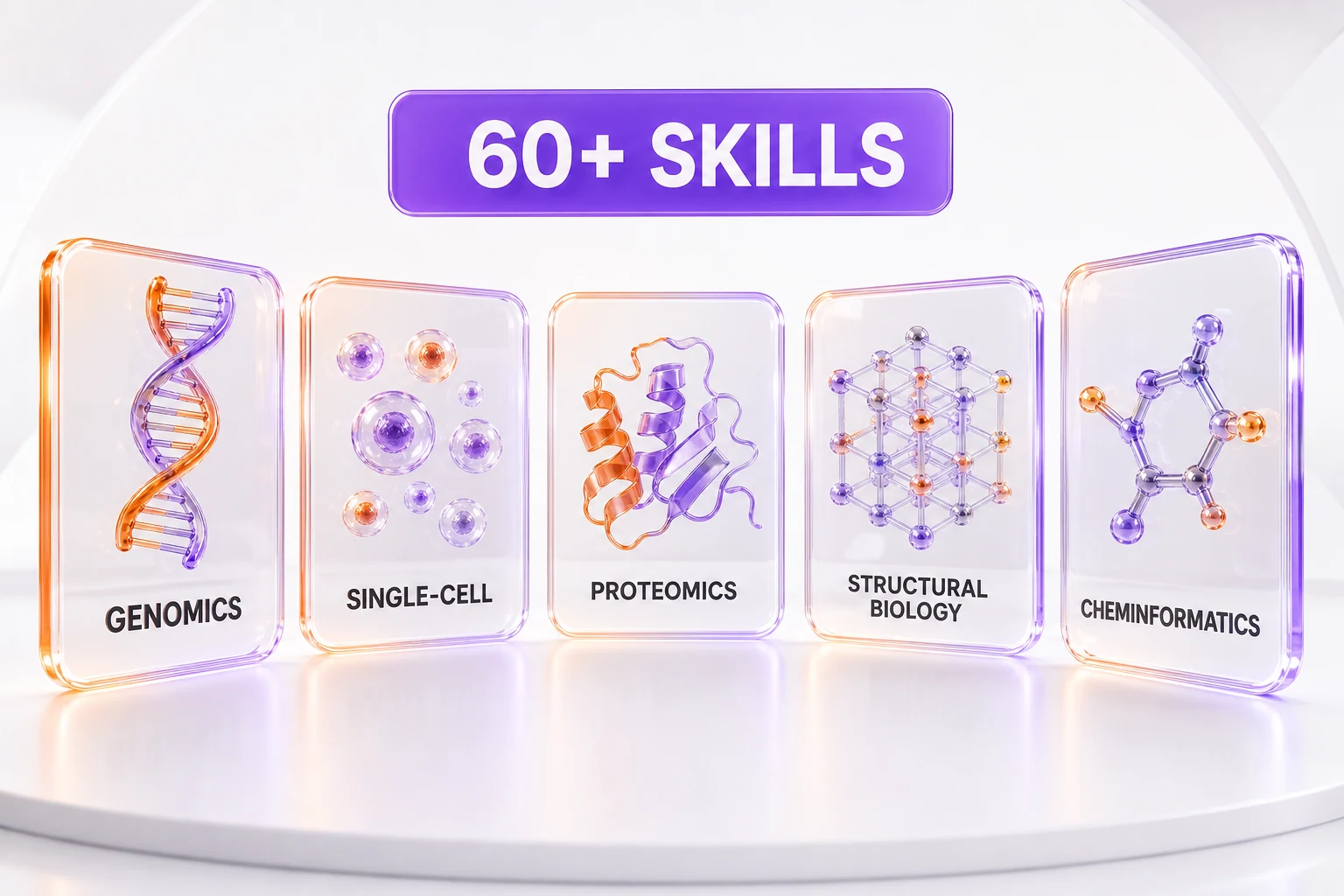
The 60-plus skills are what make the workbench feel domain-native rather than generic. Anthropic groups them across five fields: genomics, single-cell analysis, proteomics, structural biology, and cheminformatics. Each skill wires the model to the tools and data formats a specialist actually uses, so a request lands on real infrastructure instead of a plausible-sounding description of it.
The rendering matters as much as the skills. A structural biologist gets 3D protein structures they can inspect, not a paragraph describing a fold. A genomicist gets genome browser tracks, the standard way variation is read along a sequence. A chemist gets chemical structures drawn as chemists draw them. Making these artifacts first-class is a quiet but important design choice: it keeps the scientist reasoning in the visual language of their field rather than translating the model's text back into their own mental model at every step. This is the difference between a tool that assists a workflow and one that merely comments on it — and it is the kind of end-to-end reanalysis that open pipelines have started to show is possible, as when an automated genomic re-scan surfaced 241 new rare-disease diagnoses from data that had already been examined.
Where It Runs: Your Laptop, Your Cluster, Your Data

Anthropic clearly thought about where real science actually happens, which is rarely on a single machine. Claude Science can run locally on a laptop or Linux workstation, or remotely against the systems scientists already use, including remote login and high-performance computing nodes reached over SSH. For the heavy jobs that need accelerators, it integrates with Modal for on-demand GPU compute, so a workstation without a local card can still spin up the horsepower a structural-biology run demands.
The data-privacy posture is the part institutional buyers will read twice. Rather than requiring sensitive datasets to be shipped off to a vendor, the workbench is built to keep those datasets on the infrastructure that already holds them. For a hospital genomics program or a company with proprietary compound libraries, "the data stays where it is" is not a nice-to-have — it is often the precondition for using any tool at all.
The science-model integration goes a step beyond Anthropic's own weights. Claude Science "uses the skills in NVIDIA's BioNeMo Agent Toolkit to connect natively to the life sciences models and libraries in BioNeMo, including Evo 2, Boltz-2, and OpenFold3." In other words, the workbench is not trying to replace the specialized biology models the field already trusts; it orchestrates them. Claude does the planning, delegation, and review, and hands the domain-specific prediction to the model built for it. That is a more credible architecture for science than "one model to rule them all," and it lowers the bar for a lab to say yes.
Who Is Already Using It
Anthropic anchored the launch with three early users, and their work maps neatly onto the domains the workbench targets.
Manifold Bio used Claude Science for target nomination. For each tissue and target, the workbench assessed surface expression, trafficking, and safety, then ranked the candidates — the kind of triage that decides which experiments a drug-development team actually runs next. It is a concrete example of the workbench doing decision-shaping analysis, not just summarization.
Jérôme Lecoq at the Allen Institute built a multi-agent "computational review template" of roughly 20 custom skills geared toward writing long-form literature reviews, with the system pulling out each source's central claim and its key quantitative finding. That is the reviewer-agent philosophy applied to scholarship itself: not just writing prose, but tying every statement back to a traceable claim and number.
Stephen Francis at the UCSF Brain Tumor Center used Claude Science to support studies on the molecular epidemiology of glioma, investigating how thousands of small-effect germline variants combine to shape an individual's susceptibility. It is a genomics problem at population scale — precisely the sort of multi-step, data-heavy analysis the workbench is designed to carry from raw variants to interpretable result.
The Competitive Landscape
Anthropic is not alone in aiming AI at the lab bench. The most direct comparison is OpenAI, which has been building its own life-sciences push — most recently upgrading its GPT-Rosalind life-sciences system with Codex plugins and a LifeSciBench evaluation. Google DeepMind's claim on scientific AI runs through AlphaFold and the broader protein-structure lineage that earned a Nobel Prize — the same lineage whose departure to Anthropic underscored how contested this talent has become.
What differentiates Claude Science in that field is the packaging. OpenAI's and DeepMind's strengths have largely lived as models and APIs that a team still has to assemble into a workflow. Anthropic is shipping the workflow itself — the app, the skills, the rendering, the reviewer — as a single environment a scientist opens rather than builds. Whether that integration advantage holds depends on execution, but it is a genuinely different wager: not "our science model is smarter," but "our science workstation is the one you actually work in." The same instinct that made Claude Code sticky is the one Anthropic is now testing on biology.
The $30,000 Carrot: The AI for Science Program
To seed adoption, Anthropic paired the launch with a funding program rather than just a free trial. Selected AI for Science projects can receive up to $30,000 in credits, and Modal is adding up to $2,000 in compute credits on top. The timeline is tight and specific: applications are due July 15, 2026, awards are announced by July 31, and the funded project period runs from September 1 to December 1, 2026.
The structure tells you what Anthropic wants. Credits plus compute, on a fixed three-month project clock, is designed to produce concrete case studies — real labs finishing real projects on the workbench inside a quarter. That is the fastest way to convert a beta into evidence, and evidence is what moves a cautious, citation-obsessed audience. It is a modest budget by frontier-lab standards, but pointed precisely at the outcome that matters: proof the tool does science that survives review.
The Bottom Line
Claude Science is Anthropic's clearest statement yet that its future is vertical. After building the environment coders live in, it has built one for scientists — a beta workbench on macOS and Linux, 60-plus skills across five life-science domains, native rendering of the artifacts researchers actually reason with, and an architecture that orchestrates trusted biology models instead of trying to replace them. The model version behind it is unnamed, which keeps the focus where Anthropic wants it: on the workflow, not the weights.
The feature to watch is the reviewer agent. In a field where a wrong number can pass silently into a published paper, an agent whose job is to flag bad citations, untraceable figures, and code that disagrees with its charts is not a gimmick — it is the difference between a tool a scientist can trust and one they cannot. If the AI for Science cohort comes back in December with results that survive peer review, Claude Science will have proven the harder half of the thesis: that agentic AI can be trusted with the lab, not just the codebase. That is the bet, and the next few months are when it gets tested.
Frequently Asked Questions
What is Claude Science?
Claude Science is an AI research workbench from Anthropic, announced on June 30, 2026. It brings scientific tools and databases into a single environment where researchers can run every stage of their work — literature analysis, multi-step data research, visualization, and manuscript preparation. It ships in beta on macOS and Linux with more than 60 curated science skills and a reviewer agent that audits its own outputs.
Who can use Claude Science and on which platforms?
The Claude Science app is available in beta on macOS and Linux for Pro, Max, Team, and Enterprise plans. Anthropic did not name a Windows build in the announcement. The choice of macOS and Linux reflects the audience: computational biology and cheminformatics run mostly on macOS laptops and Linux clusters.
What is the reviewer agent in Claude Science?
The reviewer agent is a dedicated agent that inspects the pipeline's outputs as it runs, flagging incorrect citations, untraceable numbers, and figures that do not match their underlying code, and self-correcting as it goes. It targets the three most common ways AI-assisted science fails, and it is the feature that most distinguishes Claude Science from a generic AI assistant.
Which scientific domains does Claude Science cover?
Claude Science ships with more than 60 curated skills across five domains: genomics, single-cell analysis, proteomics, structural biology, and cheminformatics. It can render domain-native artifacts directly, including 3D protein structures, genome browser tracks, and chemical structures.
Which Claude model powers Claude Science?
Anthropic did not name a specific model version in the Claude Science announcement. The company's current lineup includes Claude Opus 4.8 as its flagship and Claude Sonnet 5 as its cheaper, more agentic default model, both of which launched in mid-2026, but the announcement does not confirm which one runs the workbench.
Where does Claude Science run, and is my data private?
Claude Science can run locally on a laptop or Linux workstation, or remotely on systems reached over SSH, including high-performance computing login nodes. For heavy jobs it integrates with Modal for on-demand GPU compute. It is designed to keep sensitive datasets on the researcher's existing infrastructure rather than shipping them to a vendor.
Does Claude Science use other AI models besides Claude?
Yes. Claude Science uses the skills in NVIDIA's BioNeMo Agent Toolkit to connect natively to the life-sciences models and libraries in BioNeMo, including Evo 2, Boltz-2, and OpenFold3. Claude handles planning, delegation, and review, and hands domain-specific prediction to the specialized biology models built for it.
What is the Claude Science AI for Science funding program?
Alongside the launch, Anthropic offers selected AI for Science projects up to $30,000 in credits, with Modal adding up to $2,000 in compute credits. Applications are due July 15, 2026, awards are announced by July 31, 2026, and funded projects run from September 1 to December 1, 2026.
Who is already using Claude Science?
Anthropic highlighted three early users at launch: Manifold Bio, which used the workbench to nominate drug targets by assessing surface expression, trafficking, and safety; Jérôme Lecoq at the Allen Institute, who built a multi-agent review template of about 20 skills for writing long-form literature reviews; and Stephen Francis at the UCSF Brain Tumor Center, who used it for molecular-epidemiology studies of glioma.