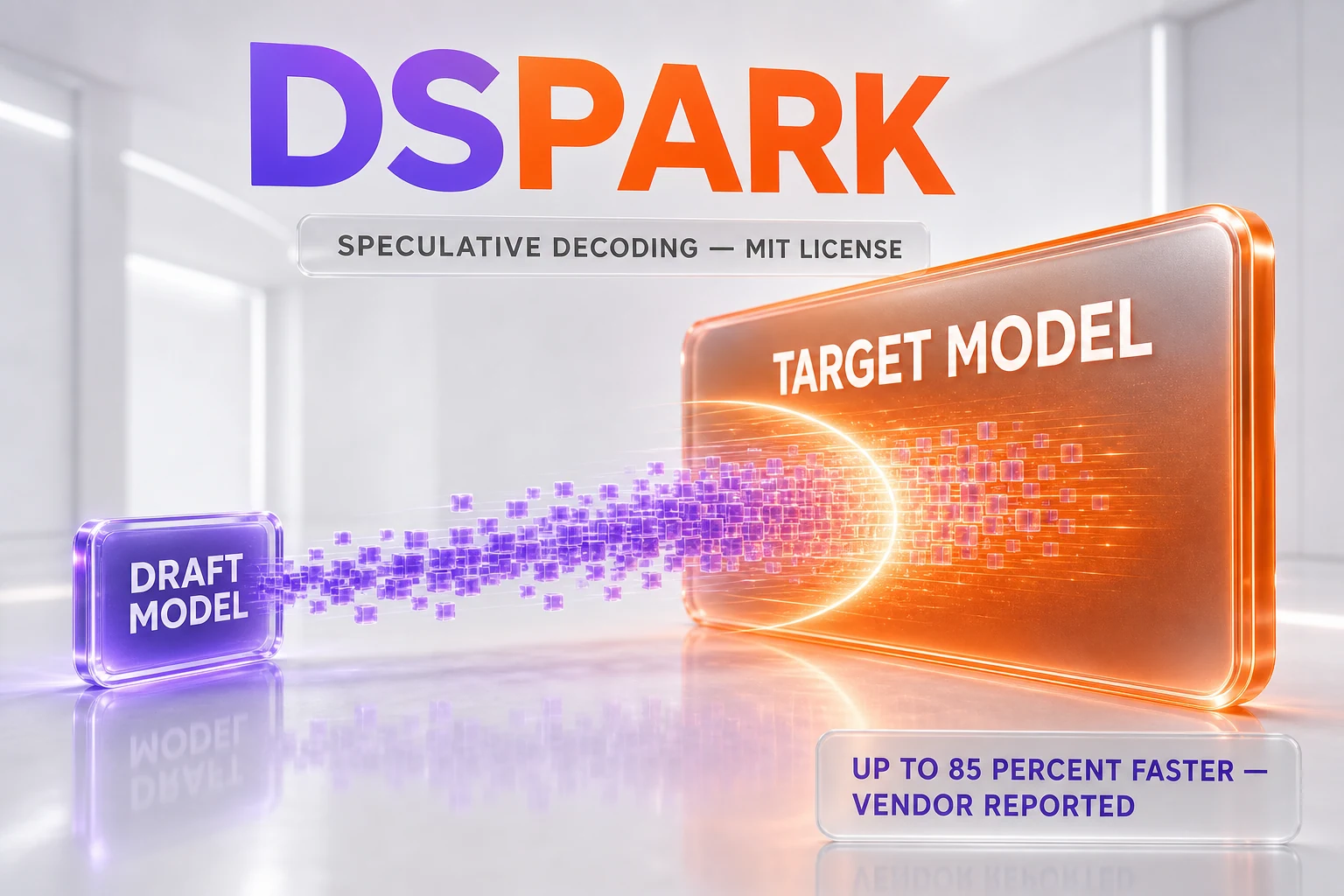
DSpark is an open-source speculative decoding framework that DeepSeek released in late June 2026 under the MIT license. It does not change the model, it changes how tokens are produced: a lightweight draft model proposes candidate tokens, and the full model verifies those candidates in batches instead of generating one token at a time. DeepSeek reports per-user generation speedups of 60 to 85 percent for V4-Flash and 57 to 78 percent for V4-Pro, at matched system throughput, against its own previous production baseline, MTP-1. Those figures are vendor-reported and no independent third party has reproduced them yet. The real story is not a benchmark, it is the economics of inference: if the same traffic takes far less generation time, it takes fewer GPUs.
Key Takeaways
- What it is: DSpark is a speculative decoding framework, not a model. It sits in front of DeepSeek V4-Pro and V4-Flash and changes the token generation loop, not the weights.
- The number everyone quotes: 60 to 85 percent faster per-user generation for V4-Flash, 57 to 78 percent for V4-Pro, at matched throughput, versus DeepSeek's previous production baseline, MTP-1. All of it is self-reported by DeepSeek, and unreplicated by any third party as of this writing.
- Fully open: MIT license. Technical paper, model checkpoints, and DeepSpec, a codebase for training and evaluating speculative decoding systems, all published on GitHub and Hugging Face. Commercial use is free, including for competitors.
- Why it hurts NVIDIA more than it hurts OpenAI: the target is the cost of serving tokens, not the leaderboard. The Motley Fool argued it makes NVIDIA's most important new bet harder to win; the South China Morning Post framed it as easing inference bottlenecks and chip strain.
- The strategic pattern: cut off from the best silicon, DeepSeek optimizes software, then gives the software away. It is the same logic as post-training V4-Pro on Huawei Ascend, applied to serving instead of training.
What DeepSeek Actually Released
On June 29 and 30, 2026, DeepSeek open-sourced DSpark. The release is not a model launch and it is not a new version of V4. It is infrastructure: the machinery that decides how quickly an existing model can emit text.
Three things shipped together, all under the MIT license, which is permissive enough to allow unrestricted commercial use:
- A technical paper. "DSpark: Confidence-Scheduled Speculative Decoding with Semi-Autoregressive Generation," posted to arXiv on July 6, 2026 as arXiv:2607.05147. This is the only primary document that states the speed claims and the conditions under which they were measured.
- Model checkpoints. Published on Hugging Face, including deepseek-ai/DeepSeek-V4-Pro-DSpark — the 1.6-trillion-parameter Mixture-of-Experts flagship, 49 billion parameters active per forward pass, 1-million-token context, with the speculative decoding module attached.
- DeepSpec. A full-stack codebase, published on GitHub, for training and evaluating draft models. It ships implementations of DSpark alongside two other algorithms, DFlash and Eagle3, plus configurations for building draft models on top of Qwen3 (4B, 8B and 14B) and Gemma-4-12B-it, and evaluation sets including GSM8K, MATH-500, AIME25, HumanEval, MBPP, LiveCodeBench, MT-Bench and Arena-Hard-v2.
That third item is the one most people skipped, and it is the most consequential. DeepSeek did not just publish a faster serving path for its own models. It published the toolkit for other people to build one for theirs.
DSpark accelerates the DeepSeek V4 family, V4-Pro and V4-Flash, which launched on April 24, 2026. It is an attachment to those models, not a replacement for them.
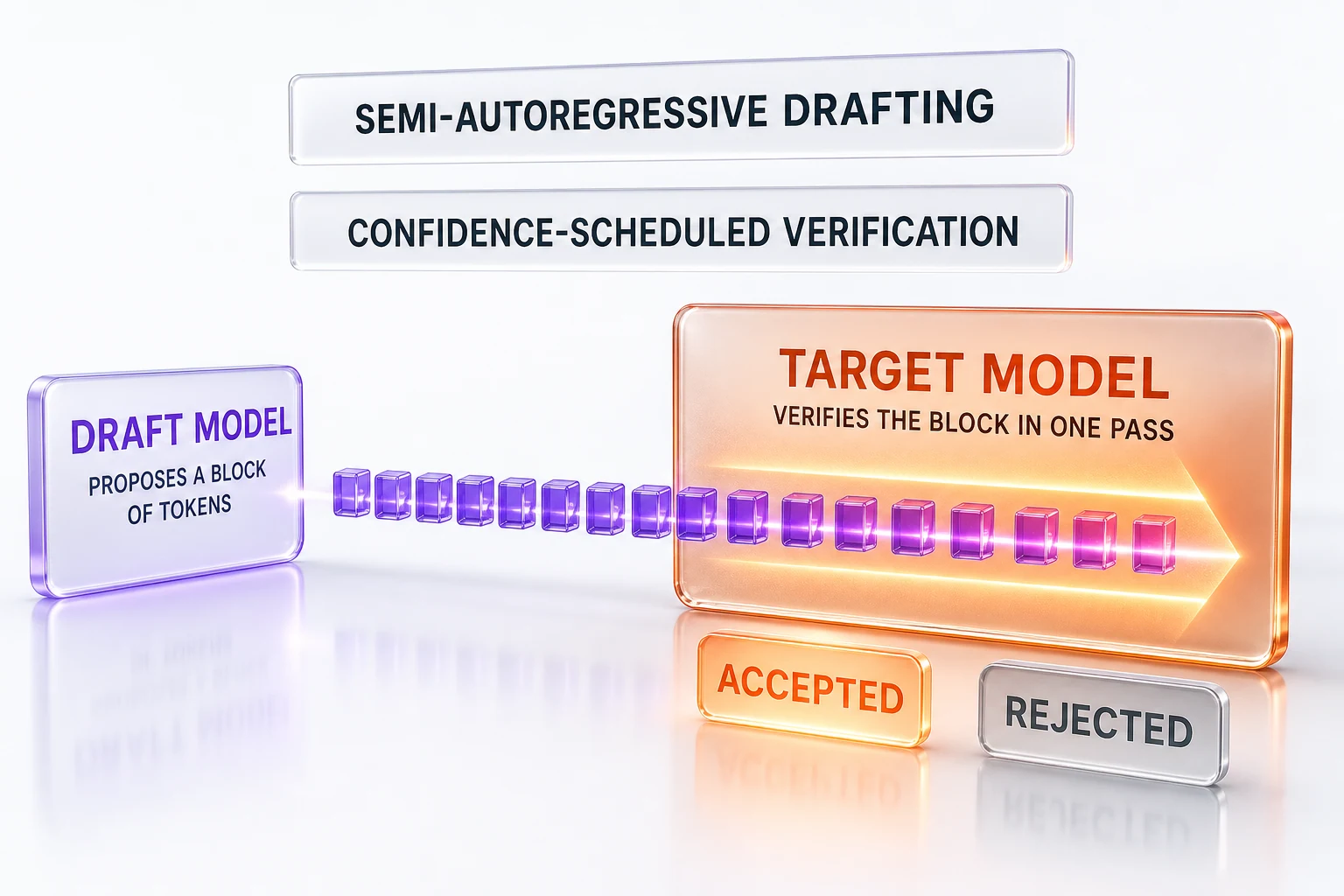
How Speculative Decoding Works, and What DSpark Adds
A large language model normally generates text one token at a time. Each token requires a full forward pass through the whole model. For a 1.6-trillion-parameter Mixture-of-Experts system, that is an expensive way to produce a single word fragment, and it is memory-bandwidth bound rather than compute bound: the GPU spends most of its time moving weights, not doing math.
Speculative decoding breaks that one-token-at-a-time constraint. A small, cheap "scout" model — the draft model — guesses the next several tokens ahead. The large model, the one whose output actually counts, then checks that whole guess in a single batched forward pass. Tokens the big model agrees with are accepted for free. Tokens it rejects are discarded and regenerated properly. The output distribution is preserved; what changes is how many expensive passes were needed to get there.
The technique is not new, and DeepSeek is not claiming it is. What DSpark contributes is two fixes to the ways speculative decoding breaks down at production scale.
Fix one: stopping the draft from decaying
Fast parallel drafters propose long runs of tokens in one shot, but because those tokens are generated without seeing each other, the guesses get progressively worse toward the end of the block. The paper calls this rapid acceptance decay, or suffix decay: the first guessed token is often right, the seventh rarely is. DSpark answers with what it calls a semi-autoregressive architecture — a parallel backbone paired with a lightweight sequential module, so the drafted tokens have some awareness of each other and the tail of the block stops falling apart.
Fix two: not wasting the batch on bad guesses
The second problem is subtler and is the one that matters for anyone running a busy API. Verifying a long block of speculative tokens costs batch capacity. If those tokens are likely to be rejected, that capacity was burned for nothing, and under heavy concurrent load that waste destroys throughput. DSpark's answer is confidence-scheduled verification: instead of verifying a fixed number of tokens for every request, it varies the verification length per request, based on an estimate of how likely the drafted prefix is to survive and on the throughput profile of the serving engine itself.
In plain terms: when the scout is confident and the system has room, check a long guess. When it is not, or the system is under pressure, check a short one. The paper's own framing is that this shifts the Pareto frontier of DeepSeek's serving system — it makes performance tiers reachable that previously were not, particularly under strict interactivity constraints, meaning cases where users need tokens to arrive fast rather than merely in bulk.
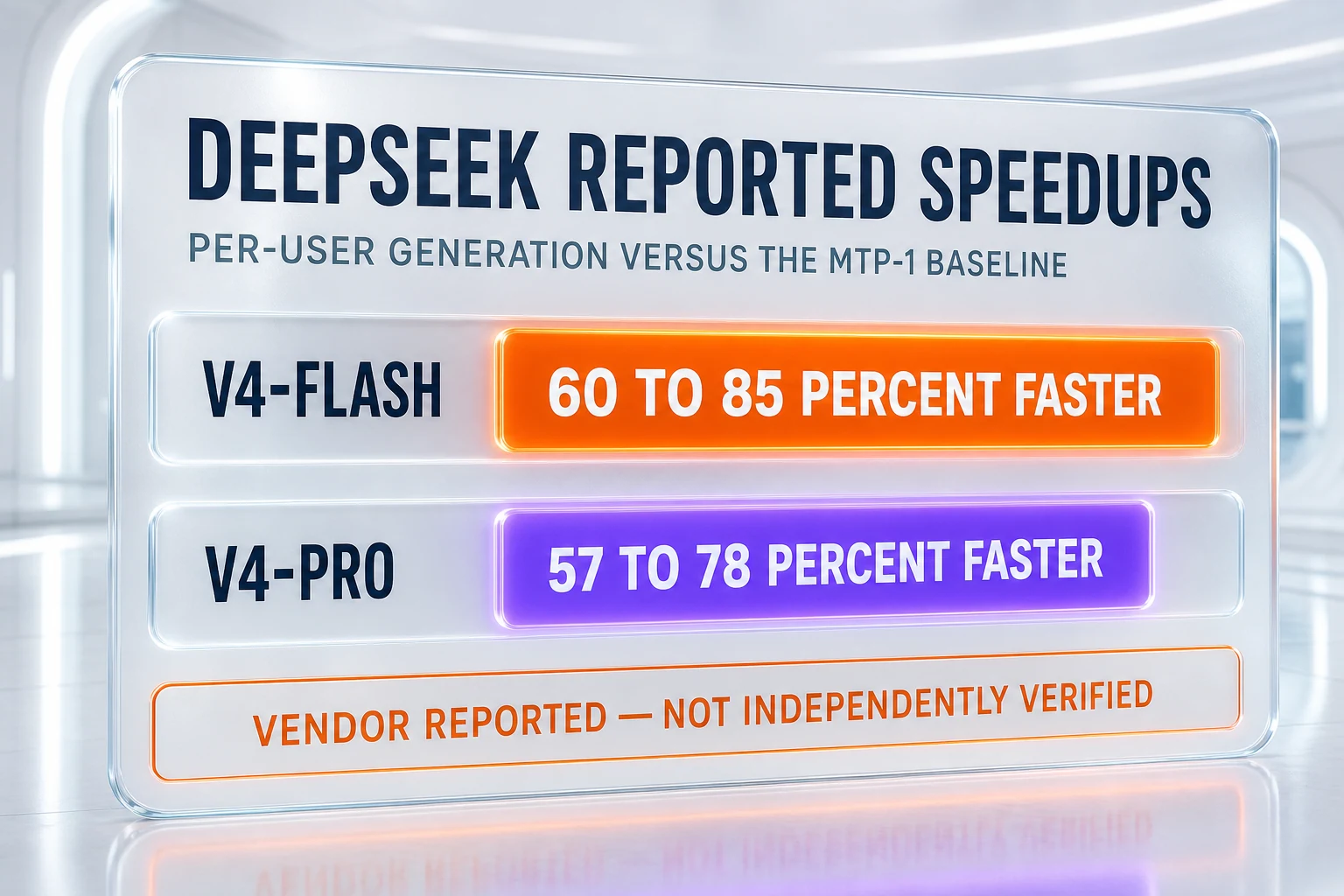
The Numbers, and Exactly Who Is Reporting Them
This is where the discipline matters, because the headline number is traveling much faster than its caveats.
The claim, stated in DeepSeek's own paper: "Compared to the established production baseline (MTP-1), DSpark accelerates per-user generation speeds by 60 to 85 percent at matched throughput levels." Reporting around the release, including VentureBeat, breaks that out per model: roughly 60 to 85 percent for V4-Flash, and 57 to 78 percent for V4-Pro.
Four qualifiers are attached to those numbers, and every one of them is load-bearing:
- They are self-reported. DeepSeek measured DSpark, inside DeepSeek's own serving system, on DeepSeek's own live traffic. That is not disqualifying — it is how most inference engineering is first reported — but it is not third-party evidence, and it must not be laundered into one.
- The baseline is DeepSeek's, too. MTP-1 is the multi-token prediction setup DeepSeek was already running in production. The gain is measured against that, not against a naive one-token-at-a-time decoder, and not against how any other lab serves its models. A different baseline would produce a different headline.
- The metric is per-user generation speed, not capacity. The speedup is in how fast tokens arrive for an individual user, at matched system throughput. It is a latency win held at constant capacity, which is precisely why it converts into a hardware argument — but it is not "85 percent more tokens served."
- No independent reproduction exists yet. As of this writing, no third-party lab or benchmarking group has published a replication of the 60 to 85 percent range. The code is MIT-licensed and public, so replication is possible. It has not happened.
We have not benchmarked DSpark ourselves, and we are not going to present a vendor's internal measurement as if we had. What we can say is that the mechanism described in the paper is coherent, the artifacts are genuinely public, and the claim is falsifiable — which is more than can be said for most performance announcements in this industry.
Why This Is an Attack on Inference Economics, Not on Benchmarks
Read the release as a model launch and you will miss it entirely. DSpark does not make DeepSeek smarter. It makes DeepSeek cheaper to run, and it makes everyone else's models cheaper to run too, because the toolkit is open.
Follow the arithmetic. If serving the same volume of traffic requires substantially less generation time per user at the same throughput, then a given fleet of accelerators absorbs more work — or the same work needs fewer accelerators. That is the entire argument, and it is why the loudest reactions came from finance and geopolitics desks rather than from the AI benchmark crowd.
The Motley Fool titled its piece "DeepSeek's DSpark Just Made Nvidia's Most Important New Bet Harder to Close." The South China Morning Post framed it as easing inference bottlenecks and chip strain. Tech Startups read it as a challenge to OpenAI and Google on cost rather than on capability. Different outlets, same conclusion: the pressure point is the unit economics of serving tokens.
The nuance worth keeping is that software efficiency does not delete demand for compute — historically it has tended to expand it, because cheaper inference unlocks use cases that were uneconomic before. What it does do is compress the pricing power of whoever sells the compute. A serving stack that is 60 to 85 percent faster per user, given away under MIT, is a permanent, un-recallable subtraction from what the industry has to pay to move a token. That is a structurally different kind of threat than a competing model.
The Strategic Paradox: Constrained on Silicon, Generous with Source
There is a coherent narrative running through DeepSeek's last two years, and DSpark is its clearest expression.
Cut off by US export controls from the best NVIDIA hardware, DeepSeek cannot win by out-spending anyone on compute. So it competes on efficiency: architectural efficiency in V4's hybrid attention, hardware independence in the Huawei Ascend post-training run, and now serving efficiency with DSpark. When you do not have the best hardware, you optimize the software.
Then comes the part that looks irrational and is not: DeepSeek publishes all of it under MIT, including for the competitors it is fighting. Anyone — American labs included — can take DeepSpec and build a faster serving path for their own models.
Giving away the efficiency is the strategy, not a concession. A constraint-driven optimization that everyone adopts becomes the industry's default assumption about what inference should cost. It commoditizes the layer DeepSeek cannot dominate through capital, it applies downward pressure on the margins of every closed API it competes with, and it buys the kind of standing in the open-weight ecosystem that no marketing budget can. Export controls were designed to slow China's frontier labs down. On the evidence of the last twelve months, they have mostly redirected them toward the one axis where openness is a weapon.
What It Actually Changes for a Developer
Strip out the geopolitics, and what lands on your desk is narrow but real.
If you use DeepSeek's API: nothing to do. Serving-side improvements show up as lower perceived latency — tokens arriving faster in the stream — with no code change. Whether they show up as a lower bill depends entirely on whether DeepSeek passes the savings through in its pricing, which is a business decision, not a technical one. If you are not sure how those savings would even appear on an invoice, our breakdown of input, output and cached token pricing is the right place to start.
If you self-host open-weight models: this is where DSpark is most directly usable. The V4-Pro-DSpark checkpoint exposes the speculative module through vLLM's speculative decoding config, with the DSpark method and a configurable number of speculative tokens, so the integration surface is a serving-config change rather than a rewrite. If self-hosting is on your roadmap, our guide to self-hosting an open-weight model covers the ground DSpark plugs into.
If you are trying to cut an inference bill: treat the 60 to 85 percent as a ceiling reported by the vendor on its own workload, not as a forecast for yours. Speculative decoding gains depend heavily on how predictable your outputs are — highly structured or repetitive generation accepts more drafted tokens than open-ended creative writing does. Measure your own acceptance rate before you build a budget on someone else's. Our guide to cutting AI API costs covers the levers that are under your control today.
If you are choosing between an open and a closed model: DSpark is a point in the open column, but not a decisive one. It sharpens the classic tradeoff rather than resolving it, and our framework for choosing between closed and open weights still applies unchanged.
What Would Change Our Read
We are treating DSpark as a credible, well-documented, and entirely unverified engineering result. Three things would move it:
- An independent replication. A third-party lab reproducing anything close to the 60 to 85 percent range, on its own hardware and its own traffic, would convert a vendor claim into an industry fact. The MIT license means nothing stands in the way of this.
- Adoption by a lab that competes with DeepSeek. If DeepSpec-derived draft models show up in someone else's production serving stack, the framework's value stops being a question of trust in DeepSeek's numbers.
- A price cut that reflects it. If DeepSeek's serving costs really fell that much, the cleanest confirmation would be a corresponding move in its API pricing. Efficiency claims that never reach the invoice deserve a raised eyebrow.
Until at least one of those lands, the honest summary is the one at the top of this page: DeepSeek says its inference is 60 to 85 percent faster per user, it has published everything needed for you to check, and nobody has checked yet.
Frequently Asked Questions
What is DeepSeek DSpark?
DSpark is an open-source speculative decoding framework that DeepSeek released in late June 2026 under the MIT license. It accelerates the generation of tokens by having a lightweight draft model propose candidate tokens that the full model then verifies in batches, instead of generating one token at a time. It is described in the paper "DSpark: Confidence-Scheduled Speculative Decoding with Semi-Autoregressive Generation," arXiv:2607.05147.
Is DSpark a new DeepSeek model?
No. DSpark is not a model and it does not change model weights or model quality. It changes the way tokens are produced at inference time. It attaches to existing DeepSeek V4 models — V4-Pro and V4-Flash, which launched on April 24, 2026 — and speeds up how quickly they emit text.
How much faster does DSpark make inference?
DeepSeek reports per-user generation speedups of 60 to 85 percent for V4-Flash and 57 to 78 percent for V4-Pro, at matched system throughput, compared with its previous production baseline, MTP-1. Every one of those figures is self-reported by DeepSeek. The "up to 85 percent faster" headline comes from the top of the V4-Flash range.
Have the 85 percent speedup claims been independently verified?
No. As of this writing, no independent third party has reproduced DeepSeek's numbers. The measurements come from DeepSeek's own paper, taken inside DeepSeek's own serving system, on its own live user traffic, against a baseline DeepSeek itself chose. The code and checkpoints are public under the MIT license, so replication is possible, but it has not been published.
What is speculative decoding, in plain terms?
Normally a large model produces one token per forward pass, which is slow and memory-bandwidth bound. In speculative decoding, a small and cheap draft model guesses several tokens ahead, and the large model checks that whole guess in a single batched pass. Accepted guesses are kept, rejected ones are regenerated properly. The final output matches what the large model would have produced on its own; only the number of expensive passes changes.
What is MTP-1, and why does the baseline matter?
MTP-1 is the multi-token prediction configuration DeepSeek was already running in production before DSpark. Every speedup figure is measured against it. That matters because the baseline defines the headline: the gain is relative to an already-optimized DeepSeek serving stack, not to a naive one-token-at-a-time decoder, and not to how any other lab serves its models. A different baseline would produce a different percentage.
What license is DSpark released under?
The MIT license, which is permissive: commercial use, modification and redistribution are allowed with essentially no restrictions beyond attribution. That applies to the DeepSpec codebase on GitHub and to the checkpoints on Hugging Face, including deepseek-ai/DeepSeek-V4-Pro-DSpark.
What exactly did DeepSeek ship with DSpark?
Three things: a technical paper on arXiv, model checkpoints on Hugging Face with the speculative decoding module attached, and DeepSpec, a full-stack codebase on GitHub for training and evaluating draft models for speculative decoding. DeepSpec ships the DSpark algorithm alongside DFlash and Eagle3, plus evaluation sets including GSM8K, MATH-500, AIME25, HumanEval, MBPP, LiveCodeBench and MT-Bench.
Does DSpark only work with DeepSeek models?
The reported production results are on DeepSeek V4-Pro and V4-Flash, and the released checkpoint is a V4-Pro variant. But DeepSpec, the accompanying codebase, includes configurations for training draft models on top of other open models, notably the Qwen3 series (4B, 8B and 14B) and Gemma-4-12B-it. That is what makes the release more than a DeepSeek optimization: it is a toolkit other teams can point at their own models.
Why does DSpark matter for NVIDIA?
Because it attacks the cost of serving tokens rather than model quality. If the same traffic requires substantially less generation time per user at the same throughput, the same workload needs fewer accelerators. The Motley Fool argued the release makes NVIDIA's most important new bet harder to close, and the South China Morning Post framed it as easing inference bottlenecks and chip strain. The counterpoint is that cheaper inference has historically expanded compute demand rather than shrinking it; what it reliably compresses is pricing power.
Does DSpark make DeepSeek's API cheaper?
Not automatically. DSpark reduces DeepSeek's serving cost; whether that reaches customers depends on whether DeepSeek changes its published pricing, which is a commercial decision. For API users, the immediate and certain effect is lower perceived latency — tokens arriving faster — with no code change required. A price cut that tracks the claimed efficiency gain would be the cleanest external confirmation that the gain is real.
Who should care about DSpark right now?
Teams that self-host open-weight models and pay for their own GPUs, because the checkpoint exposes speculative decoding through vLLM's serving config and the gains land directly on their hardware bill. Teams building serving infrastructure, because DeepSpec is a reusable toolkit rather than a one-off optimization. Everyone else — API consumers, and anyone tracking the economics of inference — should note the claim, note that it is vendor-reported, and wait for someone independent to check it.
Sources
- DSpark: Confidence-Scheduled Speculative Decoding with Semi-Autoregressive Generation — arXiv:2607.05147, the primary technical paper, source of the 60 to 85 percent claim and the MTP-1 baseline.
- deepseek-ai/DeepSpec — GitHub, the MIT-licensed codebase for training and evaluating draft models.
- deepseek-ai/DeepSeek-V4-Pro-DSpark — Hugging Face, the released checkpoint with the speculative decoding module.
- DeepSeek open sources DSpark, a new framework to speed up LLM inference by up to 85% — VentureBeat.
- Faster AI, lower costs: DSpark eases inference bottlenecks and chip strain, says DeepSeek — South China Morning Post.
- DeepSeek's DSpark Just Made Nvidia's Most Important New Bet Harder to Close — The Motley Fool.
- DeepSeek unveils DSpark, an AI breakthrough that delivers responses up to 85% faster — Tech Startups.