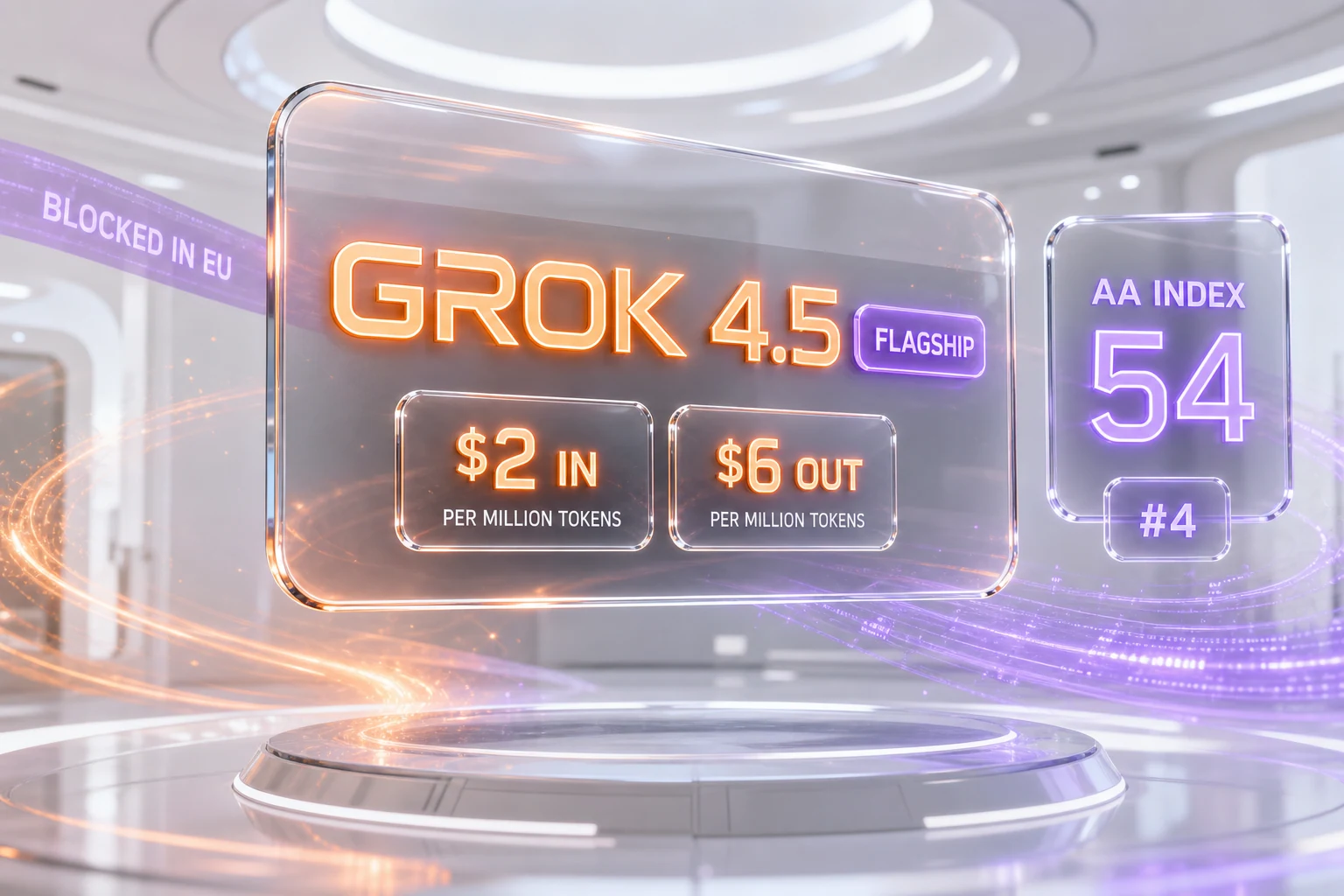
The Gist: SpaceXAI made Grok 4.5 public on July 9, 2026, its new flagship model priced at $2.00 per million input tokens and $6.00 per million output tokens — roughly half what Anthropic charges for Claude Opus 4.8 ($5.00 and $25.00) and what OpenAI charged for GPT-5.6 Sol at the time ($5.00 and $30.00, since cut to $4.00 and $20.00). Independent testing from Artificial Analysis places Grok 4.5 at number 4 on its Intelligence Index with a score of 54, behind Claude Fable 5, GPT-5.5, and Claude Opus 4.8, while it matches GPT-5.5 on coding agents (a score of 76) at a cost of $2.49 per task. The model ships with a 500,000-token context window and low, medium, and high reasoning modes — and at launch it was not offered in the European Union, putting a major flagship out of reach of an entire market. SpaceXAI framed that as a staggered rollout rather than a permanent ban, and the rollout arrived: EU users got access in the API console on July 17, 2026, nine days after the public release.
Key Takeaways
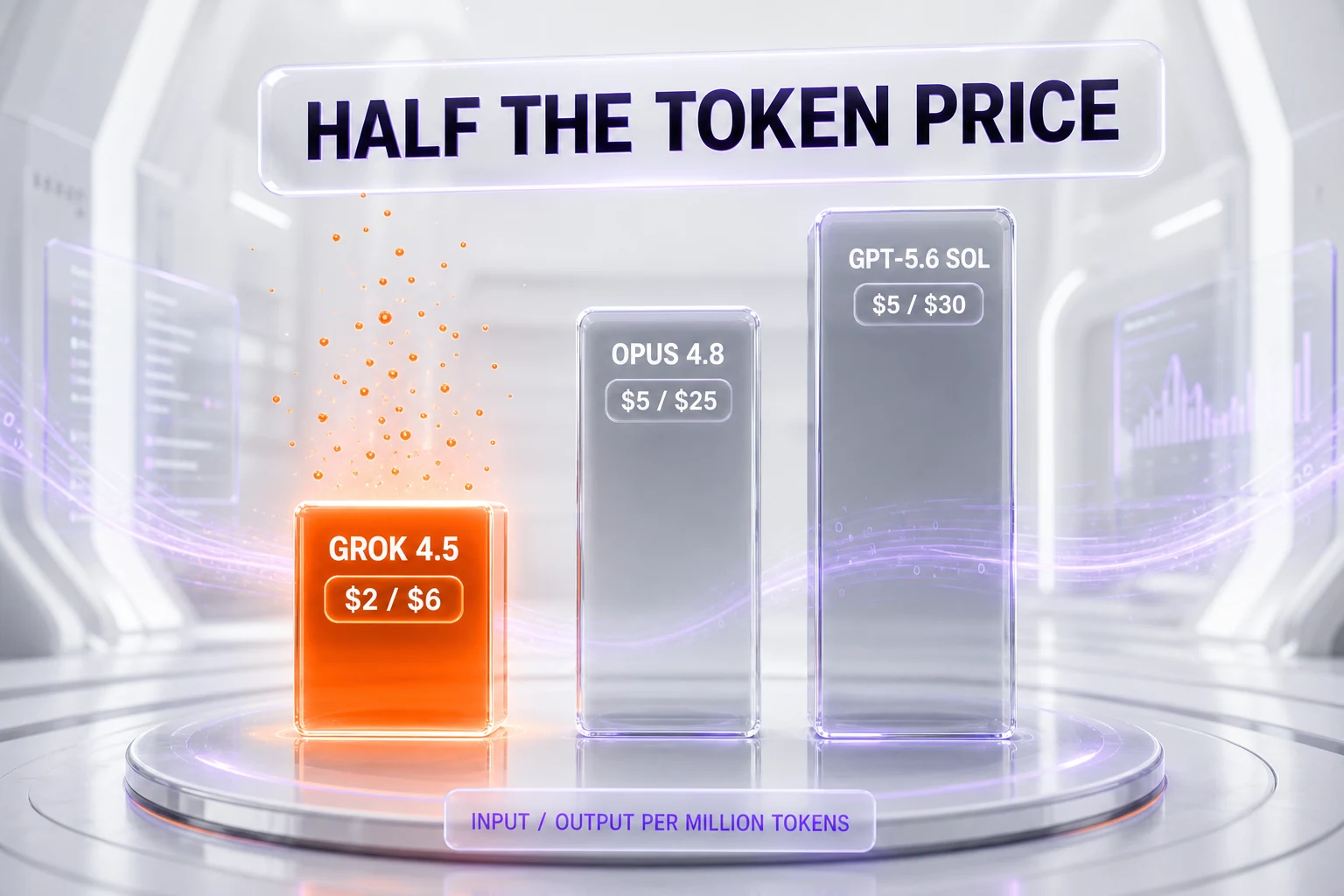
- Half the token price is the whole story. Grok 4.5 lists at $2.00 per million input tokens and $6.00 per million output tokens, against $5.00 and $25.00 for Claude Opus 4.8 and, at the time, $5.00 and $30.00 for GPT-5.6 Sol (OpenAI cut Sol to $4.00 and $20.00 on August 21, 2026). The aggressive-pricing bet, not a benchmark crown, is the headline.
- Fourth, not first. On the independent Artificial Analysis Intelligence Index it scores 54, ranking number 4 behind Claude Fable 5, GPT-5.5, and Claude Opus 4.8. Elon Musk's "Opus-class" description is a vendor claim, not an independent finding.
- Coding is its strongest suit relative to its price. Version 1.3 of the Artificial Analysis Coding Agent Index puts Grok Build with Grok 4.5 at high effort at 64.4, sixth of 52 entries, at a mean $2.59 per task against $11.71 for Claude Code with Fable 5.
- There is a real accuracy caveat. Artificial Analysis reports 52 percent accuracy and a 54 percent hallucination rate on its AA-Omniscience test — a reason to keep the model away from unverified factual work.
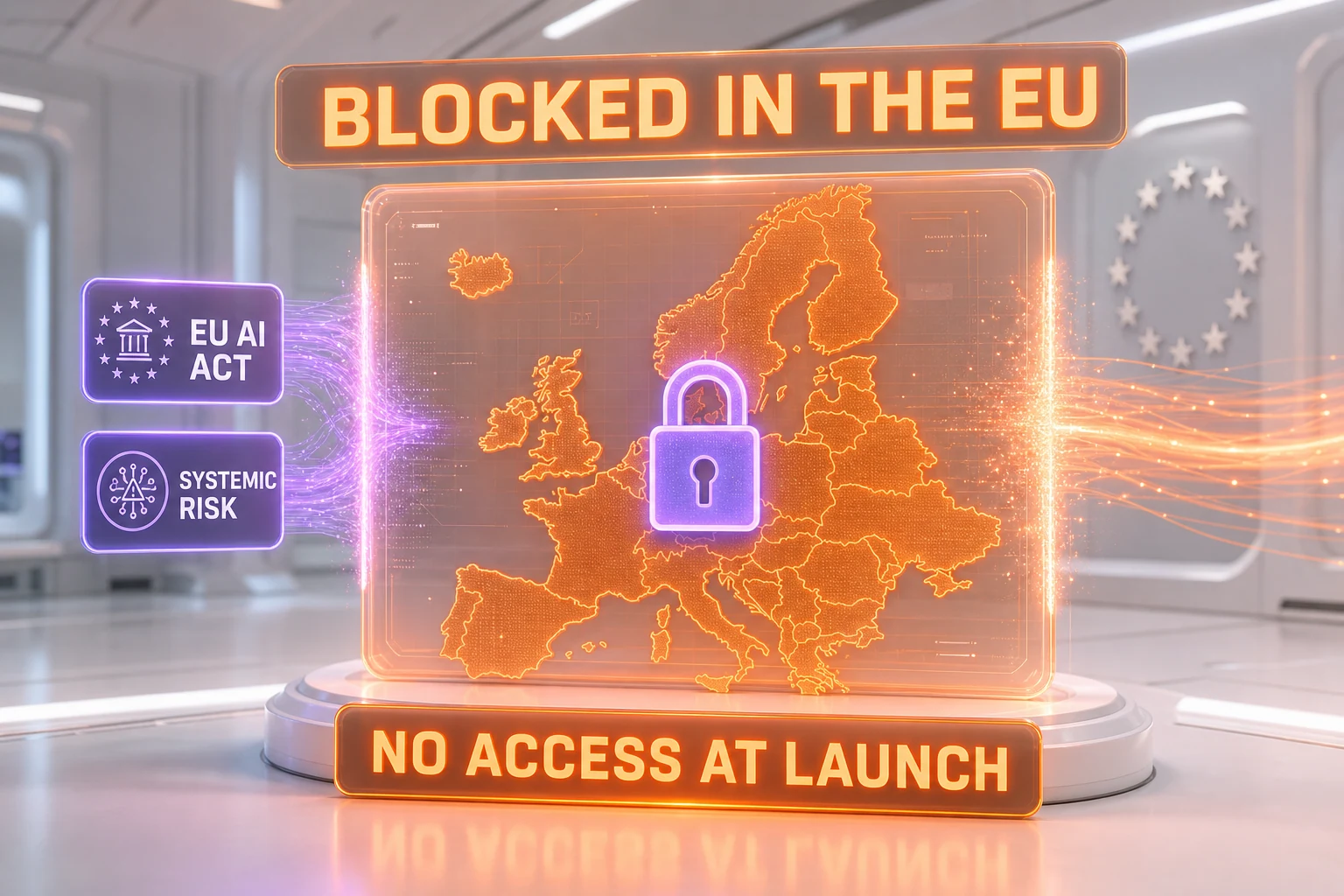
- Europe was locked out for nine days. Grok 4.5 was not offered in the EU at launch, leaving an entire regulated market without official access to the flagship. The staggered rollout SpaceXAI signaled did arrive: EU users gained API console access on July 17, 2026.
What SpaceXAI Actually Shipped
SpaceXAI — the company formerly known as xAI, which folded into SpaceX earlier in 2026 and completed its corporate rebrand in July — announced Grok 4.5 on July 8, 2026 and made it public the following day. We covered the name change in xAI Is Officially SpaceXAI Now; the products kept the Grok brand, and Grok 4.5 is the first flagship to ship under the new corporate identity. It replaces Grok 4.3 as the company's top model, though both Grok 4.3 and Grok 4.20 remain available for teams that do not want to move.
The hard specifications come from the model card. According to SpaceXAI's Grok 4.5 documentation, the model is exposed through the API as grok-4.5, accepts text and image inputs and returns text, supports function calling and structured outputs, and offers three reasoning levels — low, medium, and high, with high as the default. It carries a 500,000-token context window, and the company lists rate limits of 150 requests per second and 50 million tokens per minute across the us-east-1 and us-west-2 regions. The full SpaceXAI model list now shows Grok 4.5 sitting above the older Grok models.
SpaceXAI says the model was trained with the help of Cursor and on Nvidia GB300 GPUs, and Musk described it publicly as "Opus-class, much faster." That phrasing matters: "Opus-class" is a comparison to Anthropic's top model, and it is the vendor's own framing rather than a third-party measurement. As the independent numbers below show, the two do not sit in the same tier on the public leaderboards. The neutral read is that SpaceXAI shipped a capable, cheap, coding-strong flagship — and made a specific marketing claim on top of it that the data does not yet support.
The Pricing Play: Half the Token Price of Its Rivals
Price is where Grok 4.5 makes its loudest argument. SpaceXAI lists it at $2.00 per million input tokens, $0.30 per million cached input tokens, and $6.00 per million output tokens. Set that next to the two models it is most often compared with and the gap is stark: Claude Opus 4.8 runs $5.00 and $25.00 per million tokens, and GPT-5.6 Sol ran $5.00 and $30.00 in July 2026. On output tokens — the expensive side of most real workloads — Grok 4.5 was roughly a quarter of the price of GPT-5.6 Sol at those rates.
| Model | Input (per million tokens) | Cached input (per million tokens) | Output (per million tokens) |
|---|---|---|---|
| Grok 4.5 | $2.00 | $0.30 | $6.00 |
| Claude Opus 4.8 | $5.00 | — | $25.00 |
| GPT-5.6 Sol | $5.00 | $0.50 | $30.00 |
All figures are in US dollars per million tokens. Grok 4.5 pricing is from SpaceXAI's documentation; the Opus 4.8 and GPT-5.6 Sol figures are their respective published list prices as of July 2026 — OpenAI has since cut Sol to $4.00 input and $20.00 output under promotional pricing, announced August 21, 2026. If input, output, and cached pricing feel like a foreign language, our explainer on how input, output, and cached token pricing works breaks down why the output column tends to dominate a real bill.
Headline token prices only tell part of the story, so the more useful number is cost per completed task. On that measure, Artificial Analysis pegs Grok 4.5 at $2.49 to run its standard agentic evaluation, against $11.80 for Claude Fable 5 — the current index leader. A model that costs a fifth as much to finish the same job changes the math for anyone running high-volume, cost-sensitive pipelines, even if it is not the single most capable option on the board.
Where Grok 4.5 Actually Lands
Strip away the marketing and the independent picture is consistent: Grok 4.5 is a strong mid-pack flagship that punches hardest on code and price. On the Artificial Analysis Intelligence Index, published on July 8, 2026, it scores 54 and ranks number 4 — behind Claude Fable 5, GPT-5.5, and Claude Opus 4.8. That is a respectable result, but it is not the top of the table, and it is a full tier below the "Opus-class" label the vendor attached to it.
Coding is the bright spot. On version 1.3 of the Artificial Analysis Coding Agent Index, which scores a harness and a model together rather than a model on its own, Grok Build running Grok 4.5 at high effort reaches 64.4 — sixth of 52 entries, and 2.3 points off the leading pairing, Claude Code with Opus 5. GPT-5.5 is charted below it on the same board, at 61.49 through the Codex harness at extra-high effort — a different agent at a different effort setting, so the gap separates two pairings rather than two models on their own. For agentic coding work, where a model chews through large numbers of tokens across many steps, pairing a near-frontier coding result with Grok 4.5-level pricing is the combination that will get engineering teams to run a bake-off.
The caveat is accuracy. On the AA-Omniscience test, Artificial Analysis records a score of 26 for Grok 4.5, with 52 percent accuracy and a 54 percent hallucination rate. In plain terms, when the model is asked hard factual questions it gets a little over half right and confidently invents answers more than half the time it is wrong. That is a well-known trade-off for fast, cheap models, and it is the strongest argument for keeping Grok 4.5 inside workflows that verify their own outputs — code that runs, retrieval that cites sources — rather than open-ended factual research. For context on where the frontier sits, our reviews of Claude Fable 5 and Claude Opus 4.8 cover the models ranked above it.
One honest gap: as of July 11, 2026, Grok 4.5 has not yet appeared on the independent LMArena Elo leaderboard or on the independent SWE-bench Verified results tracked by third parties. Those numbers may arrive in the coming weeks, and when they do they will either reinforce or complicate the Artificial Analysis picture. Until then, the Intelligence Index and the Coding Agent Index v1.3 are the most complete independent reads available, and both point to the same conclusion: fast, cheap, coding-strong, not frontier-leading.
Blocked in the EU at Launch: A Flagship a Whole Market Could Not Touch
The most consequential fact about Grok 4.5 at launch had nothing to do with benchmarks. On release day the model was not available in the European Union, a gap reported at the time as following from the EU AI Act's rules for general-purpose AI models carrying what the regulation calls "systemic risk." It was worth stating plainly and without spin: a major flagship shipped that week, and roughly 450 million people in a single regulated market could not access it through official channels. That block proved temporary, exactly as SpaceXAI's launch communications suggested it would be. EU availability arrived on July 17, 2026 — nine days after the public release — when the xAI release notes published an entry titled "Grok 4.5 available in the EU," stating that "Grok 4.5 is now available in the API console for EU users." It was a staggered rollout, not a permanent exclusion. SpaceXAI has not published a statement explaining either the initial gap or its lifting, so we attribute a cause to neither.
The AI Act, whose full text sits on EUR-Lex, sets extra obligations for the most capable general-purpose models — model evaluations, systemic-risk assessments, incident reporting, and cybersecurity measures — and the European Commission's regulatory framework for AI lays out how those tiers work in practice. Independent trackers such as the AI Act explorer map the same provisions for anyone who wants to read the primary rules rather than a summary. We have followed the Act's shifting timeline closely, including the moment the EU pushed its high-risk rules to December 2027.
Whatever one thinks of the policy, the market effect during those nine days was concrete. European developers who wanted a frontier-adjacent model at Grok 4.5 pricing had to reach for an available alternative — an Anthropic, OpenAI, Google, or Mistral model that had cleared the EU's requirements — rather than route around the block. For SpaceXAI, not offering Grok 4.5 in the EU on day one traded launch-week access to one of the world's largest developer markets for a faster, lighter-touch rollout everywhere else. That trade-off has since expired; what has not is the data-residency question, since both serving regions, us-east-1 and us-west-2, sit in the United States.
Two Flagships, One Week, Opposite Bets
Timing turned Grok 4.5 into half of a story it did not write alone. On the same day it went public, July 9, 2026, OpenAI moved its GPT-5.6 family — Sol, Terra, and Luna — to general availability, according to OpenAI's announcement and its developer documentation. Two frontier labs shipped flagship models in the same week, and they made almost opposite bets.
OpenAI's bet is capability at a premium. In July 2026 GPT-5.6 Sol sat at the top of the benchmarks and was priced to match, at $5.00 and $30.00 per million tokens, with a positioning aimed at the hardest coding, agentic, and scientific work. We wrote about the unusual way OpenAI staged that rollout in OpenAI Launched GPT-5.6 Sol — Then Let Washington Decide Who Gets It. SpaceXAI's bet is the mirror image: accept a number 4 ranking and lead on price, betting that "good enough, much cheaper, and strong at code" wins a large slice of real production traffic.
Both bets can be right at once, because they target different buyers. The team building a high-stakes research agent that cannot afford a wrong answer will pay for Sol; the team running millions of routine coding or automation calls will look hard at Grok 4.5's $2.49 per task. What the same-week launches really show is that the frontier has split into two competitions — one for the top of the leaderboard, and one for the best capability you can buy per dollar — and Grok 4.5 is aimed squarely at the second.
What It Means for Builders
For anyone choosing a model this month, Grok 4.5 is a clear candidate for one job and a clear pass for another. It is a strong fit for high-volume, cost-sensitive workloads that lean on code and automation, where its GPT-5.5-level Coding Agent score and $2.49 cost per task line up against far pricier rivals. It is a weaker fit for open-ended factual work, given the 52 percent accuracy and 54 percent hallucination figures, and, for its first nine days, it was a non-starter for teams that had to serve EU users through official channels — a constraint that lifted on July 17, 2026.
The sober summary is that Grok 4.5 does not change who leads the frontier — Claude Fable 5, GPT-5.5, and Claude Opus 4.8 still sit above it on the independent index — but it does change the price of admission to strong, coding-capable inference. In a market where the top models keep getting more expensive, a credible flagship at half the token price and a fifth of the cost per task is a real competitive event, even from number 4. The asterisk was geographic, and it turned out to be temporary: for nine days that event happened behind glass for a large, wealthy market, until EU access opened on July 17, 2026.
Frequently Asked Questions
What is Grok 4.5?
Grok 4.5 is SpaceXAI's flagship AI model, made public on July 9, 2026. It is priced at $2.00 per million input tokens and $6.00 per million output tokens, carries a 500,000-token context window, and ranks number 4 with a score of 54 on the independent Artificial Analysis Intelligence Index. It replaces Grok 4.3 as the company's top model.
How much does Grok 4.5 cost?
SpaceXAI lists Grok 4.5 at $2.00 per million input tokens, $0.30 per million cached input tokens, and $6.00 per million output tokens. That is roughly half the price of Claude Opus 4.8 ($5.00 and $25.00 per million tokens) and, at the time of writing, of GPT-5.6 Sol ($5.00 and $30.00 per million tokens; OpenAI cut Sol to $4.00 and $20.00 on August 21, 2026). Artificial Analysis measures its cost at $2.49 per completed task.
Is Grok 4.5 better than Claude Opus 4.8?
On the independent Artificial Analysis Intelligence Index, Claude Opus 4.8 ranks above Grok 4.5, which sits at number 4 with a score of 54. Grok 4.5 is the cheaper model and matches GPT-5.5 on coding agents. The right choice depends on your priority: top accuracy points to Opus 4.8, while price and coding value point to Grok 4.5.
Is Grok 4.5 available in the European Union?
Yes, since July 17, 2026. It was not available at launch on July 9, 2026, a gap reported at the time as following from the EU AI Act's treatment of general-purpose AI models with systemic risk. Nine days later the xAI release notes published an entry titled "Grok 4.5 available in the EU," stating that "Grok 4.5 is now available in the API console for EU users." It was a staggered rollout rather than a permanent ban.
Why was Grok 4.5 blocked in the EU at launch?
The EU AI Act places additional obligations — such as model evaluations, systemic-risk assessments, and incident reporting — on the most capable general-purpose AI models, and Grok 4.5 falls into that category. That framing is how the launch-day gap was reported; SpaceXAI has not published a statement confirming the reason, or explaining why access opened on July 17, 2026. Either way it was a regulatory and rollout matter, not a comment on the model's quality.
How does Grok 4.5 compare to GPT-5.6?
Both went public in the same week, on July 9, 2026, but they take opposite approaches. GPT-5.6 Sol launched as a premium-priced flagship ($5.00 and $30.00 per million tokens, cut to $4.00 and $20.00 on August 21, 2026) that leads current benchmarks, while Grok 4.5 is aggressively priced ($2.00 and $6.00 per million tokens) and ranks number 4. GPT-5.6 Sol bets on capability; Grok 4.5 bets on price.
What is Grok 4.5's context window?
Grok 4.5 has a 500,000-token context window, according to SpaceXAI's documentation. It accepts text and image inputs and returns text, supports function calling and structured outputs, and offers low, medium, and high reasoning modes, with high as the default.
Is Grok 4.5 good at coding?
Yes, coding is its strongest area relative to its price. On version 1.3 of the Artificial Analysis Coding Agent Index, read on August 2, 2026, Grok Build running Grok 4.5 at high effort scores 64.4, sixth of 52 entries, at a mean $2.59 per task. GPT-5.5 is charted lower on the same board, at 61.49 through the Codex harness at extra-high effort. For high-volume agentic coding work, that pairing of a near-frontier coding result and low pricing is its main selling point.
Does Grok 4.5 hallucinate?
On the AA-Omniscience test from Artificial Analysis, Grok 4.5 scores 26, with 52 percent accuracy and a 54 percent hallucination rate. That means it invents answers on hard factual questions more often than not when it is wrong, so it is best used inside workflows that verify their own outputs rather than for open-ended factual research.
Did Grok 4.5 replace Grok 4.3?
Yes. Grok 4.5 replaces Grok 4.3 as SpaceXAI's flagship model. However, both Grok 4.3 and Grok 4.20 remain available through the API for teams that prefer to stay on an older model rather than migrate immediately.
Is Grok 4.5 really "Opus-class"?
"Opus-class, much faster" is Elon Musk's own description, so it is a vendor claim rather than an independent measurement. Independent data from Artificial Analysis places Grok 4.5 at number 4 on the Intelligence Index, a tier below Claude Opus 4.8. It has not been independently confirmed as Opus-class.
What reasoning modes does Grok 4.5 support?
Grok 4.5 supports three reasoning levels — low, medium, and high — with high as the default, according to SpaceXAI's documentation. The model is exposed as grok-4.5 in the API, with rate limits of 150 requests per second and 50 million tokens per minute across the us-east-1 and us-west-2 regions.
Sources
- SpaceXAI — Grok 4.5 model documentation (pricing, context, reasoning, rate limits)
- SpaceXAI — Models overview
- xAI — Developer release notes (EU availability, entry dated July 17, 2026)
- Artificial Analysis — Intelligence Index and cost-per-task methodology and the Artificial Analysis Coding Agent Index (v1.3, read August 2, 2026)
- Artificial Analysis — Model leaderboards
- OpenAI — GPT-5.6 (Sol, Terra, Luna) announcement
- OpenAI — Model and pricing documentation
- EUR-Lex — Regulation (EU) 2024/1689 (the AI Act), full text
- European Commission — Regulatory framework for AI
- The AI Act Explorer — Provisions on general-purpose AI and systemic risk
Published by Anthony Martinez, ThePlanetTools.ai. This article is editorial analysis of publicly reported information. ThePlanetTools.ai has no affiliation with SpaceXAI, OpenAI, or Anthropic. Benchmark figures are attributed to Artificial Analysis; pricing and specifications are from SpaceXAI's official documentation.