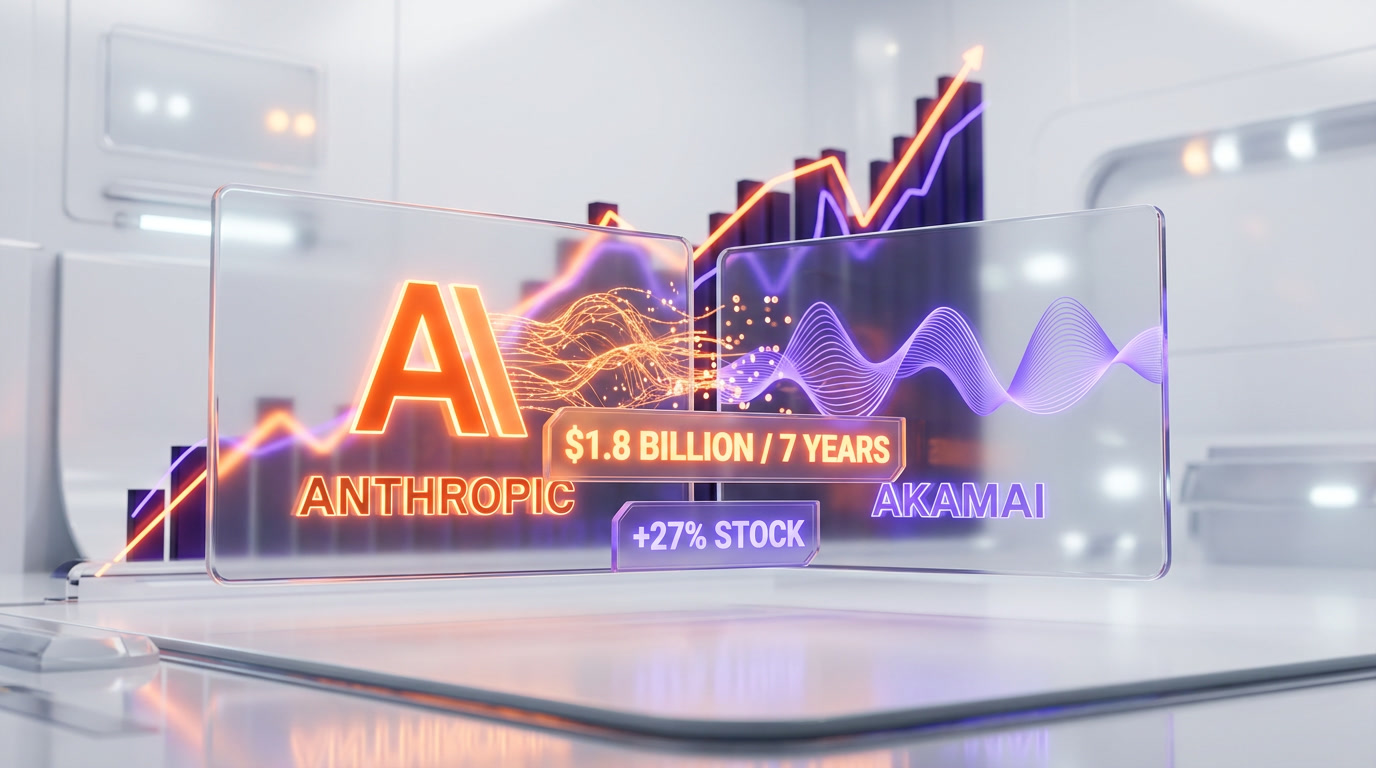
Anthropic signed a $1.8 billion, seven-year cloud computing contract with Akamai Technologies, disclosed during Akamai's Q1 2026 earnings call on May 7 and confirmed publicly on May 8, 2026. The deal is the largest customer contract in Akamai's 27-year history. Akamai stock (AKAM) jumped 27 percent to close at $148.38 on Friday, the largest single-day rally in more than 22 years. Anthropic CEO Dario Amodei said the company is "working as quickly as possible" to secure additional compute, citing 80x annualized revenue growth in Q1 2026.
What Happened
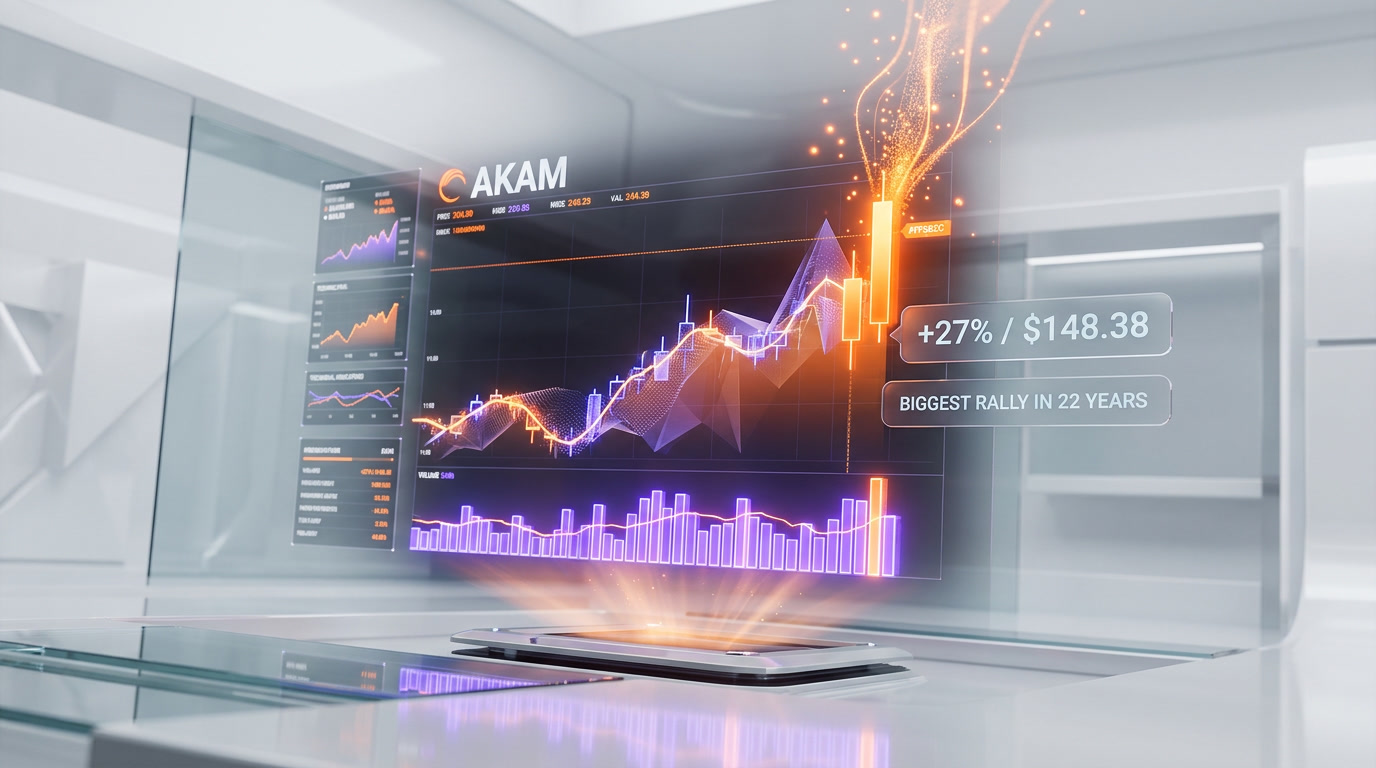
On May 7, 2026, Akamai disclosed during its first-quarter earnings call that a "leading frontier model provider" had committed $1.8 billion over seven years to Akamai Cloud Infrastructure Services. The customer was identified the next morning by Bloomberg as Anthropic, the lab behind Claude. The market reacted within hours: AKAM closed Friday May 8 at $148.38, up 27 percent on the day, the strongest single-session move the stock has posted since 2003.
Akamai CEO Tom Leighton framed the contract as a turning point on the earnings call. "These leaders in AI have chosen Akamai because their AI workloads need the scale, performance, and reliability that our cloud platform provides," Leighton said. He added on a separate CNBC interview: "I think we've been undervalued for a while, and investors have been looking for some real validation that our different approach is going to pay off, and now we're getting that validation."
The structure of the deal is what investors picked up on. Management described the $1.8 billion as a "straight committed deal over seven years," with revenue recognized ratably as Akamai brings capacity online. Initial recognition starts in Q4 2026, contributing roughly $20 to $25 million in that quarter alone. The full ramp arrives over the next 18 to 24 months.
For Anthropic, the timing tracks with Dario Amodei's public messaging. At the Code with Claude developer conference in San Francisco earlier in May, Amodei said the company saw "80x growth" in annualized revenue and Claude usage during Q1 2026, driven by coding adoption and automation workloads. His quote on the compute side was direct: "working as quickly as possible" to secure more capacity.
Why Akamai Is the Fifth Compute Partner — Not the First
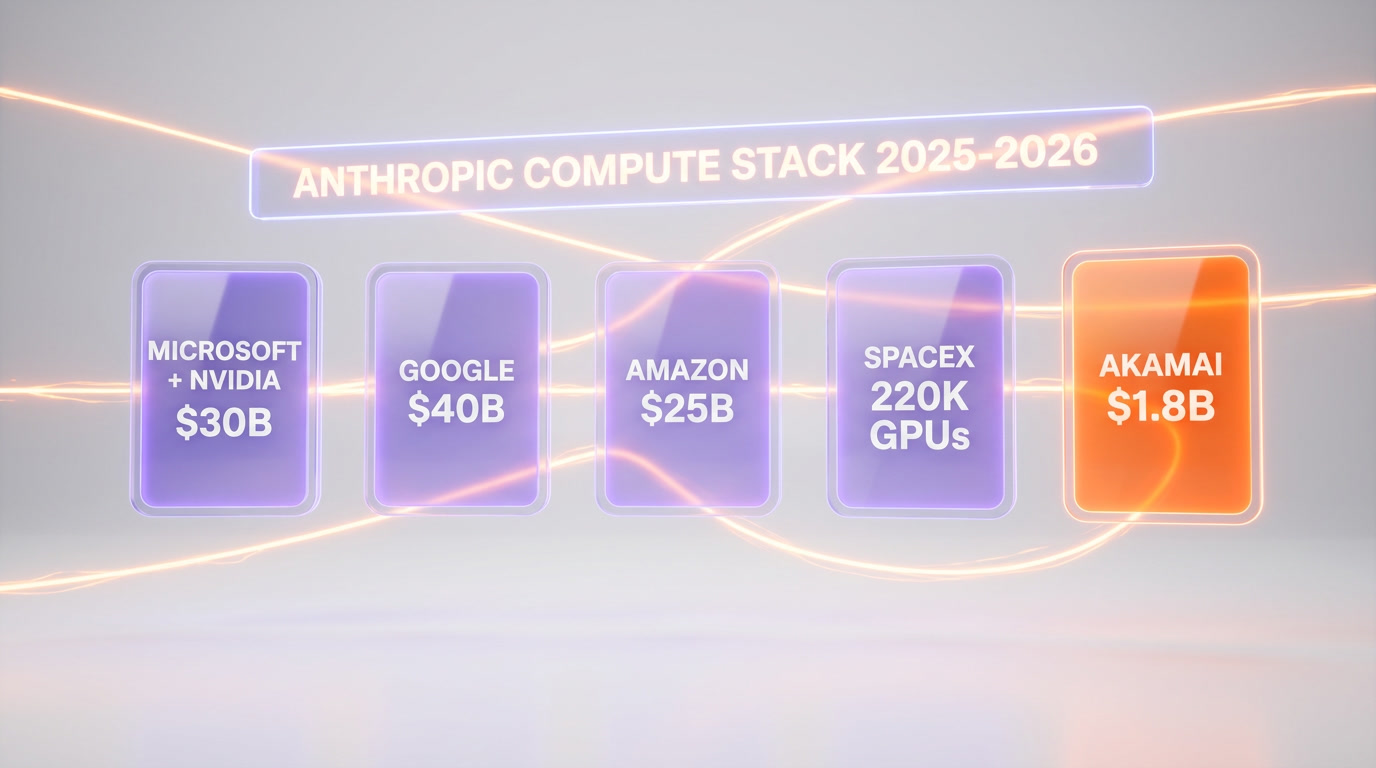
Reading this deal in isolation misses the picture. Akamai joins a stack of compute commitments Anthropic has signed in less than seven months. Each one targets a different layer of the AI infrastructure problem. Together they sketch a defensive perimeter against compute scarcity.
The lineup, in chronological order:
- Microsoft + NVIDIA — November 18, 2025. $30 billion Azure compute commitment, $10 billion NVIDIA equity investment, $5 billion Microsoft equity investment. Hyperscaler relationship anchored on NVIDIA Blackwell capacity in Azure data centers.
- Google — April 2026. $40 billion deal centered on TPUs and Broadcom-fabricated accelerators. Diversifies Anthropic away from a single accelerator vendor and reinforces the Google Cloud partnership Anthropic has held since 2022. We covered this in our breakdown of the $40B Google bet at a $350B valuation.
- Amazon — April 20, 2026. $25 billion expansion: $5 billion immediate, $20 billion in milestone tranches, on top of the prior $8 billion and the $100 billion AWS 10-year commitment from 2023. This deal puts Amazon Trainium silicon at the center of the relationship.
- SpaceX Colossus 1 — May 6, 2026. Anthropic locked 220,000 GPUs from SpaceX's Memphis-based Colossus 1 cluster. Same week, Anthropic doubled Claude Code rate limits. Full breakdown in our coverage of the SpaceX Colossus deal.
- Akamai — May 8, 2026. $1.8 billion over 7 years. Edge and CDN-native cloud infrastructure. The smallest dollar figure in the lineup, but strategically distinct from the four hyperscalers above.
That total — Microsoft + NVIDIA + Google + Amazon + SpaceX + Akamai — is a compute portfolio. Anthropic is not buying capacity from one cloud. It is assembling a multi-vendor, multi-accelerator, multi-geography supply chain. We argued in our editorial on Anthropic's 10-gigawatt empire that this is a deliberate hedge against any single supplier going dark or jacking prices.
Why Akamai, Specifically
The four hyperscaler deals all live in a similar architectural box: massive centralized data centers, dense GPU clusters, training-first workloads. Akamai sits in a different box. Its core business since 1998 has been content delivery — the CDN layer that puts cached content close to end users. Over the past three years, Akamai has been pivoting that distributed footprint into a cloud computing service, branded Akamai Cloud Infrastructure Services.
That distributed model matches a specific Anthropic problem: inference at scale. Training a frontier model happens in giant centralized clusters. Serving Claude to millions of API calls per minute, with sub-200-millisecond latency, is a different shape of problem. It rewards proximity to end users, dense regional points of presence, and infrastructure that was already designed for low-latency global delivery.
Leighton's earnings-call language pointed at this directly. He talked about Akamai's "different approach" — the same phrase he has used for several quarters when describing the company's edge-and-distributed model versus centralized hyperscalers. The Anthropic contract validates that pitch with a $1.8 billion vote.
What the Stock Move Tells Us
A 27 percent single-day move on a $20 billion+ market cap stock is not a small event. It signals the market had been pricing Akamai as a legacy CDN business with a slow cloud pivot, and the Anthropic deal forced an instant repricing. Three signals are worth flagging:
First, the magnitude of the rally — the largest in over 22 years — tells us how surprised investors were. Akamai had telegraphed the cloud pivot for at least eight quarters, but the market had been skeptical. A $1.8 billion frontier-AI customer contract changes the narrative from "legacy CDN trying to pivot" to "cloud platform with real AI demand."
Second, Leighton flagged a "very strong pipeline of major enterprise customers, including some that have very large cloud needs." Translation: the Anthropic deal is not the only AI compute contract in motion. Investors who treated this as a one-off may be re-rating again over the next two earnings cycles.
Third, the revenue ramp is back-loaded. Q4 2026 contributes only $20 to $25 million. The full $1.8 billion lands ratably over seven years — roughly $257 million annually once at full run rate. That is a meaningful but not transformative number against Akamai's roughly $4 billion annual revenue base. The market is pricing not the Anthropic dollars alone, but the validation those dollars represent for the pipeline.
Why the Number Is $1.8 Billion, Not $25 Billion
One reasonable question: why is the Akamai deal an order of magnitude smaller than the Amazon, Google, or Microsoft commitments? The answer is workload allocation.
Hyperscaler deals concentrate where heavy training and large-batch inference happen. Those workloads need contiguous GPU clusters in the tens of thousands of accelerators per region. Akamai's cloud platform is optimized for distributed inference — smaller pools of compute spread across more locations, designed to serve API traffic with low latency rather than train a 2-trillion-parameter model. The $1.8 billion sized to that role: it is meaningful inference capacity, distributed globally, but not a training contract.
That also explains the seven-year duration. Inference demand is more predictable than training demand. Anthropic can commit to a multi-year baseline because it knows Claude API traffic is going to keep growing. Training compute, by contrast, is more lumpy — you spin up massive runs for a new model generation, then those clusters either get repurposed or freed.
Implications for Builders Using Claude
For developers and teams that depend on Claude — through Anthropic's API, the Claude apps, or coding clients like Claude Code running on top of Claude Opus 4.7 — the practical effect is downstream throughput and reliability.
The Akamai capacity ramps over 18 to 24 months, but Anthropic's overall compute supply is now redundant across at least five major partners. That redundancy translates into two things builders should expect:
- Fewer hard rate-limit incidents. When one supplier is constrained, traffic shifts. Anthropic doubled Claude Code rate limits within days of the SpaceX deal. The Akamai deal is another step in the same direction — more headroom on inference, more rate-limit room for paying users and Pro tiers.
- Lower latency on edge geographies. Akamai's distributed footprint covers regions where centralized hyperscaler regions are sparse — Africa, parts of Latin America, Southeast Asia outside Singapore. Builders shipping Claude-powered products to those markets should see meaningful latency improvements as Akamai capacity comes online in 2027.
One caveat: contract language about "Akamai Cloud Infrastructure Services" does not automatically mean Anthropic API endpoints get served from Akamai PoPs tomorrow. That integration takes engineering time. Expect the first user-visible benefits in Q1 2027 at the earliest.
How This Fits the Anthropic Capital Story
The compute deals do not exist in a vacuum. They are stacked against a separate fundraising story — the company is in the middle of a $900 billion valuation conversation, with a potential IPO targeted for October 2026 at an $800 billion valuation. We covered the financing side in our piece on the 900B sprint and the $800B IPO target.
The math links up. To justify a $900 billion private valuation or an $800 billion IPO, Anthropic has to show two things: (1) revenue growth that maps onto the valuation multiple, and (2) compute supply secure enough to keep that revenue compounding without throttling. The 80x annualized revenue growth Amodei cited handles the first. The compute deal stack — Microsoft, Google, Amazon, SpaceX, Akamai — handles the second.
It is also worth noting which lab is not signing $1.8 billion CDN-edge deals: OpenAI. Their compute story has been more concentrated on Microsoft Azure, with the recent Stargate and Oracle relationships pointed at training capacity. Anthropic's stack reads as more diversified across providers, accelerator types, and workload geometries. Whether that wins long-term is an open question. What it does, today, is reduce single-supplier risk in a way OpenAI's stack does not.
What We Are Watching Next
Three things on our watch list as this deal moves from announcement to operating reality:
- Q4 2026 Akamai earnings. First quarter of revenue recognition from the Anthropic contract. Expected $20 to $25 million bump. The shape of that ramp tells us how fast the capacity is actually coming online.
- Akamai's "very strong pipeline" call-out. Leighton said Anthropic is not the only large AI customer in motion. We will be watching the Q2 and Q3 2026 earnings calls for additional contract disclosures. If two more frontier-AI deals land in the next two quarters, the cloud pivot story moves from "single big customer" to "platform play."
- Claude API availability and latency in non-US markets. Akamai's edge footprint is strongest outside North America. Real-world latency benchmarks from Africa, Southeast Asia, and Latin America in 2027 will be the practical test of whether this contract delivers what Anthropic actually needed.
The Bottom Line
Akamai locking down its largest customer contract ever — $1.8 billion over seven years — is a clean win for the company and a strategic check-the-box for Anthropic. It is not the biggest deal Anthropic has signed in 2026. It is the most architecturally interesting one. Hyperscalers solve training. Akamai solves serving Claude to a global user base without a hyperscaler-shaped center of gravity. Adding edge compute to the stack means Anthropic can scale Claude to markets and use cases where centralized cloud regions are weakest.
The 27 percent stock pop reflects how undervalued investors had been treating Akamai's pivot. The pipeline language from Leighton suggests that re-rating is not over. For Anthropic, this is one more piece of the compute puzzle locking into place — and based on Amodei's "as quickly as possible" framing, more pieces are coming.
Frequently Asked Questions
How big is the Anthropic-Akamai deal?
The contract is $1.8 billion over seven years, structured as a straight committed deal with revenue recognized ratably as Akamai brings capacity online. Initial revenue recognition starts in Q4 2026 with roughly $20 to $25 million in that quarter. It is the largest customer contract in Akamai's 27-year history, disclosed during the company's Q1 2026 earnings call on May 7, 2026.
Why did Akamai stock jump 27 percent on May 8, 2026?
AKAM closed at $148.38 on Friday May 8, up 27 percent — the largest single-day rally for the stock in more than 22 years. The move reflects investor surprise that Akamai's distributed cloud platform won a $1.8 billion frontier-AI customer (Anthropic), validating the company's multi-year pivot from legacy CDN to cloud computing infrastructure.
Is Akamai now Anthropic's main cloud provider?
No. Akamai is the fifth major compute partner in Anthropic's 2025-2026 stack, after the Microsoft and NVIDIA $30 billion plus $15 billion equity deal (November 18, 2025), the Google $40 billion TPU and Broadcom deal (April 2026), the Amazon $25 billion Trainium expansion (April 20, 2026), and the SpaceX Colossus 1 220,000-GPU lockup (May 6, 2026). Akamai handles distributed inference and edge serving, not training.
What did Dario Amodei say about the deal?
Amodei framed the broader compute push at the Code with Claude developer conference in San Francisco, saying Anthropic is "working as quickly as possible" to secure additional capacity. He cited 80x annualized revenue and usage growth for Claude in Q1 2026, driven by coding and automation adoption. The Akamai contract is one of multiple compute deals signed in response to that demand surge.
What did Akamai CEO Tom Leighton say about the contract?
On the Q1 2026 earnings call, Leighton said: "These leaders in AI have chosen Akamai because their AI workloads need the scale, performance, and reliability that our cloud platform provides." On CNBC, he added: "I think we've been undervalued for a while, and investors have been looking for some real validation that our different approach is going to pay off, and now we're getting that validation, and we have a very strong pipeline of major enterprise customers, including some that have very large cloud needs."
Why does Anthropic need Akamai if it already has Microsoft, Google, Amazon, and SpaceX compute?
Workload geometry. Hyperscaler deals concentrate on centralized GPU clusters for training and large-batch inference. Akamai's distributed cloud footprint — built originally for CDN content delivery — is optimized for low-latency inference close to end users. That matters for serving Claude API traffic globally with sub-200-millisecond response times, especially in regions where hyperscaler presence is sparse.
When does the Anthropic-Akamai capacity actually come online?
Initial revenue recognition begins in Q4 2026 with $20 to $25 million in that quarter. Full ramp happens ratably over the next 18 to 24 months. User-visible benefits — lower latency on Claude API in non-US regions, additional headroom on rate limits — should start showing up in Q1 2027 at the earliest, once the integration work between Anthropic and Akamai infrastructure completes.
Does this deal change anything for builders using Claude Code or the Claude API today?
Not immediately. The Akamai capacity ramps from Q4 2026 onward. The near-term effect builders should care about is structural: Anthropic now has compute redundancy across five major partners, which reduces single-supplier risk and supports the rate-limit increases already shipped (Claude Code limits doubled within days of the SpaceX Colossus deal on May 6, 2026). Long-term, expect lower latency on Claude API in regions where Akamai's edge footprint is strongest.
Is Akamai going to win more frontier-AI customers?
Per Leighton on the Q1 2026 earnings call: "We have a very strong pipeline of major enterprise customers, including some that have very large cloud needs." That language signals additional AI infrastructure contracts are in motion. Confirmation will come in Q2 and Q3 2026 earnings disclosures. If two or more comparable contracts land, the Akamai cloud pivot moves from "one big customer" to "validated platform."
Where can I read the original Akamai earnings disclosure?
Akamai disclosed the contract during its Q1 2026 earnings call on May 7, 2026. The customer was identified as Anthropic by Bloomberg on May 8. Primary sources include the Akamai Q1 2026 earnings transcript, Bloomberg's reporting on the deal terms, CNBC's coverage of the stock reaction, and Yahoo Finance for the financial breakdown. Direct links are cited at the end of this article.
Sources
- Bloomberg — Anthropic Inks $1.8 Billion Computing Deal With Akamai (May 8, 2026)
- CNBC — Akamai stock soars on earnings, $1.8 billion AI infrastructure deal (May 8, 2026)
- The Boston Globe — Akamai stock jumps on $1.8 billion AI deal with Anthropic (May 8, 2026)
- Yahoo Finance — Anthropic Inks $1.8 Billion Computing Deal With Akamai (May 8, 2026)