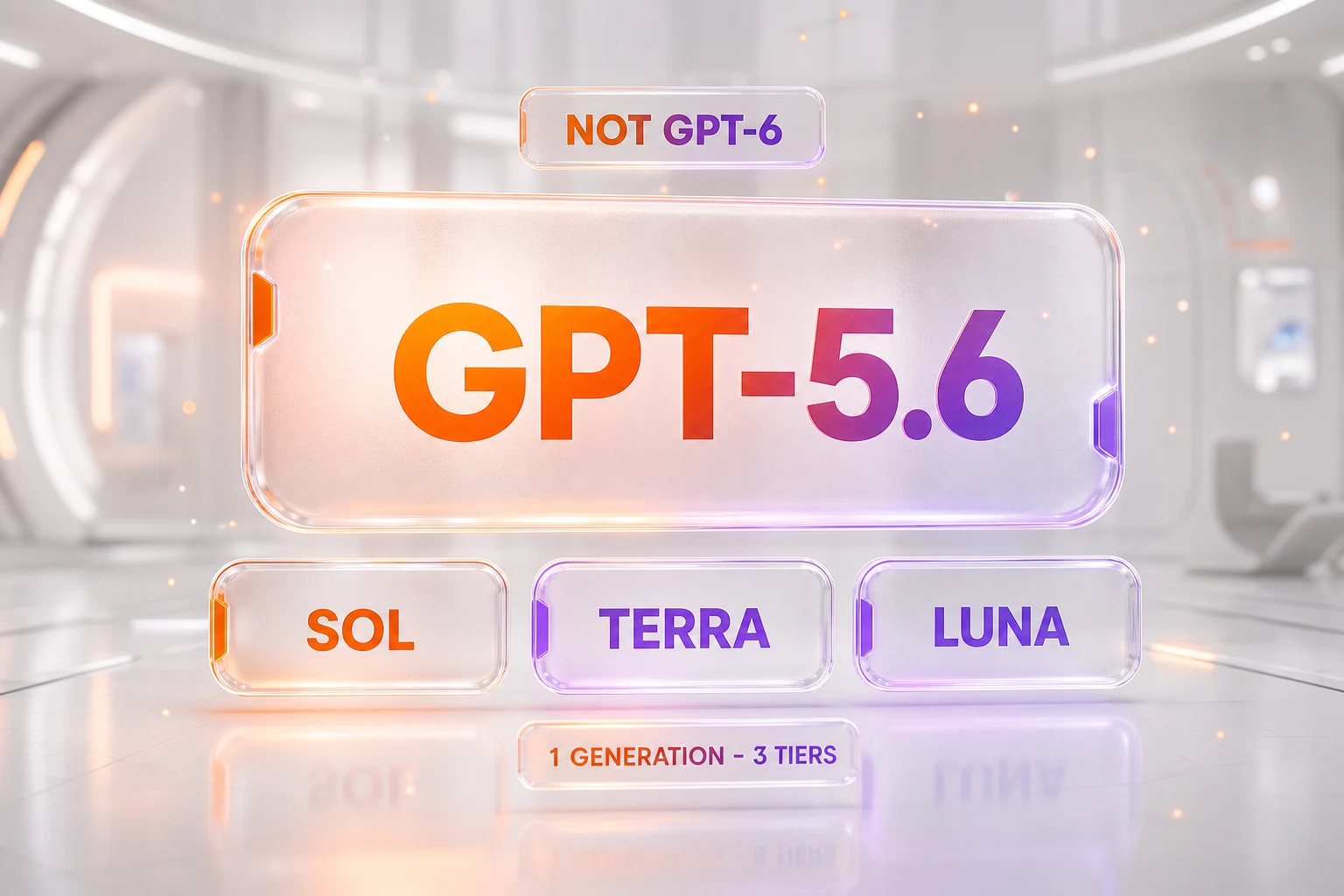
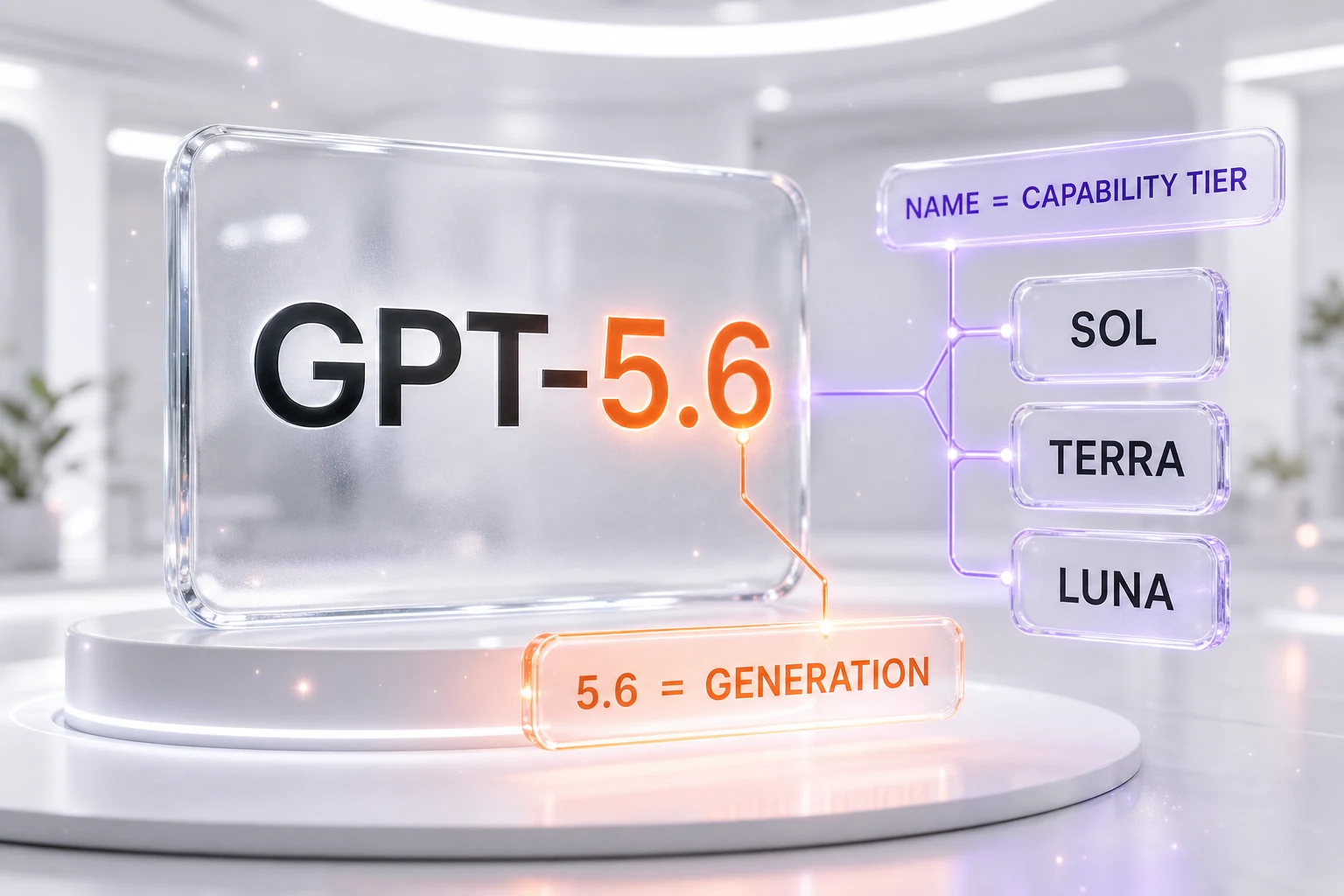
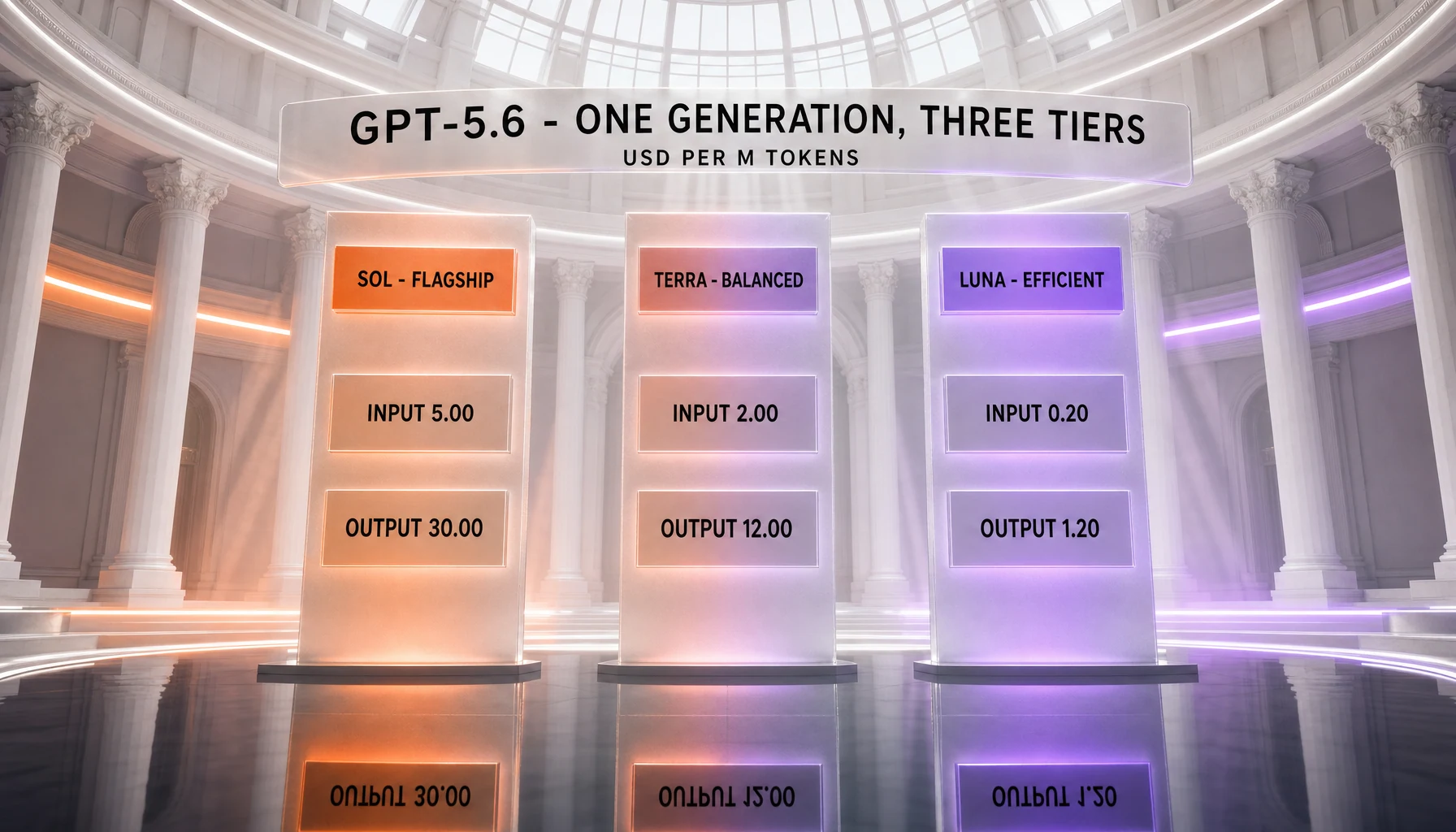
GPT-5.6 is OpenAI's July 2026 model family, and no, it is not GPT-6. OpenAI released it to the public on July 9, 2026, after a gated preview that opened on June 26. In the new naming scheme, the number 5.6 marks the generation, while the names Sol, Terra, and Luna are durable capability tiers rather than model sizes. Sol is the flagship built for the hardest coding and agentic work; it was priced at $5.00 per million input tokens and $30.00 per million output tokens in July 2026. Terra is the balanced, high-volume tier at $2.00 and $12.00. Luna is the fast, low-cost tier at $0.20 and $1.20. All three share a context window of about 1.05 million tokens. On independent testing, Sol scores 59 on the Artificial Analysis Intelligence Index — one point behind Claude Fable 5 at 60 — and, on the separate Coding Agent Index, places second at 66.6 through the Codex harness at max reasoning, a tenth of a point behind Claude Code with Opus 5.
Key Takeaways
- Not GPT-6. GPT-5.6 is a point release inside the GPT-5 generation, launched July 9, 2026. It runs alongside GPT-5.5, which OpenAI has not deprecated.
- New naming logic. The number (5.6) is the generation; the tier name (Sol, Terra, or Luna) is a capability level that OpenAI intends to carry forward across future generations, so a "Sol" tier can persist even when the number changes.
- Three tiers. Sol cost $5.00 per million input tokens and $30.00 per million output tokens at launch, cut to $4.00 and $20.00 on August 21, 2026; Terra costs $2.00 and $12.00; Luna costs $0.20 and $1.20. All three share roughly a 1.05 million-token context window and a maximum output of 128,000 tokens.
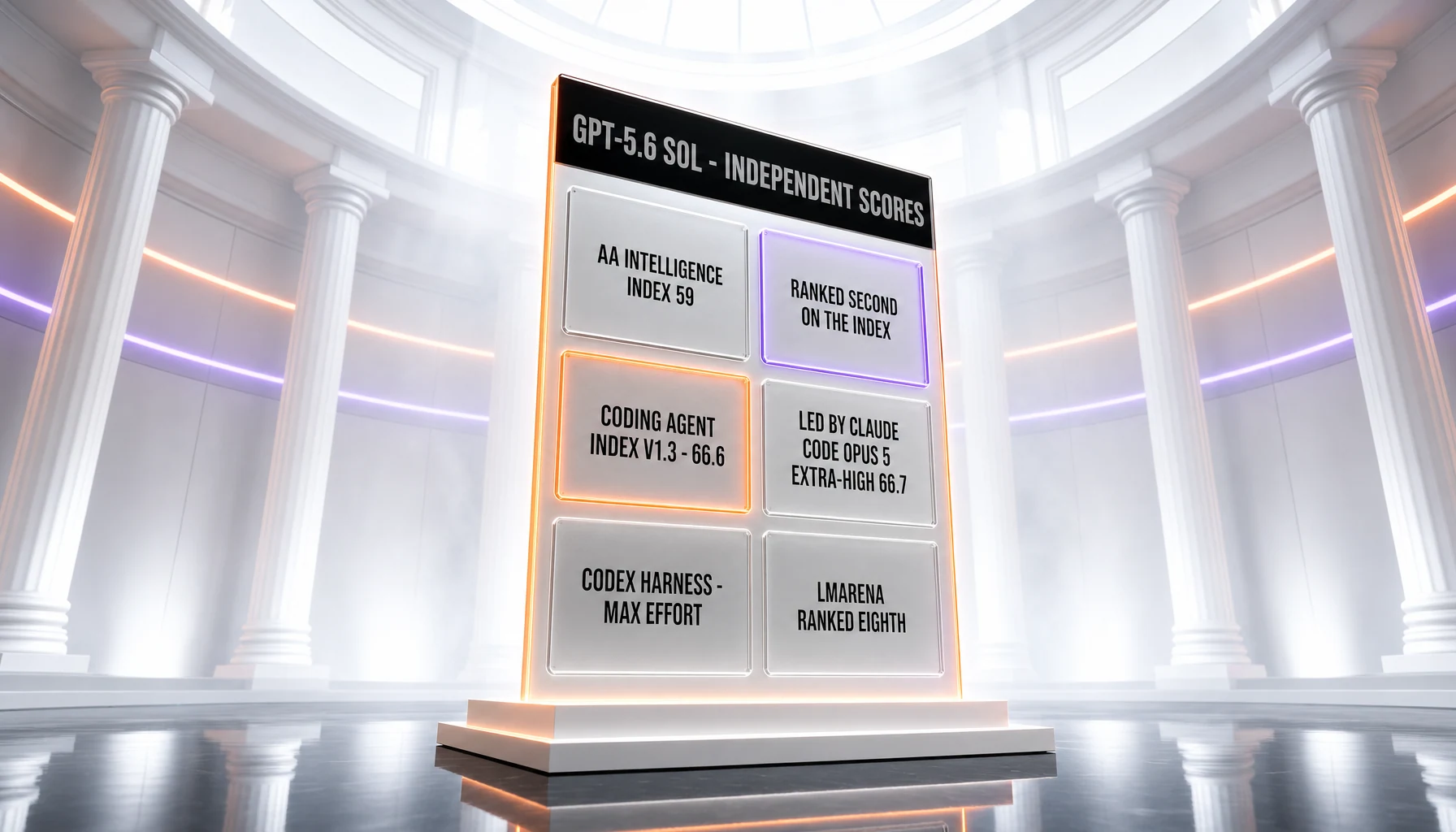
- Independent scores. Sol posts 59 on the Artificial Analysis Intelligence Index (Claude Fable 5 leads at 60) and 66.6 on version 1.3 of the Artificial Analysis Coding Agent Index, where the Codex harness running Sol at max reasoning places second behind Claude Code with Opus 5 at 66.7. It sits at eighth on the LMArena leaderboard and is absent from the independent SWE-bench Verified board.
- Access. Sol is selectable inside ChatGPT for Plus, Pro, Business, and Enterprise users; Terra and Luna are API and Codex first. All three tiers are live in the OpenAI API.
No, GPT-5.6 Is Not GPT-6
The first thing to settle is the question the name provokes. GPT-5.6 is not GPT-6, and OpenAI has not announced a model called GPT-6. Nothing in the July 9, 2026 launch materials uses that label. The confusion is understandable — a jump from GPT-5.5 to a family with brand-new names like Sol, Terra, and Luna feels like a bigger leap than a decimal bump. But the version number is deliberate: 5.6 signals an incremental generation on top of GPT-5.5, not the next whole number.
What actually changed is the naming system itself. Under the new scheme, OpenAI separates two ideas that used to be tangled together: how new the model is, and what it is built to do. The number carries the generation. The name carries what OpenAI calls a durable capability tier — a level of intelligence and cost that is meant to persist across releases. In plain terms, "Sol" is intended to keep meaning "the flagship tier" even after the generation number moves on, the way a product line keeps its name across model years. You can read OpenAI's own framing on the GPT-5.6 announcement page and the tier definitions in the OpenAI model documentation.
This matters for anyone trying to keep the AI landscape straight. If you were bracing for a GPT-6 that resets everything, that is not what shipped. What shipped is a re-labeling of the ladder, plus three concrete models sitting on three of its rungs. For context on how the previous rung compares, our GPT-5.5 overview covers the model GPT-5.6 builds on, and the numbering lineage runs back through the GPT-5.4 release.
What Is GPT-5.6?
GPT-5.6 is a family of three text-and-image reasoning models released by OpenAI on July 9, 2026. The three tiers share a common architecture and specification but are tuned and priced for different jobs: Sol for the hardest problems, Terra for balanced high-volume work, and Luna for the fastest, cheapest tasks. All three accept text and image input and return text; none of them generate images or audio natively, though image generation is available to them as a callable tool.
The rollout came in two stages. A gated preview opened on June 26, 2026 for trusted partners — a limited release we covered in our report on the gated Sol preview and its government-first access. General availability followed on July 9, 2026, bringing all three tiers to the OpenAI API, ChatGPT, and Codex at once. Because the family is only days old, treat this as an early map of what OpenAI shipped rather than a matured verdict.
One point that gets lost in the excitement: GPT-5.6 does not replace GPT-5.5. OpenAI added the new family to its lineup without retiring the old flagship, so GPT-5.5 remains a supported, selectable model. GPT-5.6 is an option on top of what already existed, not a forced migration.
The shared specifications are the same across all three tiers. Each has a context window of about 1,050,000 tokens, a maximum output of 128,000 tokens, and a training-data cutoff of February 16, 2026. Fine-tuning is not supported at launch. All three support function calling, structured outputs, streaming, the Batch API, and OpenAI's native tools — web search, file search, image generation, code interpreter, hosted shell, computer use, and MCP.
Sol, Terra, and Luna: The Three Tiers
The clearest way to understand GPT-5.6 is to look at the three tiers side by side. Every figure below is the standard rate per million tokens as it stood in July 2026, confirmed at the time in OpenAI's API pricing documentation. If the input, output, and cached-token columns need unpacking, our guide to how AI model pricing works explains what each one bills for.
| Tier | Built for | Input (per 1M tokens) | Output (per 1M tokens) | Cached input |
|---|---|---|---|---|
| Sol | Flagship — hardest coding, long-horizon agents, science, computer use | $5.00 | $30.00 | $0.50 |
| Terra | Balanced, high-volume business work — support, documents | $2.00 | $12.00 | $0.20 |
| Luna | Fastest, cheapest — summarization, drafting, routine automation | $0.20 | $1.20 | $0.02 |
July 2026 rates, per million tokens, as published by OpenAI.
Sol is the flagship, positioned by OpenAI for "the hardest problems" — complex coding, long-horizon agentic tasks, cybersecurity, scientific reasoning, computer use, and design. It carries the highest price and the strongest independent scores of the three. At $5.00 per million input tokens and $30.00 per million output tokens in July 2026, it was priced in the same neighborhood as other frontier flagships.
Terra is the balanced middle. OpenAI frames it as competitive with GPT-5.5 on quality while costing roughly half as much, aimed at high-volume business workloads like customer support and document processing. At $2.00 input and $12.00 output per million tokens, it is the tier most teams will reach for when Sol is overkill but Luna is too light.
Luna is the efficiency tier — the fastest and cheapest of the three, built for summarization, drafting, and routine automation. At $0.20 per million input tokens and $1.20 per million output tokens, it is priced to run at scale where latency and cost matter more than peak reasoning.
OpenAI also offers reduced-rate Batch pricing (roughly half the standard rate) and a Priority tier at twice the standard rate for latency-sensitive traffic, across all three tiers.
Sol vs Terra vs Luna: Which One
Choosing between the three tiers comes down to matching the model to the job rather than always reaching for the top. Here is the practical read.
Pick Sol when the task is genuinely hard and correctness is worth the cost: multi-step agentic workflows, complex refactors across a codebase, cybersecurity analysis, scientific or research reasoning, or computer-use automation where a wrong step is expensive. Sol is also the only tier selectable directly inside ChatGPT for most paid users, so for interactive chat work it is often the default. If your work leans on autonomous, tool-using behavior, our explainer on what makes a model agentic rather than a chatbot is useful background for why the flagship tier matters there.
Pick Terra when you are running a lot of reasonably demanding work and the per-token bill starts to dominate. Terra's pitch is GPT-5.5-class quality at roughly half the cost, which makes it the natural home for production workloads like support automation, document analysis, and internal tooling that need to be good but do not need to be the absolute best on the market.
Pick Luna when speed and price beat peak intelligence: high-volume summarization, first-draft generation, classification, and the routine automation glue that sits behind a product. At $0.20 per million input tokens, Luna is cheap enough to put in front of large request volumes without the cost math breaking.
A useful rule of thumb: prototype on Sol to see the ceiling of what is possible, then drop to Terra or Luna for the parts of your pipeline that do not need the ceiling. Because all three share the same context window and tool support, moving work down a tier is usually a one-line model swap rather than a rebuild.
Where Sol Stands Against the Competition
The honest way to place GPT-5.6 is through independent benchmarks, not vendor slides. The clearest third-party read comes from Artificial Analysis, which runs its own evaluations and cost measurements, and the community-voted LMArena leaderboard.
On the Artificial Analysis Intelligence Index, Sol scores 59, Terra 55, and Luna 51. That places Sol one point behind Claude Fable 5, which tops that index at 60 — a near-tie at the frontier. The efficiency angle matters here: Artificial Analysis reports Sol's cost per task at roughly $1.04, against far higher figures for some rivals, so Sol trades a single index point for a meaningful cost advantage.
Coding is where Sol looks strongest, though the board is tighter than the launch messaging suggests. Version 1.3 of the Artificial Analysis Coding Agent Index scores a harness and a model together rather than a model on its own, and it lists Codex with GPT-5.6 Sol at max reasoning at 66.6 — second, a tenth of a point behind Claude Code with Opus 5 at extra-high effort (66.7), and just ahead of Claude Code with Fable 5 at max (65.8) and Grok Build with Grok 4.5 at high (64.4). Both cheaper tiers appear on that board as well, through the same Codex harness at max reasoning: Terra at 62.28 and Luna at 58.66, which makes the three-tier ladder legible on the coding index exactly as it is on the intelligence one. For teams whose workload is mostly software engineering, the honest read is that Sol sits at the top of a tightly packed group rather than clear of it — and Artificial Analysis measures those same runs at a mean $7.08 per task for Sol, against $8.23 for Opus 5 and $11.71 for Fable 5.
Head-to-head chat quality tells a more mixed story. On LMArena's Elo leaderboard, GPT-5.6 Sol sits at eighth with an Elo around 1486, behind Claude Fable 5 at the top and several Claude and Gemini entries, and effectively tied with Gemini 3.1 Pro and just ahead of Claude Opus 4.8 Thinking on that board. Terra and Luna are not separately charted there.
One gap is worth stating plainly: as of this writing, GPT-5.6 has not been submitted to the independent SWE-bench Verified leaderboard tracked by Vals AI, so there is no third-party SWE-bench Verified score for Sol to compare against models like Claude Opus 4.8 or GPT-5.5. OpenAI has published its own coding numbers, including a SWE-bench Pro figure, but those are self-reported and use a different, harder variant — and, as our breakdown of SWE-bench Pro versus Verified explains, the two are not interchangeable. Until an independent Verified score appears, the coding case for Sol rests mainly on the Artificial Analysis Coding Agent Index v1.3.
What's New Under the Hood
Beyond the three-tier structure, GPT-5.6 introduces two features aimed squarely at agentic and coding workloads. Both are described in OpenAI's model documentation.
The first is an expanded reasoning-effort ladder. Earlier models topped out at a high or extra-high reasoning setting; GPT-5.6 adds two new rungs above that. A new "max" level pushes single-pass reasoning further, and a new "ultra" level runs a multi-agent configuration — four agents by default, scalable up to sixteen — that fan out on a problem and reconcile their work. Ultra is primarily a Sol capability and is where OpenAI positions its hardest-problem performance.
The second is Programmatic Tool Calling. Instead of only calling predefined functions, GPT-5.6 can write and execute JavaScript in an isolated, ephemeral runtime, then use the result — a sandboxed code-execution loop that is compatible with Zero Data Retention setups. For agentic tasks that need to compute, transform, or verify something mid-reasoning, this collapses a lot of orchestration that used to live in application code into the model itself.
Prompt caching is also improved, with cached reads billed at a steep discount to fresh input and a minimum cache lifetime measured in tens of minutes. Combined with those cached-read economics, the practical effect is that long, tool-heavy agent runs get cheaper to operate than the headline output price alone would suggest.
How to Access GPT-5.6
Access depends on the tier. In ChatGPT, Sol is the selectable GPT-5.6 model for Plus, Pro, Business, and Enterprise users, while Terra and Luna are exposed mainly through the API, Codex, and work surfaces rather than the consumer chat picker. Business and Enterprise plans also surface a "Sol Pro" experience, which is a ChatGPT feature layer rather than a separate, separately-billed API model.
For developers, all three tiers are available in the OpenAI API under the model IDs gpt-5.6-sol (aliased as gpt-5.6), gpt-5.6-terra, and gpt-5.6-luna, and in Codex for coding workflows. Because the tiers share a common interface and rate structure, switching between them is a matter of changing the model string, which makes it straightforward to route cheap traffic to Luna and reserve Sol for the calls that need it.
The Bottom Line
GPT-5.6 is best understood as a repackaging plus a real step forward, not a generational reset. The repackaging is the naming system: a number for the generation, a durable name for the tier, which should make OpenAI's lineup easier to reason about over time if the tiers really do persist. The step forward is concrete: a flagship in Sol that leads an independent coding benchmark and sits within one point of the intelligence frontier at a lower cost per task, plus genuinely new capabilities in multi-agent reasoning and programmatic tool calling.
The caveats are equally concrete. The most rigorous independent coding board, SWE-bench Verified, has no GPT-5.6 entry yet, so part of the coding story is still unverified by third parties. The family is only days old, which means real-world reliability at scale is still being established. And because GPT-5.5 stays in the lineup, the decision for most teams is not "upgrade or not" but "which of four models fits each job." For a landscape that keeps adding options, GPT-5.6's clearest contribution may simply be a naming scheme that makes those choices legible — as long as you remember that the thing that shipped is GPT-5.6, not GPT-6.
Sources
- OpenAI — GPT-5.6 announcement (family, tiers, positioning)
- OpenAI — model documentation (specifications, reasoning effort, tools)
- OpenAI — API pricing (per-tier token pricing)
- Artificial Analysis — Intelligence Index (independent benchmarks and cost per task) and the Coding Agent Index (v1.3, read August 2, 2026)
- LMArena — Elo leaderboard (community head-to-head ranking)
- Vals AI — SWE-bench Verified leaderboard (independent coding board; GPT-5.6 not yet listed)
Editorial note: ThePlanetTools.ai has no commercial relationship with OpenAI or any company referenced in this article. Pricing and specifications are drawn from OpenAI's official launch and documentation as of July 11, 2026; benchmark figures are attributed to the independent organizations that publish them and reflect scores available at the time of writing.
Frequently Asked Questions
Is GPT-5.6 the same as GPT-6?
No. GPT-5.6 is not GPT-6, and OpenAI has not announced a model called GPT-6. GPT-5.6 is an incremental release inside the GPT-5 generation, launched publicly on July 9, 2026. The decimal version number signals a step on top of GPT-5.5, while the tier names Sol, Terra, and Luna describe capability levels rather than a new whole-number generation.
What is GPT-5.6?
GPT-5.6 is a family of three text-and-image reasoning models from OpenAI, released on July 9, 2026. It comes in three tiers - Sol (flagship), Terra (balanced), and Luna (efficient) - that share a context window of about 1.05 million tokens but are priced and tuned for different workloads. All three accept text and image input and return text.
What do Sol, Terra, and Luna mean?
Sol, Terra, and Luna are GPT-5.6's durable capability tiers. In OpenAI's new naming system, the number (5.6) marks the generation while the tier name marks a level of intelligence and cost that is meant to persist across future generations. Sol is the flagship tier, Terra the balanced tier, and Luna the fast, low-cost tier.
When was GPT-5.6 released?
OpenAI opened a gated preview of GPT-5.6 for trusted partners on June 26, 2026, then made all three tiers generally available to the public on July 9, 2026 across the OpenAI API, ChatGPT, and Codex.
How much does GPT-5.6 cost?
Pricing is per million tokens. Sol cost $5.00 per million input tokens and $30.00 per million output tokens at launch; OpenAI cut it to $4.00 and $20.00 on August 21, 2026. Terra costs $2.00 input and $12.00 output. Luna costs $0.20 input and $1.20 output. Prompts above 272,000 input tokens are billed at twice the input rate and one and a half times the output rate across the full request. Cached input is heavily discounted on every tier, and reduced-rate Batch pricing is available.
What is the difference between Sol, Terra, and Luna?
Sol is the flagship, built for the hardest coding, agentic, and reasoning tasks, and it carries the highest price and strongest scores. Terra is the balanced tier, positioned as GPT-5.5-class quality at roughly half the cost for high-volume business work. Luna is the fastest and cheapest, built for summarization, drafting, and routine automation.
Which GPT-5.6 tier should I use?
Use Sol for genuinely hard work where correctness justifies the cost, such as multi-step agents, complex refactors, and computer use. Use Terra for high-volume production work that needs to be good but not the absolute best. Use Luna for cheap, fast tasks like summarization and drafting. Because all three share the same context window and tools, moving work down a tier is usually a one-line change.
Is GPT-5.6 better than Claude Fable 5?
It depends on the task. On the independent Artificial Analysis Intelligence Index, GPT-5.6 Sol scores 59 to Claude Fable 5's 60, a near-tie, though Sol has a lower reported cost per task. On version 1.3 of the Artificial Analysis Coding Agent Index, Codex with Sol at max reasoning places second at 66.6, a tenth of a point behind Claude Code with Opus 5. On the LMArena leaderboard, Claude Fable 5 leads and Sol sits at eighth. Fable 5 is ahead on general ranking; Sol is ahead of Fable 5 on the independent coding index but behind Opus 5.
How does GPT-5.6 compare to GPT-5.5?
GPT-5.6 is the newer generation, but it does not replace GPT-5.5, which remains a supported, selectable model. The Terra tier is positioned as matching GPT-5.5-class quality at roughly half the cost, while Sol pushes above GPT-5.5 on independent coding benchmarks. For many teams the practical choice is now between four models rather than a single upgrade decision.
What context window does GPT-5.6 have?
All three GPT-5.6 tiers share a context window of about 1,050,000 tokens (roughly 1.05 million), a maximum output of 128,000 tokens, and a training-data cutoff of February 16, 2026. Fine-tuning is not supported at launch.
Where can I use GPT-5.6?
Sol is selectable inside ChatGPT for Plus, Pro, Business, and Enterprise users, while Terra and Luna are exposed mainly through the API and Codex. In the API, the three tiers use the model IDs gpt-5.6-sol (aliased gpt-5.6), gpt-5.6-terra, and gpt-5.6-luna. Business and Enterprise plans also surface a Sol Pro feature inside ChatGPT.
Does GPT-5.6 appear on the SWE-bench Verified leaderboard?
Not yet. As of this writing, GPT-5.6 has not been submitted to the independent SWE-bench Verified leaderboard, so there is no third-party Verified score for Sol. OpenAI has published its own coding numbers, including a SWE-bench Pro figure, but those are self-reported and use a different, harder benchmark variant that cannot be compared directly with Verified scores.