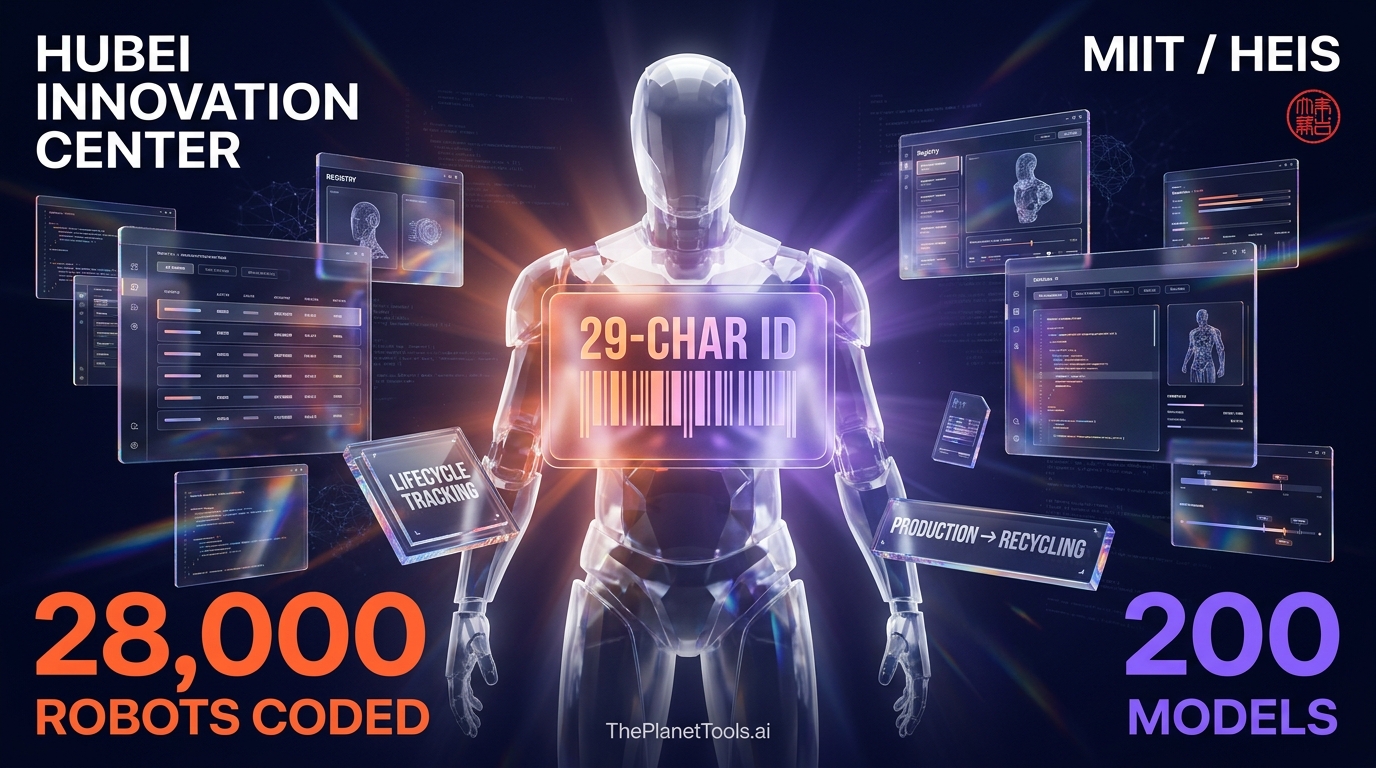
China launched the Humanoid Full Lifecycle Management Service Platform in May 2026, operated by the Hubei Humanoid Robotics Innovation Center under the Humanoid Robotics and Embodied Intelligence Standardization (HEIS) committee of the Ministry of Industry and Information Technology (MIIT). The system assigns a 29-character national digital ID to every humanoid robot manufactured in China — modeled on the 18-character citizen ID system with 11 additional characters for operational data — and according to SCMP and Biometric Update reporting on May 25, 2026, more than 28,000 robots across 200 models have already been coded. We read the launch less as a regulatory housekeeping exercise and more as the first state-level traceability infrastructure for embodied AI anywhere in the world, with implications for product liability, export tracking, and the geopolitical positioning of China's humanoid sector that no Western jurisdiction currently matches.
We have tracked the humanoid shipment and deployment cycle through the last twelve months of funding rounds and production ramps, and the digital ID platform is the cleanest signal yet that Beijing is treating embodied AI as critical industrial infrastructure rather than a consumer-tech category. All figures in this analysis are attributed to SCMP's May 25, 2026 reporting and corroborated against Biometric Update and The Next Web coverage of the same announcement; we scope every claim as reported rather than independently audited, and we flag the specific manufacturer names where the public record stops.
The Humanoid Full Lifecycle Management Service Platform: What It Actually Is
The platform's formal name — Humanoid Full Lifecycle Management Service Platform — is also its functional description. According to SCMP, the system assigns unique codes to humanoid robots to "track the robots throughout their lifecycle, from production through to recycling," and applies to "all stakeholders across the humanoid industry and supply chain, including manufacturers, service providers, sellers, users and recycle facilities," in the words of Yu Xiuming, deputy head at the China Electronics Standardization Institute (CESI), as quoted by SCMP. This is a cradle-to-grave traceability regime, not a manufacturing standard.
The 29-Character Code Structure
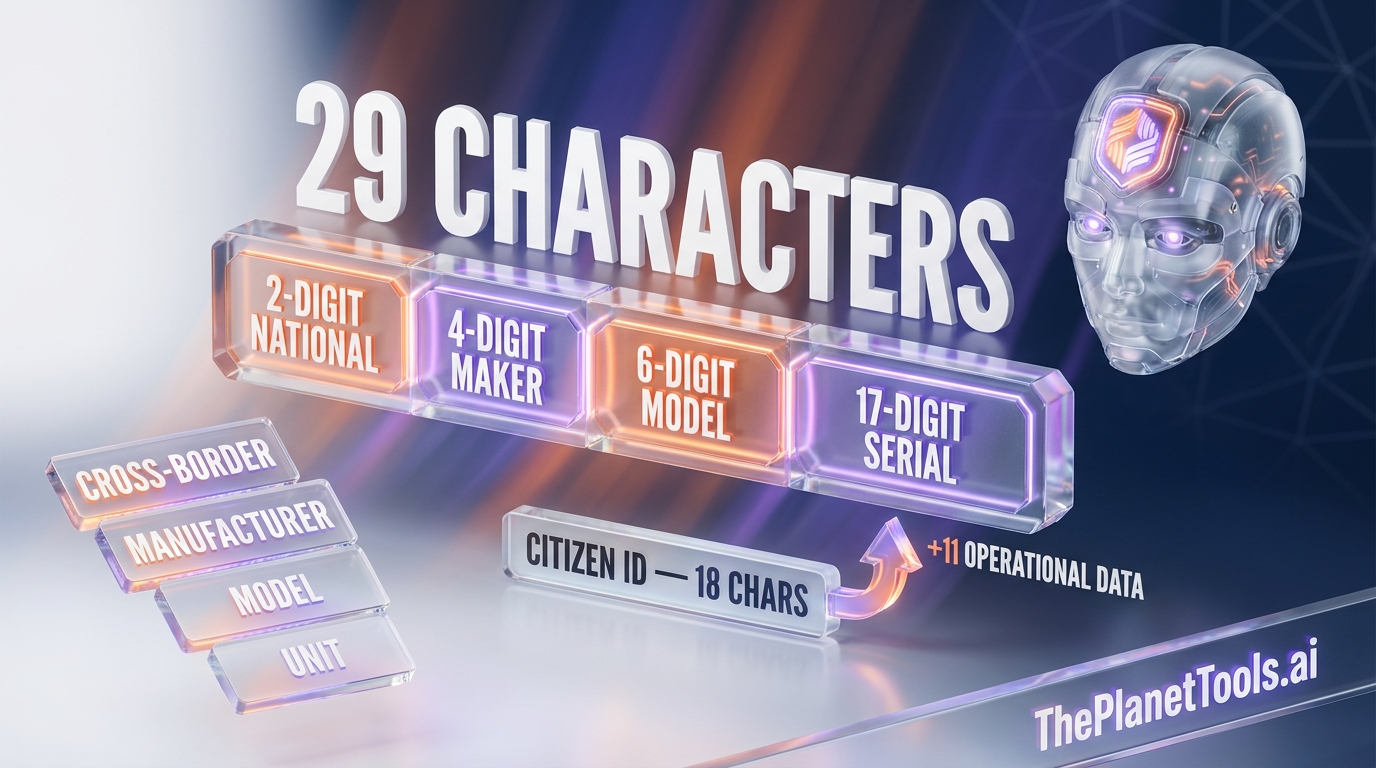
According to Biometric Update's coverage of the launch, the digital ID uses a 29-digit structure with four components: a 2-digit national code for cross-border tracking, a 4-digit manufacturer identifier, a 6-digit product model code, and a 17-digit serial number for individual units. As The Next Web reported, the format is "modeled on China's 18-character citizen ID system with 11 additional characters for operational data" — a deliberate design choice that signals the regulator is treating humanoid robots as a registered population with the same accountability infrastructure used for human citizens.
The Data Captured Per Robot
The Next Web's reporting summarizes the tracked data as covering "maintenance history, work environments, and real-time performance metrics including mechanical joint wear rates, battery degradation, and movement precision," following each robot from production through recycling. SCMP's reporting frames the broader scope as covering all participants in the supply chain. The combination — manufacturer plus serial plus operational telemetry plus end-of-life disposition — is closer to an automotive VIN-and-service-record regime than to a software product registry, and that comparison is the right reference frame for the policy intent.
Who Runs the Platform: HEIS, MIIT, and the Hubei Innovation Center
The regulatory stack behind the platform is the most strategically legible feature of the announcement, and it is worth unpacking precisely. The Humanoid Robotics and Embodied Intelligence Standardization committee, known by its initials HEIS, oversees the initiative. HEIS operates under the Ministry of Industry and Information Technology (MIIT), China's main industrial regulator and the same ministry responsible for telecom licensing, semiconductor policy, and electric-vehicle standards. The platform's day-to-day operations are run from the Hubei Humanoid Robot Innovation Center in Wuhan, according to Biometric Update.
The Significance of MIIT-Level Sponsorship
The choice of MIIT as the parent ministry, rather than a science-and-technology body or a consumer-protection regulator, is the part of the structure most worth reading carefully. MIIT is the industrial-policy arm of the Chinese state. It is the ministry that designates strategic industries, sets production quotas, and coordinates the state-adjacent capital that flows into them. Placing humanoid robotics under an MIIT standardization committee at this point in the sector's life — when global commercial deployment is still measured in tens of thousands of units annually — signals that Beijing has formally classified embodied AI as a strategic industrial category. That classification typically precedes the rest of the toolkit: targeted procurement, designated industrial parks, and a sectoral capex cycle.
Hubei as the Operational Hub
The choice of the Hubei Humanoid Robot Innovation Center as the operating venue is not incidental. Hubei province, and Wuhan specifically, has positioned itself as a humanoid-robotics hub through provincial-level investment in research centers and manufacturing infrastructure. Concentrating the registry infrastructure in the same geography as the manufacturing base reduces the friction between the regulator and the regulated population and creates a single operational center for what is, in effect, a national robot census.
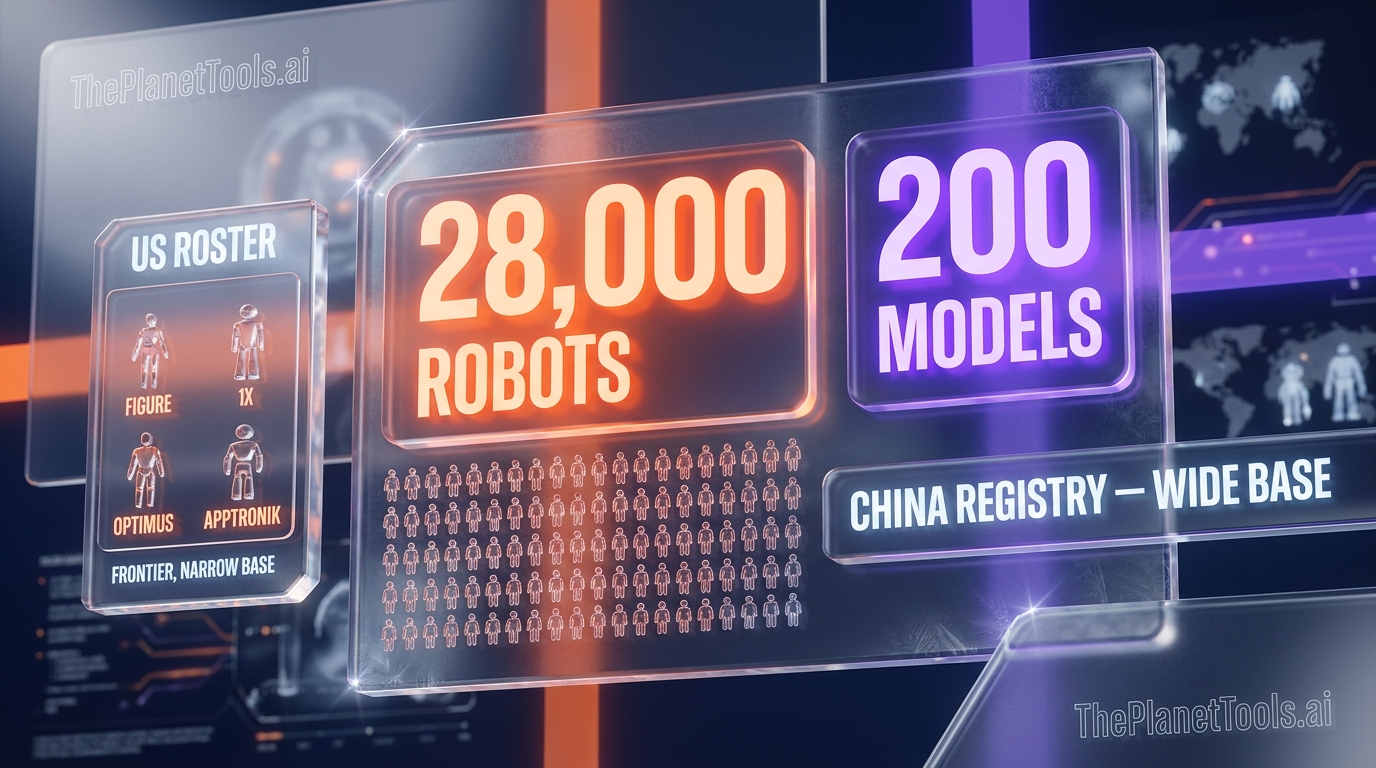
The Scale Already Coded: 28,000+ Robots, 200 Models
According to SCMP and Biometric Update, more than 28,000 robots across 200 models have already been assigned the digital ID through the platform. We treat both figures as reported by the launch announcement rather than independently audited, but the magnitudes are coherent with the broader shipment baseline visible in the sector.
Reading the 28,000 Figure Against Global Volume
For context, multiple outlets covering 2025 global humanoid shipments reported approximately 13,000 humanoid units delivered worldwide during that year, with Chinese manufacturers accounting for the majority of the volume. A registry of 28,000+ humanoids already coded in China alone, less than six months into 2026, implies either a backfill of previously deployed units now being registered retroactively, a sharp ramp in early-2026 shipments, or both. The most parsimonious read is some combination: existing inventory being brought into the registry, plus a forward production rate that is materially higher than the 2025 baseline. We have explored the 2025 shipment baseline and the Chinese cohort's volume position in our analysis of Robotera's $200M+ round and Q2 2026 thousand-unit deliveries, which provides the context for how a 28,000-unit registry is plausible at this point in the cycle.
The 200-Model Breadth Signal
The 200-model coverage figure is the part of the disclosure that quietly carries the most weight. Two hundred distinct humanoid models across a single national ecosystem describes a manufacturer cohort that is broader than the US humanoid industry's roster by an order of magnitude. The US visible-deployment cohort — Figure, 1X, Tesla Optimus, Apptronik, and a handful of others — is dense at the frontier and thin at the base. The Chinese cohort, by this registry's count, is the inverse: a wide base of manufacturers building variants that target specific industrial and service workloads. Whether all 200 models reach scaled production is a separate question. The registry breadth itself is the signal that the manufacturing ecosystem is unusually wide.
The First Batch: Manufacturers Brought Into the Registry
The launch coverage references a first batch of manufacturers brought into the registry. We have to be honest about the public record here: the specific factory names reported by some downstream coverage — including references to entities described as Optics Valley Dongzhi, Glroad, and Qirobotics in some secondary reporting — are not corroborated in the SCMP, Biometric Update, or The Next Web pieces we directly verified. We are not confirming those names as participants in the first batch on the public record we can audit. If subsequent first-party documentation from HEIS or the Hubei Innovation Center confirms them, we will update this analysis. For now, the responsible position is that a first batch exists per the announcement, but the named composition of that batch is not something we will assert as fact.
What the First-Batch Concept Tells Us Independent of Names
Even without confirmed manufacturer names, the existence of a first batch is itself an analytically useful disclosure. Registries of this kind do not typically launch with the full sector enrolled on day one. A first batch implies a staged rollout, with subsequent batches expanding coverage. That staging is consistent with how MIIT typically deploys industrial-policy infrastructure: a designated pilot cohort, an evaluation window, then broader enrollment. The 28,000+ already-coded number suggests the pilot cohort is materially sized rather than tokenistic.
Why a State-Level Robot Registry Matters: Three Strategic Reads
The digital ID platform is not just an administrative artifact. It is a piece of industrial-policy infrastructure that creates capabilities for the Chinese state and the Chinese humanoid sector that no other jurisdiction currently has. There are three strategic reads of the launch that are worth distinguishing because they each carry different implications.
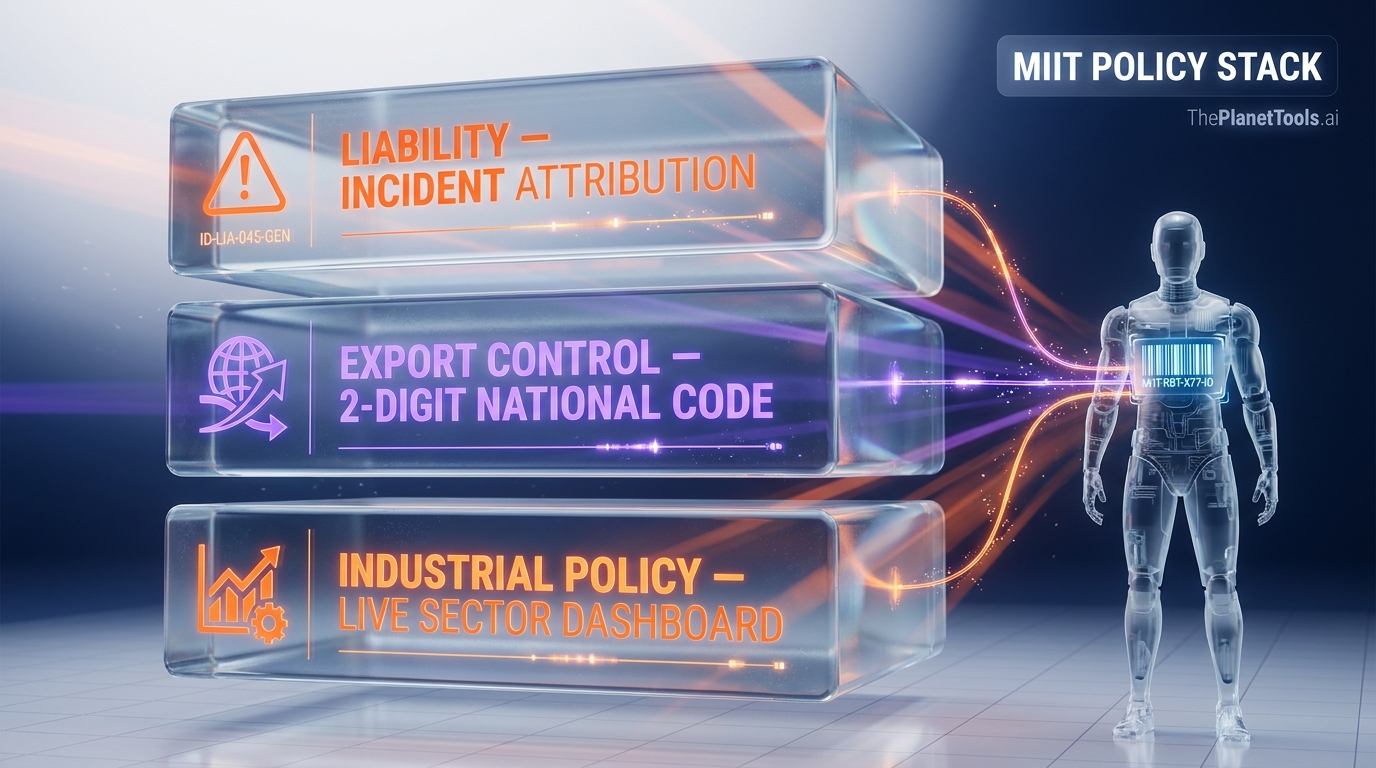
Read One: Product Liability and Incident Attribution
The most concrete and least speculative read is the one the regulator itself emphasizes. The Next Web's reporting frames the governance purpose as addressing "liability questions by creating the informational infrastructure needed to connect incidents to specific machines, manufacturers, and operational histories." As humanoids enter logistics centers, factories, and eventually consumer environments, the question of who is responsible when a robot causes property damage or human harm becomes operationally pressing. A national registry that captures manufacturer, serial number, maintenance history, and operational context is precisely the infrastructure that converts a black-box incident into an attributable event. This is the regulatory rationale at face value, and it is a defensible one independent of any geopolitical reading.
Read Two: Export Control and Cross-Border Tracking
The second read is the export-and-trade lane. The Biometric Update breakdown specifies a 2-digit national code in the 29-character ID structure, framed as enabling cross-border tracking. National codes in identifier schemas are how export-control regimes get built. A humanoid robot manufactured in China and exported to a foreign buyer would, under this structure, carry an identifier that lets the originating jurisdiction track it across borders. Whether MIIT intends to use that capability for export controls is not stated in the public announcement. The capability is built in regardless. We read this as optionality that is now available to Beijing — a tool the state can deploy if the geopolitical environment moves in that direction, without needing to build new infrastructure.
Read Three: Industrial Policy and Sector Acceleration
The third read is the one most relevant to the embodied-AI competitive landscape, and it is the most strategically loaded. A national registry is not a passive recording device. It is the data substrate that lets a regulator measure sector activity in near real time. MIIT now has, or will shortly have, a near-live view of how many humanoid robots are manufactured by which firm, deployed into which work environments, and how those units perform. That is the kind of operational visibility that lets a state coordinate industrial policy with high precision — targeted procurement, subsidy allocation, manufacturer ranking, and capacity planning all become tractable in a way that no jurisdiction operating without such a registry can match. The geopolitical implication is that China is building the operational dashboard for a strategic industry while the US humanoid sector is still operating without a central data layer of any kind.
The US Comparison: No Federal Framework Exists
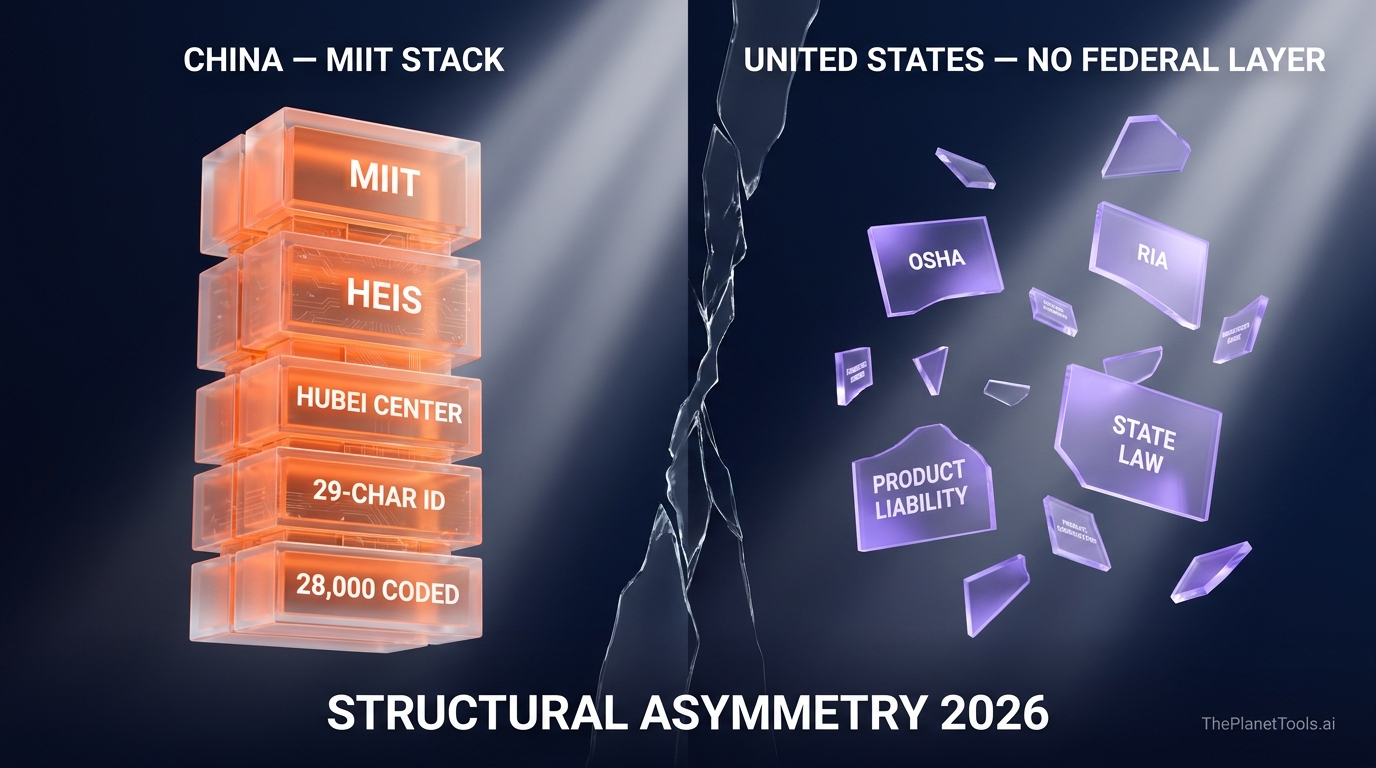
The contrast with the United States is the most important context for reading the geopolitical weight of this launch, and it is worth scoping precisely. There is no equivalent federal humanoid registry, identifier scheme, or lifecycle traceability framework in the United States at the time of writing. Humanoid robots sold or deployed in the US fall under a patchwork of existing regimes — OSHA workplace safety, product-liability case law, state-level consumer-protection rules, and sectoral standards bodies like RIA — none of which were designed for embodied AI specifically.
The Frontier-Capability vs Industrial-Infrastructure Gap
The US humanoid sector — Figure, 1X, Apptronik, and Tesla's Optimus program — is genuinely strong on the autonomy-and-capability frontier. The hands-free demonstrations from Figure's Helix-02 24-hour autonomous run and the consumer-facing milestone of 1X's NEO with a dated, priced launch are real frontier-capability progress that the Chinese cohort does not match across the board. But neither company, and no US humanoid maker, operates against a federal traceability framework. The strategic gap is not at the frontier. It is at the industrial-infrastructure layer that turns frontier capability into a sector-scale industry.
Why This Asymmetry May Persist
The asymmetry is likely to persist for structural reasons that are not specific to humanoids. The US regulatory model defaults to sector-specific, mostly reactive frameworks built after harm is documented. The Chinese regulatory model defaults to MIIT-led, mostly anticipatory infrastructure deployed before harm scales. Neither approach is universally better, and we will not pretend the Chinese model is without trade-offs — a state with operational visibility over a strategic industry is also a state with leverage over the firms in that industry. But the trade-off works in different directions for different policy goals, and on the specific axis of building industrial-scale humanoid deployment infrastructure, the Chinese approach is currently producing capabilities that the US framework is not.
Implications for the Humanoid Cohort: China vs US Manufacturers
For the Chinese manufacturer cohort, the registry is a mixed instrument. It is a compliance burden — every unit shipped now needs to be coded, registered, and tracked through end-of-life. It is also, structurally, a barrier to entry that favors established manufacturers with the operational scale to absorb the compliance overhead, and a credential that downstream buyers in regulated industries will increasingly require. The net effect on the existing cohort is likely positive for the larger, vertically integrated manufacturers and negative for very small entrants.
What It Means for Robotera, Unitree, UBTech, and the Wider Chinese Cohort
For named Chinese humanoid companies — Robotera, Unitree, UBTech, and the broader manufacturer base — the registry formalizes the operational posture they were already moving toward. Robotera's vertical-integration depth and thousand-unit Q2 2026 deployment cadence map directly to the kind of operational maturity the registry expects. Unitree and UBTech, which have built distribution and service infrastructure over multiple years, are similarly positioned to absorb the compliance overhead without strategic disruption. The registry will likely accelerate consolidation around the manufacturers that already operate at this maturity level.
What It Means for Figure, 1X, and Tesla Optimus
For the US humanoid programs, the registry has no direct compliance impact — they are not Chinese manufacturers, and the platform applies to robots manufactured in China. The indirect impact is competitive and reputational. A Chinese humanoid sold into a regulated buyer in any jurisdiction now arrives with a national-registry identifier and a structured maintenance record. A US humanoid arrives without one. Procurement officers in regulated industries — automotive, logistics, healthcare — will weigh that asymmetry over time. The US cohort's strategic response cannot be to replicate the Chinese registry, because the federal mechanism to deploy one does not exist. The response that is available is private-sector standardization through industry bodies, which is slower, less authoritative, and produces a fragmented data layer rather than a unified one.
The Deployment Context: Why a Registry Now
The timing of the registry launch is not random, and reading it against the broader 2026 deployment cadence is what surfaces the policy intent. Chinese humanoid manufacturers have moved from demonstration to dispatch in the first half of 2026, and binding deployment commitments have accelerated. Our coverage of the Humanoid x Schaeffler binding deal to put thousands of factory robots into production by 2032 documents one such commitment — a multinational industrial buyer agreeing to deploy a humanoid cohort at thousand-unit scale into European factory floors. As industrial buyers commit to humanoid deployment at that scale, the regulatory infrastructure to track those units becomes operationally necessary rather than optional.
The Sequence: Capability, Then Capital, Then Compliance
The sequence visible across the Chinese humanoid sector in early 2026 is coherent. Capability ramped first, evidenced by the breadth of the manufacturer cohort and the spread of working prototypes. Capital ramped second, evidenced by the funding rounds stacking inside individual quarters at companies like Robotera. Compliance is ramping third, evidenced by the digital ID platform. The order matters because it tells you what the state is responding to: the registry is being built around an industry that is already shipping, not in advance of one that does not yet exist. That is a meaningful tell about how serious Beijing considers the deployment phase to be.
Risks, Unknowns, and What the Public Record Does Not Show
Honest analysis requires being explicit about what this launch does not establish. The 28,000-robot and 200-model figures are as reported by the launch announcement, not independently audited; we have no third-party count. The specific first-batch manufacturer names that have circulated in secondary coverage are not confirmed in the primary sources we directly verified, and we will not assert them as fact. The exact data fields the platform captures are described at a high level in The Next Web's reporting but not enumerated in a published technical specification we can audit. The enforcement mechanism for non-compliance is not addressed in the launch coverage we reviewed. The data-access policies — who inside the Chinese government can see what data on which robots — are not part of the public announcement.
What Would Change the Read
Several subsequent data points would materially update this analysis. First, an independently audited count of registered robots and an independent confirmation of the 200-model figure. Second, publication of the technical specification for the 29-character code, including authoritative confirmation of the 4-component structure described in Biometric Update's reporting. Third, the official first-batch manufacturer roster from HEIS or the Hubei Innovation Center, which would let us verify or correct the names circulating in secondary coverage. Fourth, any disclosure on data-access policies and enforcement mechanisms, which would convert the registry from announced infrastructure into demonstrated industrial-policy capability. Absent those, the responsible read is exactly what the speakable summary says: a state-level lifecycle registry, larger than any equivalent infrastructure elsewhere, with capabilities that the launch coverage outlines clearly and operational details that remain incomplete on the public record.
Our Take
We read the Humanoid Full Lifecycle Management Service Platform as the most consequential humanoid-sector policy event of 2026 so far, not because the launch coverage is sensational but because the structure of what was announced encodes capabilities that no other jurisdiction currently has and that may be difficult to replicate later. A 29-character national identifier modeled on the citizen ID, lifecycle tracking from production through recycling, MIIT-level regulatory sponsorship, and 28,000+ robots already coded inside a single registry is industrial-policy infrastructure at scale. The product liability framing the regulator emphasizes is real and defensible, the export-tracking capability is built in whether or not it is exercised, and the industrial-policy dashboard the registry creates is the part of the launch that compounds over time.
The broader signal is the one worth carrying forward, and we want to scope it carefully. China is not winning the humanoid capability frontier — the autonomy race remains genuinely open and US programs continue to push it. China is, however, building the industrial-scale infrastructure for an embodied-AI sector while the US humanoid cohort operates without a federal data layer of any kind. Those are different races on different time horizons. The capability race is decided in months by demos and benchmarks. The industrial-infrastructure race is decided in years by the compounding effect of having an operational dashboard for a strategic sector while your competitors do not. The Hubei platform is one data point in that second race. It is, on the public record so far, a clear one. We will update this analysis the moment a third-party audit, an official first-batch roster, or an enforcement-mechanism disclosure enters the record.
What is China's Humanoid Full Lifecycle Management Service Platform?
The Humanoid Full Lifecycle Management Service Platform is a national digital registry launched in May 2026 by the Hubei Humanoid Robot Innovation Center in Wuhan, operating under the Humanoid Robotics and Embodied Intelligence Standardization (HEIS) committee within China's Ministry of Industry and Information Technology (MIIT). According to SCMP reporting on May 25, 2026, the platform assigns unique codes to humanoid robots to "track the robots throughout their lifecycle, from production through to recycling," and applies to "all stakeholders across the humanoid industry and supply chain, including manufacturers, service providers, sellers, users and recycle facilities," per Yu Xiuming, deputy head at the China Electronics Standardization Institute, as quoted by SCMP.
How many characters is the humanoid robot digital ID and what is the structure?
According to Biometric Update's coverage of the launch, the digital ID is a 29-digit code split into four components: a 2-digit national code that enables cross-border tracking, a 4-digit manufacturer identifier, a 6-digit product model code, and a 17-digit serial number for individual units. The Next Web reports the format is "modeled on China's 18-character citizen ID system with 11 additional characters for operational data." We attribute the 4-component breakdown to Biometric Update's reporting and have not independently verified the technical specification.
How many humanoid robots have already been registered in the platform?
According to SCMP and Biometric Update reporting on May 25, 2026, more than 28,000 robots across 200 distinct models have already been assigned the digital ID through the platform. We treat both figures as reported by the launch announcement rather than independently audited. For context, multiple outlets covering 2025 global humanoid shipments reported approximately 13,000 humanoid units delivered worldwide that year, with Chinese manufacturers accounting for the majority — implying the 28,000-unit registry includes some combination of retroactive coverage of previously deployed units and a sharply higher early-2026 shipment rate.
What data does the humanoid digital ID capture about each robot?
The Next Web's reporting summarizes the captured data as covering "maintenance history, work environments, and real-time performance metrics including mechanical joint wear rates, battery degradation, and movement precision," following each robot from production through recycling. SCMP's reporting frames the scope as applying to manufacturers, service providers, sellers, users, and recycling facilities. The combination — manufacturer attribution plus serial-level tracking plus operational telemetry plus end-of-life disposition — is structurally closer to an automotive VIN-and-service-record regime than to a software product registry. A detailed technical specification with the full enumerated field list is not part of the public launch coverage we directly verified.
Who regulates China's humanoid robot registry — HEIS and MIIT?
The Humanoid Robotics and Embodied Intelligence Standardization (HEIS) committee oversees the platform. HEIS operates under the Ministry of Industry and Information Technology (MIIT), China's principal industrial regulator. MIIT is the ministry that designates strategic industries, sets production quotas, and coordinates state-adjacent capital. Placing humanoid robotics under an MIIT-level standardization committee at this stage in the sector's life signals that Beijing has formally classified embodied AI as a strategic industrial category. The platform's day-to-day operations are run from the Hubei Humanoid Robot Innovation Center in Wuhan, according to Biometric Update.
Does the United States have an equivalent humanoid robot registry?
No. There is no federal humanoid registry, identifier scheme, or lifecycle traceability framework in the United States at the time of writing. Humanoid robots sold or deployed in the US fall under a patchwork of pre-existing regimes — OSHA workplace safety, product-liability case law, state-level consumer-protection rules, and sectoral standards bodies like the Robotic Industries Association — none of which were designed for embodied AI specifically. The structural asymmetry is now visible: China operates a national MIIT-level registry with 29-character IDs and lifecycle tracking, while the US humanoid sector operates without a federal data layer.
Which manufacturers are in the first batch of the humanoid registry?
The launch coverage references a first batch of manufacturers brought into the registry, but the specific factory names circulating in some secondary reporting are not corroborated in the primary SCMP, Biometric Update, or The Next Web sources we directly verified. We do not assert the named composition of the first batch as fact on the public record we can audit. If subsequent first-party documentation from HEIS or the Hubei Innovation Center confirms the specific manufacturer roster, we will update this analysis. The existence of a staged first batch is itself disclosed; the named composition is not.
How does the digital ID affect Robotera, Unitree, and UBTech?
For named Chinese humanoid companies — Robotera, Unitree, UBTech, and the broader manufacturer base — the registry formalizes the operational posture they were already moving toward. Robotera's vertical-integration depth and thousand-unit Q2 2026 deployment cadence map directly to the operational maturity the registry expects. Unitree and UBTech, which have built distribution and service infrastructure over multiple years, are similarly positioned to absorb the compliance overhead without strategic disruption. The likely net effect is to accelerate consolidation around the manufacturers already operating at this maturity level, while creating a barrier to entry for very small entrants who cannot absorb the compliance load.
How does the registry affect Figure, 1X, and Tesla Optimus?
The registry has no direct compliance impact on Figure, 1X, or Tesla's Optimus program — they are not Chinese manufacturers, and the platform applies to robots manufactured in China. The indirect impact is competitive and reputational. A Chinese humanoid sold into a regulated buyer in any jurisdiction now arrives with a national-registry identifier and a structured maintenance record; a US humanoid arrives without one. Procurement officers in regulated industries like automotive, logistics, and healthcare will weigh that asymmetry over time. The US cohort's strategic response cannot be a federal registry — the mechanism does not exist — and private-sector standardization through industry bodies is slower and produces a fragmented data layer.
Could China use the digital ID for export control of humanoid robots?
The capability is built into the structure even if the policy intent is not stated. Biometric Update specifies a 2-digit national code in the 29-character ID, framed as enabling cross-border tracking. National codes in identifier schemas are how export-control regimes get built. A humanoid robot manufactured in China and exported to a foreign buyer would, under this structure, carry an identifier that lets the originating jurisdiction track it across borders. Whether MIIT intends to use that capability for export controls is not stated in the public announcement. We read this as optionality that is now available to Beijing — a tool the state can deploy if the geopolitical environment moves in that direction, without needing to build new infrastructure.
Why is China launching the registry now in May 2026?
The timing reads as a response to deployment cadence rather than anticipation of an industry that does not yet exist. Chinese humanoid manufacturers have moved from demonstration to dispatch in the first half of 2026, evidenced by funding rounds stacking inside single quarters at companies like Robotera and by binding deployment commitments like the Humanoid x Schaeffler factory deal targeting thousand-unit scale by 2032. As industrial buyers commit to humanoid deployment at that scale, the regulatory infrastructure to track those units becomes operationally necessary rather than optional. The sequence — capability, then capital, then compliance — tells you the state is responding to an industry that is already shipping.
What are the main unknowns and risks in the China humanoid registry story?
The 28,000-robot and 200-model figures are as reported by the launch announcement, not independently audited. The specific first-batch manufacturer names circulating in secondary coverage are not confirmed in the primary sources we directly verified. The exact data fields the platform captures are described at a high level by The Next Web but not enumerated in a published technical specification we can audit. The enforcement mechanism for non-compliance is not addressed in the launch coverage. Data-access policies — who inside the Chinese government can see what data on which robots — are not part of the public announcement. The honest position is that the registry's announced capabilities are clear, but several operational details remain incomplete on the public record.