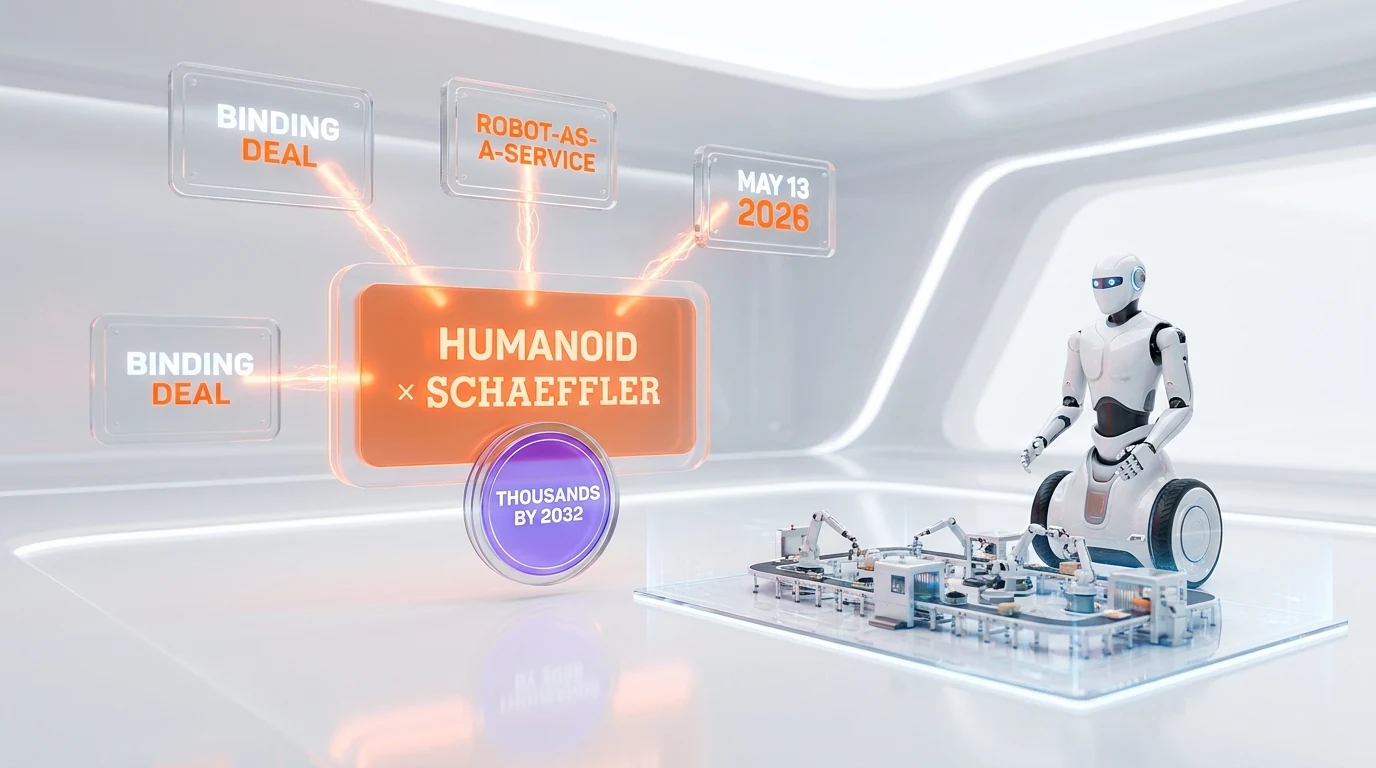
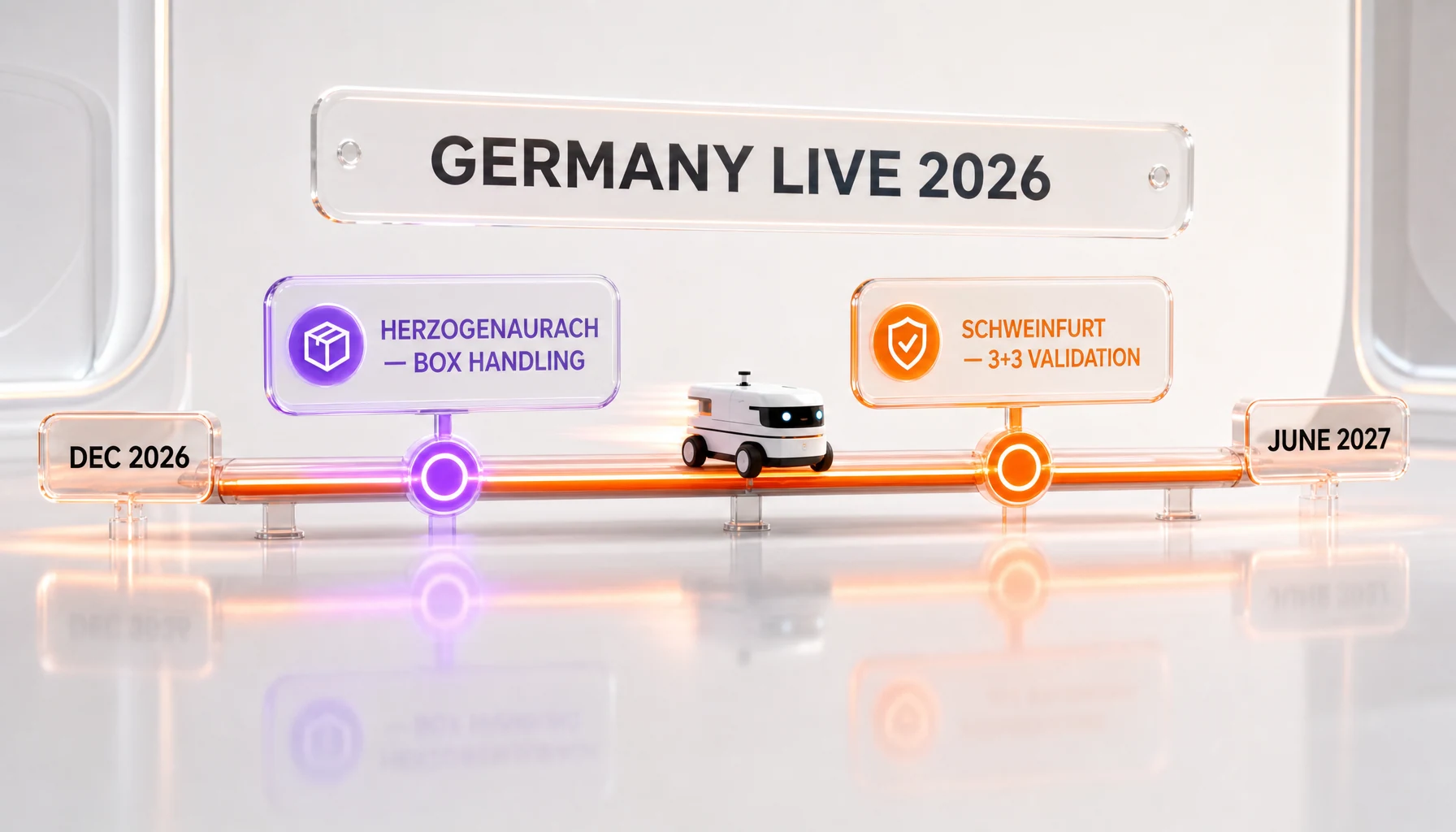
On May 13, 2026, UK robotics company Humanoid and German motion-technology supplier Schaeffler signed a binding, phased deployment and supply agreement to put a four-digit number of wheeled humanoid robots across Schaeffler's global facilities by 2032. First wheeled systems enter live production in Germany between December 2026 and June 2027 — box handling in Herzogenaurach and a three-plus-three-month validation in Schweinfurt — under a Robot-as-a-Service model. Schaeffler also becomes preferred actuator supplier under a five-year contract covering more than half of Humanoid's joint-actuator demand, a seven-figure unit volume through 2031.
The Big Picture: A Binding Contract, Not a Demo Reel
Humanoid robotics in 2026 has a credibility problem. The category is saturated with viral demo clips — robots folding laundry, pouring coffee, dancing in formation — that rarely survive contact with a real production line. The gap between a controlled stage and a 24/7 industrial shift is exactly where most humanoid programs quietly stall.
The Humanoid x Schaeffler agreement is interesting precisely because it is the opposite of a demo. It is a binding, phased deployment and supply contract signed on May 13, 2026, with a named end-state — a four-digit (thousands-scale) wheeled robot fleet across Schaeffler's global facilities by 2032 — and a near-term production milestone in Germany within the next twelve months. According to Robotics & Automation News, the deal follows successful proof-of-concepts and a January 2026 strategic partnership announcement between the two companies.
From a strategic standpoint, this is one of the most concrete post-pilot industrial commitments the humanoid sector has produced. It is the counter-narrative to the hype cycle: not a promise of general-purpose embodiment, but a scoped, contractually anchored rollout with a supplier relationship attached. We read this less as a robotics story and more as an industrialization-of-robotics story — and those are different things.
Who Are the Two Parties?
Humanoid — A 2024 UK Startup Moving to Operations
Humanoid is a UK-based AI and robotics company founded by Artem Sokolov in 2024. In a sector dominated by US and Chinese players, a London-anchored entrant signing a binding industrial contract with a German Tier-1 supplier inside two years of founding is structurally notable. The company's positioning is operational rather than research-led: its public framing emphasizes deployment, fleet economics, and uptime over benchmark theatrics.
Sokolov's framing of the deal is blunt: "Moving into real-world operations is where the true value of humanoid robots is proven." That sentence is the entire thesis of the agreement. It is a deliberate distancing from the demo-reel norm of the category.
Schaeffler — Motion Technology Buying and Supplying at Once
Schaeffler is a leading motion-technology company — bearings, precision components, drivetrain and actuation systems for automotive and industrial customers worldwide. Its role in this deal is unusual because it sits on both sides of the table simultaneously: Schaeffler is the customer deploying robots in its own plants, and the supplier of the joint actuators inside those robots.
Dr. Jochen Schroeder, Schaeffler's COO, framed it from the partner-of-record angle: "The partnership with Humanoid underscores Schaeffler's position as a trusted technology partner." For an industrial supplier, becoming the actuation backbone of a humanoid platform is a strategic adjacency play — robotics actuation is a natural extension of a motion-technology portfolio.

Deal Structure: Two Tracks, One Binding Contract
The agreement is not a single transaction. It bundles two distinct commercial tracks into one binding instrument, which is what gives it durability.
Track 1 — The Deployment Track (Robot-as-a-Service)
Humanoid does not sell Schaeffler a fleet of robots outright. It deploys them under a Robot-as-a-Service (RaaS) model. Per the source reporting, the RaaS scope includes connection to the fleet management software, maintenance, 24/7 technical support, updates, and ongoing performance management. The target is a four-digit number of wheeled units across Schaeffler's global facilities by 2032.
RaaS matters here for a reason most coverage skips: it shifts the capital and operational risk profile. Schaeffler does not carry depreciating robots on its balance sheet, and Humanoid retains responsibility for uptime, software, and performance. That alignment of incentives is exactly what a six-year phased rollout needs to survive.
Track 2 — The Supply Track (Preferred Actuator Supplier)
In parallel, Schaeffler becomes Humanoid's preferred actuator supplier under a five-year contract. The reported terms: Schaeffler covers more than 50 percent of Humanoid's demand for joint actuators, with an expected supply of a seven-digit number of actuators through 2031.
This is the part that converts a deployment deal into a strategic alliance. Schaeffler is not just a customer testing robots — it has a multi-year revenue stream tied to the same platform it is deploying. Both companies are now financially exposed to the program working.
The Phasing: Germany First, December 2026 Through June 2027
The near-term rollout is concrete and geographically specific. Initial deployment runs December 2026 through June 2027, split across two German Schaeffler sites.
Herzogenaurach — Box Handling in Live Production
At Herzogenaurach — Schaeffler's headquarters location — the wheeled systems go into live production handling boxes. Box handling is a deliberately unglamorous first task, and that is the point. It is repetitive, physically constrained, and tolerant of measured throughput — a low-risk entry task that proves the platform under real shift conditions rather than staged ones.
Schweinfurt — Three Plus Three Months of Validation
The Schweinfurt site runs a structured validation sequence: a three-month capability demonstration followed by a three-month on-site validation phase. This 3+3 cadence is the most telling design choice in the entire agreement. It is a gated rollout — capability is demonstrated, then independently validated on-site, before scale-out. That is how serious industrial programs de-risk, and it is the structural difference between a pilot and a press release.
Why Wheeled, Not Bipedal?
The initial systems are wheeled-based platforms, not bipedal humanoids. This is a strategic choice worth dwelling on, because it cuts directly against the marketing iconography of the humanoid sector.
Bipedal locomotion is the hardest, least reliable, most energy-hungry part of humanoid robotics. In a factory with flat floors and defined aisles, legs add risk and cost while delivering little operational advantage. A wheeled base with a humanoid upper body keeps the dexterity that matters — manipulation, reach, tool use — while removing the failure mode that derails most deployments.
We read the wheeled-first decision as a maturity signal. It says the program is optimizing for uptime and total cost of operation, not for the most impressive demo. That is the same discipline visible in the box-handling task selection and the 3+3 validation gate. The whole agreement is internally consistent around one objective: make it work in production, not on stage.
RaaS Economics: Why the Service Model Is the Real Story
Robot-as-a-Service is not a billing footnote — it is the structural innovation that makes a six-year, thousands-scale commitment financeable.
Risk Allocation
Under RaaS, Humanoid carries the hardware lifecycle, the software stack, the fleet management layer, and 24/7 support. Schaeffler pays for outcomes — robots performing tasks — rather than for assets it must maintain. For a manufacturer evaluating an unproven robot category, removing the asset-ownership risk is often the deciding factor.
Incentive Alignment
Because Humanoid only earns when the fleet performs, the vendor's incentives are locked to uptime and throughput for the full contract duration. This is the opposite of a hardware sale, where the vendor's incentive ends at delivery. Over a multi-year industrial program, that alignment is worth more than any single technical spec.
Fleet Learning
A managed fleet under one operator generates a continuous performance dataset across sites and tasks. Updates and performance management are explicitly in the RaaS scope, which means the fleet should improve over the contract life. The economic flywheel — more units, more data, better performance, more units — only exists because the model is service-based, not transactional.

Hype vs Real Deployment: Where This Sits in the Landscape
The humanoid sector in 2026 splits roughly into two cohorts: programs proving autonomy under controlled conditions, and programs proving economics under contractual conditions. Both matter, but they answer different questions.
On the autonomy side, Figure's Helix-02 work demonstrated a 24-hour no-teleoperation run — a genuine technical milestone in unsupervised humanoid operation. That kind of result moves the capability frontier. The Humanoid x Schaeffler deal does something different: it moves the commercial frontier. It answers the question "will an industrial buyer sign a binding multi-year contract and put real robots on a real line?" — and the answer here is yes, with dates and locations attached.
Google DeepMind's Gemini Robotics-ER 1.6 embodied reasoning model sits on the intelligence layer of this same stack — the brains that platforms like Humanoid's increasingly depend on. Together these threads show the sector maturing on three fronts at once: capability (Figure), reasoning (Google DeepMind), and industrialization (Humanoid x Schaeffler). The third has historically been the weakest, which is why this contract is the more strategically significant of the three for anyone tracking when robotics actually generates revenue.
It is worth being precise about what this deal does and does not prove. It does not prove that humanoid robots are economically superior to fixed automation for box handling — that is exactly what the Schweinfurt validation is designed to test. It proves that a Tier-1 industrial supplier has enough conviction to sign a binding contract and put its own actuator business behind the platform. Those are different claims, and conflating them is how the hype cycle gets fed.
The Counter-Narrative to Humanoid Hype
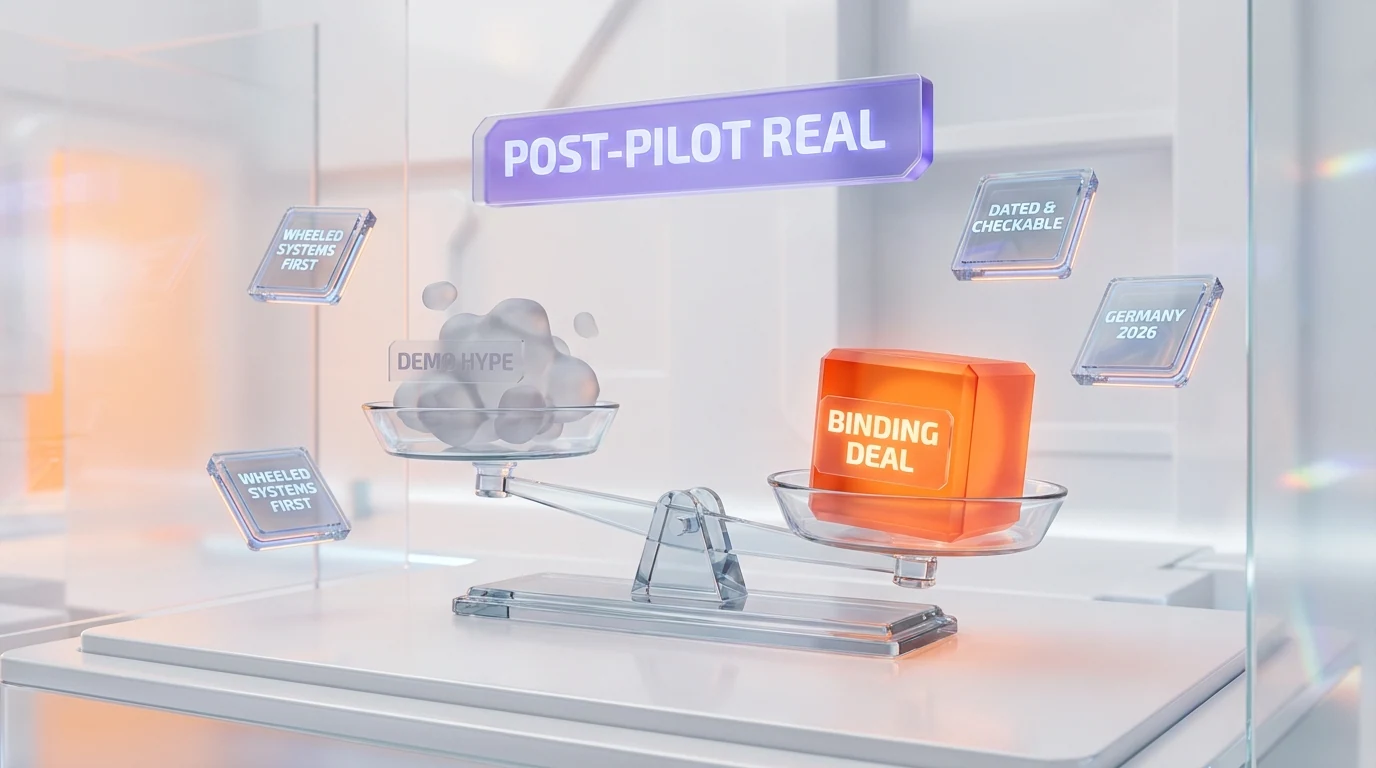
For two years, the humanoid conversation has been dominated by capability demos and valuation headlines. The structural critique — fair, in our view — is that almost none of it translated into binding industrial commitments with real deployment dates.
This agreement is a data point against that critique. Not a refutation — one contract does not make a category — but a concrete counter-example with specifics that can be checked: a named buyer, named sites, a defined task, a gated validation sequence, a multi-year supply contract, and a 2032 fleet target. Vague hype does not produce 3+3 validation phases at named German plants. Contracts do.
The broader capital context matters too. The AI and robotics buildout is running on enormous infrastructure and financing commitments — from Anthropic's 10-gigawatt compute empire to the $40 billion in NVIDIA equity bets reshaping AI capital markets. Against that backdrop of abstract, hard-to-falsify mega-commitments, a phased robot contract with concrete dates and locations is refreshingly checkable. You will be able to verify in mid-2027 whether the Schweinfurt validation passed. You cannot say that about most of the headlines in this sector.
How the Reasoning Layer Connects
Industrial humanoid platforms are increasingly an integration story, not a single-vendor story. The body, the actuators, the fleet software, and the reasoning model are often sourced or built separately. Schaeffler's role as actuation supplier is one layer. The reasoning and perception layer — the part that decides what to grasp, how to recover from an error, how to adapt to a slightly different box — is where models like Google DeepMind's embodied reasoning systems and frontier general models increasingly contribute.
For builders evaluating this stack, the relevant general-model context is worth understanding. Models such as Claude and Gemini 3.1 Pro sit upstream of the planning and instruction layers that industrial robotics increasingly leans on for task decomposition and natural-language operator interfaces. The Humanoid x Schaeffler deployment will be a real-world test of how far that integrated stack has come outside the lab.
What Could Go Wrong
Strategic honesty requires naming the failure modes. This is a binding contract, but binding contracts have off-ramps and phased contracts have gates that can fail.
The Schweinfurt 3+3 validation is a real test, not a formality. If the wheeled systems cannot hit reliability or throughput targets under live conditions, the scale-out toward the 2032 target slows or stalls — that is what gated rollouts are for. The seven-figure actuator supply commitment through 2031 is contingent on the platform actually scaling; a deployment slowdown propagates into the supply track. And the 2032 four-digit fleet target is a 2032 target — six years is a long horizon in a fast-moving sector, and external factors from supply chains to competitive platforms can reshape the math.
None of these undermine the core point. The point is not that the rollout is guaranteed — it is that the commitment is structured, dated, and checkable, which is more than the sector has typically offered.
What Would Prove This Read Wrong
To keep this honest, here is what would falsify our strategic interpretation. If the Herzogenaurach and Schweinfurt deployments slip past June 2027 without a public, substantive reason, the "concrete and checkable" framing weakens materially. If the 3+3 validation is quietly de-scoped or its criteria softened, that would signal the contract is closer to a managed pilot than a binding rollout. And if the seven-figure actuator volume is renegotiated downward before 2028, the two-track alliance thesis loses its structural weight. We will be watching all three.
Our Verdict
The Humanoid x Schaeffler agreement is the most operationally serious humanoid-industrialization signal of 2026 so far. It is not the flashiest — there is no 24-hour autonomy clip, no valuation headline. Its significance is structural: a binding two-track contract, a wheeled-first maturity choice, a gated 3+3 validation, a RaaS risk model, and a named 2032 target with German deployment inside twelve months.
Strategically, this is the kind of unglamorous milestone that actually matters more than the demo reels. Capability frontiers like Figure's autonomy work and reasoning frontiers like Google DeepMind's embodied models get the attention. But the question that decides whether humanoid robotics becomes an industry rather than a genre is the boring one: will industrial buyers sign binding contracts and put real robots on real lines? On May 13, 2026, Humanoid and Schaeffler answered yes — with dates, locations, and a supply contract attached. We will be watching Schweinfurt in mid-2027 to see whether the answer holds.
Frequently Asked Questions
What did Humanoid and Schaeffler announce on May 13, 2026?
Humanoid, a UK robotics company, and Schaeffler, a German motion-technology supplier, signed a binding, phased deployment and supply agreement to put a four-digit (thousands-scale) number of wheeled humanoid robots across Schaeffler's global facilities by 2032, under a Robot-as-a-Service model. Schaeffler also became Humanoid's preferred actuator supplier under a five-year contract.
How many robots will be deployed and by when?
The target is a four-digit number of wheeled units — meaning a number in the thousands — across Schaeffler's global facilities by 2032. The initial German deployment runs December 2026 through June 2027 at two sites before scale-out.
Where in Germany will the first robots be deployed?
Two Schaeffler sites. Herzogenaurach handles box handling in live production. Schweinfurt runs a three-month capability demonstration followed by a three-month on-site validation phase, between December 2026 and June 2027.
What is the Robot-as-a-Service (RaaS) model in this deal?
Instead of selling robots outright, Humanoid deploys them as a service. The RaaS scope includes connection to fleet management software, maintenance, 24/7 technical support, updates, and ongoing performance management. Schaeffler pays for performance rather than owning depreciating hardware.
Why are the robots wheeled instead of bipedal?
The initial systems are wheeled-based platforms. In a factory with flat floors and defined aisles, wheels remove the least reliable and most energy-hungry part of humanoid robotics — bipedal locomotion — while keeping the manipulation and reach that matter for tasks like box handling. It is a maturity choice optimized for uptime, not for demo impact.
What is Schaeffler's actuator supply role?
Schaeffler became Humanoid's preferred actuator supplier under a five-year contract covering more than 50 percent of Humanoid's joint-actuator demand, with an expected supply of a seven-figure number of actuators through 2031. This makes Schaeffler both a customer and a supplier on the same platform.
Who founded Humanoid and when?
Humanoid is a UK-based AI and robotics company founded by Artem Sokolov in 2024. Signing a binding industrial contract with a German Tier-1 supplier within two years of founding is structurally notable in a sector dominated by US and Chinese players.
Why is this deal called a counter-narrative to humanoid hype?
Most humanoid coverage has been demo clips and valuation headlines with few binding industrial commitments. This agreement is a concrete counter-example: a named buyer, named German sites, a defined task, a gated 3+3 validation sequence, a five-year supply contract, and a 2032 fleet target — all checkable, unlike vague hype.
How does this compare to Figure's Helix-02 humanoid run?
Figure's Helix-02 work demonstrated a 24-hour no-teleoperation run, moving the autonomy capability frontier. The Humanoid x Schaeffler deal moves the commercial frontier instead — it proves an industrial buyer will sign a binding multi-year contract with deployment dates. They answer different questions: capability versus economics.
What does the 3+3 month validation in Schweinfurt mean?
Schweinfurt runs a three-month capability demonstration followed by a three-month on-site validation phase. This gated cadence — demonstrate, then independently validate before scale-out — is how serious industrial programs de-risk, and it is the structural difference between a binding rollout and a press release.
What could cause this deployment to fail or slow down?
The Schweinfurt 3+3 validation is a real gate — if reliability or throughput targets are missed under live conditions, scale-out toward the 2032 target slows. The seven-figure actuator commitment through 2031 is contingent on the platform scaling, and a 2032 fleet target is a long six-year horizon subject to supply-chain and competitive shifts.
Why does Schaeffler being both customer and supplier matter?
It converts a deployment deal into a strategic alliance. Schaeffler is not just testing robots — it has a multi-year actuator revenue stream tied to the same platform it is deploying. Both companies become financially exposed to the program working, which strengthens the durability of the six-year commitment.