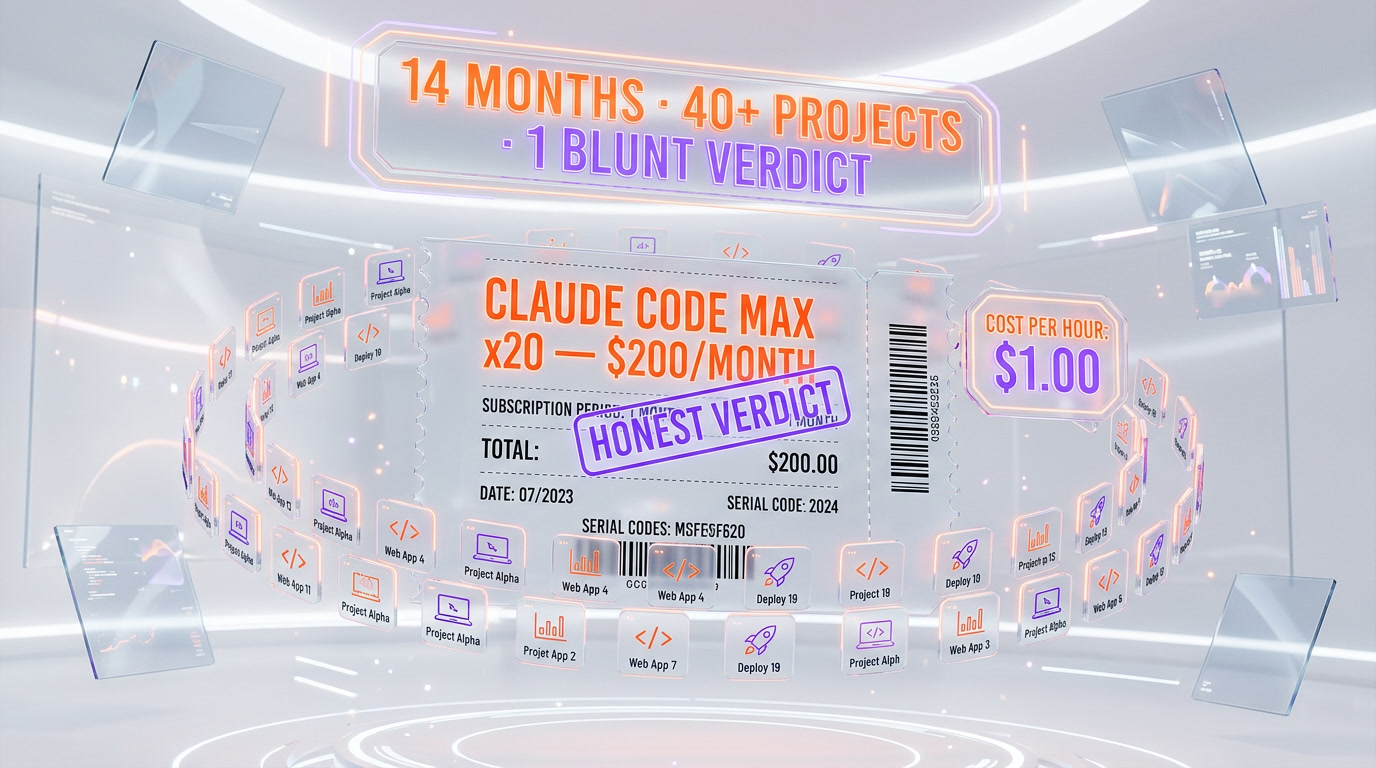
After 14 months and more than 40 production projects built on Claude Code Max x20 at $200 per month, our honest verdict is: yes, it is worth it — but only if you are a full-time builder shipping real work every week. At eight hours of daily use it costs roughly $0.83 per hour, compared to $25 to $50 per hour for a junior developer and $75 to $150 per hour for a senior one. For anyone writing code casually, Max x20 is overkill and Pro at $20 per month or Max 5x at $100 per month is the rational choice. Below, we break down the full math, the hidden costs, and the exact moment each tier stops making sense.
The $200 question — is Claude Code Max x20 actually worth it
This is the question that brought you here, so we will answer it directly before any of the tables, math, or nuance. Yes, Claude Code Max x20 is worth $200 per month if you meet all three of these conditions:
- You spend four hours or more per day inside a coding agent (not just chatting with an LLM in a browser tab).
- Your output has a direct revenue or equity link — client work, a SaaS you own, a startup you are building, a content site that monetizes.
- You regularly hit the weekly usage limits on Pro or Max 5x and have to wait for them to reset.
If you meet all three, the decision is not even close. Max x20 is the cheapest senior engineer you will ever hire, and the only serious question is why you are still reading instead of upgrading.
If you meet zero or one of those conditions, Max x20 is not worth it. You will pay $200 per month and use maybe 10 percent of the capacity. Pro at $20 per month is the right call, and you should come back to this article when your usage pattern changes.
The interesting group is in the middle: people who meet two of the three conditions. That is where we spend most of this piece. The short answer for them is Max 5x at $100 per month, which we will get to in detail.
Plans breakdown — Pro vs Max 5x vs Max x20 at a glance

Here is the honest version of the pricing table. We are including the API pay-per-token option because it is the one most reviews leave out, and in our experience it is the right answer more often than people assume.
- Claude Pro — $20 per month. Baseline Claude.ai access plus Claude Code on desktop. Good weekly usage limit for light coding. Access to Claude Sonnet and limited Opus. This is the plan you start on.
- Claude Max 5x — $100 per month. Five times the weekly usage of Pro. Same model access. Priority on new features. This is where most serious builders land long term.
- Claude Max x20 — $200 per month. Twenty times the weekly usage of Pro. Same models, higher priority, bigger context windows in practice because you can spend more tokens per task. This is what we pay for.
- Anthropic API — pay per token. Roughly $5 per million input tokens and $25 per million output tokens on Opus. No cap, no limits, no subscription. You are billed what you use.
The critical insight nobody puts in the comparison tables: Max plans are not unlimited. They are weekly pools that reset seven days after your session starts. If you blow through a Max x20 pool on day three because you ran a 30-agent pipeline, you are waiting four days for it to come back. Pay-per-token API has no such cliff. We will come back to this.
What you actually get at each tier
Anthropic's marketing language is vague on purpose. Here is what the tiers mean in real engineering units, based on 14 months of daily use.
Pro ($20 per month) — what it is really for
Pro is a great plan for someone who writes code as part of their job but not as the core of their job. Product managers prototyping with their team, backend engineers debugging a tricky SQL query, solo side-project developers shipping a feature on weekends. You will never hit the limit unless you do something foolish with a long-running agent.
Concretely, Pro gives you:
- Enough weekly budget for roughly two to three hours of active agent use per day
- Claude Sonnet with generous limits, Opus with conservative limits
- The full Claude Code CLI, all tool integrations, all skills
- Access from Claude.ai, Claude Desktop, and Claude Code simultaneously
If Pro sounds like enough for you, it almost certainly is. Upgrade when you start scheduling your coding sessions around when the limit will reset — not before.
Max 5x ($100 per month) — the power-user sweet spot
Max 5x is the plan we recommend most often to other builders. It gives you five times the weekly pool — enough for a serious full-time developer who runs the occasional long agent session but does not live inside Claude Code.
Max 5x is right for you if you:
- Do four to six hours of real agent work per day
- Want the option to run overnight pipelines without capping your weekday usage
- Have one to three active projects, not ten
- Are not paying yourself enough yet to make the extra $100 on Max x20 a no-brainer
At $100 per month and six hours per day of use, you are paying roughly $0.55 per hour of senior-level engineering. That is already an absurd deal. Most people never need anything more.
Max x20 ($200 per month) — who it is actually built for
Max x20 is not a status symbol. It is a tool for a specific kind of operator: someone who runs multiple agents in parallel, maintains several shipped products simultaneously, and treats Claude Code like a full replacement for a small engineering team.
We are in that bucket. Claude Code is how we build everything at The Planet Deals LLC — the ThePlanetTools content engine, ThePlanetTools.ai, every client microsite, every internal tool. The difference between Max 5x and Max x20 for us is the difference between finishing Friday's work on Thursday and finishing it on Saturday. At $100 of marginal cost, that is a trivial decision.
If you are not in that bucket, Max x20 is a waste. Just because you can buy the bigger pool does not mean it will change your output. Capacity without the workflow to use it is just paying Anthropic $100 extra to feel serious.
Our real usage — 14 months of daily data

We have been on Claude Code Max x20 continuously since February 2025. Here is what the last 14 months actually look like for us, broken down in a way reviewers almost never bother to do.
- Daily active use: 8 to 10 hours, six days per week. Roughly 50 hours per week of active agent time.
- Total spend: $2,800 across 14 months ($200 per month, no lapses, no downgrades).
- Weeks we hit the limit: Six weeks out of 56. All six were during launch weeks when we had three agents running in parallel for an 18-hour stretch.
- Weeks at under 50 percent pool usage: Eleven weeks out of 56. Mostly travel weeks or weeks where we were writing content instead of code.
- Weeks at between 50 percent and 100 percent pool usage: 39 weeks. The typical week.
- Projects shipped: 40 plus production projects, ranging from one-file tools to multi-site platforms with hundreds of pages.
The pattern is clear: we use Max x20 at nearly the full pool most weeks, we rarely hit the ceiling, and on the weeks we do hit it, we have the option of either waiting or switching to API for the overflow. That is exactly the shape of usage the plan is designed for.
Cost per hour math — the number nobody quotes
Everyone talks about $200 per month. Nobody talks about $200 divided by actual hours. Let us do that math.
- At 50 hours of active use per week, 4 weeks per month: 200 hours per month. $200 / 200 = $1.00 per hour.
- At 40 hours per week: 160 hours. $200 / 160 = $1.25 per hour.
- At 20 hours per week (casual power user): 80 hours. $200 / 80 = $2.50 per hour.
- At 10 hours per week (hobbyist): 40 hours. $200 / 40 = $5.00 per hour.
Even at the worst case in that list — a hobbyist paying $5 per hour for what is effectively a senior engineer on demand — you are still 10 to 30 times cheaper than a human of equivalent capability. The price only stops making sense if you are paying but not using. Which, to be fair, is the most common failure mode for expensive SaaS subscriptions in general.
The 40+ projects we built with Max x20
Abstract math is one thing, output is another. Here is a partial and non-exhaustive list of what 14 months of Max x20 actually produced at our shop. We are listing this because it is the only honest way to justify the spend.
- ThePlanetTools.ai — a content platform with hundreds of tool reviews, comparisons, guides, and news articles, fully SEO and GEO optimized. Built with Claude Code from empty repo to production, including the content renderer, Supabase schema, author system, FAQ schemas, and the entire deploy pipeline.
- ThePlanetTools.ai — an internal CMS that wraps ThePlanetTools content, social post generation, image pipelines, and SEO tooling. More than 240 API routes. Entirely built by Claude Code with supervision.
- Rankeo — a SaaS scraper product built from scratch, iterated with Claude Code agents and MCP servers running in parallel.
- KidStory — a Next.js children's content site plus a separate admin panel. Two full codebases.
- Roughly 35 additional projects — client microsites, internal CLI tools, pipeline scripts, Chrome extensions, scrapers, content generators, A/B test harnesses, migration scripts, deploy utilities, and experiments we never shipped.
If you tried to hire a freelancer to build even one of the first three projects end to end, you would spend $20k to $100k per project. We spent $200 per month and still had capacity left over for the other 37.
Cost vs a junior developer — the honest comparison

This is the comparison Anthropic's marketing hints at but never quite commits to. We will commit.
Junior developer, US market, 2026, fully loaded (salary plus benefits plus equipment plus management overhead): $4,000 to $8,000 per month. Mid-level: $8,000 to $14,000. Senior: $14,000 to $25,000. These are realistic numbers for any company hiring in North America, and they do not include the hiring process itself, which costs another $5k to $20k in recruiter fees and founder time.
Claude Code Max x20: $200 per month, no hiring process, no onboarding, no benefits, no equity dilution, no difficult conversations. Available at 3 a.m. on a Saturday. Never quits. Never gets bored of tedious refactors.
That is a 20x to 40x cost advantage over a junior hire at similar output for well-scoped engineering tasks. For certain categories — repetitive scaffolding, content generation, test writing, migration scripts — the advantage is larger because Claude Code is simply faster than any human. For other categories — greenfield architecture decisions, product intuition, stakeholder management — Claude Code offers no advantage and you still need a human.
The correct mental model, after 14 months: Claude Code Max x20 is not a replacement for a developer. It is a force multiplier for a developer who already knows what they are building. If you do not know what you are building, the plan will not save you.
When Max x20 is definitely worth it
Short list. If any two of these describe you, go pay the $200 without hesitating.
- You are a solo founder building a SaaS or content product and you ship code daily
- You run an agency and you bill clients for engineering work that Claude Code can accelerate
- You have multiple active projects that each need weekly attention
- You run long autonomous pipelines — scrapers, content generators, migrations, batch jobs — that consume tokens in bursts
- Your time is worth more than $50 per hour and Pro's weekly cap is costing you billable hours
When Max 5x is enough
Max 5x at $100 per month is the right answer for most serious builders. If any of these describe you, start there:
- You code every day but not all day
- You have one or two main projects, not five
- You do not run overnight pipelines
- You are on Pro today and you hit the limit maybe once a month, always on a Friday
Max 5x also has a quiet feature nobody talks about: the five times multiplier is enough headroom that you can experiment freely without worrying. You stop rationing. That alone is a meaningful productivity unlock, and it is the real reason most people should upgrade from Pro to Max 5x before even considering Max x20.
When Pro is the right call
Pro is still the right plan for more people than Anthropic would like to admit. Pick Pro if:
- Coding is part of your job, not all of your job
- You have never hit a weekly limit
- You are paying out of pocket and ROI matters to the dollar
- You are learning and exploring, not shipping
Pro at $20 per month is already the best coding tool deal in the history of software. Do not upgrade just because a blog said to. Upgrade when the plan starts to limit your actual work.
When the API pay-per-token plan beats Max
This is the tier almost no review covers, and it is genuinely better than Max x20 in three situations.
Situation 1 — you use Claude Code in bursts, not steady state. Some people hammer the API for one week a month and barely touch it the other three. At that usage curve, pay-per-token is cheaper than a subscription. You are probably spending $50 to $100 in API credits per month instead of $200.
Situation 2 — you need to run a specific heavy pipeline that would blow the Max x20 weekly pool. We have run batch content generation jobs that would consume a full Max x20 week's worth of tokens in a single 12-hour stretch. For those, we hit the API directly. The predictable marginal cost beats the unpredictable pool exhaustion.
Situation 3 — you are an agency or team and need per-project billing and per-client separation. Max plans are tied to a single account. The API gives you keys, usage reports, and the ability to charge clients exactly what their work cost. That is much harder to do on Max.
In practice, we run a hybrid: Max x20 for daily work, API for overflow and for tracked client jobs. That combination is the real power-user setup.
Hidden costs nobody mentions
The $200 on your credit card is not the full bill. Honest accounting, from our actual books:
- Image generation. Leonardo.ai, Midjourney, or similar — we spend about $30 to $50 per month on images for content pages. Claude Code does not generate images itself.
- MCP servers and auxiliary APIs. Supabase, Vercel, Cloudflare, IndexNow, Brave Search, GitHub API, and a handful of paid MCP servers. About $80 to $150 per month for a real production setup.
- Electricity and hardware. Running agents on your laptop for 10 hours a day is real power draw. Budget $20 to $40 per month for a genuinely fair accounting.
- Your own time learning the workflow. Not a dollar cost but a real one. Plan on 40 to 80 hours of serious use before you are actually fast with it.
- Occasional overage to the API. On the weeks we blow through the Max x20 pool, we might add $30 to $80 of direct API spend. Small but not zero.
So the real cost of running Claude Code Max x20 as a productive workstation is closer to $350 to $500 per month, not $200. Still absurdly cheap for what it produces, but worth stating honestly.
Real-world ROI — a worked example
Let us walk through one real ROI calculation so you have a template. Here is ours, heavily simplified.
Revenue attributable to Claude Code output in a representative month: roughly $12,000 to $20,000 from ThePlanetTools affiliate content, Rankeo SaaS, and paid client work. All of that output is technically possible without Claude Code, but would take at least 3x to 5x longer, which means the opportunity cost of not using it is enormous.
Total tooling cost for that month: about $450 (Max x20 + Leonardo + Supabase + Vercel + MCPs + overages).
Ratio: about 25x to 45x return on the toolchain. Max x20 is a small slice of that cost and a large slice of the output. It is the best-leveraged line item in our P&L.
Your numbers will be different. The point is not the multiple, it is the method. Track your Claude Code output, estimate the conservative dollar value, divide by $200 (or the real fully-loaded cost), and see what comes out. If the answer is under 3x, you are probably using the wrong plan. If the answer is over 10x, you should probably also be running agents overnight.
Our honest verdict — would we pay $200 again tomorrow

Yes. Without hesitation. If Anthropic told us tomorrow that Max x20 was going up to $300, we would pay it. If they told us it was going up to $500, we would still pay it and grumble. If they told us it was going up to $1,000, we would reassess — but we would reassess against the salary of an equivalent senior engineer, not against Pro. That is the right reference class.
Our broader verdict, for the different kinds of people who asked us this question:
- If you are a full-time builder with revenue on the line: buy Max x20. Do it today. Stop reading reviews.
- If you are a serious hobbyist or a developer with a day job: buy Max 5x. You will love it and never look back.
- If you are experimenting, learning, or coding on weekends: stay on Pro. Come back when the limit starts to hurt.
- If you are an agency or team: run Max x20 for the lead builder and route client work through the API. That hybrid is the optimal setup.
The $200 question answered honestly: the plan is not the problem. It is one of the best-priced tools in software history. The only question is whether you are going to put it to work. If you are, the math is trivial. If you are not, no plan will save you.
For the workflows that took us from zero to productive fastest, see our Claude Code beginner guide, and for the MCP setup that made Max x20 actually worth its pool, see our MCP setup guide. If you are weighing Claude Code against the alternatives, we have written Claude Code vs Cursor and Claude Code vs OpenAI Codex as direct head-to-heads. The full tool page lives at Claude Code on ThePlanetTools.
Frequently asked questions
Is Claude Code Max x20 at $200 per month worth it?
Yes, if you use Claude Code for four or more hours per day with revenue attached to your output. At 40+ hours per week of active use, Max x20 costs about $1 per hour of senior-level engineering capacity, compared to $75 to $150 per hour for a human senior developer. For casual users who do not hit Pro's weekly limits, Max x20 is overkill and Pro at $20 per month is the right plan.
What is the difference between Claude Max 5x and Max x20?
Max 5x at $100 per month gives you five times the weekly usage of Pro. Max x20 at $200 per month gives you twenty times the weekly usage of Pro. Both plans have the same model access, the same Claude Code features, and the same priority on new releases. The only difference is the size of the weekly usage pool. Max 5x is enough for most serious builders. Max x20 is for power users running multiple parallel agents or long autonomous pipelines.
Are Claude Max plans really unlimited?
No. Max plans are weekly usage pools, not unlimited subscriptions. The pool resets seven days after your session starts, and there are separate limits for all models combined and for Sonnet specifically. Heavy users can exhaust a Max x20 weekly pool in two or three days of intense agent work. If you hit the limit, you either wait for it to reset or switch to the pay-per-token API for the overflow.
When should I use the Anthropic API instead of a Max plan?
Use the pay-per-token API when your usage is bursty rather than steady, when you need to run a single heavy pipeline that would blow out your weekly pool, or when you are an agency that needs per-client billing and usage separation. At Opus pricing of roughly $5 per million input tokens and $25 per million output tokens, light or irregular users often spend less on the API than on a $200 Max x20 subscription. Heavy daily users almost always spend less on Max.
Does Claude Code Max include access to Claude Opus?
Yes. All paid Claude plans, including Pro, Max 5x, and Max x20, include access to Claude Opus and Claude Sonnet through Claude Code. The difference between tiers is the size of the weekly usage pool, not the models you can call. Opus consumes more pool per request than Sonnet, so heavy Opus users burn through Pro's pool faster and tend to be the first candidates for a Max upgrade.
How much does Claude Code Max x20 cost per hour of use?
At 50 hours of active Claude Code use per week, Max x20 costs about $1 per hour. At 40 hours per week it is $1.25 per hour. At 20 hours per week it is $2.50 per hour, and at 10 hours per week it is $5 per hour. For comparison, a junior developer costs $25 to $50 per hour fully loaded, a mid-level costs $50 to $85, and a senior costs $75 to $150. Even at the worst-case hobbyist usage, Max x20 is 10 to 30 times cheaper than a human of equivalent capability for scoped engineering tasks.
Can Claude Code Max replace a junior developer?
For many scoped engineering tasks — scaffolding, refactoring, test writing, migration scripts, repetitive CRUD work, content generation — yes, Claude Code Max can produce the same output faster and cheaper than a junior developer. For greenfield architecture decisions, product judgment, stakeholder communication, and debugging in unfamiliar production systems, no. The correct framing is that Claude Code is a force multiplier for a developer who already knows what they are building, not a replacement for one who does not.
What happens if I hit the Max x20 weekly limit?
When you hit the weekly pool limit on Max x20, Claude Code will stop executing agent requests until the pool resets. The reset happens seven days after the session that started the current week. You can pay for overage through the Anthropic API pay-per-token billing, which has no cap, and continue working without interruption. Most Max x20 users never hit the limit in a typical week; power users who run parallel agents occasionally do.
Is Claude Code Max worth it for solo founders?
Yes. Solo founders are the single group Max plans are best optimized for. A solo founder building a SaaS, a content site, or a client agency has tight margins, zero engineering headcount, and a direct link between shipped code and revenue. At $200 per month, Max x20 replaces an entry-level hire and produces output at a pace that would be impossible otherwise. Over 14 months we have built 40+ projects on one Max x20 subscription, and the plan has paid for itself many times over in saved contractor fees alone.