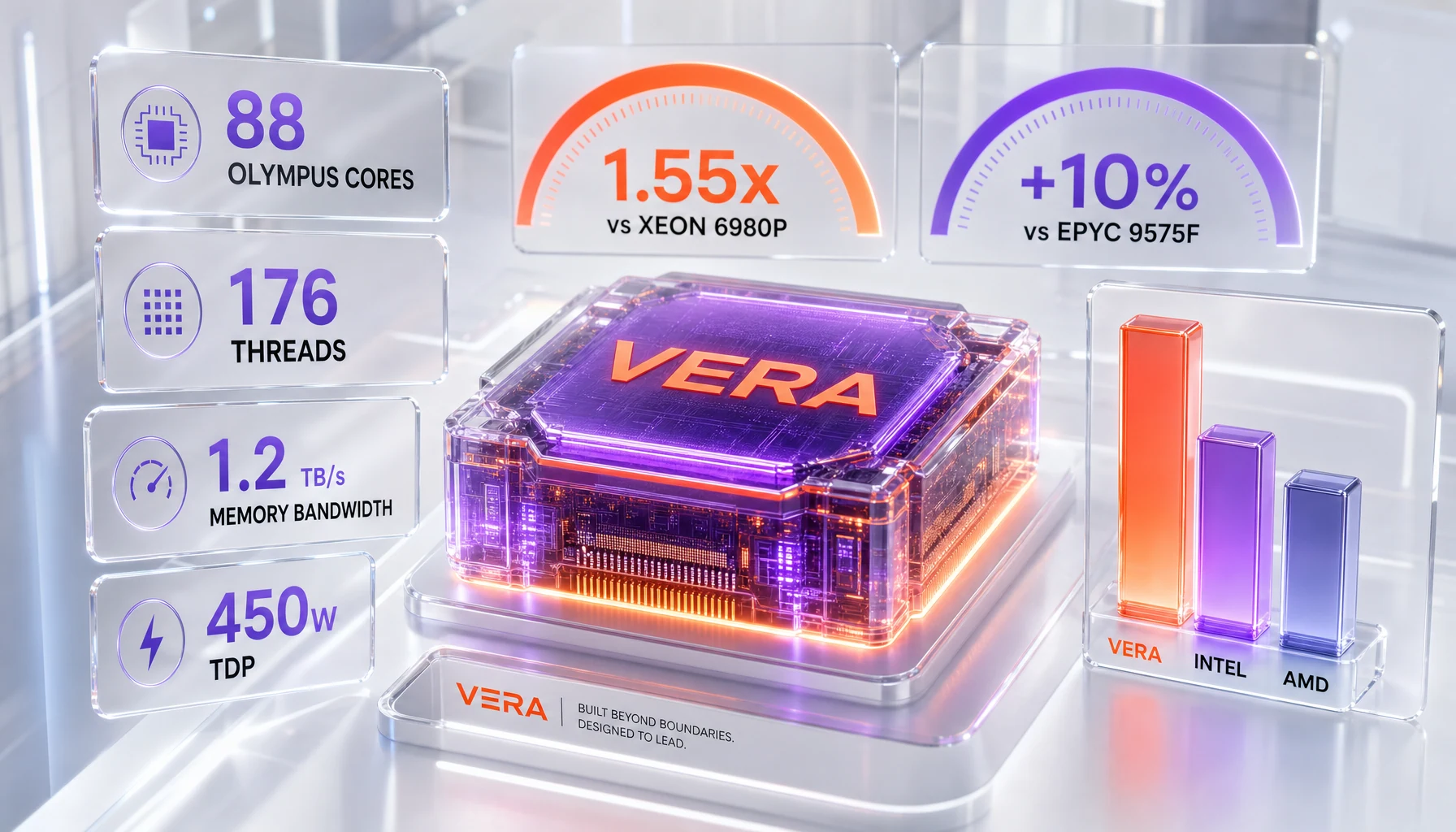
How fast is NVIDIA's Vera CPU? In the first independent Phoronix benchmarks (May 26, 2026), the 88-core Vera scored 1.55x faster than Intel's flagship Xeon 6980P and about 10% ahead of AMD's EPYC 9575F in geometric mean. It also beat NVIDIA's own prior Grace CPU by 1.6x, sustained 90% of peak memory bandwidth in STREAM TRIAD, and recorded a 20-second Linux kernel compile — roughly 2x faster per core than a 128-core x86 chip.
For two years, NVIDIA's CPU story has been a slide deck. Jensen Huang stood on the GTC stage, claimed the company's custom Arm silicon would out-execute Intel and AMD, and asked the data-center world to take it on faith until the chips shipped. On May 26, 2026, the faith got replaced by numbers. Michael Larabel of Phoronix — the most-cited independent Linux hardware outlet on the planet — published the first third-party Vera benchmarks. The verdict, in his words: this is "the most formidable competition to Intel and AMD x86_64 processors ever realized."
That sentence is not a PR play. It is the first time a non-NVIDIA party has measured shipping Vera silicon and confirmed the narrative Jensen sold at GTC. And the deeper story is not just that Vera is fast. It is why it is fast — a full-stack vertical-integration bet that Intel and AMD structurally cannot copy in the AI rack. Below, we decode the results, the architecture, and the caveats that the breathless headlines are skipping.
What Phoronix actually measured
The numbers matter, so here they are without rounding for drama. Across Phoronix's published geometric mean, NVIDIA Vera delivered approximately 1.55x the performance of a single Intel Xeon 6980P — Intel's current Granite Rapids flagship — which Phoronix framed as roughly 55% ahead of Intel's best single-socket configuration. Against AMD, Vera came in about 10% to 11% faster than the EPYC 9575F running at 5.0 GHz, beating the strongest tested EPYC setup in the suite. And against NVIDIA's own first-generation Grace CPU, Vera posted a clean 1.6x generation-on-generation gain.
Two specific results stand out beyond the headline geomean. In the STREAM TRIAD memory-bandwidth test, Vera sustained roughly 90% of its theoretical peak — an efficiency figure most server CPUs never approach, and a direct payoff of the 1.2 TB/s of LPDDR5X bandwidth on the package. And in a Linux kernel compile, Phoronix clocked 20 seconds, the fastest it has ever recorded. On a per-core basis, that compile was about 2x faster than a 128-core x86 processor, which tells you Vera is not winning purely on core count. It is winning per core, too.
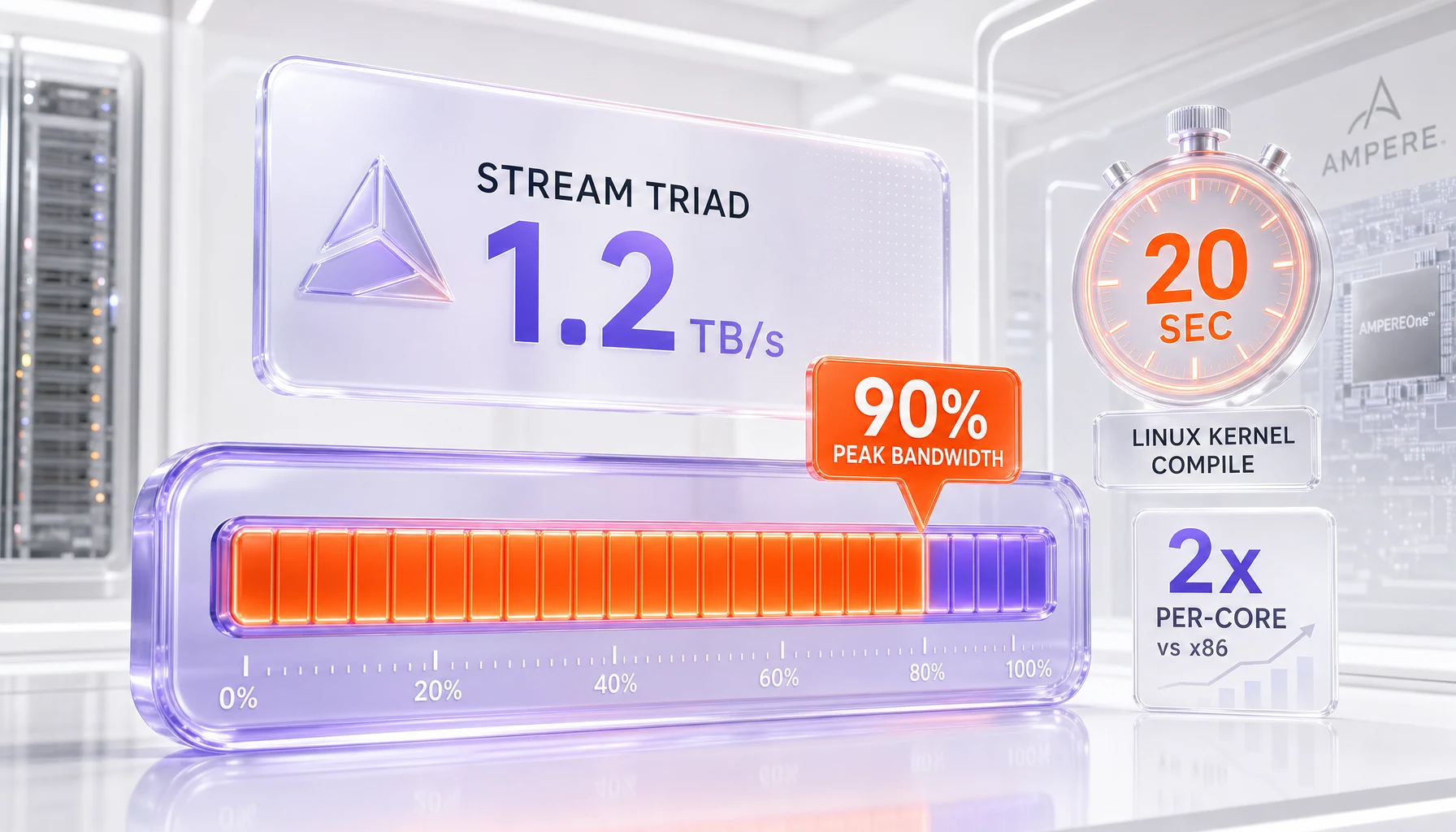
Stacked together, the picture is coherent rather than cherry-picked: high bandwidth that the cores can actually saturate, strong per-core throughput, and a geomean that lands above both x86 incumbents. That coherence is what separates a credible win from a benchmark stunt — and it is why Larabel's framing landed the way it did.
The Olympus core, decoded
The spec sheet reads like a deliberate provocation aimed at Santa Clara's neighbors. Vera packs 88 custom NVIDIA "Olympus" cores built on the Armv9.2 instruction set, exposing 176 threads through physical resource partitioning rather than conventional simultaneous multithreading. It carries 1.2 TB/s of memory bandwidth via second-generation LPDDR5X, a 450W CPU TDP, and — a detail worth holding onto — under 30W for the memory subsystem, versus the 100W-plus a comparable DDR5 bank typically draws.
The word that matters most is "custom." Olympus is not a licensed Arm Neoverse core dropped into an NVIDIA package. It is NVIDIA's own core design, which means the company controls the cache hierarchy, the memory paths, and the interconnect end to end. That is the same playbook Apple ran with its M-series silicon, scaled up to the data center and pointed at the most lucrative compute market on Earth.
Physical resource partitioning instead of SMT is the other tell. Rather than time-slicing two threads onto one core's resources and accepting the contention that comes with it, Vera physically carves the core so each thread gets dedicated resources. For the latency-sensitive, bandwidth-hungry workloads that feed an AI rack, that is a more predictable design — and it explains the unusual STREAM TRIAD efficiency.
The real story: vertical integration Intel and AMD cannot copy
Here is the strategic read, and it is not a knock on Intel or AMD's engineering. Vera is not designed to be a standalone server CPU you rack on its own. It is the CPU half of the Vera Rubin platform NVIDIA unveiled at GTC 2026 — a tightly coupled CPU-GPU system where the processor's job is to feed the accelerators without becoming the bottleneck. When you own the GPU, the interconnect (NVLink), and now the CPU core itself, you can co-design all three for one workload profile.
That is the integration advantage Intel and AMD structurally lack. Intel sells Xeons that have to serve every workload from databases to web servers; it cannot hard-optimize for one customer's accelerator. AMD has the strongest position of the two — it owns both EPYC and Instinct GPUs — but it still sells those parts into an open ecosystem where the CPU and GPU are mixed and matched by the buyer. NVIDIA is selling a closed rack where it controls every layer, and Vera's per-core compile result and bandwidth efficiency are exactly what that co-design buys you.
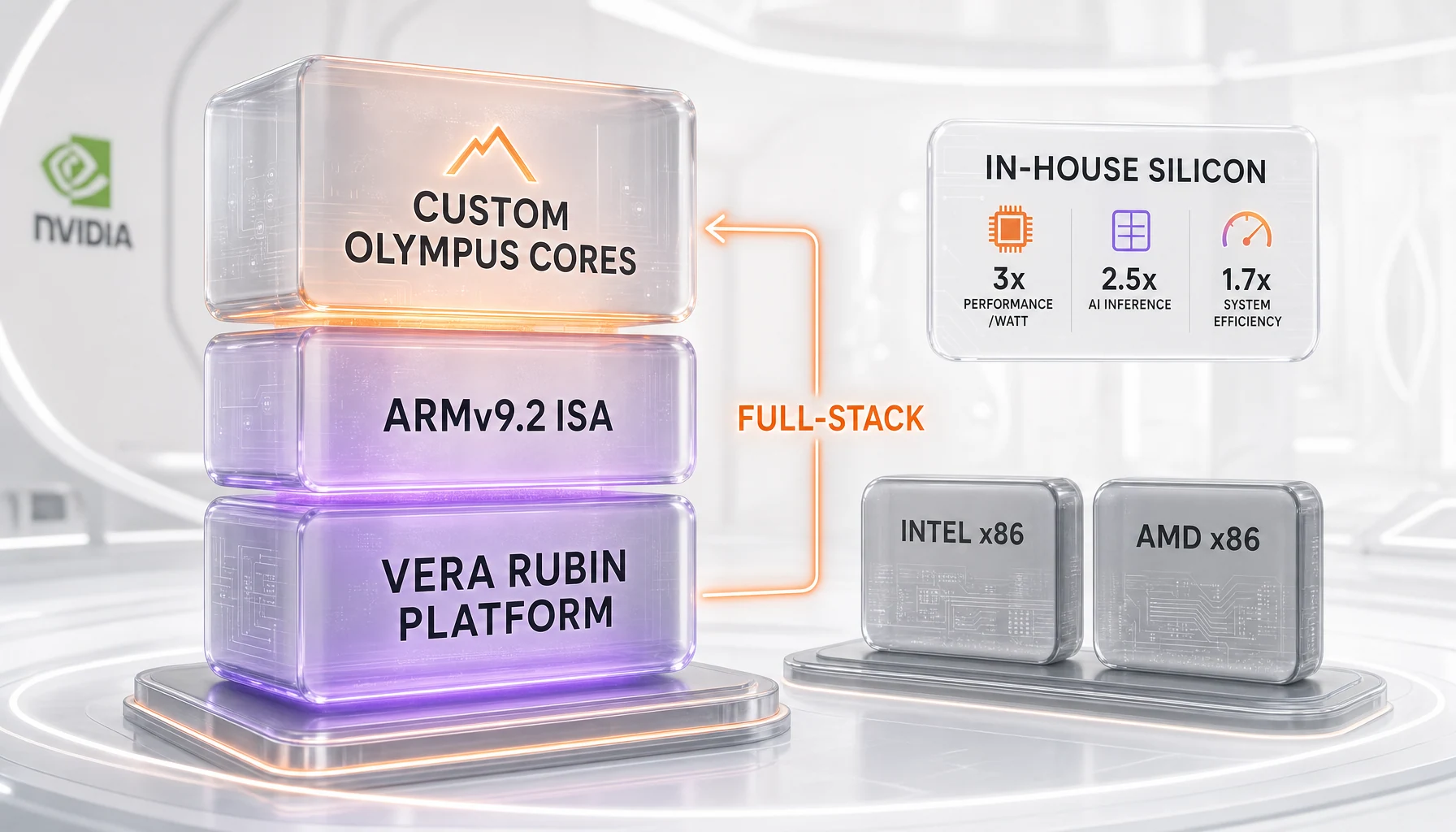
The financial logic tracks. NVIDIA has spent the past year placing enormous bets to lock in this vertical stack, from the $40 billion in equity positions that critics call circular financing to the $1 trillion in Blackwell and Rubin orders Jensen touted at GTC. Vera is the silicon that justifies the strategy. If the CPU had merely matched x86, the integration story would be a nice-to-have. Beating x86 in geomean turns it into a moat.
Why the "independent" label carries weight
Vendor benchmarks are theater. Every chip launch ships with first-party slides showing the new part winning by exactly the margin the marketing team needed. The market has learned to discount them to roughly zero. What it does not discount is a third party with a reputation to protect running the tests on its own terms.
Phoronix is that third party for Linux server hardware. Larabel has spent more than two decades publishing reproducible benchmark suites, and his outlet is routinely cited by AMD, Intel, and the open-source kernel community alike. When he writes that Vera packs competitiveness he has "never seen out of any other ARM or non-x86_64 processors," that is a calibrated statement from someone who has benchmarked nearly every server chip of the past twenty years. It is the difference between NVIDIA claiming a win and the referee confirming it.
This also lands in a market where custom silicon is suddenly everyone's strategy. Cerebras priced its IPO above range on the strength of wafer-scale inference chips, Anthropic is shopping UK silicon startups for 2027, and researchers are even chasing waste-heat analog computing for efficiency gains. Against that backdrop, NVIDIA proving its in-house CPU can beat the x86 establishment is not an isolated benchmark — it is a signal that the era of buying someone else's general-purpose processor is closing for the companies that can afford to design their own.
The caveats the headlines are skipping
Now the discipline. These are real third-party numbers, and that is genuinely a first. But "independent" needs three asterisks, and any honest read has to attach them.
First, the tests were NVIDIA-sanctioned. Phoronix ran the suite, but NVIDIA chose which benchmarks were on the table. A curated workload set — as Tom's Hardware pointedly noted — is not the same as the open, run-everything methodology Phoronix uses on retail hardware. The geomean is real; the question is whether a less friendly workload mix would tell the same story.
Second, the hardware was at NVIDIA's facility in Santa Clara, not in Phoronix's own lab. That removes the ability to independently verify the system configuration, the firmware, the cooling, and whether the comparison Intel and AMD systems were tuned to their best. Home-lab independence and host-supervised independence are different things, and the distinction matters for how much weight you put on the absolute margins.
Third, and most consequential: there was no independent power monitoring. Vera's 450W TDP is a published figure, not a measured one in this run. Without a wall-plug reading, you cannot compute performance-per-watt — the metric that actually decides data-center total cost of ownership. A chip that wins on raw throughput while drawing significantly more power can still lose the procurement math. Until someone measures Vera under load, the efficiency claim remains NVIDIA's to prove.
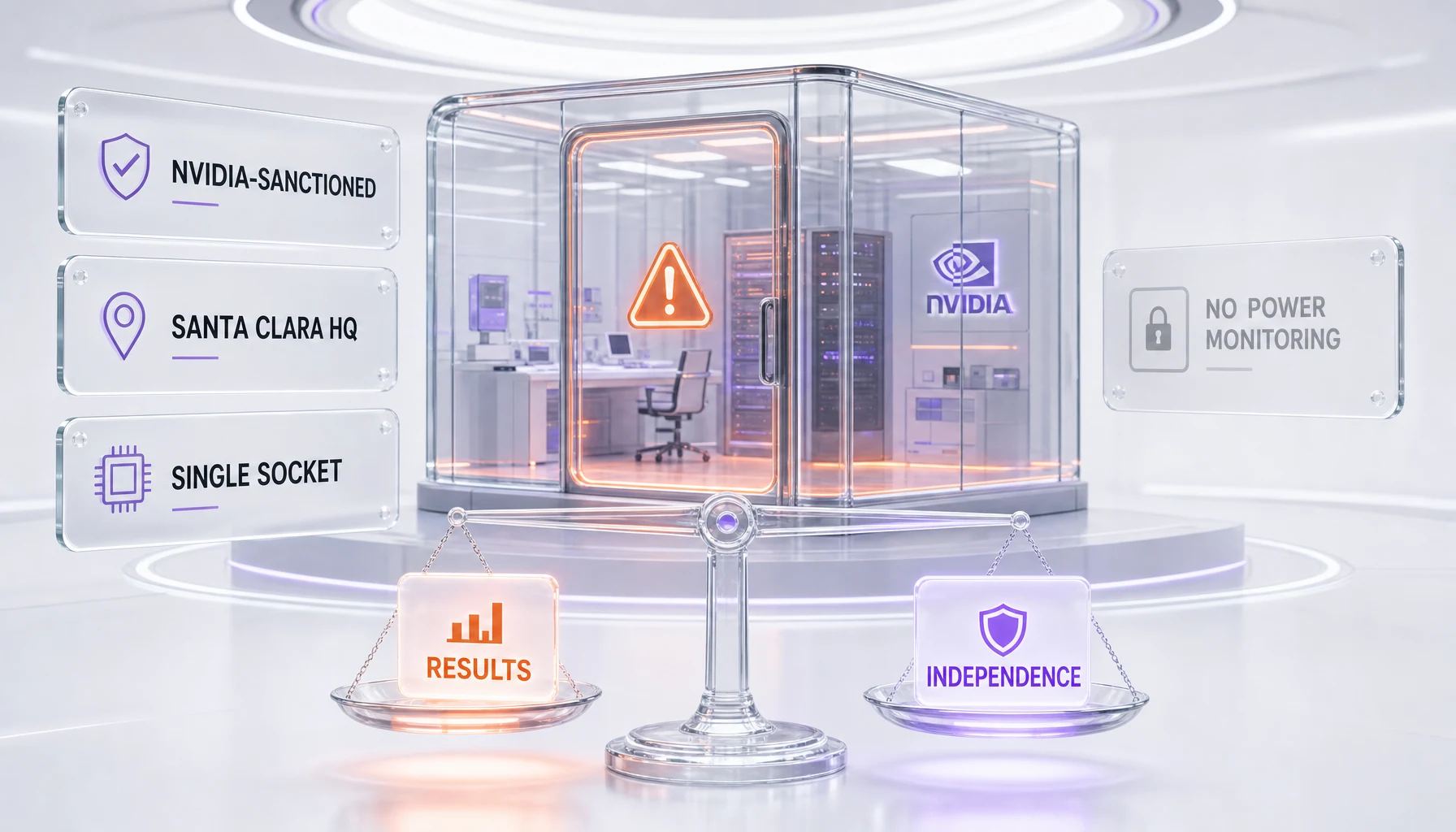
None of this means the win is fake. It means the win is provisional. The strongest interpretation the data supports is: Vera is, at minimum, fully competitive with the x86 flagships on a curated suite, and very likely faster in NVIDIA's target workloads. The weakest interpretation — that this is just GTC marketing in Phoronix clothing — does not survive contact with Larabel's track record. The truth sits closer to the strong end, with an efficiency footnote nobody has cashed yet.
What it means for data-center buyers
For hyperscalers and AI-cloud operators, the practical takeaway is that Vera is now a credible reason to standardize on NVIDIA's full rack rather than pairing Hopper-class GPUs with third-party x86 hosts. The CPU is no longer the weak link in the integration argument; it is part of the pitch. That tightens NVIDIA's grip on the rack and raises the switching cost for anyone already deep in the CUDA ecosystem.
For Intel and AMD, the message is uncomfortable but not fatal. Most of the server market is not building AI racks — it is running databases, virtualization, and general compute where x86 compatibility and an open ecosystem still win. Vera does not touch that market. But it does fence off the highest-margin, fastest-growing slice of data-center compute, and it does so with a part the incumbents cannot simply price against, because it is not sold separately. You buy the rack or you do not.
The honest bottom line: NVIDIA promised at GTC that its custom CPU would beat x86, and on May 26, 2026, an independent referee said it did — with caveats on the conditions and a wide-open question on power. That is a real milestone for vertical integration in silicon, and a louder warning shot at Intel and AMD than any keynote slide. The next thing to watch is not whether Vera is fast. Phoronix settled that. It is whether anyone outside Santa Clara gets to measure it on their own terms, with a power meter attached.
Frequently asked questions
How fast is NVIDIA's Vera CPU compared to Intel and AMD?
In the first independent Phoronix benchmarks published May 26, 2026, the 88-core Vera scored about 1.55x faster than Intel's flagship Xeon 6980P (Granite Rapids) and roughly 10% ahead of AMD's EPYC 9575F on a geometric-mean basis. Phoronix also measured a 1.6x gain over NVIDIA's own prior Grace CPU.
What is the NVIDIA Vera CPU architecture?
Vera uses 88 custom NVIDIA Olympus cores built on the Armv9.2 instruction set, exposing 176 threads through physical resource partitioning rather than traditional SMT. It pairs 1.2 TB/s of LPDDR5X memory bandwidth with a 450W CPU TDP and is the CPU half of NVIDIA's Vera Rubin platform.
Who ran the NVIDIA Vera benchmarks?
Michael Larabel of Phoronix, a long-running independent Linux hardware testing outlet, ran the first third-party benchmarks. They are the first non-NVIDIA numbers published after Vera silicon began shipping, which is why they carry more weight than GTC marketing slides.
What did Michael Larabel say about the Vera CPU?
Larabel wrote that Vera is "the most formidable competition to Intel and AMD x86_64 processors ever realized," and added that it packs competitiveness he has "never seen out of any other ARM or non-x86_64 processors."
How good is the Vera CPU's memory bandwidth?
Vera sustained roughly 90% of its peak bandwidth in the STREAM TRIAD test, an unusually high efficiency figure. With 1.2 TB/s on tap, that translates to about 4x the per-core memory bandwidth of traditional x86 server CPUs, which matters most for memory-bound AI and HPC workloads.
How fast does Vera compile the Linux kernel?
Phoronix measured a 20-second Linux kernel compile, the fastest it has recorded. On a per-core basis that is about 2x faster than a 128-core x86 processor, suggesting strong single-thread and cache performance on top of the high core count.
Are the NVIDIA Vera benchmark results trustworthy?
They are real third-party numbers, but with caveats. The tests were NVIDIA-sanctioned, run on hardware at NVIDIA's Santa Clara facility, on a curated workload set, and without independent power monitoring. The performance figures are credible; full efficiency and pricing comparisons remain unverified.
Does the Vera CPU compete with Intel Xeon 6980P and AMD EPYC?
Yes. Phoronix benchmarked Vera against Intel's Granite Rapids flagship Xeon 6980P and AMD's Turin EPYC 9575F, 9755, and 9475F. Vera posted the highest overall geometric mean in the published set, leading the best single-socket Xeon by about 55% and the strongest EPYC by roughly 11%.
What are Olympus cores and why do they matter?
Olympus is NVIDIA's first fully custom, in-house CPU core design rather than a licensed Arm Neoverse core. Designing the core itself lets NVIDIA tune cache, memory paths, and interconnect for its GPUs, which is the vertical-integration advantage Intel and AMD cannot easily match in the AI rack.
When can you buy the NVIDIA Vera CPU?
Vera is not a retail product. It ships inside NVIDIA's Vera Rubin rack-scale systems for data centers and cloud providers, with broad availability tied to the Rubin platform ramp through 2026. These benchmarks reflect early shipping silicon rather than a consumer launch.