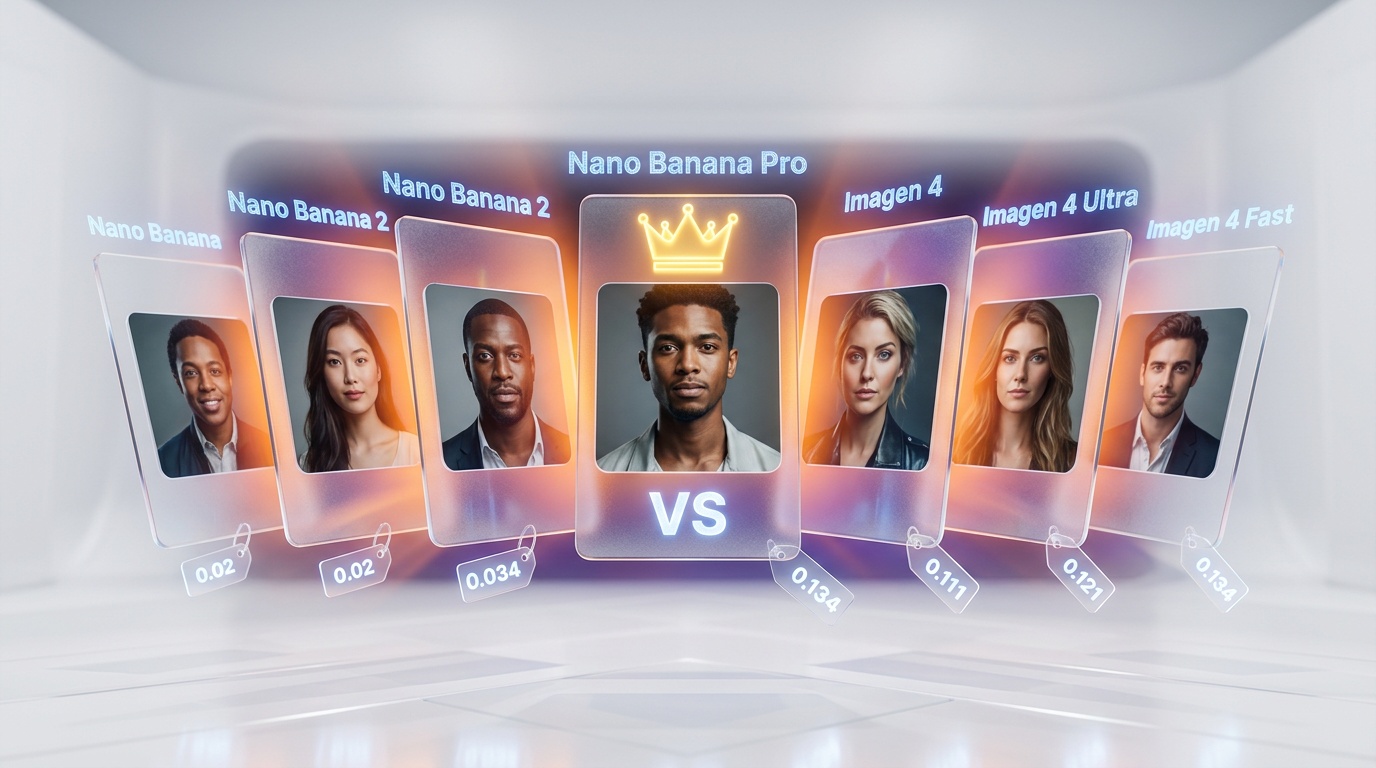
Google now offers 6 distinct AI image generation models ranging from $0.02 to $0.134 per image: Nano Banana ($0.039), Nano Banana 2 ($0.067), Nano Banana Pro ($0.134), Imagen 4 ($0.04), Imagen 4 Ultra ($0.06), and Imagen 4 Fast ($0.02). We tested all 6 with the exact same photorealistic portrait prompt. Imagen 4 Ultra wins overall quality. Nano Banana Pro wins photorealism. Imagen 4 Fast is cheapest at $0.02 per image but sacrifices prompt fidelity. Nano Banana 2 offers the best value for daily production use.
Our Test Protocol: Same Prompt, 6 Models, Raw Results
We wanted to answer a simple question: which Google image model actually produces the best results when you need photorealistic output? To find out, we ran the exact same prompt through all 6 Google image generation models available in April 2026. No cherry-picking. No re-rolls. One prompt, one generation per model, raw output compared side by side.
The Exact Prompt We Used
"A photorealistic portrait of a woman in her 30s sitting at a modern cafe terrace at golden hour, holding a ceramic coffee cup with steam rising. She wears a light linen blazer over a white t-shirt. Shallow depth of field with warm bokeh lights in the background. Natural skin texture, no retouching. Shot on 35mm film grain aesthetic. Landscape 16:9 aspect ratio."
This prompt was chosen deliberately. It tests several critical capabilities simultaneously: human face generation (the hardest task for any AI model), lighting comprehension (golden hour), material rendering (ceramic, linen, steam), depth of field simulation, and most importantly — adherence to specific clothing and scene instructions.
Test Parameters
| Parameter | Value |
|---|---|
| Prompt | Identical across all 6 models |
| Aspect Ratio | 16:9 (landscape) |
| Generations per model | 1 (no cherry-picking) |
| Post-processing | None (raw output) |
| Date tested | April 7, 2026 |
| Access method | Google AI Studio + Leonardo API (Nano Banana 2) |
Pricing Overview: What Each Model Costs
Before we dive into quality, let's talk money. The price spread across Google's 6 image models is massive — from $0.02 to $0.134 per image, a 6.7x difference. Here is the full pricing breakdown as of April 2026:
| Model | Price/Image | Family | Resolution | Speed | Best For |
|---|---|---|---|---|---|
| Imagen 4 Fast | $0.02 | Imagen | 1024px | ~2.7s | Bulk generation, prototyping |
| Nano Banana | $0.039 | Gemini Flash | 1290 tokens | ~4s | Quick iterations |
| Imagen 4 | $0.04 | Imagen | 1024px | ~5s | Balanced quality/cost |
| Imagen 4 Ultra | $0.06 | Imagen | 2048px | ~10s | Premium quality, 2K output |
| Nano Banana 2 | $0.067 | Gemini Flash | 1024px | ~5s | Production pipelines |
| Nano Banana Pro | $0.134 | Gemini Pro | 2048px | ~8s | Photorealism, editorial |
Key insight: the Imagen family (Fast/Standard/Ultra) uses a dedicated diffusion architecture optimized for image generation. The Nano Banana family (Original/2/Pro) runs inside Gemini's multimodal LLMs — Flash for the first two, Pro for the premium tier. This architectural difference explains why they handle prompts differently.
Head-to-Head Results: All 6 Images
Here are the actual images generated by each model. Same prompt, no retouching, no selection bias. Judge for yourself.
1. Nano Banana — $0.039 per image

Our verdict: Solid entry-level result. The golden hour lighting is convincingly warm, the bokeh in the background is clean and natural-looking, and the woman's face has reasonable detail. The blazer and white t-shirt are correctly rendered. At $0.039, this is a respectable output. The main limitation: skin texture feels slightly smoothed compared to the Pro version, and the overall composition is simpler.
- Prompt fidelity: 8 out of 10 — all clothing and scene elements present
- Face quality: 7 out of 10 — good but slightly over-smoothed
- Lighting: 8 out of 10 — golden hour well executed
- Overall: 7.5 out of 10
2. Nano Banana 2 — $0.067 per image

Our verdict: This is the model we use daily on ThePlanetTools.ai for all our glassmorphism article images. For photorealistic portraits, it performs well but shows its multimodal nature — the output feels more "AI-processed" than the dedicated Imagen models. Good skin detail, appropriate golden hour warmth, correct attire. We ran this through the Leonardo.ai API rather than Google AI Studio, which is our standard production pipeline.
- Prompt fidelity: 8 out of 10 — elements present and accurate
- Face quality: 7.5 out of 10 — clean, natural-looking
- Lighting: 8 out of 10 — warm golden tones
- Overall: 7.5 out of 10
3. Nano Banana Pro — $0.134 per image (WINNER: Photorealism)

Our verdict: This is the clear photorealism champion. The difference is immediately visible: real freckles on the skin, natural laugh lines around the eyes, an authentic toothy smile that does not feel AI-generated. The ceramic coffee cup has an artisanal, hand-thrown quality with visible texture. The woman's blazer has natural fabric wrinkles. The golden hour light catches individual hair strands. This is the closest any Google model gets to a real photograph. At $0.134 it is the most expensive option, but for editorial, marketing, or any use case where the image needs to pass as a real photo — this is the one. Read our full Nano Banana Pro review for more details on this model's capabilities.
- Prompt fidelity: 9 out of 10 — every element rendered with detail
- Face quality: 9.5 out of 10 — freckles, wrinkles, authentic expression
- Lighting: 9 out of 10 — golden hour with hair-strand light catching
- Overall: 9 out of 10
4. Imagen 4 (Standard) — $0.04 per image

Our verdict: Imagen 4 Standard delivers impressive results for $0.04. The steam rising from the cup is beautifully rendered — one of the best across all 6 models. The skin textures are clean without being over-smoothed. The bokeh is natural and warm. The woman's face has a pleasant, natural expression with good detail. The blazer and white t-shirt are correctly rendered. This is where Imagen's dedicated diffusion architecture shines: consistent, reliable quality at a mid-range price point. For more on all three Imagen 4 variants, see our complete Imagen 4 guide.
- Prompt fidelity: 8.5 out of 10 — excellent adherence to all elements
- Face quality: 8 out of 10 — natural, clean detail
- Lighting: 8.5 out of 10 — beautiful golden hour with steam interaction
- Overall: 8 out of 10
5. Imagen 4 Ultra — $0.06 per image (WINNER: Overall Quality)

Our verdict: Imagen 4 Ultra takes the overall quality crown. The first thing you notice: the bokeh. Those string lights in the background create a warm, magazine-quality atmosphere that none of the other models achieved at this level. The woman's skin is flawlessly natural — no smoothing artifacts, no uncanny valley, just clean, believable texture. The blazer fabric has proper light interaction. The steam from the cup catches the golden hour light naturally. Zero visible artifacts anywhere in the image. At $0.06, this is arguably the best value in Google's entire lineup when you factor in the 2K native resolution output. You are paying 55% less than Nano Banana Pro and getting results that are cleaner, if slightly less photorealistic in terms of skin micro-detail.
- Prompt fidelity: 9 out of 10 — all elements perfectly placed
- Face quality: 9 out of 10 — natural, clean, no artifacts
- Lighting: 9.5 out of 10 — magazine-quality golden hour with string light bokeh
- Overall: 9 out of 10
6. Imagen 4 Fast — $0.02 per image (Cheapest Option)

Our verdict: At $0.02 per image, Imagen 4 Fast is the budget king — but it comes with a significant caveat. This was the only model that deviated from our prompt instructions. Instead of a "light linen blazer over a white t-shirt," the model generated a floral dress. Instead of a "modern cafe terrace," we got a distinctly Parisian cafe with Haussmann architecture. The overall image quality is good — the lighting is warm, the woman looks natural, the composition is professional. But prompt fidelity matters, and Imagen 4 Fast is clearly making creative liberties to speed up generation (~2.7 seconds). For bulk work where exact prompt adherence is not critical, it is unbeatable on price. For anything requiring precision, spend the extra $0.02-0.04.
- Prompt fidelity: 6 out of 10 — changed clothing and setting
- Face quality: 7.5 out of 10 — natural and pleasant
- Lighting: 7.5 out of 10 — warm but less controlled
- Overall: 7 out of 10
Full Comparison Table: All 6 Models Ranked
| Model | Price | Overall | Photorealism | Prompt Fidelity | Speed | Best For |
|---|---|---|---|---|---|---|
| Imagen 4 Ultra | $0.06 | 9 out of 10 | 9 out of 10 | 9 out of 10 | ~10s | Premium content, marketing |
| Nano Banana Pro | $0.134 | 9 out of 10 | 9.5 out of 10 | 9 out of 10 | ~8s | Editorial, photos that must look real |
| Imagen 4 | $0.04 | 8 out of 10 | 8 out of 10 | 8.5 out of 10 | ~5s | Balanced production use |
| Nano Banana 2 | $0.067 | 7.5 out of 10 | 7.5 out of 10 | 8 out of 10 | ~5s | Daily production, pipelines |
| Nano Banana | $0.039 | 7.5 out of 10 | 7 out of 10 | 8 out of 10 | ~4s | Budget-conscious quality |
| Imagen 4 Fast | $0.02 | 7 out of 10 | 7.5 out of 10 | 6 out of 10 | ~2.7s | Bulk, prototyping, speed |
Winners by Category
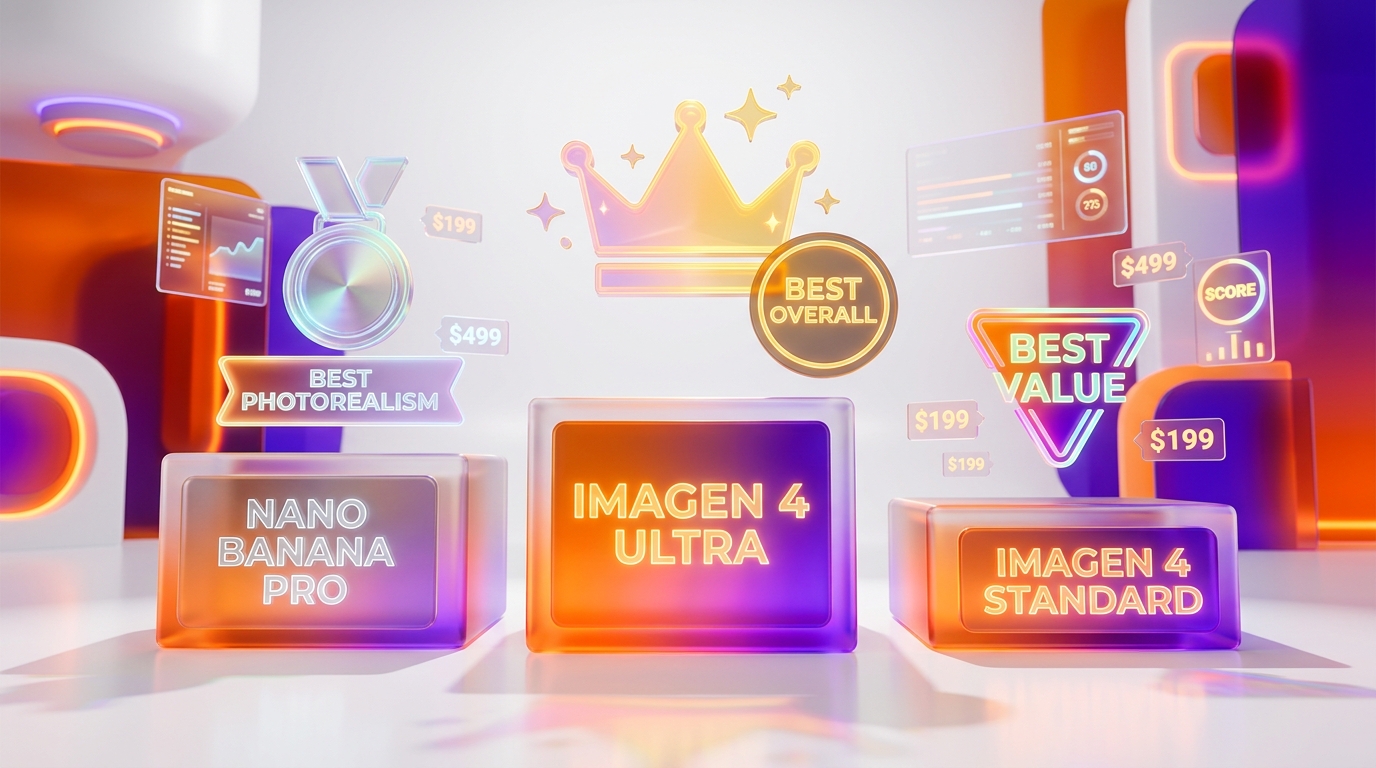
Best Photorealism: Nano Banana Pro ($0.134)
If your images need to look indistinguishable from photographs, Nano Banana Pro is the only choice. The freckles, laugh lines, fabric wrinkles, and artisanal cup texture put it in a league of its own. Running on Gemini Pro's architecture gives it an understanding of human features that the Imagen family cannot match. The trade-off: it is the most expensive model at $0.134 per image — 2.2x more than the next best option (Imagen 4 Ultra at $0.06).
Best Overall Quality: Imagen 4 Ultra ($0.06)
Imagen 4 Ultra delivers the cleanest, most polished output of any Google model. The bokeh string lights, natural skin rendering, and complete absence of artifacts make it the safest choice for professional content. At $0.06 per image with native 2K resolution, it is arguably the best value in the premium tier. You lose the micro-detail photorealism of Nano Banana Pro (no freckles, no individual hair strands), but you gain a level of polish and consistency that is hard to beat.
Best Value: Imagen 4 Standard ($0.04)
For the price-conscious creator who still needs quality, Imagen 4 Standard at $0.04 hits the sweet spot. It scores 8 out of 10 across the board with excellent prompt fidelity and clean output. You are paying 33% less than Imagen 4 Ultra and 70% less than Nano Banana Pro, with output that is 80-90% as good. For blog posts, social media, and general content — this is where the money is.
Fastest Generation: Imagen 4 Fast ($0.02)
At ~2.7 seconds per image, Imagen 4 Fast is 2-4x faster than every other model. Combined with its $0.02 price point, it is the go-to for prototyping, A/B testing, or any scenario where you need to generate hundreds or thousands of images quickly. The prompt fidelity issues we observed (outfit and scene changes) mean it is not suitable for precision work — but for bulk generation where "close enough" is acceptable, nothing beats it.
Best for Production Pipelines: Nano Banana 2 ($0.067)
We run Nano Banana 2 through the Leonardo.ai API for every image on ThePlanetTools.ai. Why? It sits in a comfortable middle ground: good quality, reasonable price, consistent output, and excellent API integration through third-party platforms. For automated pipelines where you need reliable, predictable results at scale, Nano Banana 2 is the pragmatic choice. Learn more in our complete Nano Banana guide.
Why Results Differ: Imagen vs Nano Banana Architecture
The 6 models fall into two distinct architectural families, and understanding this explains why their outputs look different:
Imagen Family (Fast, Standard, Ultra)
The Imagen models use a dedicated diffusion architecture built specifically for image generation. They excel at consistent composition, clean artifact-free output, and reliable prompt adherence. The Ultra variant supports native 2K resolution. Think of them as specialized image machines — they do one thing and they do it well.
Nano Banana Family (Original, 2, Pro)
The Nano Banana models run inside Gemini's multimodal LLMs. The original Nano Banana and Nano Banana 2 use the Flash (lightweight) variant, while Nano Banana Pro uses the full Pro model. This gives them a deeper understanding of concepts, objects, and human features — which is why Nano Banana Pro produces the most photorealistic faces. The trade-off: they can sometimes produce outputs that feel more "AI-processed" and are generally more expensive per image.
| Feature | Imagen Family | Nano Banana Family |
|---|---|---|
| Architecture | Dedicated diffusion | Multimodal LLM (Gemini) |
| Strength | Consistency, clean output | Concept understanding, photorealism |
| Weakness | Less micro-detail on faces | Can feel "AI-processed" |
| Price range | $0.02-$0.06 | $0.039-$0.134 |
| Text rendering | Good (Ultra best) | Excellent (Pro best) |
| API access | Google AI Studio, Vertex AI | Google AI Studio, Vertex AI, Leonardo |
Cost Analysis: 1,000 Images Across All Models
To put pricing in perspective, here is what 1,000 images would cost with each model:
| Model | Cost per 1,000 images | vs Cheapest |
|---|---|---|
| Imagen 4 Fast | $20 | baseline |
| Nano Banana | $39 | +95% |
| Imagen 4 | $40 | +100% |
| Imagen 4 Ultra | $60 | +200% |
| Nano Banana 2 | $67 | +235% |
| Nano Banana Pro | $134 | +570% |
For high-volume use cases (10,000+ images/month), Google's Batch API offers a flat 50% discount on all models, bringing Imagen 4 Fast down to just $0.01 per image and Nano Banana Pro to $0.067 — making the Pro tier as affordable as standard Nano Banana 2 pricing.
When to Use Which Model: Decision Guide
After testing all 6 models, here is our practical recommendation matrix:
| Use Case | Recommended Model | Why |
|---|---|---|
| Blog post hero images | Imagen 4 Standard | Best quality/price ratio at $0.04 |
| Social media at scale | Imagen 4 Fast | $0.02 + 2.7s generation = volume king |
| Product marketing | Imagen 4 Ultra | 2K resolution, zero artifacts, professional polish |
| Editorial/journalism | Nano Banana Pro | Photorealism that passes as real photography |
| Automated pipelines | Nano Banana 2 | Reliable, consistent, good API ecosystem |
| Prototyping/testing | Imagen 4 Fast | Cheapest + fastest for rapid iteration |
| E-commerce | Imagen 4 Ultra | Clean backgrounds, accurate product rendering |
| Art/creative | Nano Banana Pro | Deepest understanding of artistic concepts |
Our Experience Running These Models Daily
We have been running Nano Banana 2 through the Leonardo API for every image on ThePlanetTools.ai since March 2026. Our production pipeline generates 15-30 images daily for tool reviews, articles, and social media content. For our specific use case — glassmorphism-style 3D renders — Nano Banana 2 delivers consistent, reliable output at a price that makes sense for content at scale. When we need photorealistic imagery for specific articles, we switch to Nano Banana Pro. For everything else, Imagen 4 Standard or Ultra handles the job. The key learning: no single model fits every need. Build your pipeline with 2-3 models and route based on use case.
How to Access All 6 Models
All 6 models are accessible through Google AI Studio (free playground with rate limits) or the Gemini/Vertex AI APIs (pay-per-use). Nano Banana models are also available through third-party platforms like Leonardo.ai, which is what we use for our production pipeline.
Free Access (Google AI Studio)
- All 6 models available in the playground
- Rate limited: 5-15 requests per minute depending on model
- No credit card required
- Visit aistudio.google.com
API Access (Pay-per-use)
- Gemini API for Nano Banana family
- Vertex AI for Imagen family
- Batch API available for 50% discount on all models
- Third-party: Leonardo.ai, fal.ai, Replicate for some models

How Do Google Models Compare to Competitors?
For context, here is how Google's best models stack up against the competition in photorealistic portrait generation:
| Model | Provider | Price/Image | Photorealism (our score) |
|---|---|---|---|
| Nano Banana Pro | $0.134 | 9.5 out of 10 | |
| Imagen 4 Ultra | $0.06 | 9 out of 10 | |
| DALL-E 3 | OpenAI | $0.08 | 7.5 out of 10 |
| Midjourney v7 | Midjourney | ~$0.10 | 8.5 out of 10 |
| Flux 1.1 Pro | Black Forest Labs | $0.04 | 8 out of 10 |
| Stable Diffusion 3.5 | Stability AI | $0.03 | 7 out of 10 |
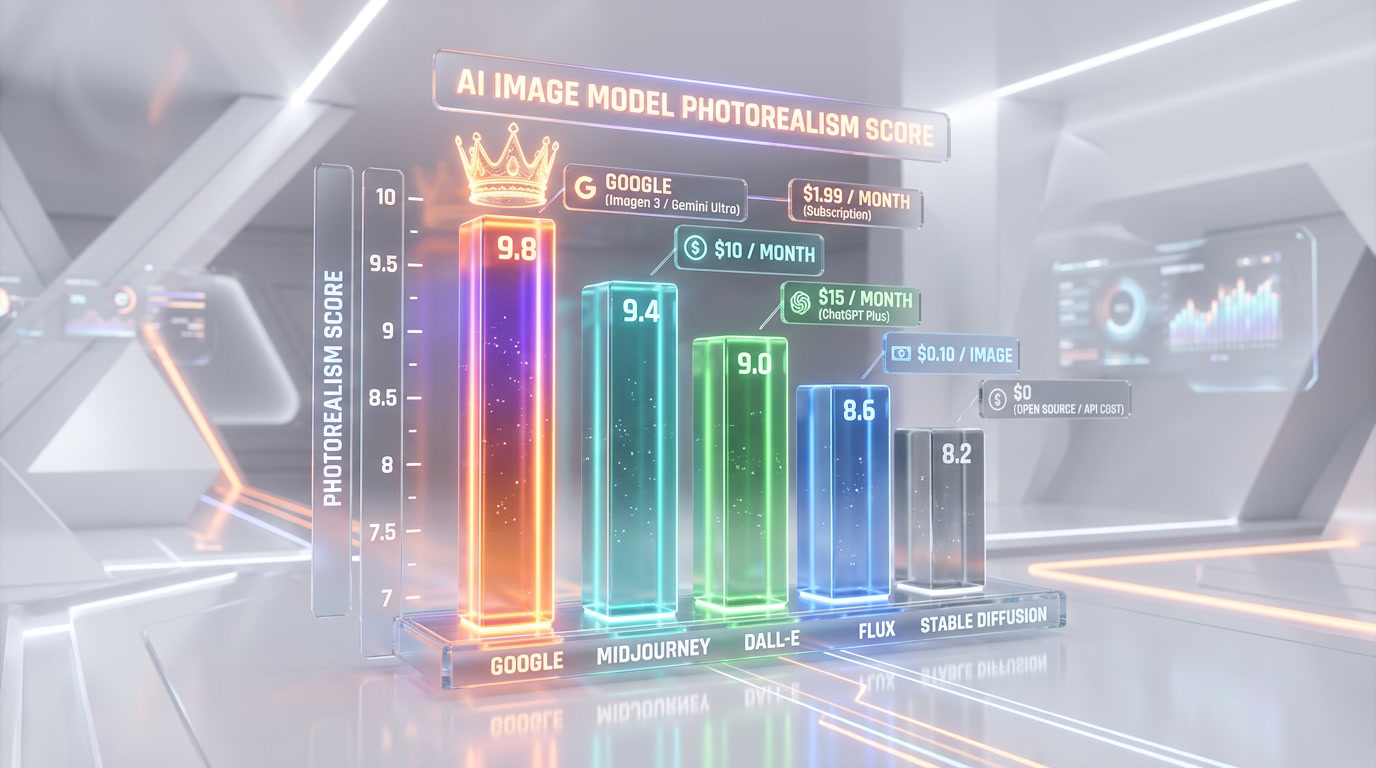
Google currently dominates the top 2 spots for photorealism. Midjourney v7 is the closest competitor for artistic quality, but at a higher price. Flux 1.1 Pro offers strong value at $0.04 but cannot match Imagen 4 Ultra's consistency.
Pro Tip: Save 50% with Google's Batch API
If you are generating images in bulk and do not need real-time results, Google's Batch API cuts every model's price in half. The trade-off: up to 24 hours for processing instead of seconds. For automated content pipelines, nightly batch jobs, or large marketing campaigns, this turns Imagen 4 Fast into a $0.01 per image model and Nano Banana Pro into a $0.067 per image model — matching standard Nano Banana 2 pricing at Pro quality.
| Model | Standard Price | Batch API Price | Savings |
|---|---|---|---|
| Imagen 4 Fast | $0.02 | $0.01 | 50% |
| Nano Banana | $0.039 | $0.0195 | 50% |
| Imagen 4 | $0.04 | $0.02 | 50% |
| Imagen 4 Ultra | $0.06 | $0.03 | 50% |
| Nano Banana 2 | $0.067 | $0.034 | 50% |
| Nano Banana Pro | $0.134 | $0.067 | 50% |
Our Final Verdict
After testing all 6 Google image generation models head-to-head with identical prompts, here is our bottom line:
For most users: Start with Imagen 4 Standard at $0.04 per image. It delivers 80-90% of the quality of the premium models at a fraction of the cost. Solid prompt fidelity, clean output, fast enough for interactive use.
For premium content: Use Imagen 4 Ultra at $0.06 per image. The 2K native resolution, zero-artifact output, and magazine-quality lighting make it the best overall model in Google's lineup. The $0.02 premium over Standard is worth it for any public-facing content.
For photorealism: Nothing beats Nano Banana Pro at $0.134 per image. If your images need to look indistinguishable from photographs — editorial, journalism, marketing — this is the only choice. The freckles don't lie.
For volume: Imagen 4 Fast at $0.02 per image (or $0.01 via Batch API) is unmatched for bulk generation. Accept the prompt fidelity trade-off and use it for prototyping, A/B testing, and scale operations.
Frequently Asked Questions
What is the best Google image generation model in 2026?
Imagen 4 Ultra ($0.06 per image) wins for overall quality — cleanest output, best lighting, zero artifacts, native 2K resolution. For maximum photorealism specifically, Nano Banana Pro ($0.134 per image) produces the most realistic human faces with natural skin texture, freckles, and micro-details that no other model matches.
What is the cheapest Google image model?
Imagen 4 Fast at $0.02 per image is the cheapest Google image generation model. With the Batch API, it drops to $0.01 per image. The trade-off: it has lower prompt fidelity than other models — in our test, it changed the requested outfit from a linen blazer to a floral dress.
What is the difference between Nano Banana and Imagen 4?
Nano Banana models (Original, 2, Pro) run inside Gemini's multimodal LLMs and excel at understanding concepts and photorealism. Imagen 4 models (Fast, Standard, Ultra) use a dedicated diffusion architecture optimized for consistent, artifact-free image output. Nano Banana Pro has the best photorealism. Imagen 4 Ultra has the cleanest overall quality.
Can you use Google image models for free?
Yes. All 6 models are available for free in Google AI Studio at aistudio.google.com. Free users get 5-15 requests per minute depending on the model, with up to 50 generations per day. No credit card required. For higher volumes, you need the paid Gemini API or Vertex AI.
Which Google image model is best for production use?
For automated production pipelines, we recommend Nano Banana 2 ($0.067 per image) — we run it daily for ThePlanetTools.ai through the Leonardo API with consistent results. For highest quality production, Imagen 4 Ultra ($0.06 per image) offers the best quality-to-price ratio with 2K native output and reliable prompt adherence.
How do you access Google image models via API?
Nano Banana models are accessible through the Gemini API. Imagen 4 models are available through Vertex AI. Both require a Google Cloud account for pay-per-use access. Third-party platforms like Leonardo.ai and fal.ai also provide API access to some Google models with their own pricing structures.
What is Google's Batch API for image generation?
Google's Batch API offers a flat 50% discount on all image generation models. Instead of real-time generation (seconds), you submit a batch and get results within 24 hours. This makes Imagen 4 Fast just $0.01 per image and Nano Banana Pro $0.067 per image — ideal for non-urgent bulk generation like content pipelines or marketing campaigns.
Frequently Asked Questions
Is Imagen 4 Ultra better than Midjourney for photorealistic portraits?
Imagen 4 Ultra scored 9 out of 10 overall in our test with magazine-quality bokeh, zero artifacts, and natural skin at $0.06 per image. For photorealistic portraits specifically, it competes directly with Midjourney v6 but at a fraction of the subscription cost. Nano Banana Pro scored higher on skin micro-detail (9.5 out of 10 face quality) but costs $0.134 per image.
Is Nano Banana Pro worth 6.7x more than Imagen 4 Fast?
It depends on your use case. Nano Banana Pro ($0.134) scored 9 out of 10 overall with real freckles, natural wrinkles, and authentic expressions — the closest to a real photograph. Imagen 4 Fast ($0.02) sacrifices prompt fidelity, changing our linen blazer to a floral dress. For editorial or marketing images that must look real, Pro is worth it. For prototyping and bulk generation, Fast saves 85% per image.
How does Nano Banana 2 compare to DALL-E 3 and Stable Diffusion for production pipelines?
Nano Banana 2 at $0.067 per image scored 7.5 out of 10 overall and is our daily driver at ThePlanetTools.ai for glassmorphism article images. It runs inside Gemini Flash's multimodal LLM, making it easy to integrate via the Leonardo API. Compared to DALL-E 3 ($0.04-0.12) and Stable Diffusion (self-hosted), Nano Banana 2 offers consistent quality with simple API access at a mid-range price point.
Which Google image model should I use for bulk content generation?
Imagen 4 Fast at $0.02 per image with ~2.7s generation time is the best choice for bulk content. At 1024px resolution, it handles prototyping and high-volume needs. However, it may deviate from prompt instructions — in our test it changed clothing and setting. For reliable bulk output with better fidelity, Imagen 4 Standard at $0.04 doubles the cost but scored 8 out of 10 overall with excellent prompt adherence.
Does Google's image API integrate with Leonardo.ai and other platforms?
Yes. Nano Banana 2 is accessible through the Leonardo.ai API, which is what we use in our production pipeline at ThePlanetTools.ai. The Imagen 4 family (Fast, Standard, Ultra) is available through Google AI Studio. Both support standard REST API calls, making integration with automation tools, CMS platforms, and custom pipelines straightforward.
What are the limitations of Google's AI image models in 2026?
Key limitations we found: Imagen 4 Fast ($0.02) ignores specific prompt details like clothing instructions. Nano Banana original ($0.039) over-smooths skin textures (7 out of 10 face quality). Nano Banana 2 output feels more AI-processed than dedicated Imagen models. No model achieved perfect 10 out of 10 prompt fidelity. The Nano Banana family uses Gemini's multimodal LLMs rather than dedicated diffusion architecture, which affects consistency.
Why did Imagen 4 Ultra win over Nano Banana Pro if Pro scored higher on photorealism?
Imagen 4 Ultra ($0.06) won overall quality because it delivered 9 out of 10 across all categories with zero artifacts, magazine-quality bokeh, and native 2K resolution — at 55% less cost than Nano Banana Pro ($0.134). Pro won photorealism specifically with 9.5 out of 10 face quality showing real freckles and natural wrinkles. Ultra is the better all-rounder; Pro is the specialist for images that must pass as real photographs.