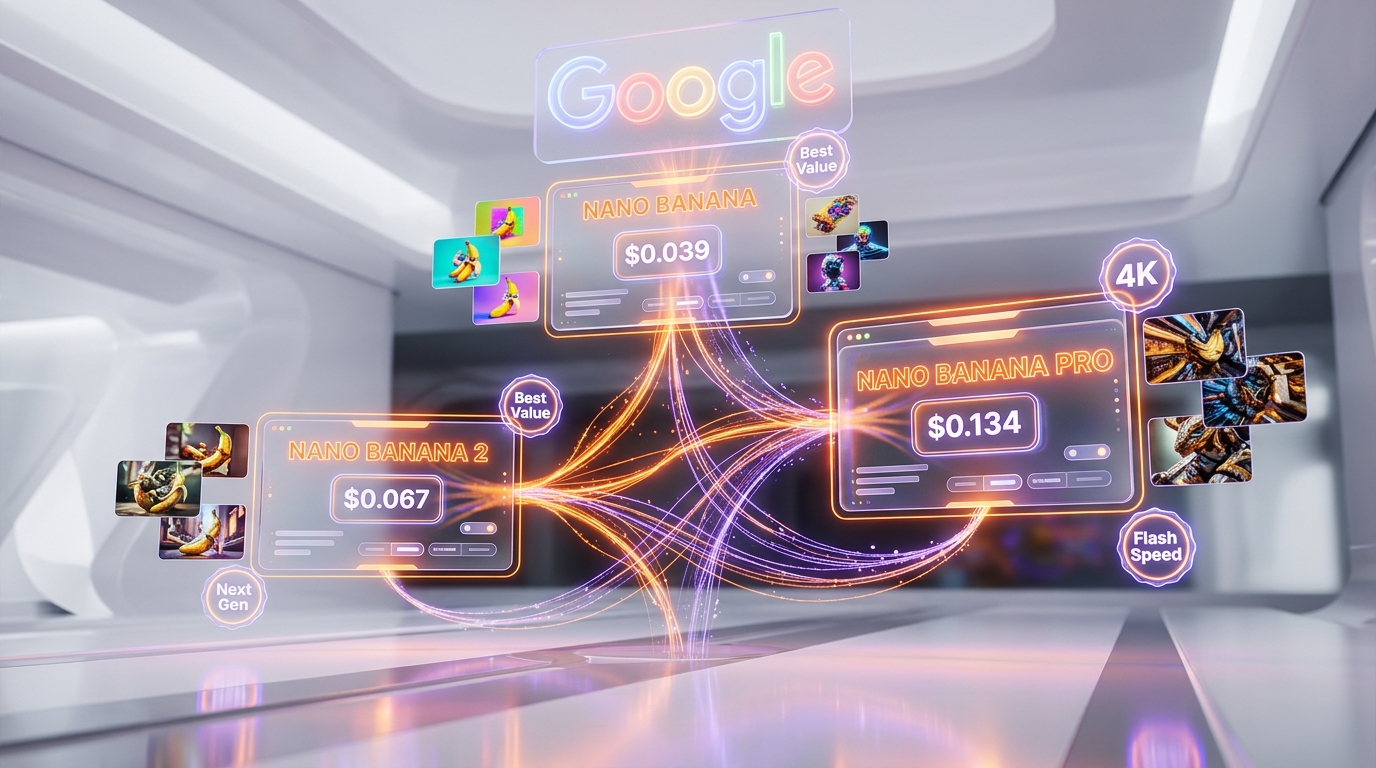
Google Nano Banana is a family of 3 native AI image generation models built into Gemini. The original Nano Banana (Gemini 2.5 Flash Image) costs $0.039 per image and launched September 2025. Nano Banana Pro (Gemini 3 Pro Image) costs $0.134 per image and delivers the best photorealism with 4K support. Nano Banana 2 (Gemini 3.1 Flash Image) costs $0.067 per image, launched February 2026, and combines Pro-level quality with Flash-level speed. We use Nano Banana 2 daily via Leonardo.ai for all our site images and have tested Pro extensively for photorealistic work.
If you have been tracking AI image generation in 2026, you have probably noticed a pattern: Google quietly dropped three separate image models under the same "Nano Banana" brand, and the naming is confusing. The original Nano Banana went viral in late 2025 with millions of images generated in the Gemini app. Then Pro arrived in November with dramatically better photorealism. Then Banana 2 landed in February 2026 combining the best of both worlds.
We have used all three models extensively. Nano Banana Pro is our go-to for photorealistic hero images and marketing assets. Nano Banana 2, accessed through Leonardo.ai, generates every glassmorphism illustration on ThePlanetTools.ai. And we have benchmarked the original against competitors like Midjourney and ChatGPT's DALL-E 3.
This guide breaks down every difference that matters: pricing (all text and image tokens), quality, speed, API access, and exactly when to use which model.
The 3 Nano Banana Models at a Glance
Before diving into details, here is the complete comparison table with every pricing tier and key specification. These are the official Google AI Studio prices as of April 2026.
| Specification | Nano Banana (Original) | Nano Banana Pro | Nano Banana 2 |
|---|---|---|---|
| Model ID | gemini-2.5-flash-image | gemini-3-pro-image-preview | gemini-3.1-flash-image-preview |
| Internal Name | Gemini 2.5 Flash Image | Gemini 3 Pro Image Preview | Gemini 3.1 Flash Image Preview |
| Release Date | September 30, 2025 | November 20, 2025 | February 26, 2026 |
| Text Input | $0.30 per million tokens tokens | $2.00 per million tokens tokens | $0.50 per million tokens tokens |
| Text Output | $2.50 per million tokens tokens | $12.00 per million tokens tokens | $3.00 per million tokens tokens |
| Image Input | $0.30 per million tokens tokens | $2.00 per million tokens tokens | $0.50 per million tokens tokens |
| Image Output | $0.039 per image | $0.134 per image | $0.067 per image |
| Knowledge Cutoff | June 2025 | January 2025 | January 2025 |
| Best For | Budget generation, quick drafts | Photorealism, 4K, text rendering | Speed + quality balance, production |
| 4K Support | No | Yes | Limited (up to 2K) |
| Free Tier | ~500 req/day in AI Studio | No free tier | No free tier |
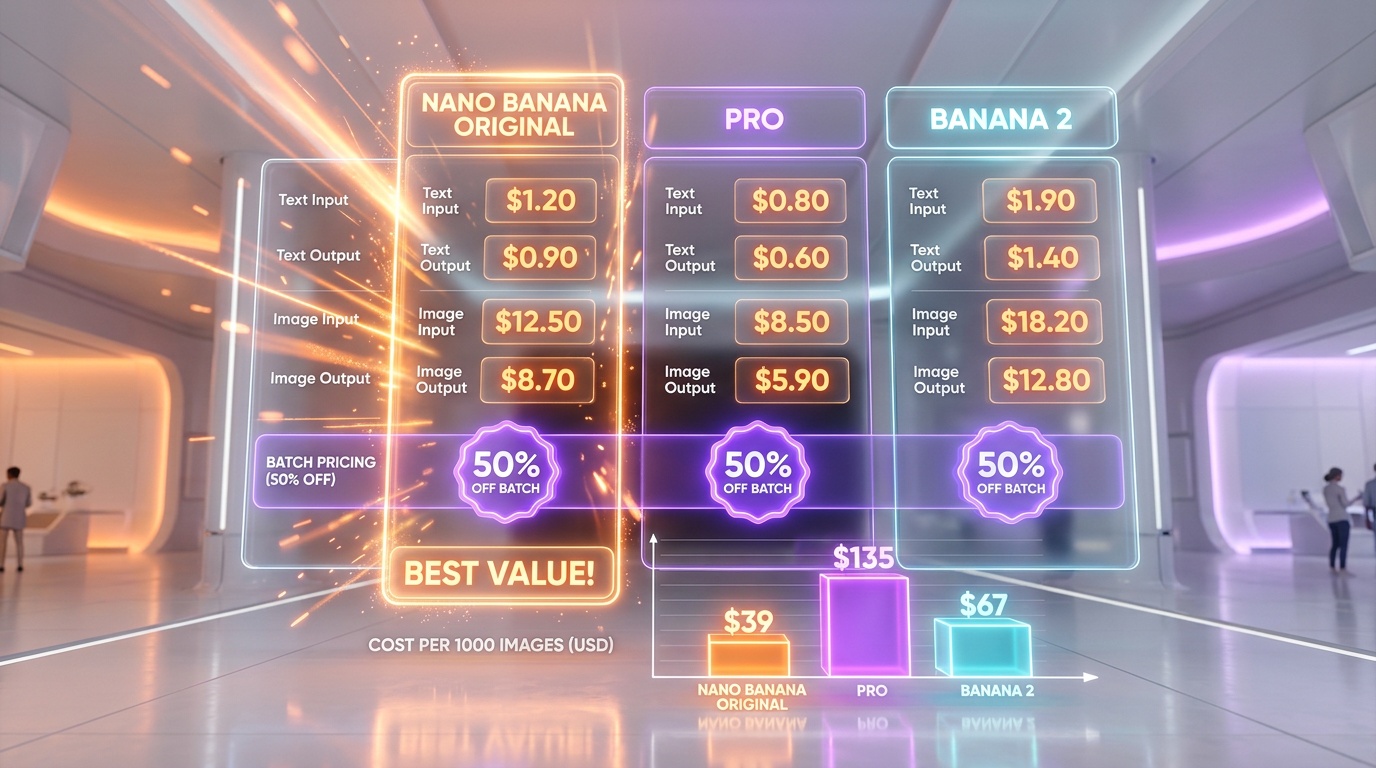
| Batch Discount | 50% off | 50% off | 50% off |
The price difference is significant. Generating 1,000 images costs $39 with the original, $134 with Pro, and $67 with Banana 2. For high-volume production, the original is 3.4x cheaper than Pro, while Banana 2 sits right in the middle at roughly half Pro's cost with comparable quality for most use cases.
Nano Banana (Original) — The Budget Pioneer
The original Nano Banana launched on September 30, 2025, as Gemini 2.5 Flash Image. Google describes it as "our state-of-the-art image generation and editing model," though that title has since passed to its successors. It went viral in countries like India where millions of users generated images through the Gemini app for free.
Pricing Breakdown
| Token Type | Price |
|---|---|
| Text Input | $0.30 per 1M tokens |
| Text Output | $2.50 per 1M tokens |
| Image Input | $0.30 per 1M tokens |
| Image Output | $0.039 per image (~1,290 output tokens) |
| Batch Image Output | $0.0195 per image (50% discount) |
At $0.039 per image, the original Nano Banana is the cheapest model in the family. For context, that means you can generate roughly 25 images for a dollar. With batch processing (24-hour turnaround), you get that down to $0.0195 per image — nearly 50 images per dollar.
Strengths and Limitations
The original Nano Banana excels at quick, low-cost image generation. It handles conversational image editing well, can render text on images with reasonable accuracy, and benefits from Google's free tier of approximately 500 requests per day through AI Studio.
However, it falls short on photorealism compared to Pro and Banana 2. The output resolution caps below 4K, and complex prompts with multiple subjects can produce inconsistent results. If you need production-quality images for a website or marketing, you will likely outgrow the original quickly.
When to Use the Original
- Prototyping and quick ideation — generate 20 variations for a dollar
- Personal projects using the free tier
- High-volume batch jobs where quality is secondary to quantity
- Simple image editing tasks (cropping, style transfer, basic modifications)
- Budget-constrained startups testing image generation features
Nano Banana Pro — The Photorealism King
Nano Banana Pro launched on November 20, 2025, built on Gemini 3 Pro Image Preview. It is the most capable model in the family and the most expensive. Google positions it for professional creative work where quality matters more than cost.
Pricing Breakdown
| Token Type | Price |
|---|---|
| Text Input | $2.00 per 1M tokens |
| Text Output | $12.00 per 1M tokens |
| Image Input | $2.00 per 1M tokens |
| Image Output | $0.134 per image |
| Batch Image Output | $0.067 per image (50% discount) |
Pro is 3.4x more expensive than the original for image generation and 6.7x more expensive for text input tokens. The text pricing matters because these are multimodal models — you send text prompts and receive images, so both token types get charged. A typical image generation request with a 200-word prompt costs roughly $0.134 for the image plus $0.0002 for the input tokens.
What Makes Pro Different
Pro delivers three capabilities the other models cannot match:
4K Resolution Output. Pro is the only Nano Banana model that generates true 4K images. For print materials, large-format displays, and high-end marketing assets, this is not optional — you need the resolution.
Superior Text Rendering. Rendering legible text in AI-generated images has been one of the hardest problems in the field. Pro handles it with significantly higher accuracy than the original or Banana 2. Marketing mockups, UI designs, and infographics with readable labels are Pro's sweet spot.
Photorealistic Quality. Pro produces the most photorealistic output in the Nano Banana family. Skin textures, lighting, reflections, and material rendering are noticeably better. For product photography, portrait-style images, and realistic scenes, Pro is the clear winner.
Pro also embeds SynthID digital watermarks in every generated image, uses grounding with Google Search for real-world accuracy, and is integrated into enterprise platforms through Vertex AI. Creative platforms including Adobe and Figma have added Pro integrations.
When to Use Pro
- Professional marketing campaigns requiring photorealistic assets
- Print materials that need 4K resolution
- Images with significant text content (mockups, infographics, UI concepts)
- Product photography replacements
- Enterprise workflows through Vertex AI where budget is secondary to quality
- Any project where "close enough" is not good enough
Nano Banana 2 — The Speed-Quality Sweet Spot
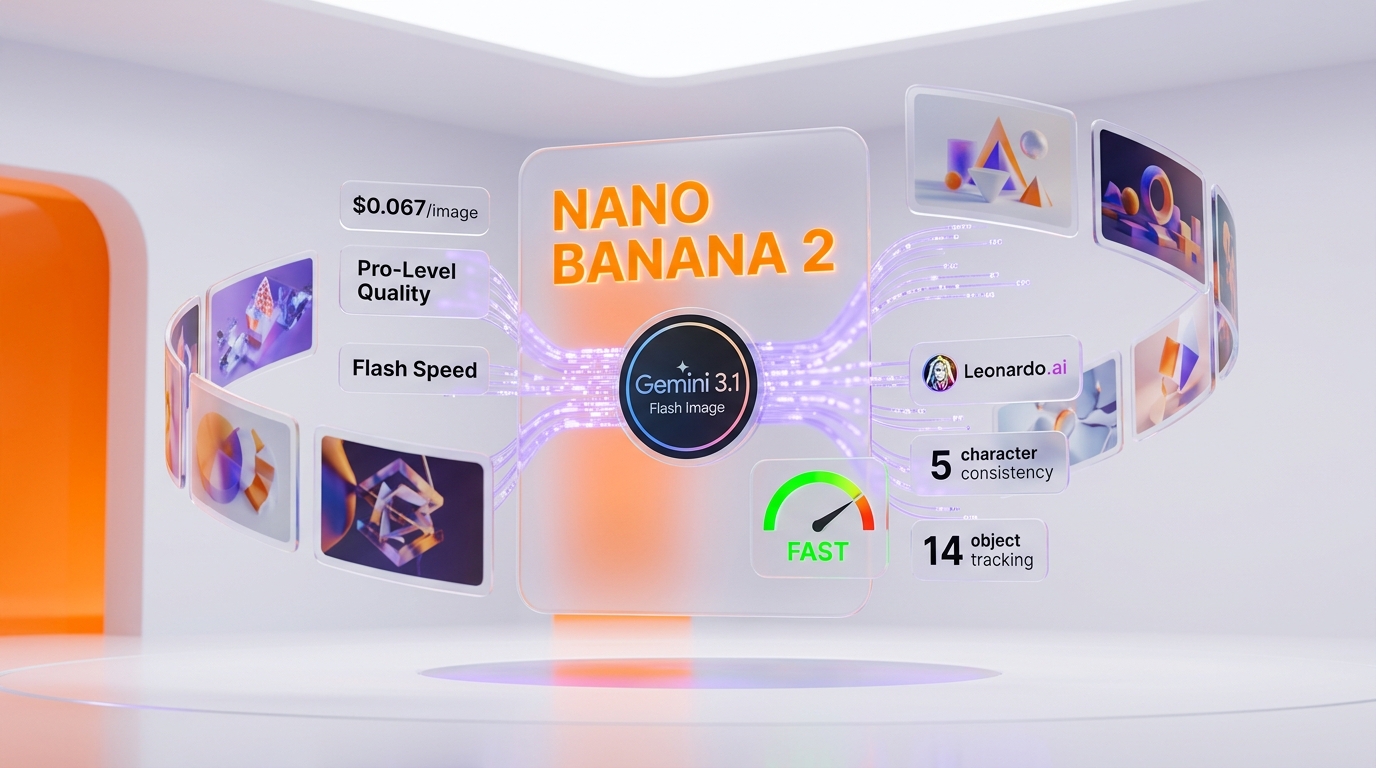
Nano Banana 2 launched on February 26, 2026, as Gemini 3.1 Flash Image Preview. Google's official description says it delivers "Pro-level visual intelligence with Flash-speed efficiency and reality-grounded generation capabilities." In practice, that description is accurate — Banana 2 closes most of the quality gap with Pro while keeping costs roughly 50% lower.
Pricing Breakdown
| Token Type | Price |
|---|---|
| Text Input | $0.50 per 1M tokens |
| Text Output | $3.00 per 1M tokens |
| Image Input | $0.50 per 1M tokens |
| Image Output (1K) | $0.067 per image |
| Image Output (2K) | $0.101 per image |
| Batch Image Output | $0.034 per image at 1K (50% discount) |
Banana 2 introduces resolution-based pricing that the other models do not have. At 1K resolution (1024px), it costs $0.067. At 2K, it jumps to $0.101. This makes the cost profile more predictable — you pay for exactly the resolution you need.
Why We Use Banana 2 Daily
Every glassmorphism illustration on ThePlanetTools.ai is generated through Banana 2 via Leonardo.ai's API. We generate images at 1376x768 resolution using the 3D Render style preset. Here is why we chose it over the other models:
Cost Efficiency at Scale. We generate 5 or more images per content page. At $0.067 per image, a full page costs under $0.35 in image generation. With Pro, that would be $0.67 or more. Over hundreds of pages, that difference adds up to hundreds of dollars.
Speed for Production Workflows. Banana 2 uses the Flash architecture, which means faster generation times than Pro. When we are building 10 to 15 content pages in a single session, waiting 30 seconds instead of 60 seconds per image makes a real difference in total pipeline time.
Quality That Meets the Bar. For our glassmorphism style (bright white scenes, orange and violet gradients, holographic cards), Banana 2 produces results that are visually indistinguishable from Pro. The Flash architecture handles stylized, graphic content extremely well. Where Pro pulls ahead is in photorealism — skin, eyes, fine textures — which our illustration style does not require.
Subject Consistency. Banana 2 can maintain character resemblance across up to 5 characters and track up to 14 distinct objects in a single workflow. This is critical for creating consistent visual branding across a content page.
Known Limitations
Banana 2 is not perfect. Generation times can hit 30 to 60 seconds even on the Flash architecture, which is slower than expected for a model designed for rapid iteration. It shares the flatter aesthetic of the original Nano Banana — great for stylized graphics but potentially lacking the dramatic depth and color saturation of Pro for photorealistic scenes. And there is no free tier for API access, unlike the original.
When to Use Banana 2
- Production websites generating images at scale (our use case)
- Content pipelines where you need 5 or more images per page
- Stylized illustrations, graphic design, and branded assets
- Any workflow where cost-per-image matters but quality cannot be sacrificed
- Applications accessed through third-party platforms like Leonardo.ai
- Infographics and text-heavy visuals (strong text rendering inherited from Pro)
Head-to-Head: Pricing Comparison (All Token Types)
Most comparisons only show image output pricing. But these are multimodal models — a complete cost analysis must include text tokens because every API call involves a text prompt. Here is the full picture.
| Cost Category | Nano Banana | Nano Banana Pro | Nano Banana 2 |
|---|---|---|---|
| 1 image (standard prompt) | ~$0.039 | ~$0.135 | ~$0.067 |
| 100 images | $3.90 | $13.50 | $6.70 |
| 1,000 images | $39.00 | $135.00 | $67.00 |
| 1,000 images (batch) | $19.50 | $67.50 | $34.00 |
| 10,000 images | $390 | $1,350 | $670 |
| 10,000 images (batch) | $195 | $675 | $340 |
| Text input (1M tokens) | $0.30 | $2.00 | $0.50 |
| Text output (1M tokens) | $2.50 | $12.00 | $3.00 |
The math is clear. For 10,000 images using batch processing, you save $480 by choosing the original over Banana 2 and $535 by choosing the original over Pro. But quality differences at that scale affect your entire product — the $340 investment in Banana 2 batch pricing often delivers better ROI than the $195 original when your images face public scrutiny.
How Nano Banana Compares to the Competition
The Nano Banana family does not exist in a vacuum. Here is how each model stacks up against the major competitors in AI image generation as of April 2026.
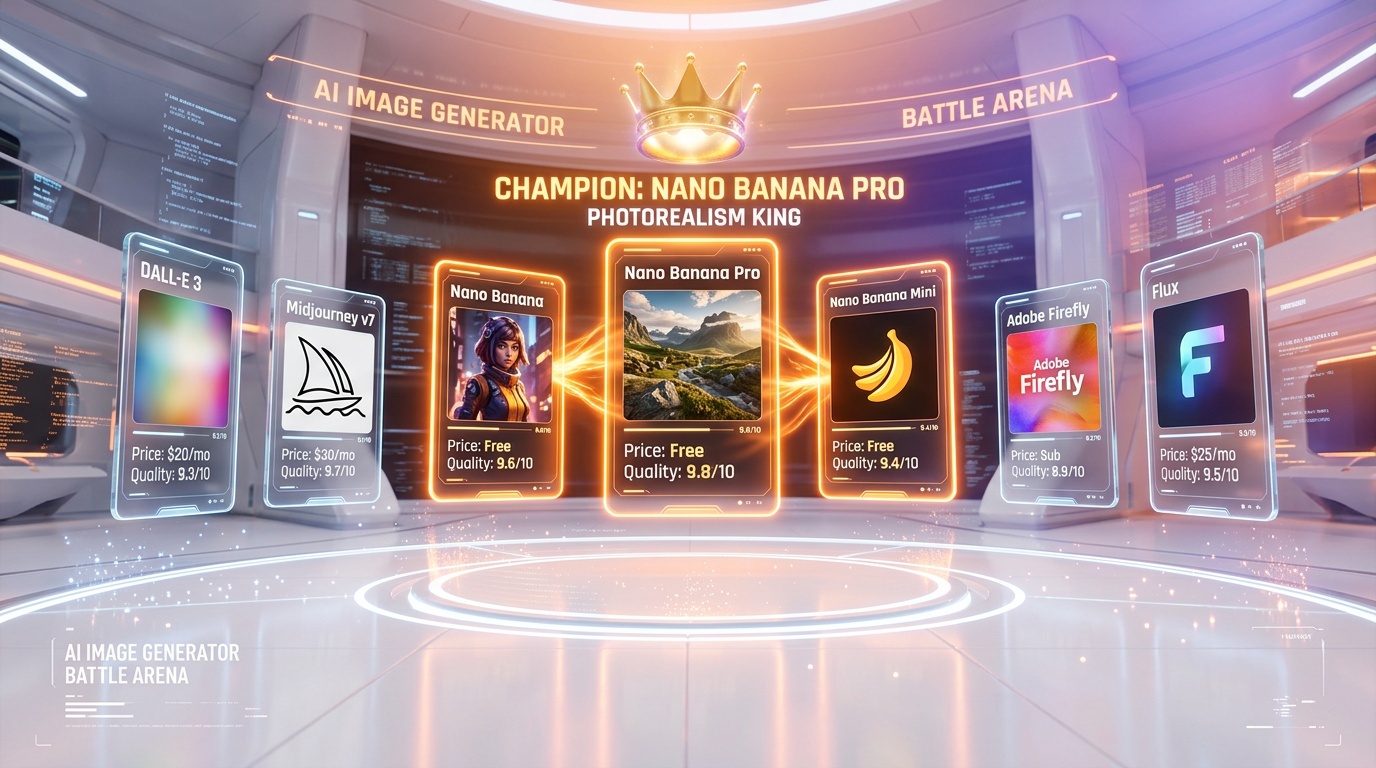
| Model | Price/Image | Photorealism | Text Rendering | API Access | Best For |
|---|---|---|---|---|---|
| Nano Banana | $0.039 | Good | Good | Yes | Budget, volume |
| Nano Banana Pro | $0.134 | Excellent | Excellent | Yes | Photorealism, 4K |
| Nano Banana 2 | $0.067 | Very Good | Very Good | Yes | Production, balance |
| DALL-E 3 (OpenAI) | $0.040-$0.120 | Good | Good | Yes | ChatGPT integration |
| Midjourney v7 | $0.02-$0.06* | Excellent | Fair | Limited | Artistic, creative |
| Stable Diffusion 3.5 | Free (self-host) | Good | Fair | Self-hosted | Open source, custom |
| Adobe Firefly 3 | Subscription | Very Good | Good | Enterprise | Commercial safe |
| Ideogram 3.0 | $0.02-$0.08 | Good | Excellent | Yes | Text in images |
| Flux 1.1 Pro | $0.04-$0.06 | Very Good | Good | Yes | Fast generation |
*Midjourney pricing is subscription-based ($10-$120 per month), per-image cost varies by plan and usage.
Key Competitive Advantages
Versus DALL-E 3. Nano Banana Pro surpasses DALL-E 3 in photorealism and text rendering. Banana 2 matches DALL-E 3's quality at a comparable price point but with better API flexibility. The original undercuts DALL-E 3's cheapest tier. Google's advantage: native multimodal integration means you can chat with the model about image edits using natural language.
Versus Midjourney v7. Midjourney still produces the most artistically distinctive images, especially for creative and stylized work. But Midjourney's API access remains limited compared to Google's open API. For programmatic generation at scale, the Nano Banana family wins on accessibility. Pro matches Midjourney's quality for photorealism while offering better text rendering.
Versus Stable Diffusion 3.5. Stable Diffusion's open-source nature means zero per-image cost if you self-host, but you need GPU infrastructure. For teams without ML engineering resources, Nano Banana's API is far simpler to integrate. Quality-wise, Banana 2 and Pro both exceed Stable Diffusion 3.5 in out-of-the-box photorealism.
Versus Flux 1.1 Pro. Flux is fast and affordable but lacks the deep multimodal integration that makes Nano Banana models unique. You cannot edit images conversationally with Flux the way you can with any Nano Banana model through Gemini.
API Integration Guide
All three Nano Banana models are accessible through the Gemini API, Google AI Studio, and Vertex AI. The API interface is identical across models — you only change the model ID. Here is a basic integration example.
Direct API Access
Through the Gemini API, you send a text prompt and receive an image. The model ID determines which Nano Banana model processes your request:
gemini-2.5-flash-image— Original Nano Bananagemini-3-pro-image-preview— Nano Banana Progemini-3.1-flash-image-preview— Nano Banana 2
All three support the same API parameters: prompt text, output resolution (where applicable), style presets, and safety settings. Switching between models requires changing a single string in your API call.
Third-Party Platform Access
Several creative platforms have integrated Nano Banana models:
- Leonardo.ai — Offers Nano Banana, Nano Banana Pro, and Nano Banana 2 as selectable models. Charges 140 to 250 API credits per generation depending on the model and resolution. This is how we access Banana 2 for our production pipeline.
- Adobe Creative Suite — Pro is available through Firefly's enterprise integration
- Figma — Pro integration for design prototyping
- OpenRouter — All three models available through their unified API at competitive rates
Our Production Setup
At ThePlanetTools.ai, our image generation pipeline works like this: we send structured prompts to Leonardo.ai's API specifying the nano-banana-2 model. Each prompt follows our glassmorphism style guide — bright white scenes, orange (#FF6B2C) primary glow, violet (#8B5CF6) accents, holographic cards with readable text. The images generate at 1376x768 resolution using the 3D Render style preset, then get uploaded to our Supabase storage and injected into content HTML automatically.
Total cost per content page with 5 images: approximately $0.35 to $0.50 depending on prompt complexity. At our current publishing rate of 10 to 15 pages per week, that is $3.50 to $7.50 weekly in image generation costs.
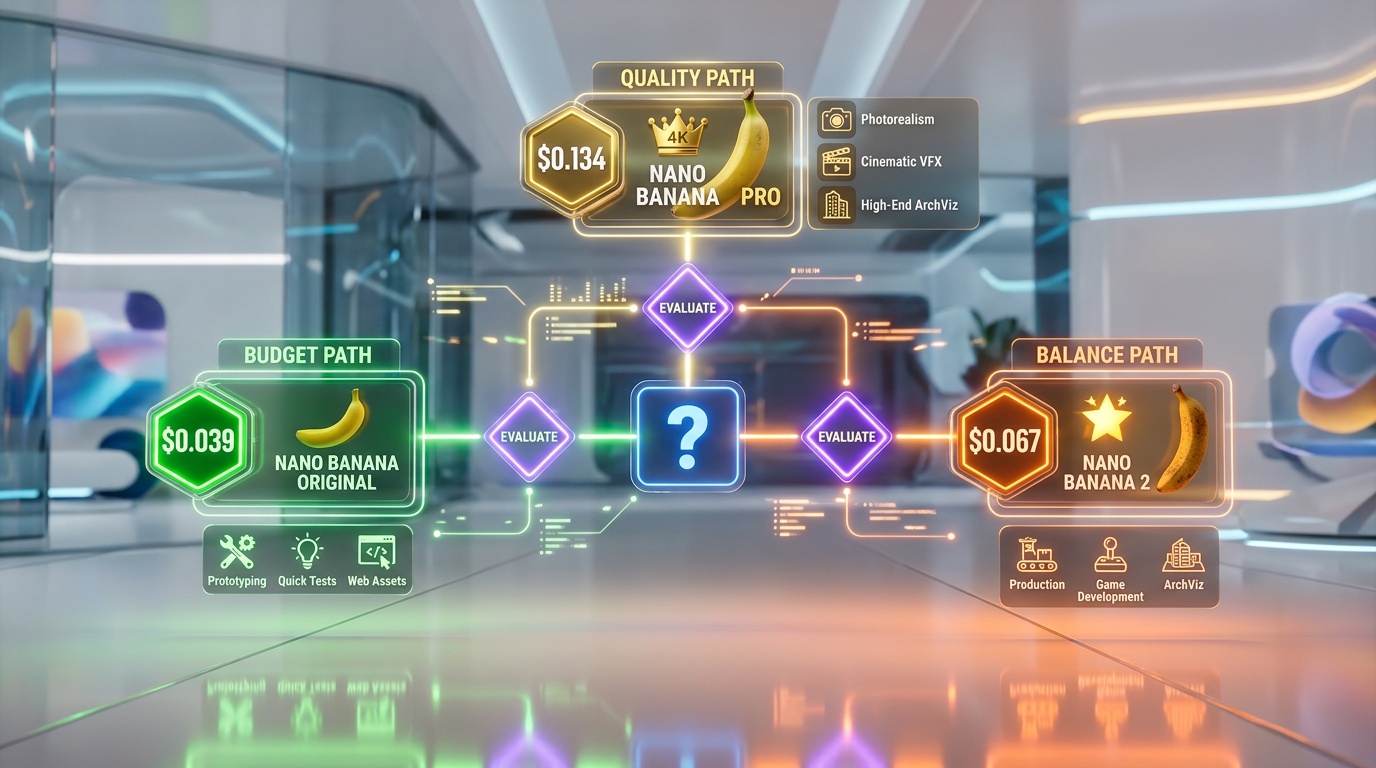
Which Model Should You Choose?
After testing all three models across hundreds of image generation tasks, here is our decision framework.
Choose Nano Banana (Original) If:
- You are prototyping and need quick, cheap iterations
- You want to use the free tier (500 requests per day in AI Studio)
- Image quality is not the primary concern
- You are building a proof of concept before investing in Pro or Banana 2
- Budget is under $50 per month for image generation
Choose Nano Banana Pro If:
- Photorealism is non-negotiable (product photos, portraits, realistic scenes)
- You need true 4K resolution output
- Text rendering accuracy is critical (marketing materials, infographics)
- You are creating client-facing work where quality justifies the 3.4x cost premium
- You work in enterprise with Vertex AI integration needs
Choose Nano Banana 2 If:
- You need production-quality images at scale
- Speed matters as much as quality
- Your style is more graphic/stylized than photorealistic
- You access models through platforms like Leonardo.ai
- You want the best price-to-quality ratio in the family
- You generate 100 or more images per month
Advanced Tips from Our Daily Usage
After generating thousands of images across all three models, here are the practical insights we have gathered.
Prompt Engineering Differences
Each model responds differently to prompt structure. The original Nano Banana works best with short, direct prompts (50 to 100 words). Pro handles complex, multi-element prompts better than any other model in the family — describe 5 subjects with specific spatial relationships and it usually nails it. Banana 2 sits in the middle — it handles complexity well but benefits from explicit style keywords.
Batch Processing Strategy
All three models offer 50% batch discounts for 24-hour turnaround. If you do not need images immediately, always use batch mode. We schedule our content image generation overnight and review results the next morning. The savings at scale are massive: 10,000 images via Banana 2 batch costs $340 versus $670 in real-time.
Style Consistency Across Models
Switching between models mid-project creates visual inconsistency. Stick to one model per project or per visual style. We use Banana 2 for all standard content images and only switch to Pro for specific photorealistic hero images that need to impress on first impression.
The Leonardo.ai Advantage
Leonardo.ai offers all three models plus additional style presets and post-processing options. Their credit system can be more cost-effective than direct API access for medium-volume users (500 to 2,000 images per month). The platform also handles rate limiting, retries, and quality filtering automatically — saving engineering time on infrastructure.
The Future of Nano Banana
Google's trajectory is clear: faster models, lower prices, better quality. The jump from the original to Banana 2 in just five months was dramatic. We expect the following developments in the second half of 2026:
- Price reductions — Google has historically dropped API prices as models mature. Banana 2's pricing will likely decrease by Q3 2026.
- Nano Banana 3 — Based on the naming pattern and Google's release cadence, a next-generation model is probable by late 2026.
- Video integration — With Veo 3.1 already available, expect tighter integration between image and video generation models.
- Wider free tiers — Competitive pressure from open-source models like Stable Diffusion and Flux may push Google to expand free access.
Cost Optimization Playbook
Here is the strategy we use to minimize costs while maintaining quality across our content pipeline.
1. Tiered Generation Approach
Not every image needs the same quality level. We use a tiered system: hero images and cover images get generated with Pro for maximum impact. In-content illustrations use Banana 2 for cost efficiency. Quick drafts and internal prototypes use the original. This mixed approach cuts our total image budget by approximately 40% compared to using Pro exclusively.
2. Prompt Optimization
Shorter prompts cost less in text input tokens. We have refined our prompts to be maximally descriptive with minimal words. A well-crafted 80-word prompt consistently outperforms a 300-word prompt across all three models. With Pro's $2.00 per million tokens input token pricing, verbose prompts add measurable cost at scale.
3. Batch Everything Possible
The 50% batch discount is the single biggest cost saving available. We batch all non-urgent generation. Only time-sensitive news article images get generated in real-time.
4. Cache and Reuse
We store all generated images in Supabase storage with metadata linking them to their source prompts. Before generating a new image, we check if a similar prompt has already been processed. This eliminates redundant generation and has saved us approximately 15% in monthly costs.
Common Mistakes to Avoid
Based on our experience and community feedback, here are the pitfalls to watch for.
- Using Pro for everything. Pro is the best model, but paying $0.134 per image for social media thumbnails or internal documentation images is wasteful. Match the model to the use case.
- Ignoring batch pricing. The 50% discount on batch processing is free money if your workflow allows 24-hour turnaround. Most content production workflows do.
- Treating Nano Banana like DALL-E. These models respond to different prompt patterns. Prompts optimized for DALL-E 3 will not perform optimally on Nano Banana. Invest time in testing prompts specifically for whichever model you choose.
- Not tracking per-image costs. With multimodal pricing (text input + image output), actual costs per image vary based on prompt length. Monitor your actual spend, not just the listed image output price.
- Skipping the free tier. The original Nano Banana's 500 requests per day free tier in AI Studio is generous. For small projects or learning, use it before committing to paid access.
Frequently Asked Questions
Frequently Asked Questions
Is Google Nano Banana better than Midjourney for AI image generation?
It depends on the model. Nano Banana Pro ($0.134 per image) matches or exceeds Midjourney in photorealism and supports true 4K output. Nano Banana 2 ($0.067 per image) offers comparable quality at lower cost with faster generation. The original ($0.039 per image) is cheaper but falls short of Midjourney's quality. All three Nano Banana models are accessible via API, unlike Midjourney which has limited API availability.
Is Nano Banana Pro better than ChatGPT's DALL-E 3 for photorealistic images?
Yes, Nano Banana Pro delivers superior photorealism with true 4K resolution, better text rendering accuracy, and more realistic skin textures, lighting, and reflections. Pro costs $0.134 per image and includes SynthID digital watermarks plus grounding with Google Search for real-world accuracy. DALL-E 3 is limited to 1024x1024 natively. Pro integrates with Adobe, Figma, and Vertex AI for enterprise workflows.
Who should use Nano Banana 2 instead of Nano Banana Pro?
Nano Banana 2 is ideal for production teams needing consistent, high-quality images at scale. At $0.067 per image (50% cheaper than Pro's $0.134), it delivers Pro-level visual quality with Flash-speed efficiency. We use Banana 2 daily via Leonardo.ai for all our glassmorphism illustrations. Choose Pro only when you need true 4K resolution, superior text rendering, or the absolute best photorealism for marketing campaigns.
What are Google Nano Banana's limitations?
The original Nano Banana lacks 4K support, struggles with complex multi-subject prompts, and produces less photorealistic results. Pro is expensive at $0.134 per image ($134 per 1,000 images) with no free tier. Banana 2 caps at 2K resolution and also has no free tier. Only the original offers a free tier (~500 requests per day in AI Studio). All models have knowledge cutoffs (June 2025 for original, January 2025 for Pro and Banana 2).
Does Nano Banana integrate with Leonardo.ai and Adobe?
Yes. Nano Banana 2 (Gemini 3.1 Flash Image) is available through Leonardo.ai — we use this integration daily for all our site images at $0.067 per image. Nano Banana Pro integrates with Adobe and Figma for professional creative workflows, and is available through Google's Vertex AI for enterprise deployments. All three models are accessible via Google AI Studio's API.
How much does it cost to generate 1,000 images with each Nano Banana model?
At standard pricing: Original costs $39 (1,000 × $0.039), Banana 2 costs $67 (1,000 × $0.067), and Pro costs $134 (1,000 × $0.134). All three models offer a 50% batch discount for 24-hour turnaround, cutting costs to $19.50, $34, and $67 respectively. The original is 3.4× cheaper than Pro, while Banana 2 sits at roughly half Pro's cost.
Which Nano Banana model is best for website and blog images?
Nano Banana 2 is the best choice for website and blog images. At $0.067 per image, it combines Pro-level visual quality with Flash-speed generation. We generate every illustration on ThePlanetTools.ai using Banana 2 via Leonardo.ai. It supports up to 2K resolution which is sufficient for web use. Only upgrade to Pro ($0.134 per image) if you need 4K or text-heavy infographics.