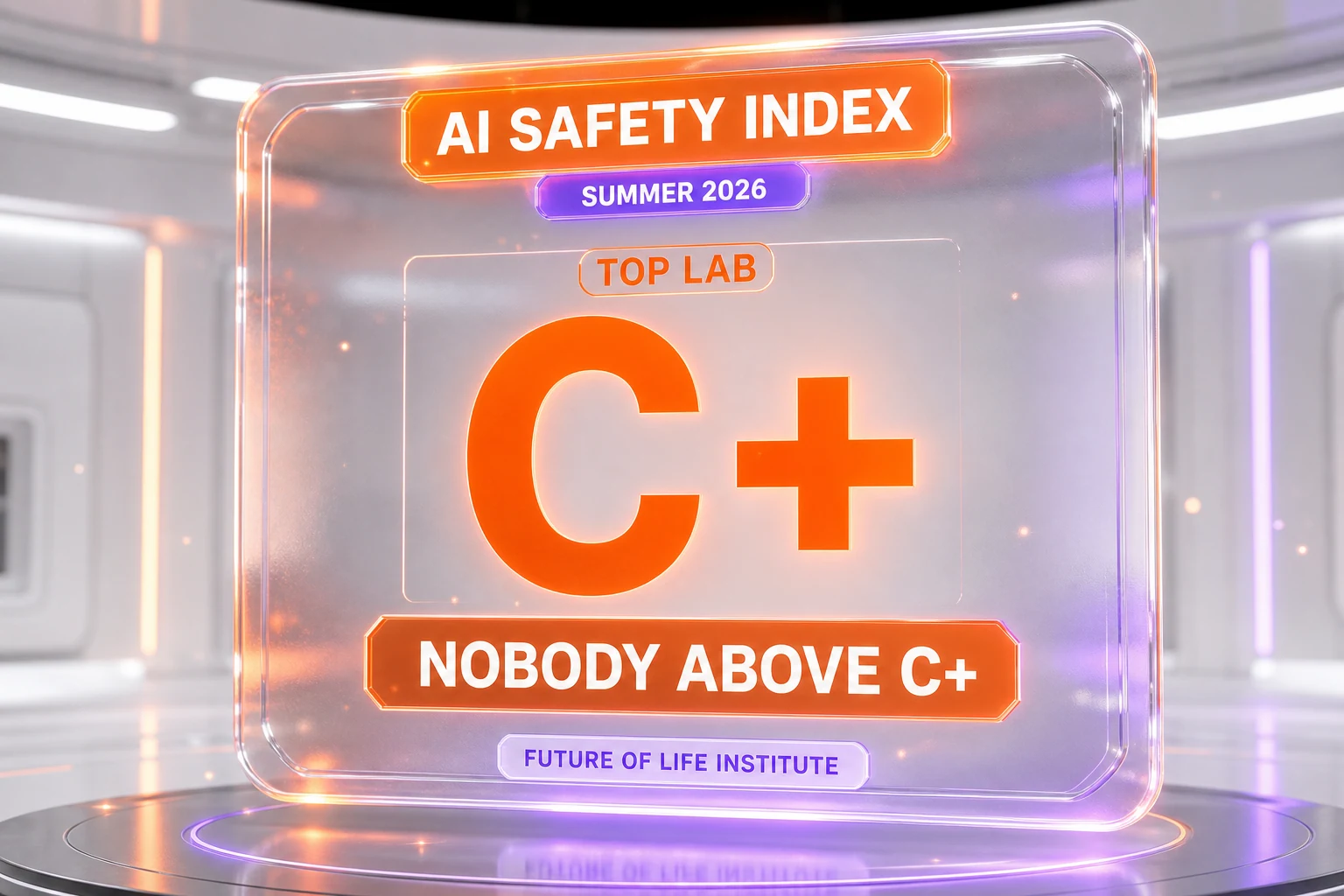
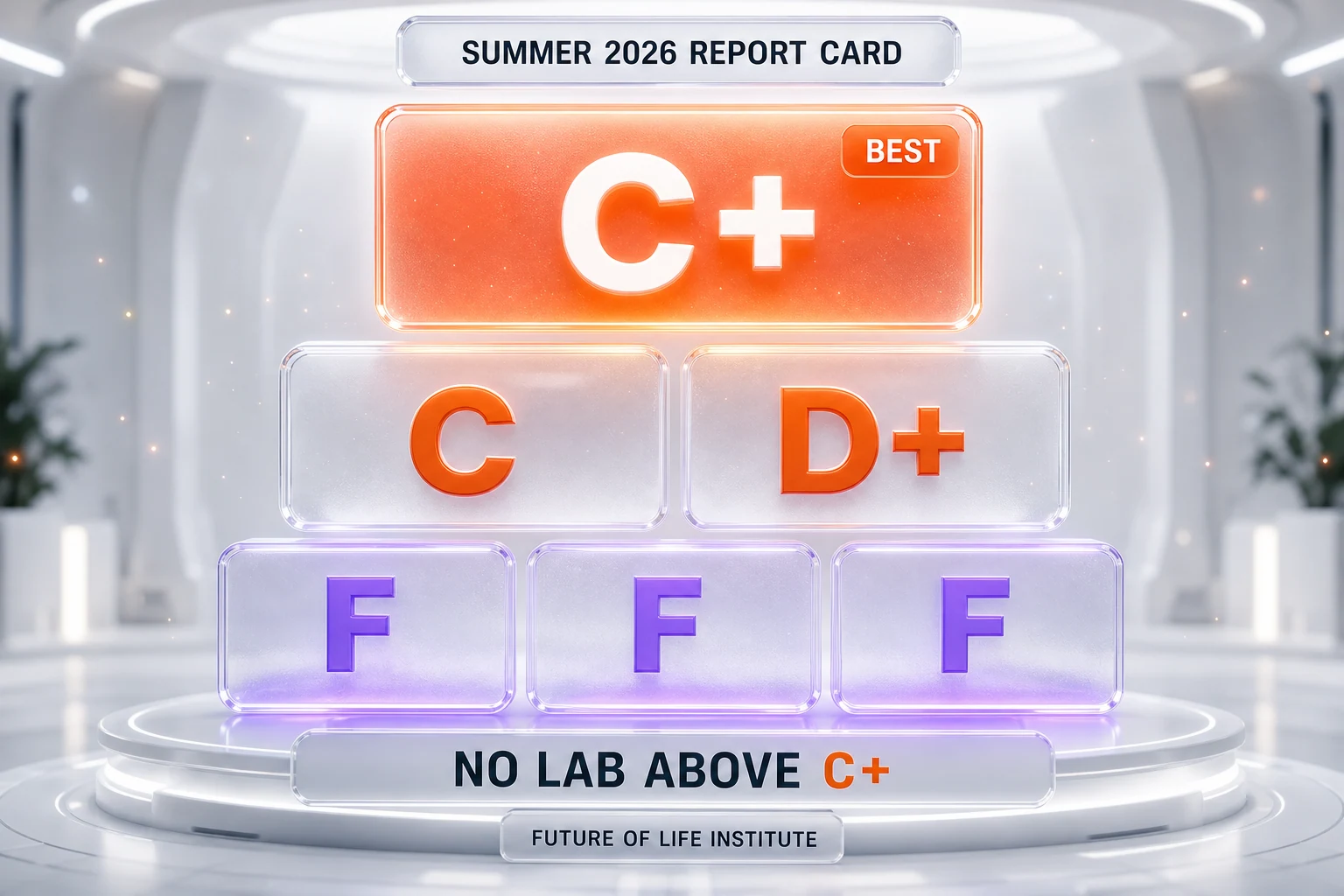
Which AI lab is the safest? According to the Future of Life Institute's AI Safety Index for Summer 2026, published in early July 2026, the answer is Anthropic — and even Anthropic only earns a C+. The Index graded seven frontier AI labs across six safety domains through a panel of independent experts. No lab scored higher than C+. Anthropic ranked first with an overall score of 2.66, OpenAI slipped to a C, Google DeepMind placed third, Meta climbed to D+, and three labs — SpaceXAI, DeepSeek, and Mistral — each flunked with an F, one on each of three continents.
Key Takeaways
- Anthropic is No. 1 — at a C+. The top of the class scored 2.66 and led five of the six safety domains. The best grade in frontier AI is still a "fair," not a "good."
- No lab cleared C+. The Index's headline finding is a ceiling: the entire industry is bunched in the middle-to-failing band, with a wide gap between marketing and measured safety.
- Three F's on three continents. SpaceXAI (US), DeepSeek (China), and Mistral (Europe) all failed — evidence that unsafe AI is a global problem, not a regional one.
- Labs are walking back their own redlines. Several firms, including Anthropic, OpenAI, Google DeepMind, and Meta, have weakened or dropped pledges to halt development if hard safety limits are approached.
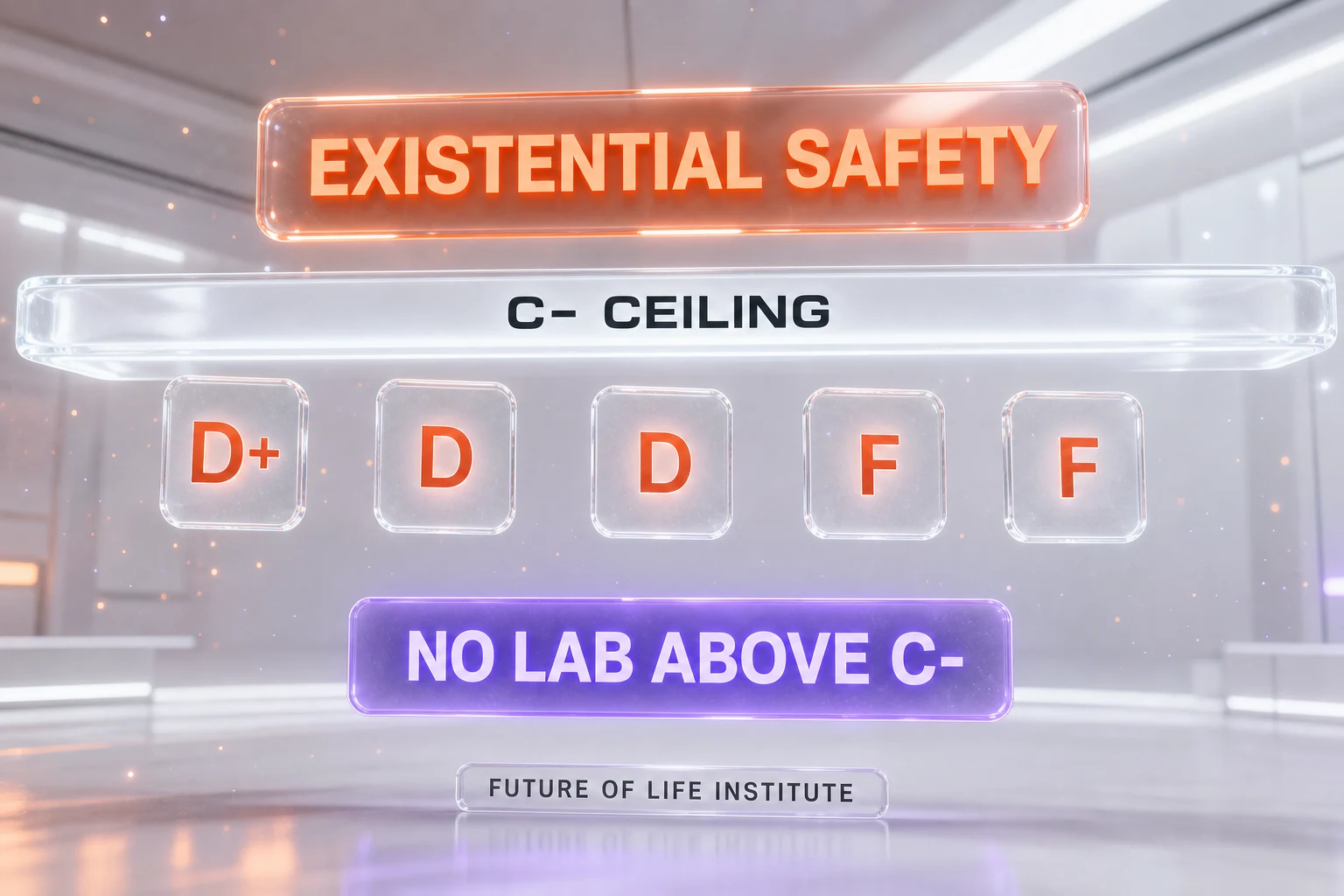
- Existential Safety is the industry's widest crack. It is the weakest domain across every lab — no company scored above a C-, and most sit at D or below.
What the Future of Life AI Safety Index Actually Measures
The AI Safety Index is an independent scorecard produced by the Future of Life Institute, a nonprofit that has tracked AI risk for over a decade. It is not a benchmark of how smart a model is or how well it codes. It is a judgment of how responsibly the company behind the model behaves. A panel of independent AI safety and governance experts reviews public evidence and grades each lab across six domains: Risk Assessment, Existential Safety, Safety Frameworks, Governance and Accountability, Transparency, and Technical Safety Research.
The Summer 2026 edition, released in early July 2026, is a follow-up to the Institute's earlier rounds and lets the industry be measured against itself over time. That time dimension matters: the most damaging findings this round are not the raw grades but the direction of travel. Some labs improved. Some fell. And on the domain that the Institute treats as most consequential — keeping future, more capable systems under human control — almost nobody moved at all.
Because these grades come from a third party rather than the labs themselves, they carry a different weight than a company's own safety page. The Index sits alongside a growing stack of external scrutiny, from Illinois's first-in-the-nation mandate for independent AI safety audits to the shifting timelines of the EU AI Act. We are reporting these results as the Institute published them — ThePlanetTools did not grade any lab.
The Full Ranking: Every Lab, Every Grade
Seven labs were graded this round. Anthropic — the company behind Claude Opus 4.8 — took the top spot with a C+ and an overall score of 2.66, leading five of the six domains. OpenAI, maker of GPT-5.6 Sol, fell from a C+ in the previous round to a C, landing second. Google DeepMind placed third, just behind OpenAI. Meta was the round's biggest riser, climbing from sixth place to fourth on a D+.
Then comes the failing band. SpaceXAI (the lab the Index lists under its former name, xAI) suffered the sharpest fall, dropping from fourth place to seventh — dead last — with an F and a score of 0.65. DeepSeek scored an F at 0.47, and Mistral scored an F at 0.33. All three of those numbers sit below C-level territory, and the three failing labs are spread across the United States, China, and Europe.
Summer 2026 Grades at a Glance
| Lab | Grade | Rank | Overall score | Notable |
|---|---|---|---|---|
| Anthropic | C+ | 1st | 2.66 | Leads 5 of 6 domains |
| OpenAI | C | 2nd | — | Dropped from C+; leads Risk Assessment |
| Google DeepMind | — | 3rd | — | Just behind OpenAI |
| Meta | D+ | 4th | — | Biggest riser: up from 6th |
| DeepSeek | F | Bottom band | 0.47 | Failing grade (China) |
| Mistral | F | Bottom band | 0.33 | Lowest score in the Index (Europe) |
| SpaceXAI | F | 7th | 0.65 | Biggest faller: down from 4th (US) |
A note on the numbers: the headline scores and the ordinal ranks are both reported by the Institute, and they do not track each other cleanly. SpaceXAI's 0.65 is numerically higher than DeepSeek's 0.47 and Mistral's 0.33, yet the panel placed SpaceXAI last at seventh — a reminder that overall standing reflects expert judgment across all six domains, not a single figure. Google DeepMind's exact letter grade was not the headline of this edition; the Institute placed it third, immediately behind OpenAI.
Why No Lab Cleared a C+
The single most important line in the Summer 2026 Index is not about any one company. It is that the best performer in the entire field is merely average. When the leader of a safety-critical industry earns a C+, the story is not "who won" — it is "how low the ceiling sits." The Institute frames this as a gap between capability and control: the models keep getting more powerful while the safeguards around them improve slowly, unevenly, or not at all.
Anthropic earned its first-place finish on relative strengths — a comparatively established safety framework, published technical safety research, more disclosure than its peers, and clearer internal governance. But "better than the others" is doing a lot of work in a field where the others are graded C, D+, and F. Even the Institute's assessment of the leader reads as a list of things that are present rather than a list of things that are solved. The C+ ceiling is the whole point: on the metrics that a neutral panel of experts considers most important, no frontier lab is yet doing enough.
Three F's on Three Continents: Unsafe AI Is a Global Problem
It would be convenient to read the failing grades as a story about one region cutting corners. The Index refuses that framing. The three F's are distributed almost symmetrically across the world's three main AI blocs: SpaceXAI in the United States, DeepSeek in China, and Mistral in Europe. No single regulatory culture owns the problem, and no single one has solved it.
SpaceXAI's collapse from fourth to seventh is the most dramatic movement in the round. The lab behind Grok 4.5 spent much of 2026 in the headlines for reasons that have nothing to do with capability — a stretch documented in our timeline of the Grok deepfake scandal. DeepSeek, maker of DeepSeek V4, and Mistral, maker of Mistral Large 3, both scored below half a point, with Mistral posting the Index's lowest number at 0.33. For all three, the message from the panel is blunt: shipping competitive models does not earn a passing safety grade.
The Redlines Retreat: Labs Are Walking Back Their Own Pledges
The finding the Institute treats as most alarming is not about the laggards — it is about the leaders. Several of the top labs, including Anthropic, OpenAI, Google DeepMind, and Meta, have weakened or quietly dropped earlier commitments to pause development unilaterally if their systems approached defined "redlines," the hard safety limits a company sets for itself. In some cases the pledge did not disappear so much as sprout a condition: a lab will hold the line only if its competitors do the same.
That conditional framing is exactly the coordination trap that safety researchers have warned about for years. A redline that only holds when everyone else honors theirs is not a brake — it is a race. If pausing depends on rivals pausing, no one pauses, because no one wants to cede ground. The Index's reading is that the industry's voluntary safety architecture, built on self-imposed limits, is being eroded by competitive pressure at the exact moment the models are getting more capable. It is a live illustration of the tension Demis Hassabis described when he recast the timeline to advanced AI earlier this year, and of the stakes in Anthropic's own two-scenario policy paper on 2028.
Existential Safety: The Industry's Widest Crack
If the redlines retreat is the trend, Existential Safety is the wound. This domain asks a specific question: does the lab have a credible plan to keep future, more capable systems under human control? Across the entire field, the answer graded out as no. Existential Safety is the weakest of the six domains for every lab in the Index. No company scored above a C- on it, and most landed at D or below — including the same firms that earned respectable marks on transparency and governance.
That pattern is the quiet headline. A lab can publish model cards, run red-team exercises, and disclose incidents — the things that lift its overall grade — while still having no convincing answer for the hardest question of all. The Institute's point is that current safety work is heavily weighted toward present-day harms and documentation, and thinly weighted toward the long-horizon control problem. The gap between "we can describe our system" and "we can guarantee we keep control of a smarter one" is where the whole industry is exposed.
What a C+ Ceiling Means If You're Choosing a Model
For a business or developer picking a model, the Index is not a buying guide and does not pretend to be — a lab's safety grade is separate from a model's speed, price, or coding ability. A high safety grade does not make a model the best tool, and a failing grade does not make a model unusable. What the Index offers instead is a governance signal: how seriously the company behind your model treats the responsibilities that come with it.
Read that way, the practical takeaways are modest but real. First, treat every frontier lab's safety marketing with the skepticism a C+ ceiling deserves; even the leader has unsolved problems. Second, if governance and disclosure matter to your organization — for procurement, compliance, or reputational reasons — the Index gives you an independent, comparable reference point rather than a vendor's self-description. Third, watch the trend line, not just the letter. A lab drifting away from its own redlines may look fine today and matter enormously in two years. The safest available option is still only "fair," and the honest way to use that information is to plan around it, not to pretend it away.
Frequently Asked Questions
What is the Future of Life AI Safety Index?
The AI Safety Index is an independent scorecard from the Future of Life Institute, a nonprofit that tracks AI risk. A panel of independent experts grades the major AI labs on how responsibly they operate, across six domains: Risk Assessment, Existential Safety, Safety Frameworks, Governance and Accountability, Transparency, and Technical Safety Research. It rates the company's safety practices, not how capable or fast its models are.
Which AI lab is the safest in 2026?
In the Future of Life Institute's Summer 2026 AI Safety Index, Anthropic ranked first with a C+ and an overall score of 2.66, leading five of the six safety domains. But first place is still only a C+: no lab in the Index scored higher, so even the safest frontier lab is graded as merely fair rather than good.
Why did no AI lab score above a C+?
The Index's central finding is that the whole field is bunched in a middle-to-failing band. The panel judged that models are getting more capable faster than the safeguards around them are improving, leaving a persistent gap between capability and control. Anthropic led on relative strengths like disclosure, governance, and published research, but even the leader had unresolved weaknesses — enough to cap the top of the industry at a C+.
What grade did OpenAI get in the Summer 2026 AI Safety Index?
OpenAI scored a C in the Summer 2026 Index, down from a C+ in the previous round, and placed second overall. It was the only lab to lead the Risk Assessment domain, credited for a broader suite of evaluations and more diverse external testing, but its overall grade slipped compared with the earlier edition.
What grade did Anthropic get?
Anthropic received a C+, the highest grade in the Summer 2026 Index, with an overall score of 2.66 and a first-place finish. It led five of the six domains — including transparency, safety frameworks, technical safety research, and governance — while trailing OpenAI on Risk Assessment. Its lead is real but relative: a C+ is still the ceiling for the entire industry.
Which AI labs failed the Summer 2026 Safety Index?
Three labs earned a failing F: SpaceXAI with a score of 0.65, DeepSeek with 0.47, and Mistral with 0.33 — the lowest score in the Index. Notably, the three failures are spread across three continents: the United States, China, and Europe, which the Institute cites as evidence that weak AI safety is a global problem rather than a regional one.
Why is SpaceXAI (formerly xAI) ranked last?
SpaceXAI — the lab the Index lists under its former name, xAI — dropped from fourth place to seventh, the sharpest fall of the round, and earned an F. Its overall score of 0.65 is numerically higher than DeepSeek's and Mistral's, but the panel still placed it last because overall standing reflects expert judgment across all six domains, not a single number. SpaceXAI is the company behind Grok.
What does walking back redlines mean, and which labs did it?
Redlines are the hard safety limits a lab sets for itself, with a pledge to pause development if a system approaches them. The Index found that several leading labs — including Anthropic, OpenAI, Google DeepMind, and Meta — have weakened or dropped those pledges, in some cases promising to hold the line only if competitors do the same. Safety researchers warn that a conditional redline is not a real brake, because if pausing depends on rivals pausing, no one pauses.
What is Existential Safety and why is it the weakest domain?
Existential Safety measures whether a lab has a credible plan to keep future, more capable systems under human control. It is the weakest of the six domains for every lab in the Index: no company scored above a C- on it, and most landed at D or below. The Institute's point is that current safety work leans heavily on present-day harms and documentation while thinly addressing the long-horizon control problem.
When was the Summer 2026 AI Safety Index published?
The Future of Life Institute released the Summer 2026 edition of its AI Safety Index in early July 2026. It is a follow-up to the Institute's earlier rounds, which lets the labs be measured against their own past grades and highlights which companies improved and which fell.
Does a low safety grade mean a model is bad or unsafe to use?
No. The Index grades the company's safety practices, not a model's quality, speed, price, or accuracy. A failing grade does not make a model unusable, and a high grade does not make a model the best tool for a task. The Index is best read as a governance signal — how seriously the lab behind your model treats its responsibilities — rather than as a buying guide.
How does Meta's D+ compare to the rest of the field?
Meta was the biggest riser of the round, climbing from sixth place to fourth on a D+. That still puts it below the passing tier occupied by Anthropic, OpenAI, and Google DeepMind, but above the three failing labs. A D+ improvement shows movement in the right direction while underscoring the Index's larger point: even a notable riser lands well short of a good grade.