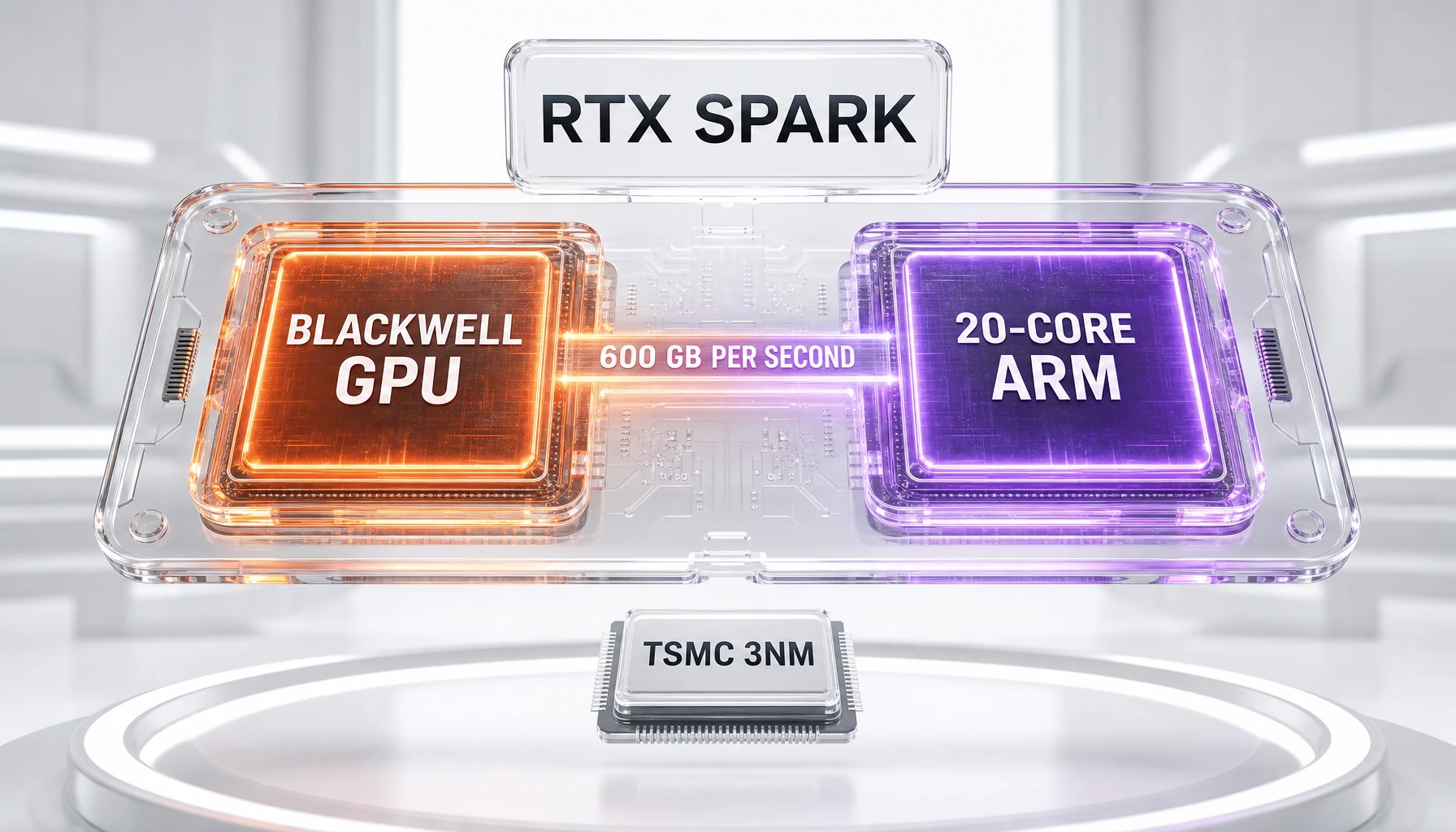
NVIDIA's RTX Spark is a two-chiplet system-on-chip for consumer Windows-on-Arm laptops and mini-PCs, unveiled by CEO Jensen Huang at Computex 2026 on June 1, 2026. It fuses a Blackwell-architecture GPU chiplet rated at 6,144 CUDA cores — roughly GeForce RTX 5070 class — with a 20-core Arm CPU co-designed with MediaTek, linked by a 600 GB per second silicon bridge. Built on TSMC's 3nm process with around 70 billion transistors, it is NVIDIA's first chip aimed at mainstream consumer PCs in more than a decade, and it is pitched squarely at on-device AI agents, local inference, content creation, and gaming. First devices are expected before the 2026 holidays, with wider availability in early 2027. NVIDIA disclosed no pricing.
For a site that lives and breathes AI tooling, the headline number here is not the CUDA count. It is the phrase "on-device AI agents." NVIDIA spent the last three years selling the most expensive accelerators on Earth into data centers — the company that built the cloud now wants a beachhead inside your laptop. RTX Spark is the vehicle, and the timing tells you exactly which way the AI workload pendulum is swinging: back toward the edge, back toward the device in your hands.
This is an analysis of what NVIDIA actually announced, what it deliberately left blank (price, mostly), and why a consumer Arm chip from the world's most valuable semiconductor company is one of the more consequential moves for local AI in years. We did not test the silicon — nobody outside NVIDIA and its launch partners has — so treat every performance characterization as a vendor claim until independent benchmarks land.
What NVIDIA actually unveiled at Computex 2026
Jensen Huang took the stage at the Taipei Music Center on June 1, 2026, and confirmed what the leak community had been circling for months under the codenames N1 and N1X. The shipping name is RTX Spark. It is a single processor package containing two distinct chiplets stitched together, and NVIDIA is positioning it as a full PC platform rather than a discrete add-in part.
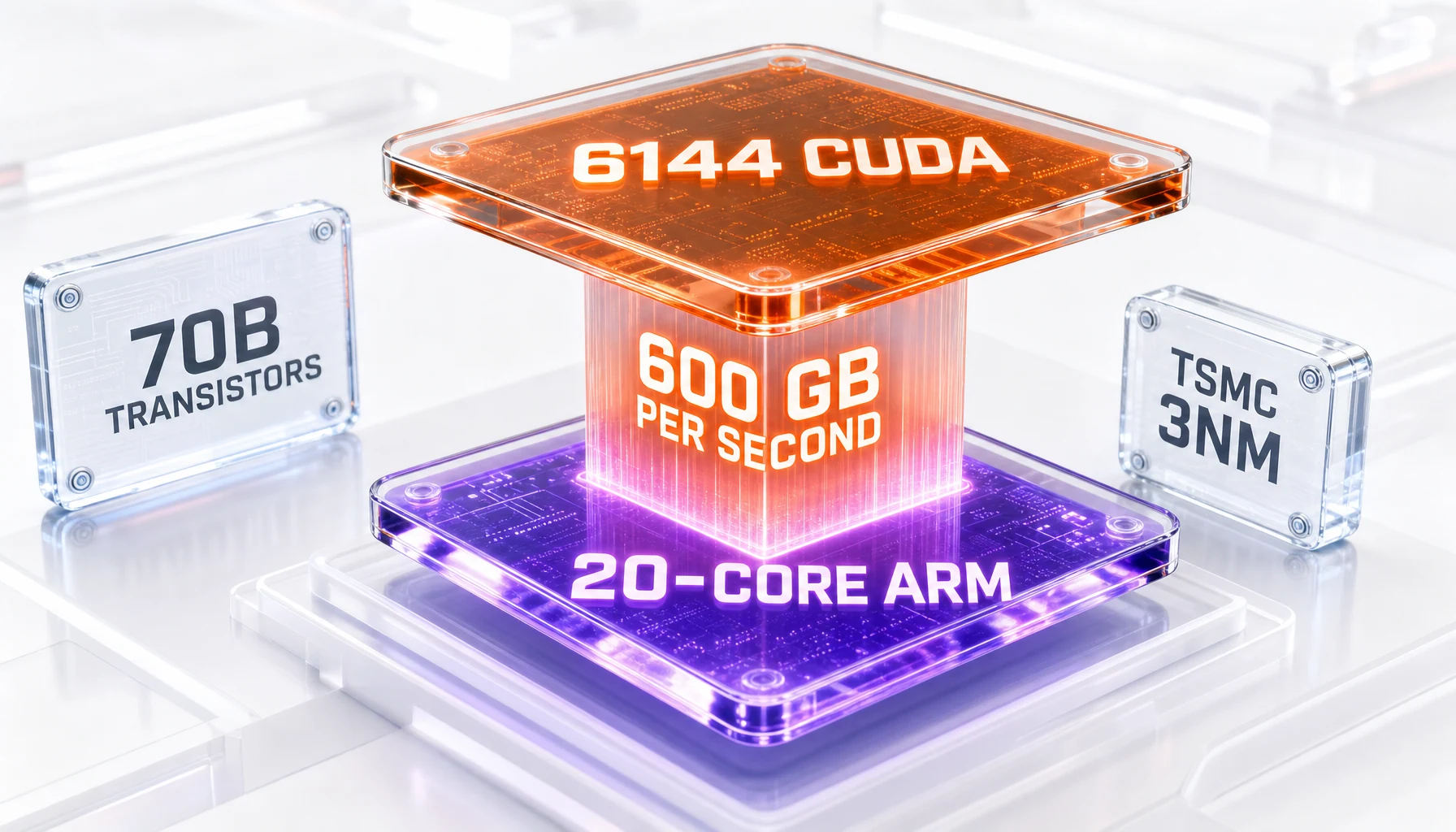
The structure breaks down like this. One chiplet is a GPU built on NVIDIA's Blackwell architecture, carrying 6,144 CUDA cores — a configuration NVIDIA characterizes as roughly GeForce RTX 5070 class. The second chiplet is a 20-core Arm CPU co-designed with MediaTek, NVIDIA's long-standing partner in the automotive and embedded space. The two chiplets communicate over a silicon interconnect rated at 600 GB per second, which is the kind of on-package bandwidth you need if you want the CPU and GPU to share memory and feed an AI model without choking on data transfer.
NVIDIA confirmed the chip is manufactured on TSMC's 3nm node and carries on the order of 70 billion transistors. For context, that transistor budget puts RTX Spark in the same physical league as high-end discrete GPUs and mobile flagship SoCs, not the modest integrated graphics that Windows-on-Arm devices have shipped with to date.
The CPU side: a 20-core Arm design with MediaTek
The CPU chiplet is where the "first consumer Arm chip in over a decade" framing comes from. NVIDIA's previous mainstream Arm-for-PC ambitions stalled out years ago, and the Tegra line drifted toward automotive, robotics, and the Nintendo Switch rather than Windows laptops. RTX Spark is a deliberate return to the consumer client market.
The 20-core layout is split into two clusters: ten high-performance Arm Cortex-X925 cores and ten efficiency-focused Cortex-A725 cores, with peak clocks reported up to roughly 4.1 GHz on the performance cores. That is a big-little arrangement familiar from the smartphone world, scaled up for a sustained laptop and mini-PC thermal envelope. Co-designing it with MediaTek matters: MediaTek already ships hundreds of millions of Arm cores annually and knows how to tune power curves for thin devices, which is precisely the discipline NVIDIA has historically lacked outside of its data-center comfort zone.
The GPU side: Blackwell comes to the laptop
The GPU chiplet is the part that makes RTX Spark interesting for AI specifically. A Blackwell-class GPU with 6,144 CUDA cores brings the same tensor hardware, CUDA programming model, and software stack that developers already use on NVIDIA's data-center and desktop parts. That continuity is NVIDIA's single biggest structural advantage over every other player in this fight. A model that runs on a CUDA GPU in the cloud runs on a CUDA GPU in RTX Spark with minimal porting friction.
RTX 5070-class performance in a laptop SoC is not trivial. If the vendor characterization holds up under independent testing, it would put RTX Spark well ahead of the integrated graphics in current Windows-on-Arm devices and into the territory where running quantized large language models locally — at usable token rates — stops being a science project and becomes a default.
Why a consumer Arm chip from NVIDIA matters now
NVIDIA does not enter low-margin consumer markets on a whim. The company has spent the AI boom selling $30,000-plus accelerators by the rack. A consumer PC SoC carries thinner margins, brutal OEM negotiations, and a Windows-on-Arm software ecosystem that is still maturing. So why now?
The answer is the AI workload itself. The first wave of generative AI was overwhelmingly cloud-hosted because the models were too big and the hardware too scarce to run anywhere else. That assumption is breaking. Quantization, distillation, and smaller capable models have made on-device inference genuinely useful — we have tracked this shift directly in coverage of Apple optimizing 70B-class LLMs on the M5 with MLX and Google running Gemma 3 270M entirely on-device on the Coralboard with no cloud round-trip. The edge is no longer a fallback. For a growing class of AI features, it is the preferred runtime.
NVIDIA sees the same thing everyone else does: if inference moves to the device, whoever owns the device's AI silicon owns a recurring, high-volume slice of the AI economy that the data center cannot capture. RTX Spark is NVIDIA refusing to cede that slice to Apple, Qualcomm, Intel, and AMD by default.
On-device AI agents are the real pitch
NVIDIA framed RTX Spark around three workloads: AI agents running on-device, content creation, and gaming. The agent framing is the one that deserves the most attention, because it is the one the rest of the industry is converging on. Agentic AI — software that plans, calls tools, and acts on your behalf across a session — is hungry for two things: low latency and persistent local context. Both favor running on the device rather than shuttling every step to a remote server.
An on-device agent does not pay network latency on every tool call, does not leak your local files to a third-party endpoint, and does not stop working when your connection does. That is a meaningfully better experience for the kind of always-on, context-aware assistant the entire field is racing toward. We have written about how the broader web is being restructured for exactly this in our look at the agentic web and the rise of MCP, WebMCP, and A2A — and the punchline is that the more agents proliferate, the more pressure there is to run them close to the user. RTX Spark is hardware built to that thesis.

The Windows-on-Arm battle just got serious
Windows-on-Arm has been the perpetual bridesmaid of the PC industry — promising battery life and efficiency, perpetually hobbled by app compatibility and underwhelming silicon. Qualcomm's Snapdragon X line moved the needle, but the platform still lacked a heavyweight willing to throw genuinely class-leading graphics and AI hardware at it. RTX Spark changes that calculus.
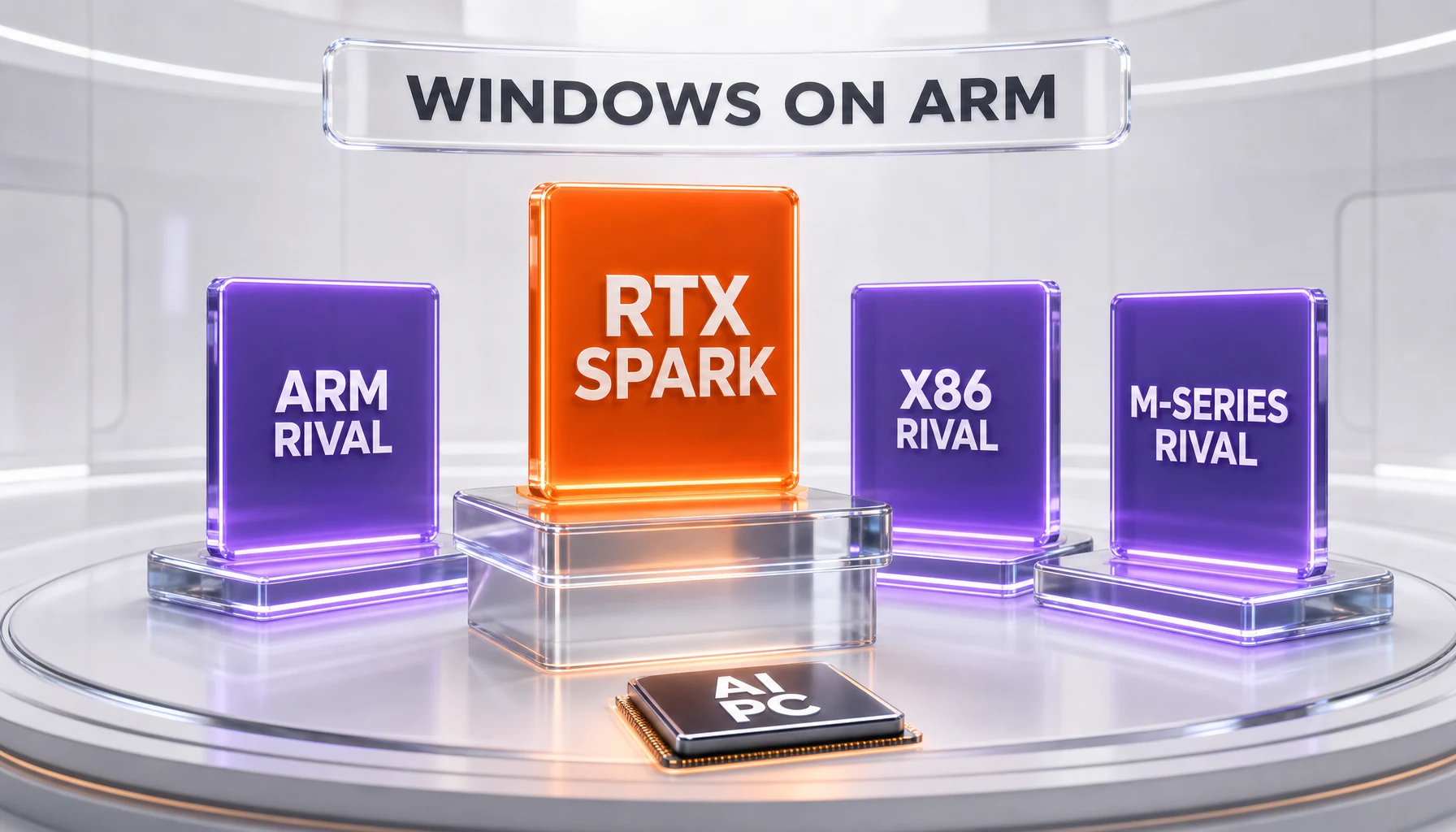
NVIDIA is explicitly positioning RTX Spark against four named camps: Apple's M-series silicon, Qualcomm's Snapdragon X2 Elite, Intel, and AMD. Each of those rivals has a different vulnerability that NVIDIA is probing.
Versus Apple
Apple's M-series remains the benchmark for performance-per-watt in client computing, and Apple has been aggressive about local AI — its MLX framework and unified-memory architecture make Macs unusually good at running models on-device. But Apple's silicon is locked to macOS. RTX Spark targets Windows, the platform with the overwhelming majority of enterprise and developer seats, and it brings the CUDA ecosystem that the AI developer world already standardizes on. That combination — Windows reach plus CUDA gravity — is something Apple structurally cannot offer. We have covered Apple's local-AI momentum in our analysis of the Mac demand surprise and what it signals about local LLM pricing pressure, and RTX Spark is NVIDIA's answer to exactly that thesis on the Windows side of the fence.
Versus Qualcomm
Qualcomm's Snapdragon X2 Elite is the incumbent challenger for premium Windows-on-Arm, and it has earned credibility on battery life and NPU performance. Where it has been weaker is graphics — Snapdragon's GPU has never been the reason anyone buys the chip. RTX Spark attacks precisely that flank by leading with RTX 5070-class graphics and the full CUDA stack. If you are a developer or creator who wants Arm efficiency without giving up GPU compute, NVIDIA wants RTX Spark to be the obvious pick over Snapdragon.
Versus Intel and AMD
Intel and AMD own x86, and x86 still owns the installed base. Their bet is that compatibility and raw single-thread performance keep customers on familiar ground. NVIDIA's counter is that the Arm efficiency curve plus a first-class GPU and AI stack is a better fit for the AI-PC era than legacy x86 — and that the software compatibility gap on Arm is closing faster than the x86 efficiency gap. This is the same decoupling-of-architectures dynamic playing out across the industry; our coverage of how Huawei is closing the AI-chip gap with novel 3D architecture shows the same theme: process and architecture innovation are scrambling the old x86-versus-everything-else hierarchy.
RTX Spark is not Vera — and that distinction matters
It is easy to conflate RTX Spark with NVIDIA's other recent Arm CPU work, but they serve completely different markets. NVIDIA's Vera is a data-center CPU, the Arm-based host processor designed to feed NVIDIA's rack-scale accelerators — we covered the first independent Phoronix benchmarks of the Vera CPU beating Intel and AMD in server workloads. Vera lives in the cloud. RTX Spark lives in your laptop.
The two share NVIDIA's growing commitment to Arm, but they sit at opposite ends of the compute spectrum. Vera is about owning the host CPU inside the AI factory so NVIDIA controls the full data-center stack. RTX Spark is about owning the AI processor inside the consumer device so NVIDIA controls the full client stack. Read together, they reveal a single strategy: NVIDIA wants to be the AI silicon vendor everywhere the workload runs — from the hyperscale rack down to the thin-and-light laptop — and Arm is the common architecture knitting both ends together.
What RTX Spark could mean for local inference
Strip away the marketing and the practical question for anyone building or using AI tools is simple: does RTX Spark make running models locally meaningfully better? On paper, the answer is yes, with caveats.
The 600 GB per second on-package interconnect is the unsung hero here. Local LLM inference is frequently bottlenecked not by raw compute but by memory bandwidth — how fast you can stream model weights to the execution units. A high-bandwidth bridge between the CPU and Blackwell GPU chiplets, with shared memory, is exactly the architecture that helps token generation rates on quantized models. Pair that with CUDA tensor cores and you have a platform that should run the current generation of 7B-to-30B-class models comfortably, and larger quantized models within reach.
The CUDA continuity is the second structural advantage. The local-AI tooling ecosystem — inference runtimes, quantization libraries, fine-tuning frameworks — overwhelmingly targets CUDA first. A consumer device that speaks native CUDA inherits that entire ecosystem on day one, with none of the porting and optimization overhead that has slowed local AI on competing NPUs and GPUs. That is a genuine moat, and it is the reason RTX Spark could matter more for local inference than its raw specs alone suggest.
The caveats worth stating plainly
None of this is proven yet. Every performance figure here is a vendor characterization from a keynote, not an independent benchmark. Windows-on-Arm app compatibility remains a real friction point, and how well x86 software emulates on this CPU will shape the actual user experience. Memory capacity and configuration — which NVIDIA did not detail in depth — will heavily determine which models actually fit. And thermals in a thin laptop are unforgiving; sustained RTX 5070-class performance in a fanless or lightly-cooled chassis is a very different thing from a burst on a benchmark slide. We will reserve judgment until devices ship and third parties test them.
Availability, partners, and the desktop and DGX variants
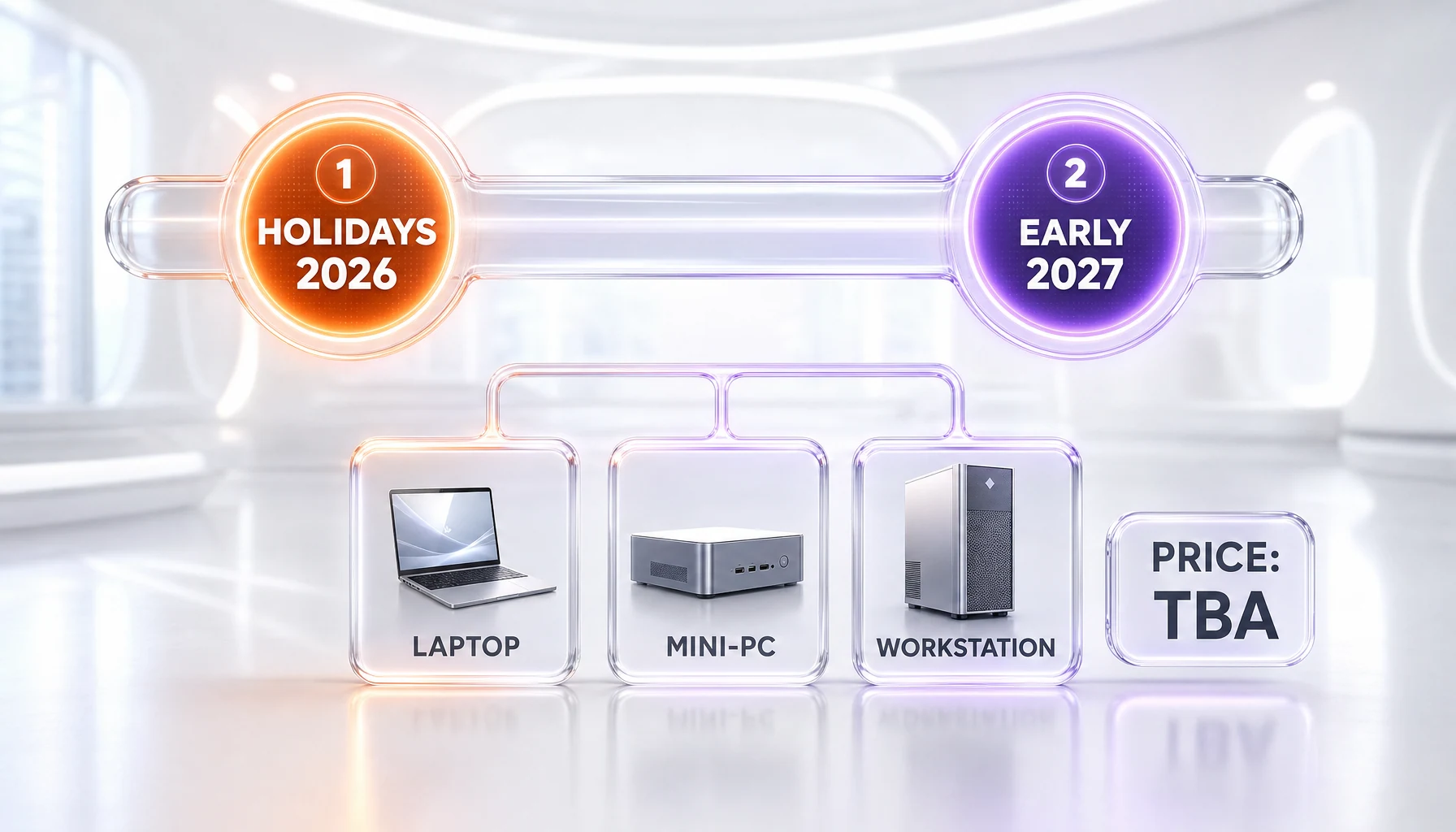
NVIDIA said the first RTX Spark devices are expected before the 2026 holiday season, with broader availability arriving in early 2027. Named OEM launch partners include Dell, Lenovo, Asus, and MSI — the same roster that anchors NVIDIA's discrete-GPU laptop business, which suggests RTX Spark devices will slot into existing premium product lines rather than launch as a niche curiosity.
NVIDIA also referenced desktop and DGX Station variants of the platform, signaling that RTX Spark is a family rather than a single laptop part. The desktop variant points at mini-PCs and small-form-factor builds; the DGX Station reference suggests a developer-and-prosumer workstation aimed at local AI development. That spread — laptop, mini-PC, workstation — is consistent with a company trying to seed an entire on-device AI hardware tier, not just ship one device.
The price question NVIDIA left unanswered
The single most important number for a consumer chip is the one NVIDIA did not give: price. No pricing was disclosed at Computex 2026, and that silence is strategic. Pricing is what will determine whether RTX Spark is a halo platform for high-end creator and developer machines or a genuine volume play that pressures Apple, Qualcomm, Intel, and AMD across the mainstream. Until NVIDIA or its OEM partners put dollar figures on shipping devices, any claim about RTX Spark's market impact is speculation. We will not guess at a price, and you should be skeptical of anyone who does.
The strategic read: NVIDIA wants the whole stack
Step back from the spec sheet and RTX Spark reads as the consumer bookend of a strategy NVIDIA has been executing relentlessly. In the data center, NVIDIA already owns the GPU, increasingly owns the CPU with Vera, owns the interconnect, and owns the software with CUDA. RTX Spark extends that vertical integration to the client. The same CUDA gravity that locked in hyperscalers is now being aimed at developers' laptops.
The risk for NVIDIA is real. Consumer hardware is a margin minefield, Windows-on-Arm is unproven at scale, and Apple, Qualcomm, Intel, and AMD will not surrender the client market quietly. But the prize is equally real: if on-device AI becomes the default runtime for a meaningful share of AI workloads, the company that supplies the silicon and the software for that runtime captures a recurring, high-volume position that complements — rather than cannibalizes — its data-center dominance.
For builders and AI-tool users, the takeaway is straightforward. RTX Spark is a signal that the most powerful name in AI silicon now believes the device in your hands is a strategic battleground worth fighting for. Whether the chip delivers on its claims is a question for independent benchmarks and shipping hardware. But the direction it points — toward local inference, on-device agents, and CUDA everywhere — is the clearest statement yet about where NVIDIA thinks AI is headed next. The edge is back, and NVIDIA intends to own it.
Frequently asked questions
What is NVIDIA RTX Spark?
RTX Spark is NVIDIA’s consumer PC processor unveiled by Jensen Huang at Computex 2026 on June 1, 2026. It is a single package built from two chiplets: a Blackwell-architecture GPU with 6,144 CUDA cores (roughly GeForce RTX 5070 class) and a 20-core Arm CPU co-designed with MediaTek, connected by a 600 GB per second silicon bridge. It is fabricated on TSMC’s 3nm process and aimed at Windows-on-Arm laptops and mini-PCs for on-device AI agents, content creation, and gaming.
Why is RTX Spark significant for NVIDIA?
RTX Spark is NVIDIA’s first chip aimed at mainstream consumer PCs in more than a decade. After years of selling data-center accelerators, NVIDIA is using RTX Spark to claim a position in on-device AI, where local inference and AI agents are increasingly run. It extends NVIDIA’s vertical integration—GPU, CPU, interconnect, and the CUDA software stack—from the data center down to the consumer device.
What are RTX Spark’s specifications?
RTX Spark combines a Blackwell GPU chiplet with 6,144 CUDA cores (around GeForce RTX 5070 class) and a 20-core Arm CPU built with MediaTek—ten Cortex-X925 performance cores plus ten Cortex-A725 efficiency cores, clocking up to roughly 4.1 GHz. The two chiplets are linked by a 600 GB per second on-package interconnect. The chip is made on TSMC 3nm and carries around 70 billion transistors.
Is RTX Spark based on Arm or x86?
RTX Spark is an Arm-based design. Its CPU chiplet uses 20 Arm cores (Cortex-X925 and Cortex-A725) co-designed with MediaTek, targeting Windows-on-Arm. This puts RTX Spark in direct competition with Apple’s M-series and Qualcomm’s Snapdragon X2 Elite, and positions it against Intel and AMD’s x86 platforms.
How does RTX Spark compare to Qualcomm Snapdragon X2 Elite?
Both are Arm chips targeting premium Windows-on-Arm devices. Snapdragon X2 Elite has earned credibility on battery life and NPU performance, where its graphics have historically been the weaker point. RTX Spark leads with RTX 5070-class Blackwell graphics and the full CUDA software stack, attacking exactly that graphics-and-AI-compute flank. Independent benchmarks are needed before any performance ranking is confirmed.
How does RTX Spark compare to Apple silicon?
Apple’s M-series sets the bar for performance-per-watt and is strong at local AI through MLX and unified memory, but it is locked to macOS. RTX Spark targets Windows—the platform with most enterprise and developer seats—and brings the CUDA ecosystem that AI developers already standardize on. The combination of Windows reach and CUDA gravity is something Apple’s closed platform structurally cannot match.
How is RTX Spark different from the NVIDIA Vera CPU?
They serve completely different markets. NVIDIA’s Vera is a data-center Arm CPU designed to host rack-scale AI accelerators in the cloud. RTX Spark is a consumer PC processor for laptops and mini-PCs. They share NVIDIA’s commitment to Arm but sit at opposite ends of the compute spectrum—Vera in the AI factory, RTX Spark in your laptop.
What does RTX Spark mean for local AI and on-device inference?
RTX Spark is built for local inference. Its 600 GB per second interconnect and shared memory help with the memory-bandwidth bottleneck that limits local LLM token rates, and its native CUDA support inherits the entire CUDA-first local-AI tooling ecosystem on day one. On paper it should run current 7B-to-30B-class models comfortably, with larger quantized models within reach—though all performance claims remain vendor characterizations until independent testing.
When will RTX Spark devices be available?
NVIDIA said the first RTX Spark devices are expected before the 2026 holiday season, with wider availability in early 2027. There was an erroneous report citing a 2024 launch window—that is incorrect; the official timeline is holidays 2026 into early 2027.
Which manufacturers will make RTX Spark devices?
NVIDIA named Dell, Lenovo, Asus, and MSI as OEM launch partners—the same roster that anchors its discrete-GPU laptop business. This suggests RTX Spark will slot into existing premium product lines rather than launch as a niche product.
How much will RTX Spark cost?
NVIDIA did not disclose any pricing at Computex 2026. The price will determine whether RTX Spark is a halo platform for high-end machines or a volume play that pressures Apple, Qualcomm, Intel, and AMD across the mainstream. Until NVIDIA or its OEM partners publish figures on shipping devices, any specific price is speculation.
Are there desktop and workstation versions of RTX Spark?
Yes. NVIDIA referenced desktop and DGX Station variants alongside the laptop platform, indicating RTX Spark is a family rather than a single part. The desktop variant points at mini-PCs and small-form-factor builds, while the DGX Station reference suggests a developer and prosumer workstation aimed at local AI development.