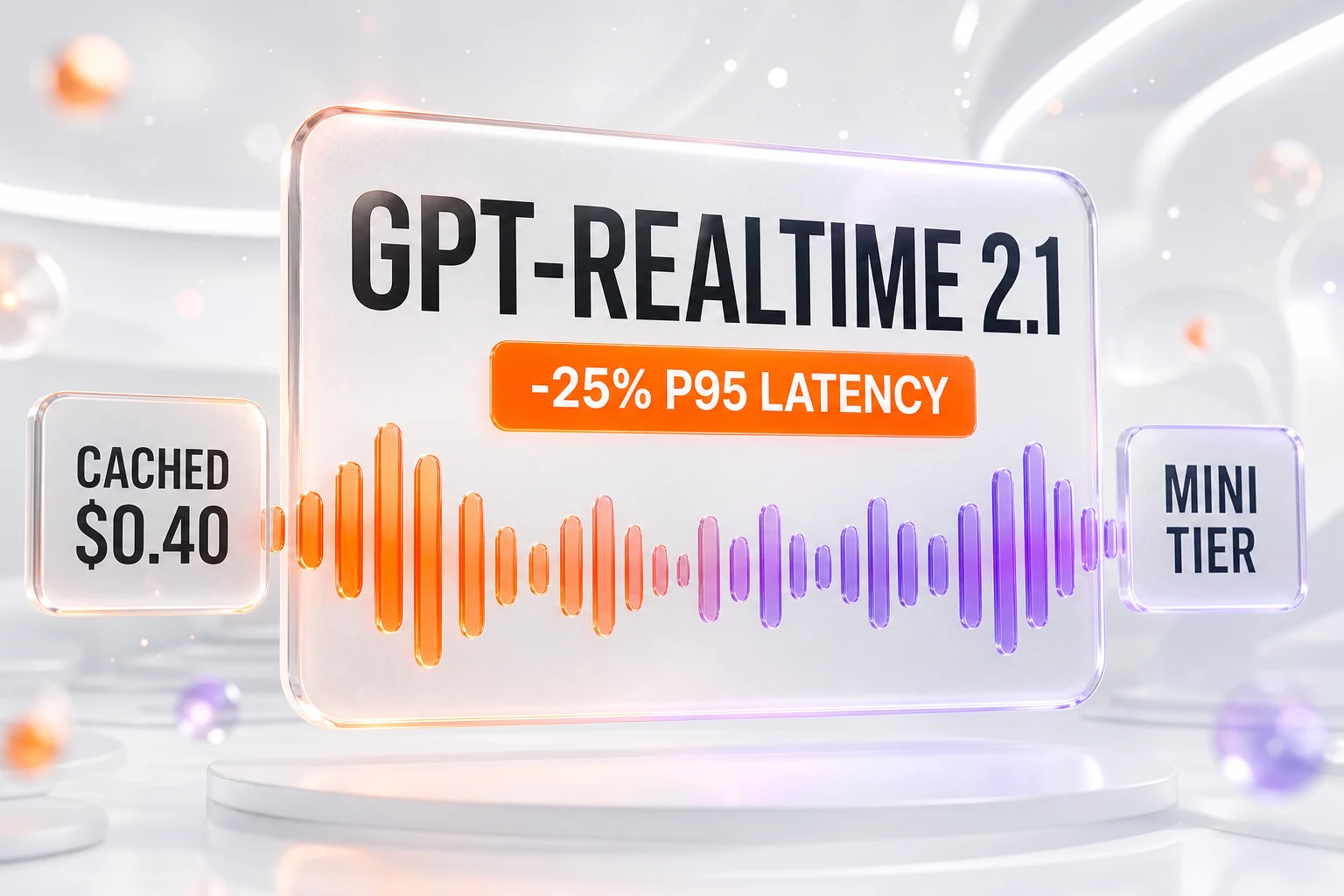
Quick Take — On July 6, 2026, OpenAI added two speech-to-speech models to its Realtime API: gpt-realtime-2.1 and gpt-realtime-2.1-mini. The headline change is speed — OpenAI says improved caching cut p95 latency by at least 25% across its Realtime voice models. The second change is cost: cached text on gpt-realtime-2.1 is billed at 0.40 dollar per million tokens versus 4.00 dollars per million for standard text input, and a new mini tier starts at 0.60 dollar per million text input tokens. The flagship also exposes a configurable reasoning effort setting, from minimal to xhigh, that lets builders trade latency for smarter turns.
Key Takeaways
- Two new models: gpt-realtime-2.1 and gpt-realtime-2.1-mini shipped on OpenAI's Realtime API on July 6, 2026.
- At least 25% lower p95 latency across OpenAI's Realtime voice models, achieved through improved caching rather than a new architecture.
- Cached tokens get radically cheaper: cached text on gpt-realtime-2.1 costs 0.40 dollar per million tokens, one tenth of the 4.00 dollars per million for standard text input; cached audio drops to the same 0.40 dollar per million against 32.00 dollars for standard audio input.
- A low-cost mini tier: gpt-realtime-2.1-mini is a smaller reasoning model priced far below the flagship — 10.00 dollars per million audio input tokens versus 32.00 for the full model.
- Reasoning on a dial: a configurable reasoning effort setting spans minimal, low, medium, high and xhigh, and OpenAI recommends starting at low for most production voice agents.
What OpenAI Actually Shipped
OpenAI released two new speech-to-speech models on its Realtime API — an update to gpt-realtime plus a new gpt-realtime-2.1-mini — in an announcement posted to the OpenAI Developer Community on July 6, 2026. Both target the same job: powering low-latency voice agents that listen and speak in real time, over the same Realtime endpoint developers already use. The update is incremental in name and meaningful in practice.
According to OpenAI's announcement, gpt-realtime-2.1 brings "improved alphanumeric recognition, silence and noise handling, and interruption behavior" on top of speech-to-speech interactions with "configurable reasoning effort, instruction following, and tool use." In plain terms: it should be better at catching spelled-out order numbers and confirmation codes, more graceful when a caller pauses or talks over the agent, and smarter about when to think harder mid-conversation. gpt-realtime-2.1-mini is described as "a mini reasoning model for faster, lower-cost realtime voice interactions" — the same capability envelope, tuned for volume and price. Both are available now to test in OpenAI's Realtime playground.
Why the 25% Latency Cut Matters for Voice UX
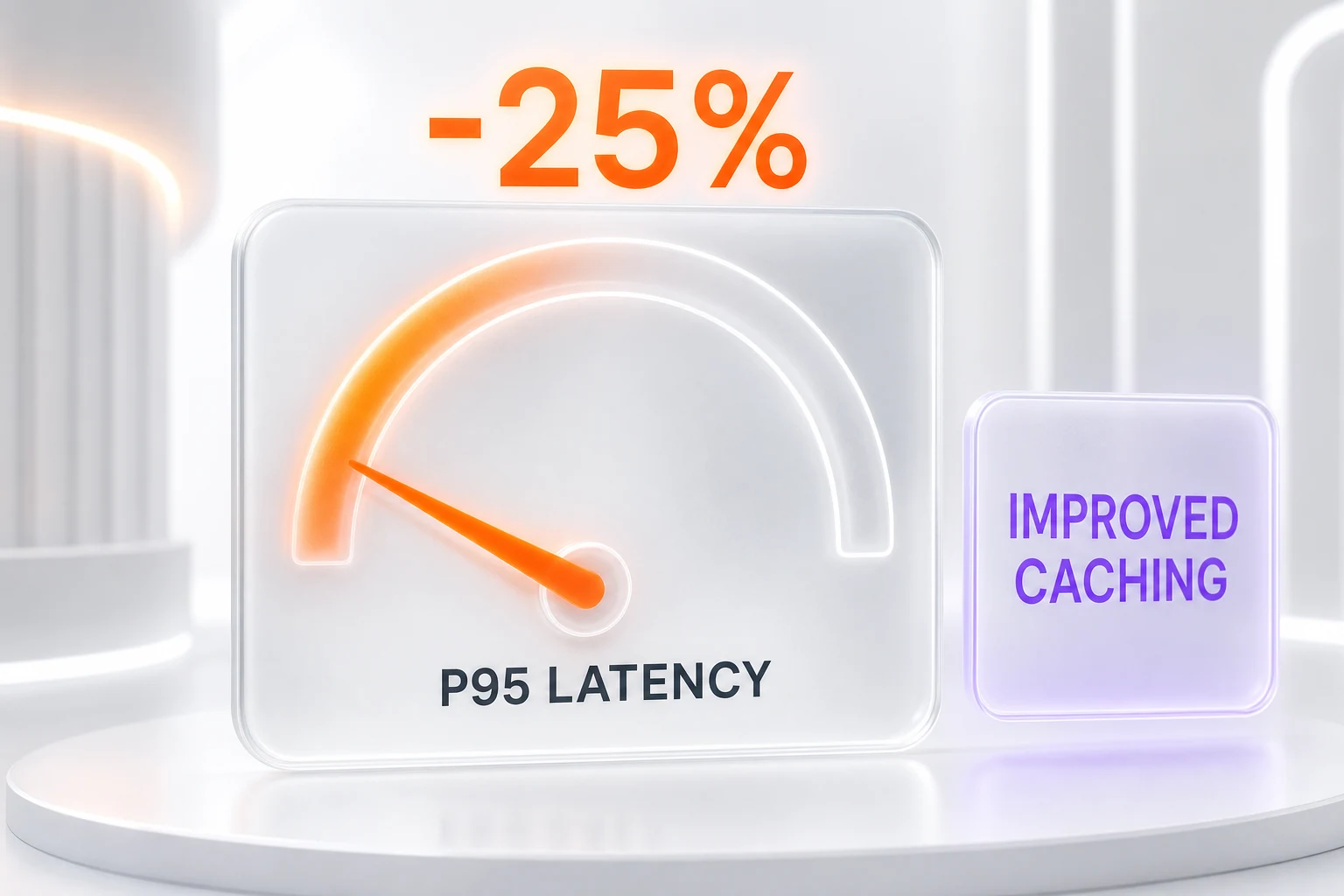
In voice interfaces, latency is the product. A 25% reduction in p95 latency is the difference between an assistant that feels like a phone tree and one that feels like a person — the p95 figure matters because it measures the slow tail, the one-in-twenty responses that make users talk over the bot or hang up. OpenAI says the gain comes from improved caching rather than a new model architecture, which is a telling detail.
Caching helps here because a voice agent resends a lot of the same context on every turn: the system prompt, tool definitions, and the growing transcript of the conversation. If those repeated tokens are served from cache instead of recomputed, both the time-to-first-token and the cost per turn fall. That is why the latency win and the pricing win in this release are really the same story told twice. OpenAI documents the mechanism in its Realtime API guide and its prompt caching guide, and for a plain-English breakdown of how input, output and cached tokens are billed differently, see our explainer on AI model pricing.
The Pricing Shift: Cached Tokens Change the Math
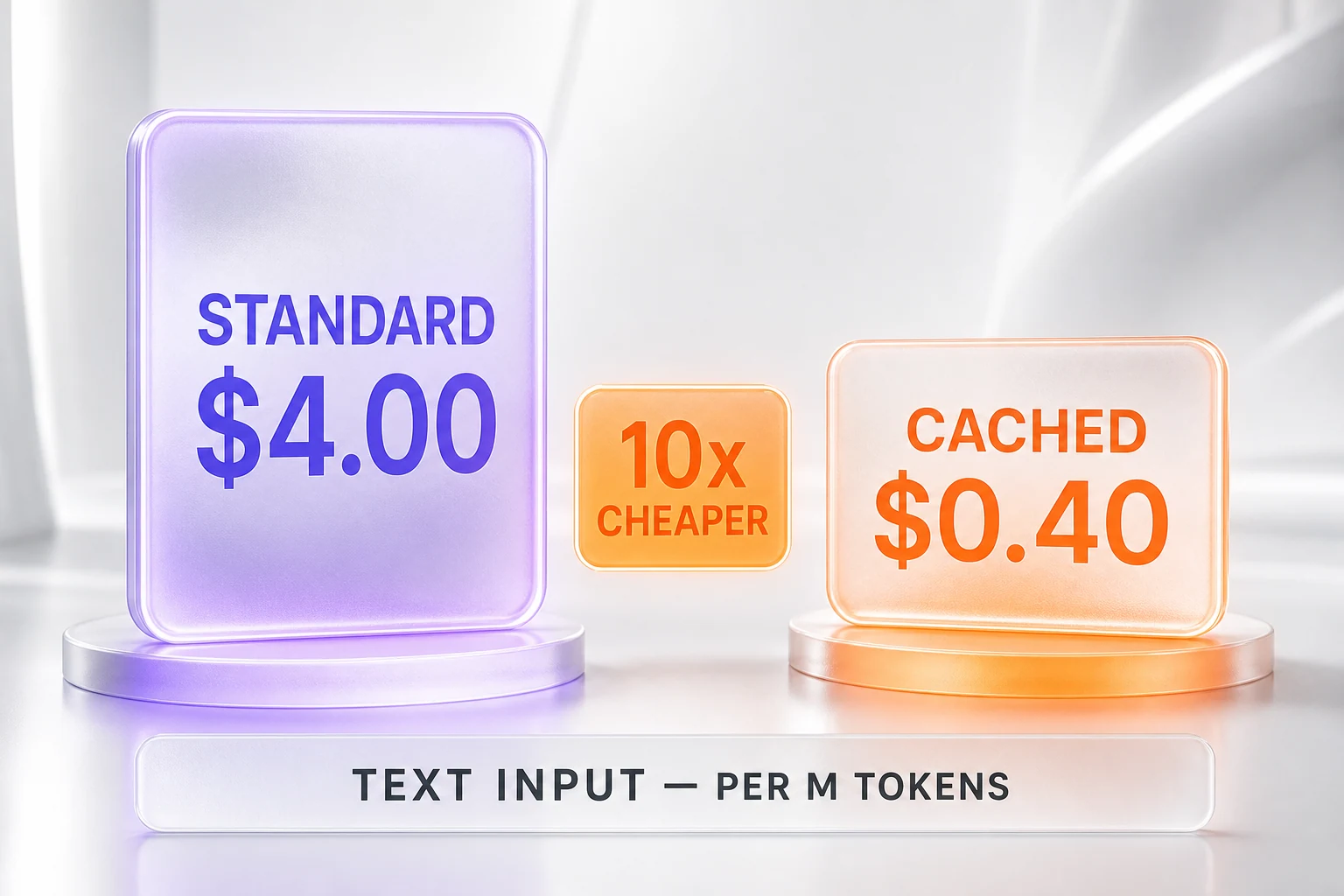
The most consequential number in this release is not the latency figure — it is 0.40. On gpt-realtime-2.1, cached text input is billed at 0.40 dollar per million tokens, one tenth of the 4.00 dollars per million charged for uncached text input. Cached audio input gets the same 0.40 dollar per million rate, against 32.00 dollars per million for standard audio input — an 80-fold discount on the tokens a voice agent repeats most.
gpt-realtime-2.1 and 2.1-mini pricing (per million tokens)
| Token type | gpt-realtime-2.1 | gpt-realtime-2.1-mini |
|---|---|---|
| Text input | $4.00 | $0.60 |
| Text input (cached) | $0.40 | $0.06 |
| Text output | $24.00 | $2.40 |
| Audio input | $32.00 | $10.00 |
| Audio input (cached) | $0.40 | $0.30 |
| Audio output | $64.00 | $20.00 |
All prices in US dollars per million tokens, per OpenAI's July 6, 2026 announcement and API pricing.
Read down the columns and the strategy is obvious. For a customer-support agent that streams audio in and out while resending a fat system prompt every turn, caching turns the dominant cost line — repeated input — into a rounding error, while output tokens (24.00 dollars per million for text, 64.00 dollars per million for audio on the flagship) become the real budget. That inverts how teams should think about prompt design for voice: long, static instructions are now cheap to keep resident, so the optimization moves to keeping responses tight. Microsoft's public math on agent token economics shows how quickly per-token costs compound at production volume — and why a cached-input discount this steep reshapes the budget.
The 2.1-mini Tier and the Real-Time Cost War
gpt-realtime-2.1-mini is OpenAI's answer to a market that has been undercutting it on price. Across the board it costs a fraction of the flagship: 10.00 dollars per million audio input tokens versus 32.00, 20.00 dollars per million audio output tokens versus 64.00, and 2.40 dollars per million text output tokens versus 24.00 — roughly a third of the audio cost and a tenth of the text-output cost of gpt-realtime-2.1. For high-volume, lower-complexity voice work, that is the tier most builders will reach for first.
The context is a crowded, fast-moving field. Voice-agent platforms like Vapi — which we covered when it raised at a 500 million dollar valuation — build on top of models like these, while ElevenLabs pushes on voice quality and Google and Amazon push their own real-time speech stacks. OpenAI competes on two fronts at once: raw model quality against specialists like ElevenLabs and Google, and price against everyone. A cheaper mini tier is how it defends the high-volume middle of the market that actually pays the bills.
The Reasoning Effort Dial, Explained
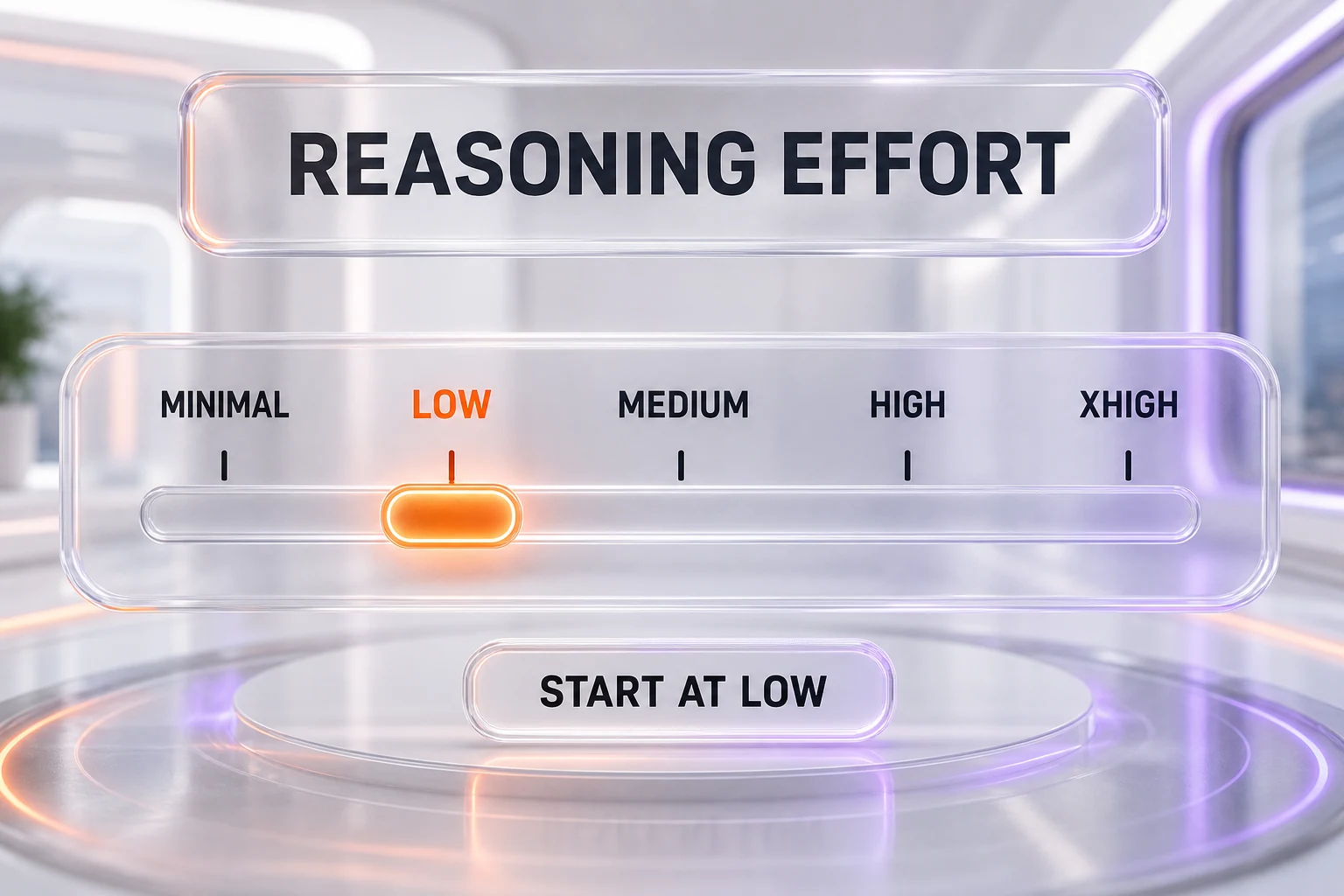
gpt-realtime-2.1 exposes a configurable reasoning effort setting — the same knob OpenAI added to its reasoning models, now wired into speech-to-speech. Per OpenAI's Realtime documentation, the allowed values are minimal, low, medium, high and xhigh, and the guidance is explicit: start at low for most production voice agents, then tune up or down based on task complexity, latency tolerance, and failure cost. Higher effort buys better judgment at the price of a slower, more expensive turn.
OpenAI's own use-case ladder, laid out in its Realtime models prompting guide, is a useful map. Minimal suits smart-home commands, timers and simple lookups where speed is everything. Low covers customer support, order lookups and basic policy questions. Medium is for multi-step reasoning like technical support and diagnostics. High is for high-precision or escalation decisions, and xhigh is reserved for complex planning and high-stakes orchestration where the added latency is worth it. For voice agents specifically, the default instinct should be to stay low and only climb when a task genuinely needs it — a discipline that matters more in a live conversation than in a chat window, where a Realtime pause is far more noticeable.
Who Should Care — and Who Shouldn't
If you build voice agents on OpenAI's Realtime API, this update is a straightforward win worth adopting: you get lower latency and dramatically cheaper cached tokens with no architecture change, plus a mini tier for cost-sensitive workloads. Teams running high-volume phone support, drive-thru or IVR-replacement systems, and always-on voice assistants are the clearest beneficiaries — especially those resending large system prompts every turn, who will see the biggest caching savings.
It matters less if you are not on OpenAI's stack or if voice is not real-time. Batch transcription and asynchronous speech work — the territory of Whisper-style models — is untouched by a Realtime update. If you have standardized on a competitor's voice platform, the calculus is a migration question, not a free upgrade. And if your agent is doing genuinely hard reasoning, remember that the reasoning-effort dial and the mini tier pull in opposite directions: cheaper and faster is not the same as smarter.
What OpenAI Didn't Say
The announcement is notably terse about several things builders will want to know. It does not mention new voices, and it says nothing about expanded language coverage — so treat the voice and language lineup as unchanged until OpenAI states otherwise. It also does not label the models as preview or general availability in the post itself; they are live to test in the playground and callable on the Realtime API, but OpenAI's own production-reliability guidance still applies.
There is also no published benchmark behind the "at least 25%" latency claim — no methodology, workload, or region breakdown — so it is a vendor figure, not an independently verified one. That is normal for a launch-day changelog, and the number is plausible given the caching mechanism described in OpenAI's Realtime guide, but teams with strict latency budgets should measure p95 on their own traffic before rewriting a service-level objective around it.
The Bottom Line
Strip away the version number and gpt-realtime-2.1 is a pricing-and-latency release dressed as a model update — and that is exactly why it matters. OpenAI is not claiming a leap in intelligence; it is making real-time voice cheaper and faster to run at scale, and adding a mini tier to hold the volume market. In a category where the quality gap between the leading voice models has narrowed, the fight has moved to latency, price and operational control. This release pushes on all three.
Our read: the caching economics are the real headline. When the tokens a voice agent repeats most — system prompt, tools, transcript — drop to one tenth or one eightieth of their former cost, the unit economics of always-on voice change in a way that a fresh set of voices never would. The open question is whether OpenAI can hold the line on price with a mini tier while competitors race the same direction. For now, if you ship voice on OpenAI, the playbook is simple: upgrade, turn on caching, start your reasoning effort at low, and re-run your cost model. The math just moved.
Frequently Asked Questions
What are gpt-realtime-2.1 and gpt-realtime-2.1-mini?
gpt-realtime-2.1 and gpt-realtime-2.1-mini are two speech-to-speech AI models OpenAI released on its Realtime API on July 6, 2026. They power low-latency voice agents that listen and respond in real time. gpt-realtime-2.1 is the flagship with configurable reasoning, and gpt-realtime-2.1-mini is a smaller, lower-cost reasoning model for higher-volume voice interactions.
When were gpt-realtime-2.1 and 2.1-mini released?
OpenAI announced both models on July 6, 2026, in a post to the OpenAI Developer Community. They are available immediately to test in OpenAI's Realtime playground and callable through the Realtime API.
How much faster is gpt-realtime-2.1?
OpenAI says the update reduced p95 latency by at least 25% across its Realtime voice models, achieved through improved caching rather than a new architecture. Because p95 measures the slow tail of responses, the gain most affects the worst-case delays that make voice agents feel sluggish. The figure is OpenAI's own and is not independently benchmarked.
How much does gpt-realtime-2.1 cost?
On gpt-realtime-2.1, text input is 4.00 dollars per million tokens, cached text input is 0.40 dollar per million, and text output is 24.00 dollars per million. Audio input is 32.00 dollars per million, cached audio input is 0.40 dollar per million, and audio output is 64.00 dollars per million.
How much does gpt-realtime-2.1-mini cost?
gpt-realtime-2.1-mini is priced well below the flagship: 0.60 dollar per million text input tokens, 0.06 dollar per million cached text input, and 2.40 dollars per million text output. Audio input is 10.00 dollars per million tokens, cached audio input is 0.30 dollar per million, and audio output is 20.00 dollars per million.
What are cached tokens and why do they matter for voice agents?
Cached tokens are repeated input — such as a system prompt, tool definitions, or conversation history — that the model can serve from cache instead of recomputing. On gpt-realtime-2.1, cached text costs 0.40 dollar per million tokens versus 4.00 dollars for standard text input, and cached audio costs 0.40 dollar per million versus 32.00 dollars. Because voice agents resend the same context every turn, caching cuts both latency and cost.
What reasoning effort levels does gpt-realtime-2.1 support?
According to OpenAI's Realtime documentation, gpt-realtime-2.1 supports five reasoning effort levels: minimal, low, medium, high and xhigh. Higher effort improves the model's judgment at the cost of higher latency and price per turn.
Which reasoning effort should I use for a voice agent?
OpenAI recommends starting at low for most production voice agents, then tuning up or down based on task complexity, latency tolerance, and failure cost. Minimal suits simple commands and lookups; medium fits multi-step diagnostics; high and xhigh are for high-precision or high-stakes tasks where the added latency is justified.
What is the difference between gpt-realtime-2.1 and gpt-realtime-2.1-mini?
Both are speech-to-speech reasoning models on the same Realtime API, but gpt-realtime-2.1-mini is smaller, faster and much cheaper — for example, 10.00 dollars per million audio input tokens versus 32.00 on the flagship. The flagship is the better choice for complex reasoning, while the mini tier suits high-volume, lower-complexity voice work.
Did OpenAI add new voices or languages with gpt-realtime-2.1?
No. OpenAI's announcement does not mention new voices or expanded language support, so the voice and language lineup should be treated as unchanged until OpenAI states otherwise. The release focuses on latency, caching-based pricing, a mini tier, and reasoning-effort control.
How does gpt-realtime-2.1 compare to ElevenLabs, Google and Vapi?
OpenAI competes on model quality against voice specialists like ElevenLabs and on real-time stacks from Google and Amazon, while platforms such as Vapi build voice agents on top of models like gpt-realtime. OpenAI's announcement does not publish head-to-head benchmarks, so comparisons on latency and price should be validated on your own workload.
How do I start using gpt-realtime-2.1?
Both models are available now in OpenAI's Realtime playground and through the Realtime API. To adopt them, point your Realtime integration at gpt-realtime-2.1 or gpt-realtime-2.1-mini, enable prompt caching for repeated context, and set the reasoning effort — starting at low for most production voice agents.