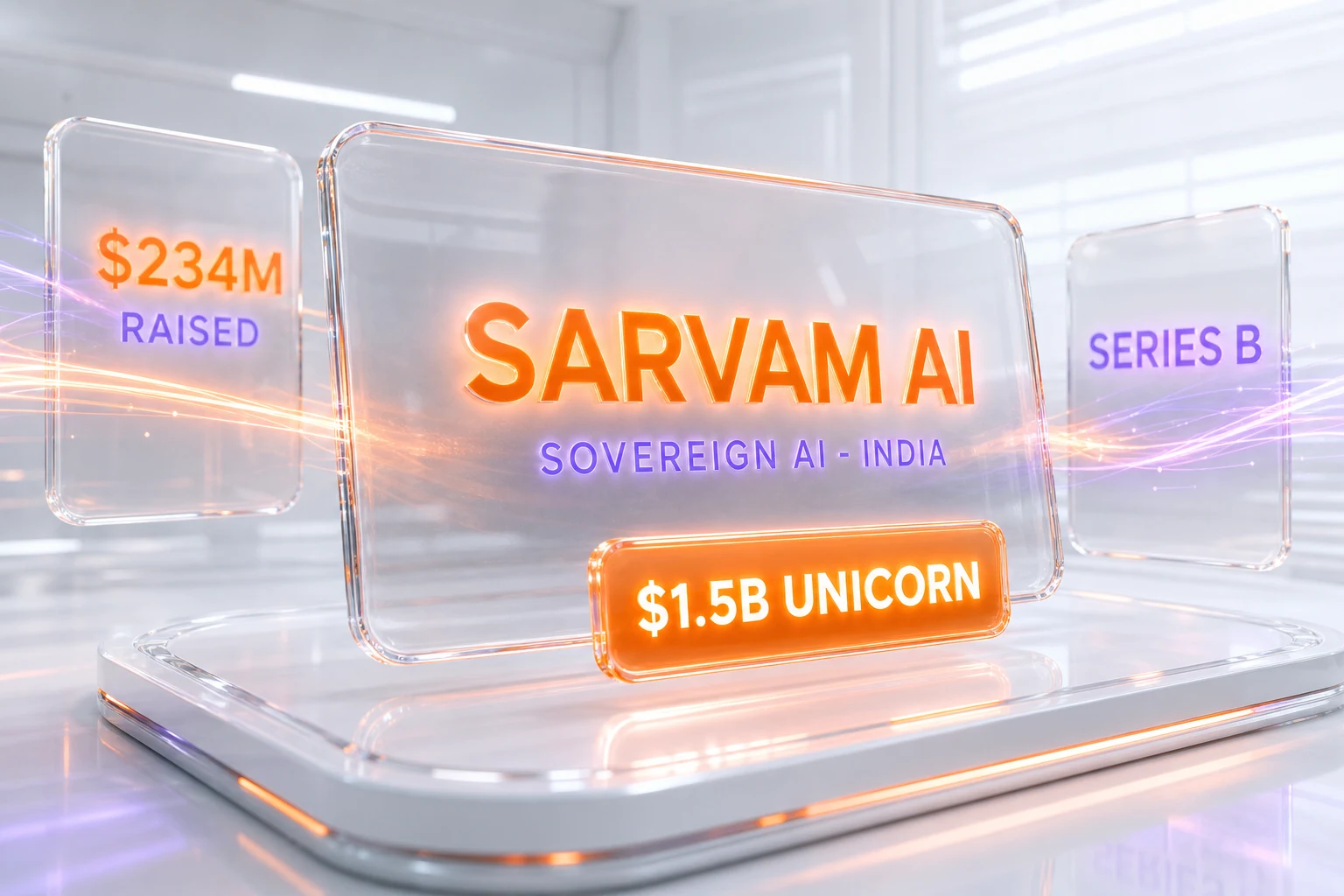
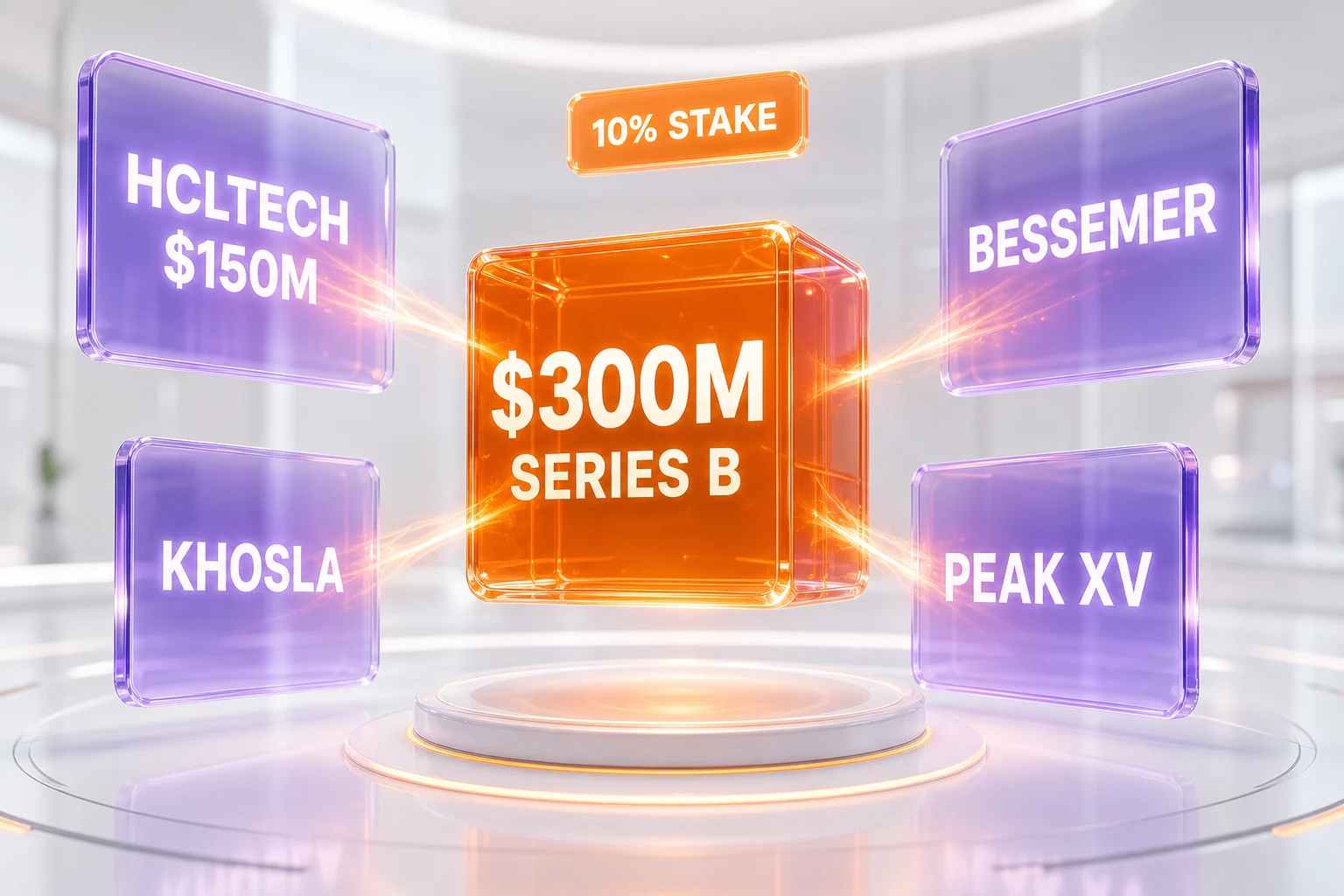
Sarvam AI, a Bengaluru-based sovereign AI company, became India's newest unicorn on June 15, 2026 after raising $234 million in the first close of a $300 million Series B at a $1.5 billion post-money valuation. HCLTech led the round as strategic investor with $150 million, taking a stake of just over 10 percent, co-led by Bessemer Venture Partners, with existing backers Khosla Ventures and Peak XV Partners returning. The capital funds a next-generation frontier model aimed at agentic AI, coding, and cybersecurity.
What Happened
On June 15, 2026, Sarvam announced it had closed $234 million in the first tranche of a Series B targeting $300 million in total, valuing the three-year-old company at $1.5 billion post-money. That valuation crosses the unicorn threshold and makes Sarvam one of the most valuable independent AI labs in India.
The headline investor is HCLTech, the Indian IT services giant, which put in $150 million as the lead strategic backer and acquired a stake of just over 10 percent in Sarvam. Bessemer Venture Partners co-led the round as a new investor. Existing backers Khosla Ventures and Peak XV Partners (formerly Sequoia Capital India) re-upped, while Lightspeed Venture Partners — an early seed investor — did not participate in this round.
Sarvam was founded in 2023 by Vivek Raghavan and Pratyush Kumar, both of whom previously built India-focused language systems at AI4Bharat, a research lab at IIT Madras. The company raised roughly $41 million across its seed and Series A in December 2023 from Lightspeed, Khosla Ventures, and Peak XV. It was also among the first startups selected under the federal IndiaAI Mission, the government program to build a domestic foundation model.
The Numbers at a Glance
| Metric | Detail |
|---|---|
| Round | Series B (first close) |
| First close raised | $234 million |
| Total target | $300 million |
| Post-money valuation | $1.5 billion |
| Lead (strategic) | HCLTech — $150 million, just over 10 percent stake |
| Co-lead | Bessemer Venture Partners |
| Returning investors | Khosla Ventures, Peak XV Partners |
| Founded | 2023, Bengaluru |
| Founders | Vivek Raghavan, Pratyush Kumar |
For context, the raise lands the same quarter that Europe accelerated its own sovereign-AI push — from the EU Tech Sovereignty Package to the Cohere and Aleph Alpha merger that created a $20 billion European champion. The pattern is now hard to miss: national and regional AI labs are getting funded at scale, on purpose.
Why It Matters
Sovereign AI is the idea that a country, or a large institution within it, should control the full stack of its critical AI — the model weights, the training data, the inference infrastructure, and the deployment layer — rather than renting all of it from a handful of US or Chinese frontier labs. For most of the past three years, that argument lived in policy papers and ministerial speeches. Sarvam's $1.5 billion valuation is a sign it has moved into the realm of fundable, venture-grade businesses.
Two things make this round more than a standard up-round. First, the lead check came from HCLTech, not a pure financial fund. A strategic investor taking just over 10 percent signals that India's largest enterprises now see a domestic frontier-model builder as infrastructure worth owning a piece of, not merely a vendor to procure from. C Vijayakumar, HCLTech's CEO, framed it as "a significant step toward building India's trusted and globally competitive AI ecosystem."
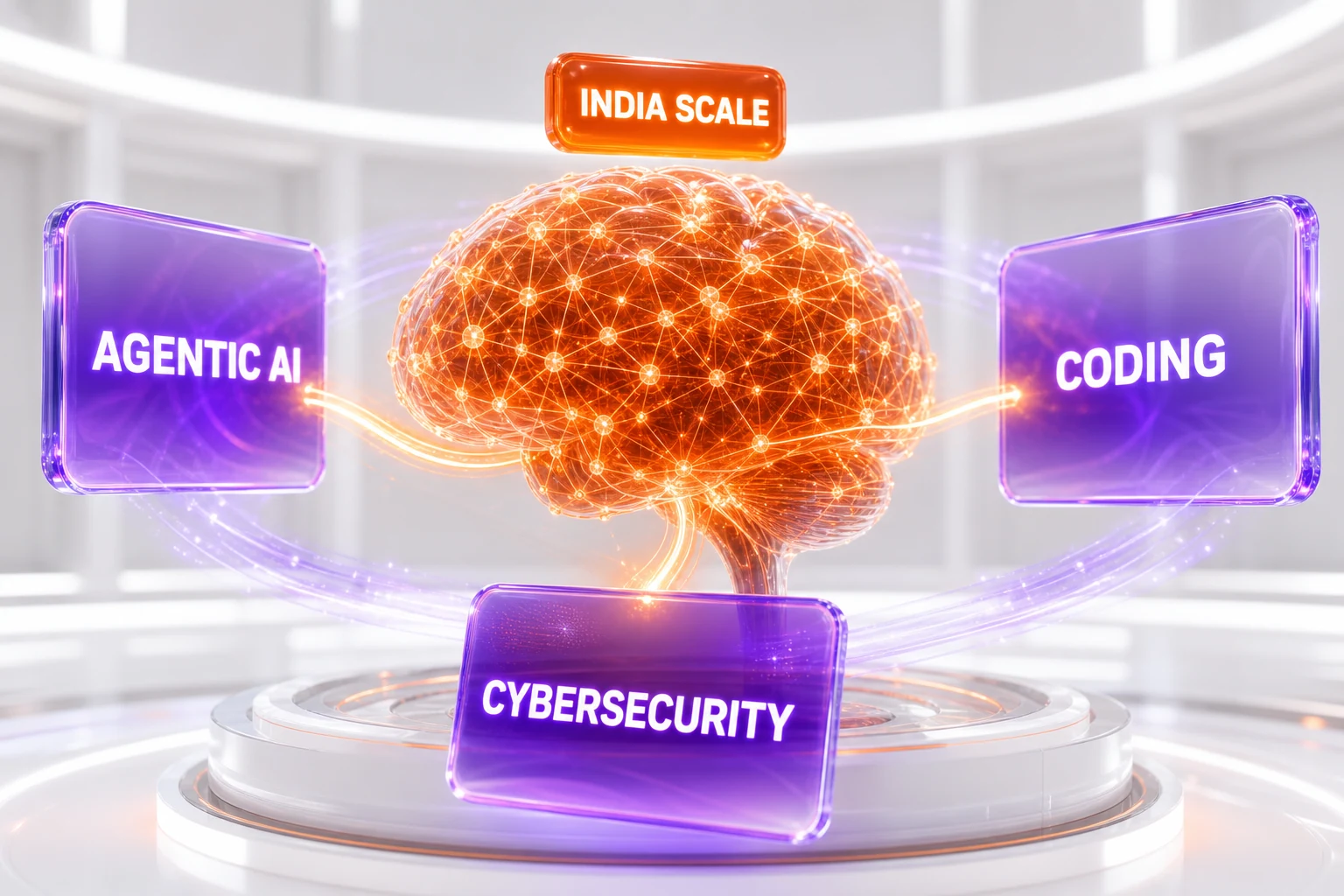
Second, the use of funds is unusually pointed. Sarvam is not spending the money on a general-purpose chatbot to compete head-on with ChatGPT. The capital is earmarked for training a next-generation frontier model focused on three verticals where control and trust matter most: agentic AI, coding, and cybersecurity — plus the compute to deploy it across banking, insurance, government, and defense. Co-founder Pratyush Kumar put the thesis plainly: "We are clear that research-led innovation to create AI that works at India's scale is a very large opportunity."
The Rise of National AI Labs
Sarvam is the clearest Indian example of a global shift. Governments that once assumed they would consume AI as a cloud service are now bankrolling — directly or through strategic corporates — their own frontier labs. The motivations stack up fast: data residency and privacy law, language and cultural coverage that US models handle poorly, national-security concern over depending on foreign inference, and the simple economics of not paying a per-query toll forever on infrastructure deemed critical.
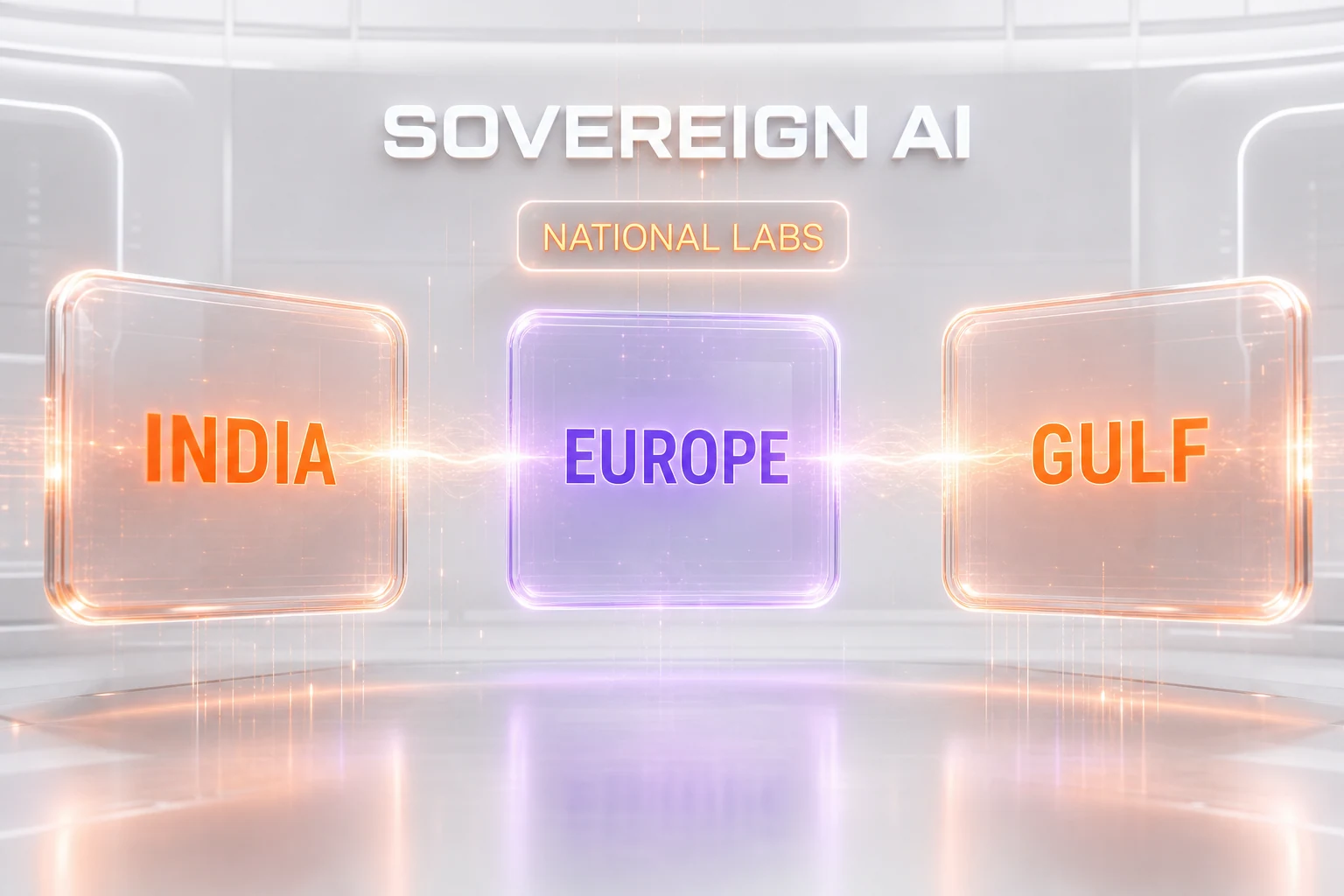
The result is a market that no longer maps cleanly onto a US-versus-China axis. India, the EU, and the Gulf states are each underwriting independent capacity. That reframes the competitive picture for the incumbents: OpenAI, Anthropic, and Google are still the frontier leaders by raw capability, but they increasingly compete against a layer of well-funded national champions that win on sovereignty, localization, and procurement trust rather than on benchmark scores alone.
How It Compares
The unicorn label is doing a lot of work here, so it helps to size Sarvam against its peers. At $1.5 billion, Sarvam is a fraction of the frontier leaders — Anthropic alone raised $65 billion at a $965 billion valuation earlier this year. But sovereign labs are not playing the same game. Their advantage is not being the biggest model; it is being the trusted, locally controlled one.
Within the broader AI-unicorn class of 2026, Sarvam joins a crowded cohort. China's Vast (Tripo AI) crossed $1 billion in the same window, and the US continues to mint specialized unicorns at pace. What sets Sarvam apart is the buyer it is built for: an Indian state agency, a domestic bank, or a defense procurement office that cannot, for legal or strategic reasons, route sensitive workloads through a foreign frontier API.
On capability, Sarvam already ships a family of models — including its 105-billion and 30-billion parameter language models, plus vision and speech systems — and reports meaningful production scale: more than 2 million conversational interactions and 10 million API calls per day, over 35 million document pages digitized, and deployments touching 17 million farmers for the Ministry of Agriculture and 45 million insurance policy renewals. That deployment footprint, not a leaderboard ranking, is the moat a strategic investor like HCLTech is paying for.
The US-vs-China Frame Is Breaking Down
For two years the AI race has been narrated as a binary contest between American and Chinese labs, reinforced by export controls and, more recently, China's talent-travel curbs that mirror US chip restrictions. Sarvam's round is evidence that the binary is too small. A third tier — sovereign labs funded by middle powers and their national enterprises — is forming underneath the frontier, and it is being capitalized in nine-figure checks. The open-weights fight makes the point too: even the best US open-weights model still trails China, which leaves room for national labs to build on whichever open base serves their sovereignty goals.
Our Take
We have been tracking the sovereign-AI thesis for months, and Sarvam is the cleanest data point yet that it is real rather than rhetorical. The detail that convinces us is not the valuation — unicorn status is increasingly cheap in 2026 — but the composition of the round. When a $13-billion-revenue IT services company writes the lead check and takes a double-digit equity stake, that is a structural bet on owning national AI infrastructure, not a financial punt on a hot startup.
The risk worth watching is focus. Sarvam is targeting three hard frontiers at once — agentic, coding, and cybersecurity — on a $300 million round that is, by frontier standards, modest. The labs that win sovereign mandates will likely be the ones that resist the temptation to chase a general-purpose model and instead dominate the specific, trust-sensitive workloads their home market actually needs. On the evidence of how this round is structured — strategic lead, vertical use of funds, existing production scale — Sarvam looks like it understands that.
What's Next
The immediate milestone is the second close that takes the Series B to its full $300 million target; expect additional strategic and sovereign-aligned capital to fill it. Beyond that, the signal to watch is whether Sarvam's next frontier model ships into government and defense deployments at the scale its funding implies — the difference between a well-funded lab and an indispensable one. Either way, the takeaway for anyone tracking the AI market is now unavoidable: the race is no longer just US versus China. The national labs have arrived, and they are getting funded.
Frequently Asked Questions
How much did Sarvam AI raise and at what valuation?
Sarvam AI raised $234 million in the first close of a $300 million Series B, at a post-money valuation of $1.5 billion, announced on June 15, 2026. The first close alone made the Bengaluru company India's newest AI unicorn.
Who led Sarvam's Series B and how much did HCLTech invest?
HCLTech led as the strategic investor with $150 million, acquiring a stake of just over 10 percent in Sarvam. Bessemer Venture Partners co-led the round, with existing backers Khosla Ventures and Peak XV Partners returning. Lightspeed Venture Partners, an earlier seed investor, did not participate.
What is sovereign AI and why does it matter?
Sovereign AI is the principle that a country or large institution controls its own critical AI stack — model weights, training data, inference infrastructure, and deployment — rather than depending entirely on foreign frontier labs. It matters for data residency, language coverage, national security, and the long-term cost of renting critical infrastructure. Sarvam's $1.5 billion valuation shows the thesis is now fundable at venture scale.
What will Sarvam use the funding for?
Sarvam is using the capital to train a next-generation frontier model focused on agentic AI, coding, and cybersecurity, plus access to large-scale compute to deploy across banking, insurance, government, and defense. It is not building a general-purpose ChatGPT competitor; it is targeting trust-sensitive vertical workloads at India's scale.
How does Sarvam compare to OpenAI, Anthropic, or Cohere?
By raw capability and capital, Sarvam is far smaller — Anthropic alone raised $65 billion at a $965 billion valuation in 2026. Sarvam competes on sovereignty rather than benchmarks: it is the locally controlled, trusted option for Indian government and enterprise buyers who cannot route sensitive workloads through foreign APIs. It sits in the same emerging tier as Europe's Cohere–Aleph Alpha champion.
Who founded Sarvam AI and when?
Sarvam was founded in 2023 in Bengaluru by Vivek Raghavan and Pratyush Kumar, who previously built India-focused language systems at AI4Bharat, a research lab at IIT Madras. It raised about $41 million across its seed and Series A in December 2023 and was among the first startups selected under the federal IndiaAI Mission.
Sources
- Sarvam AI — "Sarvam raises $300M Series B" (official announcement)
- TechCrunch — "Sarvam becomes India's newest AI unicorn with $234 million funding round led by HCLTech"
- Business Today — "Sarvam AI becomes unicorn with $234 million funding; HCLTech leads with $150 million"
- Business Standard — "Sovereign AI startup Sarvam raises $234 mn from HCLTech, Bessemer"