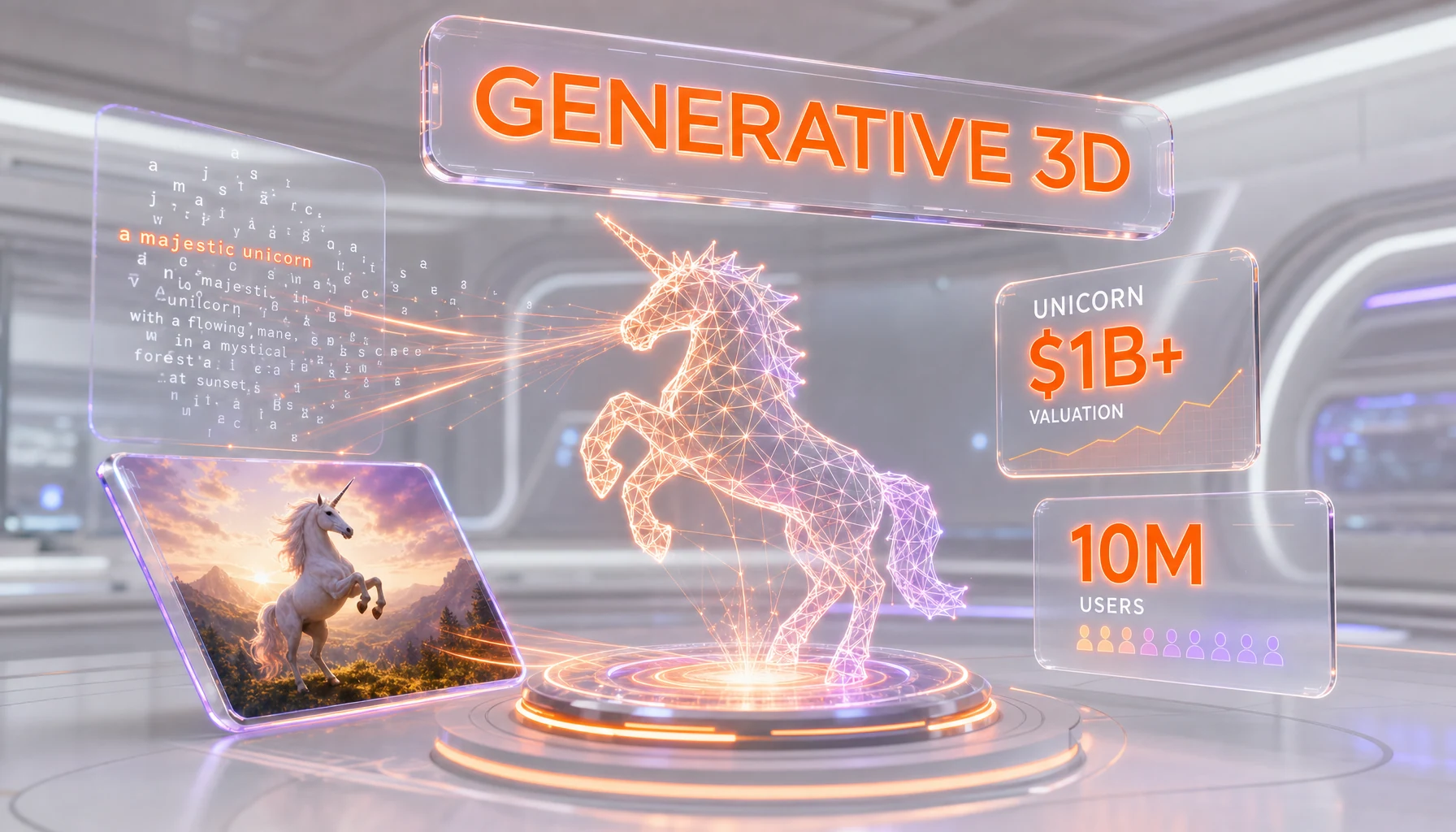
Vast is a Beijing-based generative 3D modeling startup, the maker of Tripo AI, that crossed a $1B-plus valuation this week to become China's latest artificial-intelligence unicorn, according to a Bloomberg report dated June 1, 2026. The company has raised nearly $200 million in total since it was founded in 2023, and is led by CEO Simon Song, a former co-founder of the Chinese AI unicorn MiniMax. Tripo AI turns text and image prompts into detailed 3D objects and counts roughly 10 million individual users and around 90,000 studios and companies, with clients reported to include NetEase and Sony.
What Happened
This week, Bloomberg reported that Vast, a startup focused on generative 3D modeling, had crossed a valuation of more than $1 billion, joining the small club of Chinese artificial-intelligence companies to reach unicorn status. The milestone caps a financing arc that brings the company's total raised to nearly $200 million since it was founded in 2023.
The headline product is Tripo AI, a tool that converts text and image prompts into detailed three-dimensional objects. Where most of the AI attention over the past two years has gravitated toward chatbots, large language models, and image and video generators, Vast bet on a narrower and harder problem: turning a sentence or a single picture into a usable 3D mesh. According to the figures cited in the reporting, Tripo AI now serves roughly 10 million individual users and around 90,000 studios and companies, with reported clients including the Chinese gaming giant NetEase and the Japanese conglomerate Sony.
The mechanics of the round deserve care. Earlier in 2026, a Series A of about $50 million — reported in March and led by Alibaba and Hengxu Capital with participation from Baidu Ventures — is widely described as the financing that pushed Vast past the $1 billion mark. Separately, the Bloomberg report tied to this week's unicorn confirmation attributes the most recent capital to Ince Capital and a fund backed by China Life Insurance. Because the Bloomberg piece sits behind a paywall and the public recoups differ on which tranche did what, we are deliberately not asserting a single, precise figure for "the new round." The cleanest accurate framing is the one the reporting supports across sources: Vast has raised nearly $200 million to date, with lead investors named according to Bloomberg, and a valuation now north of $1 billion.
What is not ambiguous is the founder. Vast is run by Simon Song, who previously co-founded MiniMax — itself one of the higher-profile Chinese AI unicorns, known for its work on large multimodal and language models. A founder leaving one unicorn to build another in an adjacent corner of the same market is, by itself, a signal about where experienced Chinese AI operators think the next defensible category lives.
What Generative 3D Modeling Actually Is
Generative 3D modeling is the task of producing a three-dimensional asset — geometry, and often textures and materials — from a high-level input such as a text prompt or a 2D image. The output is not a picture of a 3D object; it is an actual 3D model: a mesh of vertices, edges, and faces that can be rotated, lit, rigged, and dropped into a game engine, a 3D printer slicer, an AR scene, or a film pipeline.
This is a meaningfully different problem from text-to-image or text-to-video. A 2D image generator only has to produce a flat array of pixels that looks plausible from one viewpoint. A 3D generator has to produce something that holds together from every viewpoint, with consistent topology, sane proportions, clean UV mapping for textures, and geometry that does not collapse into spaghetti when an artist tries to edit it. The classic failure modes — floating fragments, melted faces, the so-called "multi-face Janus problem" where a model renders a second face on the back of a head — are exactly the kinds of errors that make a generated asset useless in a real production pipeline.
That difficulty is also the moat. Plausible 2D image quality has become close to a commodity in 2026, with strong models shipping from nearly every major lab. Useful 3D output, by contrast, is still hard enough that a focused team with the right training data and the right reconstruction techniques can build something competitors cannot trivially copy. Vast's wager is that "text-to-3D and image-to-3D, done well enough to be production-grade" is a category worth a unicorn valuation on its own — not a feature that gets absorbed into a general-purpose model next quarter.

Why It Matters
For developers, designers, and studios, the practical significance of a tool like Tripo AI is the collapse of a cost curve. Traditionally, building a single game-ready or print-ready 3D asset is slow, specialized work. A skilled 3D artist might spend hours to days modeling, retopologizing, UV-unwrapping, and texturing one object. Multiply that across the thousands of props, characters, and environment pieces a modern game or virtual production needs, and 3D content becomes one of the most expensive, slowest bottlenecks in the entire pipeline.
Generative 3D attacks exactly that bottleneck. If a prompt or a reference image can produce a usable base mesh in seconds — even one that still needs cleanup — the artist's role shifts from building everything from scratch to curating, correcting, and finishing. That is the same productivity story that played out in code with AI coding agents and in copywriting with language models, now arriving for the most labor-intensive corner of digital content. The reported user base — about 10 million individuals and roughly 90,000 studios and companies — suggests this is not a demo that people try once. It is being pulled into real workflows.
The second reason it matters is what it says about the shape of the AI market in 2026. The fact that an experienced founder could spin up a focused 3D company and reach a billion-dollar valuation in roughly three years tells you the frontier is no longer only about who has the biggest chatbot. Specialized "vertical" AI — models tuned for one demanding modality — is proving that it can build durable businesses next to the giants. We have seen the same dynamic in world models and physical-world AI bets, where labs are deliberately stepping away from the language-model race to chase a different prize; our coverage of Runway's world models bet and AMI Labs' billion-dollar seed round around world models traces that same instinct from a different angle. Generative 3D is another node in that map: a hard, spatial, non-text problem where the winners may not be the usual frontier labs.
How Tripo AI Compares in the Text-to-3D Race
Vast is not building in an empty field. The reporting explicitly positions the company against Tencent and Google, two of the heaviest players moving into generative 3D. That framing is worth unpacking, because each competitor approaches the problem from a different starting position.
Tencent — the open-source pressure
Tencent has been pushing aggressively on the open side of generative 3D and spatial generation. The company open-sourced its HY-World 2.0 system, which generates explorable text-to-3D worlds and made that capability free to anyone — a move we covered in depth in our piece on Tencent open-sourcing HY-World 2.0. Open weights are a double-edged competitive weapon: they commoditize the base capability, pressure paid tools on price, and seed an ecosystem that a closed competitor has to outrun on quality, speed, and integration rather than on access alone. For Vast, Tencent's open-source posture means the threshold for "good enough free 3D" keeps rising, and the company has to justify its product on reliability, asset quality, and workflow fit rather than on the raw existence of a text-to-3D button.
Tencent's broader strategy matters too. The company has been doubling down on AI spending even under earnings pressure — we tracked that capital intensity in our reporting on Tencent's Q1 2026 revenue miss and doubled AI capex. A competitor with that kind of balance sheet and a gaming ecosystem to feed is a serious adversary in exactly the verticals — gaming, virtual worlds, avatars — where Tripo AI is strongest.
Google — the platform and the research depth
Google's threat is different. It is not primarily a dedicated text-to-3D product business; it is the depth of its research and the gravity of its platform. Google's labs have published extensively on neural reconstruction and 3D-aware generation, and the company's broader generative stack — spanning image and video models — gives it the option to fold 3D into a larger creative suite whenever it decides the market is ripe. The risk for any focused player is the classic platform-absorption risk: a capability you sell as a product becomes a free feature inside someone else's ecosystem. Vast's defense against that is depth and focus — being the team that has solved the unglamorous reliability problems that a generalist add-on tends to ignore.
Where Vast sits
Vast's positioning, then, is the classic specialist's bet: be narrower than the giants but deeper. Against Tencent's free, open systems, the pitch is production-grade reliability and a polished tool rather than a research drop. Against Google's platform gravity, the pitch is focus — a company whose entire reason to exist is making generative 3D actually work for creators, not a side feature of a bigger product. Whether that holds depends on staying meaningfully ahead on output quality and creator workflow, because the floor underneath the whole category keeps rising.

The Founder Signal: From MiniMax to Vast
Founder pedigree is one of the strongest predictors of a startup's trajectory, and Vast's is unusually strong for its category. Simon Song co-founded MiniMax, one of the Chinese AI companies that earned unicorn status on the strength of large multimodal and language models. MiniMax has been a notable name in the Chinese model landscape — we covered the company's self-improving model work in our report on MiniMax M2.7, the self-evolving model — and an operator who helped build that has both the technical credibility and the fundraising network to start a new company on favorable terms.
That background also explains the deliberate choice to avoid the most crowded part of the market. Someone who has already built a frontier-style model company knows exactly how brutal the language-model arms race is: the capital requirements, the talent competition, the relentless release cadence. Choosing generative 3D instead is a strategic decision to compete where the field is thinner, the technical problem is distinct, and the incumbents have not yet locked down the category. It is the same logic we keep seeing across the 2026 landscape — experienced founders and labs deliberately picking spatial, embodied, or world-modeling problems rather than re-fighting the chatbot war.
Vast and China's AI Tooling Ecosystem
Vast's rise does not happen in isolation. It sits inside a Chinese AI ecosystem that has spent 2026 producing capital, talent, and product at a startling pace — and increasingly turning that energy toward specialized tooling rather than only foundation models.
The investor list tells part of the story. The names attached to Vast's financing across the reporting — Alibaba, Baidu Ventures, Hengxu Capital, and, per Bloomberg, Ince Capital and a China Life Insurance-backed fund — read like a roster of China's strategic AI capital. Alibaba in particular has been one of the most active forces in Chinese AI, both as a model builder and as an investor; we have tracked Alibaba's own model progress in our coverage of Qwen 3.6 beating Google's Gemma 4 on coding benchmarks. When a company like Alibaba both ships its own frontier models and funds focused players like Vast, it is effectively placing bets across the entire stack — foundation models for itself, vertical tools through its venture arm.
There is also a competitive-strategy subtext. Chinese tech giants have been jostling for position in the AI value chain, including over the most coveted model labs — we reported on the dynamics when Tencent and Alibaba sought stakes in DeepSeek. In a market where the marquee foundation labs are fiercely contested and sometimes resistant to outside ownership, backing a fast-growing specialist like Vast is a way for strategic investors to gain exposure to AI's expansion into new modalities without having to win a bidding war over the biggest names.
All of this is unfolding against a tightening geopolitical backdrop. China's AI sector has been navigating talent controls, export pressure, and a broader decoupling from US technology supply chains — context we explored in our analysis of China's AI talent travel curbs. A homegrown unicorn in generative 3D, built by a returning founder and funded by domestic strategic capital, is exactly the kind of company that fits China's stated ambition to build a self-sufficient AI stack from chips to applications. Vast is a small but telling data point: the Chinese ecosystem is now strong enough to produce category-defining tools, not just copies of Western products.
Who Is Actually Using Tripo AI
The reported user base splits into two very different audiences, and understanding both explains the company's valuation. On one side are the roughly 10 million individual users — hobbyists, indie game developers, 3D-printing enthusiasts, designers, and creators who want a fast way to turn an idea into a model without a 3D-modeling background. This is the long tail, the source of viral growth and word-of-mouth, and the funnel that feeds everything else.
On the other side are the roughly 90,000 studios and companies. This is where the revenue logic lives. A studio integrating generative 3D into its pipeline is not a casual user; it is a recurring, higher-value customer with real production needs around asset quality, consistency, licensing, and throughput. Reported clients including NetEase — one of the world's largest gaming companies — and Sony signal that Tripo AI is being evaluated, and used, by exactly the kind of demanding, high-volume customers that validate a tool as production-grade rather than a toy.
That mix — a massive free-to-cheap individual base feeding a smaller but lucrative enterprise tier — is the same flywheel that built many successful creative-software businesses. The individual users provide growth, feedback, and brand reach; the studios provide the money. If Vast can keep both halves spinning while the underlying technology keeps improving, the unicorn valuation has a defensible business underneath it rather than just hype.

The Risks Beneath the Headline
A billion-dollar valuation in three years is impressive, and it also concentrates a specific set of risks worth naming honestly.
The first is commoditization from above. If the open-source frontier — led by players like Tencent — keeps closing the quality gap and giving away capable text-to-3D systems, the willingness of users to pay for a standalone tool erodes. Vast has to stay far enough ahead on reliability, asset quality, and workflow integration that "free but rougher" is not good enough for the customers who matter.
The second is platform absorption. If Google, or any company with a dominant creative or game-development platform, decides to bundle competent generative 3D into an existing suite, a focused tool can find its addressable market shrinking from the outside in. The history of standalone features being swallowed by platforms is long.
The third is the gap between users and durable revenue. Ten million individual users is a great top-of-funnel number, but free and low-cost users are not the same as profit. The 90,000 studios and companies are where the business has to be proven, and converting a viral tool into sticky enterprise contracts — with the support, reliability, and licensing guarantees that studios demand — is a different and harder game than going viral.
The fourth is the broader environment. Chinese AI companies in 2026 operate under real constraints — compute access, talent mobility, and the politics of cross-border technology. None of these are unique to Vast, but they shape the ceiling on how fast and how far a Chinese AI unicorn can scale internationally, especially when some of its most natural customers and competitors sit on the other side of a widening technology divide.
Our Take
We read Vast's unicorn milestone less as a story about one company and more as a marker of where AI value is migrating in 2026. The chatbot land grab is largely settled into a handful of giants. The interesting money — and the interesting engineering — is increasingly flowing into the modalities that are still genuinely hard: video, world models, embodied AI, and now spatial 3D generation. Vast is a clean example of an experienced operator reading that map correctly and building where the competition is thinner and the technical moat is deeper.
The founder signal is the part we weight most heavily. A co-founder of an established model unicorn choosing to build generative 3D rather than another language model is a deliberate, informed bet that the next defensible AI businesses will be specialists, not generalists. The Alibaba-and-Baidu-adjacent capital stack and the reported Bloomberg-named investors suggest serious Chinese strategic money agrees. And the user numbers — even read conservatively — describe a product that has escaped demo status and entered real pipelines at companies like NetEase and Sony.
What we are watching, and what would change our read, is the quality-versus-free gap. The single biggest threat to Vast is not Google's research or Tencent's balance sheet in the abstract — it is the day a free, open, good-enough text-to-3D system makes a paid specialist tool feel optional for the studios that drive revenue. As long as Tripo AI's output stays meaningfully better and its workflow stays meaningfully smoother than the free alternatives, the moat holds. The moment that gap closes, a unicorn valuation built on a vertical bet gets tested fast.
What's Next
The near-term questions are concrete. Can Vast convert its enormous individual base into a growing, durable enterprise revenue line, given that the 90,000 studios and companies are where the valuation has to be justified? Can it stay ahead of an open-source frontier that keeps lowering the price of "good enough" 3D? And can a focused 3D specialist hold its ground as Tencent presses with free systems and Google retains the option to bundle 3D into a larger creative platform at any time?
The bigger story is the one Vast helps confirm: 2026 is the year vertical AI grew up. Generative 3D has produced its first billion-dollar pure-play, built in China, by a returning unicorn founder, funded by domestic strategic capital, and aimed squarely at two of the strongest players in the field. Whether Vast becomes a lasting category leader or a cautionary tale about specialists getting squeezed between free and bundled, it has already proven the category is real — and that is the part that will matter long after this week's headline fades.
Frequently asked questions
What is Vast and what does it do?
Vast is a Beijing-based generative 3D modeling startup founded in 2023, best known for its product Tripo AI, which turns text and image prompts into detailed 3D objects. According to a Bloomberg report dated June 1, 2026, Vast crossed a valuation of more than $1 billion to become China's latest AI unicorn, having raised nearly $200 million in total to date.
Who founded Vast and what is the connection to MiniMax?
Vast is led by CEO Simon Song, who previously co-founded MiniMax, one of China's higher-profile AI unicorns known for its large multimodal and language models. After helping build a frontier-style model company, Song chose to start Vast in the adjacent and less crowded category of generative 3D modeling rather than re-entering the language-model race.
How much has Vast raised and what is its valuation?
Vast has raised nearly $200 million in total since it was founded in 2023, with a valuation now north of $1 billion. A roughly $50 million Series A reported in March 2026 — led by Alibaba and Hengxu Capital with participation from Baidu Ventures — is widely described as pushing the company past the unicorn mark. Bloomberg attributes the most recent capital to Ince Capital and a fund backed by China Life Insurance. Because exact tranche figures differ across sources, we cite the total raised rather than a single precise new-round amount.
What is Tripo AI and how does generative 3D work?
Tripo AI is Vast's flagship product. It converts a text prompt or a single image into an actual 3D model — a mesh of geometry, often with textures and materials — that can be rotated, edited, and used in a game engine, 3D printer, AR scene, or film pipeline. This is harder than text-to-image because the output must hold together from every viewpoint with consistent topology, not just look correct from one angle.
How many people use Tripo AI?
According to the figures cited in the reporting, Tripo AI serves roughly 10 million individual users and around 90,000 studios and companies. The individual base drives growth and word-of-mouth, while the studios and enterprises represent the higher-value, recurring-revenue tier of the business.
Which companies use Tripo AI?
Reported clients include NetEase, one of the world's largest gaming companies, and Sony, the Japanese conglomerate. Adoption by demanding, high-volume customers like these is a signal that Tripo AI is being used as a production-grade tool rather than only as a casual or hobbyist demo.
How does Vast compete with Tencent in text-to-3D?
Tencent has pushed aggressively on open-source generative 3D, including open-sourcing its HY-World 2.0 system for explorable text-to-3D worlds and making it free. That open posture raises the bar for free, good-enough 3D, so Vast competes on production-grade reliability, asset quality, and workflow integration rather than on simply offering a text-to-3D capability.
How does Vast compete with Google in generative 3D?
Google's threat is platform gravity rather than a dedicated 3D product. With deep research in neural reconstruction and a broad image and video generation stack, Google could fold 3D into a larger creative suite at any time. Vast's defense is focus — being the team dedicated entirely to making generative 3D work for creators, rather than treating it as a side feature.
Why is generative 3D a different problem than text-to-image or text-to-video?
A 2D image generator only has to produce pixels that look plausible from one viewpoint, while a 3D generator must produce geometry that holds up from every angle, with consistent topology, clean UV mapping, and sane proportions. Avoiding failure modes like floating fragments, melted faces, and the multi-face Janus problem is exactly what makes useful 3D generation hard — and what gives a focused player a technical moat.
Which investors back Vast?
Across the reporting, names attached to Vast's financing include Alibaba and Hengxu Capital with participation from Baidu Ventures on the March 2026 Series A, plus Ince Capital and a fund backed by China Life Insurance per Bloomberg. That roster reads like a list of China's strategic AI capital placing bets on the country's AI tooling layer.
What does Vast's rise say about China's AI ecosystem?
Vast is evidence that China's AI ecosystem is now strong enough to produce category-defining specialized tools, not just foundation models or copies of Western products. A homegrown generative 3D unicorn — built by a returning MiniMax co-founder and funded by domestic strategic investors like Alibaba and Baidu Ventures — fits China's stated ambition to build a self-sufficient AI stack from chips to applications.
What are the biggest risks to Vast's business?
The main risks are commoditization from open-source frontiers like Tencent's free systems, platform absorption if a giant such as Google bundles 3D into an existing suite, and the gap between 10 million individual users and durable enterprise revenue from the 90,000 studios and companies. Broader constraints on Chinese AI — compute access, talent mobility, and cross-border technology politics — also cap how fast it can scale internationally.