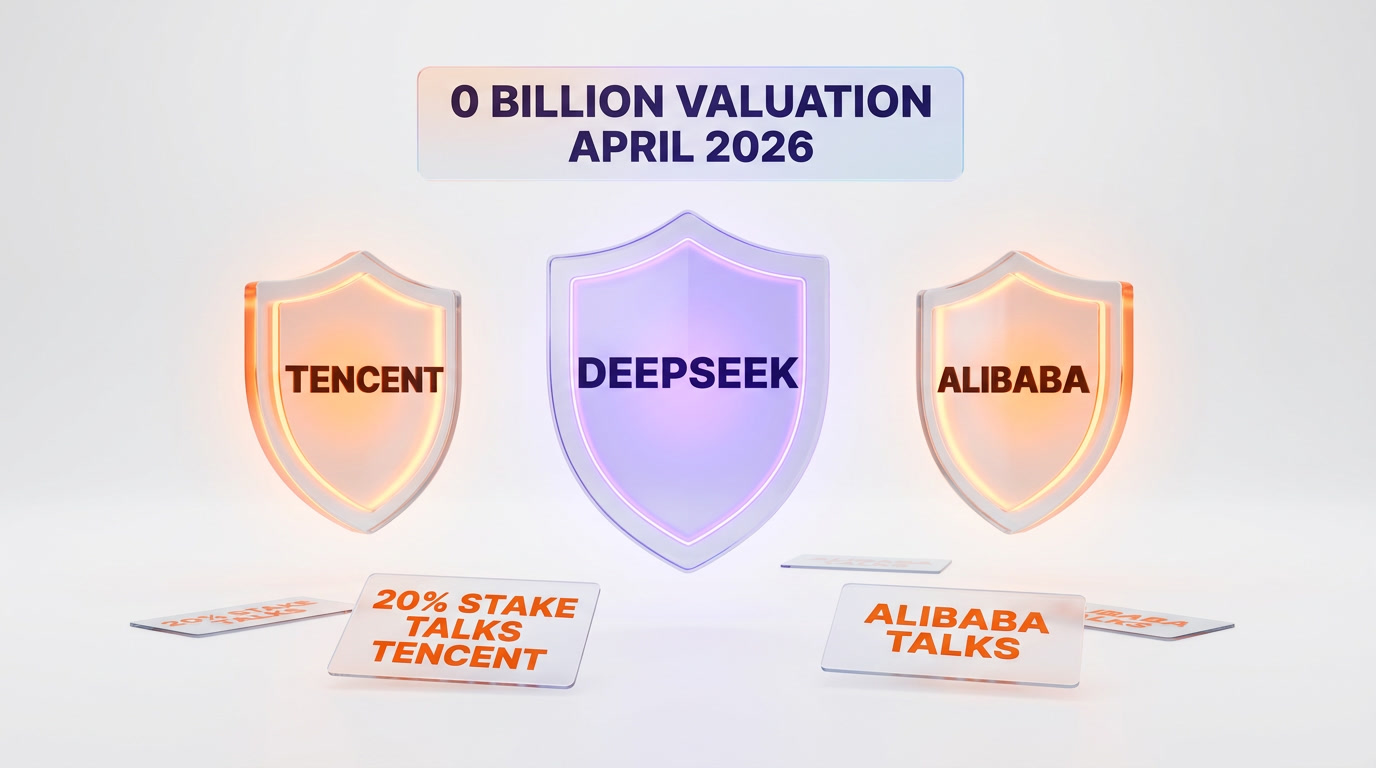
Tencent and Alibaba are in talks to invest in DeepSeek at a valuation exceeding $20 billion, according to The Information (April 22, 2026). Tencent proposed acquiring up to a 20% stake. DeepSeek is reluctant to cede that much control. Target raise: at least $300 million, up from an initial $10 billion valuation to $20 billion plus in 48 hours of investor interest. Benchmark: MiniMax ($30B+), Moonshot ($18B), Zhipu ($50B+). Launched 48 hours after DeepSeek V4.
The deal on the table: Tencent wants 20%, DeepSeek is not having it
The Information broke the story on April 22, 2026, and within 48 hours it had reshaped how the Chinese AI ecosystem talks about consolidation. Two of China's three largest technology conglomerates — Tencent Holdings and Alibaba Group — are negotiating to participate in DeepSeek's first ever outside funding round. The headline number that matters: Tencent reportedly offered to acquire up to 20% of DeepSeek, and DeepSeek reportedly declined to cede that stake.
Let us be precise about the numbers, because the reporting has drifted in some outlets. DeepSeek started the conversation seeking to raise roughly $300 million at a $10 billion valuation. Investor interest was so heavy that the valuation target doubled to $20 billion plus within 48 hours. The benchmark commonly cited is MiniMax, a rival Chinese large language model lab whose valuation had climbed to around $30 billion at the time of reporting (some secondary benchmarks floated $40 billion as a theoretical ceiling given DeepSeek's outsized brand awareness). Moonshot AI, another competitor, is raising at $18 billion. Zhipu is at $50 billion plus. DeepSeek sits somewhere in the middle of that pack by reported valuation, but arguably at the top by global recognition.
Why is this happening right now? Two reasons. First, DeepSeek launched DeepSeek V4 on April 24, 2026 — the successor to the V3 that upended Silicon Valley in January 2025 — with Hybrid Attention, 1 million token context, and pricing that undercuts every Western frontier lab. Momentum is peak. Second, the Frontier Model Forum pact announced the same week (OpenAI, Anthropic, Google uniting against Chinese espionage) put pressure on Beijing's tech conglomerates to consolidate their AI bets. The timing is not coincidental.
What Tencent is putting on the table
Tencent's reported 20% stake proposal is aggressive. For context, the largest stake any single investor holds in a comparable Chinese AI lab (MiniMax, Moonshot, Zhipu) is under 15%. Tencent is effectively asking for board-shaping influence at DeepSeek, which would represent the first time the company yields outside control since its 2023 founding. At a $20 billion valuation, 20% would cost Tencent approximately $4 billion. At the $40 billion benchmark floated in some analyst reports, that stake would cost $8 billion.
For Tencent, the math is easy. The company sits on over $75 billion in cash and short-term investments. $4 billion to $8 billion is a rounding error. But the strategic stake is enormous: Tencent's own frontier model, Hunyuan, has been trailing DeepSeek in open benchmark scores since V3 launched in January 2025. Buying into DeepSeek is cheaper and faster than catching up from scratch.
What Alibaba is offering (and why the terms are quieter)
Alibaba's role in the talks is more opaque. The company is engaged in funding discussions but no public stake percentage has leaked. Our read: Alibaba is likely pursuing a strategic minority stake (5% to 10%) rather than Tencent's 20% bid, because Alibaba already has its own frontier family. Qwen 3.6 beat Google's Gemma 4 on coding benchmarks in April 2026 — Alibaba's lab is ahead of Tencent's, which makes a defensive investment less urgent but a strategic hedge more attractive.
Why would Alibaba invest in a direct competitor to Qwen? Three words: open source optionality. DeepSeek open-sources its weights under MIT license. Qwen also has open-weight variants. If Chinese open-source AI becomes the global alternative to the closed OpenAI and Anthropic stacks, Alibaba wants to be at the center of that ecosystem, not competing with one of the two leading players in it.
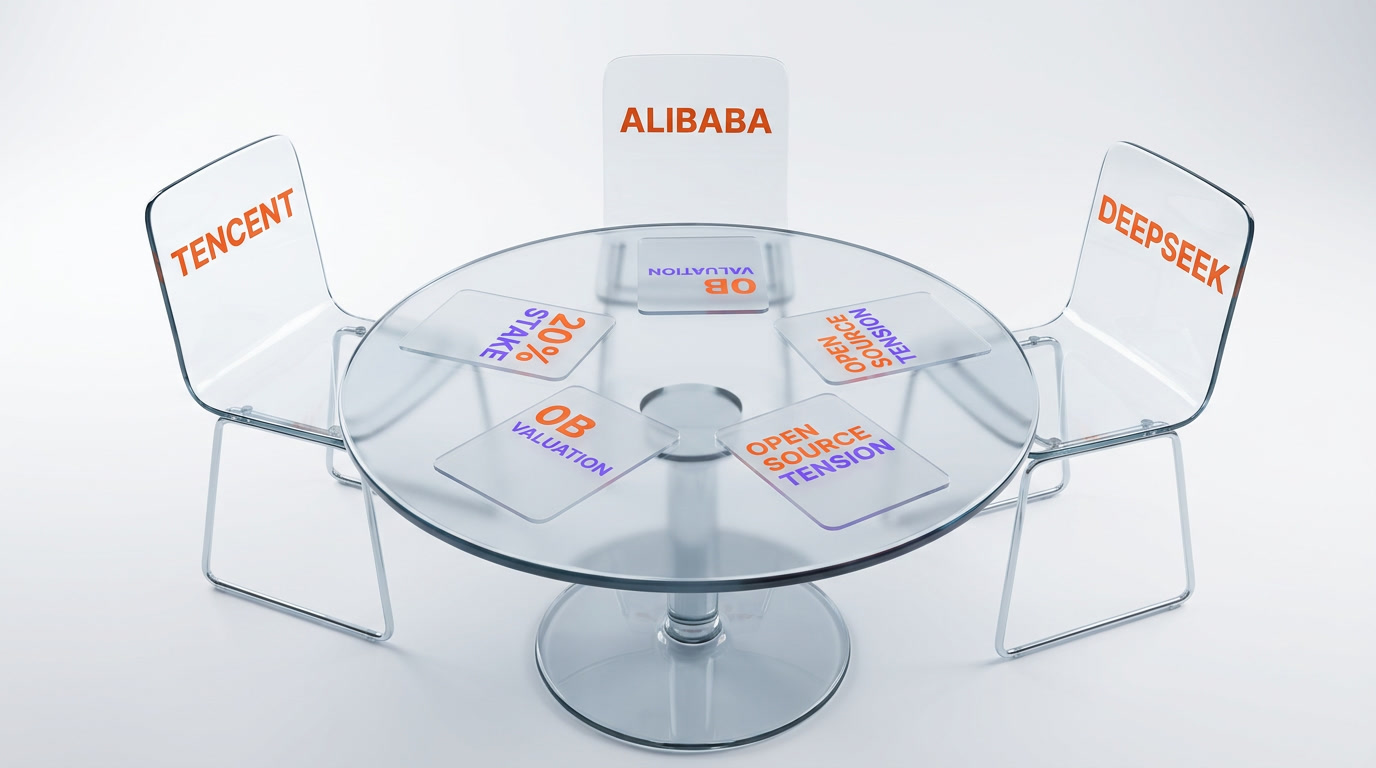
Why DeepSeek is resisting the 20% stake
This is the most interesting part of the story, and the part most Western coverage misses. DeepSeek's resistance to Tencent's 20% stake is not about money. Liang Wenfeng, founder of DeepSeek, is also the co-founder and majority owner of Zhejiang High-Flyer Asset Management, a quantitative hedge fund with an estimated $8 billion plus in assets under management. DeepSeek does not need Tencent's capital to survive. It is already funded by one of China's most profitable hedge funds.
The resistance is about strategic independence. Three specific concerns:
- Open source identity. DeepSeek's entire brand is built on releasing MIT-licensed weights. A 20% Tencent stake would hand board influence to a company (WeChat) whose core business model is closed-source superapp walled gardens. That is a philosophical collision.
- Dual-hat problem. Liang runs both DeepSeek and High-Flyer. High-Flyer reportedly uses DeepSeek models in its trading strategies. Any outside investor at 20% would demand transparency into how the two entities share research, GPUs, and talent — something High-Flyer has historically refused to disclose.
- Exit optionality. If DeepSeek eventually IPOs (most likely Hong Kong, following MiniMax and Zhipu), a 20% Tencent preferred stake makes the cap table messy. A 5% to 10% strategic investment from multiple parties preserves IPO flexibility.
The Liang Wenfeng playbook: cash, control, patience
Liang Wenfeng is not a typical AI founder. He did not come from Stanford or Tsinghua AI labs. He came from quant finance. He built High-Flyer into one of China's top hedge funds, stockpiled tens of thousands of Nvidia A100 GPUs before the 2022 US export bans (which is why DeepSeek can still train frontier models despite the chip restrictions), and used those GPUs first for trading, then for AI research.
That backstory matters. A founder who already owns thousands of H100-era GPUs, runs a profitable hedge fund, and holds majority equity in his own AI lab does not need Tencent. He can wait. He can negotiate. He can say no to 20%. And he reportedly has.
The Chinese AI landscape: why five labs are competing for the same crown
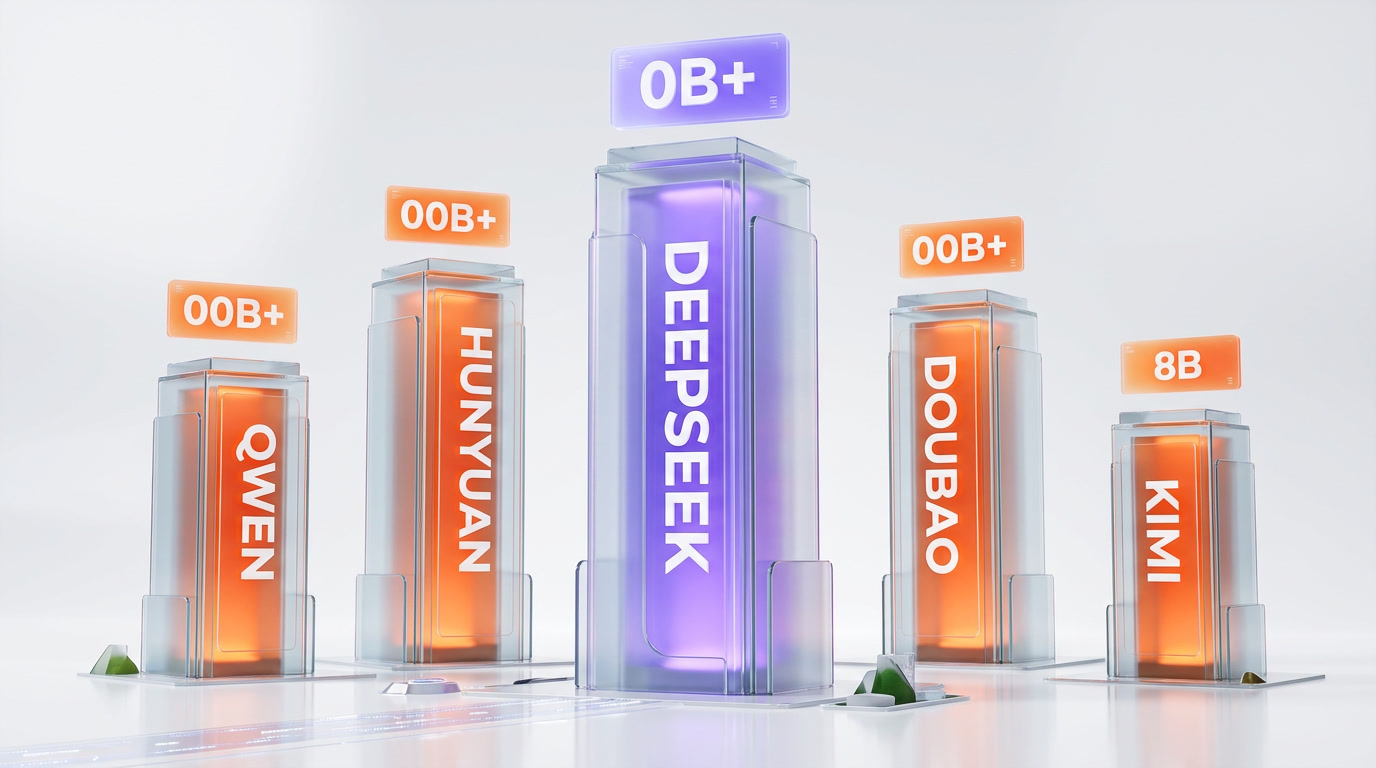
The Tencent plus Alibaba plus DeepSeek triangle does not exist in a vacuum. Five Chinese frontier labs are currently in active competition, each backed by a different mix of BigTech, state, and private capital:
| Lab | Parent / Backer | Latest model (April 2026) | Open source? | Valuation |
|---|---|---|---|---|
| DeepSeek | High-Flyer (Liang Wenfeng) | DeepSeek V4 (Pro 1.6T / Flash 284B) | Yes, MIT license | $20B+ target |
| Qwen | Alibaba | Qwen 3.6 | Partial (open-weight variants) | Part of Alibaba ($200B+) |
| Hunyuan | Tencent | Hunyuan T3 | Partial | Part of Tencent ($500B+) |
| Doubao | ByteDance | Doubao 1.6 Pro | Closed | Part of ByteDance ($300B+) |
| Kimi | Moonshot AI | Kimi K2 | Partial | $18B target raise |
DeepSeek is the only fully open source operator in this list. That is both its competitive moat and its reason to refuse the 20% stake. Once you cede control to a closed source parent like Tencent, the open source identity erodes — slowly at first, then all at once.
Where DeepSeek sits in the valuation ladder
The benchmarks cited most often in the Tencent talks:
- Zhipu AI: $50 billion plus valuation after January 2026 Hong Kong IPO
- MiniMax: $30 billion plus (some analyst reports use $40 billion as forward benchmark) after Hong Kong IPO
- DeepSeek: $20 billion plus target, rising toward $40 billion if V4 momentum holds
- Moonshot AI: $18 billion target raise in progress
- Character AI (for reference, US): Acquired by Google, undisclosed valuation
DeepSeek is arguably undervalued at $20 billion given its V4 launch with trillion-parameter open weights and the global citation dominance its models enjoy. That is exactly why investor demand doubled the target valuation in 48 hours. It is also exactly why Liang can afford to negotiate hard.
Why Tencent and Alibaba both want in right now
Three strategic drivers converge on this specific April 2026 window:
Driver 1: DeepSeek V4 just landed
The V4 launch on April 24, 2026 put DeepSeek at the top of global LLM citation rankings. At launch, V4-Pro ran at $1.74 per million input tokens and $3.48 per million output tokens. V4-Flash: $0.14 per million input, $0.28 per million output. Those launch prices were 70% to 85% cheaper than Claude Opus 4.7 and GPT-5 Turbo on comparable benchmarks. Every Chinese enterprise considering an AI rollout now has a first-call option that costs less than Western frontier models. DeepSeek has cut V4-Pro sharply since: the 75 percent introductory discount became the permanent list price on May 22, 2026, that cut was then reversed: since August 16, 2026 V4-Pro bills $0.66 per million input tokens and $1.98 per million output outside peak hours, and $1.32 and $3.96 during them, which is above the launch rates quoted here on output.
For Tencent and Alibaba cloud divisions (Tencent Cloud, Alibaba Cloud), hosting DeepSeek inference becomes enormously strategic. Whichever cloud hosts the API most efficiently captures downstream enterprise spend. A 20% stake gives Tencent a seat at the inference-pricing table. A smaller Alibaba stake gives Alibaba Cloud preferential compute relationships.
Driver 2: US sanctions pressure
Rep. Bill Huizenga (R-MI) introduced proposed sanctions legislation in April 2026 targeting Chinese AI firms allegedly using "query-and-copy" distillation techniques on American models. If enacted, it would restrict Chinese labs from accessing US cloud providers, US training data, and US investment capital. The Trump administration has been broadly receptive to tightening AI exports to China.
Chinese tech consolidation is a direct response. If US capital dries up, domestic Tencent plus Alibaba capital becomes the lifeline. DeepSeek's reluctance to accept Tencent's 20% is a bet that the sanctions will not bite hard enough in 2026 to force the deal. Tencent's aggressive 20% bid is a bet that they will. One of the two is wrong.
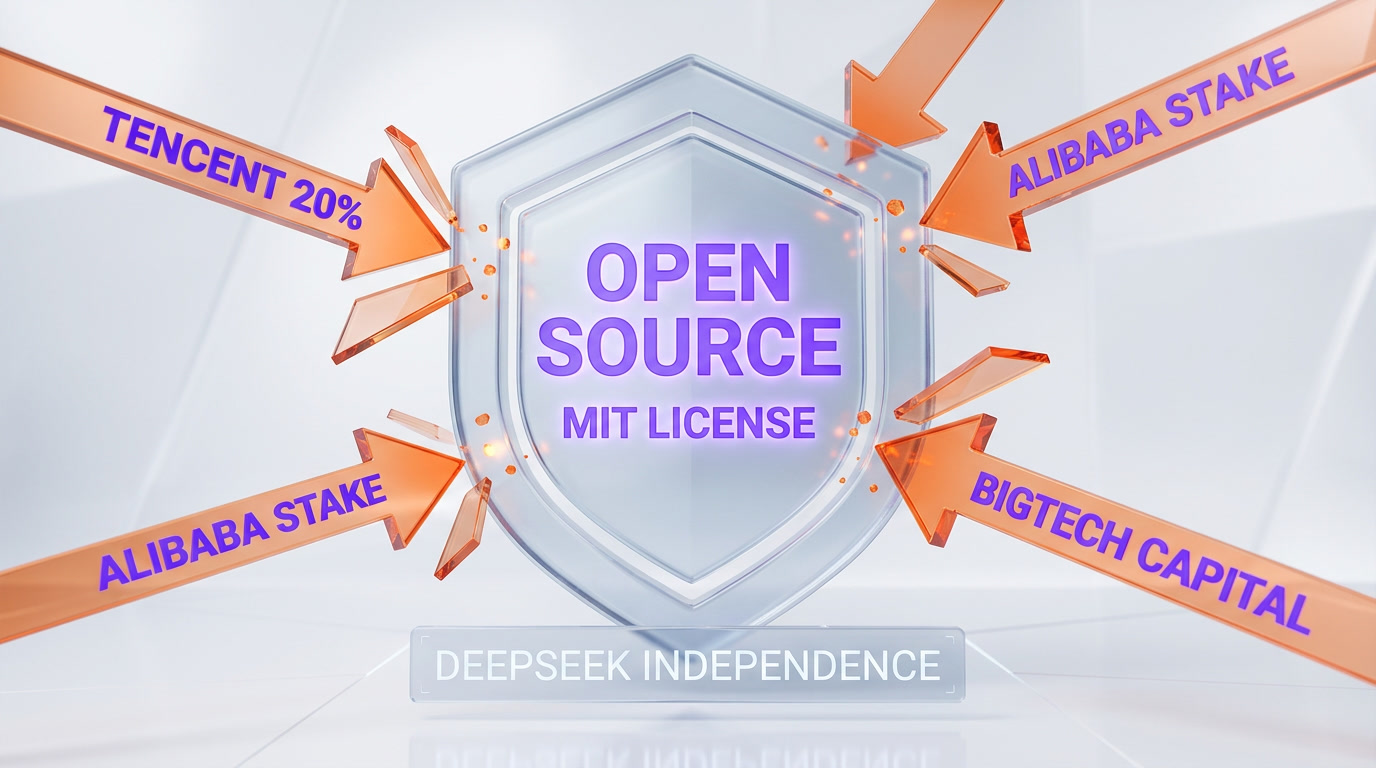
Driver 3: China's AI sovereignty narrative
Beijing has been explicit since late 2025 that Chinese AI champions should stay Chinese. The Manus blocked Meta acquisition in early 2026 — where China's regulators called a $2 billion Meta offer a "conspiracy" and barred the founders from leaving the country — sent the message clearly. Chinese AI labs are national strategic assets. They are not for sale to foreigners.
In that context, Tencent and Alibaba investing in DeepSeek is state-aligned behavior. It keeps DeepSeek's cap table domestic. Even if Liang resists 20%, he will almost certainly accept some domestic BigTech capital, because the alternative — foreign capital — is politically toxic right now.
The Anthropic plus Google parallel: same week, same numbers, opposite worlds
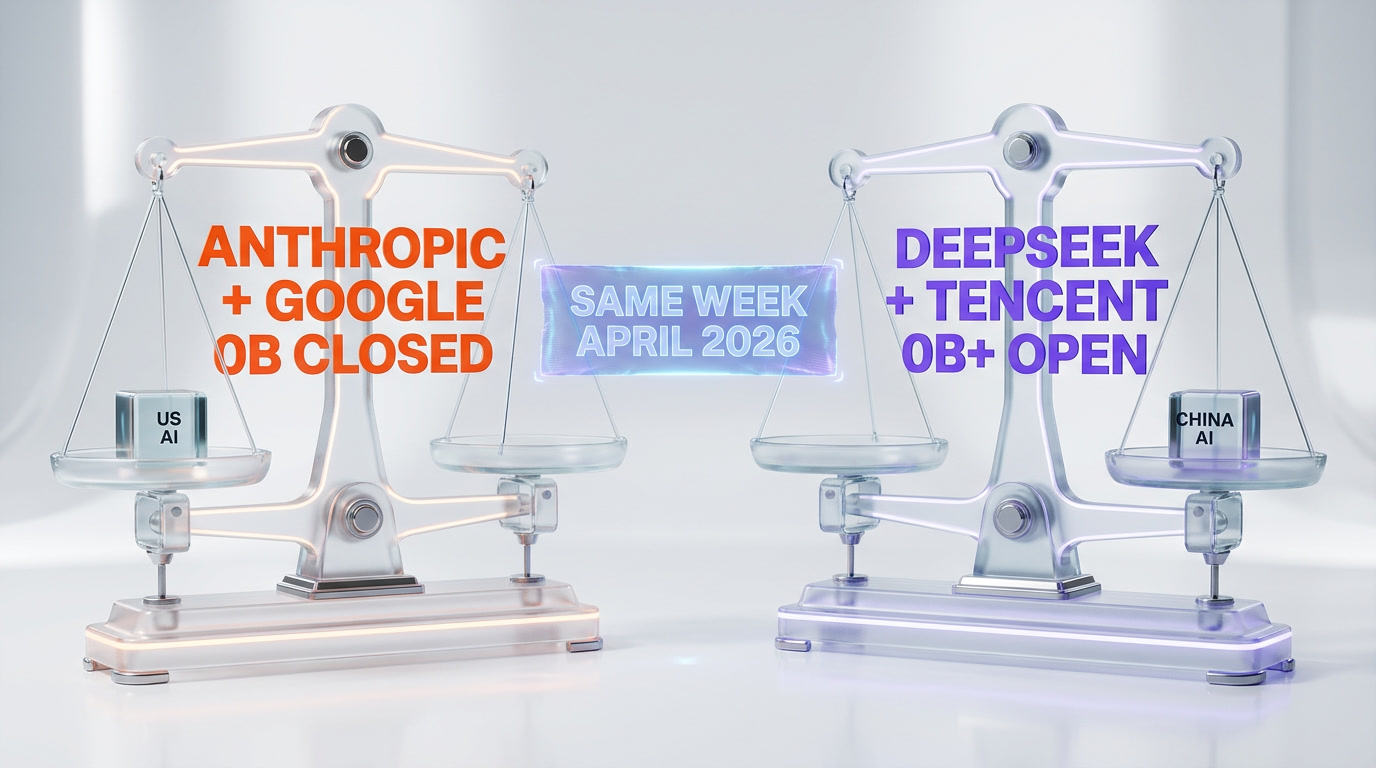
Here is the coincidence that should make everyone pause. In the same week that Tencent and Alibaba are negotiating DeepSeek's first funding round, Google committed $40 billion to Anthropic at a $350 billion valuation as an IPO launchpad. Two frontier AI deals. Both involving approximately $40 billion. Both unfolding the same week of April 2026. Two completely opposite philosophical worlds.
| Dimension | Anthropic + Google | DeepSeek + Tencent/Alibaba |
|---|---|---|
| Deal size benchmark | $40 billion committed | $20-40 billion valuation target |
| Source posture | Closed weights | Open weights, MIT license |
| Governance | Google preferred stake, board seat | DeepSeek resisting 20% stake |
| Geography | US-centric Silicon Valley | Hangzhou-centric, BigTech Shenzhen/Hangzhou |
| Regulatory alignment | US LTIA compliance, NIST AI RMF | Cyberspace Administration of China alignment |
| IPO timeline | October 2026 target (Google IPO launchpad) | Hong Kong 2027 possible |
| Target customer | US Fortune 500, federal government | Chinese enterprise, belt-and-road markets |
Two parallel ecosystems are crystallizing. American AI (closed, capital-heavy, enterprise-first). Chinese AI (open, cost-aggressive, globally distributed through open weights). Neither is winning. Both are locking in their capital structures this quarter.
Who wins long term? It depends on where you stand
If you are a US Fortune 500 CIO, Anthropic plus Google is the safer bet. Compliance, security, enterprise support, established contracts. If you are a Vietnamese SaaS founder, a Dubai healthtech startup, or a Brazilian fintech, DeepSeek V4 at $0.22 per million input tokens off-peak is still the obvious call — and if Tencent plus Alibaba keep it on their clouds, adoption accelerates. The two ecosystems will likely coexist for the next decade, each serving different geographies and compliance regimes.
What the deal means for developers and enterprise users
Three concrete implications if the Tencent deal closes (even at a smaller stake than 20%):
- Tencent Cloud becomes a primary DeepSeek inference host. Latency to Asian users improves. Enterprise SLAs become available. Pricing may get marginally more premium for SLA tiers, but the core rate is now $0.22 input and $0.66 output per million tokens off-peak, double that at peak.
- DeepSeek integrates with WeChat Work and Tencent Meeting. Chinese corporate adoption surges, especially for companies already deep in Tencent's SaaS stack.
- Open weights may slow. If Tencent takes a 10% to 20% stake, expect V5 and beyond to release with a 30 to 90 day delay between internal Tencent availability and public open weights release. This is the quiet cost of BigTech capital.
For developers using Claude Code or OpenAI's stack, the Chinese deals are not an immediate threat. But for developers in emerging markets using DeepSeek via Fireworks, Together AI, or self-hosted endpoints — the Tencent relationship may affect availability, pricing, and release cadence. Watch Q3 2026 for how the deal actually structures the open weights cadence.
The philosophical tension: open source vs BigTech control
Our take: Liang Wenfeng's resistance to Tencent's 20% stake is not just financial. It is identity. DeepSeek is the global face of Chinese open source AI. That identity is worth more than the $4 billion Tencent would bring to the table. If Liang accepts anything above 10%, DeepSeek starts looking less like Anthropic-of-China and more like a Tencent subsidiary. That is a brand death no amount of Tencent Cloud compute can reverse.
The most likely outcome: a split round. Tencent takes 8% to 10%. Alibaba takes 4% to 6%. Some domestic state-adjacent fund (possibly through a Hong Kong SPV) takes another 5%. Liang and High-Flyer retain 70%-plus. DeepSeek raises $500 million to $700 million total. Valuation settles around $22 billion to $25 billion. No single investor has board control. V4 pricing stays open. V5 development continues on the current cadence.
If we are right, everyone wins. Tencent and Alibaba get exposure to the hottest AI brand in China. Liang retains control. Open weights continue. Chinese AI sovereignty narrative is satisfied. The US sanctions pressure becomes less existential because DeepSeek now has BigTech air cover.
If we are wrong and Tencent insists on 20%, one of two things happens: either DeepSeek walks away and waits six months for the pressure to ease, or Liang accepts and DeepSeek's open source narrative gets quietly compromised. We think Liang walks. The hedge fund cash runway lets him.
Timeline to watch
- April 22, 2026: The Information breaks the Tencent plus Alibaba story
- April 24, 2026: DeepSeek V4 launches (Pro + Flash, Hybrid Attention, 1M context)
- April 2026 (ongoing): Valuation doubles from $10B to $20B target in 48 hours
- May-June 2026 (expected): Term sheet finalized, round closes or talks collapse
- Q3 2026 (expected): First operational signals — Tencent Cloud DeepSeek partnership announcements, updated WeChat Work integrations
- Q4 2026 / Q1 2027 (possible): Hong Kong IPO preparations begin if round closes successfully
Frequently asked questions
How much is DeepSeek worth in April 2026?
DeepSeek is targeting a valuation exceeding $20 billion in its first outside funding round, up from an initial $10 billion target that doubled within 48 hours of investor interest (The Information, April 22, 2026). Some analyst reports cite $40 billion as a forward benchmark based on comparable valuations — MiniMax sits around $30 billion and Zhipu at $50 billion plus.
What stake did Tencent propose in DeepSeek?
Tencent proposed acquiring up to 20% of DeepSeek as part of the first funding round. DeepSeek reportedly declined to cede that large a stake, preferring to preserve strategic independence and open source identity. A 20% stake at $20 billion valuation would cost Tencent approximately $4 billion.
Is Alibaba also investing in DeepSeek?
Yes, Alibaba is engaged in parallel funding discussions. Specific stake terms have not leaked publicly, but our read is a strategic minority position (5% to 10%) rather than Tencent's 20% bid — because Alibaba already has Qwen 3.6 as its own frontier model family.
Why is DeepSeek resisting the 20% stake?
Three reasons: (1) open source identity — DeepSeek's MIT-licensed weights would conflict with Tencent's closed-source superapp culture at 20% influence, (2) dual-hat governance — founder Liang Wenfeng runs both DeepSeek and High-Flyer hedge fund, and a large outside stake would force transparency on how the two entities share resources, (3) exit optionality — a clean cap table preserves Hong Kong IPO flexibility for 2027.
How does DeepSeek's valuation compare to other Chinese AI labs?
As of April 2026: Zhipu AI at $50 billion plus (post-IPO), MiniMax at $30 billion plus (post-IPO), DeepSeek at $20 billion plus target, Moonshot AI at $18 billion target raise. DeepSeek has arguably the strongest global brand awareness of the four, which is why investor demand doubled the valuation in 48 hours.
What is the connection between DeepSeek and High-Flyer?
Liang Wenfeng is the co-founder and majority owner of both Zhejiang High-Flyer Asset Management (a quantitative hedge fund with estimated $8 billion plus AUM) and DeepSeek. High-Flyer reportedly stockpiled tens of thousands of Nvidia A100 GPUs before the 2022 US export bans, which is why DeepSeek can still train frontier models despite chip restrictions. The two entities are legally separate but share GPUs, talent, and research.
How does this deal compare to Google's $40 billion Anthropic investment?
Same week, same approximate dollar benchmark, opposite philosophical worlds. Google committed $40 billion to Anthropic at $350 billion valuation as an IPO launchpad — closed weights, US-centric, enterprise-first. Tencent plus Alibaba are negotiating DeepSeek at $20 to $40 billion — open weights, China-centric, cost-aggressive. Two parallel AI ecosystems crystallizing simultaneously.
Will the deal affect DeepSeek V4 pricing or availability?
Unlikely in the short term, and in the event it was not the talks that moved the price. V4-Pro launched at $1.74 per million input tokens and $3.48 per million output; DeepSeek made its 75 percent introductory discount permanent on May 22, 2026, so V4-Pro billed $0.435 per million input and $0.87 per million output through August 15, 2026. Since August 16, 2026 both models bill by time of day: V4-Pro at $0.66 input and $1.98 output per million tokens off-peak and double at peak, V4-Flash at $0.22 and $0.66 off-peak and $0.44 and $1.32 at peak. If Tencent takes 10% to 20%, expect Tencent Cloud to become a primary inference host for Asian latency, and possibly a 30 to 90 day delay on public open weights for V5 and beyond — the quiet cost of BigTech capital.
What are the five main Chinese frontier AI labs in April 2026?
DeepSeek (High-Flyer / Liang Wenfeng, fully open source), Qwen (Alibaba, partial open weights), Hunyuan (Tencent, partial), Doubao (ByteDance, closed), Kimi (Moonshot AI, partial). DeepSeek is the only fully open source operator, which is both its competitive moat and the reason it resists large BigTech stakes.
What is the role of US export controls in driving this deal?
Rep. Bill Huizenga (R-MI) introduced proposed sanctions legislation in April 2026 targeting Chinese AI firms allegedly using "query-and-copy" distillation on American models. The Trump administration has signaled willingness to tighten AI exports. Chinese tech consolidation — Tencent plus Alibaba backing DeepSeek — is a direct defensive response to keep capital and strategic control domestic.
What is our most likely scenario for how the deal closes?
Our prediction: a split round. Tencent takes 8% to 10%. Alibaba takes 4% to 6%. A domestic state-adjacent fund takes another 5%. Liang and High-Flyer retain 70% plus. Total raise of $500 million to $700 million. Final valuation settles at $22 billion to $25 billion. No single investor gets board control. V4 open weights cadence continues. If Tencent insists on 20%, we think Liang walks and waits six months — the hedge fund cash runway lets him.
When will the deal be finalized?
Based on typical Chinese VC round timelines post-The Information leak, expect term sheet finalization in May or June 2026, with first operational signals (Tencent Cloud partnership announcements, WeChat Work integrations) in Q3 2026. A Hong Kong IPO preparation cycle could begin Q4 2026 or Q1 2027 if the round closes cleanly.
Sources and methodology
Primary reporting: The Information (April 22, 2026 breaking story), Bloomberg (April 22, 2026 secondary), Yahoo Finance, Reuters secondary reporting. Valuation benchmarks: Hong Kong Stock Exchange filings for MiniMax and Zhipu, PYMNTS April 2026 analysis. Chinese AI lab landscape: DeepSeek V4 launch documentation, Alibaba Qwen 3.6 benchmark reports, Tencent Hunyuan T3 changelog. Geopolitical context: Rep. Bill Huizenga April 2026 sanctions bill text, Frontier Model Forum espionage pact announcements.
Our analysis framework: we do not have insider access to DeepSeek, Tencent, or Alibaba term sheets. What we provide is a structured read of public reporting plus our framework for understanding Chinese BigTech consolidation dynamics, open source AI strategy, and cross-Pacific capital flow. The "most likely scenario" section above is an editorial prediction, not reported fact.