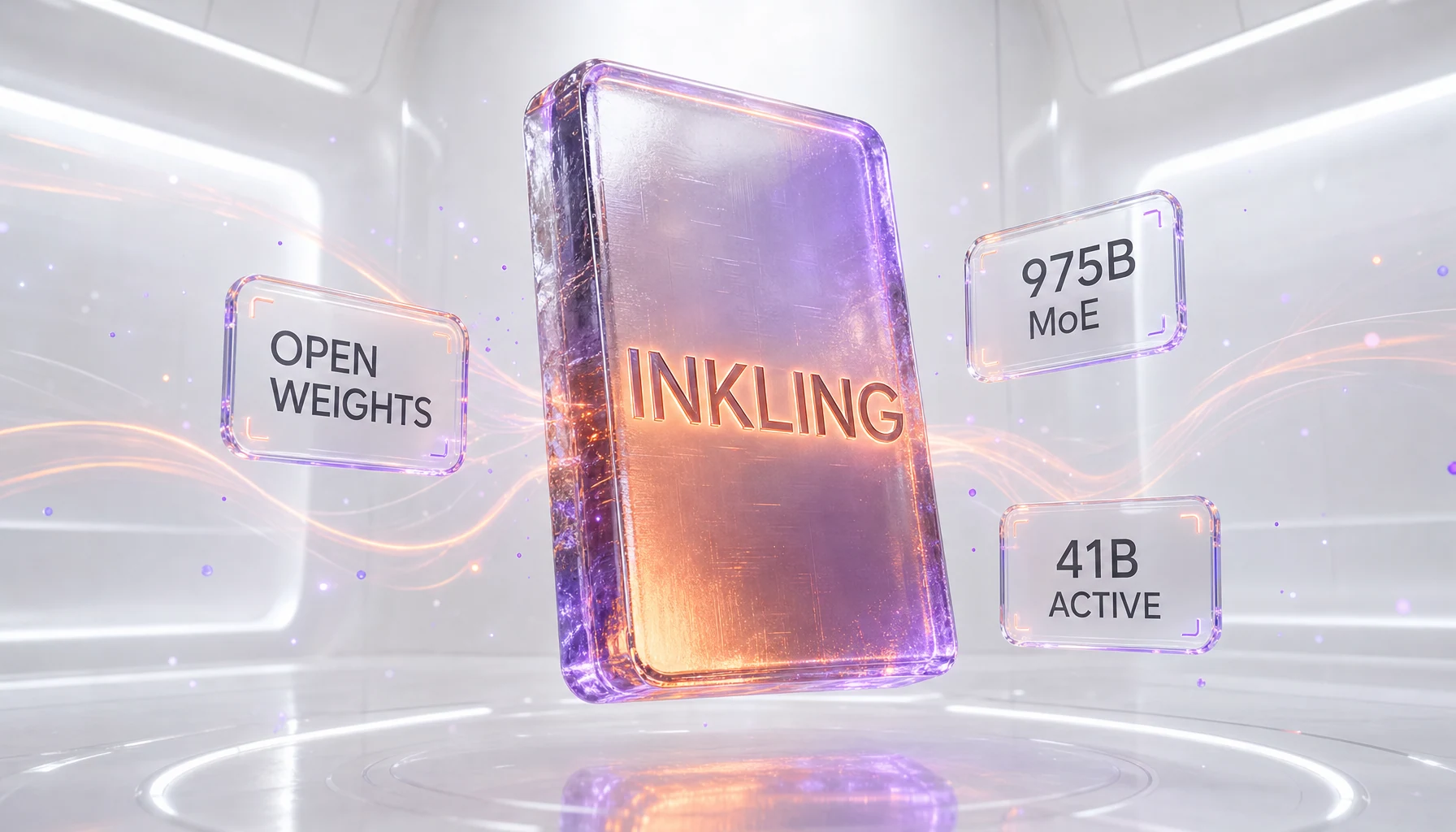
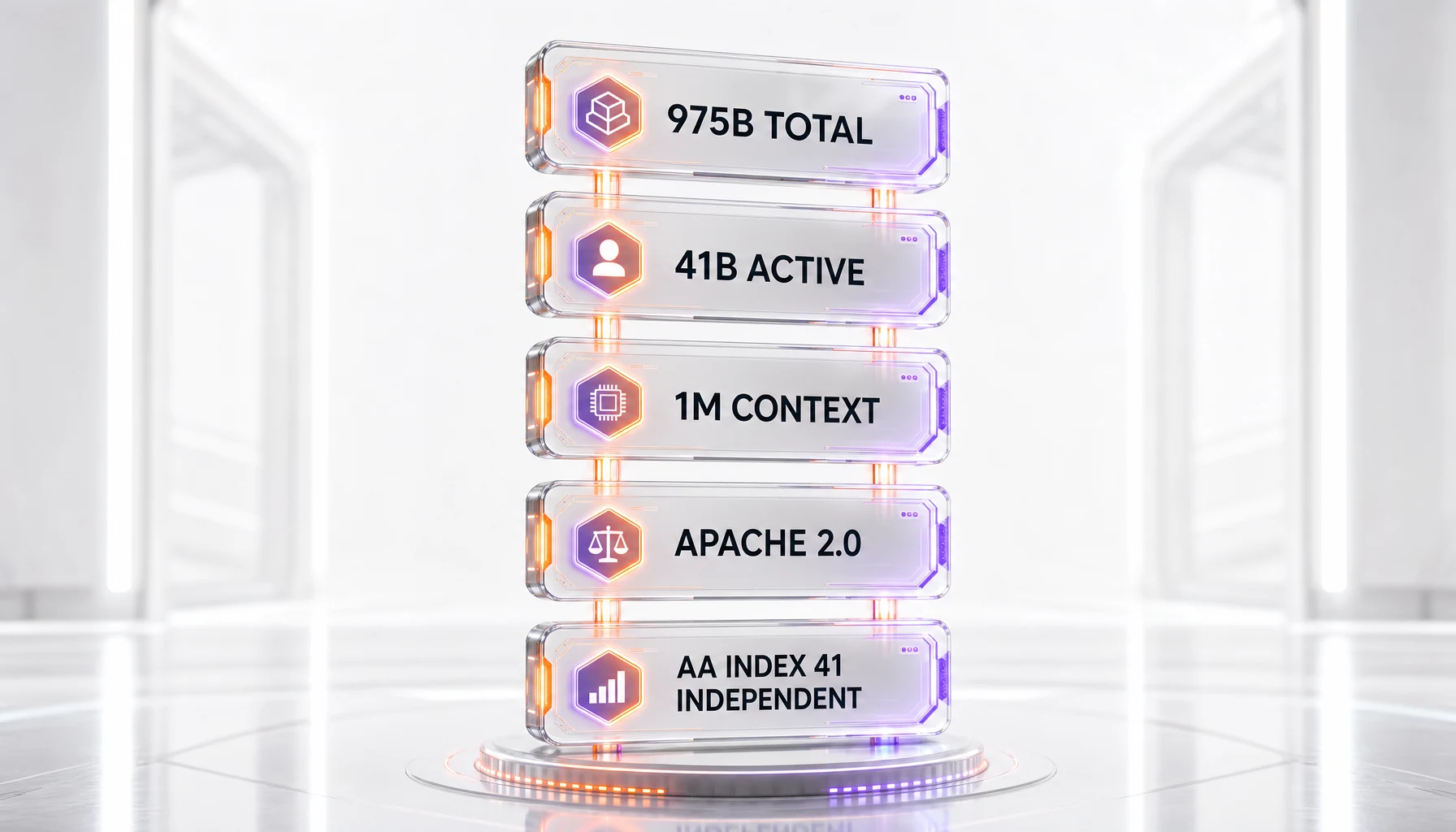
Thinking Machines Lab, the Nvidia-backed startup founded by former OpenAI CTO Mira Murati, released Inkling on July 15, 2026 — its first open-weights model, trained from scratch. Inkling is a 975-billion-parameter mixture-of-experts model that activates 41 billion parameters per token, supports a context window up to 1 million tokens, and was pre-trained on 45 trillion tokens of text, image, audio, and video. It ships under the Apache 2.0 license on Hugging Face and scores 41 on the independent Artificial Analysis Intelligence Index — roughly 16 points above the median for comparable open-weights models. Its pitch is deliberately contrarian: a base built to be customized, not a model chasing the top of the charts.
Quick Take: Inkling is the most consequential open-weights release of mid-2026 not because it wins benchmarks, but because of who shipped it and why. Murati's lab is betting that the next wave of value comes from adaptable open bases that enterprises fine-tune for their own workflows — the opposite of the one-size-fits-all frontier race. Note upfront: this is our editorial analysis of the launch and the published materials. We have not benchmarked Inkling ourselves, and we flag clearly which numbers are independent and which are self-reported by the vendor.
Key Takeaways
- First open model from Murati's lab. Thinking Machines Lab released Inkling under Apache 2.0 on July 15, 2026 — downloadable weights, trained from scratch, its debut foundation model.
- 975B total, 41B active. A mixture-of-experts design with a context window up to 1 million tokens, pre-trained on 45 trillion multimodal tokens spanning text, image, audio, and video.
- One independent number. The Artificial Analysis Intelligence Index puts Inkling at 41, versus a median near 25 for open-weights models of similar size. Every other benchmark cited below is self-reported by Thinking Machines.
- A checkpoint caveat you cannot skip. The vendor's benchmark run used a different checkpoint than the weights it actually published, so those numbers do not map exactly to the model you can download.
- Built for customization, not the leaderboard. Inkling is positioned as an open base to fine-tune and adapt, with a lighter Inkling-Small preview for lower cost and latency.
Who Is Thinking Machines Lab — and Why Murati Matters
Thinking Machines Lab is the startup founded by Mira Murati, the former Chief Technology Officer of OpenAI, and it has been one of the most closely watched new labs in the field since it emerged. It is Nvidia-backed, which matters for a company that needs to train a nearly trillion-parameter model from scratch — that kind of run is a serious compute commitment, and having a chip partner in the corner shapes what is feasible.
Until now, the lab had shown its thinking through narrower work rather than a flagship foundation model. Earlier in 2026 it put out its interaction-focused research, which we covered when the lab shipped its TML-interaction-small interaction models in May 2026. Inkling is a different category entirely: a from-scratch, general-purpose, multimodal foundation model with open weights. It is the moment the lab stops being defined by its founder's résumé and starts being defined by what it ships.
The choice to make that debut open is itself a statement. Murati spent years inside the most prominent closed-model lab in the world. Choosing to release Inkling's weights under a permissive license — rather than gating it behind an API only — signals a bet that the open ecosystem is where a new lab can build durable relevance fastest.
What Exactly Is Inkling?
Inkling is a general-purpose, multimodal large language model released as open weights. In plain terms: you can download it, run it on your own hardware, and adapt it, subject to the terms of its license. It was announced on Wednesday, July 15, 2026, and made available on Hugging Face the same day.
Three facts define what it is. First, the license is Apache 2.0 — one of the most permissive open licenses, which allows commercial use, modification, and redistribution with minimal friction. That is a meaningful contrast to the more restrictive community licenses some other labs attach to their "open" models. Second, it is multimodal by design, not multimodal as a bolt-on: it was pre-trained across text, image, audio, and video. Third, it was trained from scratch, meaning it is not a fine-tune or a distillation of somebody else's base — it is Thinking Machines' own model, top to bottom.
There are two members of the family. The headline model is the full 975-billion-parameter Inkling. Alongside it, the lab shipped Inkling-Small as a preview: a lighter variant with roughly 12 billion active parameters, aimed at lower cost and latency for teams that do not need the full model's ceiling. If you are weighing whether to reach for an open base at all, our explainer on how to choose between closed and open-weight models in 2026 lays out the trade-offs.
Inside the Architecture: 975B Mixture-of-Experts, 41B Active
Inkling is a mixture-of-experts (MoE) model. The number that grabs headlines is 975 billion total parameters, but the number that matters for cost is 41 billion — the parameters actually activated to process each token. MoE designs work by routing every token through a small subset of specialized "expert" sub-networks rather than the entire model, so you get the capacity of a very large model at the compute cost of a much smaller one during inference.
The context window runs up to 1 million tokens, putting Inkling in the same long-context tier as the leading frontier and open models of 2026. That is enough to hold entire codebases, long document sets, or multi-hour transcripts in a single prompt without external retrieval.
The pre-training corpus is where the multimodal claim gets concrete: 45 trillion tokens spanning text, image, audio, and video. A corpus that size and that diverse is expensive to assemble and to train on, which is part of why the Nvidia backing is relevant. It also explains the model's positioning — a broad, general base rather than a narrowly specialized instrument.
One feature is worth calling out because it speaks directly to the customization thesis: controllable thinking effort. Inkling lets you dial the amount of reasoning it applies, trading latency and cost against depth on a per-request basis. That is the kind of knob teams want when they are adapting a base to their own economics rather than accepting a fixed inference profile.
The Benchmarks — and the Caveat You Cannot Ignore
Here is where careful reading matters, because there are two very different kinds of numbers attached to Inkling, and conflating them would be a mistake.
The independent number. Artificial Analysis, a third-party evaluation firm, places Inkling at 41 on its Intelligence Index. For context, the median for open-weights models of comparable size sits around 25. A score of 41 is a strong result for an open model — it is the single figure here that was produced by someone other than the model's maker, and it is the one we would weight most heavily.
The self-reported numbers. Everything below was published by Thinking Machines itself. Treat these as vendor-reported claims, not independent verification:
| Benchmark | Score (vendor-reported) |
|---|---|
| AIME 2026 (math) | 97.1% |
| GPQA Diamond (science) | 87.9% |
| SWE-bench Verified (coding) | 77.6% |
| SWE-bench Pro (public split) | 54.3% |
| Terminal-Bench 2.1 (agentic) | 63.8% |
| BrowseComp (web browsing) | 77.1% |
| MCP Atlas (tool use) | 74.1% |
If those coding figures interest you, it helps to know what the two SWE-bench tracks actually measure — the gap between the Verified and Pro splits is real, and we break it down in our guide to SWE-bench Pro versus SWE-bench Verified.
Now the caveat that has to travel with every one of those self-reported scores. Thinking Machines states that these results were obtained during testing between June 30 and July 13, 2026, on a checkpoint that is different from the one it ultimately released. In other words, the numbers in that table were measured on an earlier or otherwise distinct version of the model — not the exact weights you can download from Hugging Face today. The lab deserves credit for disclosing this openly; most vendors would not. But it changes how you should read the table: these are directional indicators of the model family's capability, not a guaranteed spec sheet for the published checkpoint. Anyone making a procurement decision should re-run the evaluations they care about on the actual downloaded weights.
The Thesis: Customization, Not Leaderboard Dominance
Strip away the parameter counts and this is the real story. Thinking Machines is explicit that Inkling is "built for customization, not leaderboard dominance." That single line is the whole strategy, and it is a genuine departure from how most frontier labs frame their launches.
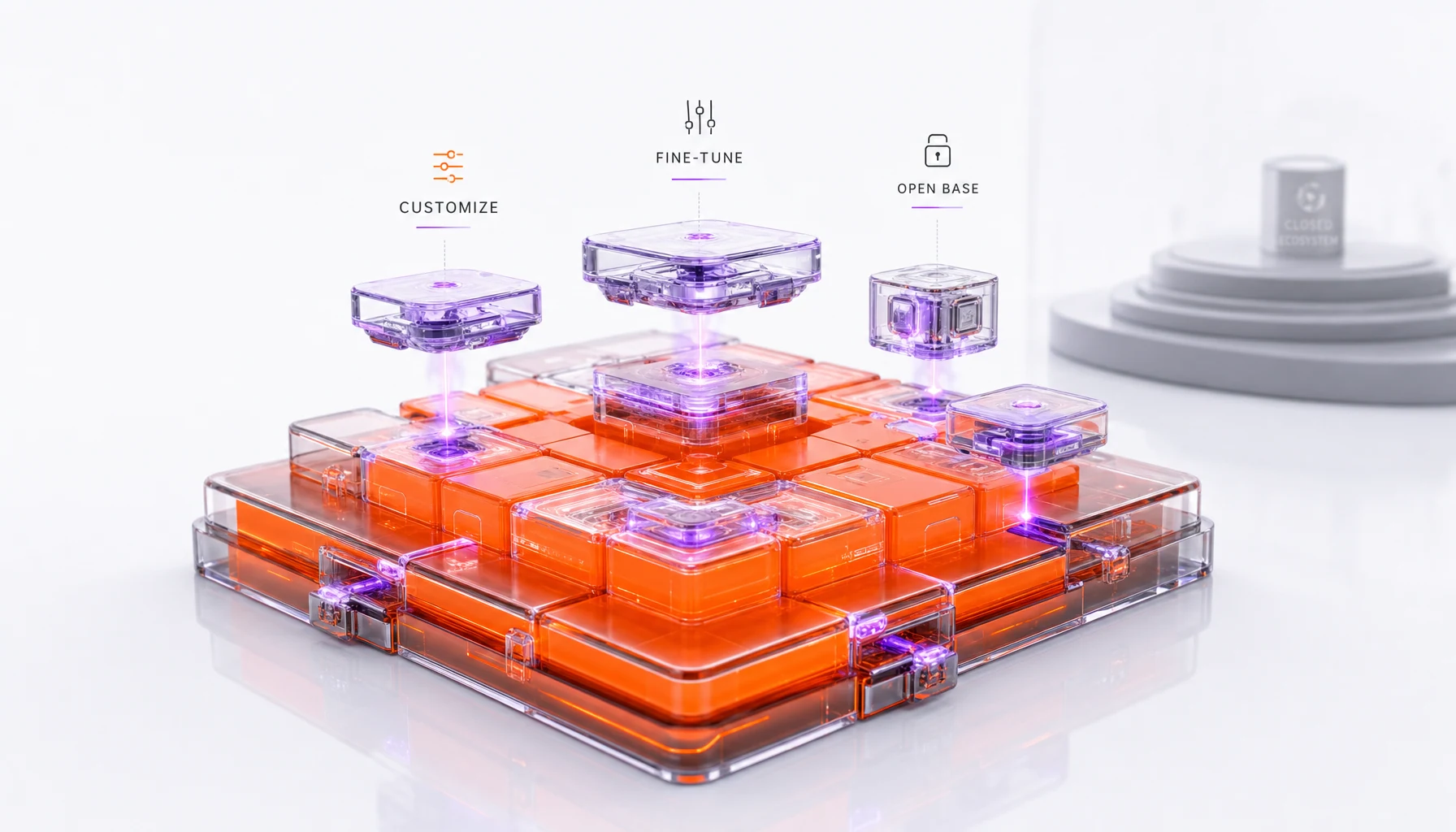
The dominant pattern in 2026 has been a race to the top of aggregate benchmarks, with each lab claiming the crown for a few weeks until the next release. Inkling opts out of that race. Its argument is that for a large share of real-world deployments, the marginal points at the very top of a leaderboard matter far less than the ability to take a capable open base and shape it — through fine-tuning, distillation, and configuration like the controllable thinking effort — to a specific domain, cost target, and latency budget.
This is why the open license and the from-scratch training are not incidental. A permissive Apache 2.0 base that a company fully controls is a very different asset from an API endpoint it rents. You can specialize it, run it in your own environment, and avoid the lock-in that comes with a closed model. The bet is that a growing cohort of serious builders now values that control over a headline score. Whether the market agrees is the open question Inkling was built to answer.
Pricing: Where Inkling Sits
Because the weights are open, the most important price is effectively zero — you can download and self-host Inkling under Apache 2.0 and pay only for your own compute. For teams that would rather call an API, Thinking Machines offers a hosted endpoint, and its rates sit toward the premium end of the market: roughly $1.87 per million input tokens and $4.68 per million output tokens.
To put that in perspective, the provider median for models in this class runs closer to $0.60 per million input tokens and $2.20 per million output tokens. Inkling's hosted pricing is therefore well above average. That pricing gap reinforces the strategy rather than undercutting it: the lab is not trying to win on cheapest-per-token API access. It is nudging serious adopters toward doing what the model was designed for — taking the open weights in-house and running them on their own terms. If you want to go that route, our walkthrough on how to self-host an open-weight AI model covers the practical steps.
What It Changes for a Builder
For anyone deciding what to build on over the next few quarters, Inkling adds a genuinely new option to the open-weights shelf — a shelf that in 2026 already includes strong entrants like DeepSeek V4, GLM-5.2, and Kimi K2.6. What distinguishes Inkling in that company is less any single benchmark and more its explicit design for adaptation, its clean Apache 2.0 license, and the credibility of the team behind it.
The practical takeaway is a sequence. Start with the independent signal: an Intelligence Index of 41 says the base is capable enough to be worth your time. Then treat the vendor's benchmark table as a hypothesis rather than a fact — and if a specific capability like coding or tool use is load-bearing for you, re-run that evaluation on the exact downloaded checkpoint, given the vendor's own disclosure that its numbers came from a different version. Finally, weigh the thing that does not show up in any benchmark: how much you value owning and shaping the model versus renting a closed one. Inkling is built for teams whose answer to that last question is "a lot."
It is early. The published checkpoint has not been independently stress-tested at scale beyond the Artificial Analysis index, and the real proof of the customization thesis will be the fine-tunes and deployments that show up in the weeks ahead. But as a first move from Murati's lab, Inkling is a clear and coherent one — and it plants a flag on a piece of ground most of the frontier has been ignoring.
Frequently Asked Questions
What is Inkling?
Inkling is the first open-weights model from Thinking Machines Lab, the Nvidia-backed startup founded by former OpenAI CTO Mira Murati. Released on July 15, 2026, it is a 975-billion-parameter mixture-of-experts model with 41 billion active parameters per token, a context window up to 1 million tokens, and multimodal pre-training across text, image, audio, and video. It ships under the Apache 2.0 license on Hugging Face.
Who made Inkling?
Inkling was built by Thinking Machines Lab, founded by Mira Murati, who was previously Chief Technology Officer at OpenAI. The lab is Nvidia-backed. Inkling is its first from-scratch foundation model, following its earlier interaction-focused research released in May 2026.
Is Inkling open source and free to use?
Inkling is released as open weights under the Apache 2.0 license, which permits commercial use, modification, and redistribution. You can download the weights from Hugging Face and self-host them, paying only for your own compute. Thinking Machines also offers a hosted API at roughly $1.87 per million input tokens and $4.68 per million output tokens.
How large is Inkling and how many parameters are active?
Inkling has 975 billion total parameters but activates only 41 billion per token, thanks to its mixture-of-experts architecture. That means it delivers the capacity of a very large model at the inference cost of a much smaller one. A lighter Inkling-Small preview activates roughly 12 billion parameters.
What is the difference between Inkling and Inkling-Small?
Inkling is the full 975-billion-parameter model. Inkling-Small is a lighter preview variant with roughly 12 billion active parameters, aimed at lower cost and latency for teams that do not need the full model's ceiling. Both come from the same July 15, 2026 release.
How good is Inkling compared to other open-weights models?
The one independent measure available is the Artificial Analysis Intelligence Index, which scores Inkling at 41 — roughly 16 points above the median of about 25 for open-weights models of comparable size. That is a strong result for an open model. All other benchmark figures currently available are self-reported by Thinking Machines rather than independently verified.
What are Inkling's benchmark scores?
Thinking Machines self-reports AIME 2026 at 97.1%, GPQA Diamond at 87.9%, SWE-bench Verified at 77.6%, SWE-bench Pro (public split) at 54.3%, Terminal-Bench 2.1 at 63.8%, BrowseComp at 77.1%, and MCP Atlas at 74.1%. These are vendor-reported, not independent, and they carry an important caveat about the checkpoint used for testing.
Why do Inkling's benchmark numbers come with a caveat?
Thinking Machines states that its benchmark results were obtained during testing between June 30 and July 13, 2026, on a checkpoint that is different from the model it actually published. So the self-reported scores do not map exactly to the weights available for download. The lab disclosed this openly, but it means anyone relying on those numbers should re-run the evaluations they care about on the released checkpoint.
What does "built for customization, not leaderboard dominance" mean?
It is Thinking Machines' framing for Inkling's strategy. Rather than chasing the top of aggregate benchmark charts, Inkling is designed to be a capable open base that enterprises fine-tune, distill, and configure for their own domains, cost targets, and latency budgets. Features like controllable thinking effort and the permissive Apache 2.0 license support that adapt-it-yourself approach.
What is controllable thinking effort?
Controllable thinking effort is an Inkling feature that lets you adjust how much reasoning the model applies to a request, trading latency and cost against depth. It gives teams a per-request knob to tune the model's inference profile to their own economics — one of several ways Inkling is built to be adapted rather than used as a fixed endpoint.
How much does Inkling cost to run?
Self-hosting is the cheapest path: the Apache 2.0 weights are free to download, and you pay only for compute. Thinking Machines' hosted API is priced toward the premium end at roughly $1.87 per million input tokens and $4.68 per million output tokens, versus a provider median closer to $0.60 and $2.20 per million tokens respectively. The premium pricing pushes serious adopters toward self-hosting.
Should I switch to Inkling right now?
Treat it as a promising new option rather than a drop-in upgrade. The independent Intelligence Index of 41 says the base is capable, but the published checkpoint has not been broadly independently tested, and the vendor's own benchmarks came from a different checkpoint. If ownership, customization, and a clean Apache 2.0 license matter to you, Inkling is worth evaluating against DeepSeek V4, GLM-5.2, and Kimi K2.6 — after re-running the benchmarks that matter for your use case on the actual weights.
Sources
- Thinking Machines Lab — Introducing Inkling
- Thinking Machines Lab — Inkling model card
- TechCrunch — Thinking Machines bets against one-size-fits-all AI with Inkling
- MarkTechPost — Thinking Machines Lab releases Inkling, a 975B open-weights multimodal MoE
- Artificial Analysis — Inkling model analysis and Intelligence Index