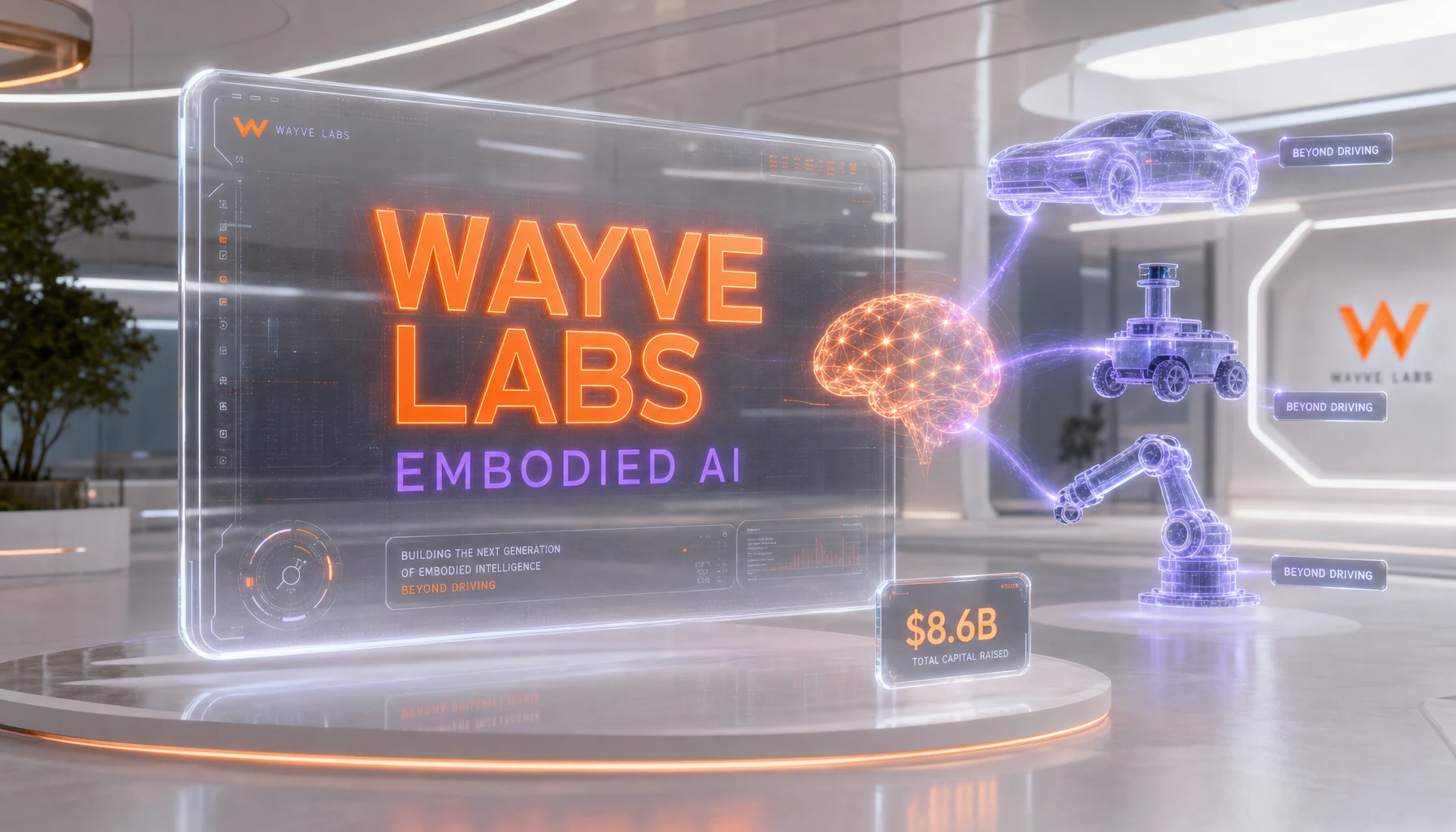
Wayve Labs is Wayve's new frontier research unit for embodied AI, announced on May 29, 2026, that pushes beyond the company's self-driving roots into general physical intelligence. Led by Chief Scientist Jamie Shotton, who declared that "intelligence that cannot act in the physical world is incomplete," the lab spans six research axes including world models and cross-embodiment learning across mobility and manipulation. It is backed by Wayve's $1.5 billion Series D and $8.6 billion valuation, and it is hiring Research Scientists in Sunnyvale, London, and Vancouver.
What Happened
On May 29, 2026, Wayve — the UK company best known for its end-to-end, learned approach to self-driving — announced Wayve Labs, a dedicated frontier research unit aimed at embodied artificial intelligence well beyond the car. In its own framing, published under the title "Building intelligence that can act in the world," Wayve positions the lab as a long-horizon bet on physical intelligence rather than another product launch.
The lab is led by Jamie Shotton, Wayve's Chief Scientist, who joined from Microsoft and is a familiar name in computer vision and machine learning research circles. His framing is the thesis statement for the whole effort: "Intelligence that cannot act in the physical world is incomplete." That single sentence is doing a lot of work — it draws a line between today's text-and-image foundation models and a class of systems that have to move things, avoid things, and recover from their own mistakes in real time.
This is not a few researchers and a press release. Wayve says dozens of researchers are already attached to Wayve Labs, and it is actively recruiting Research Scientists across three sites: Sunnyvale in California, London (Wayve's headquarters), and Vancouver in Canada. The geographic spread alone signals intent — this is a multi-continent hiring push, not a side project.
One caveat worth stating up front, because it changes how you should read every claim below: Wayve Labs is explicitly framed as fundamental research with no immediate commercialization. There is no robot to buy, no API to call, no benchmark leaderboard to top this quarter. What there is, instead, is a statement of direction from a company that already runs learned policies on real vehicles — and that direction is "all of embodied AI," not "better lane-keeping."
The Six Research Axes
Wayve Labs organizes its work around six research axes. Read together, they describe an attempt to build the full stack of physical intelligence — perception, prediction, decision, and generalization — rather than to optimize any single capability.
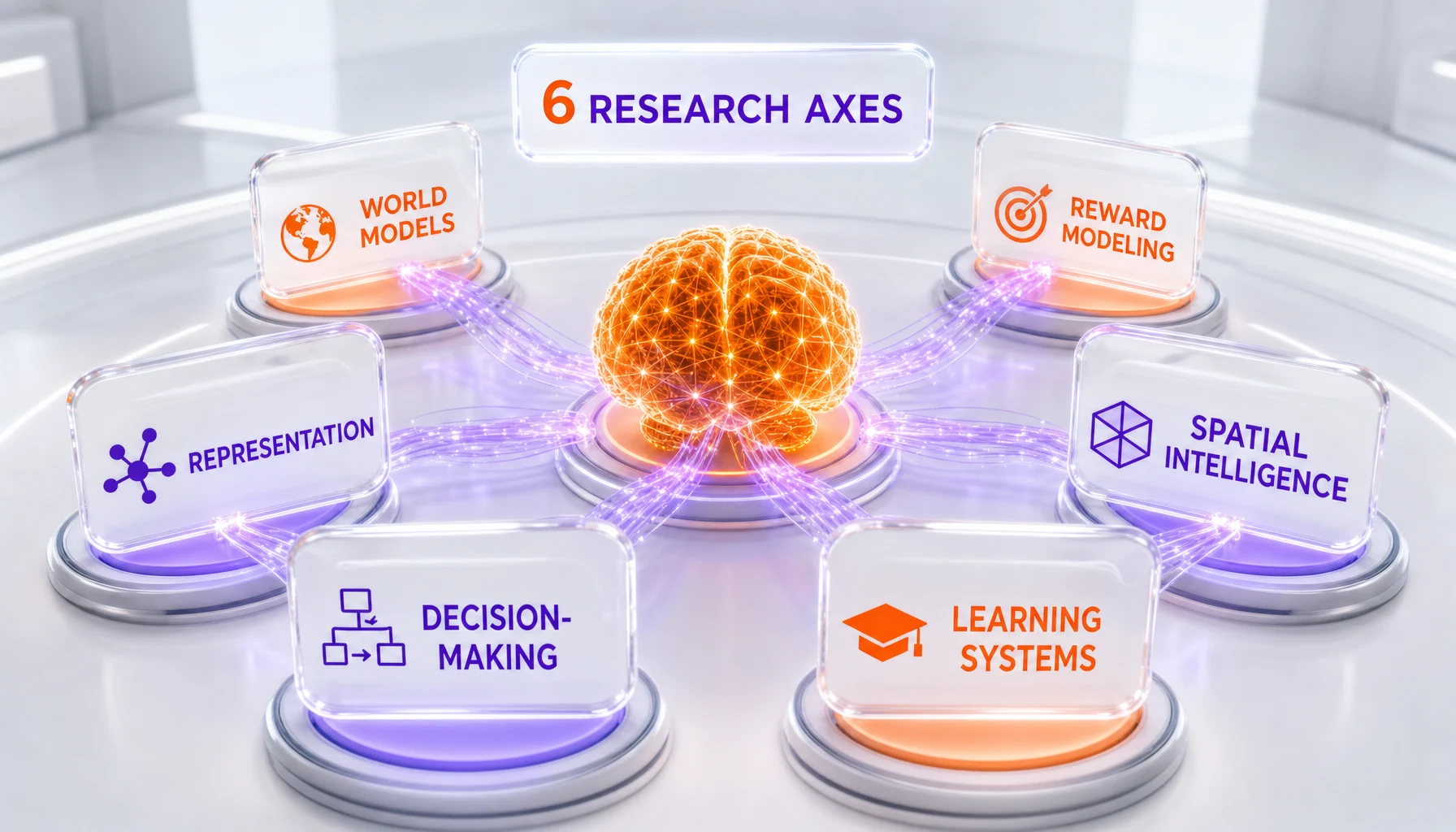
- World and reward modeling — learning an internal simulation of how the environment behaves, and what "good" looks like, so a system can evaluate actions before committing to them.
- Representation learning — building the compressed, reusable internal features that let a model understand scenes and objects efficiently.
- Spatio-physical intelligence — reasoning about space, geometry, contact, and physics, the part of intelligence that text-only models never have to confront.
- Decision-making architectures — the planning and control machinery that turns understanding into sequences of safe actions.
- Learning systems — the training infrastructure, data engines, and optimization methods that make any of the above scale.
- Cross-embodiment learning — the headline axis, explicitly described as learning across "diverse robotic platforms across mobility and manipulation."
The list is notable for what it refuses to narrow down to. A self-driving company could have published a research agenda about perception robustness, sensor fusion, and long-tail scenario coverage — all squarely about cars. Instead, four of the six axes (world modeling, representation, spatio-physical reasoning, and cross-embodiment) are stated at a level of generality that applies to any robot with a body. That is a deliberate signal about scope.
Why Cross-Embodiment Learning Is the Whole Game
If you want to understand the ambition behind Wayve Labs in one idea, it is cross-embodiment learning. The bet is simple to state and brutally hard to deliver: train a single model so that what it learns on one robot body transfers to others. Wayve's own phrasing — "diverse robotic platforms across mobility and manipulation" — quietly stacks two very different problems. Mobility is about moving a body through space without hitting things. Manipulation is about using a body to change the world: grasping, placing, turning, pushing.
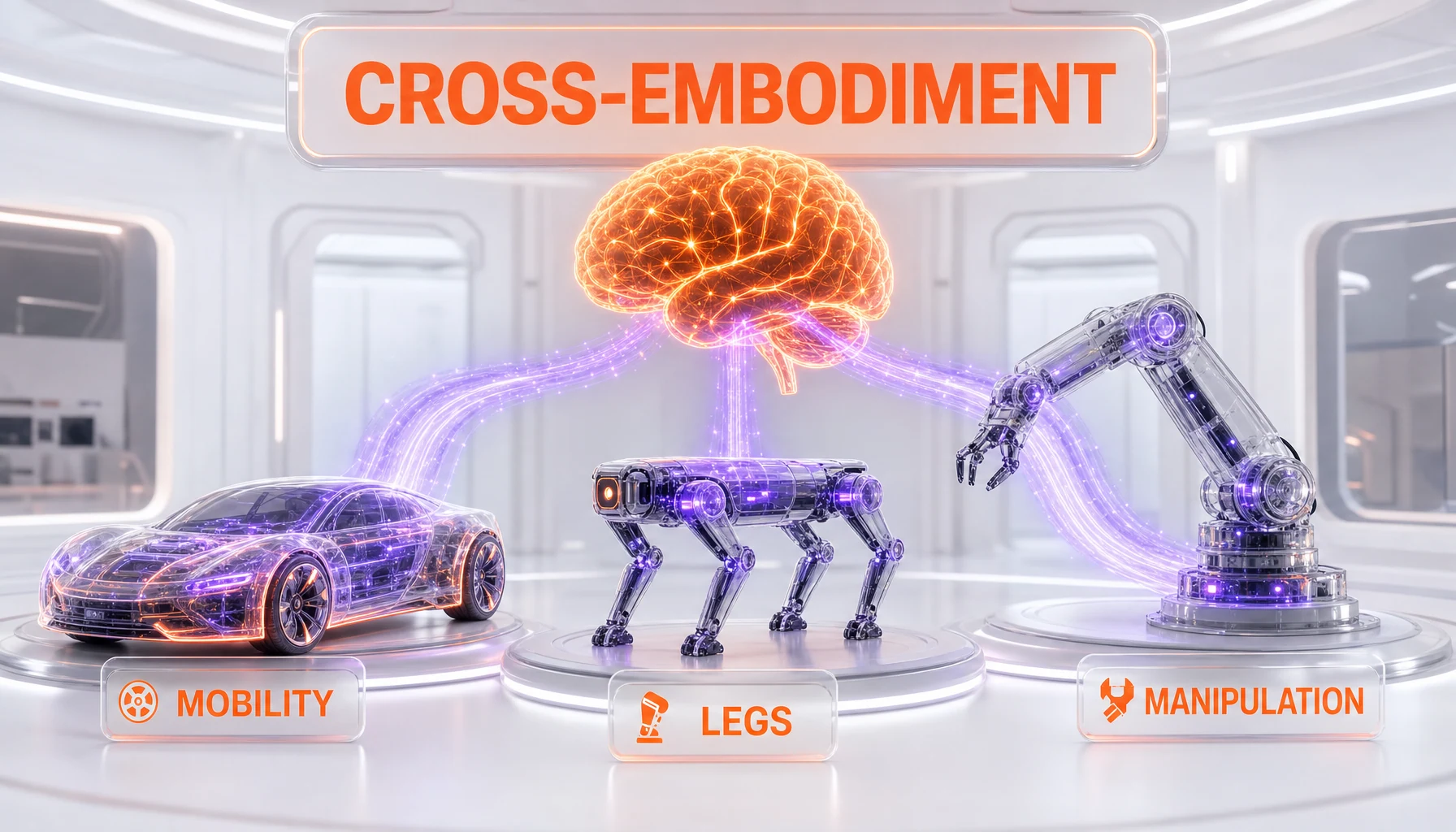
Historically, robotics has solved these as separate disciplines, with separate models, separate datasets, and separate teams. The cross-embodiment thesis says that is an artifact of how we built things, not a law of nature — that there is a shared substrate of physical understanding underneath driving a car, walking on legs, and moving an arm, and that a sufficiently general model can learn it once and reuse it everywhere.
This is why Wayve's self-driving background matters more than it might first appear. Wayve already runs end-to-end learned policies on real vehicles. A car is, in robotics terms, one embodiment with an unusually rich, high-stakes stream of real-world interaction data. The Wayve Labs argument is that this is a beachhead: master the hardest continuous-control mobility problem on public roads, then treat that competence as the first data point in a much larger cross-embodiment program. Whether the transfer actually happens is the open research question — but the strategic logic is coherent.
Why It Matters
The reason Wayve Labs is worth more than a passing mention is what it says about where frontier AI capital and talent are flowing in 2026. For three years the center of gravity was language models. The story now bending the field is the move into the physical world — and Wayve is a particularly clean example of an established, revenue-bearing AV company explicitly declaring that self-driving was never the destination.
It also reframes a question that has nagged at the AV sector: what is autonomous driving actually for, as an AI program? Wayve's answer is that it was always a route into general embodied intelligence. That is a confident, almost provocative reframe. It tells investors, recruits, and partners that the company intends to be measured against the broad embodied-AI frontier — alongside the research labs chasing embodied reasoning models and the humanoid companies chasing real-world autonomy — rather than purely against other self-driving stacks.
For practitioners, the most actionable signal is the talent market. Three simultaneous Research Scientist hubs in Sunnyvale, London, and Vancouver, with dozens already on board, is a meaningful new bidder for embodied-AI researchers. In a field where the binding constraint is people who can do world models and robot learning at scale, opening a war chest of headcount across three continents is its own kind of statement.
The Money Behind the Bet
Fundamental research is expensive and slow, and the only reason a company can credibly say "no immediate commercialization" is if it has the balance sheet to mean it. Wayve does. In February 2026, the company closed a $1.5 billion Series D, reaching an $8.6 billion valuation. The disclosed backers read like a map of who has a stake in physical AI: Microsoft, Nvidia, Uber, Mercedes-Benz, Nissan, and Stellantis.
Look at that list and the strategy clarifies. You have a hyperscaler (Microsoft) and the dominant AI-compute vendor (Nvidia) on the infrastructure side. You have a mobility platform (Uber) on the deployment side. And you have three global automakers (Mercedes-Benz, Nissan, Stellantis) on the manufacturing-and-distribution side. That is a coalition that benefits whether Wayve's intelligence ends up in a passenger car, a delivery fleet, or — if cross-embodiment works — something with legs or arms.
The $8.6 billion valuation is also context for the lab's framing. At that level, the pressure is no longer to prove the core driving business exists; it is to articulate a vision big enough to justify the price. Wayve Labs is, in part, the narrative that does that — converting a self-driving valuation into an embodied-AI valuation.
Three Labs, Three Continents
The shape of an AI research effort is often legible in where it chooses to plant offices, and Wayve Labs is spreading itself deliberately across three of the densest embodied-AI talent markets in the world.

London is the anchor — it is Wayve's headquarters and the heart of a UK research scene that punches well above its weight in machine learning. Sunnyvale puts the lab in Silicon Valley, within recruiting range of the same pool that DeepMind, Nvidia, and the major robotics startups draw from. Vancouver is the quieter, smarter pick: a deep Canadian ML bench, favorable immigration for international researchers, and proximity to the West Coast without the Bay Area cost structure.
Spreading a brand-new lab across three continents from day one is not the cheap option. It is what you do when the binding constraint is talent rather than capital — and with a $1.5 billion Series D behind it, Wayve has explicitly chosen to spend that capital on people in three markets at once. The "dozens" of researchers already attached are the seed; the open Research Scientist roles across all three hubs are the statement of how big the lab intends to get.
How It Compares to the Rest of the Field
Wayve Labs is not arriving into an empty room. Embodied AI and world models are arguably the most crowded frontier of 2026, which makes the comparison set the most useful way to locate Wayve's bet.
On the world-models axis, the most direct intellectual neighbors are the labs treating world simulation as the post-language-model frontier. Runway's multi-billion-dollar world-models bet approaches it from generative video and simulation. AMI Labs, founded by Yann LeCun, frames world models as the explicit successor to the LLM paradigm. And Jeff Bezos-backed Project Prometheus is reportedly pouring capital into physical world models at a multi-billion-dollar scale. Wayve Labs plants its flag in the same territory — world and reward modeling is its first listed axis — but with a distinguishing asset none of those pure-research efforts have: a fleet of vehicles already generating real-world interaction data.
On the embodiment-and-hardware axis, the comparison shifts to the robot builders. Google DeepMind ships embodied-reasoning models like Gemini Robotics-ER 1.6 aimed at giving robots a reasoning layer. Humanoid companies are racing on duration and autonomy — Figure's multi-hour, no-teleoperation humanoid runs are a useful benchmark for what "embodied autonomy in the wild" looks like today. Wayve Labs is making a different structural bet than the humanoid builders: rather than committing to one form factor and proving it can run for hours, it is betting that a shared learning substrate can move across form factors at all. That is a harder claim, and a more general one.
The honest summary is that Wayve Labs is not obviously ahead or behind any of these — it has not shipped a model, a demo duration, or a benchmark to compare. What it has is a distinctive starting position: the only entrant in this list whose embodied-AI program grew out of running learned policies on real cars at scale.
The Skeptic's Case
We would be doing readers a disservice to present this as a clean win, so here is the bear case, stated plainly.
First, cross-embodiment transfer is one of the longest-standing unsolved problems in robotics, and "we have a lot of driving data" does not obviously help with manipulation. Driving is continuous control in a largely rigid, predictable world; dexterous manipulation is contact-rich, deformable, and notoriously poor at transferring from simulation or from other tasks. A model that is superb at the former may learn very little that helps with the latter.
Second, "no immediate commercialization" is both a luxury and a risk. It buys research freedom, but it also means Wayve Labs will be judged on papers, recruiting wins, and demos for some time before any revenue line validates the direction. In a 2026 funding climate that has rewarded frontier narratives generously, that is survivable — but it is a narrative-dependent position.
Third, the comparison set is formidable and well-capitalized. DeepMind has compute and a robotics history; the world-model labs have focused, founder-driven theses; the humanoid companies have hardware in the field. Wayve Labs is entering a contest where everyone has a head start on some axis.
None of this makes the bet wrong. It makes it exactly what Wayve says it is: frontier research, with the uncertainty that label implies.
What to Watch Next
Because Wayve Labs is a research unit rather than a product, the leading indicators are not launches — they are signals of seriousness. Here is what we will be tracking.
- Hiring velocity across the three hubs. Sunnyvale, London, and Vancouver are the lab's stated centers. How fast "dozens" becomes "hundreds" is the clearest proxy for commitment.
- The first cross-embodiment results. Any published evidence that a model trained partly on driving transfers to a non-driving embodiment would be the single most important validation of the thesis.
- World-model publications. World and reward modeling is the first listed axis. Concrete research output here would show whether Wayve is competing on the same ground as the dedicated world-model labs.
- Partner pull-through. With Microsoft, Nvidia, Uber, and three automakers on the cap table, watch for any of them surfacing Wayve Labs work in their own embodied or robotics programs.
- The line between Labs and the core business. Whether Wayve keeps Labs as pure research or starts feeding its output back into the shipping self-driving stack will tell us how patient the company really intends to be.
Our Take
What strikes us most about Wayve Labs is the framing discipline. It would have been easy — and arguably more marketable — to announce a flashy humanoid or a robotics product. Instead Wayve led with a research thesis ("intelligence that cannot act in the physical world is incomplete"), six unglamorous research axes, and an honest admission that none of it is for sale yet. That is the posture of a company that believes the prize is the underlying intelligence, not the first demo.
The cross-embodiment bet is the part we are most genuinely uncertain about, and that is meant as a compliment. It is the kind of claim that, if it works, reorganizes the whole robotics industry around shared foundation policies — and if it does not, leaves Wayve as a very well-funded self-driving company that took a swing. Either way, the move clarifies something important about 2026: the frontier has quietly shifted from teaching models to talk to teaching them to act, and the companies with real-world interaction data at scale think that gives them an edge.
One more thing worth naming, since we are dating this carefully: this announcement landed on May 29, 2026, and we are treating it as an analytical read on a frontier direction, not a breaking-news scoop on the last 24 hours. The interesting question is not "what did Wayve say last night" — it is "what does a self-driving champion declaring for general embodied AI tell us about where physical intelligence is heading." Our answer: the AV-to-robotics pivot is no longer a fringe idea, and Wayve just made it the centerpiece of an $8.6 billion company.
Frequently Asked Questions About Wayve Labs
What is Wayve Labs?
Wayve Labs is Wayve's new frontier research unit for embodied AI, announced on May 29, 2026. It pushes beyond Wayve's self-driving roots into general embodied intelligence — AI that can perceive, reason, and act in the physical world across many robot types, not just cars. It is positioned as fundamental research rather than a product with an immediate commercial launch.
Who leads Wayve Labs?
Wayve Labs is led by Jamie Shotton, Wayve's Chief Scientist, who previously worked at Microsoft. Framing the mission, Shotton said: "Intelligence that cannot act in the physical world is incomplete." Wayve says dozens of researchers are already attached to the lab.
What does embodied AI mean?
Embodied AI refers to artificial intelligence that operates through a physical body — a car, a mobile robot, a robotic arm — perceiving the world through sensors and acting through motors and actuators. The core claim behind Wayve Labs is that intelligence is "incomplete" if it cannot act in the physical world, so learning must be grounded in real interaction, not just text.
What are world models and why does Wayve Labs care about them?
A world model is a learned internal simulation of how the environment behaves, so an AI system can predict the consequences of its actions before taking them. World modeling is one of the six research axes Wayve Labs lists. World models are also the central bet of labs like Runway, AMI Labs founded by Yann LeCun, and Jeff Bezos-backed Project Prometheus — making them one of the defining frontier directions of 2026.
What is cross-embodiment learning?
Cross-embodiment learning is training a single AI model so that what it learns on one robot body transfers to others — described by Wayve as "diverse robotic platforms across mobility and manipulation." Instead of training a separate model per robot, one foundation policy is meant to generalize across cars, legged robots, and manipulation arms. It is one of the six research axes Wayve Labs has named.
What are the six research axes of Wayve Labs?
Wayve Labs lists six research axes: world and reward modeling, representation learning, spatio-physical intelligence, decision-making architectures, learning systems, and cross-embodiment learning across diverse robotic platforms spanning mobility and manipulation.
Where is Wayve Labs hiring?
Wayve Labs is actively recruiting Research Scientists across three sites: Sunnyvale in California, London (Wayve's headquarters in the UK), and Vancouver in Canada. Wayve says dozens of researchers are already on the lab.
How much funding does Wayve have?
Wayve raised a $1.5 billion Series D in February 2026, reaching an $8.6 billion valuation. Disclosed investors across Wayve's backing include Microsoft, Nvidia, Uber, Mercedes-Benz, Nissan, and Stellantis. That capital base is what lets Wayve fund a fundamental-research unit without immediate commercial pressure.
Is Wayve Labs building a product or a robot you can buy?
No. Wayve Labs is framed as fundamental, frontier research with no immediate commercialization. Wayve's existing business remains its self-driving software for vehicles; Wayve Labs is the longer-horizon bet on general embodied intelligence rather than a near-term consumer or robot product.
How does Wayve Labs compare to Google DeepMind, Figure, and other embodied AI players?
Google DeepMind ships embodied-reasoning models such as Gemini Robotics-ER 1.6, and companies like Figure run multi-hour autonomous humanoid demonstrations. Wayve Labs differs in pedigree: it comes from an end-to-end self-driving company that already runs learned policies on real vehicles at scale, and it is betting that cross-embodiment learning lets that driving experience generalize to broader robotics.
Why is a self-driving company moving into general robotics now?
Wayve argues that driving is one instance of embodied intelligence, and that the same learning systems, world models, and decision-making architectures should generalize to other robots. With a $1.5 billion Series D and an $8.6 billion valuation, Wayve has the capital to treat self-driving as a beachhead and chase the larger embodied-AI frontier through Wayve Labs.
Sources: Wayve newsroom, "Building intelligence that can act in the world" and the Wayve Labs page (wayve.ai), published May 29, 2026. Funding figures reflect Wayve's February 2026 Series D as disclosed by the company. This is an editorial analysis by ThePlanetTools.ai; we are not affiliated with Wayve.